
By Judy Zhou, Founder
Key Takeaways
- Most brands waste their first 90 days with an AI SEO provider because briefs target 2019-era rankings instead of entity grounding and per-LLM citation targets.
- Wikipedia accounts for 27% of ChatGPT citations while representing under 0.2% of training data and appearing in 89% of Google first-page results.
- Overlap between top Google results and AI-cited sources has dropped from 70% to under 20%, rendering traditional SEO briefs actively misleading.
- Define the specific AI surfaces that matter for your category—ChatGPT and Perplexity for B2B SaaS, Google AI Overviews for ecommerce—before sending any brief.
Priya had spent six weeks negotiating the contract with an AI SEO services agency. On the morning the engagement kicked off, she sent over her brand's brief. Forty slides, meticulously organized by keyword priority and content pillar. The agency's lead strategist opened it, scrolled quietly for a moment, then asked a single question: 'Do you have a Wikidata entity ID for the brand?' Priya muted herself and typed it into Google. She didn't know what Wikidata was. That gap, right there, was about to define the next quarter.
Most brands waste their first 90 days with an AI SEO services provider because their brief is built for 2019-era Google SEO, not answer engine optimization. Wikipedia accounts for 27% of ChatGPT citations while representing less than 0.2% of raw training data. Google integrates Wikipedia into 89% of first-page results. If your brief doesn't address entity grounding, citation density targets, and per-LLM reporting, you're paying for traditional SEO dressed up in AI language. I've watched this happen across dozens of engagements, and the pattern is always the same: the client briefs for rankings, the agency delivers rankings, and nobody notices the brand is invisible in ChatGPT until a board member asks about it.
The overlap between top Google results and AI-cited sources has dropped from roughly 70% to under 20%. That means your existing SEO brief is actively misleading your provider about what needs fixing. Here's how to build one that isn't.
What AI surfaces matter for your category?
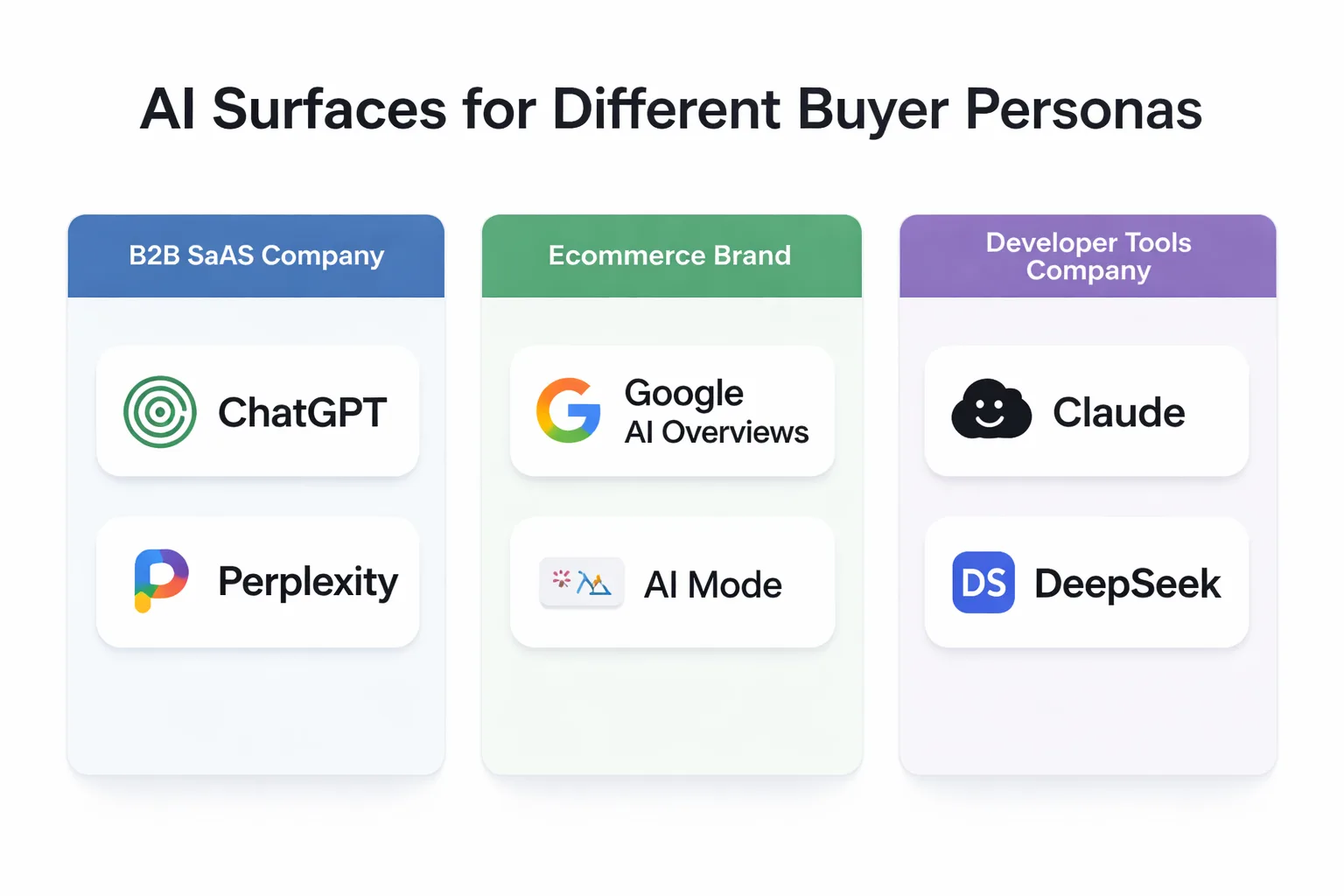
Not every AI engine matters equally for every business. A B2B SaaS company's buyers live in ChatGPT and Perplexity. An ecommerce brand's customers are increasingly in Google AI Overviews and AI Mode. A developer tools company might find Claude and DeepSeek drive more relevant traffic than Gemini ever will.
The mistake I see in nearly every brief: brands list "all AI search engines" as their target surface and move on. That's not a brief. That's a wish list. Your provider needs to know which surfaces your buyers actually use so they can prioritize tracking, content production, and citation outreach toward the engines that move pipeline.
Here's what to include in your brief for this step. First, identify your top three buyer personas and map where they search. If you sell to developers, Claude and Perplexity matter more than Gemini. If you sell to marketing leaders, ChatGPT and Google AI Overviews are your primary surfaces. Second, rank those surfaces by business impact, not by volume. A single Perplexity citation in a high-intent commercial query can drive more qualified traffic than a hundred Gemini mentions in informational prompts. Third, specify which surfaces you want daily tracking on versus weekly trend monitoring.
In my work auditing content ops, I've found that brands which narrow their target surface list to three or four engines consistently outperform those trying to cover everything. The focused brands get deeper citation analysis per engine. The scattered brands get shallow dashboards that look comprehensive but tell you nothing actionable.
When you brief your provider, give them a prioritized list like this: "Track ChatGPT, Perplexity, and Google AI Overviews as primary surfaces with weekly reporting. Monitor Claude and Gemini as secondary surfaces with monthly trend checks. Ignore DeepSeek and Grok for now; our buyers don't use them." That level of specificity forces the provider to allocate their hours where they matter.
If you're not sure which surfaces your buyers use, run a quick survey. Ask your last 20 customers how they research tools in your category. You'll get answers faster than any market research report, and they'll be more accurate for your specific audience.
One more dimension to consider in this step: the difference between conversational surfaces and SERP-embedded surfaces. ChatGPT and Claude are conversational. Users ask follow-up questions, refine prompts, and have extended research sessions. Google AI Overviews and AI Mode are SERP-embedded. Users see AI-generated answers at the top of search results and may or may not click through. Your brief should acknowledge this distinction because it affects content strategy. For conversational surfaces, your content needs to answer questions comprehensively enough that the AI can extract and synthesize. For SERP-embedded surfaces, your content needs to win the citation slot against traditional ranking pages. These are different optimization challenges, and your provider needs to know which one matters more for your business.
You should also specify whether agentic SEO matters for your category yet. Agentic SEO is the practice of optimizing for AI agents that take actions on behalf of users, like booking a demo or comparing pricing. If your buyers are starting to use agent-based tools to evaluate vendors in your category, your brief needs to flag that. Most providers won't ask about it because it's bleeding edge. But if it applies to you, the content requirements shift. You need structured pricing data, feature comparison tables, and API-accessible information that agents can parse. That's a different deliverable than articles optimized for human reading.
Step 2. Document Your Current Citation Gaps Before the First Call
Walk into the brief with data. Nothing establishes credibility faster than showing your provider exactly where your brand stands today in AI answers.
The process is simpler than most people think. Open ChatGPT, Claude, Perplexity, and Google AI Overviews. Type in 15 to 20 prompts that your buyers would realistically use. Not keyword-stuffed queries. Natural questions like "what's the best tool for [your category]" or "how does [your category] compare to [adjacent category]." Write down which prompts mention your brand, which mention competitors, and which mention nobody you recognize.
This is your citation gap map. It's the single most valuable document you can hand a provider because it shows them exactly where the work needs to happen. A provider who sees that you're cited in 3 of 20 prompts but your top competitor appears in 14 of 20 knows immediately what the engagement needs to achieve.
I run this exact exercise using our AI visibility checker because manual testing across multiple LLMs gets tedious fast and results change weekly. But even a manual audit of 20 prompts across three engines gives you a baseline that 90% of brands skip. Those brands walk into agency calls with nothing but keyword rankings and traffic charts. In the AI search era, those metrics tell your provider almost nothing useful.
Here's what to document for each prompt you test. The AI engine name. The exact prompt text. Whether your brand appears, and if so, where in the response (first mention, middle of a list, last). Which competitors appear. Which sources the AI cites to support its answer. That last piece matters enormously because those cited sources are your outreach targets. If Perplexity keeps citing a specific industry blog when answering prompts about your category, that blog is now on your citation acquisition list.
Wikipedia accounts for 27% of ChatGPT citations while representing less than 0.2% of raw training data, according to SearchAtlas analysis. That ratio should reframe how you think about citation gaps. It's not just about who mentions your brand. It's about which authoritative sources AI engines trust enough to cite, and whether your brand is connected to those sources.
Your brief should include the full gap audit results in a spreadsheet. Column headers: Prompt, Engine, Brand Mentioned (Y/N), Position, Competitors Mentioned, Cited Sources. Twenty rows of real data. That spreadsheet tells your provider more about your needs than any positioning document ever will.
Let me give you a concrete example of how this changes the conversation. I worked with a brand in the project management software space. Their manual audit showed that ChatGPT mentioned them in 2 of 20 prompts. Competitors appeared in 16 of 20. But the interesting finding was in the cited sources column. ChatGPT was pulling its recommendations from three sources repeatedly: a G2 comparison page, a specific Reddit thread in r/productivity, and one industry analyst's blog. The brand had zero presence on any of those three sources. That's not a content production problem. That's a citation acquisition problem. The brief immediately shifted from "write more articles" to "get mentioned on G2, participate in that Reddit thread, and pitch the analyst." Without the gap audit, the provider would have spent three months writing blog posts that nobody cited.
The audit also reveals prompt categories where no brand wins consistently. These are greenfield opportunities. If you find prompts where AI engines give generic answers without naming specific brands, those are topics where a well-structured, authoritative piece of content can establish your brand as the default answer. Flag these in your brief as priority content targets. Your provider should know which prompts are competitive battles versus which are open territory.
One technical note on running the audit. AI engine responses are not deterministic. The same prompt can return different answers on different days. Run your audit twice, a week apart, and note any changes. This gives your provider a sense of response volatility for your category. High volatility means the AI hasn't settled on authoritative sources yet, which means there's an opportunity to influence those sources. Low volatility means the AI has formed stable preferences, and changing them requires sustained effort.
Step 3. Specify Source and Entity Requirements
This is the step where most briefs fail completely. Brands hand over keyword lists and content pillars but say nothing about entity grounding, and that omission costs them months.
Entity grounding means making sure AI engines can define your brand as a distinct, recognizable entity with clear attributes and relationships. Think of it this way: traditional SEO asks Google to rank your page. Entity grounding asks AI engines to understand who you are, what you do, and how you relate to other things in the world. If an AI can't define your brand, it won't recommend it. Intero Digital's analysis makes this point directly, and it matches everything I've seen in practice.
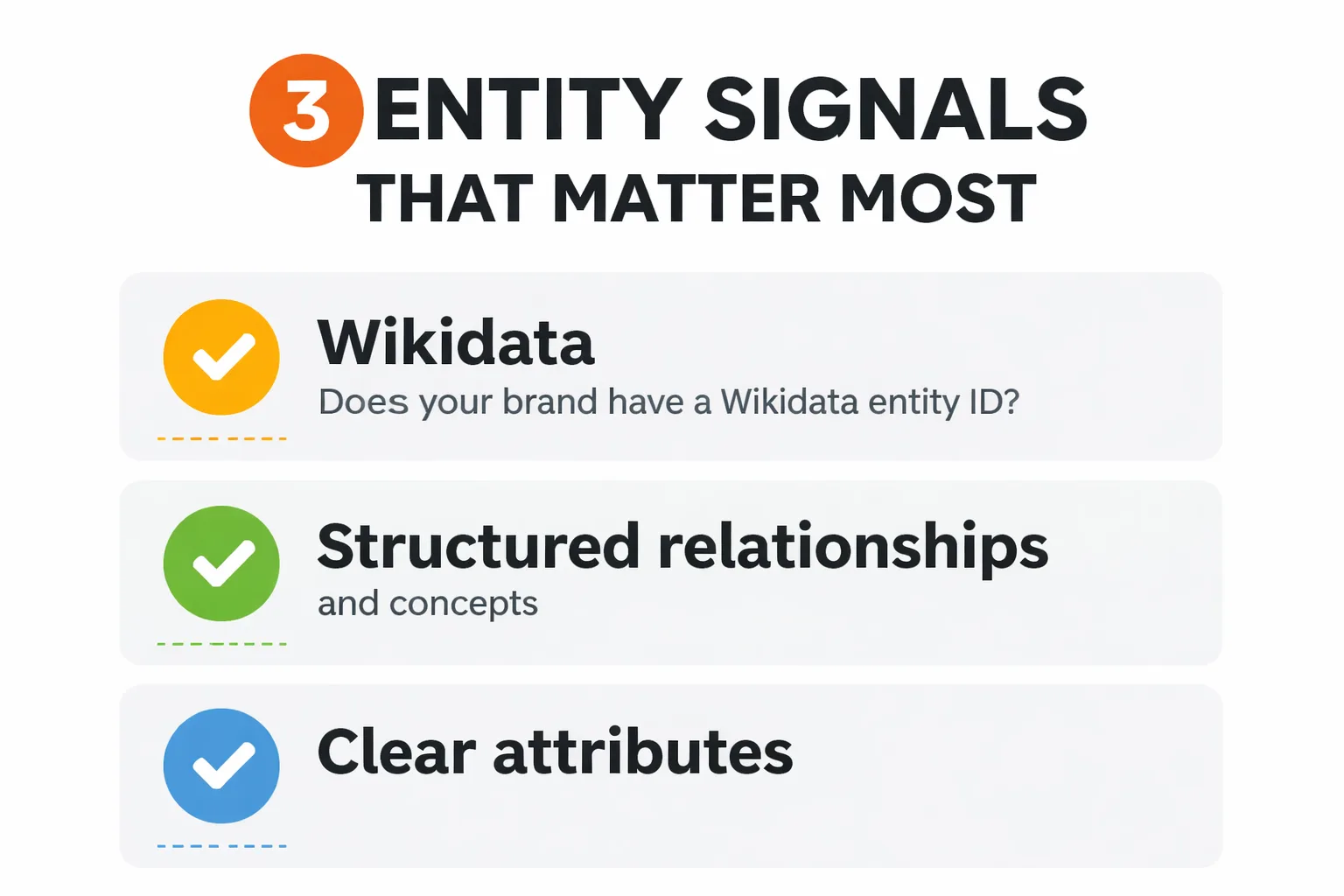
Three entity signals matter most for your brief. First, Wikidata. Does your brand have a Wikidata entity ID? If not, that's priority one. Wikidata provides the structured relationships and concept connections that LLMs use to understand entities. Second, Wikipedia presence. Given that Wikipedia drives 27% of ChatGPT citations, having a properly sourced Wikipedia page (or at minimum, being mentioned in relevant category pages) is foundational. Third, knowledge panel accuracy. Search for your brand on Google. Does a knowledge panel appear? Is the information in it correct? If the panel shows outdated product descriptions or wrong founding dates, that misinformation propagates into AI answers.
Your brief should explicitly list what entity signals need fixing. Be specific. "Our Wikidata entry is missing our product category classification. Our Wikipedia page was deleted 18 months ago for notability concerns and needs to be rebuilt with proper sourcing. Our Google knowledge panel shows an old logo and incorrect headquarters location." That level of detail gives your provider an immediate work plan.
The entity conversation also extends to third-party mentions. AI engines don't just read your website. They synthesize information from across the web. If authoritative sources in your industry describe your brand inconsistently, AI answers will reflect that inconsistency. Your brief should identify which third-party sources currently describe your brand and flag any discrepancies. This is where answer engine optimization principles come into play. It's not enough to optimize your own site. You need to optimize how the web describes you.
I've seen brands spend six months producing content without addressing entity gaps, only to find that AI engines still can't correctly identify what they sell. The content was fine. The entity foundation was missing. Fix entity signals first, then build content on top of that foundation. If your brief doesn't make this sequencing explicit, your provider will likely default to content production because that's what they know how to bill for.
Let's break down what a Wikidata entity actually contains and why it matters. A Wikidata entry for a brand typically includes: the entity type (company, organization, product), industry classification, founding date, headquarters location, key people, official website, and relationships to other entities (parent company, subsidiaries, competitors). When an LLM encounters your brand name in a prompt, it queries its internal knowledge graph for these attributes. If the attributes are missing or wrong, the LLM either hallucinates (fills gaps with incorrect information) or skips your brand entirely in favor of a competitor whose entity data is complete and accurate. Your brief should include a screenshot of your current Wikidata entry with annotations showing what's missing or incorrect.
For knowledge panel accuracy, the process is different. Google's knowledge panel pulls from multiple sources including Wikidata, Wikipedia, and Google's own Knowledge Graph. You can't directly edit the Knowledge Graph, but you can influence it by fixing the underlying sources. Claim your Google Business Profile, verify your Wikidata entry, and ensure your Wikipedia page (if you have one) is accurate and well-sourced. Changes take weeks to propagate, so start this process before the engagement kicks off, not during it.
Your brief should also address schema markup on your own site. At minimum, your homepage should include Organization schema with accurate name, logo, URL, description, and same-as links pointing to your Wikidata entry, Wikipedia page, and official social profiles. If your provider doesn't mention schema markup in their proposal, ask about it. If they don't know what Organization schema is, find another provider.
Step 4. Set Deliverable Standards for Content Quality
This is where you separate serious providers from content mills. If your brief doesn't specify quality standards, you'll get AI slop. I guarantee it.
I learned this the hard way. Over the past year, I tested AI-generated content across roughly 70 client sites. The failure rate for AI content using traditional SEO tactics (keyword density, meta optimization, word count targets) was 60%. Google's Helpful Content System ignored it. AI engines didn't cite it. The content existed but contributed nothing. What actually worked was a complete pivot to structuring content for what I call AI extractability: direct answers under question headings, comparison tables, structured data, and front-loaded claims with specific numbers.
Your brief needs to specify three quality requirements. First, human approval gates. No content goes live without a human reviewer checking it for accuracy, originality, and brand voice alignment. This is non-negotiable. Any provider who pushes back on human review is telling you they want to ship volume over quality. Second, citation-density targets. Every claim in every article should link to an authoritative source. I'm not talking about one or two links per article. I'm talking about source attribution on every factual statement. This is what makes content citable. AI engines extract from content that itself cites reliable sources because citation density signals authority. Third, source attribution requirements. Specify which sources are acceptable (industry publications, primary research, government data) and which are not (competitor blogs, content farms, your own marketing pages).
The difference between AI slop and answer-engine-optimized content comes down to structure and sourcing. AI slop reads like a Wikipedia summary rewritten in slightly different words. Answer-engine-optimized content reads like an expert answering a specific question with data, examples, and a clear point of view. Your brief should specify the difference.
Here's a concrete standard you can put in your brief. "Every article must open with a direct answer to the title's implied question within the first 200 words. Every factual claim must link to a primary source. Articles must include at least one comparison table when the topic involves evaluating options. Content must be structured with question-shaped H2 headings that match how users phrase queries to AI engines. No article publishes without human review and approval." That paragraph alone will eliminate 80% of the providers who would have wasted your budget.
I've also found that 44% of AI citations come from the first third of a page. Your brief should require front-loaded answers. If the provider writes articles where the useful information is buried at the bottom, AI engines won't extract it. The structure matters as much as the content itself.
In my own work, I've insisted on what we call a quality firewall: a 16-dimension check that blocks weak drafts before they reach the CMS. You don't need to specify 16 dimensions in your brief, but you should require that the provider has some automated quality gate. Ask them to describe it. If they can't, they don't have one.
Let's get specific about what those quality dimensions should cover. At minimum, your brief should require checks for factual accuracy (every claim verified against a primary source), originality (no duplicated content across articles or competitors), cannibalization detection (new articles don't compete with existing ones for the same query), structural completeness (TOC, TLDR, FAQ section, schema markup), and readability (appropriate reading level for the target audience). These five checks alone will catch 90% of the problems that make AI content uncitable.
Your brief should also specify content archetypes. Not every article should be structured the same way. A listicle needs different formatting than a how-to guide. An explainer requires different depth than a problem-solver piece. If your provider treats every article as a generic blog post, the content will be mediocre across the board. Specify which archetypes matter for your category and require the provider to follow archetype-specific structures.
The content quality conversation should also address multi-language requirements if your brand operates in multiple markets. AI engines cite content in the user's language when available. If you need visibility in Spanish-speaking markets, your brief should specify that content must be natively written in Spanish, not auto-translated. Auto-translated content performs significantly worse in AI citation because the phrasing doesn't match how native speakers actually ask questions.
Step 5. Agree on a Reporting Format Before Work Starts
If you don't define what success looks like in the contract, your provider will define it for you. And their definition will favor them.
Most AI SEO service reports I've seen are repackaged traditional SEO dashboards. Keyword rankings. Organic traffic. Backlinks acquired. These metrics are not wrong, but they're insufficient. They tell you about Google. They tell you nothing about whether your brand is appearing in AI answers, which is the entire point of the engagement.
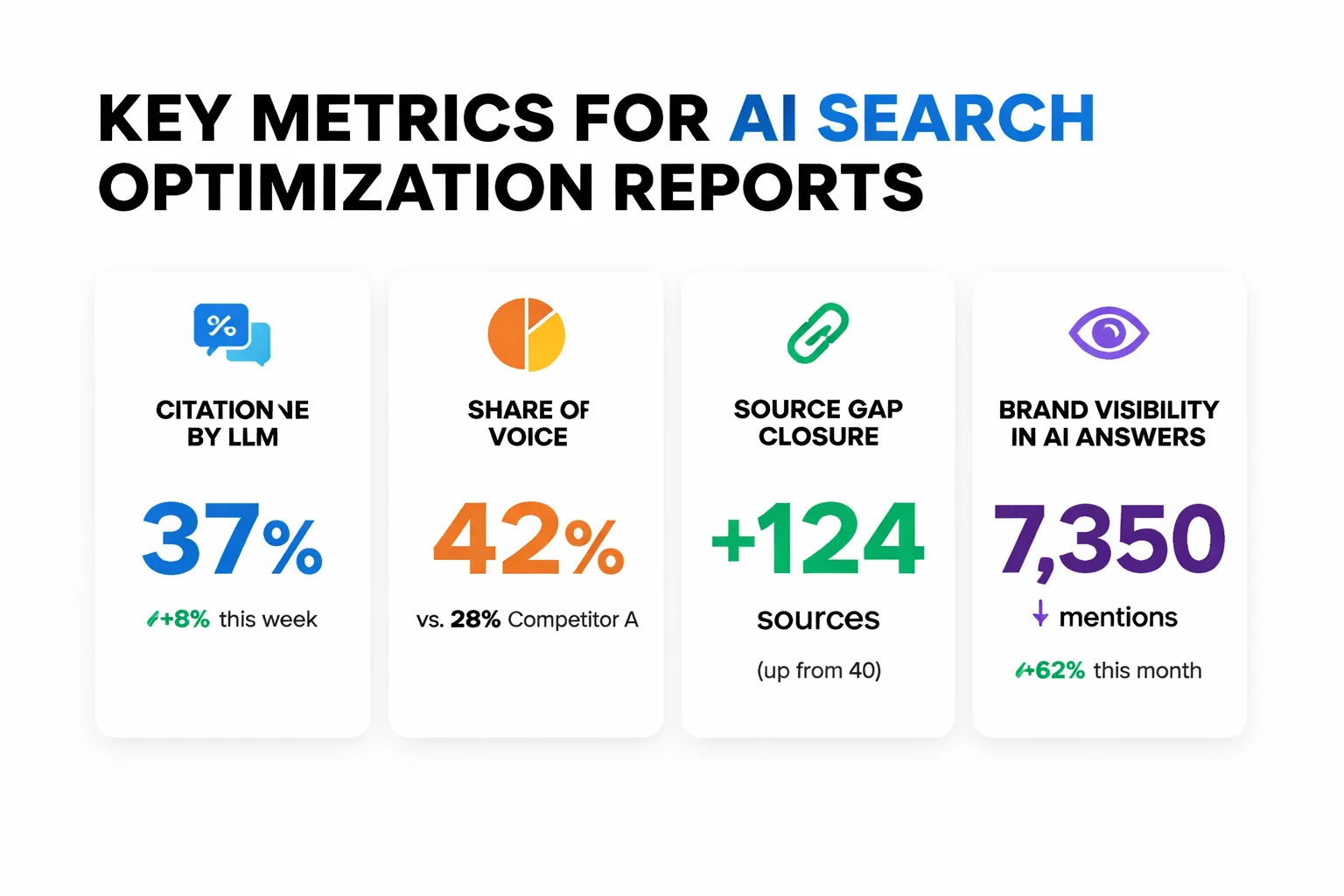
A proper AI search optimization report should include four specific metrics. First, citation rate by LLM. What percentage of tracked prompts mention your brand in each AI engine? This should be tracked weekly with trend data. Second, share of voice. When an AI answer mentions brands in your category, what percentage of those mentions are yours versus competitors? Third, source gap closure. How many of the sources that AI engines cite for your topics now mention or link to your brand compared to the start of the engagement? Fourth, content-to-citation ratio. How many articles were published, and how many of those earned AI citations? This ratio tells you whether the content strategy is actually working or just producing volume.
Ahrefs studied 75,000+ brands and millions of AI citations across multiple AI search engines to understand citation patterns, as documented in their generative engine optimization research. The data shows that topical authority and citation patterns follow predictable structures. Your provider should be reporting against these patterns, not against legacy SEO benchmarks.
Your brief should specify the exact report format. I recommend a simple structure: a one-page weekly summary with citation rate by engine, a monthly deep dive showing trend data and source gap analysis, and a quarterly review tied to business outcomes (pipeline influenced, deals touched by AI-sourced traffic). If the provider can't deliver this format, they're not an AI SEO provider. They're a traditional SEO agency with an AI label.
One more thing on reporting. Avoid vanity metrics in the contract. "Articles published" is a vanity metric unless paired with "citations earned." "Prompts tracked" is a vanity metric unless paired with "mention rate." "Backlinks acquired" is a vanity metric unless paired with "citations from those linking domains." Every metric in your report should be paired with an outcome metric that shows whether the activity actually moved the needle.
The reporting conversation is also where you set expectations for timeline. AI visibility gains are slower than traditional SEO gains in some ways and faster in others. Citation rate can improve within weeks if entity signals are fixed quickly. Content-driven citation growth typically takes 60 to 90 days. Source gap closure through outreach can take three to six months. Your brief should acknowledge these timelines so neither side is surprised when results don't appear overnight.
Let's talk about what a good weekly report actually looks like in practice. Page one should have three sections. Section one: citation rate by engine, shown as a percentage with week-over-week change. If your citation rate in ChatGPT went from 15% to 18% this week, that's a 3-point lift and the report should explain what drove it. Section two: new citations earned, listing the specific prompts where your brand appeared for the first time and the source the AI cited. Section three: prompts lost, listing where your brand dropped out of the AI answer and why. That third section is where most providers hide bad news. Your brief should require it. If you only see wins, you're not getting the full picture.
The monthly deep dive should add three more dimensions. Competitor movement: which competitors gained or lost citation share and on which prompts. Source analysis: which domains AI engines cited most frequently for your category this month, and how many of those domains mention your brand. Content performance: which published articles earned citations, which didn't, and what the pattern difference is between the two groups. This last analysis is how you refine the content strategy over time. If listicles with comparison tables earn citations at 3x the rate of explainer articles, your brief should adapt to produce more listicles.
For the quarterly review, tie everything to business metrics. How many demo requests came from users who mentioned finding you through ChatGPT or Perplexity? What's the estimated pipeline value of AI-sourced traffic? These numbers are harder to track but they're what ultimately justify the engagement. Your provider should help you set up attribution mechanisms, even simple ones like adding "how did you hear about us" fields that include AI engine options.
How Does Generative Engine Optimization Differ from Traditional SEO?
Generative engine optimization (GEO) is the practice of optimizing content and entity signals specifically for AI answer engines rather than for traditional search result pages. The distinction matters because the ranking signals are fundamentally different. Traditional SEO rewards backlinks, keyword relevance, page authority, and user experience signals. GEO rewards source authority, entity completeness, citation density, content structure that facilitates extraction, and third-party validation across the web.
When you brief a provider, you need to understand which optimization framework they're operating in. If they're applying traditional SEO signals to content and calling it GEO, the work won't produce AI citations. I've seen this happen repeatedly. The provider writes keyword-optimized content, builds backlinks, and reports improved rankings. But when you check ChatGPT or Perplexity, the brand still isn't mentioned. That's because the provider optimized for the wrong engine.
Your brief should explicitly state which optimization framework you expect. "We want generative engine optimization, not traditional SEO with AI keywords. Success means brand mentions in AI answers, not just improved Google rankings." This clarity prevents scope creep and ensures the provider's work aligns with your actual goals. If you want to dive deeper into this distinction, our AEO vs SEO comparison breaks down the tactical differences.
What Is Answer Engine Optimization and Why Does It Matter for Your Brief?
Answer engine optimization (AEO) is the practice of structuring content so AI engines can extract and cite it when answering user questions. AEO is narrower than GEO. GEO encompasses the full strategy (entity building, citation acquisition, content structure, source outreach). AEO is specifically about content structure: making your content easy for AI to parse, extract, and cite.
AEO matters for your brief because it defines the content quality standards in Step 4. When you tell your provider to produce answer-engine-optimized content, you're telling them to structure articles with direct answers under question headings, comparison tables for evaluative queries, sourced claims throughout, and schema markup that helps AI engines understand the content's structure.
The practical implication for your brief is that you should specify AEO structural requirements explicitly. Don't assume the provider knows what AEO means. I've talked to agencies that use the term but still produce traditional blog posts with keyword-optimized headings. Your brief should include specific structural requirements: question-shaped H2s, front-loaded answers in the first 200 words, comparison tables for any evaluative content, FAQ blocks at the end of articles, and schema markup (Article, FAQ, HowTo) on every page.
If you're working with a provider who needs a reference point, point them to our what is AEO guide for a framework. Or if they're confusing AEO with GEO, our AEO vs GEO breakdown clarifies the distinction. The point is to make sure everyone in the engagement is working from the same definitions.
Do you know which AI engines cite your brand today?
How to Evaluate AI Search Optimization Services Before You Brief
Before you write the brief, you need to make sure you're briefing the right provider. Not every agency offering ai search optimization services actually has the capability to deliver. The rebranding wave has been aggressive. Traditional SEO agencies have slapped "AI SEO" on their services pages without changing their methodology.
Here's how to evaluate a provider before you invest time in a brief. Ask three diagnostic questions. First, "How do you track brand mentions in ChatGPT specifically?" If they say they use manual testing or don't have a tracking tool, they can't measure outcomes. Second, "Can you show me a Wikidata entry you've created or edited for a client?" If they can't, they don't do entity grounding work. Third, "What's your content-to-citation ratio on recent engagements?" If they don't track this metric, they're not measuring whether their content actually earns AI citations.
The providers worth briefing will answer all three questions with specifics. The ones who can't will deflect with generic statements about "AI-driven content strategies" and "comprehensive optimization approaches." Those are red flags. Move on.
You should also ask about their LLM visibility tool stack. What tools do they use to track citations? Do they have direct API access to AI engines, or are they running manual queries? How often is their data refreshed? The answers tell you whether their reporting will be reliable or anecdotal.
When This Briefing Process Fails
I want to be honest about where this framework breaks down, because pretending it's universal would be its own kind of slop.
This process fails when your brand has zero existing entity presence. If you're a six-month-old startup with no Wikipedia page, no Wikidata entry, no third-party coverage, and no industry recognition, no amount of brilliant briefing will fix the entity gap quickly. Entity building takes time. Your provider can help, but the timeline is months, not weeks. Don't expect a briefing framework to accelerate foundational brand awareness work.
It also fails when your category is too new for AI engines to have formed opinions. If you're in a genuinely emerging space where AI engines don't yet have training data or authoritative sources to cite, your provider is essentially building the category from scratch. That's a different engagement than optimizing existing visibility. The brief needs to reflect that reality.
Finally, this fails when the provider you've hired doesn't actually have AI search optimization capabilities. Many agencies have rebranded their traditional SEO offerings with AI language. If your provider can't show you their own LLM citation tracking methodology, can't explain how they measure brand mentions in ChatGPT, and has never built a Wikidata entry, no brief will rescue the engagement. Audit the provider's capabilities before you brief them.
What This Actually Means
The brands winning in AI search right now aren't the ones with the biggest budgets or the most content. They're the ones who walked into their provider relationship with a clear picture of where they stood, what needed fixing, and what success looked like. That's what this five-step brief gives you.
The shift from traditional SEO to AI search optimization isn't incremental. It's structural. Your brief needs to reflect that. Stop briefing for rankings and start briefing for citations, entity presence, and answer visibility. The providers who can deliver against that brief are the ones worth hiring. The ones who can't will reveal themselves the moment you ask about Wikidata.
If you want to see where your brand stands today before you write that brief, run a citation gap audit first. The data will tell you everything you need to know about what your brief should prioritize. I've watched brands skip this step and pay for it in wasted quarters. Don't be Priya. Walk in with data, walk in with standards, and walk in with a reporting format that holds your provider accountable to outcomes that matter.
FAQ
What is the difference between AI SEO services and traditional SEO services?
AI SEO services focus on getting your brand mentioned and cited in AI-generated answers across engines like ChatGPT, Perplexity, Google AI Overviews, and Claude. Traditional SEO services focus on ranking web pages in Google's organic search results. The methodologies overlap on content production and technical SEO, but AI SEO adds entity grounding, citation acquisition, LLM-specific content structuring, and AI visibility tracking that traditional SEO doesn't cover.
How much do AI SEO services typically cost?
Costs vary widely based on scope. A focused engagement covering entity fixes, content production, and citation tracking for a single brand typically ranges from $3,000 to $10,000 per month. Larger engagements with multi-language content, aggressive outreach, and competitive tracking can exceed $15,000 per month. Be wary of providers charging under $2,000 per month; they likely can't deliver the entity work and citation tracking that drives results.
How long before I see results from AI SEO services?
Entity signal fixes (Wikidata, knowledge panel, schema markup) can produce citation improvements within 2 to 4 weeks. Content-driven citation growth typically takes 60 to 90 days as AI engines index and begin citing new articles. Source gap closure through outreach and PR takes 3 to 6 months. Set these expectations in your brief so your provider isn't pressured to show overnight results that aren't realistic.
Can I do AI SEO myself without hiring a provider?
You can do the citation gap audit, entity signal fixes, and basic content structuring yourself. Tools like our AI visibility tracker let you monitor your brand's presence across AI engines without an agency. However, sustained citation acquisition, multi-engine monitoring at scale, and competitive intelligence typically require dedicated resources that a provider can offer. Start with the audit yourself, then decide whether to hire based on what the data shows.
What should I do if my provider isn't delivering AI citations after 90 days?
First, check whether the foundational work was done. Is your Wikidata entry complete? Does your site have Organization schema? Are published articles structured with question-shaped headings and sourced claims? If the foundation is solid but citations aren't appearing, the issue is likely content discoverability. Ask your provider for their content-to-citation ratio. If they've published 30 articles and earned zero citations, the content strategy needs to change, not just produce more volume.
Should my AI SEO brief include ecommerce-specific requirements?
If you sell products online, yes. Ecommerce GEO and agentic commerce require structured product data, pricing transparency, and review schema that AI agents can parse. Your brief should specify product page optimization, review aggregation strategy, and structured data requirements for product snippets. AI engines increasingly answer shopping queries with product recommendations, and brands without structured product data won't be recommended.
About the Author
Judy Zhou, Founder
Judy Zhou leads content strategy at Meev, where she oversees AI-driven content research and publishing for hundreds of brands. With a background in SEO and editorial operations, she focuses on building content systems that rank on Google, get cited by AI search engines, and drive measurable business results.
Run a free AI visibility audit and walk into your next provider call with data they can't ignore.