
By Judy Zhou, Founder
Key Takeaways
- AI search interactions represent 30% of total search volume, so brands must track citations inside LLM answers or risk total invisibility.
- 93% of AI Mode sessions end without a click, meaning success now requires direct citation in generated responses instead of traditional rankings.
- Google AI Overviews trigger for 21% of queries, forcing content teams to audit structure for answer-engine readiness alongside classic SEO.
- AI SEO tools merge ranking data with LLM citation tracking to audit content and automate publishing of articles built to earn mentions in ChatGPT and similar surfaces.
Last spring, a content strategist at a mid-size SaaS company noticed something strange. A competitor she'd been tracking for years had started appearing inside ChatGPT answers for nearly every category-level question in their space. Her company, despite having more published content, a stronger domain, and a longer history, was invisible. She wasn't ranking below them. She simply didn't exist in that context. That moment sent her down a rabbit hole that eventually led to a stack of tools she'd never heard of six months earlier: AI visibility platforms, entity grounding services, LLM citation trackers.
That strategist had stumbled into the core problem these tools solve. AI search interactions now represent 30% of total search volume, and Google AI Overviews appear for 21% of all queries according to Ahrefs' AI Search Benchmark Report. Meanwhile, 93% of AI Mode sessions end without a click. If your brand isn't cited inside the AI-generated answer itself, you don't exist. AI search engine optimization tools are software platforms that track brand mentions and citations across LLM-powered search surfaces, audit content for answer-engine readiness, and automate the publishing of articles structured to earn those citations. They merge traditional ranking intelligence with LLM citation tracking, closing the gap between what ranks on Google and what gets cited by ChatGPT.
What Is an AI Search Engine Optimization Tool?
An AI search engine optimization tool is software that helps brands appear in both classic Google results and AI-generated answers by tracking citations across LLMs, auditing content structure, and automating answer-optimized publishing. It covers the full spectrum of modern search visibility, from keyword tracking to entity grounding for AI search.
The category exists because search itself split in two. You have the old world of ten blue links (now mostly AI Overviews on Google) and the new world of conversational answers on ChatGPT, Claude, Gemini, Perplexity, and Grok. Traditional SEO tools were built for the first world. They track rankings, backlinks, and technical health. AI search engine optimization tools were built for the second. They track whether your brand appears inside AI-generated answers, which sources those answers cite, and what content you need to publish to earn those citations.
In my work auditing content operations at Meev, I see the same gap every week. Teams have detailed dashboards showing their Google positions. They have no idea whether ChatGPT mentions them when a prospect asks about their category. The two universes operate on entirely different ranking signals. Google rewards links, technical structure, and authority. AI engines reward entity salience, third-party coverage, and structured data that helps them verify facts. A tool that only tracks one universe is giving you half the picture.
The McKinsey AI Search Optimization Benchmark analyzed 154 websites and found an average AI Readiness Score of 75.89 out of 100. Only 44.16% of sites achieved an 'Excellent' score above 80. That means more than half the web is structurally unprepared for AI search, and most teams don't even know they have a problem.
The underlying technology stack matters here. Traditional SEO tools are essentially crawlers and link databases. They scrape Google, count backlinks, and audit HTML. AI search engine optimization tools are built on a fundamentally different architecture. They use LLM APIs to send thousands of prompts to models like GPT-4, Claude, and Gemini, then parse the responses to extract brand mentions, citation URLs, and sentiment. Some use direct API access (more accurate, more expensive). Others rely on web scraping (cheaper, less reliable). The AEO vs SEO distinction isn't just theoretical. It determines the entire infrastructure stack. An AEO tool needs API budgets, prompt engineering logic, response parsing pipelines, and entity resolution systems. A traditional SEO tool needs a crawler and a link index. The complexity gap is enormous, and it's why so many early tools in this space produce unreliable data.
What two jobs do these tools do?
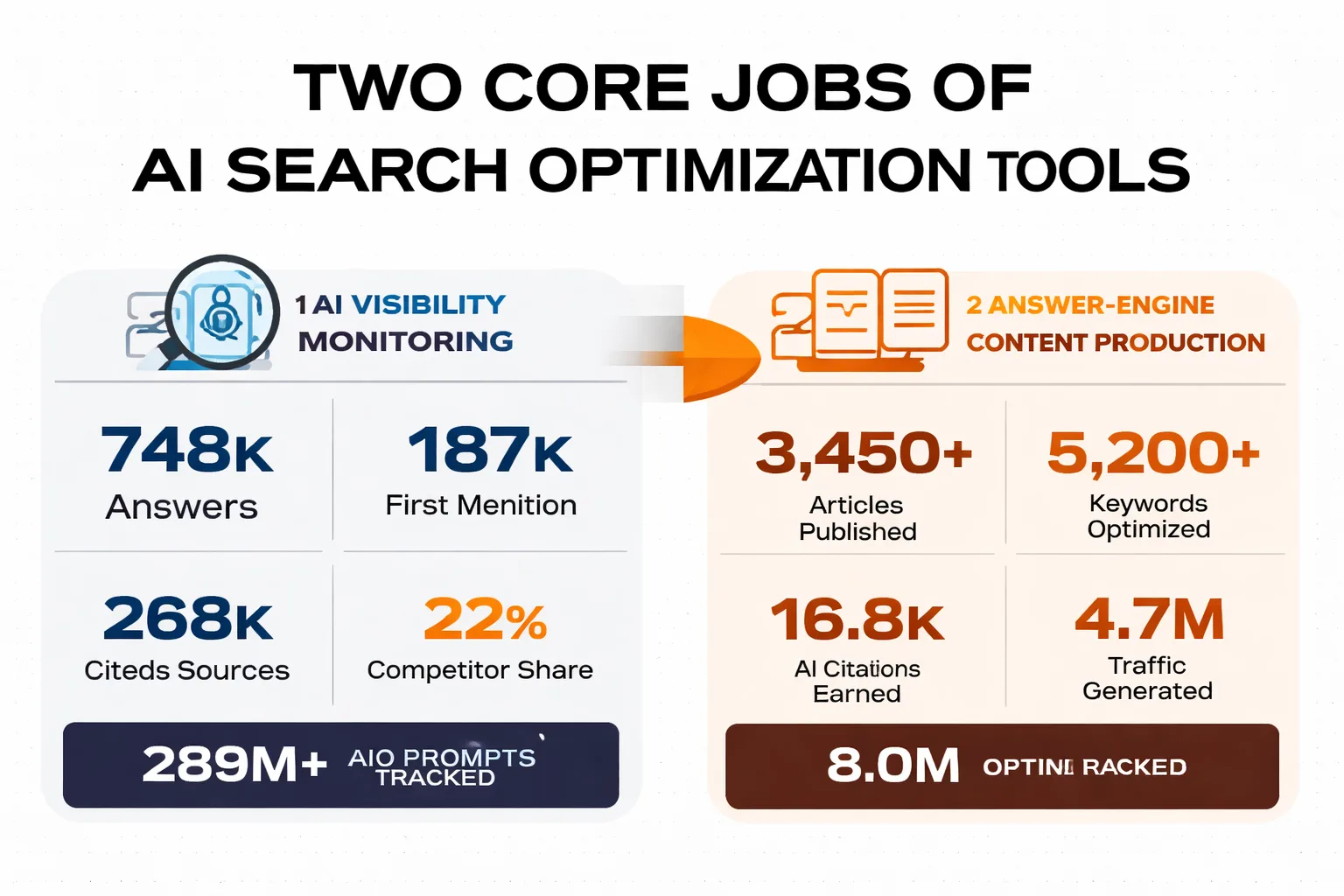
Every legitimate tool in this space does two things. Some do both. Most do one.
The first job is AI visibility monitoring. This means tracking how often and where your brand appears in AI-generated answers across every major AI search surface. Not just 'are we mentioned' but where in the answer you appear (first mention, buried in a list, absent entirely), which sources the AI cited alongside your mention, and how your share of voice compares to competitors. Semrush Enterprise AIO, for example, monitors 289 million+ relevant LLM prompts globally. That scale matters because LLM responses are non-deterministic. Ask the same question twice and you may get different sources cited each time. Without high-volume prompt testing, your visibility data is anecdotal.
The second job is answer-engine content production. This means researching, writing, and publishing articles structured specifically to earn citations from AI engines. Not traditional blog posts optimized for keyword density. Articles built with answer engine optimization principles: clear entity definitions, fact-verified claims with inline source links, structured schema markup, and content archetypes that match how AI engines retrieve and synthesize information.
Here's where most teams fail. They do one job and ignore the other.
A team that only monitors visibility knows they're invisible but has no system to fix it. They can see the gap but can't close it. A team that only publishes AI-optimized content has no feedback loop. They push articles into the void and hope the citations come, with no way to measure whether their content actually moved the needle. The tools that matter are the ones that close the loop: monitor, identify gaps, publish targeted content, measure whether citations increased. Everything else is a point solution.
In my experience, the teams that get results treat this as a single workflow, not two separate tools. You see a competitor cited where you're absent. You research what that competitor published. You write a better, more citation-worthy version. You publish it. You check whether your citation rate moved. That cycle, repeated weekly, is what actually builds AI search visibility. Tools that force you to switch between three different dashboards to complete one cycle kill momentum.
Let me give you a concrete example of how this loop works in practice. Say your visibility tracker shows that for the prompt 'best CRM for startups,' a competitor appears in 40% of ChatGPT responses while you appear in 5%. You dig into the cited sources and discover the competitor is frequently mentioned alongside G2 review data and a specific TechCrunch product launch article. Your next move isn't to write a generic blog post about CRMs. You need to earn coverage on platforms AI engines trust. You might pursue a G2 listing optimization, pitch a comparison article to a tech publication, and publish a deeply researched alternative on your own site with structured FAQ schema. Two weeks later, you re-run the same prompts. If your citation rate moved from 5% to 12%, the loop worked. If it didn't, you adjust. That diagnostic-to-prescriptive cycle is the entire value proposition of an AEO tool.
Which AI Search Optimization Tool Is Most Intuitive?
The most intuitive AI search optimization tool is one that combines visibility tracking, content gap detection, and publishing into a single dashboard with plain-language scoring. Intuitive tools show you what to do next, not just what happened. They surface citation gaps as actionable prompts rather than raw data exports.
When I evaluate which ai search optimization tool is most intuitive, I look for three UX signals. First, a unified dashboard. If I need to switch between a 'rankings' tab, a 'citations' tab, and a 'content' tab to understand my situation, the tool was designed by an engineer, not a marketer. Second, plain-language citation scoring. 'Your brand appears in 12% of relevant prompts, down 3 points week-over-week' is useful. A raw JSON export of 500 LLM responses is not. Third, one-click publishing or at minimum a direct CMS integration. If I find a citation gap and then have to open a separate tool, write an article, format it, and manually publish it, I won't do it consistently.
The top user friendly ai search optimization tools share a common design philosophy: they reduce the distance between insight and action. You see a gap. You fix it. In the same platform. Without a project management meeting.
What separates beginner-friendly tools from enterprise-grade platforms is the level of abstraction. Small teams need tools that make decisions for them. 'Here are three topics where competitors are cited and you're not. Here's a draft for each. Approve and publish.' Enterprise teams need tools that provide raw data exports, API access, and custom segmentation because they have analysts to interpret the data. If you're a founder or a solo marketer, you don't need an analyst dashboard. You need a tool that tells you what to write next.
This is where the AEO vs SEO distinction becomes practical. Traditional SEO tools tell you what keywords to target. AI search engine optimization tools tell you what entities to establish, what questions to answer, and what sources to earn citations from. The UX needs to reflect that difference. A keyword difficulty score is a familiar abstraction. A 'citation probability score' is a new one, and the best tools make it feel as natural as checking your rank tracker.
I'll give you a specific UX pattern to watch for. The best tools I've tested use a 'citation gap' interface. Instead of showing you a list of 500 prompts and asking you to figure out which ones matter, they surface a prioritized list: 'These three prompts have high commercial intent, your competitor is cited in all of them, and you're absent. Click here to generate a draft.' That's intuitive. A tool that dumps 500 rows into a table and expects you to filter, sort, and analyze is a data product, not a workflow product. For small teams, the workflow product always wins.
Another UX signal: onboarding speed. If a tool requires a two-hour implementation call with a customer success manager before you can see your first visibility report, it's not built for small teams. The best tools auto-fill your brand positioning, audience, and topics from your homepage scan. You sign up, enter your domain, and within minutes you see your baseline AI visibility. That frictionless setup is what separates a tool built for founders from a tool built for enterprise procurement cycles.
Which AI Search Optimization Tool Provides the Best Data Accuracy?
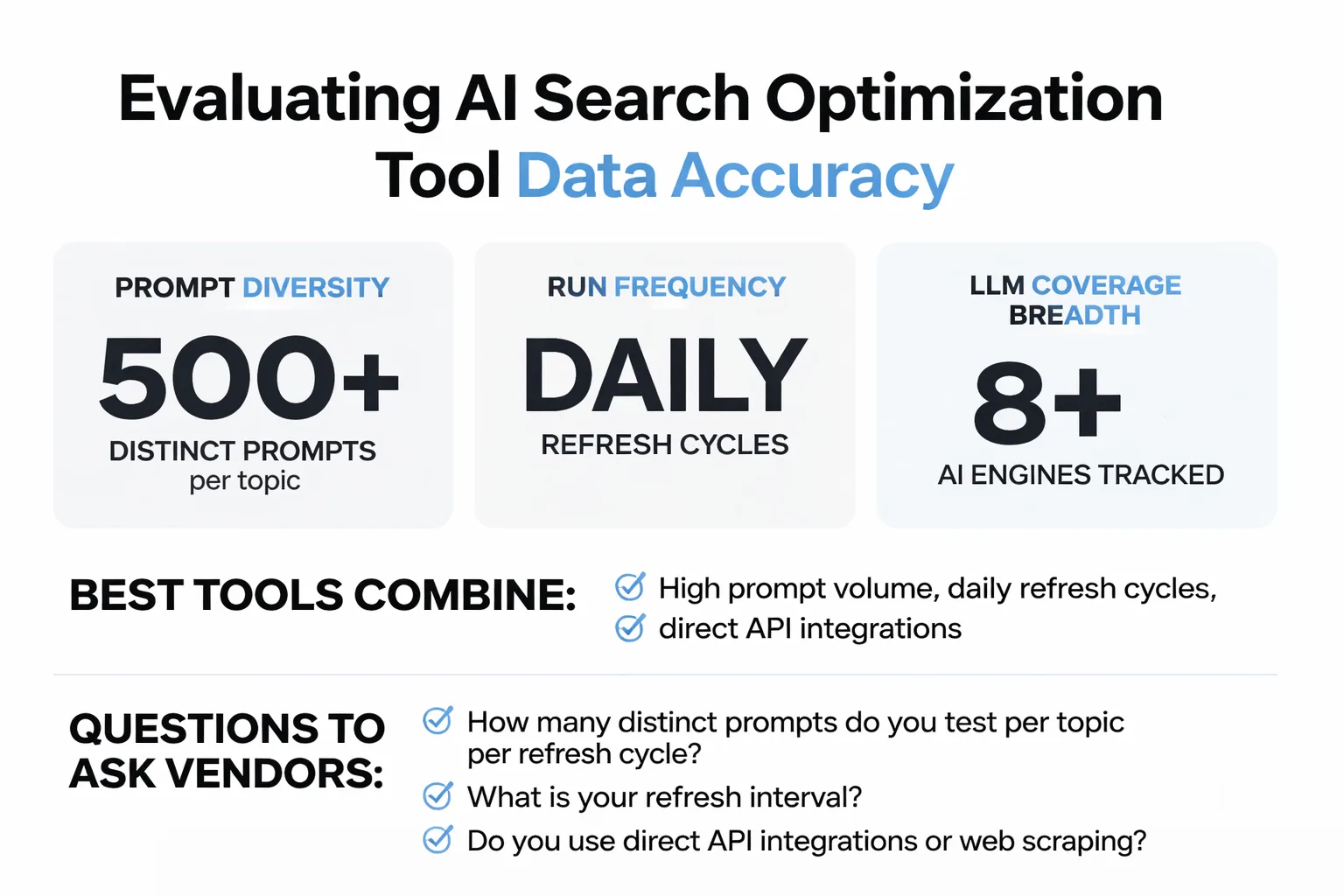
Data accuracy in AI search optimization means three things: prompt diversity (how many distinct prompts are tested per topic), run frequency (how often prompts are re-run to account for LLM non-determinism), and LLM coverage breadth (how many AI engines are tracked). The best tools for data accuracy combine high prompt volume, daily refresh cycles, and direct API integrations with each LLM rather than relying on web scraping.
This question matters more than people realize. LLM responses are probabilistic. The same prompt can return different sources on different runs. A tool that tests a prompt once and reports 'your brand is not cited' is giving you a single sample from a distribution. You need enough samples to know whether your actual citation rate is 5% or 25%.
When evaluating the most reliable ai search optimization tool for data accuracy, ask vendors three questions. How many distinct prompts do you test per topic per refresh cycle? What is your refresh interval? Do you use direct API access or web scraping for each LLM? Direct API access matters because web-scraped results can differ from API results. Some engines gate certain response types behind API access entirely.
The Semrush Enterprise AIO solution monitors 289M+ prompts globally, which gives it statistical power. But prompt volume alone isn't enough. You also need per-LLM drill-down. A tool that reports 'your brand appears in 15% of AI answers' is useless if it averages across engines where you're strong (Perplexity, 30%) and engines where you're invisible (Claude, 2%). You need per-model granularity to know where to focus.
This is why I emphasize LLM visibility tool architecture. The best tools don't blend results into a single score. They show you each model separately because the ranking signals differ. ChatGPT draws heavily from web search results. Claude relies more on its training data. Perplexity uses real-time web retrieval with citations. A brand can be highly visible in one and absent in another. An aggregate score hides that gap. A per-LLM dashboard reveals it.
Let me explain why this matters with a real scenario. I was looking at a client's AI visibility data across three engines. ChatGPT cited them in 22% of relevant prompts. Perplexity cited them in 35%. Claude cited them in 3%. An aggregate score would say '20% visibility, looking decent.' But that Claude gap is a massive problem because Claude is increasingly used in enterprise environments. If your target buyers are using Claude (through tools like Amazon Q or enterprise Claude deployments), you're invisible to them. A tool that only tracks ChatGPT and Perplexity would give you a false sense of security. You need every major AI search surface tracked independently.
There's also a cost dimension to data accuracy. Direct API calls to LLMs are expensive. A Perplexity Sonar API call costs roughly $0.005 per query. If you're testing 100 prompts per topic across 10 topics daily, that's $5 per day on Perplexity alone. Add ChatGPT, Claude, and Gemini API costs and you're looking at $20-50 per day in API fees just for monitoring. Tools that use web scraping avoid these costs but get inferior data. The most reliable ai search optimization tool for data accuracy uses a hybrid architecture: direct API access for engines where it matters most, supplemented by cost-efficient scraping where the data is consistent. At Meev, we use direct Perplexity Sonar API and direct DeepSeek and Grok integrations specifically to preserve measurement validity while cutting per-call costs by roughly 5x compared to third-party data providers.
The Shift from Keywords to Entities
Here's my contrarian take. Most teams approaching AI search optimization are still thinking in keywords. They want to know 'what keywords should I target for AI search?' That question is category confusion. AI engines don't retrieve documents by keyword match. They synthesize answers by retrieving entities and relationships from their training data and real-time web sources.
Entity grounding for AI search means establishing your brand as a recognized entity in the knowledge graphs that AI engines reference. This is where Wikidata and knowledge graph presence becomes non-negotiable. If your brand doesn't exist as a structured entity in Wikidata, you're relying entirely on web mentions to establish your identity. That's a fragile position. Research on Wikidata population found that even major academic conferences are 'only minimally represented in Wikidata' (arxiv.org). If conferences with decades of history are underrepresented, imagine how many brands are simply invisible to knowledge graph retrieval.
The Generative Engine Optimization study found that global household brands appear in 73% of relevant AI answers on first run. That's not because those brands optimized keywords. It's because they have dense entity presence across Wikipedia, Wikidata, news coverage, review platforms, and structured schema on their own sites. AI engines can verify their existence and attributes from multiple independent sources. If your brand lacks that entity density, no amount of keyword optimization will make you appear in AI answers.
This is why the best rated competitor analysis tools for ai search optimization don't just show you what keywords competitors rank for. They show you what entity sources AI engines cite for your competitors. Which publishers mention them. Which structured data they have. Which knowledge graph entries they appear in. That's the competitive intelligence that actually matters in 2026.
Think about it this way. A traditional competitor analysis tells you 'Competitor X ranks #3 for [best project management software].' Useful, but limited. An AI search competitor analysis tells you 'Competitor X is cited in 45% of AI answers for project management prompts. The AI engines cite their G2 profile, their Wikipedia page, and three TechCrunch articles when mentioning them. You have none of those entity sources.' That second analysis is actionable. It tells you exactly which entity sources to build. You need a G2 profile. You need Wikipedia coverage. You need earned media from publications AI engines trust. The tool that gives you that level of specificity is worth 10x more than one that just shows keyword gaps.
Want to see where your brand actually appears in AI answers?
How to Choose the Right Tool for a Small Team
Small teams need a different evaluation framework than enterprises. You don't have a dedicated SEO analyst. You don't have a content team of five. You need a tool that does the thinking for you and produces output you can act on within minutes, not days.
Here's the framework I use when advising small teams.
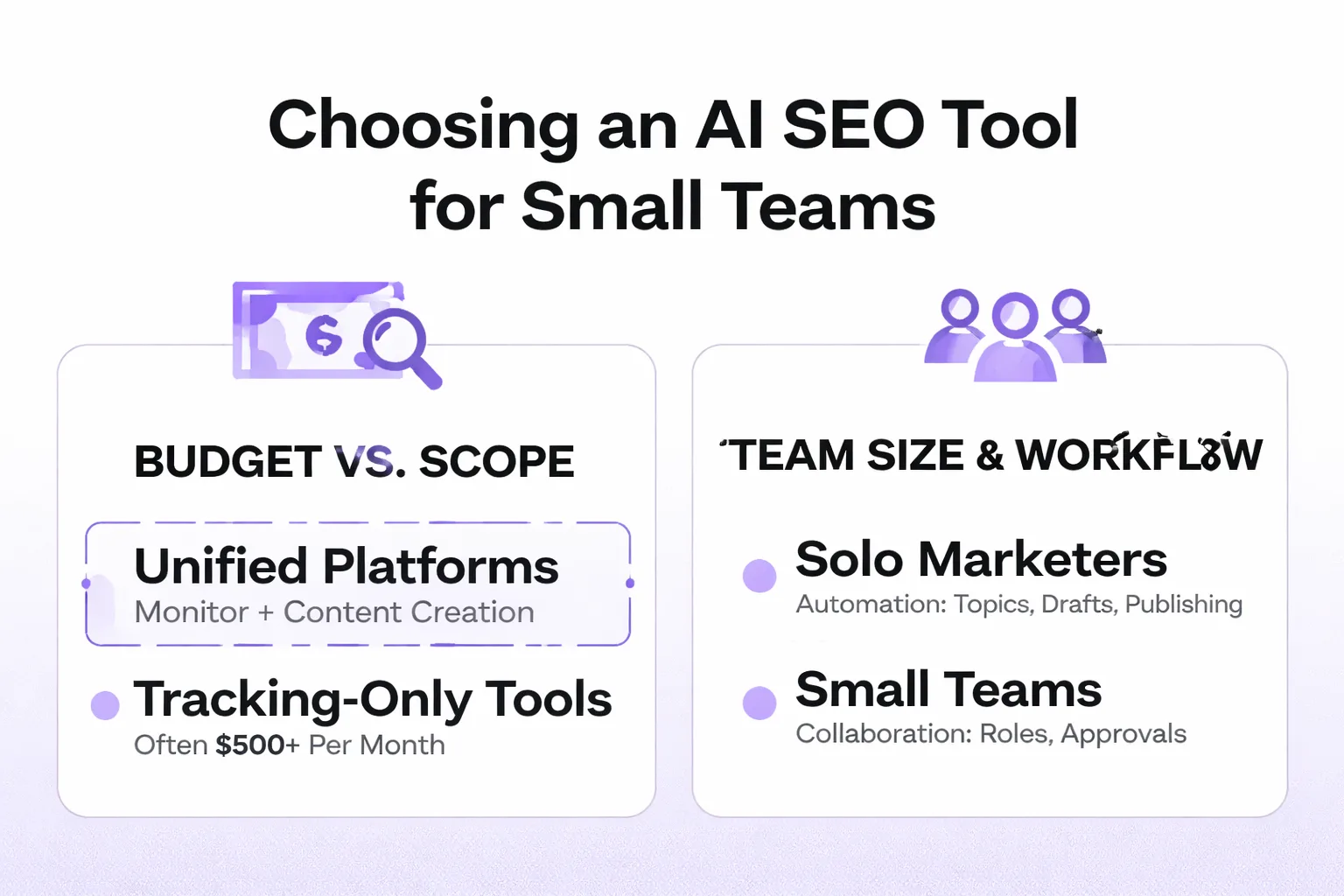
Budget vs. scope. Most AI visibility tools are priced for enterprises. If you're paying $500+ per month for tracking alone, you're getting visibility data but no way to act on it. Look for platforms that combine monitoring with content production. The cost of a tracking-only tool plus a separate content tool plus a separate publishing workflow almost always exceeds the cost of a unified platform.
Team size and workflow. If you're a solo marketer or founder, you need automation. A tool that generates topic ideas, drafts articles, and publishes to your CMS with minimal manual intervention. If you have a small team, you need collaboration features: role-based access, approval workflows, the ability to assign content tasks. But don't overpay for enterprise collaboration features you'll never use.
Publishing volume. Be honest about how much content you can actually produce and review. A tool that generates 150 articles per month is useless if you only have capacity to review and approve 10. Match the tool's output capacity to your review capacity. Unreviewed AI content is a liability, not an asset.
Combined platform vs. point solutions. This is the biggest decision. You can stitch together a visibility tracker, a content generator, a CMS, and an outreach tool. Each is best-in-class at its specific job. But the integration overhead kills small teams. Every context switch between tools is friction. For teams of one to five people, a combined monitoring-plus-publishing platform almost always wins on total output, even if individual features are less deep.
The tools I'd evaluate first are ones that close the loop between diagnosis and action. At Meev, we built our platform specifically because I kept seeing teams with great visibility data and no system to act on it. They knew they were invisible in ChatGPT. They had no idea what to publish, how to structure it, or whether it would work. A Perplexity AI visibility checker tells you where you stand. A ChatGPT AI visibility checker tells you the same for the biggest LLM. But neither tells you what to do next.
That's the gap that matters. The best AI search engine optimization tools don't just diagnose. They prescribe. They look at your citation gaps, identify which topics need coverage, research what competitors published, draft articles structured for citation, and publish them to your CMS. Then they measure whether citations actually increased. That closed loop is what separates a tool from a toy.
The Earned Media Problem Nobody Talks About
Here's something that caught me off guard. I used to believe owned content was the dominant lever for AI visibility. Write great articles on your own site, optimize them well, and AI engines will find and cite them. The data says otherwise.
84% to 89% of AI-generated answers come from earned media: third-party coverage in credible publications. AI engines prioritize sources they can verify independently. Your own blog is a single source making claims about itself. A third-party publication making the same claim carries far more weight in entity verification.
This changes what 'content production' means in the AI search context. It's not just publishing on your own site. It's earning mentions on the sites that AI engines actually cite. That's why the best AI search engine optimization tools include citation path analysis: identifying which publishers AI engines cite most often for your topics and helping you earn coverage there.
I shifted my entire strategy after internalizing this. I still publish owned content, but I treat it as entity reinforcement, not the primary citation driver. The primary citation driver is earned media. The tools that help me identify which publishers to target, verify contacts, and draft outreach pitches are the ones that actually move my AI visibility numbers. Tools that only track my own site's rankings are looking backward.
This is also why I've soured on Reddit as a shortcut for AI visibility. I tried leaning into Reddit last year for a quick boost. The results were underwhelming because Reddit data access is fragmented. Google and OpenAI have paid access. Bing, Perplexity, and Claude face restrictions. Your brand information isn't being picked up evenly across AI tools. A comprehensive signal graph built on owned first-party content, structured schema, distributed reviews, and earned media is the only reliable approach.
Let me break down the earned media math. If 84-89% of AI answers cite third-party sources, then at most 11-16% cite the brand's own website. That means even if you perfectly optimize every page on your site for AI citation, you're fighting for at most 16% of the citation surface. The other 84-89% is controlled by publishers you don't own. This is why I now spend more time on outreach than on-page optimization. A single mention in a publication that AI engines trust (think industry-specific authority sites, not just major media) can move your citation rate more than 20 blog posts on your own domain. The leverage is enormous, and most teams are ignoring it entirely.
The Limitations Nobody Mentions
These tools have real limitations, and pretending they don't is dishonest.
First, LLM non-determinism makes 'accuracy' a moving target. No tool can give you a precise citation rate because the underlying models don't produce consistent outputs. The best you get is a statistical estimate with confidence intervals. Any tool reporting exact percentages without explaining its methodology is overselling.
Second, coverage gaps. Every tool has blind spots. Some don't track Grok. Some don't track DeepSeek. Some scrape web results instead of using API access, which means they're seeing a different version of the answer than a real user gets. Ask vendors what they track and how. 'All major AI search surfaces' should be the baseline, not a premium feature.
Third, content quality. I tried integrating a highly-touted AI content tool into a client's workflow last quarter, hoping to scale blog production. The resulting content consistently lacked depth. It felt like we were automating low-value tasks. I pulled back after seeing no measurable improvement in organic traffic or keyword rankings within a 30-day trial. AI content without a quality gate is a liability. Google's guidelines on automated content are clear: content produced primarily to manipulate search rankings violates policy. The tools that work are the ones with quality firewalls that block weak drafts before they reach your CMS.
Fourth, the category is new and volatile. AI engines change their retrieval methods constantly. A tool that works today may break next month when an LLM updates its training data or changes its citation behavior. Don't lock into annual contracts until you've validated that a tool's data matches reality.
Fifth, and this is the one that frustrates me most: many tools conflate 'mention' with 'citation.' A mention is when an AI engine names your brand in its answer. A citation is when it links to a source about your brand. These are different signals with different implications. A mention without a citation means the AI knows about you but isn't pointing users to you. A citation means the AI is directing traffic (or at least attention) to a specific source. Tools that report 'visibility' without distinguishing between mentions and citations are giving you an inflated sense of your presence. Ask vendors whether they track these separately.
What Agentic SEO Changes About Tool Selection
The term 'agentic SEO' gets thrown around loosely. Here's what it actually means for tool selection. An AI SEO agent doesn't just generate content. It makes decisions. It looks at your visibility data, identifies the highest-impact gap, researches the topic, drafts the article, optimizes it for citation, and publishes it. Without you specifying each step.
This is different from a content generator. A content generator waits for you to tell it what to write. An agent figures out what to write on its own, based on what will move your citation rate. The distinction matters for small teams because agents reduce the cognitive load of content strategy. You don't need to decide what to write. You need to review what the agent wrote.
But agents without quality gates are dangerous. I've seen the skepticism in communities like r/AskMarketing, where experienced practitioners worry about generic output and Google penalties. Their concern is valid. An agent that publishes without human review is a risk. An agent that drafts, quality-checks, and waits for your approval is a productivity multiplier. The difference is the workflow design, not the AI model.
When evaluating tools, look for this specific pattern: autonomous topic discovery, archetype-aware writing (listicles and explainers require different structures), fact verification with source tracing, a quality firewall that blocks weak drafts, and human approval before publish. If a tool auto-publishes without a gate, run.
The quality firewall concept deserves more attention. At Meev, we use a 16-dimension quality metric that scores every draft before it can reach your CMS. It checks 11 article-quality signals (fact verification, source diversity, structural completeness, entity density, and more) and a 5-dimension Google Penalty Risk Matrix. If a draft scores below 70 out of 100, it's blocked. No competitor in the auto-blogging space has an equivalent gate. They ship whatever the model produces. That's why AI-generated content has a reputation problem. Not because the models can't write well, but because most tools don't verify what the model wrote before publishing it. An agent that writes without verification is a liability. An agent that writes, verifies, and gates is an asset.
Putting It Into Practice
If you're a founder or marketer at a small company trying to figure out where to start, here's what I'd do.
First, get a baseline. Use an AI visibility checker to see where you stand across AI engines. You need to know whether you're cited at all before you can improve. Most teams skip this step and jump straight to content production. That's like writing a blog post without checking what keywords you already rank for.
Second, identify your biggest gap. Not all gaps matter equally. Focus on prompts where your competitors are cited and you're absent. Those are the highest-leverage opportunities. A good AI SEO tool will surface these automatically.
Third, check your entity foundation. Do you have a Wikidata entry? Structured schema on your site? Reviews on major platforms? If your entity foundation is weak, fix it before investing in content. Content published on a weak entity foundation is like building a house on sand.
Fourth, start a content cycle. Pick one gap per week. Write an article that answers the question better than the current cited sources. Publish it. Check whether your citation rate moved. Repeat.
Fifth, pursue earned media. Use citation path analysis to find which publishers AI engines cite for your topics. Earn coverage there. This is where I'd use a tool like Meev's Citation Path to find publishers, verify contacts, and draft outreach pitches in one workflow.
The teams that win in AI search aren't the ones with the biggest budgets. They're the ones with the tightest feedback loops. Monitor, identify gaps, publish, measure, adjust. Do it weekly. The tools that enable that cycle are the ones worth paying for.
If you want to go deeper on specific aspects of this workflow, check out our best GEO tools guide for a comparison of generative engine optimization platforms, or use our free LLMs.txt validator to check whether your site is properly signaling to AI crawlers.
FAQ
What's the difference between AI SEO tools and traditional SEO tools?
Traditional SEO tools track rankings on search engine results pages, analyze backlinks, and audit technical site health. AI search engine optimization tools track brand mentions inside AI-generated answers across LLMs like ChatGPT and Perplexity, identify citation gaps, and help produce content structured to earn those citations. Traditional tools optimize for clicks from Google. AI SEO tools optimize for citations from language models.
How often should AI visibility be monitored?
Daily for SERP-driven surfaces like Google AI Overviews. Weekly at minimum for LLM-driven surfaces like ChatGPT and Claude. LLM responses are non-deterministic, so single checks are unreliable. You need repeated sampling to establish a baseline citation rate. Tools that refresh monthly or quarterly are too slow to catch changes in AI engine behavior.
Can AI SEO tools guarantee citations in AI answers?
No. No tool can guarantee citations because AI engines are non-deterministic and their retrieval methods change constantly. Tools can increase your probability of being cited by improving entity presence, publishing citation-worthy content, and earning third-party coverage. But citation rates fluctuate. Any vendor promising guaranteed AI visibility is lying.
What's the minimum budget for AI search optimization?
Entry-level visibility tracking starts around $50 per month. Combined monitoring-plus-publishing platforms range from $100 to $300 per month for small teams. Enterprise solutions run $500+. For small teams, a combined platform is more cost-effective than stitching together separate tracking, content, and publishing tools.
Do I need Wikidata presence for AI search visibility?
It significantly helps. Wikidata is a structured knowledge graph that AI engines reference for entity verification. If your brand isn't in Wikidata, AI engines rely entirely on web mentions to establish your identity, which is less reliable. Brands with strong Wikidata presence, structured schema, and distributed third-party coverage appear in more AI answers than brands relying on owned content alone.
How do I know if an AI SEO tool's data is accurate?
Ask the vendor three questions: how many distinct prompts are tested per topic per refresh, what is the refresh interval, and do they use direct API access or web scraping for each LLM. Direct API access is more reliable than scraping. High prompt volume with frequent refresh gives statistical confidence. Per-LLM drill-down (not just aggregate scores) reveals where you're actually strong or weak.
About the Author
Judy Zhou, Founder
Judy Zhou leads content strategy at Meev, where she oversees AI-driven content research and publishing for hundreds of brands. With a background in SEO and editorial operations, she focuses on building content systems that rank on Google, get cited by AI search engines, and drive measurable business results.
Stop guessing about your AI search visibility. Get a baseline across every major LLM and start closing citation gaps this week.