

By Judy Zhou, Founder
Key Takeaways
- Only 12% of LLM citations overlap with Google's top-ten rankings, meaning traditional SEO success does not guarantee AI visibility.
- Entity-rich content improves AI citation visibility by up to 40%, and adding statistics improves it by 41% (the single most effective tactic tested).
- Niche brands appear in only 11% of relevant AI answers, compared to 73% for global brands, making active LLM SEO essential for small teams.
- AI-sourced visitors convert at roughly 4.4x the rate of traditional organic traffic, making citation optimization a higher-ROI investment than traditional SEO.
LLM SEO is what happens when the search result becomes the answer.
LLM SEO is the discipline of structuring content, entity signals, and web presence so large language models surface and cite your brand in generated answers. It replaces the old goal of ranking in ten blue links with a harder one: becoming the source an AI engine trusts enough to quote by name. The stakes are real. A 2025 study using Ahrefs data found only 12% of LLM citations overlap with top-ten Google rankings, and ChatGPT's overlap drops to 8%. If you are ranking well on Google, you might still be invisible to AI.
That gap is why this discipline exists. Over a third of consumers now start searches with AI instead of Google, according to GrowthOS's 2026 analysis. Those users never see a results page. They see a synthesized paragraph, maybe with footnote citations, and they make decisions based on what that paragraph says. If your brand is absent or, worse, framed as a lesser alternative, you lose the conversation before it starts.
In my work leading content strategy at Meev, I see teams treat this as a technical SEO problem. It is not. It is a reputation and entity problem. The models decide what to cite based on how consistently your brand appears across authoritative sources, how cleanly your entity is defined, and whether your content is structured for extraction. This article breaks down what LLM SEO is, how it differs from adjacent terms like generative engine optimization and answer engine optimization, and what concrete steps move the needle.
What Is LLM SEO?
At its core, LLM SEO is the practice of optimizing your content and digital presence so that large language models mention, cite, and favorably frame your brand when answering queries related to your industry. The term itself emerged as practitioners realized that traditional SEO techniques, built for keyword matching and link authority, do not transfer cleanly to generative answers.
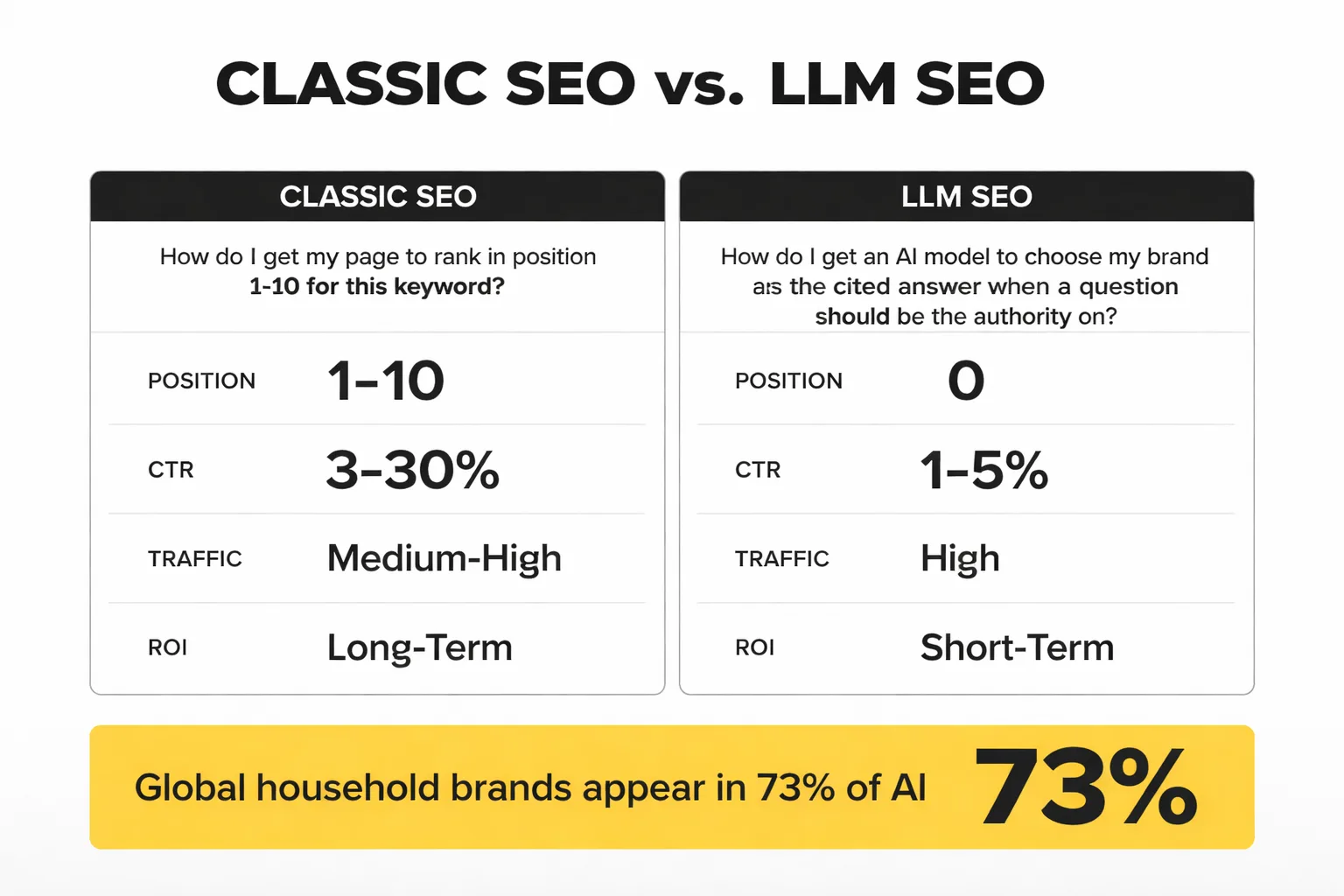
The distinction matters. Classic SEO asks: "How do I get my page to rank in position 1-10 for this keyword?" LLM SEO asks: "How do I get an AI model to choose my brand as the cited answer when a user asks a question I should be the authority on?" These are fundamentally different optimization targets. Ranking in Google's top ten does not guarantee AI citation, and AI citation does not require traditional ranking.
The research backs this up. The arXiv study on Generative Engine Optimization at Scale found that global household brands appear in 73% of AI answers for their branded queries. Mid-market brands show up 44% of the time. Niche and small brands appear in only 11% of relevant AI answers. That 11% number should terrify every small team reading this. If you are niche, you are functionally invisible to AI search unless you actively work on this.
LLM SEO encompasses several sub-disciplines that each target a different layer of the problem. You need content that is structured for extraction (clear answers, factual density, proper formatting). You need entity signals that tell the model who you are (Wikidata, schema markup, consistent NAP across the web). You need citation frequency, meaning other authoritative sources reference your brand. And you need favorable framing, which is the hardest part. A mention is not a win if the AI says "Brand X is a decent starting point, but advanced users should consider Brand Y."
How LLM SEO Differs from GEO and AEO
The terminology landscape is a mess. Every agency and tool vendor coins their own acronym, and the overlap creates genuine confusion. Let me map the three terms you will encounter most.
Generative Engine Optimization (GEO) is the academic term, coined in the Princeton and IIT Delhi research paper that studied how to optimize content for generative engines. GEO focuses on content-level optimizations: adding statistics, using authoritative tone, structuring answers for extraction. The research found that adding statistics to content improves AI visibility by 41%, and entity-rich content improves it by up to 40%. GEO is tactical and content-centric.
Answer Engine Optimization (AEO) is the broader umbrella. It covers optimization for any answer engine, including voice assistants, featured snippets, and AI search. AEO predates the LLM explosion. It is about structuring content to be the selected answer for a direct question. If you want a deeper breakdown of how AEO compares to traditional SEO, I wrote about AEO vs SEO separately.
LLM SEO is the most specific of the three. It targets large language models specifically: ChatGPT, Claude, Gemini, Perplexity, Grok, DeepSeek. It goes beyond content structure (GEO's focus) and beyond answer extraction (AEO's focus) to include entity grounding, knowledge graph presence, cross-web citation patterns, and narrative framing. LLM SEO is where GEO and AEO meet entity optimization and brand reputation management.
Here is the practical distinction. If you add statistics and structure your content with clear Q&A formatting, you are doing GEO. If you optimize for featured snippets and voice search, you are doing AEO. If you are also managing your Wikidata entry, ensuring consistent brand entity definitions across 50+ web sources, tracking how ChatGPT frames your brand vs competitors, and building content specifically designed to be cited by Perplexity, you are doing LLM SEO. The AEO vs GEO comparison dives deeper into those two specifically.
The overlap is real. Most practitioners use the terms interchangeably, and that is fine for conversation. But when you are building an optimization strategy, the distinction matters because each layer requires different work. GEO is content tactics. AEO is structure and formatting. LLM SEO is the full stack: content, structure, entity, reputation, and measurement across every major AI search surface.
The Core Signals LLMs Use to Decide What to Cite
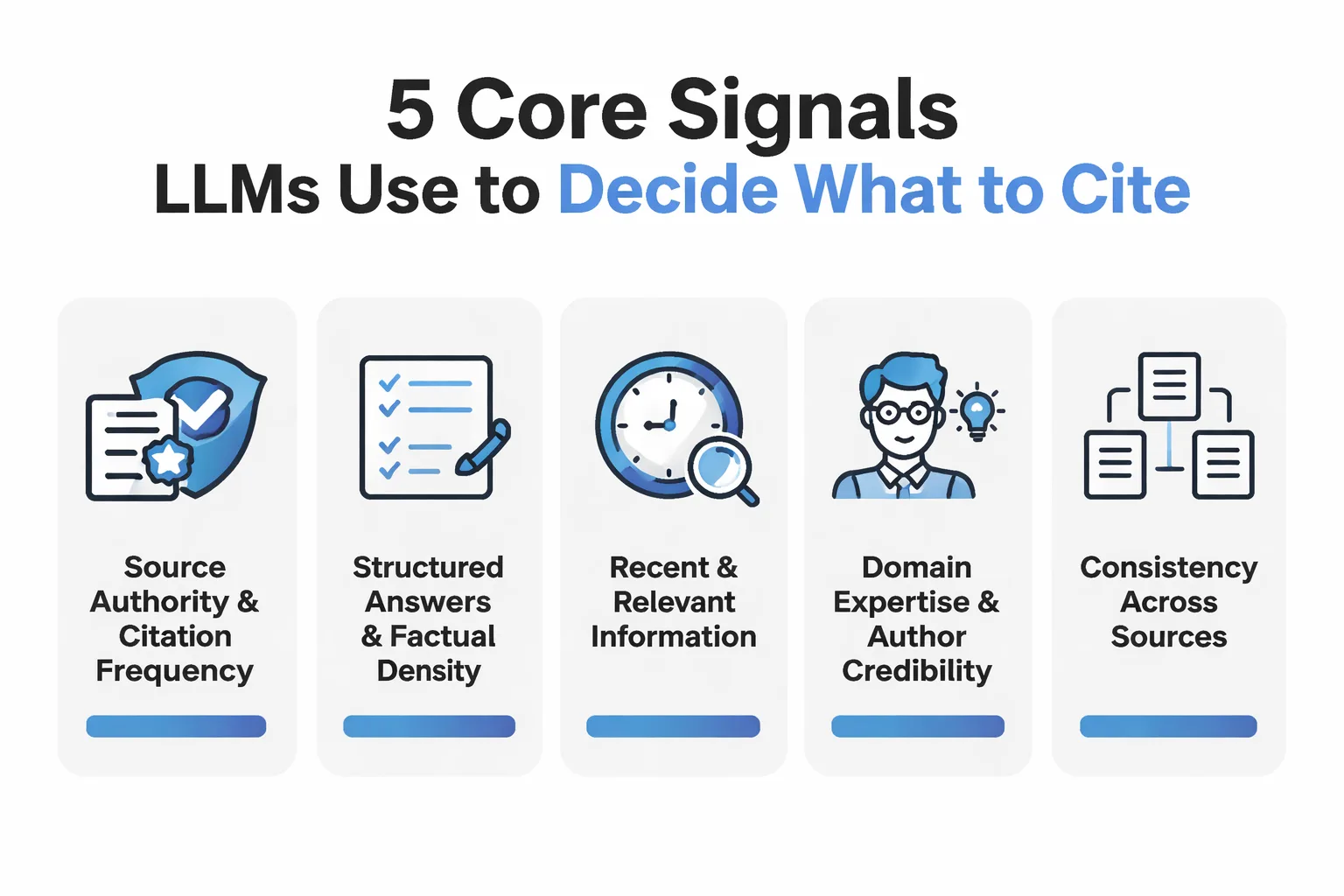
LLMs do not have a public ranking algorithm the way Google does. But through research, testing, and observation, we can identify the signals that consistently influence whether a model cites your brand. Five factors matter most.
Source authority and citation frequency. Models are trained on web content and retrieve from live sources. If authoritative domains cite your brand frequently, the model encounters your name in trusted contexts and is more likely to reproduce it. Neil Patel, in a LinkedIn analysis on AI reputation, argues that "backlinks won't save you" in LLM search. What matters instead is "real names, real case studies, real reviews, original research people actually reference." The models are looking for substantive, cited, authoritative mentions, not link equity.
Structured answers and factual density. The Princeton/IIT Delhi GEO research found that adding statistics to content improves AI citation visibility by 41%. That was the single most effective optimization tested. Content that states facts clearly, includes specific numbers, and answers questions in extractable formats (definitions, comparisons, step-by-step) gets cited more. A glossary entry that defined a term clearly received 107 citations as a top grounding query over 30 days, according to ZipTie.dev's research on original data. One well-structured page outperformed dozens of generic blog posts.
Entity consistency across the web. This is where most teams are asleep at the wheel. LLMs build internal representations of entities (people, companies, products) from the open web. If your brand entity is defined inconsistently (different descriptions on your site, your Crunchbase profile, your Wikidata entry, and industry directories), the model's confidence in citing you drops. Consistent entity definitions across 20+ sources signal reliability. Wikidata is particularly important because it is a structured, machine-readable knowledge graph that models reference directly.
Freshness and recency. Models weight recent information, especially for queries about current tools, trends, or recommendations. A brand that published authoritative content two years ago and went silent will lose citation share to competitors publishing fresh, relevant work. This is not about blog post frequency. It is about maintaining a current, active presence on the topics where you want to be cited.
Favorable framing context. This is the signal most people miss. A brand mention is not inherently positive. If the model's training data or retrieved context frames your brand as a budget option, a beginner tool, or a stepping stone to something better, that framing propagates into answers. I have seen AI answers that mention a brand as "a good starting point before upgrading to [competitor]." That is a citation that actively harms you. Optimizing for favorable framing, not just mention volume, is the real challenge of LLM SEO.
What LLM SEO Looks Like in Practice
Let me make this concrete with a diagnostic comparison I see repeatedly. Two brands in the same SaaS niche. Both have decent websites. Both publish content. One appears in ChatGPT and Perplexity answers consistently. The other is invisible.
The cited brand has a few characteristics that explain its presence. Its website content is structured with clear definitional pages ("What is [topic]?" with a concise answer in the first paragraph). It has a Wikidata entry with accurate, up-to-date entity information. Its brand appears on three or four high-authority industry publications, not in sponsored posts but in genuine expert commentary and original research. Its content includes specific statistics, comparison tables, and factual claims that other sites reference.
The invisible brand has a different profile. Its website is JavaScript-heavy with content that renders client-side, which Chris Long's case study on LinkedIn showed causes failures in ChatGPT's citation retrieval. Its blog posts are 800-word opinion pieces with no statistics, no original data, and no clear extractable answers. It has no Wikidata presence. Its brand mentions across the web are inconsistent: different taglines, different product descriptions, different category labels on different sites.
The gap between these two brands is not about content volume or backlink count. It is about structure, entity presence, and citation context. The cited brand made itself easy to understand and easy to quote. The invisible brand made the model work too hard to figure out what it is and whether it is authoritative.
Here is what the diagnostic looks like in practice. You run a set of 50 prompts related to your industry across ChatGPT, Perplexity, and Claude. You note whether your brand appears, where in the answer it appears (first mention, middle of a list, last), and how it is framed. Then you do the same for your top three competitors. The gap between your citation rate and theirs is your LLM SEO gap. If you want to run this diagnostic yourself, our AI visibility checker automates the prompt audit across every major AI search surface.
The auto parts industry offers a useful data point here. Hedges & Company's AI search optimization case studies tracked auto parts websites that implemented structured content and entity optimization. They saw a 10% increase in engaged sessions per active user, a 15% increase in engagement rate, and a 26% decrease in average engagement time (meaning users found answers faster). Those are real business outcomes from LLM SEO work, not vanity metrics.
How to Start Measuring Your LLM SEO Performance
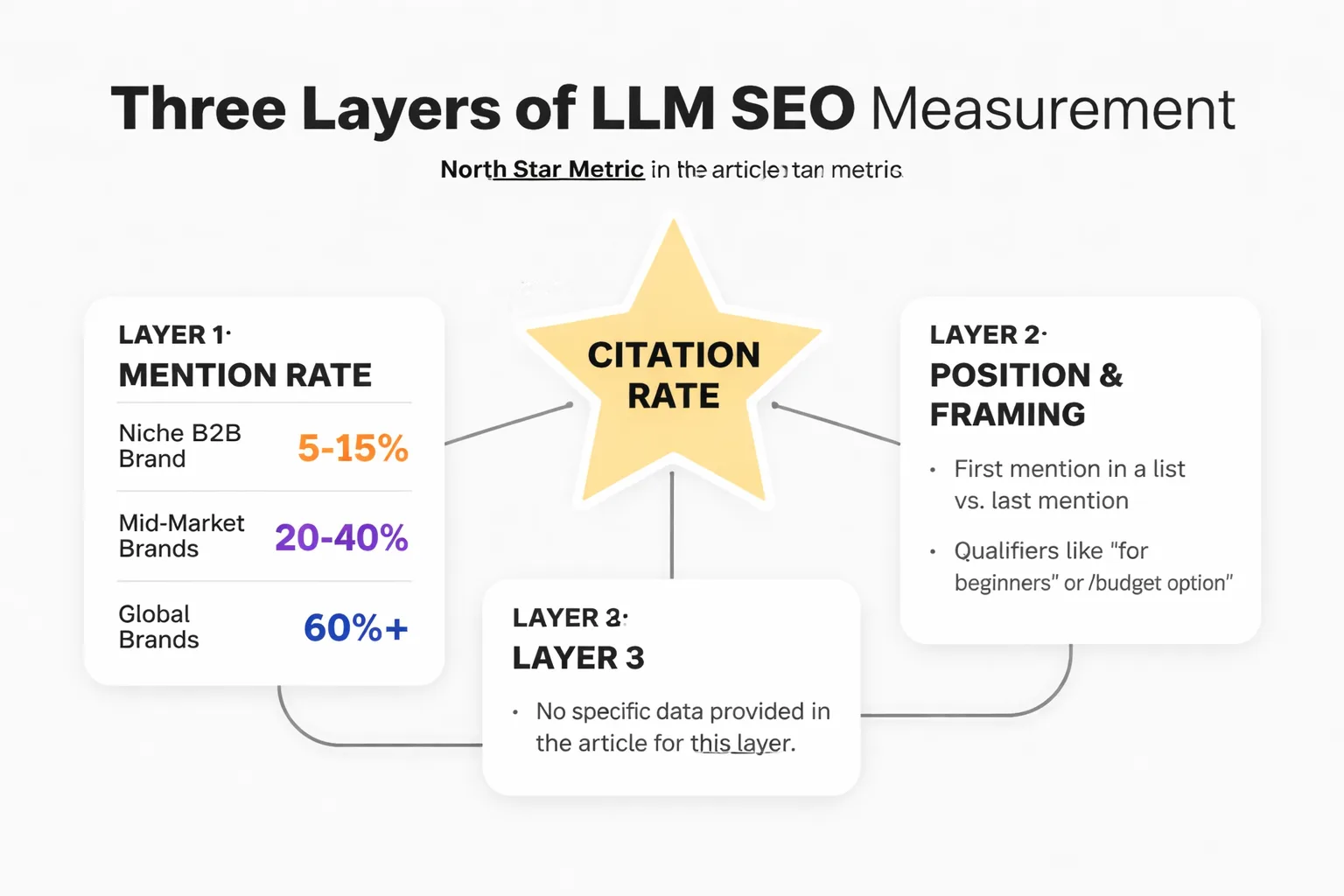
You cannot optimize what you do not measure. The core metric for LLM SEO is citation rate: the percentage of relevant prompts where your brand is mentioned or cited by an AI engine. This is your north star. But citation rate alone is insufficient. You need three layers of measurement.
Layer 1: Mention rate. What percentage of relevant prompts mention your brand at all? This is your baseline visibility. For a niche B2B brand, a starting mention rate of 5-15% is common. For mid-market brands, 20-40%. Global brands sit at 60%+. These benchmarks come from the arXiv visibility study that tracked brand visibility across AI search engines at scale.
Layer 2: Position and framing. Where in the answer does your brand appear, and what words surround it? First mention in a list of recommendations is valuable. Last mention with a qualifier like "for beginners" or "budget option" is damaging. You need to track not just whether you are cited but whether the citation helps or hurts your positioning. This is where most ai search optimization tools fall short. They count mentions. They do not analyze framing.
Layer 3: Share of voice. What percentage of citations in your topic space go to you vs. competitors? If you are cited in 15% of relevant prompts but your top competitor is cited in 45%, you are losing the narrative. Share of voice across AI engines is the competitive metric that matters most for B2B teams.
Running a prompt audit is the starting point. You select 30-50 prompts that represent the questions your buyers ask during research. These are not keyword-stuffed queries. They are natural-language questions: "What is the best tool for [use case]?" "How does [concept] work?" "What are the alternatives to [competitor]?" You run each prompt across ChatGPT, Perplexity, Claude, Gemini, and Google AI Overviews. You record the full response, extract every brand mention, note the position and surrounding context, and repeat weekly to track trends.
This is manual work if you do it by hand. It takes 4-6 hours per audit cycle for 50 prompts across five engines. For small teams, that is a real time commitment. The alternative is using an AI visibility tracker that automates the prompt execution, mention extraction, and trend reporting. Either way, the goal is the same: establish your baseline, identify where competitors are cited and you are not, and prioritize the content and entity gaps that close the distance.
Why Does Entity Grounding Matter for AI Citations?
Entity grounding is the foundation that most LLM SEO guides skip. Here is the short answer: entity grounding is the process of ensuring AI models have a clear, consistent, authoritative understanding of what your brand is, what it does, and why it matters.
When an LLM decides whether to cite your brand, it checks its internal entity representation. If that representation is vague, inconsistent, or incomplete, the model's confidence drops and it cites someone else. Think of it this way. Google ranks pages. LLMs cite entities. If your entity is not well-defined in the model's knowledge, you do not exist as a citation candidate.
The practical work of entity grounding involves several layers. First, your Wikidata entry needs to exist, be accurate, and include structured properties (industry, founded date, key people, official website, product category). Second, your schema markup on your website needs to define your organization entity clearly with Organization schema, sameAs links to your profiles, and consistent NAP information. Third, your brand needs to appear consistently across high-authority third-party sources: Crunchbase, Wikipedia (if notable enough), industry directories, and expert commentary on major publications.
The Frase practitioner guide on entity optimization for GEO emphasizes that entity consistency across sources matters more than raw citation count. Ten consistent mentions across authoritative sources outperform a hundred inconsistent ones. The model needs to see the same entity definition in multiple trusted contexts to build confidence.
When Should You Use AI SEO Agents?
The conversation around AI SEO agents and agentic SEO is where the field gets speculative. Let me separate what is real from what is hype.
AI SEO agents are autonomous or semi-autonomous systems that perform SEO tasks: keyword research, content gap analysis, schema generation, even content drafting. In the LLM SEO context, the vision is an agent that continuously monitors your AI visibility, identifies citation gaps, researches what content would close those gaps, drafts it, and publishes it.
Here is what is real today. Agents can effectively handle topic research, content drafting, schema generation, and basic technical audits. They can monitor prompt results and flag citation changes. They can identify which competitors are cited for which topics and surface content opportunities. This is genuinely useful automation.
Here is what is not real yet. No published case study documents a named brand achieving measurable LLM citation gains through fully autonomous AI SEO agent implementation. I looked. The closest thing is the Hedges & Company auto parts case studies I mentioned earlier, and those involved significant human strategy alongside the tooling. The promise of "set up an agent and watch your citations grow" is marketing, not reality.
My contrarian take: the agency model for LLM SEO is wrong. You should not hire a generative engine optimization agency to do this work for you. The work is too entangled with your brand narrative, your product positioning, and your subject matter expertise to outsource cleanly. What you need is a tool that gives you the data (citation rates, framing analysis, competitor gaps) and the content infrastructure to act on it. The strategy stays in-house. The execution gets automated. That is the model we built at Meev, and it is what I see working for small teams that cannot afford a full content operation.
How Does Platform-Specific Optimization Work?
Each AI search surface has different citation patterns, source preferences, and content formats it favors. A strategy that works on one platform can leave you invisible on another, as GrowthOS noted in their 2026 comparison.
Google AI Overviews pull from top-ranking organic results and prioritize content that already ranks well in traditional search. If you rank in Google's top three for a query, you have a decent shot at appearing in the AI Overview. The Semrush AI search study found that AI Overviews tend to cite domains with high traditional authority. This is where classic SEO and LLM SEO overlap most.
Perplexity functions as a research engine. It cites sources inline with every answer, making it the most transparent platform for understanding why you are or are not cited. Perplexity favors content with clear factual claims, original data, and structured answers. If your content has statistics, comparison tables, and definitive statements, Perplexity is your friend. Our Perplexity AI visibility checker is specifically designed to track this surface.
ChatGPT excels at conversational and creative generation. Its citation behavior is less transparent than Perplexity's. The Chris Long case study demonstrated that JavaScript-heavy sites fail to appear in ChatGPT's citation section even when indexed. ChatGPT favors content that is server-rendered, text-accessible, and entity-consistent. Our ChatGPT AI visibility checker tracks this surface specifically.
Claude and Gemini have their own patterns. Claude tends to be more analytical and favors in-depth, well-sourced content. Gemini integrates with Google's knowledge graph, so entity grounding matters disproportionately there.
The implication is that you need per-platform tracking. A single "AI visibility" number averaged across platforms is misleading. You need to know where you are strong and where you are absent, then prioritize the platform where your buyers actually search. For B2B teams, that is usually Perplexity and ChatGPT. For consumer brands, Google AI Overviews and Gemini matter more.
Do you know which AI engines cite your brand and which ones cite your competitors?
Building Your LLM SEO Content Strategy
Content is the delivery mechanism for every LLM SEO signal. Without the right content, entity grounding has nothing to ground, structured data has nothing to structure, and citation tracking has nothing to track. Your content strategy for LLM SEO should target four content types.
Definitional content. Pages that clearly define concepts, terms, and categories in your space. These are the pages that get cited as grounding queries. The ZipTie.dev research showed one glossary entry receiving 107 citations in 30 days. Definitional content should answer "What is [X]?" in the first paragraph with a clear, quotable sentence. No preamble. No throat-clearing. Just the answer.
Original research and data. Content that presents new statistics, survey results, or proprietary data. The Princeton/IIT Delhi study found that adding statistics improves AI visibility by 41%. Original research is the single most effective content type for earning citations because it gives models something no other source has. If you can produce one original data study per quarter, you will outperform competitors publishing weekly blog posts with no original information.
Comparison and evaluation content. Content that objectively compares tools, approaches, or solutions in your space. AI engines frequently answer "What is the best [X]?" and "How does [A] compare to [B]?" queries. If your comparison content is the most thorough and well-structured, it becomes the cited source. Be honest in comparisons. Models can detect promotional bias, and overly promotional content gets deprioritized.
Case studies and proof content. Real stories with real numbers. Neil Patel's analysis emphasized that models look for "real names, real case studies, real reviews." Case studies with specific metrics, named clients, and verifiable outcomes are citation magnets. They also help with favorable framing because they position your brand as proven rather than theoretical.
The content you produce for LLM SEO should be fact-verified, properly cited, and structured with schema markup. Every claim should trace to a source. Every page should have appropriate schema (Article, FAQ, HowTo depending on content type). And every page should be internally linked with descriptive anchors that reinforce entity relationships. This is where a quality-gated content system becomes valuable. It ensures every piece of content you publish meets the structural and factual standards that LLMs reward, without requiring you to manually check each article against a 16-point checklist.
Adapting Your Team for AI-First Search
Most SEO teams are built for the old world: keyword research, on-page optimization, link building, rank tracking. That skill set does not disappear, but it needs to be extended. Here is how I see teams adapting.
The keyword researcher becomes a prompt researcher. Instead of mapping keywords to pages, they map natural-language questions to content opportunities. The prompt set replaces the keyword list. This is not a small shift. Keywords are short, intent-ambiguous strings. Prompts are full questions with clear intent. The research methodology is different.
The content writer becomes a content architect. Instead of writing for readability and keyword density, they write for extraction. That means leading with the answer, using clear definitional structures, including statistics, and formatting content so that an LLM can pull a clean sentence and cite it. The answer engine optimization framework provides the structure for this shift.
The link builder becomes a citation builder. Instead of acquiring backlinks for authority, they acquire brand mentions on authoritative sources that AI engines cite. This means PR, expert commentary, industry publications, and original research that earns references. The outreach is similar but the target is different: you want mentions and citations, not just links.
The rank tracker becomes an AI visibility tracker. Instead of monitoring Google positions, they monitor citation rates, framing, and share of voice across every major AI search surface. This requires new tooling. Traditional rank trackers do not capture AI citations. You need a dedicated LLM visibility tool that runs prompts across AI engines and tracks mentions over time.
For small teams, this adaptation is actually easier than for large organizations. A three-person team can pivot in a month. A fifty-person SEO department needs six months of change management. If you are small, use that agility. Start tracking AI visibility this week. Run your first prompt audit. Identify your top three citation gaps. Write one piece of content designed to close the biggest gap. Measure the result. Iterate.
The teams that win in AI-first search will not be the ones with the biggest budgets. They will be the ones that moved fastest to understand the new rules and built the muscle to execute against them. The data is clear: AI-sourced visitors convert at roughly 4.4 times the rate of traditional organic traffic. The quality of attention from AI search is higher. The volume is growing. The teams that optimize for it now will build an insurmountable head start.
FAQ
What is the difference between LLM SEO and traditional SEO?
Traditional SEO optimizes for ranking in Google's search results (ten blue links). LLM SEO optimizes for being cited in AI-generated answers across platforms like ChatGPT, Perplexity, and Claude. The key difference: only 12% of LLM citations overlap with top-ten Google rankings, meaning traditional SEO success does not guarantee AI visibility.
How often should I audit my AI visibility?
Weekly is the sweet spot for active optimization. AI models update their responses frequently, and citation patterns shift as new content enters the training and retrieval pipeline. A weekly audit of 30-50 prompts across 5+ AI engines gives you enough trend data to spot changes without overwhelming a small team.
Do I need Wikidata presence for LLM SEO?
Yes, if you are a brand that wants to be cited by AI engines. Wikidata is a structured, machine-readable knowledge graph that LLMs reference directly for entity information. Without a Wikidata entry, your brand entity is defined only by unstructured web content, which reduces model confidence in citing you.
Can I outsource LLM SEO to an agency?
You can outsource execution (content production, technical optimization) but not strategy. LLM SEO is too entangled with your brand narrative and product positioning to hand off entirely. The framing of your AI citations depends on how you describe your own value proposition, which is not something an external agency can own.
What content format gets cited most by AI engines?
Original research with statistics is the single most effective format. The Princeton/IIT Delhi study found that adding statistics improves AI visibility by 41%. Definitional content (glossary entries, "What is" pages) also performs well, with one example receiving 107 citations in 30 days.
How long does it take to see LLM SEO results?
Expect 8-12 weeks to see initial citation changes after implementing entity grounding and structured content. AI models do not update in real time. Your content needs to be crawled, indexed, and factored into retrieval before citation patterns shift. Consistency over months is what moves the needle, not a single push.
About the Author
Judy Zhou, Founder
Judy Zhou leads content strategy at Meev, where she oversees AI-driven content research and publishing for hundreds of brands. With a background in SEO and editorial operations, she focuses on building content systems that rank on Google, get cited by AI search engines, and drive measurable business results.
Stop guessing whether AI engines mention you. Run your first AI visibility audit today and see exactly where you stand.