
By Judy Zhou, Founder
Key Takeaways
- 65% of pages cited by Google AI Mode and 71% cited by ChatGPT include structured data, turning product schema into required infrastructure for AI visibility.
- Gartner estimates 20% of online shopping transactions will flow through AI platforms by 2030 while AI search traffic hits 40% of total search by 2027.
- Adding schema markup alone does not drive AI citations, as Ahrefs found minimal movement across 1,885 pages that implemented it.
- Product schema must make items machine-readable entities that AI engines can verify, cite, and recommend rather than just chasing rich results.
In 2011, Google, Bing, and Yahoo jointly launched Schema.org. A quiet, technical handshake between search engines and webmasters that most merchants ignored for the better part of a decade. Back then, product markup was a nice-to-have that might earn you a star rating in the SERPs. Thirteen years later, that same foundational standard has become the load-bearing infrastructure of AI-powered commerce. The large language models driving answer engines, shopping agents, and generative search results were trained on structured data, and they still prefer to cite it. History, it turns out, rewards the merchants who read the footnotes.
Product schema for AI search is not about rich results anymore. It is about making your products machine-readable entities that AI engines can verify, cite, and recommend with confidence. The data backs this up: 65% of pages cited by Google AI Mode include structured data, and 71% of pages cited by ChatGPT include structured data. Meanwhile, Gartner estimates 20% of online shopping transactions will flow through AI platforms by 2030, and AI search traffic is projected to hit 40% of total search traffic by 2027. If your product data is not structured, you are invisible to the fastest-growing commerce channel since mobile.
But here is the contrarian truth that most guides will not tell you: adding schema markup alone will not causally drive AI citations. Ahrefs tracked 1,885 pages that added schema markup and found AI citations barely moved. The pages that get cited have schema, yes, but that correlation reflects better-maintained sites, stronger content, and deeper authority. Schema is necessary but not sufficient. The merchants who win treat it as one layer in an entity grounding strategy, not a checkbox.
In my work leading content strategy at Meev, I have audited the AI visibility of hundreds of brands. The pattern is consistent. Brands that structure their product data, ground it in external knowledge sources, and track their citation footprint across AI engines are the ones showing up in ChatGPT product recommendations and Perplexity shopping answers. Everyone else is hoping. Hope is not a strategy.
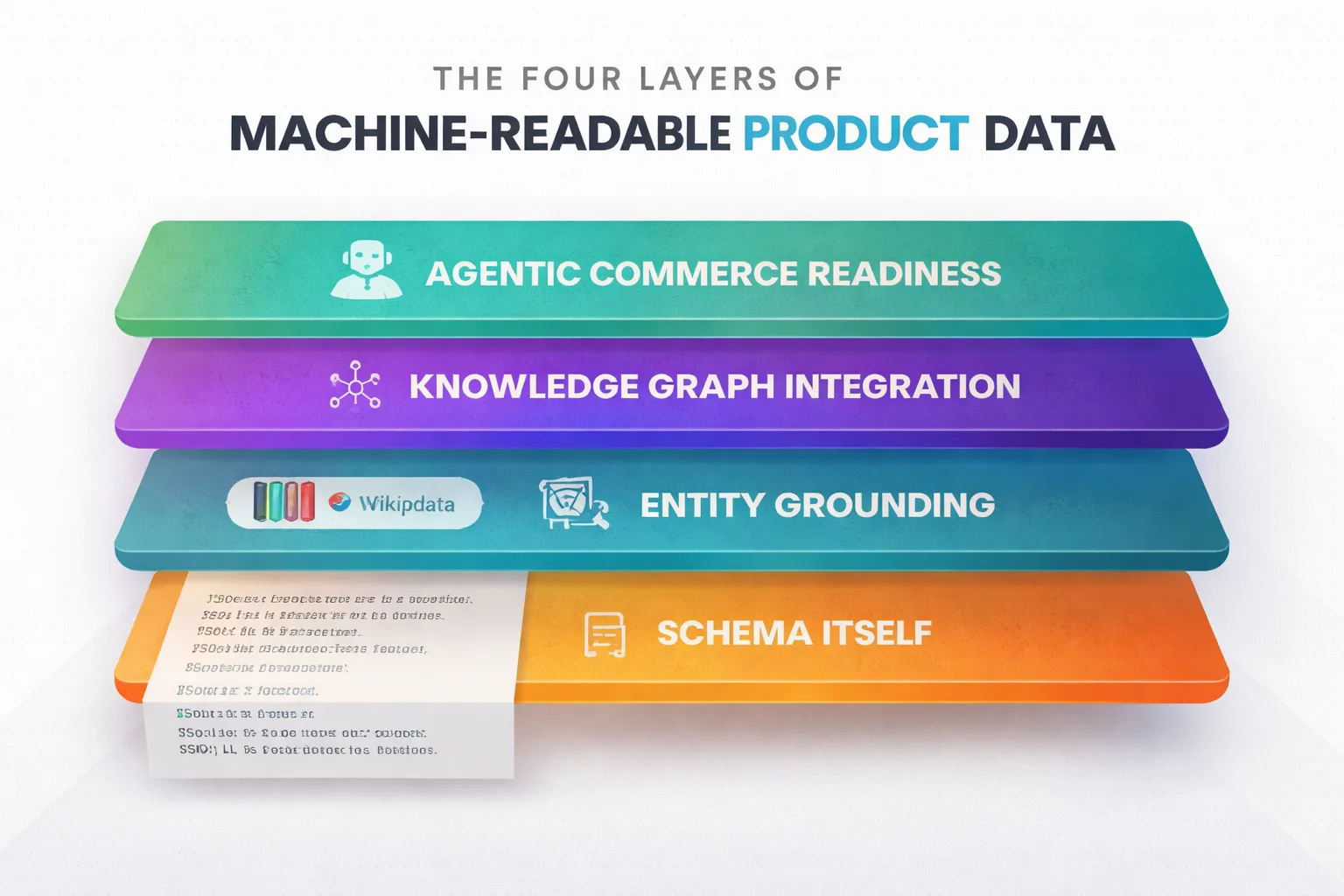
What are the four layers of machine-readable data?
Product structured data is not a single thing you plug in. It is a stack of four distinct layers, each serving a different consumer of your data. Understand the stack before you touch a line of JSON-LD.
The first layer is the schema itself. This is your JSON-LD markup on product pages, category pages, and review pages. It tells crawlers what your product is, what it costs, and whether it is in stock. Google Search Central's ecommerce structured data guide is the canonical reference. This layer is your foundation.
The second layer is entity grounding. This is where most merchants stop and where the real AI visibility gap opens. Entity grounding means connecting your product and brand to external knowledge sources: Wikidata, Wikipedia, manufacturer databases, and authoritative third-party content. Sharon Otieno's research on entity grounding in AI search frames this shift from "ranking pages" to "educating machines" through entity-rich architecture. LLMs evaluate entity authority across third-party sources. If your brand exists only on your own website, you have low entity authority in the eyes of an AI model.
The third layer is the content layer. Schema tells machines what your product is. Content tells them why it matters. Product descriptions, comparison guides, FAQ sections, and buying guides give AI engines the contextual text they need to cite you in answer to a question. FAQ schema in particular has one of the highest AI citation rates among structured data types, with FAQPage content appearing in ChatGPT, Perplexity, and Google AI Overviews significantly more than unstructured content. This is true even though Google restricted FAQ rich results in traditional search back in August 2023. The divergence between traditional search visibility and AI engine visibility is real, and it favors merchants who optimize for both.
The fourth layer is monitoring. You cannot improve what you do not measure. Tracking your brand's presence across AI search surfaces tells you whether your schema and content investments are translating into actual citations. This is where tools like an AI visibility tracker become essential, because the citation landscape shifts weekly.
How Does Product Schema Work for AI Engines?
Product schema works for AI engines by converting unstructured HTML into structured key-value pairs that language models can parse, verify, and retrieve with high confidence during generation. When a user asks ChatGPT or Perplexity for a product recommendation, the AI engine retrieves information from its training data and live search results. Structured data makes retrieval more accurate because the machine does not have to guess which HTML element is the price or the availability status. It reads the schema directly.
The mechanics matter. When ChatGPT processes 2 billion queries daily, it needs to extract product attributes fast. Schema markup gives it a clean parsing path. Instead of running a heuristic over your DOM to figure out whether "$49.99" is the price or the shipping cost, the engine reads "price": "49.99" from your JSON-LD and moves on. This reduces extraction errors and increases the probability that your product data appears accurately in the generated answer.
But here is the nuance that most guides miss. Kurt Fischman's empirical study of 730 AI citations across 1,006 pages found that generic schema markup (Article, Organization, BreadcrumbList) showed zero independent effect on LLM citation rates (p = .296). The schema types that moved the needle were product-specific schema with entity grounding. Position in organic search was the dominant predictor, with each position reducing citation odds by approximately 24%. Position 1 pages were cited 43% of the time. Position 7 pages were cited 5% of the time.
The practical takeaway: product schema with entity grounding at position 1 gives you a 43% citation probability. Generic schema at position 7 gives you 5%. Schema without ranking is a tree falling in an empty forest.
What properties matter most for AI?
Not all schema properties are created equal. Some are table stakes. Some move the needle on AI citations specifically. Here is my breakdown based on what I see working.
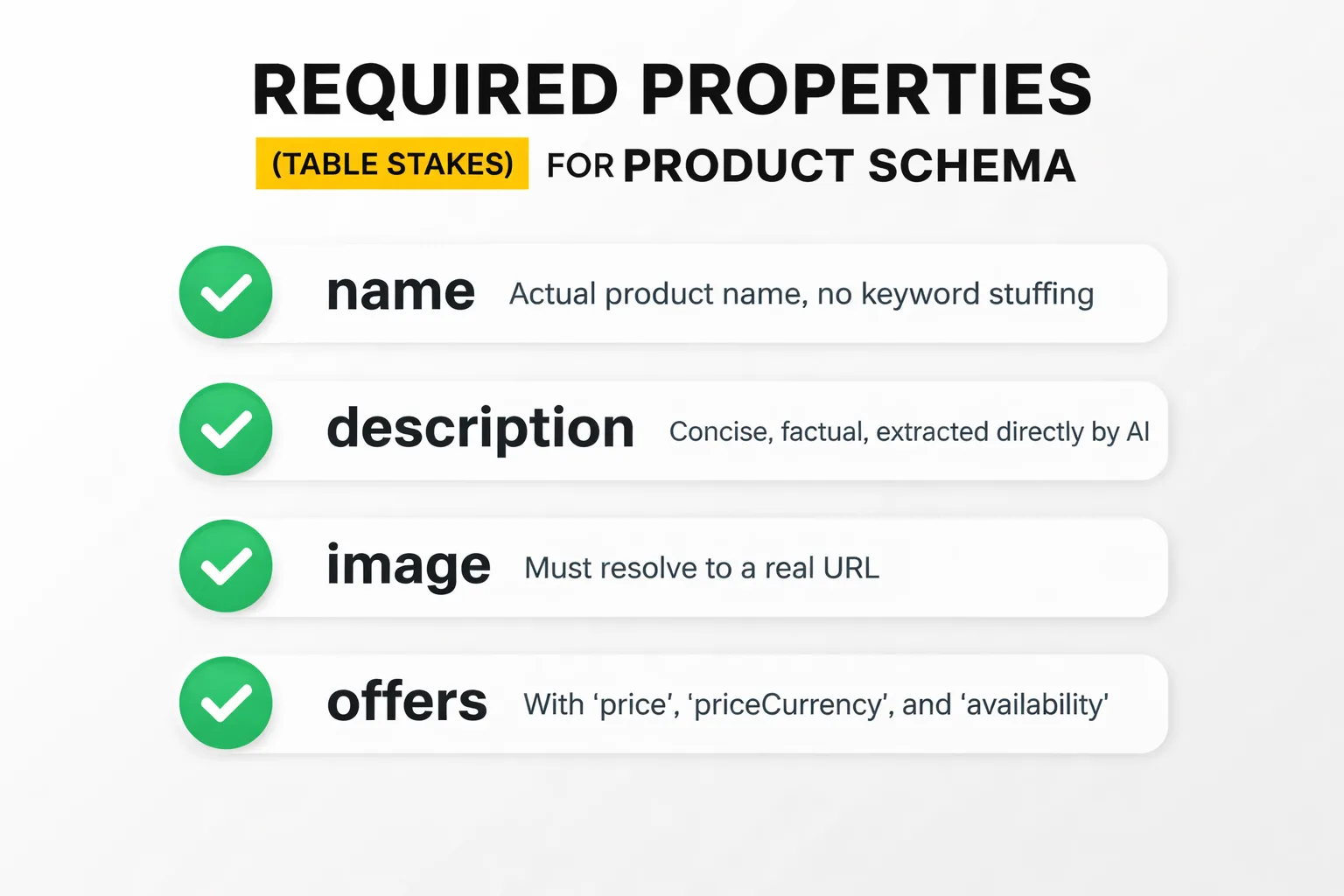
Required Properties (Table Stakes)
These are the properties that Google's Product structured data documentation requires for eligibility in search features. Without them, you are not even in the game.
name is obvious but frequently botched. Merchants stuff keywords into product names, which hurts readability for both humans and machines. Use the actual product name as a human would say it. description should be concise and factual. AI engines extract this field directly into answer snippets, so vague marketing copy gets ignored. image must resolve to a real URL. Broken image URLs in schema are one of the most common errors I encounter. offers with price, priceCurrency, and availability are non-negotiable for commerce.
AI-Specific Properties (The Edge)
These properties do not affect traditional search rankings much, but they materially improve how AI engines understand and cite your products.
brand is critical for entity grounding. It connects your product to a brand entity. If your brand has a Wikidata entry, the brand property helps AI engines link your product to that entity. gtin13 or gtin8 (Global Trade Item Number) is how AI engines verify that your product is a real, identifiable good. Products with GTINs are more likely to be cited because the AI can cross-reference them against manufacturer databases. mpn (Manufacturer Part Number) serves a similar verification function. aggregateRating with ratingValue and reviewCount gives AI engines social proof data they can cite in recommendations. review properties with individual review text give AI engines quotable content.
The Property Most Merchants Miss
additionalType is a property almost nobody uses, and it is gold for AI visibility. It lets you specify additional types for your product beyond the standard Product type. You can link to a category URL or a Wikidata entity that describes the product type. This gives AI engines a richer understanding of what your product is and where it fits in the product taxonomy.
Why Does Entity Grounding Outperform Schema Alone?
Entity grounding outperforms schema alone because AI engines do not trust single-source data. They verify product and brand information against multiple independent sources before citing it. Schema on your site is a claim. Entity grounding across Wikidata, manufacturer databases, and authoritative third-party content is verification. AI engines cite verified claims, not unverified ones.
Think of it this way. Schema is you telling the AI, "This is my product, it costs $49.99, and it is the best widget on the market." Entity grounding is the AI checking Wikidata, finding your brand entity, cross-referencing your GTIN against a manufacturer database, reading a review on a third-party site, and then deciding your claim is credible enough to include in an answer.
The Fischman study confirms this empirically. Product schema with Wikidata grounding showed a statistically significant positive effect on LLM citation rates. Generic schema without entity grounding showed zero effect. The difference is not marginal. It is the difference between being cited and being invisible.
In my own experience tracking AI visibility, I have seen brands with immaculate on-page schema get zero AI citations because they have no external entity presence. I have also seen brands with mediocre schema but strong Wikidata entries, Wikipedia pages, and third-party review coverage get cited regularly. The lesson: invest in entity grounding before you invest in schema perfection.
For merchants serious about this, the workflow is: claim or create your brand's Wikidata entry, ensure your GTINs are registered in manufacturer databases, pursue reviews on third-party platforms that AI engines crawl, and build a comprehensive signal graph across owned content, structured data, and distributed reviews.
Are your products showing up in AI search answers, or are competitors getting cited instead?
Implementation: JSON-LD, Testing, and Validation
Let us get practical. Here is how to implement product schema that actually works for AI search, not just for Google's rich results validator.
JSON-LD Is the Only Format That Matters
Use JSON-LD. Not Microdata. Not RDFa. JSON-LD is what AI engines parse most reliably because it is a clean JavaScript object embedded in a script tag. It does not interleave with your HTML, so extraction errors are rare. Google's own documentation recommends JSON-LD, and every AI citation study I have read shows JSON-LD as the dominant format on cited pages.
A basic product schema block looks like this:
{ "@context": "https://schema.org/", "@type": "Product", "name": "Acme Wireless Headphones Pro", "description": "Over-ear wireless headphones with active noise cancellation and 40-hour battery life.", "image": "https://example.com/images/headphones-pro.jpg", "brand": { "@type": "Brand", "name": "Acme" }, "gtin13": "0123456789012", "mpn": "ACME-HP-PRO", "offers": { "@type": "Offer", "price": "249.99", "priceCurrency": "USD", "availability": "https://schema.org/InStock" }, "aggregateRating": { "@type": "AggregateRating", "ratingValue": "4.6", "reviewCount": "847" } }
Testing Your Schema
Google's Rich Results Test validates schema for Google Search eligibility. Use it. But do not stop there. Google's validator tells you if your schema is syntactically correct and eligible for rich results. It does not tell you if AI engines can parse it.
For AI-specific validation, I recommend manually testing your product pages by asking ChatGPT and Perplexity about your products. If you sell "Acme Wireless Headphones Pro," ask ChatGPT: "What are the best wireless headphones under $300?" and see if your product appears. Ask Perplexity: "Tell me about Acme Wireless Headphones Pro." The results will tell you more about your AI visibility than any validator.
For systematic tracking, an AI visibility tool can monitor your brand's presence across all major AI search surfaces daily, showing you exactly where you are cited, where you are absent, and which sources those citations come from.
Common Implementation Errors
The most common error I see is merchants putting product schema on category pages. Google's guidance on this is nuanced: product schema should go on individual product pages. Category pages should use ItemList schema, not Product schema. Mixing them up confuses AI engines about what entity the page represents.
The second most common error is stale availability data. If your schema says InStock but the product is backordered, AI engines will cite incorrect information. When users click through and find the product unavailable, trust erodes. Automate availability updates in your schema.
The third error is missing priceCurrency. I see this constantly with international merchants. A price of "249.99" without a currency is meaningless to an AI engine trying to compare products across regions.
How Do You Track AI Visibility for Products?
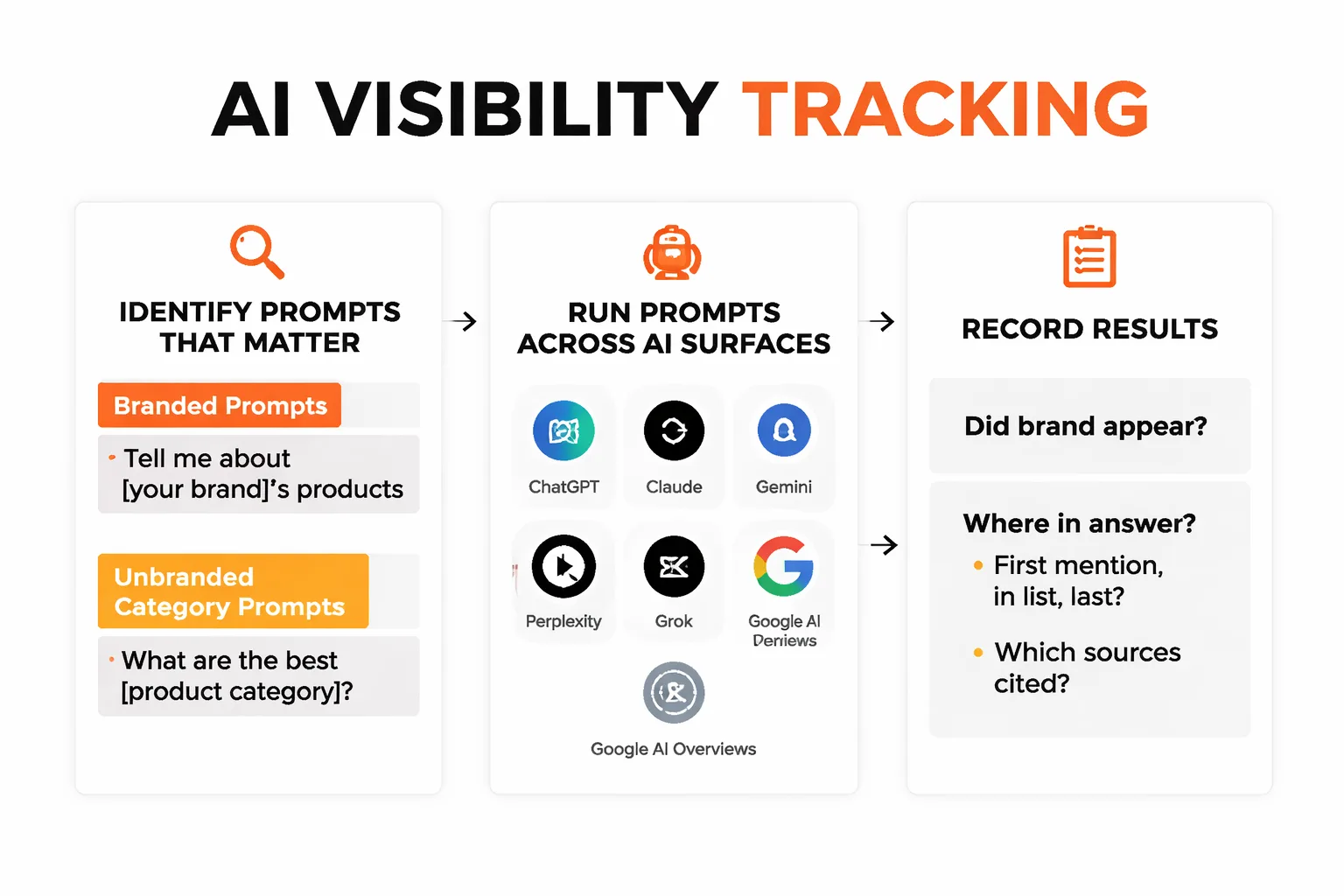
You track AI visibility for products by monitoring branded and unbranded prompts across every major AI search surface, recording where your products appear in the generated answers, and mapping which sources those citations come from. This is not something you can do manually at scale. You need a system.
The tracking workflow has three components. First, identify the prompts that matter. These include branded prompts ("Tell me about [your brand]'s products") and unbranded category prompts ("What are the best [product category]?"). Second, run those prompts across ChatGPT, Claude, Gemini, Perplexity, Grok, Google AI Overviews, and AI Mode. Third, record whether your brand appears, where in the answer it appears (first mention, in a list, last), and which sources the AI engine cites.
AI-referred sessions jumped 527% between January and May 2025. That growth means AI visibility is no longer a nice-to-have metric. It is a channel that drives measurable traffic and revenue.
In my work at Meev, I have seen merchants discover through AI visibility tracking that their products are cited in Perplexity but completely absent from ChatGPT. That gap is actionable. It tells you which engine's training data or retrieval pipeline you need to influence. Maybe you need more content on sites that ChatGPT crawls. Maybe your Perplexity presence comes from a single high-authority review site, and you need to diversify. Without tracking, you are flying blind.
A dedicated LLM visibility tool automates this process, running your target prompts across all major AI engines on a regular cadence and showing you trend data over time. The trend data matters because AI citations are not stable. A product that appears in ChatGPT's answers this week may disappear next week if the model's retrieval results shift.
Product Schema for Different Product Types
Not all products are equal in the eyes of AI engines. The schema strategy that works for physical goods will not work for digital products, services, or subscriptions. Here is how to adapt.
Physical Products
Physical products are the easiest case. The standard Product schema with offers, gtin, brand, and aggregateRating covers most scenarios. The key for AI search is making sure your GTINs are real and registered. AI engines cross-reference GTINs against manufacturer databases. Fake or unregistered GTINs reduce citation probability.
Digital Products
Digital products (software, ebooks, courses) need Product schema with offers but typically do not have GTINs. Use mpn instead. Set availability to https://schema.org/InStock since digital products do not run out of stock. Include additionalType linking to a Wikidata entity for the product category (e.g., https://www.wikidata.org/wiki/Q7397 for software). This helps AI engines understand what type of digital product you sell.
Services and Subscriptions
Services are trickier. Schema.org has a Service type, but AI engines seem to prefer Product schema for citation purposes. If you are selling a subscription service, model it as a Product with offers that include priceSpecification for recurring billing. Include category to specify the service type. The goal is to give AI engines enough structured data to understand what you sell without forcing them to interpret a Service type they may not handle well.
Integrating Schema with Knowledge Graph Initiatives
Schema on your site is step one. The bigger play is integrating your schema with external knowledge graph initiatives. This is where entity grounding becomes a system, not a tactic.
Wikidata
Claim or create your brand's Wikidata entry. This is the single highest-leverage action you can take for AI visibility. Wikidata is the structured data backbone of Wikipedia, and it is a primary source for LLM training and retrieval. If your brand is not in Wikidata, you are missing the easiest entity grounding opportunity available.
To get started, search for your brand on Wikidata. If an entry exists, verify the information is correct and add missing properties (official website, logo, GTINs if applicable). If no entry exists, create one with citations to reliable sources (news articles, press releases, official company pages). The bar for notability is lower than Wikipedia's, but you still need verifiable sources.
Google's Knowledge Graph
Google's Knowledge Graph pulls from multiple sources, including Wikidata, Wikipedia, and structured data across the web. You cannot directly edit it, but you can influence it by maintaining consistent NAP (Name, Address, Phone) information, having a Wikipedia page (even a stub helps), and ensuring your schema markup uses consistent brand naming.
Third-Party Review Platforms
Review platforms like Trustpilot, G2, and industry-specific review sites are critical for AI visibility. Research shows that 84% to 89% of AI-generated answers come from earned media, meaning third-party coverage in credible publications. Reviews on these platforms serve a dual purpose: they provide aggregateRating data for your schema, and they give AI engines independent verification of your product quality.
For a holistic approach to AI search optimization, consider how answer engine optimization ties together schema, content, and external entity signals into a single strategy.
When This Fails: Where Schema Does Not Move the Needle
I need to be honest with you about the limits of schema markup. Not every merchant who implements product schema will see AI citations increase. Here are the specific scenarios where it fails.
Scenario 1: Low domain authority. If your site has minimal backlinks and thin content, schema will not save you. The Fischman study showed that organic rank position is the dominant predictor of AI citation. Each position reduces citation odds by 24%. If you are ranking on page 3, your schema is invisible to AI engines because they never retrieve your page in the first place. Fix your rankings before you fix your schema.
Scenario 2: No external entity presence. I have seen merchants with perfect JSON-LD, valid GTINs, and complete aggregateRating data get zero AI citations because their brand does not exist outside their own website. No Wikidata entry. No Wikipedia page. No third-party reviews. No press coverage. AI engines do not cite unverified entities. Schema is a claim. External presence is verification. Without verification, your claims are ignored.
Scenario 3: Niche products with low search volume. If nobody is asking AI engines about your product category, your schema will not generate citations because there are no prompts to trigger retrieval. This is not a schema problem. It is a demand problem. You need to build category awareness through content and earned media before AI citations follow.
The hard truth is that schema markup is infrastructure, not marketing. It makes your product data parseable. It does not make your product desirable. If your product is not being talked about, reviewed, and referenced across the web, no amount of structured data will make AI engines recommend it.
Future-Proofing Your Schema for Agentic Commerce
Agentic commerce is the next phase, and it is arriving faster than most merchants realize. Gartner estimates 20% of online shopping transactions will flow through AI platforms by 2030. When AI agents start making purchases on behalf of users, your schema is what they will read to evaluate your product.
Google AI Overviews now appear on 14% of shopping queries, a 5.6x increase in 4 months. That growth curve is not slowing down. Here is how to future-proof your schema for what is coming.
Add merchant Properties
Schema.org has merchant properties under Offer that most merchants ignore. seller, eligibleCustomerType, and eligibleTransactionVolume give AI agents context about who can buy and under what conditions. As agentic commerce matures, these properties will help AI agents determine whether your product is available to their user.
Use hasMerchantReturnPolicy
Return policy data is critical for agentic commerce. AI agents need to know return terms before recommending or purchasing a product. The hasMerchantReturnPolicy property lets you specify return window, return method, and return fees. Merchants who implement this now will have a structural advantage when agentic commerce scales.
Implement shippingDetails
The shippingDetails property lets you specify shipping rate, shipping destination, and handling time. AI agents comparing products across merchants will use this data to factor in total cost (price plus shipping). If your competitors have shippingDetails and you do not, AI agents will prefer them because they can calculate total cost for the user.
Monitor Emerging Properties
Schema.org evolves. New properties are added regularly. The best way to stay current is to monitor the Schema.org Product type documentation and Google's Search Central blog. Properties related to sustainability (hasEnergyConsumptionDetails), accessibility (isAccessibleForFree), and certifications are gaining traction as AI engines factor more attributes into recommendations.
For merchants who want to track how these emerging properties affect their AI visibility, an enterprise AI rank tracker can correlate schema changes with citation changes over time, giving you data on what works for your specific products.
The Measurement Layer: Knowing Your Schema Works
This is the part that separates merchants who speculate from merchants who know. You can implement every schema property I have described, ground your entities in Wikidata, and publish FAQ content until your fingers bleed. If you are not measuring whether any of it moves the needle on AI citations, you are doing faith-based SEO.
The measurement layer has three pieces.
First, baseline your current AI visibility. Before you change anything, record where your brand and products appear across AI search surfaces today. Which engines cite you? Which prompts trigger citations? Which sources do those citations come from? This baseline is your control group.
Second, implement your schema changes in batches. Change one thing at a time. Add GTINs first. Measure for two weeks. Then add aggregateRating. Measure for two weeks. Then add FAQ schema to your product pages. Measure for two weeks. This is slow, but it is the only way to attribute citation changes to specific schema changes.
Third, track the source of every citation. When ChatGPT cites your product, what source does it link to? Is it your product page? A third-party review? A Reddit thread? Understanding citation sources tells you where to invest next. If most of your citations come from a single third-party review site, you need to diversify. If your product page is never the source, your schema may not be parseable enough.
In my experience, merchants who measure see results. Merchants who do not measure are still adding schema properties and wondering why nothing changed. The difference is not effort. It is feedback loops. If you want to understand how AEO differs from SEO in terms of measurement, the key distinction is that AEO requires tracking citation presence and source attribution, not just rankings.
For ongoing monitoring, I recommend using a ChatGPT AI visibility checker alongside a Perplexity AI visibility checker to cover the two engines that drive the most AI-referred traffic. Combined with broader tracking across all major AI surfaces, you get a complete picture of your schema's impact.
What This Actually Means for Merchants
Product schema for AI search is not a project you finish. It is a discipline you maintain. The merchants who win in 2026 and beyond are the ones who treat structured data as living infrastructure, not a one-time implementation.
The data is clear. 71% of ChatGPT-cited pages and 65% of Google AI Mode-cited pages include structured data. But Ahrefs' tracking of 1,885 pages showed that adding schema alone does not causally drive citations. The gap between those two statistics is where the real work lives. Schema is correlated with citations because well-maintained, authoritative sites tend to have schema. But schema does not cause citations. Entity grounding, organic ranking strength, and external authority cause citations. Schema makes them possible.
Here is my honest assessment after auditing AI visibility for hundreds of brands. The merchants who succeed do four things: they implement clean, complete product schema with GTINs and brand entities. They ground those entities in Wikidata and third-party sources. They publish FAQ and product content that AI engines can quote. And they track their citation presence across every major AI surface, adjusting their strategy based on what the data tells them.
The merchants who fail do one thing: they add schema and wait.
Do not wait. Measure, iterate, and build the entity presence that makes your products unignorable to AI engines. The infrastructure you build today will compound as agentic commerce scales. The merchants who start now will have a multi-year head start on those who treat AI search as a future problem.
FAQ
Does product schema directly cause AI citations?
No. Ahrefs tracked 1,885 pages that added schema markup and found AI citations barely moved. Schema is correlated with citations because well-maintained sites tend to have it, but it does not causally drive them. What drives citations is a combination of organic ranking strength, entity grounding, external authority, and content that AI engines can quote. Schema is necessary infrastructure that makes citation possible, not a lever that creates it.
Should I use FAQ schema if Google deprecated FAQ rich results?
Yes. Google restricted FAQ rich results in traditional search in August 2023, but AI search platforms (ChatGPT, Perplexity, Google AI Overviews) actively use FAQ schema to extract and cite information. FAQPage schema has one of the highest AI citation rates among structured data types. The divergence between traditional search and AI search means you need to optimize for both, and FAQ schema is one of the highest-ROI schema types for AI visibility.
How long does it take for product schema to affect AI visibility?
There is no fixed timeline. AI engines do not crawl and index schema in real time the way Google does. Based on my observations, schema changes typically take 2-6 weeks to surface in AI citations, and only if the underlying page is already being retrieved by the AI engine. If your page is not ranking organically, schema changes will not produce citations regardless of how long you wait.
What is the single most important schema property for AI search?
brand with entity grounding is the most important. It connects your product to a brand entity that AI engines can verify across external sources. Without brand, your product exists in isolation. With it, AI engines can link your product to your Wikidata entry, your Wikipedia page, and third-party coverage. This verification chain is what makes citation possible.
Can I put product schema on category pages?
No. Product schema should go on individual product pages. Category pages should use ItemList schema that references individual Product entities. Putting Product schema on a category page confuses AI engines about what entity the page represents, which can reduce citation accuracy for your individual products.
How do I know if my product schema is working for AI search?
Track your brand's citation presence across AI search surfaces before and after implementing schema changes. Use an AI visibility tracking tool to monitor branded and unbranded prompts across ChatGPT, Perplexity, Google AI Overviews, and other engines. If your citation rate increases after schema implementation, it is working. If it does not, the issue is likely not your schema but your organic ranking, entity grounding, or content depth.
About the Author
Judy Zhou, Founder
Judy Zhou leads content strategy at Meev, where she oversees AI-driven content research and publishing for hundreds of brands. With a background in SEO and editorial operations, she focuses on building content systems that rank on Google, get cited by AI search engines, and drive measurable business results.
Stop guessing about your AI visibility. See exactly where your brand is cited across every major AI search surface and close the gaps that matter.