
By Judy Zhou, Founder
Key Takeaways
- 42% of CRM software buyers now use AI search as part of their evaluation process, so teams must map queries to entity resolution and knowledge graph retrieval instead of keyword buckets.
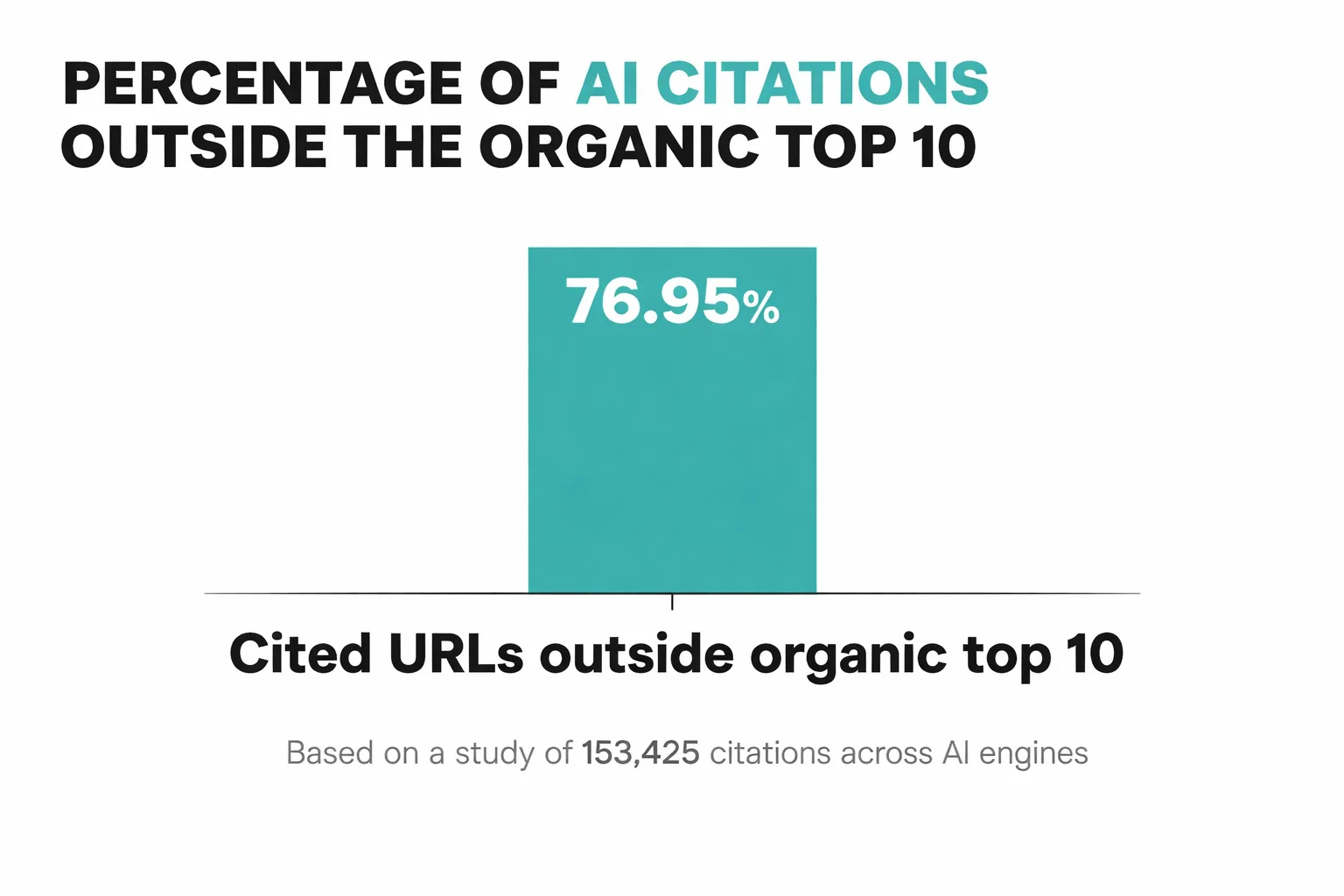
- 76.95% of URLs cited by AI engines fall outside the organic top 10, showing that classic ranking and AI citation follow entirely different rules.
- Wikipedia accounts for 12-13% of ChatGPT citations and 22% of its training data, making entity grounding through knowledge graphs a prerequisite for visibility.
- Treat every search query as a natural-language prompt that triggers inference-layer synthesis rather than document retrieval to capture the traffic traditional SEO frameworks miss.
In 1998, the search query was a blunt instrument. You typed words into AltaVista or the early Google, and the engine matched those words against a document index. The analysis required of SEOs was similarly blunt: find the words people type, put those words on your page. Twenty-six years later, the search query has become the entry point into a layered inference stack. Triggering knowledge graph lookups, entity resolution, generative answer synthesis, and agentic task execution. And the analytical frameworks most teams use have not kept pace with any of it.
A search query in 2026 is no longer a keyword string to match; it is a natural-language prompt that triggers entity resolution, knowledge graph retrieval, and generative synthesis across every major AI search surface. Teams that still analyze queries as keyword buckets are optimizing for a retrieval system that has already been replaced by an inference layer. The data is stark: 42% of CRM software buyers now use AI search as part of their evaluation process, meaning traditional query-to-keyword mapping misses nearly half of high-intent commercial traffic. 76.95% of URLs cited by AI engines fall outside the organic top 10, proving that classic ranking and AI citation are governed by entirely different rules. Meanwhile, Wikipedia accounts for 12-13% of ChatGPT citations and 22% of its training data, making entity grounding through knowledge graphs a prerequisite for visibility. The old playbook is dead. Here is how to analyze a query when the engine synthesizes answers instead of matching keywords.
What Makes a Search Query Different in the AI Era
The fundamental shift is not from keywords to questions. It is from retrieval to inference. When a user types "best CRM for B2B SaaS" into Google, the engine retrieves a ranked list of documents that contain those terms and related variants. When the same user types "which CRM should a 20-person B2B SaaS team use if they need Salesforce integration and custom reporting" into ChatGPT, the engine does not retrieve a document. It resolves the entities (CRM, B2B SaaS, Salesforce), retrieves knowledge about those entities from its training data and live search results, synthesizes a novel answer, and cites the sources that informed that synthesis. The query is longer, the intent is sharper, and the resolution mechanism is entirely different.
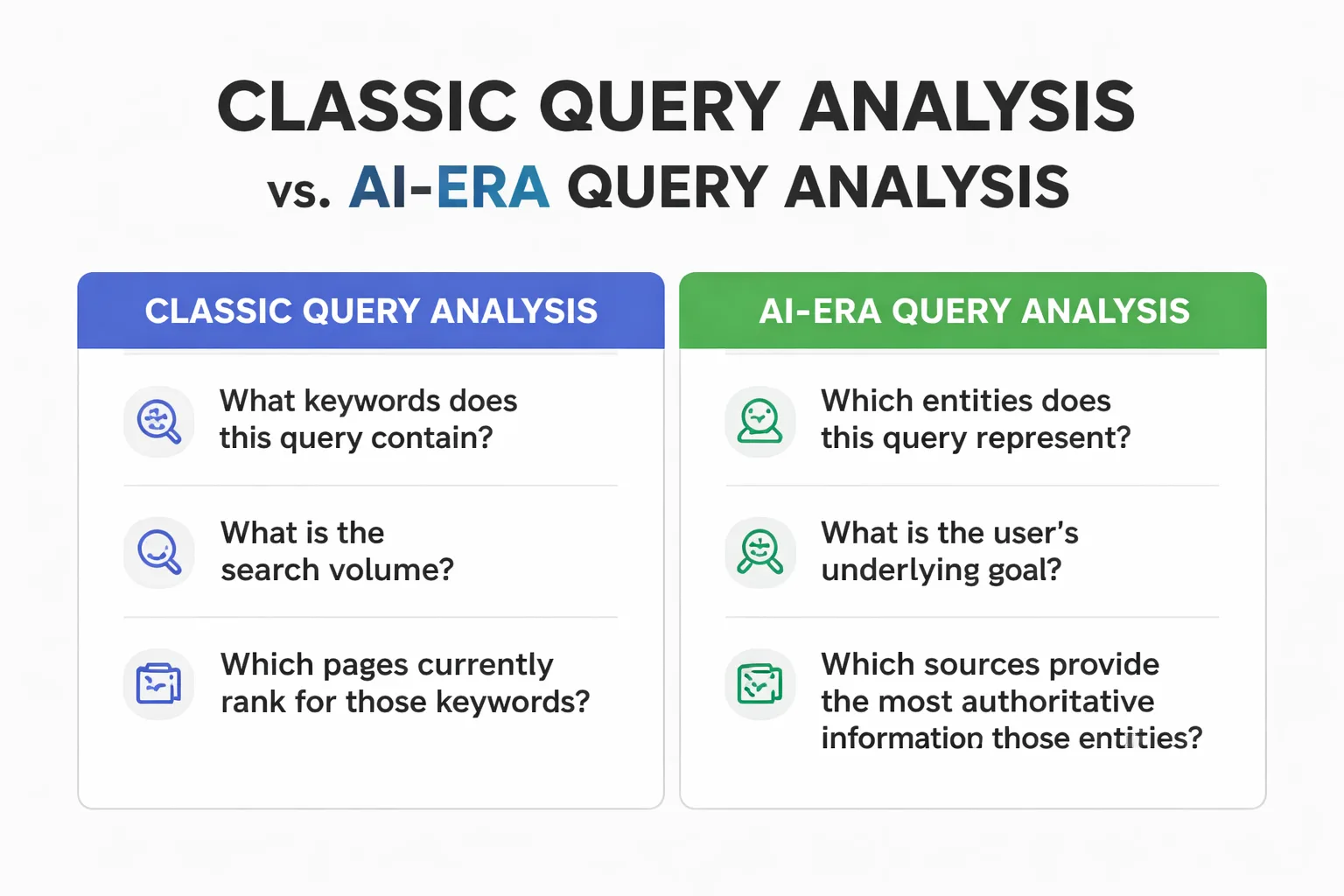
This distinction changes what analysis means. Classic query analysis asks: what keywords does this query contain, what is the search volume, and which pages currently rank for those keywords? AI-era query analysis asks: which entities does this query reference, which sources does the AI engine cite for those entities, and what structured data would make a page eligible for citation? The first question optimizes for ranking. The second optimizes for citation. These are not the same goal, and they require different workflows.
The length difference matters more than people realize. Classic queries average 2-4 words. Conversational AI queries average 8-12 words and often include constraints (price range, team size, integration requirements) that classic keyword tools cannot capture. A keyword tool sees "best CRM" as a 9,900-volume head term. An AI engine sees "best CRM for a 20-person team that needs Salesforce integration" as a specific commercial intent with entity constraints. The volume tool tells you nothing about the conversational variants that actually drive AI citations. This is why ai search optimization requires a fundamentally different keyword research process: you are not looking for volume buckets, you are looking for the natural-language phrasings that trigger synthesis.
The intent layer is also thicker. A classic query has one intent: informational, navigational, or transactional. An AI query often layers intents: "How does HubSpot compare to Salesforce for a team of 15, and what is the implementation cost?" That is informational (comparison), commercial (pricing), and transactional (evaluation) in a single prompt. Classic SEO would pick one intent and optimize a page for it. AI search optimization requires answering all three layers in a single, well-structured response. The engine will synthesize an answer that touches all three, and it will cite the page that best addresses all three layers. A page that only covers comparison will lose the citation to a page that covers comparison, pricing, and implementation guidance.
The conversational nature of AI search also means queries evolve within a session. A user might start with "what is generative engine optimization?" and then follow up with "how much does it cost?" and then "can it integrate with WordPress?" Each follow-up query carries the context of the previous one. The AI engine maintains that context and synthesizes answers that build on the conversation. Your content strategy needs to account for this conversational chain: each page should answer the initial query thoroughly while linking to pages that answer the likely follow-up queries. Internal linking is not just about passing authority. It is about building a conversational path that the AI engine can follow from one query to the next, citing your domain at each step.
Step 1. Classify Intent Before You Write
Intent classification is the foundation of query analysis, and most teams do it wrong because they stop at three categories. The classic model (informational, navigational, transactional) was built for a world where each query mapped to one page type. AI engines do not work that way. A single conversational query can carry multiple intents, and the AI engine will synthesize an answer that addresses all of them. Your content needs to do the same.
The four intent types that matter in 2026:
1. Informational: The user wants to understand something. "What is answer engine optimization?" The AI engine will retrieve explanatory content, prioritize sources that define the concept clearly, and synthesize a definition. Your page needs to define the term in the first 100 words, cite authoritative sources, and use structured headers that break the concept into sub-questions. The AI engine extracts from the top of the page and from question-shaped headers. If your definition is buried in paragraph four, the engine may never reach it.
2. Navigational: The user wants to find a specific page or brand. "Meev AI visibility tool." The AI engine will resolve the brand entity, check the knowledge graph for official URLs, and return the canonical page. Your job is to ensure your brand entity is properly grounded in Wikidata and that your sameAs schema links to the correct Wikipedia or Wikidata entries. Without that grounding, the AI engine may resolve your brand to a different entity or fail to recognize it at all.
3. Commercial: The user is evaluating options. "Best AI SEO tool for small teams." The AI engine will retrieve listicle-style content, comparison pages, and review aggregators. First Page Sage created roughly 70 customized web pages with superlative keywords across multiple industries and consistently ranked at the top of ChatGPT responses for their target queries. The strategy was not about keyword density. It was about appearing in the sources AI engines trust for commercial evaluation. Evan Bailyn, CEO of First Page Sage, noted that appearing in the top five Google results plus two or three industry lists with superlative keywords like "top" or "best" cements placement at the top of AI responses.
4. Transactional: The user is ready to act. "Sign up for Meev AI visibility tracker." The AI engine will resolve the brand, check for official sign-up pages, and may execute the task through an agentic workflow. Transactional queries in AI search are evolving into agentic commerce, where the AI agent not only finds the page but may complete the purchase on the user's behalf. This means your transactional pages need to be machine-readable: clear pricing, structured product data, and schema that an agent can parse to execute the transaction.
The analytical move is to take a raw query and tag every intent layer it contains. "How does Meev compare to Profound for AI visibility tracking, and can I start a free trial?" That is commercial (comparison), transactional (free trial), and navigational (Meev, Profound). Your content needs a comparison section, a pricing section, and clear entity signals for both brands. One page, three intent layers, all answered.
The intent classification also determines which AI engine matters most. Informational queries are heavily handled by ChatGPT and Google AI Overviews. Commercial evaluation queries are heavily handled by Perplexity (which cites sources more aggressively) and Gemini (which integrates Google Shopping data). Transactional queries are increasingly handled by agentic surfaces that can execute tasks. Knowing the intent layer tells you which engine to monitor for citation presence.
Step 2. Map the Query to the Sources AI Engines Trust
This is where classic query analysis completely breaks down. The traditional approach is to Google the query, note the top 10 ranking pages, and reverse-engineer their content structure. That tells you what Google's retrieval system rewards. It tells you nothing about what AI engines cite.
The data makes this gap unmistakable. In a study of 153,425 citations across AI engines, 76.95% of cited URLs were outside the organic top 10. That means more than three-quarters of the pages AI engines choose to cite do not rank on the first page of Google for the query. If you only analyze the SERP, you are ignoring the majority of sources that actually drive AI visibility.
Source-level citation tracking is the practice of running a query across AI engines and recording which domains they cite. This is not the same as tracking rankings. You are not asking "who ranks for this query?" You are asking "who does the AI engine trust enough to cite when answering this query?" Those are different sets of domains, and the overlap is smaller than most SEOs assume.
Wikipedia dominates AI citations for a reason. Wikipedia accounts for 12-13% of ChatGPT citations and 22% of its training data, according to Similarweb's analysis of 600,000 citation events. Wikipedia is not winning because it ranks first on Google. It is winning because it is the most entity-rich, structured, and knowledge-graph-connected source in the world. AI engines use Wikipedia (and its underlying Wikidata) for entity disambiguation. If your brand or topic is not properly defined in Wikidata, the AI engine may not recognize it as a distinct entity, which means it cannot cite you even if your content is excellent.
The practical workflow for source mapping:
Take your target query and run it across ChatGPT, Perplexity, Claude, Gemini, and Google AI Mode. Record every cited domain. Group them by type (encyclopedia, industry publication, vendor blog, review aggregator, government source). Note which content format each citation uses (definition, list, comparison, data table, how-to). This gives you a citation map: the set of sources and formats the AI engine trusts for this query. Your content strategy is to either get cited by those sources (through outreach and PR) or create content that matches the formats the AI engine prefers for this query type.
The citation map also reveals competitive gaps. If you run the query "best AI visibility tool" across Perplexity and ChatGPT, and your competitor appears in 4 of 5 citation sets while you appear in zero, you have a concrete gap to close. The citation map tells you exactly which sources the AI engine trusts, which means you know where to focus your outreach. If G2 and Capterra appear in the citation set for commercial queries in your space, you need presence on those platforms. If a specific industry publication appears consistently, you need a PR strategy to get cited there.
This is where a tool like Meev's AI visibility tracker becomes essential. Running queries manually across multiple AI engines is time-consuming and the results shift weekly. A tracking system that monitors your brand's citation presence across every major AI search surface, with daily refresh on SERP-driven surfaces, gives you the source map without the manual labor. The point is not to track rankings. It is to track which sources own the answer for your queries and whether you are among them.
The source map also reveals which content formats the AI engine prefers for each query type. Informational queries tend to cite encyclopedic sources (Wikipedia, industry guides) and definitional content. Commercial queries tend to cite listicles, comparison tables, and review aggregators. Transactional queries tend to cite vendor pages with structured product data. If your content format does not match what the AI engine prefers for that query type, you will not be cited regardless of content quality. A long-form essay will not get cited for a commercial comparison query. A data table will.
Step 3. Build Content That Owns the Answer
Once you know the intent layers and the trusted sources, the content build is concrete. The goal is not to rank first. The goal is to be the source the AI engine cites when it synthesizes its answer. That requires a different content structure.
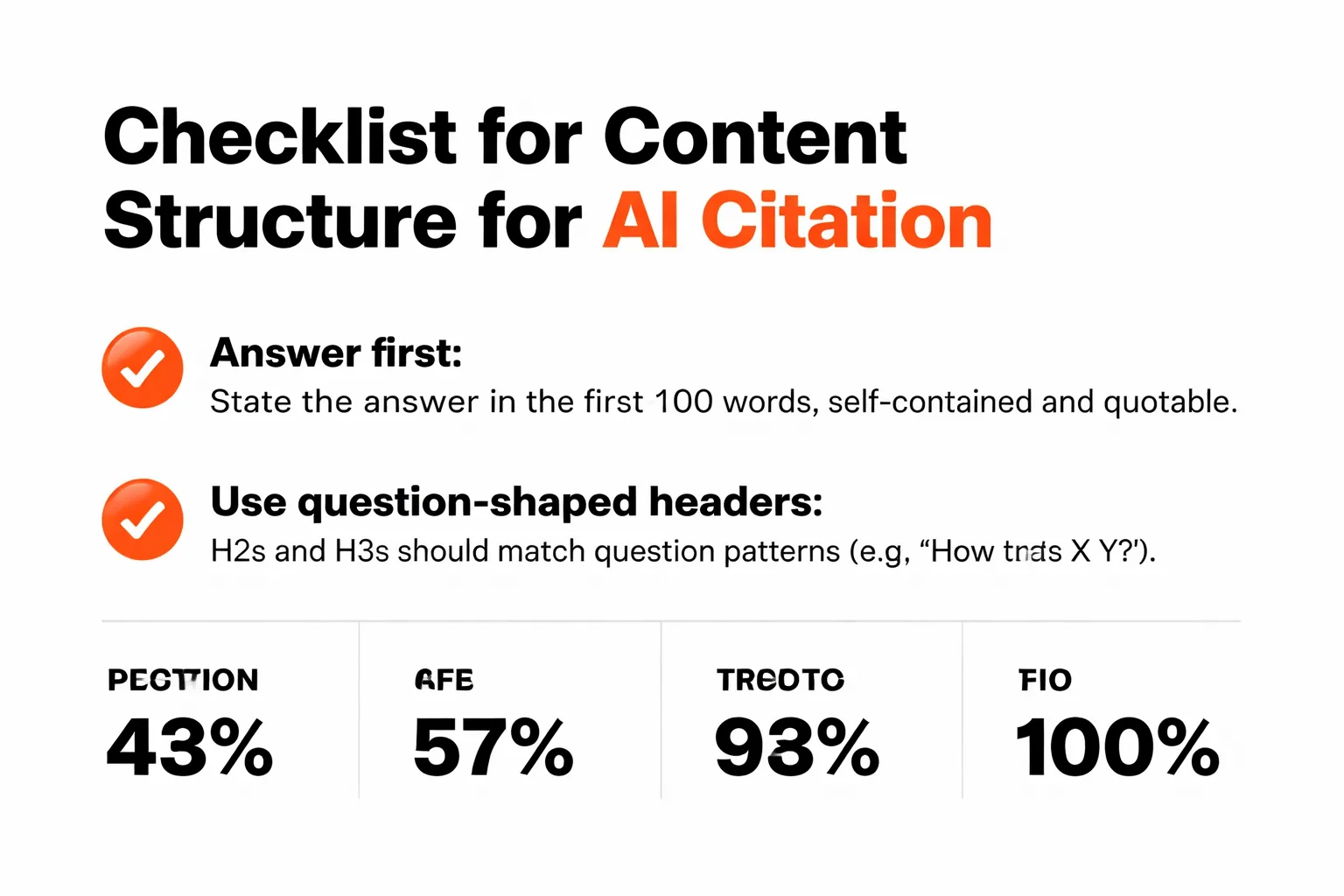
Answer first. The AI engine extracts from the top of the page. If your direct answer is in paragraph four, the engine may never reach it. State the answer in the first 100 words, in a form that is self-contained and quotable. "Answer engine optimization is the practice of structuring content so AI search engines cite it as a source when generating answers to user queries." That sentence is extractable. The AI engine can pull it, attribute it to your domain, and cite you. A paragraph that buries the answer under 200 words of context cannot be cited the same way.
Use question-shaped headers. AI engines extract from H2s and H3s that match question patterns. "How does answer engine optimization differ from SEO?" is more extractable than "AEO vs SEO: A Comparison." The question format mirrors how users phrase queries, which mirrors how AI engines structure their synthesized answers. This is why understanding AEO vs SEO matters at the content-structure level, not just the strategy level.
Cite data with sources. AI engines prioritize content that itself cites authoritative sources. If your page makes a claim and links to the primary source, the AI engine can verify the claim and is more likely to cite your page as the intermediary. If your page makes unsourced claims, the AI engine has no reason to trust it over any other page making the same unsourced claim. The citation economy is recursive: pages that cite get cited.
Structure with schema markup. Article schema, FAQ schema, and HowTo schema give AI engines machine-readable content boundaries. The AI engine does not need to guess where your answer starts and ends. The schema tells it. This is especially important for generative engine optimization, where the engine is looking for structured, verifiable content to build its synthesis from.
Ground your entities. Every brand, product, and concept in your content should be linked to its knowledge graph representation. If your brand has a Wikidata QID, reference it in your sameAs schema. If your content mentions a well-known concept, link to its Wikipedia page. This is not about passing link equity. It is about telling the AI engine "this entity I am writing about is the same entity you have in your knowledge graph." Without that connection, the AI engine may not resolve your entity correctly, which means it cannot cite you for queries about that entity.
The content build is not about word count or keyword density. It is about extractability. Can the AI engine pull a self-contained, sourced, well-structured answer from your page and cite you for it? If yes, you own the answer. If no, you are invisible in AI search regardless of your Google ranking.
A concrete example makes this clearer. Consider the query "what is entity grounding for AI search?" A traditional SEO page might open with 300 words about the history of knowledge graphs, then define entity grounding in paragraph four. An AI-optimized page opens with: "Entity grounding for AI search is the practice of connecting your brand or topic to its knowledge graph representation, typically through Wikidata QIDs and sameAs schema links, so AI engines can recognize and cite your content accurately." That sentence is extractable, self-contained, and quotable. The AI engine can pull it directly into its synthesized answer and attribute it to your domain. The rest of the page elaborates with examples, mechanics, and supporting data, but the core answer is extractable from the first 100 words.
The same principle applies to commercial queries. For "best AI SEO tool for small teams," the extractable answer is not a 500-word essay about AI SEO. It is a structured list with clear criteria: tool name, price, key features, best use case. The AI engine will extract the list and cite your page as the source. A narrative essay without a structured list will not be cited for a commercial query, regardless of how well it is written.
Are your pages getting cited by AI engines or just ranking on Google?
How to Track Whether Your Content Answered the Query
Publishing is not the end of query analysis. It is the midpoint. The question is not "did I optimize for the query?" but "did the AI engine actually cite my page when answering the query?" Those are different questions, and the gap between them is where most teams lose.
Citation monitoring is the practice of running your target queries across AI engines on a recurring basis and checking whether your domain appears in the cited sources. This is not a one-time check. AI citation results shift weekly, sometimes daily, based on model updates, source availability, and query variant. A query where you are cited today may drop you next week if a competitor publishes better-structured content or if the AI model updates its retrieval weights.
The measurement problem is real and under-discussed. Forbes research found that purchase-intent questions return unstable results, with an apparent 8% to 11% citation share movement indistinguishable from random noise. That means if your citation rate moves 9% week over week, you cannot tell whether your content moved the needle or whether the AI engine's output simply varied. This is a measurement problem that classic SEO never had. Google rankings are relatively stable. AI citations are not.
This is why tracking infrastructure matters. You need a system that runs the same query set across ChatGPT, Perplexity, Claude, Gemini, and Google AI Mode on a consistent schedule, records the cited sources, and flags when your domain enters or exits the citation set. Manual checks are insufficient because the noise floor is too high to distinguish signal from random variation without consistent, repeated measurement.
The framework matters more than the number. As Jason Goldberg noted in his Forbes analysis, even when AI visibility metrics are unreliable, building the measurement practice is worthwhile because it standardizes methodology and vocabulary across the team. You learn which query types are stable (informational, definitional) and which are volatile (commercial, purchase-intent). You learn which AI engines cite you most and which ignore you. You learn which sources consistently appear in answers for your topics, which tells you where to focus your outreach.
Meev's monitoring workflow handles this by tracking mention position (first, in a list, last) across every major AI search surface, with per-LLM drill-down dashboards that show the actual response text and citations behind every mention. The point is not to chase a single number. It is to build a pattern: which queries you are cited for, which you are absent from, and which content changes move the citation needle over time.
The measurement challenge extends beyond noise. Vendor case studies in the AI visibility space often lack the methodological transparency needed to validate their claims. A case in point: one vendor reported a 7x AI visibility lift (from 3.2% to 22.2%) without disclosing prompt run frequency, confidence intervals, baseline settlement period, or prompt set consistency. As Todd Paris noted in his analysis of the Profound AI Ramp case study, without these disclosures, the cited improvement is impossible to validate and may simply reflect natural variance in AI engine outputs. This is the measurement equivalent of claiming a 7x ROAS without disclosing ad spend, attribution window, or baseline conversion rate. The number is meaningless without the method.
This is why any AI visibility reporting framework worth using must disclose its methodology: how many times each prompt was run, over what period, with what confidence intervals, and against what baseline. Without that disclosure, the numbers are noise dressed up as signal. Teams that build their measurement practice on unvalidated vendor metrics end up optimizing for phantom gains, chasing content changes that moved nothing while the real levers go untouched.
What This Won't Fix
Query analysis is powerful, but it has boundaries. Teams that expect it to solve every visibility problem will be disappointed, and understanding those boundaries prevents wasted investment.
First, query analysis will not fix a brand that lacks entity recognition. If your brand is not in Wikidata, does not have a Wikipedia page, and has no presence in the knowledge graph, no amount of query analysis or content optimization will make AI engines cite you. The AI engine cannot cite an entity it does not recognize. Entity grounding is a prerequisite, not an output, of query analysis. Teams that skip entity grounding and jump straight to content production are building on sand.
Second, query analysis will not compensate for weak source diversity. If every page on your site covers the same topic with slight variations, AI engines will cite one page and ignore the rest. Cannibalization is not just a Google problem. It is an AI citation problem. The AI engine picks the best page for the query and cites it. If you have five pages competing for the same query, the engine picks one and the other four are invisible. Consolidating topical coverage into single authoritative pages is more effective than spreading thin across multiple pages.
Third, this framework does not help with agentic commerce execution. If your goal is to have an AI agent complete a purchase on your behalf, query analysis tells you which queries trigger agentic workflows but does not optimize the transactional infrastructure (APIs, structured product data, checkout schema) that the agent needs to execute. That is a separate engineering problem, not a content problem.
How Does Conversational Search Change Query Analysis?
Conversational search fundamentally changes the unit of analysis. In classic SEO, the unit is the keyword: a discrete string with measurable volume and competition. In conversational AI search, the unit is the conversation: a multi-turn exchange where each query carries context from the previous one. This means you cannot analyze a single query in isolation. You need to analyze the query chain.
A user might start with "what is AI visibility?" then ask "how do I track it?" then ask "what does Meev cost?" The AI engine maintains context across all three turns and synthesizes answers that build on the previous exchange. Your content strategy needs to account for this chain. Each page should answer the initial query thoroughly while linking to pages that answer the likely follow-up queries. Internal linking is not just about passing authority. It is about building a conversational path that the AI engine can follow from one query to the next, citing your domain at each step.
The conversational chain also reveals intent progression. A user who starts with "what is generative engine optimization?" and follows with "how much does a generative engine optimization agency cost?" has progressed from informational to commercial intent within two queries. Classic SEO would treat these as separate pages targeting separate keywords. AI search optimization treats them as a single user journey, and the content strategy should reflect that: the informational page should link directly to a pricing or comparison page, creating a path that mirrors the conversational chain.
This is where internal linking strategy becomes an AEO tactic, not just an SEO tactic. The links between your pages create the conversational path that AI engines follow. If your informational page about answer engine optimization links to a comparison page about AEO tools, the AI engine can follow that path when synthesizing answers for a user who progresses from definitional to commercial queries. Without those links, the AI engine may cite your informational page but cite a competitor for the commercial follow-up.
When Should You Optimize for AI Citations vs Classic Rankings?
Not every query deserves AI optimization. Some queries still drive more traffic through classic Google rankings than through AI citations, and allocating budget correctly requires understanding which queries belong to which bucket.
The decision framework is straightforward. Optimize for AI citations when the query is informational, definitional, or commercial evaluation. These are the query types where AI engines synthesize answers and cite sources. Optimize for classic rankings when the query is navigational, local, or long-tail transactional. These are the query types where users still click through to specific pages.
The data supports this split. Semrush's analysis of traditional SEO vs AI SEO positions AEO as an evolution of SEO, not a replacement. The two are complementary. Optimizely's field notes on SEO vs AEO agree, framing AEO as an upgrade path rather than a substitute. The practical implication: teams should maintain their classic SEO foundation while building AI citation capabilities for the query types where AI synthesis dominates.
The budget allocation question is real. A small team with limited resources cannot optimize every page for both classic ranking and AI citation. The answer is to segment the content portfolio. Top-of-funnel definitional content gets AI optimization (structured answers, entity grounding, schema markup). Mid-funnel commercial content gets both (classic ranking for the head term, AI citation for the conversational variant). Bottom-funnel transactional content gets classic SEO (the user is clicking through to buy, not asking an AI for a synthesized answer).
This segmentation is why having a unified view of both classic and AI visibility matters. If you only track Google rankings, you miss the 42% of buyers who use AI search. If you only track AI citations, you miss the majority of search traffic that still flows through Google. Meev's platform bridges this gap by tracking both classic Google rankings and AI citation presence in a single dashboard, so teams can see which queries drive traffic through which channel and allocate content investment accordingly.
The Query Analysis Framework That Actually Works
The framework is not complicated. It is just different from what most teams are used to.
Start with the query. Classify every intent layer it contains. Map the sources AI engines cite for that query, not the pages Google ranks. Build content that is extractable, sourced, and entity-grounded. Track whether you appear in the citation set, segmented by query type and stability. Adjust based on which content changes produce durable citation gains versus which are noise.
The teams that win in AI search are not the ones with the most content or the highest keyword density. They are the ones who understand that a search query in 2026 is not a keyword to match. It is a prompt that triggers an inference stack, and the content that gets cited is the content that feeds that stack with structured, sourced, entity-rich answers. Classic SEO is not dead. But it is no longer sufficient. The query has evolved. The analysis must evolve with it.
FAQ
What is a search query in the context of AI search engines?
A search query in the AI era is a natural-language prompt that triggers entity resolution, knowledge graph lookups, and generative answer synthesis. Unlike classic keyword queries (2-4 words matched against a document index), AI queries average 8-12 words and often layer multiple intents (informational, commercial, transactional) that the AI engine must address in a single synthesized response.
How does search query analysis differ for AI vs classic SEO?
Classic query analysis focuses on keyword identification, search volume, and SERP ranking. AI-era query analysis focuses on entity recognition, source citation mapping, and content extractability. The key difference: classic analysis asks who ranks for the query, while AI analysis asks who gets cited when the engine synthesizes an answer. Over 76% of cited URLs fall outside Google's top 10, meaning these two analyses produce different target source lists.
What is entity grounding and why does it matter for AI citations?
Entity grounding is the practice of connecting your brand or topic to its knowledge graph representation, typically through Wikidata QIDs and sameAs schema links. AI engines use these connections for entity disambiguation. If your brand is not properly grounded in Wikidata, the AI engine may not recognize it as a distinct entity, which means it cannot cite your content even if it is well-structured and authoritative.
How do you track AI citations for your target queries?
Run your target queries across ChatGPT, Perplexity, Claude, Gemini, and Google AI Mode on a recurring schedule. Record which domains appear in the cited sources and where your brand falls in the mention order. Use a dedicated AI visibility tool to automate this process, since manual tracking is insufficient given the 8-11% noise floor on purchase-intent queries identified by Forbes research.
What content structure gets cited most by AI search engines?
AI engines cite content that answers the query directly in the first 100 words, uses question-shaped headers, cites primary sources inline, and includes schema markup (Article, FAQ, HowTo). The content must be extractable: the AI engine should be able to pull a self-contained, quotable sentence and attribute it to your domain. Pages that bury answers under context or lack structured data are rarely cited regardless of their ranking position.
Is answer engine optimization replacing traditional SEO?
No. AEO and SEO are complementary. Traditional SEO still drives Google traffic, and Google still accounts for the majority of search referrals. But 42% of CRM buyers now use AI search in their evaluation process, meaning teams that ignore AEO are invisible to nearly half of high-intent commercial queries. The practical approach is to maintain classic SEO while building AI search optimization capabilities alongside it.
How often do AI citation results change?
AI citation results shift weekly, sometimes daily, based on model updates, source availability, and query variant. Purchase-intent queries are the most volatile, with an 8-11% noise floor that makes week-over-week changes difficult to attribute to content actions. Informational and definitional queries are more stable. Consistent, recurring measurement is the only way to distinguish real signal from natural variance.
About the Author
Judy Zhou, Founder
Judy Zhou leads content strategy at Meev, where she oversees AI-driven content research and publishing for hundreds of brands. With a background in SEO and editorial operations, she focuses on building content systems that rank on Google, get cited by AI search engines, and drive measurable business results.
Stop guessing which queries cite your brand. Track every major AI search surface and close the citation gaps that actually move revenue.