
By Judy Zhou, Founder
Key Takeaways
- Nike appears in 73% of relevant AI answers on first run across 100,000+ prompts.
- Gartner predicts a 25% drop in traditional search engine volume by late 2026.
- Seer Interactive shifted ChatGPT outputs in 36 hours by adding structured entity data to footer text.
- 84-89% of AI answers cite earned media, so prioritize third-party coverage over brand pages.
A mid-sized outdoor gear brand had spent three years building what their CMO called an 'unassailable' content moat. Thousands of buying guides, comparison pages, and product deep-dives, all ranking on page one. Then their analytics team noticed something strange: referral traffic from AI assistants was flowing almost entirely to two direct competitors. Nobody had changed a thing. The rankings were intact. But when customers asked AI tools to recommend a four-season tent, the brand simply didn't come up. They had optimized for an algorithm that was no longer the one making the decision.
That story is playing out across ecommerce right now. Nike appears in 73% of relevant AI answers on first run, according to an analysis of 100,000+ prompt responses across 100+ brands conducted between March and May 2026. Gartner predicted a 25% drop in traditional search engine volume by late 2026 as AI-driven solutions mature, and that trend is accelerating. Seer Interactive influenced ChatGPT outputs within 36 hours just by changing footer text to structured entity data, per a case study shared by Chris Long. 84% to 89% of AI-generated answers cite earned media (third-party publications) rather than brand-owned pages.
Your ecommerce GEO strategy can't be an afterthought. It's the difference between being recommended by AI assistants when shoppers ask 'best four-season tent' and being invisible in the channels where purchase decisions increasingly start.
In my work leading content strategy at Meev, I audit AI visibility for ecommerce brands every day. The pattern is always the same: stores that rank well on Google are getting demolished in AI answers because they optimized for a ranking algorithm, not a recommendation engine. This playbook is what I give them.
What's the core problem with ranking vs recommending?
Traditional SEO asks: 'Is this page relevant and authoritative enough to rank for this keyword?' GEO asks something fundamentally different: 'Does an AI system understand what this product IS, and does it have enough corroborating signals to recommend it?'
That distinction matters more than most marketers realize. When a shopper asks ChatGPT for a tent recommendation, the AI isn't running a SERP query. It's retrieving entities from its training data and (when web search is triggered) synthesizing information from multiple sources into a conversational answer. Your product page doesn't need to rank #1. It needs to be understood as an entity with specific attributes, relationships, and corroborating mentions across the web.
ResultFirst's GEO analysis puts it bluntly: ecommerce products that lack knowledge graph presence 'may still rank occasionally but fail to surface consistently in AI-generated answers, comparisons, and recommendations.' I've seen this firsthand. A client's product pages were ranking in the top three for their primary keywords, but when I tested the same queries across ChatGPT, Claude, and Perplexity, the brand appeared in zero responses. Their competitors, who had weaker organic rankings but stronger entity presence across third-party review sites and structured data, were winning every AI recommendation.
The shift from AEO vs SEO isn't just academic. It's a structural change in how purchase decisions get made. Google still processes 16+ billion searches per day, but the nature of those searches is shifting. Users are no longer typing 'best four-season tent' and scrolling through blue links. They are asking conversational questions and expecting synthesized, opinionated answers. The traditional SERP is becoming a fallback, not the primary discovery mechanism.
This is why I cringe when I see ecommerce teams treating GEO as 'SEO 2.0.' It is not an upgrade. It is a different paradigm. SEO rewards depth and authority on a single domain. GEO rewards breadth and corroboration across the entire web. SEO measures rankings and click-through rates. GEO measures mention rates, citation sources, and share of voice in AI answers. The metrics, the tactics, and the mindset are all different.
How Does AI Decide What to Recommend?
AI engines build recommendations through a process called retrieval-augmented generation (RAG). When a user asks 'best lightweight hiking boots,' the AI retrieves relevant information from its training data and live web sources, then synthesizes an answer. The key insight: the AI isn't matching keywords. It's matching entities and relationships.
Think of it this way. Traditional SEO is a librarian who finds books by checking if the title and index match your query. GEO is a knowledgeable friend who understands what a 'four-season tent' means, knows which brands make good ones, and recommends based on a web of trust signals: reviews, expert roundups, forum discussions, manufacturer specs, and knowledge graph entries.
For ecommerce, this means three things must be true simultaneously. First, your product must exist as a recognized entity (not just a URL). Second, that entity must have rich, consistent attributes (price, materials, use case, ratings). Third, those attributes must be corroborated by multiple independent sources. If your product page says 'lightweight' but no third-party review or knowledge graph entry confirms that attribute, the AI may weight a competitor whose 'lightweight' claim is independently verified.
According to an arXiv study analyzing 100,000+ AI responses, mainstream brands like Nike dominate AI recommendations because of training data over-representation. The AI learns from word-frequency clustering, not product testing. This creates a self-reinforcing cycle: brands mentioned frequently online get recommended more, which generates more mentions, which strengthens their dominance.
But here's the opening for smaller brands. That cycle can be broken by actively building entity presence and corroboration signals. The Seer Interactive case proved it: structured data changes influenced ChatGPT within 36 hours. You don't need Nike's brand awareness to win AI recommendations. You need the right structural signals.
The mechanics of RAG matter for ecommerce specifically because product attributes are finite and comparable. When an AI system retrieves information about tents, it is looking for entities with attributes like 'weight,' 'capacity,' 'season rating,' and 'price.' The more clearly and consistently those attributes are structured across your site and the web, the more likely the AI is to retrieve your product when the user's query matches those attributes. This is why a product page that says '4.2 lbs, 2-person, 4-season, $349' in structured data will outperform a page that says 'lightweight and durable for extreme conditions' in plain text, even if the latter ranks higher on Google.
How to audit AI visibility before touching content?
Before you write a single new product description, you need to know where you stand. Most ecommerce teams skip this step and jump straight to content production. That's like prescribing medication without a diagnosis.
Start by testing 20-30 purchase-intent prompts across every major AI search surface. Not just 'best [product category]' but specific, conversational queries: 'I need a lightweight tent for winter camping in Colorado, budget under $400.' Track whether your brand appears, where in the response it appears (first mention, buried in a list, absent), and which sources the AI cites to justify its recommendations.
This is where AI visibility reporting becomes essential. Manual testing gives you a snapshot, but AI responses are non-deterministic. The same prompt can return different answers on different days. You need systematic tracking over time to identify patterns.
A critical warning about measurement. Matt Diggity flagged a Surfer study showing that 23% of ChatGPT API responses didn't trigger web search at all, while 100% of scraped (browser-simulated) results did. API responses averaged 406 words versus 743 words for scraped results. If your visibility tool uses APIs, you're getting a false sense of how visible you actually are. This is exactly why at Meev we use a hybrid LLM tracking architecture that combines direct API access with browser-simulated scraping, so you see what real users see.
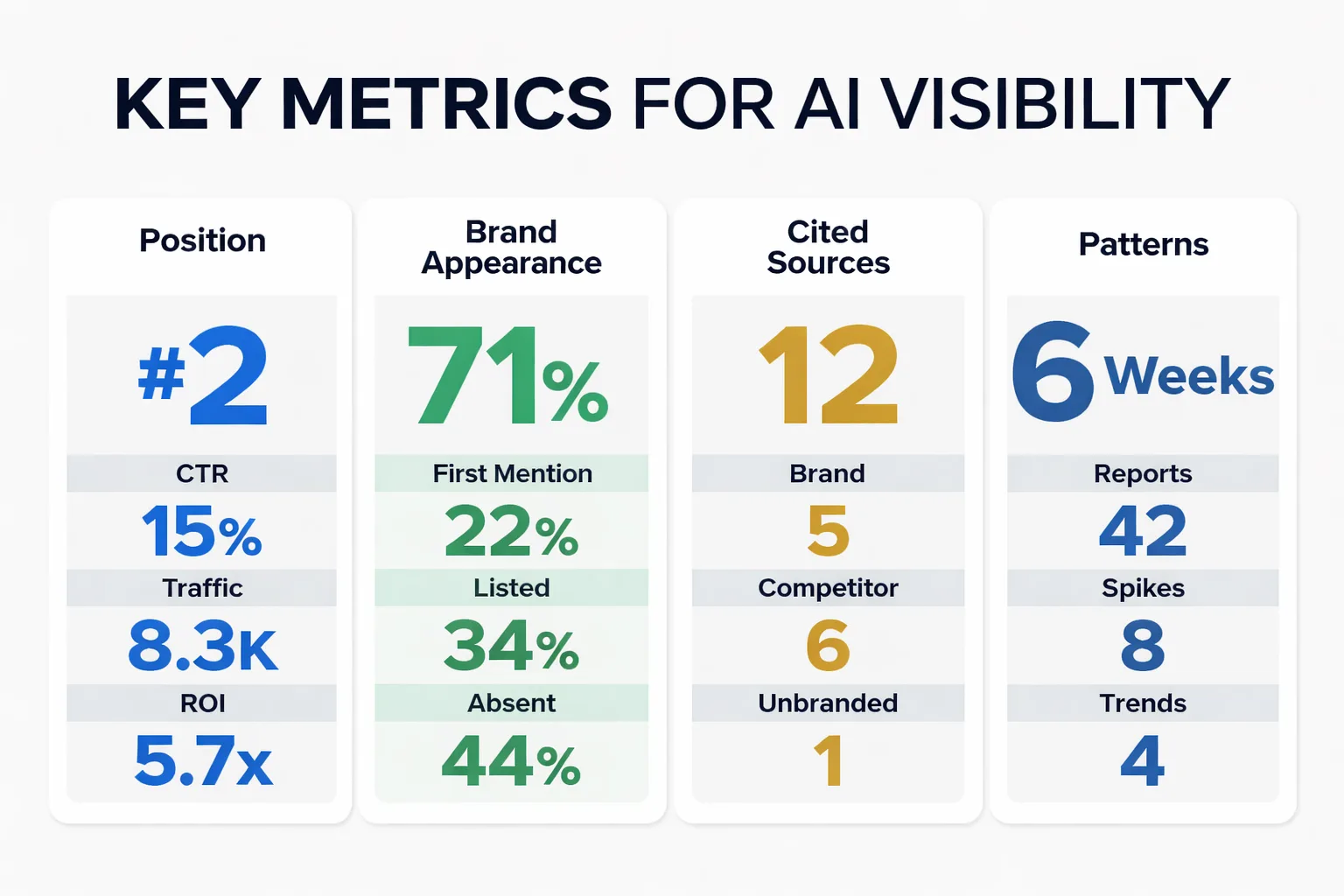
Your audit should produce three outputs: a visibility scorecard (where you appear, where you don't), a competitor citation map (which sources AI engines cite for your category), and a gap list (specific prompts where competitors appear and you don't). These three documents drive every decision in the rest of this playbook.
Let me give you a concrete example of what this looks like. I audited a D2C skincare brand that was convinced they were invisible in AI search. After testing 30 prompts across six AI surfaces, we found they actually appeared in 12% of Perplexity responses but zero ChatGPT responses. The cited sources in Perplexity were all Reddit threads and one beauty blog. The gap wasn't their product. The gap was that ChatGPT's training data had no third-party corroboration for their brand entity. The fix wasn't more content on their site. It was earning mentions from the specific domains ChatGPT relies on for skincare recommendations.
How to build entity grounding for products?
This is the phase where most ecommerce GEO strategy efforts fail. Teams understand they need 'structured data,' so they install a Shopify plugin that outputs Product schema and call it done. That's necessary but nowhere near sufficient.
Entity grounding means making your products understandable as discrete entities with attributes, relationships, and context that AI systems can retrieve and reason about. Product schema markup is the foundation. It tells search engines 'this is a product, here's its price, here's its availability.' But entity grounding goes further.
Let me walk through what real entity grounding looks like for a single product. Say you sell a four-season tent called the 'Summit Pro 2.' Here's what needs to exist:
On your product page: Full Product schema with brand, model, price, availability, aggregateRating, material, weight, season rating, and dimensions. Not the stripped-down schema most Shopify themes output by default. You need every attribute field populated.
In your site architecture: A clean category hierarchy that makes relationships explicit. '/tents/four-season/summit-pro-2' tells both humans and AI systems what this product is and where it fits. '/products/summit-pro-2-v3' tells them nothing.
In your content ecosystem: Buying guides, comparison pages, and educational content that reference the product by name and attribute. 'The Summit Pro 2 weighs 4.2 pounds, making it one of the lightest four-season tents in its price range' is an entity-rich sentence. 'Check out our best tent' is not.
In your structured data relationships: Organization schema linking your brand entity to your product entities. ItemList schema on category pages showing how products relate to each other. Review schema that connects customer feedback to specific product attributes.
The Seer Interactive case study is instructive here. They didn't rewrite product pages or publish new content. They added structured entity data to a website footer: '130+ clients, 97% retention rate.' Within 36 hours, ChatGPT began incorporating that data into its responses. The lesson: AI systems are actively crawling for structured entity information. If you provide it clearly, they use it.
Now consider the scale problem. If you run a Shopify store with 500 products, manually grounding each one as an entity sounds impossible. It's not, but it requires a system. Start with your top 20 products by revenue. Ground those completely: full schema, clean URL structure, internal linking from category and guide pages, and review schema. Then expand to the next 50. The 80/20 rule applies here. Your top products drive the majority of AI-relevant purchase prompts, and grounding them thoroughly will move your overall visibility more than superficially tagging all 500.
Phase 3: Establish Wikidata and Knowledge Graph Presence
This is where I lose most ecommerce teams. 'Wikidata? That's for Wikipedia articles about celebrities, not for my tent store.' Wrong. And the cost of being wrong is enormous.
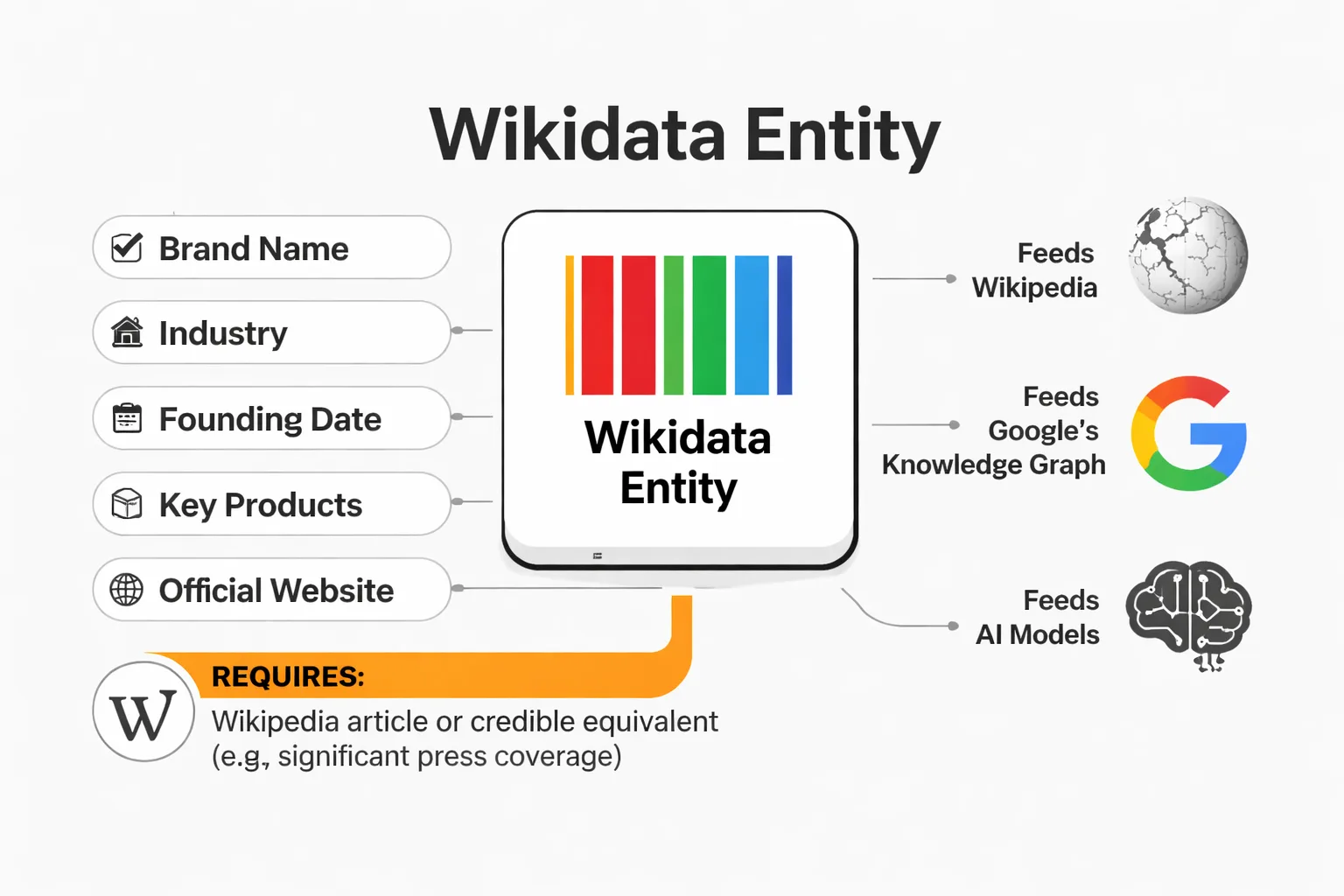
Wikidata is the structured data backbone that feeds Wikipedia, Google's Knowledge Graph, and increasingly, AI models. When ChatGPT or Claude needs to understand what a brand or product IS, it often checks knowledge graph entries first. If your brand doesn't exist as a Wikidata entity, you're forcing the AI to piece together your identity from scattered web pages. That's unreliable, and AI systems default to brands they can identify with confidence.
Creating a Wikidata entry for your brand isn't complicated, but it requires following community guidelines. You need a Wikipedia article (or a credible equivalent like significant press coverage) to justify the entry. The entry should include your brand name, industry, founding date, key products, and official website. Once created, this entity becomes a reference point that AI systems can cite and connect to your product entities.
Beyond Wikidata, you need presence in Google's Knowledge Graph. This happens through consistent NAP (name, address, phone) information across the web, a verified Google Business Profile, and structured data on your site that matches your external listings. The goal is to create a single, unambiguous identity for your brand that every AI system can verify.
I'll be blunt about what I've observed. Brands with knowledge graph presence get cited by AI systems at dramatically higher rates than those without. The arXiv study showed that global household names (tier one in their brand-stature ladder) appear in 73%+ of relevant AI answers. Those brands all have robust knowledge graph entries. Mid-market brands (tier two) appear sporadically. SMEs and D2C startups (tier three) are largely absent. The knowledge graph gap is the single biggest structural barrier to AI visibility for smaller ecommerce brands.
Let me address the platform question I get constantly. Whether you're on Shopify (which powers 5.6M+ live stores with $378B in GMV) or WooCommerce (which powers 39% of all ecommerce sites globally), the entity grounding principles are identical. The implementation differs. Shopify's /products/ URL prefix and limited schema control mean you may need custom Liquid templates or a headless approach to output full entity markup. WooCommerce gives you more flexibility through custom post types and plugins, but requires more technical maintenance. Neither platform has a built-in advantage for AI citation rates. What matters is how thoroughly you implement entity grounding regardless of platform.
Phase 4: Optimize for Agentic Commerce
Here's where the conversation gets interesting. Most GEO content stops at 'optimize for AI answers.' But the real frontier is agentic commerce: AI agents that don't just recommend products but actually execute purchases on behalf of users.
When a user tells their AI assistant 'Order me a lightweight four-season tent under $400,' the agent needs to do more than recommend. It needs to find the product, verify availability, compare prices, check shipping options, and complete the transaction. This requires a different kind of optimization.
Agentic SEO means structuring your ecommerce site so AI agents can navigate it programmatically. Think of it as building an API layer for your storefront that AI agents can interact with. Here's what that involves:
Machine-readable product availability. Your inventory status needs to be accessible in real-time, not just rendered in HTML. This means structured data that updates dynamically and (ideally) a product API that agents can query.
Transparent pricing and shipping. AI agents comparison-shop instantly. If your pricing or shipping costs are hidden behind JavaScript interactions or login walls, the agent will skip you. Every cost component should be visible in structured data.
Schema for the full purchase journey. Beyond Product schema, you need Offer schema (with price, availability, priceCurrency), ShippingRateSettings, and ReturnPolicy schema. These tell the agent not just what you sell but the terms of purchase.
LLMs.txt for agent discoverability. A llms.txt file tells AI agents which parts of your site are available for crawling and synthesis. It's the robots.txt equivalent for the AI era. Most ecommerce stores don't have one yet, which means early adopters get a structural advantage.
The shift to agentic commerce is happening faster than the shift to AI search. When I talk to CMOs, the message is consistent: 'Our traditional SEO doesn't work anymore.' Tom Lee reported on LinkedIn that clients are experiencing 25% organic traffic drops despite maintained rankings. The traffic isn't disappearing. It's being intercepted by AI agents that synthesize answers instead of sending users to your site.
The practical implication for ecommerce is that you need to think about two distinct user journeys. The first is the human journey: a shopper visits your site, browses products, reads descriptions, adds to cart, and checks out. The second is the agent journey: an AI system retrieves your product data, compares it against competitors, and either recommends or purchases without a human ever visiting your site. Your ecommerce GEO strategy needs to serve both journeys. Most stores are optimized exclusively for the first.
Phase 5: Build Corroboration Through Earned Media
Remember the stat I opened with: 84% to 89% of AI-generated answers come from earned media. That's not a typo. AI systems weight third-party sources far more heavily than brand-owned content when making recommendations. This makes complete sense when you think about it. A brand claiming 'our tent is the lightest' is marketing. A review site confirming 'the Summit Pro 2 is among the lightest four-season tents we've tested' is evidence.
This is why I've shifted my entire approach to what I call Machine Relations (MR). Traditional PR targets human journalists. Machine Relations targets the AI systems that synthesize those journalists' work into recommendations. The goal is the same: get credible third-party sources to describe your products with entity-rich, attribute-specific language.
Here's how this works in practice. You identify the domains that AI engines cite most often for your product category. These are typically review sites, roundups, comparison articles, and expert guides. Then you pursue mentions from those specific sources. Not generic backlinks. Mentions that include your brand name, product name, and key attributes in context.
At Meev, our Citation Path feature does exactly this. It finds the publishers AI engines actually cite for your topics, surfaces verified contacts, and drafts personalized outreach pitches grounded in your knowledge base. It's the closed-loop approach I wish I'd had years ago when I was doing this manually with spreadsheets and guesswork.
The corroboration layer is what separates brands that appear in AI recommendations from those that don't. Your product page is your claim. Third-party coverage is your proof. AI systems need both to recommend you with confidence.
Let me be specific about what 'corroboration' means in practice. It's not enough to get a backlink from a high-authority site. The mention needs to contain entity-rich language that AI systems can extract. A backlink from OutdoorGearLab that says 'the Summit Pro 2 impressed our testers with its 4.2-pound weight and full-coverage fly' is worth ten times more than a backlink from the same site that says 'check out Summit Pro tents here.' The first gives the AI system extractable attributes. The second gives it nothing.
This is also why I've moved away from relying on Reddit for AI visibility. I tried leaning into Reddit for a quick boost last year, and the results were underwhelming. While Google and OpenAI seem to have paid access to Reddit data, other engines like Perplexity and Claude face restrictions. The visibility just wasn't translating across all the AI tools I track. A comprehensive signal graph built on owned first-party content, structured schema, and distributed reviews across multiple platforms is the only reliable approach.
Are your products showing up in AI recommendations, or are competitors taking every AI-driven sale?
Phase 6: Publish Answer-Engine Optimized Content at Scale
Once you've built the structural foundation (entity grounding, knowledge graph presence, corroboration signals), you need content that AI engines can cite. This is where most ecommerce teams either underinvest (publishing nothing) or overinvest in the wrong thing (publishing keyword-stuffed product descriptions).
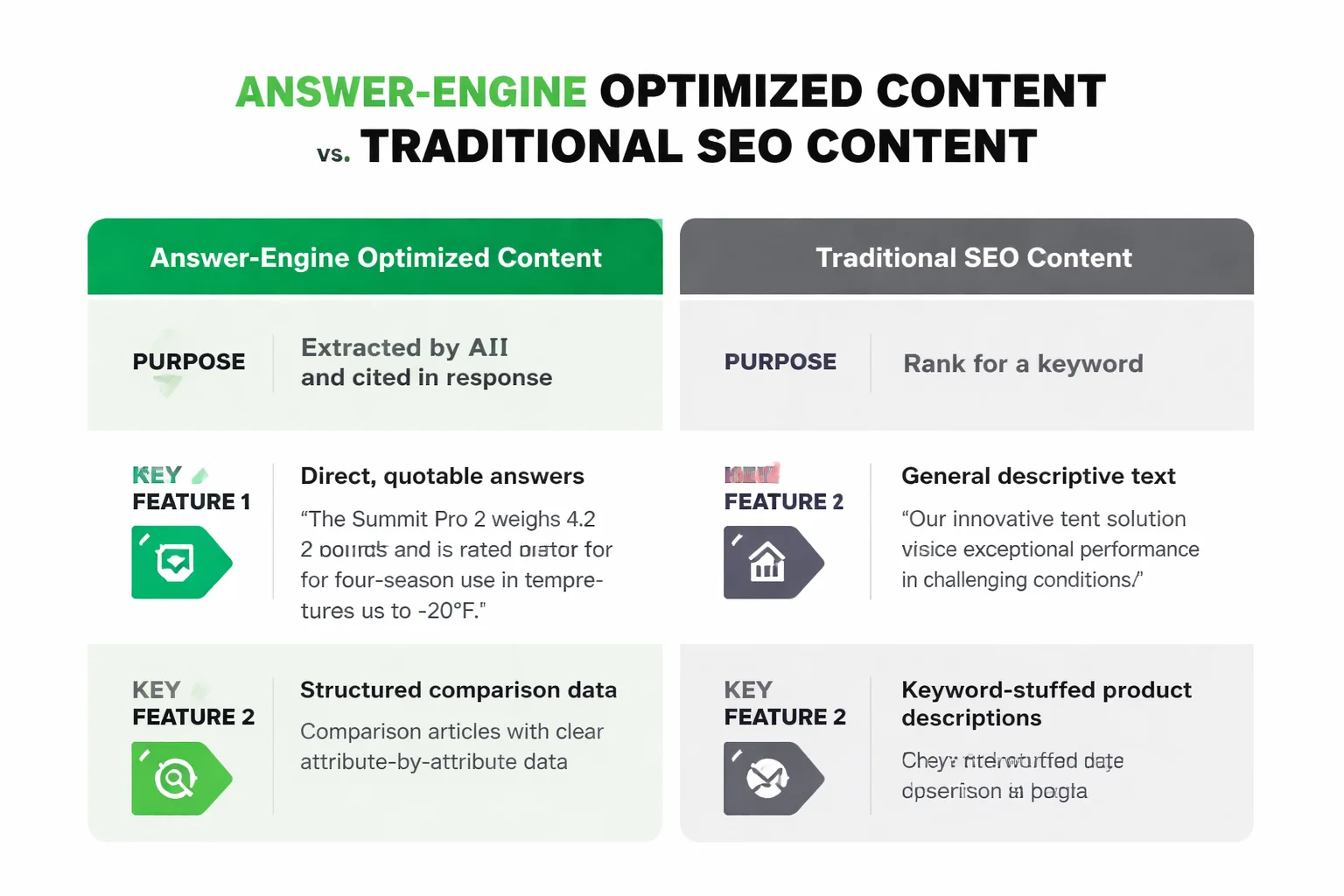
Answer-engine optimized content serves a different purpose than traditional SEO content. It's not designed to rank for a keyword. It's designed to be extracted by an AI system and cited in a response. This means:
Direct, quotable answers. AI systems extract sentences that directly answer questions. 'The Summit Pro 2 weighs 4.2 pounds and is rated for four-season use in temperatures down to -20°F.' That's extractable. 'Our innovative tent solution provides exceptional performance in challenging conditions' is not.
Structured comparison data. When AI systems build comparison tables, they pull from structured content. Comparison articles with clear attribute-by-attribute breakdowns get cited more than narrative reviews.
Entity-rich language. Every piece of content should name products by their full entity name, include key attributes, and establish relationships to other entities (use cases, comparable products, complementary gear).
This is where AI search engine optimization tools come in. The right platform doesn't just generate content. It generates content structured for extraction. At Meev, our archetype-aware writing system produces Listicle, How-To, Explainer, Problem-Solver, and Vertical articles, each with retrieval weights and quality criteria tuned for how AI systems actually consume content. Every article goes through a 16-dimension quality firewall that blocks weak drafts before they reach your CMS.
The content you publish should fill the gaps your Phase 1 audit identified. If competitors are cited for 'best lightweight tent' but you're not, you need content that establishes your product's lightweight credentials in extractable, citable language. Not more blog posts about 'the history of camping.'
Here's a concrete content plan for a single product gap. Say your audit reveals that your tent brand is absent from AI responses to 'best four-season tent under $500.' You need four pieces of content. First, a comparison article on your site: 'Summit Pro 2 vs. [Competitor]: Weight, Durability, and Price Compared.' Second, a how-to guide: 'How to Choose a Four-Season Tent for Winter Camping.' Third, a listicle: '7 Four-Season Tents Under $500 Ranked by Weight.' Fourth, a problem-solver: 'Why Most Four-Season Tents Fail in Heavy Snow (And Which Ones Don't).' Each piece uses entity-rich language, includes structured comparison data, and is published with full schema markup. This is how you build the content layer that AI engines extract from.
Phase 7: Track, Measure, and Iterate
GEO is not a set-it-and-forget-it strategy. AI responses are non-deterministic and constantly evolving. The prompt that returns your brand today might return a competitor tomorrow because the model updated or a new third-party article was published.
Your measurement framework needs to track metrics that traditional SEO tools can't capture. Here's what I track for ecommerce brands:
Mention rate: What percentage of relevant prompts include your brand? Track this per AI surface (ChatGPT, Claude, Gemini, Perplexity, Grok, Google AI Overviews) because each has different retrieval patterns.
Mention position: When your brand appears, is it the first recommendation, buried in a list of five, or mentioned as an afterthought? Position matters as much as presence.
Citation source tracking: Which domains are AI engines citing when they mention (or don't mention) your brand? This tells you exactly which third-party sources to pursue for corroboration.
Share of voice: What percentage of AI answers in your category cite you versus competitors? This is the GEO equivalent of market share, and it's the metric I'd put on a CMO's dashboard.
Prompt coverage: How many distinct purchase-intent prompts trigger your brand? You might appear for 'best four-season tent' but not for 'warm tent for winter camping.' Coverage gaps reveal entity weaknesses.
Using an AI visibility tool that tracks these metrics over time is non-negotiable. Manual testing is a starting point, not a strategy. You need daily refresh on SERP-driven surfaces and rolling refresh on LLM-driven surfaces to catch shifts before they impact revenue.
For brands ready to go deeper, the Perplexity AI visibility checker and ChatGPT AI visibility checker provide surface-specific drill-downs that reveal exactly how each engine talks about your products.
The iteration loop is critical. Every two weeks, review your visibility data and ask three questions. Which prompts shifted? Which new sources appeared in citations? Which competitors gained or lost share of voice? Then adjust your content and corroboration strategy accordingly. If a new review site suddenly appears as a top citation source for your category, that's an outreach target. If your mention position dropped from first to third on a high-value prompt, check whether a competitor published new content or earned a major third-party mention. GEO is a live game. The brands that win are the ones that monitor and respond fastest.
When This Playbook Fails
I'm not going to pretend this strategy works for every ecommerce store, because it doesn't. Three scenarios consistently break this playbook.
Brand-new stores with zero web presence. If you launched last month and have no reviews, no press coverage, no organic traffic, and no knowledge graph entry, entity grounding won't help you. AI systems can't recommend entities they've never encountered. You need to build baseline web presence first. Get listed in directories, earn your first reviews, get a handful of press mentions. Then apply this playbook.
Commoditized products with no differentiation. If you sell generic phone cases from a supplier that fifty other stores also use, AI systems have no reason to recommend you specifically. Entity grounding requires distinguishable attributes. If your product is identical to competitors' products, no amount of structured data will make AI systems prefer your version.
Stores with broken technical foundations. If your site loads in eight seconds, has duplicate content across 500 product variants, or returns 404s on half your pages, GEO won't save you. Fix your technical SEO first. AI systems still crawl your site. If the crawl is broken, the entity data never reaches them.
What This Actually Means
The brands winning AI recommendations in 2026 aren't the ones with the most content or the best keyword rankings. They're the ones that AI systems can understand, verify, and recommend with confidence. That requires a fundamentally different approach: entity grounding instead of keyword optimization, knowledge graph presence instead of backlink profiles, corroboration through earned media instead of owned content volume, and agentic commerce readiness instead of CTR optimization.
Your ecommerce GEO strategy is the bridge between ranking on Google and being recommended by AI. The brands that build that bridge now will own the next decade of ecommerce discovery. The ones that don't will keep ranking page one while their competitors take every AI-recommended sale.
Start with the audit. Find your gaps. Build your entities. Earn your corroboration. Track your visibility. The playbook is right here. The question is whether you execute it before your competitors do.
FAQ
How is GEO different from traditional SEO for ecommerce?
Traditional SEO optimizes pages to rank in search engine results pages. GEO optimizes products and brand entities to be recommended in AI-generated answers. SEO focuses on keywords, backlinks, and page authority. GEO focuses on entity grounding, knowledge graph presence, structured data, and third-party corroboration. Both matter, but GEO is increasingly where purchase decisions start.
How long does it take to see results from ecommerce GEO?
The Seer Interactive case showed footer changes influencing ChatGPT within 36 hours. But that's a best-case scenario with an established site. For most ecommerce stores, expect 4-8 weeks for entity grounding changes to register, 8-12 weeks for knowledge graph presence to build, and 3-6 months for corroboration through earned media to move the needle on AI recommendations.
Do I need to abandon traditional SEO to focus on GEO?
No. Google still handles 16+ billion searches per day. Traditional SEO still drives traffic and revenue. But if you're only doing SEO and ignoring GEO, you're leaving the fastest-growing discovery channel unattended. Run both in parallel, with GEO as the new priority layer.
Which AI surfaces should I track for ecommerce?
Every major AI search surface: ChatGPT, Claude, Gemini, Perplexity, Grok, Google AI Overviews, and AI Mode. Each has different retrieval patterns and citation behaviors. A brand might dominate Perplexity citations but be absent from Claude responses. Surface-specific tracking reveals where you're winning and where you're invisible.
Can small ecommerce brands compete with giants like Nike in AI recommendations?
The arXiv study showed Nike appears in 73% of relevant AI answers. That dominance is real but not permanent. The Seer Interactive case proved that structured data changes can influence AI outputs within 36 hours. Small brands that build strong entity presence, earn targeted third-party corroboration, and publish extractable content can win category-specific prompts where they have genuine differentiation.
What's the single most important first step?
Audit your current AI visibility. Test 20-30 purchase-intent prompts across all major AI surfaces. Record where you appear, where competitors appear, and which sources the AI cites. Everything else in this playbook flows from that baseline.
About the Author
Judy Zhou, Founder
Judy Zhou leads content strategy at Meev, where she oversees AI-driven content research and publishing for hundreds of brands. With a background in SEO and editorial operations, she focuses on building content systems that rank on Google, get cited by AI search engines, and drive measurable business results.
Run a free AI visibility audit and discover exactly which prompts mention your competitors instead of you.