
By Judy Zhou, Founder
Key Takeaways
- AI-referred shoppers convert at nearly 50% higher rates and carry 14% higher average order values than organic search visitors.
- AI-referred sessions jumped 527% year-over-year in the first five months of 2025, with over half landing directly on product pages.
- Replace keyword stuffing with entities, structured data, and third-party validation to make AI engines recommend your products.
- Apply research-backed GEO strategies to increase AI visibility by up to 40%.
Your best customers are now asking AI which product to buy. Not Google.
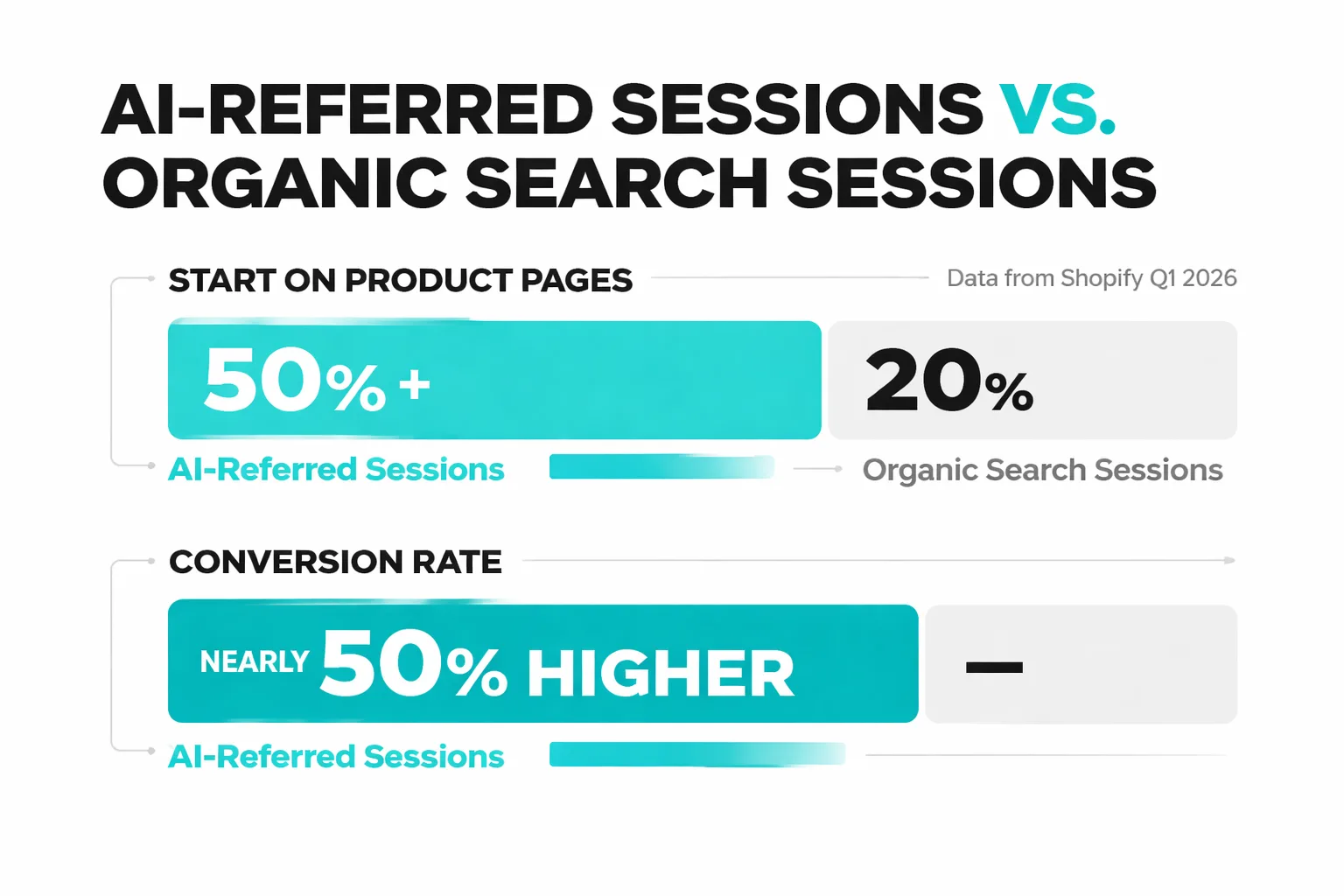
AI-referred shoppers convert at nearly 50% higher rates and carry 14% higher average order values than organic search visitors, according to Shopify's Q1 2026 commerce data. If you want to get products in ChatGPT and other AI assistants, you are competing for a high-intent audience that arrives ready to buy. AI-referred sessions jumped 527% year-over-year in the first five months of 2025, per Previsible's AI traffic report. Research-backed GEO strategies can boost AI visibility by up to 40%, according to a University of Toronto study published on arXiv. The opportunity is massive. The playbook is new.
I lead content strategy at Meev, where I oversee AI-driven content research and publishing for hundreds of brands. In my work auditing content operations, I see the same mistake daily: teams treat AI product discovery like traditional SEO. It is not. You cannot stuff keywords into a product description and expect ChatGPT to recommend your brand. AI engines build answers from entities, structured data, and third-party validation. If your brand lacks these signals, you are invisible.
This guide is the playbook I use to fix that. We will cover how OAI-SearchBot crawls product data, how to optimize product descriptions for AI understanding, how to leverage reviews, and how to build the entity signals that make AI assistants trust your brand.
Is the AI shopping shift permanent?
Most teams still think of AI search as an experiment. The data says otherwise. AI-referred traffic is not a trickle. It is a flood, and the shoppers riding that wave are more valuable than the ones coming from Google.
More than half of AI-referred sessions start directly on product pages, compared to just 20% for organic search. That means AI shoppers arrive with a specific product in mind. They have already made a decision. They are not browsing. They are buying. This is the core reason AI-referred sessions convert at nearly 50% higher rates, according to Shopify's Q1 2026 data.
If your product is not the one AI recommends, you lose that sale before the shopper ever visits your site. This is why AI search optimization is no longer optional for ecommerce brands.
How OAI-SearchBot Crawls Product Information
OpenAI uses a dedicated crawler called OAI-SearchBot to fetch and index web content for ChatGPT's search and shopping features. Understanding what this bot looks for is step one of chatgpt shopping optimization.
OAI-SearchBot behaves differently from Googlebot. It prioritizes clean, structured, machine-readable content. If your product pages are heavy on JavaScript rendering or lack structured data, the bot may struggle to parse your product attributes. You need to ensure your site serves clean HTML with product schema markup. The bot wants to find product names, prices, availability, descriptions, and reviews in a format it can extract without executing complex scripts.
Technical SEO for AI is not about pleasing a ranking algorithm. It is about feeding a language model the raw data it needs to understand your product. That means fast server response times, clean DOM structures, and no reliance on client-side rendering for critical product information.
There is a critical distinction between OAI-SearchBot and GPTBot. GPTBot crawls the web for training data. OAI-SearchBot crawls for real-time search results within ChatGPT. You need to allow both in your robots.txt file, but OAI-SearchBot is the one that directly impacts whether your products appear in ChatGPT Shopping results. If you block OAI-SearchBot, your products will not appear in real-time recommendations even if your training data footprint is strong.
Check your server logs for OAI-SearchBot requests. If you do not see any hits, your site is either blocking the bot or your product pages are not being discovered. Both problems are fixable, but you need to diagnose them first. A simple log analysis can tell you exactly which pages the bot is fetching and which ones it is skipping.
How Does ChatGPT Choose Products to Recommend?
ChatGPT builds product recommendations by synthesizing information from multiple sources: its training data, real-time web search results via OAI-SearchBot, and structured data feeds. The engine looks for brand entities it recognizes, products with strong review signals, and third-party coverage that validates the product's claims. A 50-prompt study by Friction AI across SaaS, ecommerce, finance, and health categories found that ChatGPT consistently favors brands with strong external validation over those with only strong on-site SEO.
This is the part most teams miss. ChatGPT does not trust your product page. It trusts what other people say about your product. According to research cited on arXiv, AI search exhibits a systematic bias toward earned media over brand-owned and social content. If you want to get products in ChatGPT, you need third-party coverage. You need reviews on platforms AI engines can access. You need your brand mentioned in articles that AI models cite.
The Friction AI study also revealed category-specific patterns. In SaaS, ChatGPT recommends tools that appear in comparison articles on major tech publications. In ecommerce, it favors products with Amazon listings that have hundreds of reviews. In finance, it recommends services that have been covered by mainstream financial media. The pattern is consistent: AI engines trust established third-party sources over brand-owned content. The implication is clear. If your entire strategy is optimizing your own website, you are fighting with one hand tied behind your back. You need a brand radar 2.0 approach that tracks how AI engines perceive your brand across the entire web.
What role does structured data play?
Structured data is the language AI assistants speak. If your product pages do not use schema.org Product markup, you are forcing AI engines to guess what your page is about. Guessing leads to errors. Errors lead to your product being excluded from recommendations.
At minimum, every product page needs Product schema with these properties: name, image, description, brand, offers (price, currency, availability), and aggregateRating. If you have variants, use ItemList schema to group them. If you sell through multiple channels, ensure your structured data is consistent across all of them.
But structured data alone is not enough. The schema must match the visible content on the page. If your schema says a product is in stock but the page says out of stock, AI engines will flag the inconsistency. Trust breaks fast.
Here is a concrete example. I audited a DTC skincare brand last quarter that had beautiful product pages with rich visual content. Their schema markup was present but incomplete. The brand element was missing. The aggregateRating property pointed to reviews that lived on a separate subdomain. OAI-SearchBot could not connect the product to the brand entity or the review signals. The brand was invisible in ChatGPT recommendations despite having strong organic search rankings. We fixed the schema to include the brand element and embedded aggregateRating directly on the product page. Within six weeks, the brand started appearing in ChatGPT responses for category-related prompts.
The lesson is simple. Schema is not a checkbox. It is the primary data structure AI engines use to understand your product. Every missing property is a missed opportunity for AI visibility.
What is entity grounding for AI search?
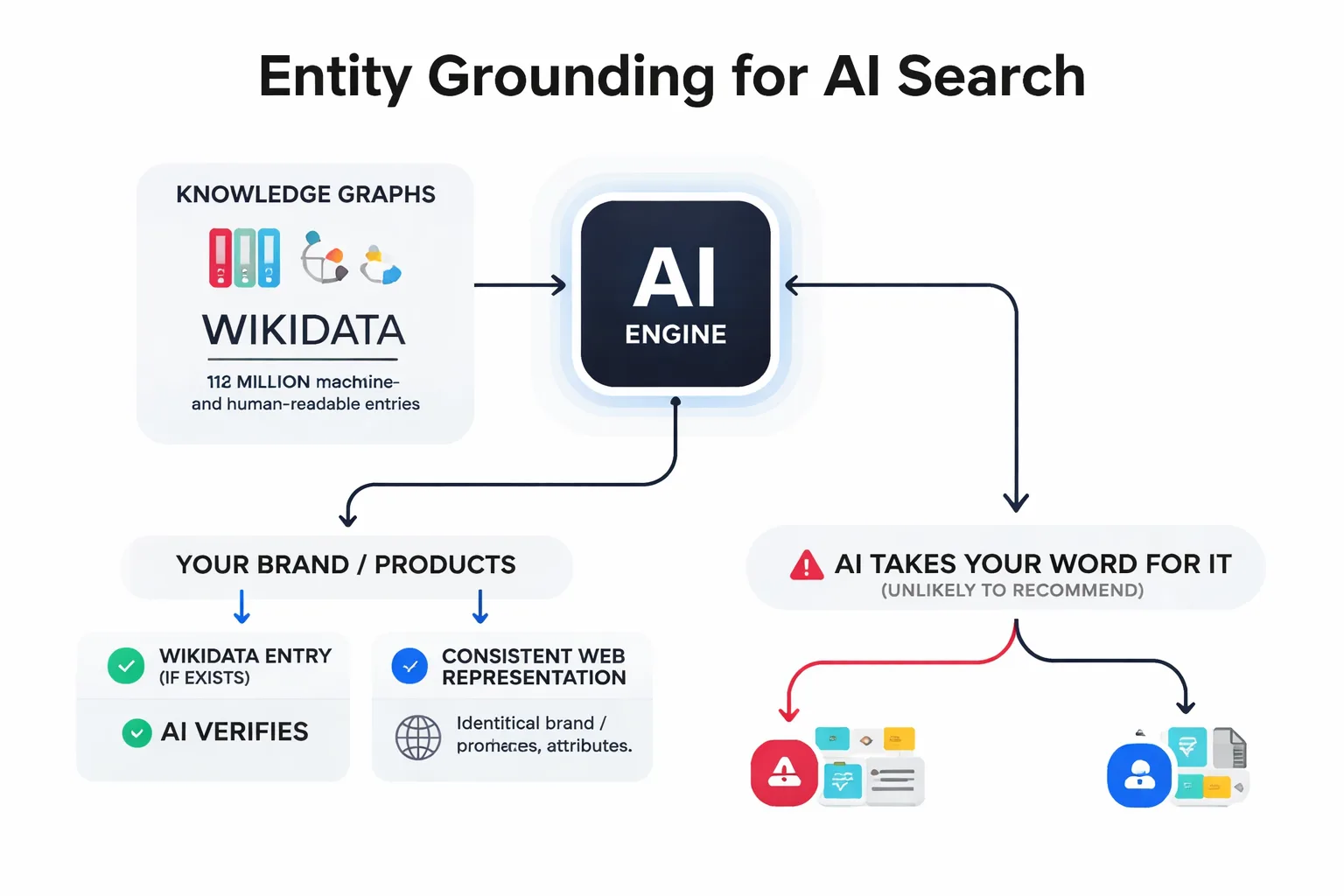
This is where most guides stop. They tell you to add schema and write good descriptions. They never mention entity grounding. Entity grounding is the process of ensuring your brand and products exist as recognized entities in the knowledge graphs AI engines use to verify information.
Wikidata contains over 112 million machine- and human-readable entries, and frameworks like LangChain enable ChatGPT to reference this knowledge graph directly. If your brand has a Wikidata entry with accurate product information, AI engines can verify your existence and attributes against a trusted source. If you do not have a Wikidata entry, you are asking AI engines to take your word for it. They will not.
Entity grounding also means ensuring your brand is consistently represented across the web. Your brand name, product names, and key attributes should be identical everywhere. If your product is called ProMax 3000 on your site but ProMax3000 on Amazon and Pro Max 3000 on review sites, AI engines may treat these as three different products. Consistency is not a branding nicety. It is a technical requirement for AI visibility.
Creating a Wikidata entry is not trivial. You need to establish notability, cite reliable secondary sources, and follow Wikidata's formatting rules. But the payoff is significant. Once your brand exists as a Wikidata entity, AI engines can programmatically verify your brand's attributes, product lines, and market position. This is especially valuable for newer brands that lack the web footprint of established competitors.
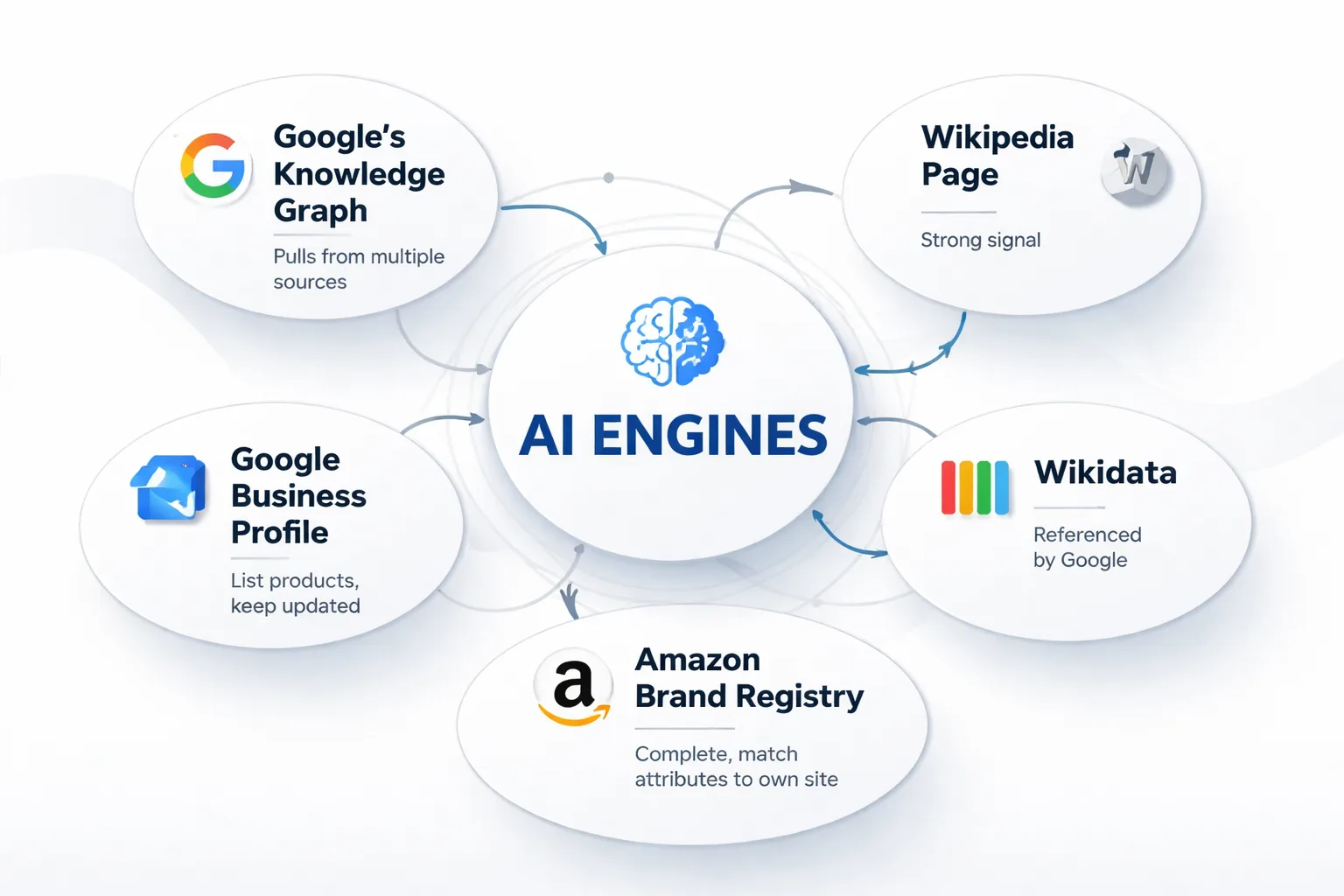
Beyond Wikidata, ensure your brand has consistent entries in Google's Knowledge Graph, Amazon's brand registry, and any industry-specific databases or directories. Each of these sources feeds into the entity resolution processes that AI engines use to determine which products to recommend.
Optimizing Product Descriptions for AI Understanding
AI engines do not read product descriptions the way humans do. They parse them for entities, attributes, and relationships. A description that reads beautifully to a human may be meaningless to a language model if it lacks structured attributes.
Write descriptions that serve both audiences. Lead with a clear, declarative sentence that names the product, its category, and its primary use case. "The Acme X200 is a wireless mechanical keyboard designed for programming and gaming." That sentence gives an AI engine three entities to work with: the product, its category, and its use case.
Follow with specifications in a structured format. Use tables for technical specs. Use bullet points for features. Avoid burying critical attributes in paragraphs of marketing copy. The AI engine needs to extract price, dimensions, materials, compatibility, and warranty information quickly. If it has to parse a 500-word story about your brand's heritage to find the product weight, you have made its job harder.
Here is a specific framework I use. Split your product description into three blocks. Block one is the declarative summary: product name, category, primary use case, and key differentiator. Block two is the specification table: every attribute a shopper might compare, formatted as a table with clear column headers. Block three is the narrative: the brand story, the design philosophy, the emotional appeal. This structure gives AI engines the structured data they need first, then the context they need to understand your product's positioning. Never put critical specifications inside JavaScript widgets or interactive configurators. AI crawlers cannot interact with your page. They can only read the static HTML.
Why Do Customer Reviews Drive AI Recommendations?
Customer reviews are the social proof layer that AI engines use to rank and filter products. ChatGPT and other assistants look for products with high review volumes, strong average ratings, and recent review activity. Reviews provide the sentiment data that AI engines use to assess product quality.
Distribute your reviews across multiple platforms. Your own site matters, but AI engines also pull from Amazon, Trustpilot, Google Shopping, and category-specific review sites. A product with 500 reviews on your site and zero reviews elsewhere looks suspicious to an AI model. A product with reviews distributed across five platforms looks established and trustworthy.
I tried to lean into Reddit for a quick visibility boost last year, but the results were underwhelming. While Google and OpenAI seem to have paid access to Reddit data, other engines face restrictions. The visibility just was not translating across all the AI tools I track. A distributed review strategy across owned properties and established third-party platforms is far more reliable.
Review recency matters as much as volume. AI engines weight recent reviews more heavily because they reflect the current state of the product. If your product had great reviews in 2024 but has not received a new review in six months, AI engines may interpret that as declining relevance. Build systems that generate reviews continuously. Post-purchase email sequences, in-app review prompts, and follow-up campaigns that ask for reviews weeks after delivery all contribute to a steady stream of fresh sentiment data.
Are your products showing up when shoppers ask AI assistants what to buy?
Ensuring Website Crawlability for AI Bots
Your robots.txt file may be blocking the wrong bots. Many ecommerce sites block unknown crawlers by default, which means OAI-SearchBot, PerplexityBot, and other AI crawlers never see your product pages.
Check your robots.txt file for AI bot user agents. Allow OAI-SearchBot, PerplexityBot, ClaudeBot, and GPTBot. If you use a CDN or firewall, ensure these bots are not being blocked at the network level. I have seen sites with perfect schema, great content, and strong reviews get zero AI visibility because their firewall was silently rejecting every AI crawler.
Server response time also matters. AI crawlers fetch pages in bulk. If your server takes 3 seconds to respond, the crawler may time out and skip your pages. Aim for sub-500ms response times on product pages. Use caching, CDNs, and optimized databases to hit that target.
Beyond robots.txt, check your rate limiting rules. Many CDNs and WAFs throttle or block bots that make rapid sequential requests. OAI-SearchBot fetches multiple pages in a single crawl session. If your rate limiter blocks it after three requests, the bot will skip the rest of your product catalog. Whitelist known AI crawler user agents in your rate limiting configuration to ensure they can crawl your full catalog without interruption.
Leveraging Customer Ratings Across Platforms
Ratings are not just numbers. They are signals. AI engines use aggregate ratings to compare products within a category. If your product has a 4.2-star average and your competitor has 4.7, the AI engine will likely recommend the competitor.
But ratings volume matters too. A product with 10 reviews and a 5.0 average is less trustworthy than a product with 2,000 reviews and a 4.6 average. AI engines know this. They weight products with higher review volumes more heavily because the data is statistically more reliable.
Encourage reviews actively. Send post-purchase emails. Offer incentives where allowed by platform policies. Make it easy for customers to leave reviews on the platforms AI engines actually crawl. Do not just collect reviews on your own site and call it done.
The distribution of ratings across platforms also matters. If your product has a 4.8 average on your own site but a 3.9 average on Amazon, AI engines will likely weight the Amazon rating more heavily because it is perceived as more independent. Monitor your ratings across all platforms where your product is listed. If you see a rating discrepancy, investigate the root cause. Product quality issues, fulfillment problems, or listing accuracy gaps can all cause lower ratings on third-party platforms.
Building a Knowledge Graph Presence
Your brand needs to exist in the knowledge graphs that AI engines use for fact-checking and entity resolution. This goes beyond Wikidata.
Google's Knowledge Graph pulls from multiple sources: Wikipedia, Wikidata, Google Business Profile, and structured data on your website. If your brand has a Wikipedia page, that is a strong signal. If it does not, you need to compensate with stronger signals elsewhere.
Create a Google Business Profile even if you are a pure-play ecommerce brand. List your products. Keep the profile updated. This feeds Google's Knowledge Graph and, by extension, Google AI Overviews and AI Mode.
For Amazon sellers, ensure your Amazon brand registry is complete. Amazon's product graph is a significant data source for AI shopping features. Your brand name, product attributes, and category mappings on Amazon should match your own site exactly.
The relationship between these knowledge graphs is interconnected. Google's Knowledge Graph references Wikidata entries. Amazon's product graph cross-references brand registry data. Perplexity uses its own index but pulls from the same underlying web sources. If your brand is consistently represented across all of these graphs, AI engines can verify your product's existence and attributes with high confidence. If there are discrepancies, the engines may hedge by excluding your product from recommendations.
How Does Generative Engine Optimization Work for Ecommerce?
Generative Engine Optimization (GEO) is the practice of optimizing content specifically for AI-generated answers rather than traditional search results. For ecommerce, GEO means ensuring your products appear in the recommendations AI assistants give when users ask what to buy.
A University of Toronto study on GEO found that research-backed optimization strategies can boost AI visibility by up to 40%. The study compared AI search to traditional Google search and found that the ranking factors are fundamentally different. Traditional SEO rewards backlinks, keyword density, and domain authority. GEO rewards structured data, entity presence, citation-worthy content, and third-party validation.
For ecommerce GEO specifically, the tactics that matter most are: product schema completeness, entity consistency across platforms, review distribution, and earned media coverage. If you are looking for generative engine optimization tools to help with this process, focus on platforms that track AI citations, not just traditional rankings.
The University of Toronto study also identified specific tactics that moved the needle. Adding relevant statistics and quotations to content increased AI citation rates significantly. Structuring content with clear citations and authoritative references improved visibility. These findings apply directly to ecommerce. Product pages that include verified specifications, cited testing data, and expert review quotes are more likely to be cited by AI engines than pages with generic marketing copy.
The Earned Media Advantage
This is the finding that changed my entire approach to AI visibility. According to research, 84% to 89% of AI-generated answers come from earned media rather than brand-owned or social content. That means your own product pages, blog posts, and social media accounts are responsible for less than 15% of what AI engines cite.
The implication is staggering. You can have the best product pages in the world. You can have perfect schema, beautiful descriptions, and hundreds of reviews on your site. If no third-party source mentions your product, AI engines have nothing to cite. They will recommend your competitor who was covered by a tech blog last month.
This is why I shifted my focus to Machine Relations. I am no longer just trying to rank our own site. I am actively pursuing mentions from high-authority external sources, because that is what AI models actually cite. If you want to understand the difference between traditional ranking and AI citation patterns, the AEO vs SEO framework breaks down the tactical shifts you need to make.
The earned media advantage also explains why established brands dominate AI recommendations. They have years of press coverage, review articles, and comparison guides written about them. Newer brands cannot replicate that footprint overnight. But they can start building it strategically. Identify the publications AI engines cite most often for your category. Create content that those publications would want to reference. Pitch your product to journalists and reviewers who write comparison articles. Every third-party mention is a data point that AI engines can use to verify and recommend your product.
How Do You Track AI Visibility for Products?
You cannot optimize what you cannot measure. AI visibility tracking means monitoring how often your brand appears in AI-generated answers across every major AI search surface. This includes ChatGPT, Claude, Gemini, Perplexity, Grok, Google AI Overviews, and AI Mode.
The challenge is that AI visibility measurement is still immature. Todd Paris, a researcher in the field, reported on LinkedIn that vendor dashboards produce inconsistent rankings that change between runs. Marketers ask daily why their numbers shift every time they run a project. They correctly intuited they were not doing anything wrong. The vendor tools themselves are the problem. They raced to lock in marketer mindshare, which meant skipping over the hard part of measurement.
This is a real problem. If your AI visibility tool gives you different results every time you run it, you are reallocating content budgets based on noise. You need a tool that uses direct API integrations rather than scraping, because direct integrations produce reproducible results.
At Meev, we built our tracking architecture on direct API connections to Perplexity Sonar, DeepSeek, and Grok specifically because scraping-based tools are unreliable. Direct API calls cost more per query but produce stable, reproducible measurements. That stability is the difference between making data-driven decisions and guessing.
Beyond stability, you need to track the right metrics. Mention position matters: whether your brand appears first, in a list, or last in an AI answer. Share of voice matters: what percentage of answers cite you versus competitors. Citation source matters: which domains AI engines cite when they mention your brand. These three metrics together give you a complete picture of your AI visibility. Tracking mentions alone is not enough. You need to know where you appear, how often, and what sources are driving those appearances.
AI Citation Patterns Across Assistants
Different AI engines cite different sources. Understanding these patterns helps you prioritize where to invest your optimization efforts.
BrightEdge research compared citation patterns across five AI engines and found significant variation. Search Engine Journal's analysis of this data showed that ChatGPT, Google AI Overviews, Google AI Mode, Google Gemini, and Perplexity each have distinct citation preferences. What works for ChatGPT may not work for Claude.
This means a one-size-fits-all optimization strategy will underperform. You need to track your visibility across all major AI surfaces and adjust your strategy based on where you are strong and where you are absent. An enterprise AI rank tracker can help you monitor your position across multiple engines without manually querying each one.
The practical implication is that you need engine-specific strategies. If Perplexity cites Reddit and niche forums heavily, you need a strategy for those platforms. If Google AI Overviews prioritizes high-authority domains with structured data, you need to focus on schema and authoritative backlinks. If ChatGPT favors established media publications, you need to invest in PR and earned media. A single tactic applied uniformly across all engines will leave gaps. Track each engine separately, identify where you are missing, and tailor your optimization efforts to the specific citation patterns of each platform.
What Is ChatGPT Shopping and Product Discovery?
ChatGPT Shopping is OpenAI's product recommendation feature that allows users to ask ChatGPT for product suggestions and receive specific brand recommendations with links to purchase. It pulls from real-time web search results, structured product data, and the model's training corpus to generate recommendations.
The feature represents a fundamental shift in how consumers discover products. Instead of searching Google, scrolling through ads, and visiting multiple retailer sites, users ask a single question and get a curated answer. The AI does the comparison shopping for them. If your product is not in the answer, you are not in the consideration set.
For ecommerce brands, ChatGPT Shopping optimization means ensuring your products have the structured data, review signals, and third-party coverage needed to appear in these recommendations. It is not a separate channel. It is an extension of your broader answer engine optimization strategy.
ChatGPT Shopping also introduces new user behaviors that differ from traditional search. Users ask conversational questions rather than typing keyword queries. "What is the best wireless mechanical keyboard under $150 for a software developer?" is a typical ChatGPT Shopping prompt. Your product content needs to answer these multi-dimensional queries. That means your product descriptions, reviews, and third-party coverage need to address specific use cases, price ranges, and user personas. Generic product copy that says "high-quality keyboard" will not match the specificity of the prompt. Detailed, use-case-specific content will.
Applying for Merchant Programs and Integrations
OpenAI has been expanding its shopping features throughout 2026, and integration pathways are evolving. Currently, the most reliable way to get your products featured is not through a direct merchant program application but through ensuring your product data is accessible and well-structured for OAI-SearchBot.
If you sell on Shopify, ensure your store's structured data is rendering correctly. Shopify's platform supports product schema out of the box, but custom themes can break it. Use Google's Rich Results Test to verify your schema is parsing correctly.
If you sell on Amazon, your Amazon listings are already part of a massive product graph that AI engines can access. Ensure your listings are complete with accurate attributes, high-quality images, and active reviews.
For direct-to-consumer brands, the path is harder. You need to ensure your site is crawlable, your schema is complete, and your brand has enough third-party coverage that AI engines can verify your product's existence and quality.
The integration landscape will continue to evolve. OpenAI may introduce formal merchant programs or direct feed integrations similar to Google Shopping. Until then, treat your structured data and web presence as your merchant feed. Every product page is a feed entry. Every schema property is a feed attribute. Every review is a feed signal. The brands that treat their web presence as a de facto product feed will be best positioned when formal integration pathways open up.
How Do Product Attributes Influence AI Recommendations?
AI engines build recommendations by matching product attributes to user queries. The more attributes you provide, the more queries your product can match. This is not about keyword stuffing. It is about providing complete, accurate, structured attribute data that AI engines can use for filtering and comparison.
Think about how a user asks for a product recommendation. They specify category, price range, use case, features, and constraints. "I need a lightweight laptop under $1,200 with 16GB RAM and good battery life for travel." That prompt contains five attributes: weight, price, RAM, battery life, and use case. If your product page only specifies price and RAM, you can only match two of the five criteria. The AI engine will recommend a competitor whose product page specifies all five.
Audit your product attributes against the queries your customers actually ask. Look at the prompts users type into ChatGPT when searching for products in your category. Identify the attributes they mention. Then check whether your product pages and schema markup include those attributes. Every missing attribute is a query you cannot match.
Agentic SEO and Continuous Optimization
Agentic SEO represents the evolution of GEO. Instead of periodic audits and manual optimizations, agentic SEO uses AI agents to continuously monitor, discover, and optimize for AI search visibility. Siteimprove describes agentic SEO as a shift from keywords to continuous discoverability, where real-time keyword discovery, instant technical fixes, and continuous intent alignment replace traditional periodic audits.
The conceptual advantage is clear. AI search is not static. The answers change daily based on new web content, updated reviews, and shifts in the model's training data. A static optimization strategy degrades over time. You need continuous monitoring to catch visibility drops before they cost you sales.
However, I want to be honest about the limitations. No controlled study directly benchmarks agentic SEO against standard GEO in terms of citation rate performance. The distinction between the two methodologies is conceptual, not empirically validated through head-to-head comparison. Agentic SEO is positioned as superior because it operates continuously, but if you are looking for hard data proving it outperforms manual GEO, that data does not exist yet.
That said, the logic is compelling. AI search results shift constantly. A product that appears in ChatGPT recommendations today may disappear next week if a competitor publishes new content or receives a surge of reviews. Continuous monitoring catches these shifts. Whether you use an automated agent or a manual weekly review process, the key is frequency. Monthly audits are too slow for AI search. Weekly monitoring is the minimum viable cadence.
Comparing Product Visibility Across AI Models
Each AI assistant processes product information differently. ChatGPT synthesizes web search results with its training data. Claude emphasizes cited sources and structured reasoning. Perplexity provides real-time web search with inline citations. Google AI Overviews pulls from Google's search index and shopping graph. Gemini integrates Google's knowledge graph with real-time data.
These differences mean your product visibility strategy needs to be multi-platform. A strategy that works for ChatGPT may not work for Claude. A product that appears in Google AI Overviews may be absent from Perplexity. You need to understand the strengths and biases of each platform.
For ChatGPT, focus on broad web presence and earned media. For Claude, prioritize well-structured, citation-rich content. For Perplexity, ensure your product is covered by sources that Perplexity's index prioritizes. For Google AI Overviews, invest in traditional SEO signals alongside structured data. For Gemini, leverage Google's ecosystem: Business Profile, Shopping graph, and YouTube.
The practical approach is to build a strong foundation that works across all platforms: structured data, entity grounding, distributed reviews, and earned media. Then layer platform-specific tactics on top of that foundation. Track your visibility across all surfaces using a unified LLM visibility tool so you can see which platforms are responding to your optimization efforts and which ones need more work.
What This Won't Fix
This playbook will not fix a bad product. If your product has genuine quality issues, negative reviews will accumulate across platforms. AI engines will detect the negative sentiment and exclude your product from recommendations. No amount of schema markup or entity grounding can overcome a 2.1-star average.
This playbook also will not fix a non-existent brand. If your company launched last month, has no third-party coverage, no reviews, and no Wikidata entry, you will not appear in AI recommendations. Entity grounding takes time. You need to build the signals first. AI engines do not recommend brands they cannot verify.
If you are in either of these situations, focus on product quality and brand building first. Come back to AI optimization when you have a product worth recommending and enough external validation for AI engines to trust.
Ethical Implications and Bias in AI Recommendations
AI product recommendations are not neutral. They reflect the biases in training data, the availability of structured information, and the dominance of certain platforms in the data ecosystem. Products from large brands with extensive web presence are more likely to be recommended than products from small brands with limited coverage, even if the smaller product is objectively better.
This bias has real consequences. If AI engines only recommend products from brands that can afford extensive PR campaigns, Wikidata management, and multi-platform review strategies, smaller brands get squeezed out. The solution is not to abandon AI optimization but to democratize access to the tactics that work. That is part of why I write these guides.
The bias also extends to product categories. AI engines may underrepresent products from categories that have less web coverage overall. Niche products, artisanal goods, and products from emerging markets may suffer from limited training data and fewer third-party reviews. Brands in these categories need to invest more aggressively in building their web presence and entity signals to compensate for the structural bias in AI data.
FAQ
Can I pay to get my products recommended by ChatGPT?
No. ChatGPT's product recommendations are based on web search results, structured data, and the model's training data. There is no paid placement program for ChatGPT product recommendations. You cannot buy your way in. You have to earn it through structured data, reviews, and third-party coverage.
How long does it take to see AI visibility results?
Typically 4 to 12 weeks after implementing structured data, entity grounding, and earned media campaigns. AI engines do not update their recommendations in real time. They crawl, process, and synthesize information on their own schedules. Consistency over weeks matters more than any single push.
Do I need to be on Amazon to get recommended by AI assistants?
No, but it helps. Amazon's product graph is a significant data source for AI shopping features. If you sell DTC only, you need to compensate with stronger schema, more third-party coverage, and a robust review strategy on platforms AI engines can access.
How is AI search optimization different from traditional SEO?
Traditional SEO focuses on ranking your own pages in search results. AI search optimization focuses on getting your brand cited in AI-generated answers. The tactics overlap but the priorities differ. AI optimization weights structured data, entity presence, and earned media more heavily than backlinks and keyword density. The AEO vs GEO comparison breaks down these differences in detail.
Which AI assistants should I optimize for?
All of them. ChatGPT, Claude, Gemini, Perplexity, Google AI Overviews, and AI Mode each have different user bases and citation patterns. Optimizing for only one limits your reach. Use an AI visibility tracker to monitor your presence across all major surfaces and prioritize gaps.
What is the single most important thing I can do today?
Audit your product schema. If your schema.org Product markup is incomplete or missing, fix it today. That is the foundation everything else builds on. Without it, your entity grounding, review strategy, and earned media efforts will all underperform.
The playbook is clear. Structured data, entity grounding, distributed reviews, and earned media are the four pillars of AI product visibility. Start with schema. Build your entity presence. Pursue third-party coverage. Track your visibility across every major AI surface. The brands that move now will own the AI recommendation space for years. The ones that wait will wonder why their competitors keep showing up in every answer.
About the Author
Judy Zhou, Founder
Judy Zhou leads content strategy at Meev, where she oversees AI-driven content research and publishing for hundreds of brands. With a background in SEO and editorial operations, she focuses on building content systems that rank on Google, get cited by AI search engines, and drive measurable business results.
See exactly where your brand appears across every major AI search surface and close the gaps costing you high-intent customers.