How to Set Up AI Visibility Tracking for a New Domain in 5 Steps
By Judy Zhou, Founder
Key Takeaways
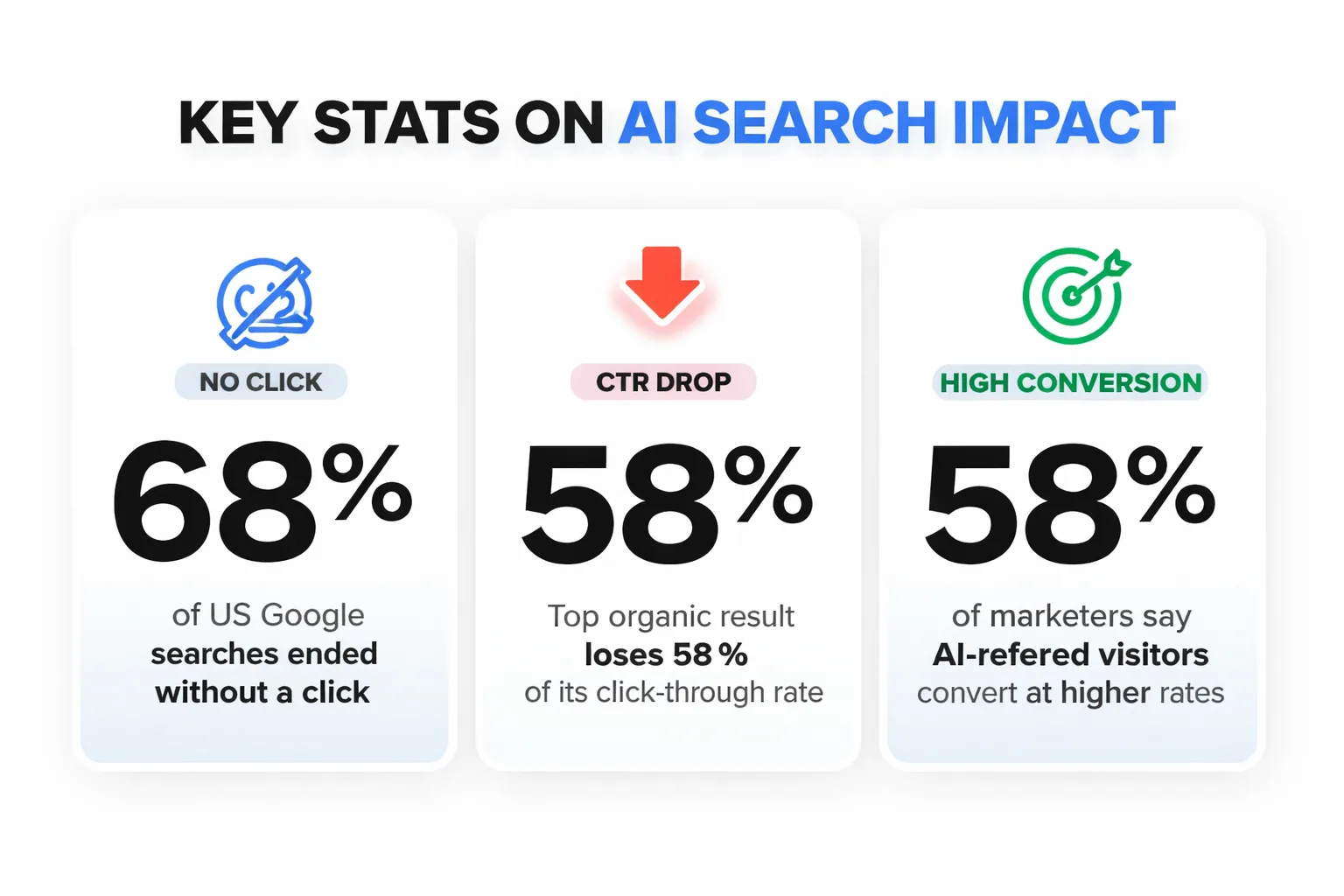
- 68% of US Google searches ended without a click in the first four months of 2026, forcing new domains to track AI summaries from day one.
- When AI Overviews appear, the top organic result loses 58% of its click-through rate, so run a baseline LLM visibility audit before any content launch.
- 58% of marketers report higher conversion rates from AI-referred traffic than traditional organic visits, making competitor analysis in AI search tools a priority over classic SEO.
- Follow the five-step framework—define buyer prompts, choose an LLM coverage platform, run a baseline, identify gaps, then publish and iterate—to build citations for domains starting with zero authority.
Maya had spent four months building the perfect e-commerce launch: clean site architecture, a content calendar, a backlink outreach plan, and a competitive keyword map her agency was proud of. Two weeks after going live, a colleague typed the brand's core product into Perplexity and watched three competitors get named in the AI summary. Her domain wasn't mentioned once. Maya had never considered that a new category of visibility existed, that LLMs were forming opinions about her domain before most humans had even visited it.
68% of US Google searches ended without a click in the first four months of 2026. When AI Overviews appear, the top organic result loses roughly 58% of its click-through rate. And according to HubSpot's 2026 State of Marketing report, 58% of marketers say AI-referred visitors convert at higher rates than traditional organic traffic. If you're launching a new domain, you need the best platform for ai search optimization competitor analysis you can find, because the old playbook of ranking first and waiting for traffic is dead on arrival. I've spent the last year auditing content operations for brands navigating this exact shift, and the pattern is clear: teams that track AI visibility from day one catch up faster than teams with twice the budget who start six months late.
Here's the five-step framework I use to set up AI visibility tracking for new domains, built specifically for teams starting from zero authority, zero citations, and zero LLM mentions.
What prompts do your buyers actually use?
Most teams skip this step and it costs them months. They start with keyword research tools, export a list of 500 search terms, and try to track those in an AI visibility platform. The problem is that people type completely different language into ChatGPT and Perplexity than they type into Google. Google queries are keyword fragments: "best CRM for startups." AI queries are conversational: "What's the best CRM for a 15-person SaaS startup that needs Salesforce integration but can't afford Enterprise pricing?"
The length and specificity matter because LLMs retrieve and synthesize differently for short vs. long prompts. A two-word query might pull from a different source set than a full sentence with constraints. If you track only short keywords, you're measuring a surface your buyers barely use.
Here's how I build a prompt list for a new domain:
1. Interview five recent customers. Ask them what they typed into ChatGPT or Google when researching the problem your product solves. You'll get raw, specific language you'd never guess from a keyword tool. 2. Pull your top 20 organic keywords from Google Search Console (if you have any data) or from a competitor analysis tool like Ahrefs. Convert each into a natural-language question. "Project management software" becomes "What project management software works best for remote design teams?" 3. Add comparison prompts. Buyers in evaluation mode ask AI engines to compare options: "How does [Your Brand] compare to [Competitor]?" or "What are the alternatives to [Competitor]?" These are critical because they're where you either get cited or get excluded from the consideration set. 4. Include problem-first prompts. "How do I reduce churn in my B2B SaaS?" or "What's causing my Shopify checkout abandonment?" These prompts surface content that addresses root causes, not just product features.
You want 10-20 prompts total. Not 200. A focused list forces you to track deeply (actual response text, citation sources, mention position) rather than broadly (just a binary mentioned/not-mentioned flag). In my experience, teams that track 200 prompts get shallow data they never act on. Teams that track 15 prompts get actionable insight every single week.
The goal at this stage isn't comprehensiveness. It's representativeness. Your prompt list should mirror the actual journey your buyer takes from problem awareness to solution evaluation.
One more thing I've learned the hard way: re-validate your prompt list every quarter. The language buyers use shifts fast. In Q1, I was tracking prompts about "AI writing tools." By Q3, buyers had started asking about "AI content agents" instead. Same intent, different language. If I hadn't updated my prompt list, I'd have been tracking queries no one asks anymore.
Step 2. Choose a Tracking Platform and Connect Your Domain
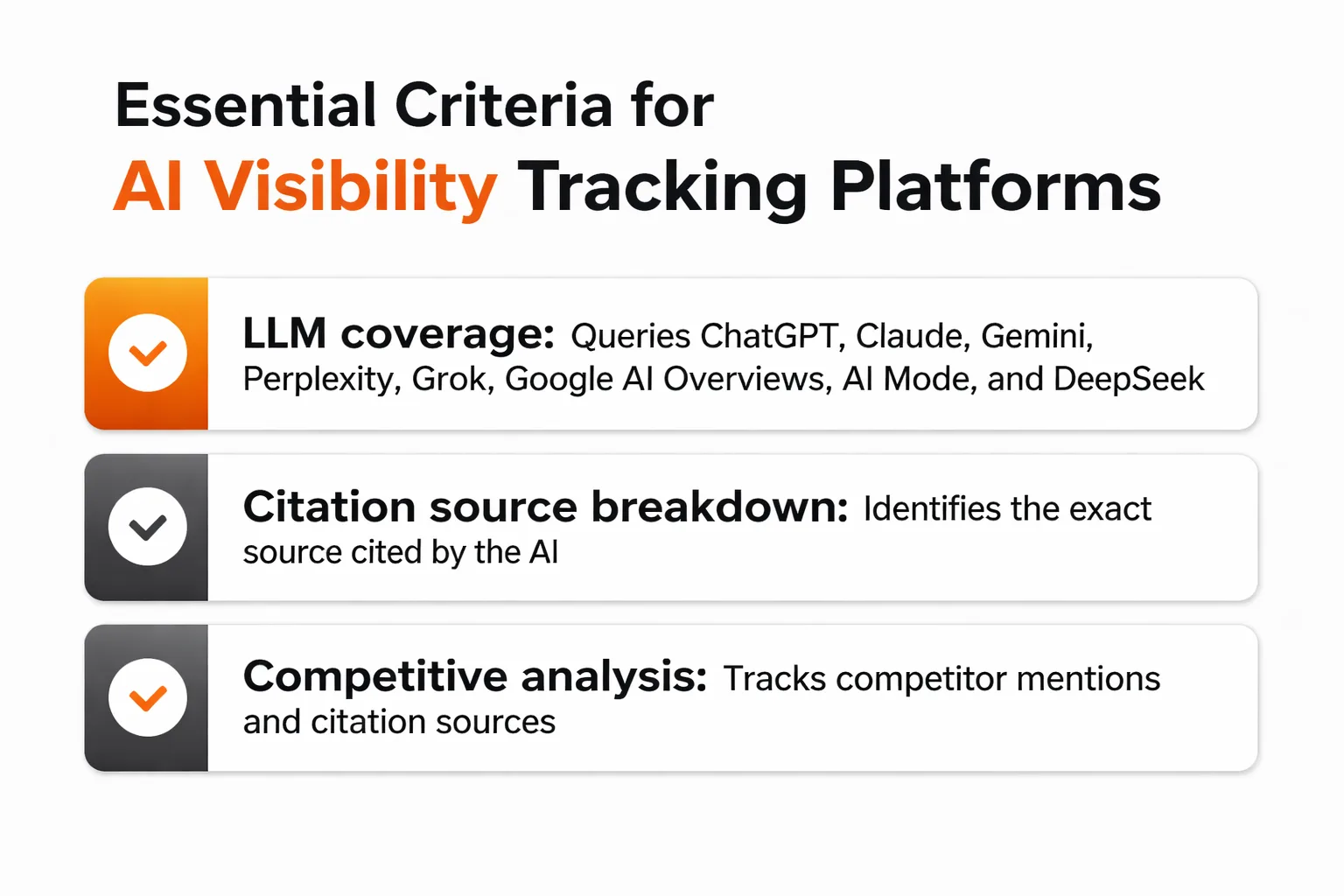
This is where most teams either overspend or underspecify. The market for AI search engine optimization tools has exploded, and the range of what these platforms actually track is wider than most buyers realize. Some tools monitor brand mentions across the open web. Others query LLMs directly and parse citation sources. A few do both. The best platform for ai search optimization competitor analysis depends on three criteria I'll walk through below.
LLM coverage. You need a platform that queries every major AI search surface: ChatGPT, Claude, Gemini, Perplexity, Grok, Google AI Overviews, AI Mode, and DeepSeek. Not just two or three. Each engine has different retrieval pipelines and training data, so your citation rate on Perplexity might be 15% while your citation rate on Claude is 0%. If your platform only covers the cheap APIs, you're flying blind on the engines that matter most to enterprise buyers. I've seen brands appear prominently in ChatGPT but get completely ignored by Gemini, and without multi-engine tracking, they'd never know.
Citation source attribution. This is the feature that separates real platforms from toys. When an AI engine mentions your brand, you need to know why. Which source did it cite? Was it your blog, a Reddit thread, a G2 review, a competitor's comparison page, or a Wikipedia entry? Without source attribution, you can't take action. You're just watching a number go up or down with no understanding of the mechanism. The platforms worth paying for show you the actual response text and the cited URL behind every mention. You can read exactly what the AI said about you and trace it to the source that fed the answer.
Competitor tracking in the same run. This is the non-negotiable feature for competitive analysis. When the platform queries a prompt, it should return not just your mention status but every competitor mentioned in the same response, their position (first mention, in a list, last), and their citation sources. This gives you share-of-voice data: if you're mentioned in 8% of responses and your top competitor is mentioned in 45%, you know exactly how much ground you need to cover.
In my work auditing content ops, I've seen teams spend $400-600/month stitching together 5-7 different tools to get what one integrated platform should provide. That's not a budget problem. That's a fragmentation problem. When your AI visibility data lives in five different dashboards, nobody looks at any of them. You need one source of truth where prompts, citations, competitors, and content gaps live in the same view.
When you connect your domain, the platform should auto-detect your brand entity and start resolving it against known knowledge graph entries. If your brand isn't in Wikidata or doesn't have a Wikipedia page, the platform should flag that as a gap on day one. Entity grounding matters more for new domains than established ones because LLMs have no prior training data about you. They learn about you from what they can find and verify. If there's nothing to find, you don't exist in the answer.
Step 3. Run Your Baseline and Read the Citation Report
Your first baseline report will be humbling. For a new domain, expect a mention rate close to zero. That's not a failure. That's your starting line. The value of the baseline isn't in the number itself. It's in the structure of the data you now have to work with.
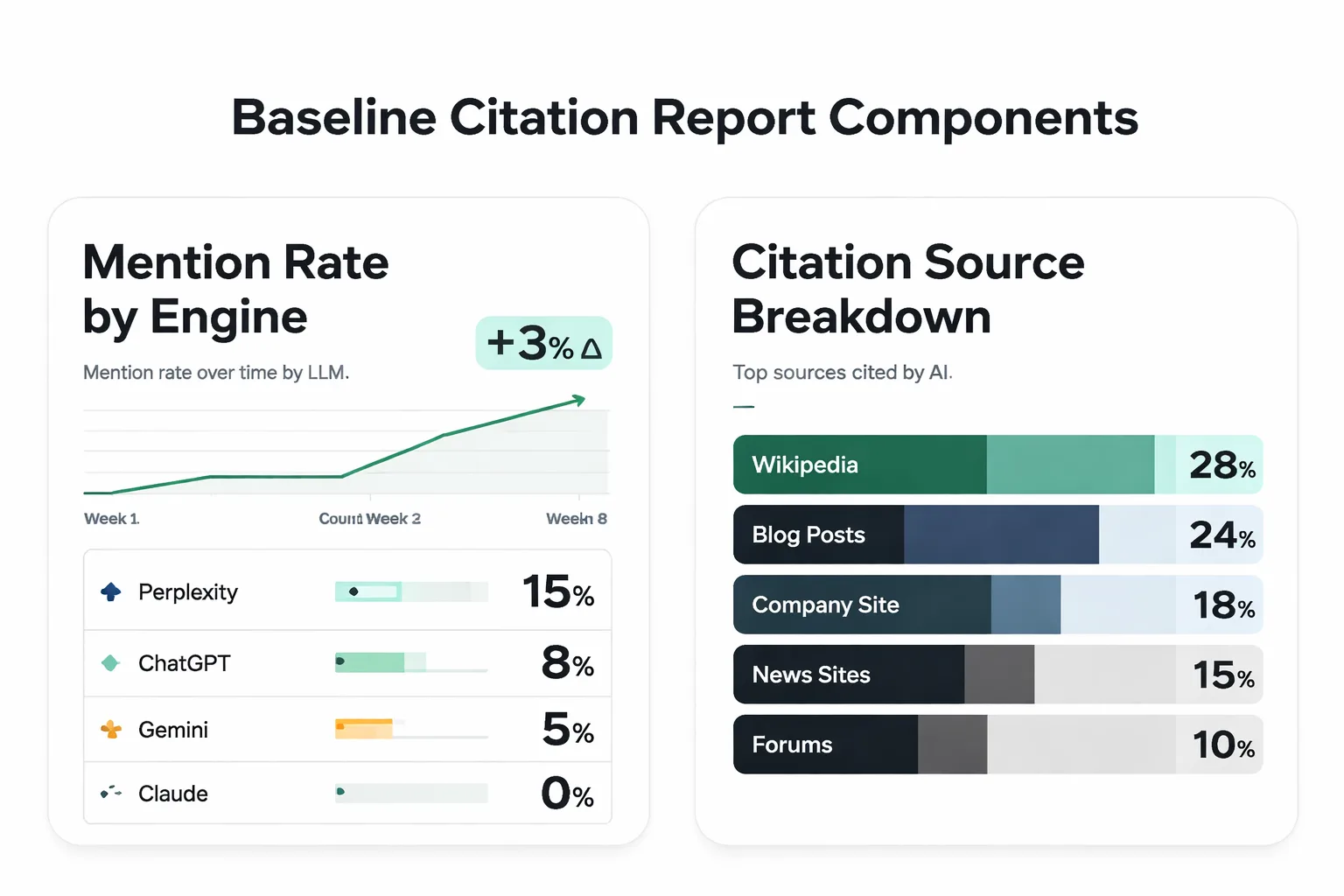
Here's what a baseline citation report should contain and how to read each section:
Mention rate by engine. This is the percentage of your tracked prompts where your brand appears in the AI's response, broken down by each LLM. You'll likely see 0% across the board for a new domain. What matters is tracking the delta over time. If you're at 0% in week one and 3% in week eight, that's movement. If you're at 0% in week one and 0% in week eight, something in your strategy isn't working and you need to diagnose why.
Citation source breakdown. When an AI mentions your brand (or when it mentions a competitor instead of you), what source did it cite? This is the most actionable data point in the entire report. If Perplexity cites a G2 comparison page when answering "best CRM for startups," and your competitor is on that page but you aren't, you now know exactly what to do: get listed on that G2 comparison page. The citation source breakdown turns an abstract visibility problem into a concrete to-do list.
Competitor share-of-voice. This shows what percentage of AI answers cite each competitor vs. you. For a new domain, your competitors will likely dominate. That's expected. What you're looking for is which competitors are cited most often and for which prompts. A competitor cited in 60% of responses for your core category prompt is a different problem than one cited in 15%. The first means they have strong entity authority in your space. The second means there's room for multiple players and you can compete.
Mention position. Where in the AI's response does your brand appear? First mention carries more weight than being listed fifth in a bulleted list. For new domains, even getting mentioned at all is a win. But as you iterate, you want to track position movement. Moving from "not mentioned" to "mentioned last in a list of five" is progress. Moving from "mentioned last" to "mentioned first" is the goal.
I tell every team I work with: screenshot your baseline report. Print it. Tape it to the wall. In 12 weeks, when your mention rate has moved from 0% to 8%, you'll want to remember where you started. The baseline is your before picture. Without it, you can't prove the work is working.
Step 4. Identify Your Highest-Leverage Content Gaps
This is where tracking becomes strategy. A citation gap report tells you which prompts you're absent from. Your job is to figure out why and prioritize which gaps to close first.
Not all gaps are equal. Some require a new article. Some require updating an existing page. Some require earning a mention on a third-party site you don't control. Here's the prioritization framework I use:
Priority 1: Source gaps where a competitor is cited from a source you can replicate. If the AI cites a competitor's blog post answering a prompt you track, and you don't have an equivalent article, write one. This is the most direct path to citation parity. The AI already told you what source format it prefers for this prompt. Match it.
Priority 2: Entity gaps where your brand isn't in the knowledge graph. If the AI doesn't mention you at all, even for brand-name prompts, you have an entity grounding problem. No amount of content will fix this until LLMs can resolve your brand as a known entity. This means creating or updating your Wikidata entry, ensuring your website has proper structured data (Organization schema, sameAs links to your social profiles), and building presence on platforms LLMs use as reference sources (Wikipedia, Crunchbase, G2, industry directories).
Priority 3: Framing gaps where you're mentioned but unfavorably. This is the one most teams miss. An AI might mention your brand as "a newer alternative" or "a budget option" while positioning a competitor as "the industry standard." You're technically visible, but the framing actively funnels buyers away from you. Fixing this requires content that establishes your positioning in the terms you want to be known for. If you want to be cited as "the best [X] for [Y]," your content needs to make that case with evidence, not just claim it.
Priority 4: Volume gaps where you're absent from high-value prompts. Some prompts get asked more than others. A prompt like "What are the best project management tools?" is high-volume and high-competition. A prompt like "What's the best project management tool for a 12-person architecture firm using Revit?" is lower-volume but higher-intent and easier to win. For a new domain, I prioritize the long-tail, specific prompts first. You can win those faster, and winning them builds the entity authority that eventually helps you compete on broader prompts.
The key insight: citation gaps are diagnostic, not prescriptive. They tell you what's broken. They don't tell you what to build. You have to read the citation source, understand what the AI found valuable about that source, and then decide whether to replicate it, surpass it, or find a different angle entirely.
Wondering where your brand stands in AI search answers today?
Step 5. Publish, Re-Run, and Iterate
Tracking without action is just expensive voyeurism. The entire point of steps one through four is to inform what you publish in step five. Here's the closed-loop system I use:
Publish answer-engine optimized content. For each priority gap you identified in step four, create content that directly answers the prompt the AI was asked. This isn't traditional SEO content. It's answer engine optimization content. The structure is different. You lead with a direct answer in the first paragraph (because LLMs extract from the top of the page). You cite primary sources inline (because LLMs weight source-backed claims higher than unsourced assertions). You use clear headings that mirror the prompt's language. You include comparison tables, numbered lists, and structured data that LLMs can parse and synthesize.
Re-run the same prompts. After publishing, wait one to two weeks for indexing and retrieval. Then re-run the same 10-20 prompts you tracked in your baseline. Compare mention rate, citation source, and mention position to your baseline. Did your new article get cited? Did a competitor get displaced? Did your mention position improve? This is your iteration signal.
Track citation rate movement over 4-week cycles. Don't check daily. LLM retrieval cycles are slower than Google's index. Weekly or biweekly check-ins give you enough signal to spot trends without noise. A 4-week cycle gives you enough time for content to be indexed, for LLMs to re-train or re-retrieve, and for the data to stabilize.
In my work with brands using AI visibility tracking platforms, the teams that see the fastest movement share one habit: they close the loop within the same tool. They see a gap, draft content to fill it, publish it, and re-run the prompt without leaving the platform. The teams that struggle are the ones where the visibility data lives in one tool, the content lives in another, and the publishing happens in a third. Context switching kills momentum.
For a new domain, expect the first cycle to show minimal movement. LLMs need to discover your content, index it, and start retrieving it. The second cycle is where you'll see your first citations. The third cycle is where patterns emerge and you can start optimizing for framing and position, not just presence.
When This Framework Fails
This five-step process doesn't work for every domain. Here's where it breaks down.
Brand-new categories with no existing AI answers. If you're creating a category so new that no one is asking AI engines about it, there's nothing to track. Your prompts return empty results because the question hasn't been asked enough for LLMs to have formed an answer. In this case, visibility tracking is premature. You need category education first: foundational content that defines the problem, explains why existing solutions fall short, and positions your approach. Once buyers start asking AI engines about the category, then tracking becomes meaningful.
Highly regulated industries with thin AI coverage. In healthcare, legal, and financial services, AI engines are cautious. They hedge, disclaim, and cite authoritative institutional sources (Mayo Clinic, IRS, bar associations) rather than commercial brands. No matter how well-optimized your content is, an LLM is unlikely to recommend your law firm over a .gov or .edu source. In these spaces, the strategy shifts from direct citation to being the source that authoritative sites cite. You write the research, create the data, or publish the framework that the institutions link to. The LLM finds you through them.
Domains with no unique data or perspective. If your content is indistinguishable from what five competitors have already published, LLMs have no reason to cite you over them. AI engines prioritize novel information: original research, proprietary data, expert analysis, unique frameworks. If you can't bring any of these to the table, visibility tracking will show you exactly how invisible you are, and no amount of optimization will change that until you change what you're publishing.
Why Most Teams Skip Step 1
I want to be honest about something. Step one, the prompt definition step, is the step most teams skip. I've done it myself. You buy a platform, you're excited to see data, and the fastest path to data is importing your existing keyword list. It feels productive.
The tradeoff is real. Interviewing customers takes time. Converting keywords to natural language prompts takes mental effort. Building a comparison prompt list requires knowing your competitors well enough to know which ones buyers actually compare you against. It's the hardest step because it requires the most human input, and human input is what most teams are trying to minimize when they adopt an AI tool.
But the teams that skip it end up tracking the wrong prompts, seeing irrelevant data, and concluding that "AI visibility doesn't work for us." It does work. They just measured the wrong thing. The five extra hours you spend on prompt definition will save you five months of tracking noise.
The New Domain Advantage
Here's the contrarian take. Everyone assumes new domains are at a disadvantage in AI search. They have no authority, no backlinks, no brand recognition. In traditional SEO, that's a death sentence. In AI search, it's actually an opportunity.
Established competitors are stuck with content built for Google's ranking system: keyword-stuffed headers, thin listicles, pages optimized for featured snippets. That content is what LLMs have ingested, and much of it is low-quality. When you start from scratch, you can build content specifically for answer engines from day one. No legacy content to rewrite. no keyword cannibalization to fix, no outdated schema to clean up. You're building on a clean foundation while your competitors are renovating a house built on 2015 SEO principles.
I've seen new domains earn their first AI citation within four weeks of launch. Not because they out-authored competitors, but because they published content that answered prompts better than anything else available. LLMs don't care about your domain age. They care about whether your content answers the question, cites its sources, and is structured for extraction.
The teams winning in AI search right now aren't the ones with the biggest budgets. They're the ones who started tracking early, found their gaps fast, and closed them with content designed for the answer engine, not the search engine.
What This Won't Fix
Two things this framework won't solve, because I don't want you to expect something I can't deliver.
First, it won't fix a bad product. If your product doesn't deserve to be recommended, no amount of AI visibility optimization will make ChatGPT suggest it. LLMs are increasingly sophisticated at filtering out content that doesn't serve user intent. If your content says you're the best but the evidence doesn't support it, the AI won't cite you. And if it does cite you once, it won't for long as retrieval cycles update and user feedback signals kick in.
Second, it won't replace a real AI visibility tool with manual checking. I've seen teams try to save money by manually typing prompts into ChatGPT every week and recording results in a spreadsheet. That works for 5 prompts. It doesn't work for 20 prompts across 8 AI engines with weekly tracking, citation source attribution, and competitor share-of-voice analysis. The manual approach doesn't scale, and worse, it introduces inconsistency. Different sessions return different answers based on personalization, location, and model updates. You need a platform that queries consistently, stores results, and shows you trends over time.
How Does Generative Engine Optimization Differ from Traditional SEO?
Generative engine optimization (GEO) is the practice of structuring content so AI search engines cite your products and brands. I get asked about the AEO vs GEO distinction constantly, and the practical difference matters for how you set up tracking.
Traditional SEO optimizes for ranking positions. You target a keyword, build a page, earn backlinks, and climb the SERP. The feedback loop is clear: position goes up, traffic goes up. GEO optimizes for citation retrieval. You target a prompt, build content that answers it comprehensively, and hope the LLM ingests and retrieves your content when synthesizing an answer. The feedback loop is murkier: you publish, wait, and check if your content appears in the citation trail.
For new domains, the GEO advantage is that the playing field is flatter. Google's ranking algorithm heavily weights domain authority, backlink profiles, and historical performance. A new domain can't compete on those signals for years. LLMs, by contrast, retrieve based on relevance, recency, and source quality within a given prompt context. A well-structured, factually dense article published yesterday on a brand-new domain can outperform a thin, outdated article on a domain with 90 domain authority. I've watched it happen.
The Princeton-led GEO research found that adding citations, quotations, and statistics can lift visibility in generative engine responses by up to 40%. That's not a marginal gain. That's the difference between being cited and being invisible. For new domains, this means your content strategy should prioritize evidence-backed claims from day one. Every assertion should trace to a source. Every comparison should include data. Every recommendation should cite its reasoning.
What Role Does Entity Grounding Play for New Domains?
Entity grounding is the mechanism by which LLMs recognize your brand as a distinct, real thing. Not just a string of text on a page, but an entity with attributes: a category, a description, relationships to other entities, and a canonical source of truth.
For established companies, entity grounding happens organically. LLMs have ingested thousands of mentions across news articles, blog posts, review sites, and social media. They know what Salesforce is. They know what Notion is. They've built a rich entity profile from years of training data.
For a new domain, entity grounding is a blank slate. The LLM has never heard of you. You need to build that entity profile deliberately. Here's what I prioritize for new domains:
Wikidata. Create a Wikidata entry for your company. Include your official name, description, industry, founding date, website URL, and key personnel. Wikidata is structured, machine-readable, and widely used by LLMs as a reference source. It's the single highest-leverage entity grounding action for a new domain.
Organization schema. Add structured data to your homepage and key pages. Include your name, logo, description, sameAs links (pointing to your social profiles, Crunchbase, G2, and other canonical references). This helps LLMs connect your web presence into a unified entity.
Third-party presence. Get listed on platforms LLMs use as reference sources: G2, Capterra, Crunchbase, GitHub (for technical products), and industry-specific directories. These listings serve as independent verification of your entity. An LLM is more likely to cite you if it can corroborate your existence across multiple authoritative sources.
The llms.txt validator is a useful tool for checking whether your domain is providing the right signals to AI crawlers. It won't solve entity grounding on its own, but it ensures you're not accidentally blocking the crawlers that build entity profiles.
How Do You Translate AI Search Results Into Actionable Competitive Insights?
Reading an AI search result is different from reading a SERP. A Google results page gives you ten blue links and a rank order. An AI answer gives you a synthesized narrative with embedded citations, and the competitive intelligence is in the narrative structure, not the link list.
Here's what I look for when I read an AI answer for competitive insights:
Who gets named first. The first brand mentioned in an AI answer gets the strongest positioning effect. It's the "default" recommendation. If your competitor is always named first, you need to understand why. Is it because they have more entity authority? More high-quality content on the topic? More third-party reviews and mentions? The citation source will tell you.
What framing language is used. AI engines don't just list brands. They describe them. "X is the industry leader for enterprise teams, while Y is a lighter alternative for small businesses." That framing is a competitive positioning statement. If you're Y in that sentence, you're being positioned as the lesser option. Your content strategy needs to actively reshape that narrative.
Which sources are cited. The citation trail reveals the AI's information diet for your topic. If it consistently cites G2 reviews, you need a strong G2 presence. If it cites Reddit discussions, you need community engagement. If it cites a specific blog post, you need to understand what made that post citation-worthy and create something better.
What's absent. Sometimes the most valuable insight is what the AI didn't say. If you ask "What's the best tool for [your category]?" and the AI lists five competitors but omits you, that's a visibility gap. But if the AI lists five competitors and omits an entire use case or approach that your product serves, that's a content gap. You can own that unaddressed angle.
FAQ
How often should I re-run AI visibility prompts for a new domain?
Weekly or biweekly. LLM retrieval cycles are slower than Google's index, so daily checking creates noise without signal. A 4-week cycle gives you enough time for new content to be indexed and for LLMs to re-retrieve. I recommend weekly check-ins for the first month (because you want to catch early movement fast) and biweekly after that once you have a stable baseline.
What's a good AI mention rate for a new domain?
For a domain under six months old, anything above 0% is progress. In my experience, new domains typically see their first citation within 4-8 weeks of publishing answer-engine optimized content. A 5-10% mention rate across your tracked prompts within the first three months is a strong start. Don't compare yourself to established competitors with 40-60% mention rates. Compare yourself to your own baseline.
Do I need a Wikipedia page for AI visibility?
It helps, but it's not required. What matters is entity grounding: LLMs need to resolve your brand as a known entity. Wikipedia is one signal, but Wikidata entries, llms.txt validation, proper Organization schema on your site, and presence on platforms LLMs reference (Crunchbase, G2, GitHub for technical brands) all contribute. If you can't get a Wikipedia page (they're hard to earn for new companies), focus on the other signals.
Can I use traditional SEO tools for AI visibility tracking?
Not effectively. Traditional SEO tools like Semrush and Ahrefs excel at backlink analysis, keyword tracking, and technical SEO. They don't query LLMs directly or parse AI response citations. Some are adding AI features, but they're bolted onto a Google-first architecture. For AI visibility, you need a platform built from the ground up to query AI engines, parse natural language responses, and track citation sources. That said, traditional tools are still valuable for the foundational SEO work that supports AEO vs SEO strategy.
How is generative engine optimization different from regular SEO?
Generative engine optimization focuses on getting cited in AI-generated answers, not ranking in search result pages. The key differences: content structure (direct answers first, not keyword-optimized headers), source attribution (citing primary sources inline so LLMs can verify claims), entity grounding (ensuring LLMs recognize your brand as a legitimate entity), and conversational language (matching how people phrase questions to AI, not how they type into Google). The AEO vs GEO distinction matters because the tactics don't fully overlap.
What's the minimum budget for AI visibility tracking?
Expect to spend $50-300/month for a solid platform. Entry-level plans cover basic mention tracking across major LLMs. Mid-tier plans ($200-300/month) add citation source attribution, competitor tracking, and content gap identification. Enterprise plans add multi-domain management, team collaboration, and API access. For a new domain with one brand, a mid-tier plan is usually the right starting point.
About the Author
Judy Zhou, Founder
Judy Zhou leads content strategy at Meev, where she oversees AI-driven content research and publishing for hundreds of brands. With a background in SEO and editorial operations, she focuses on building content systems that rank on Google, get cited by AI search engines, and drive measurable business results.
Run your first AI visibility baseline this week and see exactly which prompts cite your competitors instead of you.