

Best Bing Rank Tracker Tools for 2026
By Judy Zhou, Founder
Key Takeaways
- Bing rank tracking now measures AI citation eligibility in Copilot, where only 12% of AI-cited URLs rank in Google's top 10 per Ahrefs' analysis of 15,000 prompts.
- Connect your Bing rank tracker to AI citation data, since Bing Webmaster Tools launched its AI Performance dashboard in public preview on February 10, 2026.
- Monitor Bing visibility for Microsoft Copilot citations across M365, Windows, and Edge rather than the old 3-5% search traffic metric.
- Treat Bing indexing as binary for entity existence in Copilot, as its index—not Google's—powers the citation pipeline for enterprise answer engines.
'If your entity isn't grounded in Bing's index, you don't exist in Copilot. It's that binary,' said Lily Ray, VP of SEO Strategy at Amsive, speaking at SMX Advanced 2025. That framing redefines what a Bing rank tracker actually measures in 2026. It's no longer just a secondary SERP position report. It's a proxy for AI citation eligibility, knowledge graph presence, and LLM retrieval likelihood across the fastest-growing answer engine ecosystem in enterprise software. The tools you choose to monitor Bing visibility will determine how much of that landscape you can actually see and act on.
The conventional wisdom about Bing rank tracking is wrong. Most SEO teams treat Bing as a secondary check, a box to tick after Google rankings are sorted. That posture was defensible in 2022. In 2026, it's actively dangerous. Bing's index feeds Microsoft Copilot, and Ahrefs' analysis of 15,000 prompts found only 12% of AI-cited URLs rank in Google's top 10 for the same query. The citation pipeline runs through Bing, not Google. Bing Webmaster Tools launched its AI Performance dashboard in public preview on February 10, 2026, confirming that Microsoft now treats Bing indexing and AI citation as the same product surface. A bing rank tracker that only reports SERP positions, without any connection to AI citation data, is measuring the wrong thing.
Why Bing Visibility Matters More Now
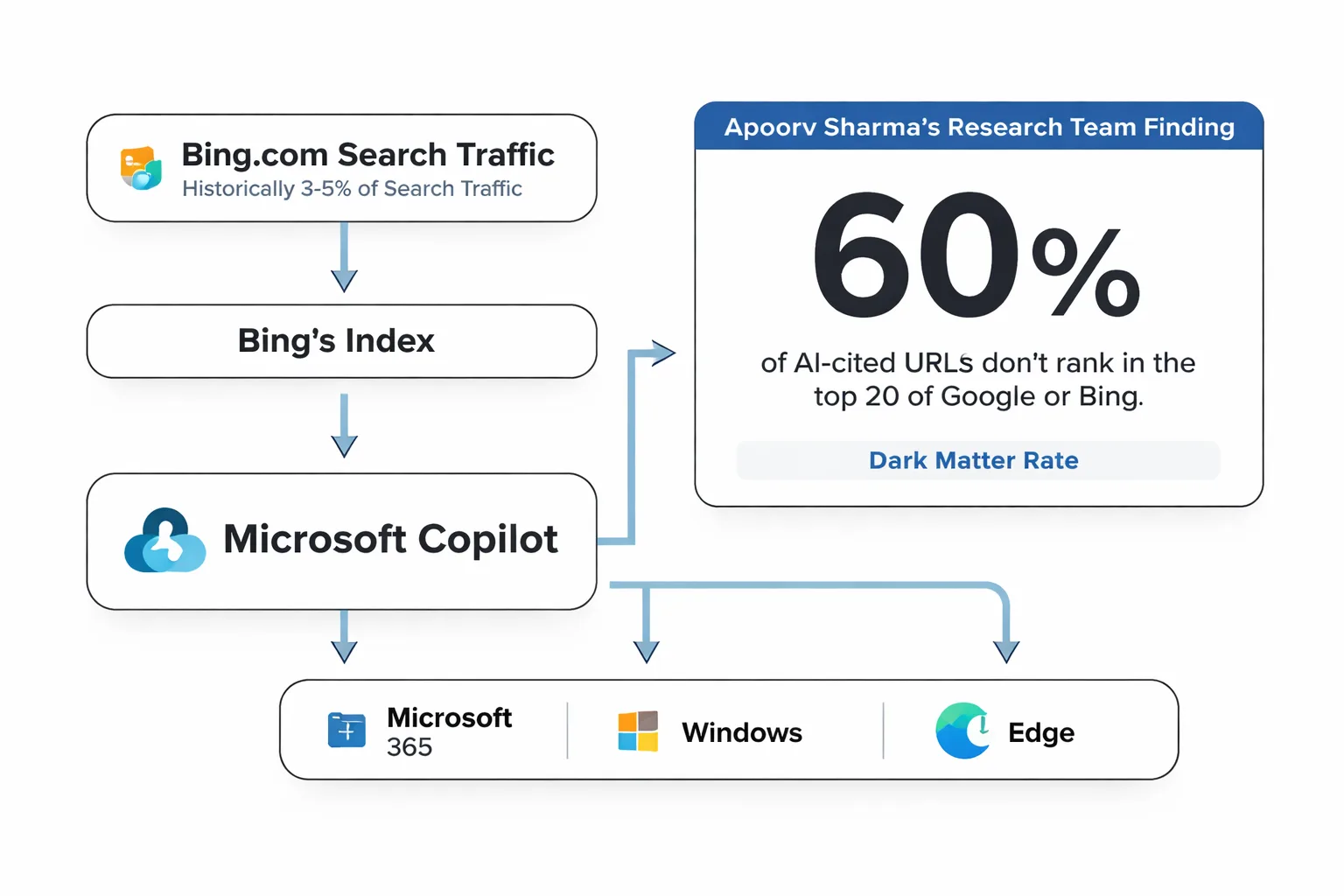
The old argument for tracking Bing was simple: it powered ~3-5% of search traffic, so you tracked it as a secondary signal. That math doesn't hold anymore. The value of Bing visibility is no longer just the clicks that come from Bing.com. The value is the citations that flow from Bing's index into Microsoft Copilot, which serves enterprise search across Microsoft 365, Windows, and Edge.
Apoorv Sharma's research team found that 60% of AI-cited URLs don't rank in the top 20 of Google or Bing, creating what he calls a 'dark matter rate' where pages shaping AI presence are invisible to standard rank trackers. That finding should reframe how you think about position tracking entirely. If you're only tracking positions 1-20, you're missing the majority of pages that AI engines actually cite. The implication is direct: a bing rank tracker needs to go beyond traditional SERP positions and connect to AI citation visibility, or it's giving you an incomplete picture of your search presence.
This is where the connection to answer engine optimization becomes critical. AEO isn't just about optimizing content for AI answers. It's about ensuring the sources AI engines retrieve are sources you control or have influenced. Bing's index is a primary retrieval layer for Copilot. If your entity, your content, and your brand aren't grounded in that index, Copilot will construct answers from competing sources. A bing rank tracker that shows you where you rank on Bing.com is the first step. But the real goal is understanding whether those rankings translate into AI citations.
The strategic shift is this: Bing tracking has moved from a traffic-optimization task to a generative engine optimization task. You're not tracking Bing to get more Bing clicks. You're tracking Bing because Bing's index is the grounding layer for one of the most widely deployed AI assistants in enterprise software. Teams that understand this distinction are already building Bing-specific content strategies. Teams that don't are still wondering why their Google rankings don't translate into AI visibility.
Consider a concrete scenario. A B2B SaaS company sells procurement software. They rank #1 on Google for 'procurement automation platform.' But on Bing, they rank #4, behind three competitors who have invested in Bing Webmaster Tools submission, IndexNow pinging, and structured data markup. When a procurement manager asks Microsoft Copilot 'what are the best procurement automation platforms,' Copilot retrieves from Bing's index. The competitors at positions 1-3 on Bing are far more likely to be cited in the answer, because Bing's retrieval system weights its own ranking signals. The company ranking #1 on Google but #4 on Bing is invisible in the AI answer. This is not a hypothetical. It's the structural reality of how Copilot retrieves information.
How Does Bing Feed AI Search?
Bing's relationship to AI search is structural, not incidental. Microsoft Copilot retrieves information from Bing's index when generating answers. This means Bing's crawl frequency, index freshness, and entity understanding directly influence what Copilot knows about your brand. The Ahrefs AI search overlap study tested 15,000 long-tail queries across Google and Bing and found an 11% average citation overlap between AI assistants and Google/Bing top 10 combined. Perplexity showed higher overlap at roughly 33% (1 in 3 citations from top 10), but the overall pattern is clear: AI engines pull from a much wider source pool than traditional SERP rankings capture.
The mechanism works in layers. First, Bing crawls and indexes your content. Second, Bing's knowledge graph extracts entities, relationships, and attributes from that content. Third, when a user asks Copilot a question, Copilot's retrieval system queries Bing's index for relevant passages. Fourth, Copilot generates an answer using those passages and cites the source URLs. Your Bing ranking position matters because it signals to Bing's retrieval system that your content is relevant and authoritative for a given topic. But ranking alone isn't sufficient. Entity grounding, structured data, and knowledge graph presence determine whether Copilot recognizes your brand as a distinct, citable entity.
This is why a modern bing rank tracker needs to do more than report positions. It needs to help you understand whether your Bing presence is translating into AI retrieval. The Bing Webmaster Tools AI Performance dashboard is one data source for this, though it tracks citation visibility only (not clicks, rankings, or traffic). The gap between what standard rank trackers show and what AI engines actually cite is where most brands lose visibility without knowing it.
The retrieval layer also explains why Bing's IndexNow protocol matters more than most SEO teams realize. IndexNow lets you ping Bing the moment you publish or update content, bypassing the normal crawl queue. For time-sensitive content, this can mean the difference between being cited in a Copilot answer within hours versus waiting days for Bing's crawler to discover the change. A bing rank tracker that monitors position changes should ideally be paired with an IndexNow submission workflow, so that when you publish new content, Bing's index updates immediately and your rank tracker can begin measuring the impact.
What a Bing Rank Tracker Actually Measures
A bing rank tracker reports your URL's position in Bing's organic search results for tracked keywords. That's the baseline definition. But the best tools in 2026 measure more than a single number. They track SERP feature occupancy (featured snippets, knowledge panels, image packs, local packs), position changes over time, competitor positions for the same keywords, and visibility scores that aggregate across a keyword set.
The limitation is that traditional rank tracking captures only one layer of visibility. Semrush's 2025 AI Overviews study analyzed 200,000 queries and found that AI Overviews appear for many informational queries where traditional SERP features are sparse. The same dynamic applies to Bing and Copilot. A page can rank position 4 on Bing, never appear in a Copilot citation, and a page ranking position 25 can be the primary source for a Copilot answer. The disconnect happens because AI retrieval considers factors beyond rank position: content structure, entity salience, passage-level relevance, and knowledge graph connections.
This is why teams focused on AI search optimization need to think of rank tracking as one signal in a larger visibility stack. A bing rank tracker tells you where you stand in Bing's organic results. An AI visibility tool tells you whether AI engines are actually citing your content. You need both. Tracking Bing without tracking AI citations is like tracking your website's load speed without tracking whether users actually convert. The metric is necessary but insufficient.
The practical implication for tool selection is this: evaluate bing rank trackers not just on their SERP reporting accuracy, but on whether they integrate with or connect to AI citation data. Tools that exist in isolation from the AI search layer will become less relevant as more search experiences shift to generative answers.
To make this concrete, consider what happens when a brand tracks 500 keywords on Bing using a traditional rank tracker. The tool reports that the brand ranks in the top 10 for 120 of those keywords. That looks like strong visibility. But when the same brand checks Copilot citation data for those same 500 topics, they find their brand is cited in only 15 Copilot answers. The 120 top-10 Bing rankings produced 15 AI citations. That's a 12.5% conversion rate from ranking to citation. Without tracking both layers, the brand would assume their Bing visibility is producing AI presence when it isn't. The delta between 120 rankings and 15 citations is the optimization gap, and it's only visible when you track both signals together.
Are your Bing rankings actually translating into Copilot citations?
Key Features That Matter in 2026
The feature set for a bing rank tracker has expanded. Here's what to evaluate:
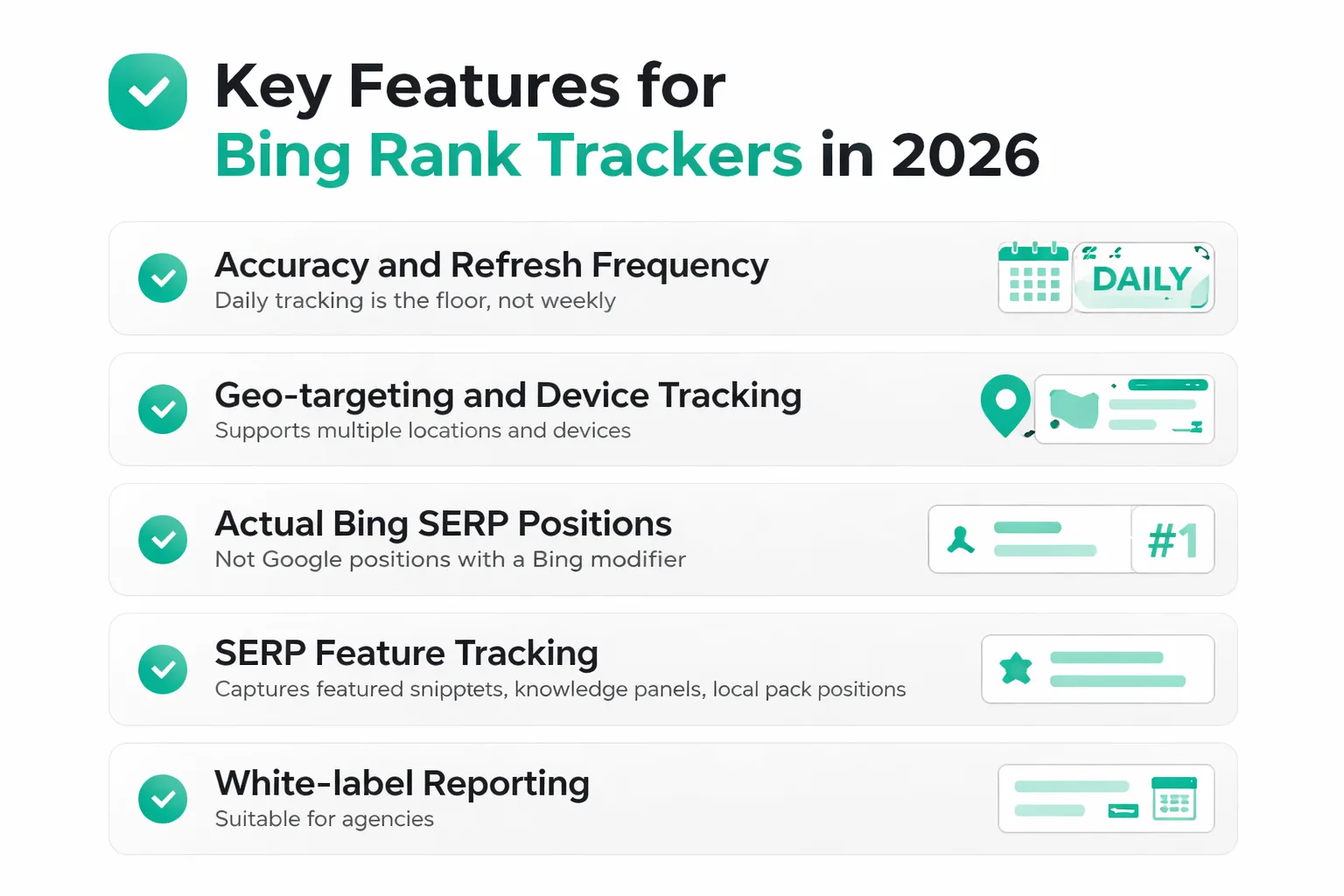
Accuracy and refresh frequency. Daily tracking is the floor. Bing's index updates can shift positions significantly within 24 hours, especially for news-adjacent queries. Tools that refresh weekly will miss meaningful volatility. Look for tools that report actual Bing SERP positions, not Google positions with a Bing modifier applied. Some lower-quality tools estimate Bing rankings based on Google data and a correlation model. That approach is fundamentally unreliable because Bing and Google use different algorithms, different ranking signals, and different SERP layouts. A bing rank tracker that doesn't query Bing's actual SERP is not a bing rank tracker.
Geo-targeting and device tracking. Bing serves different results by location and device. A bing rank tracker that only reports desktop positions for a default US location will miss the full picture. For teams running ecommerce GEO strategies, geo-targeted Bing tracking is essential because Copilot's answers vary by region and language. A brand ranking #1 for 'CRM software' on Bing in the US might rank #6 in the UK and not at all in Germany. If your business serves multiple markets, you need a tool that tracks Bing positions per location, not a single aggregated position.
SERP feature tracking. Bing's SERP includes featured snippets, knowledge panels, people-also-ask boxes, and image packs. These features matter because they signal that Bing has structured understanding of the content behind them. A page occupying a Bing featured snippet is more likely to be retrieved by Copilot than a page ranking position 3 in plain organic results. Track SERP features, not just blue-link positions.
Competitor analysis. Knowing your own position is table stakes. Knowing where competitors rank on Bing, and more importantly, whether competitors are being cited by Copilot when you're not, is where the strategic value lives. Look for tools that let you track competitor domains alongside your own.
Reporting and integrations. The best tools produce reports that non-SEO stakeholders can understand. Look for white-label reporting, scheduled email digests, and API access for teams that need to pipe Bing ranking data into dashboards or AI visibility reporting systems.
AI citation connection. This is the differentiator that most tools still lack. A bing rank tracker that can cross-reference Bing positions with AI citation data gives you the full picture. This is where the market is heading, and where tools like Meev's LLM visibility tool are creating a new category that bridges traditional rank tracking with AI citation monitoring.
Comparison of Leading Bing Rank Tracking Tools
The market for bing rank tracking tools splits into two tiers: established SEO platforms that include Bing tracking as part of a broader suite, and specialized tools that focus on rank tracking precision. Here's how the leading options compare for 2026.
Nightwatch
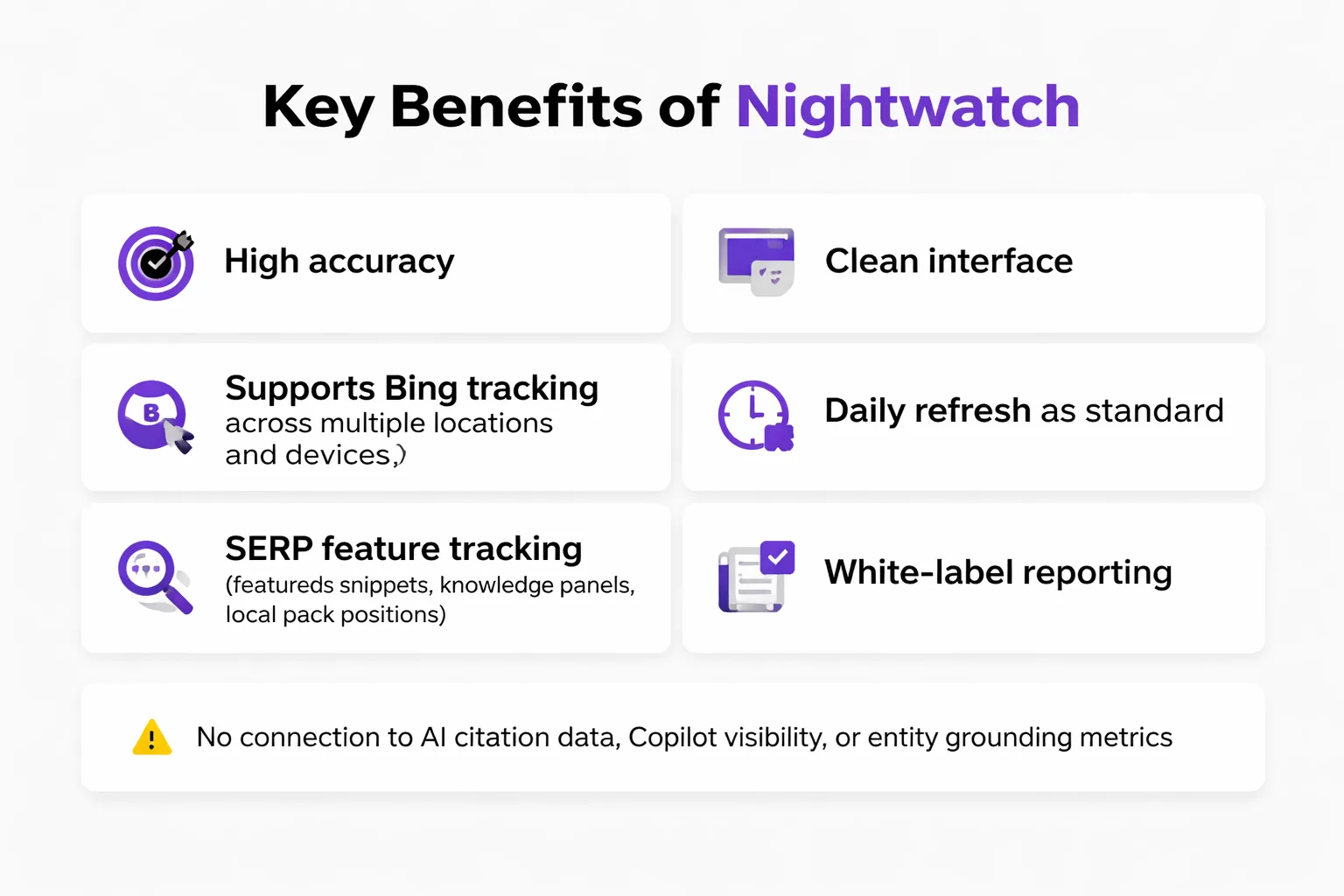
Nightwatch is a rank tracking tool known for its accuracy and clean interface. It supports Bing tracking across multiple locations and devices, with daily refresh as standard. Nightwatch's strength is its SERP feature tracking, which captures Bing featured snippets, knowledge panels, and local pack positions. The tool also offers white-label reporting, making it suitable for agencies managing multiple clients.
The limitation is that Nightwatch operates entirely within the traditional SERP tracking paradigm. There's no connection to AI citation data, no Copilot visibility reporting, and no entity grounding metrics. For teams that need a reliable bing rank tracker for position reporting, Nightwatch delivers. For teams building an AEO strategy, it's one piece of a larger puzzle that requires additional tools.
SEO PowerSuite
SEO PowerSuite's Rank Tracker tool is a desktop-based option that supports unlimited keyword tracking across Bing, Google, and other search engines. It's one of the few tools that offers a true perpetual license model, which appeals to teams that prefer one-time software purchases over SaaS subscriptions. The tool supports geo-targeted Bing tracking, competitor analysis, and scheduled reporting.
The desktop architecture is both a strength and a weakness. It gives you full control over data and doesn't impose keyword limits based on subscription tier. But it requires local compute resources, doesn't offer cloud-based collaboration, and has no AI citation integration. SEO PowerSuite is a solid choice for individual practitioners and small teams that need deep rank tracking without ongoing subscription costs. It's not the right choice for teams that need real-time collaboration or AI visibility layering.
AccuRanker
AccuRanker positions itself as a fast, enterprise-grade rank tracker with Bing support. Its key differentiator is speed: AccuRanker can process large keyword sets and deliver updated positions faster than most competitors. The tool supports daily Bing tracking, SERP feature reporting, and competitor analysis. It also offers API access, which makes it suitable for teams that need to integrate Bing ranking data into custom dashboards.
AccuRanker's weakness is the same as Nightwatch's: it's a traditional rank tracker with no AI citation layer. The tool reports what Bing's SERP looks like, not what Copilot is citing. For teams that need both, AccuRanker will need to be paired with a dedicated AI visibility tool. The cost of running two separate platforms is a consideration for smaller teams.
GeoRanker
GeoRanker specializes in geo-targeted rank tracking, which makes it particularly relevant for local SEO and ecommerce GEO strategies. The tool supports Bing tracking across specific cities and regions, not just country-level targeting. This granularity matters because Bing's results vary significantly by location, and Copilot's answers inherit that geographic variation.
GeoRanker's focus on geo precision is its main advantage. The trade-off is a narrower feature set compared to full-suite tools. There's no site audit, no backlink analysis, and no content optimization module. For teams that specifically need location-level Bing tracking, GeoRanker is worth evaluating. For teams that need a broader SEO platform, it's better used as a specialized complement.
SEOptimer
SEOptimer is primarily an SEO audit tool that includes basic rank tracking functionality. It's not a dedicated bing rank tracker, but it does report Bing positions for tracked keywords. The appeal is simplicity: SEOptimer is easy to set up, produces clean reports, and is priced for small businesses.
The limitation is depth. SEOptimer's rank tracking is basic compared to dedicated tools. There's no SERP feature tracking, no competitor position monitoring, and no API access. For a small business that wants a quick read on Bing positions alongside an SEO audit, SEOptimer works. For a team building a serious Bing visibility strategy, it's insufficient as a primary tool.
ScrapeGraphAI (API Approach)
For engineering teams that want full control, ScrapeGraphAI offers an API-based approach to building a custom bing rank tracker. Rather than paying for a SaaS platform, you build a scraping pipeline that queries Bing's SERP, parses positions, and stores data in your own database. The advantage is total customization: you define what to track, how often, and how the data is structured.
The disadvantage is engineering overhead. Building and maintaining a SERP scraper requires handling rate limits, proxy management, CAPTCHA solving, and parser updates when Bing changes its SERP layout. For teams with dedicated engineering resources, this approach offers maximum flexibility. For marketing teams without engineering support, it's impractical. The API approach also doesn't solve the AI citation gap; you'd still need a separate system for tracking Copilot visibility.
Free vs. Paid Bing Rank Tracking
The free options for Bing rank tracking are limited but worth understanding. Bing Webmaster Tools is the primary free resource. It provides some ranking data for your own verified domains, and with the AI Performance dashboard launched in February 2026, it now shows citation visibility in Copilot answers. This is a significant addition that makes Bing Webmaster Tools more valuable than it was even six months ago.
The limitation of Bing Webmaster Tools is that it only shows data for your own domains. You can't track competitor positions, you can't track keywords you don't already rank for, and the data is limited to what Bing chooses to expose. It's a diagnostic tool, not a strategic planning tool.
Free SERP rank tracker tools exist, but most are limited to Google. The few that support Bing typically offer restricted keyword counts (5-10 keywords), infrequent refresh (weekly), and no SERP feature tracking. For a team just starting to think about Bing visibility, these tools can provide a baseline. But they won't support a serious AEO strategy.
Paid tools range from $30-100/month for entry-level options to $200-500/month for enterprise-grade platforms. The question isn't whether to pay for a bing rank tracker. The question is whether the tool you're paying for is measuring the right things. A $99/month tool that reports Bing positions but ignores AI citations is less valuable than a $99/month tool that connects Bing positions to Copilot citation data.
The cost calculus changes when you factor in the AI citation gap. If you're paying $99/month for a traditional bing rank tracker and another $99/month for a separate AI visibility tool, you're spending $198/month and reconciling two data sources manually. A unified platform that tracks both Bing positions and AI citations in a single dashboard may cost $150-270/month but eliminates the integration overhead and provides a more coherent data picture. For small teams where time is the most expensive resource, the unified approach is often more cost-effective despite the higher sticker price.
How to Set Up Bing Rank Tracking
Setting up a bing rank tracker involves five steps. First, identify the keywords that matter for your Bing visibility. These aren't always the same keywords you track for Google. Bing's user base skews toward enterprise and desktop, which means informational and B2B queries may have different relative importance. Use a keyword combiner approach to expand your seed list into Bing-specific long-tail variations.
Second, configure geo-targeting. Bing's results vary by location, and if your business serves specific regions, you need to track positions for each relevant location. For national brands, track at the country level. For local businesses, track at the city level. For ecommerce, track in every market you ship to.
Third, add competitor domains. Track the same keywords for your top 3-5 competitors on Bing. This gives you relative visibility data, not just absolute position data. The goal is to understand whether you're gaining or losing ground on Bing compared to competitors, because that relative position influences which brands Copilot is more likely to cite.
Fourth, enable SERP feature tracking. Make sure your tool is capturing Bing featured snippets, knowledge panels, and local pack positions. These features signal that Bing has structured understanding of your content, which is a prerequisite for Copilot citation.
Fifth, connect Bing ranking data to AI citation data. This is the step most teams skip. Use an AI visibility checker to monitor whether your brand is being cited in Copilot answers for the same topics you're tracking on Bing. The gap between your Bing ranking position and your Copilot citation rate is the most actionable metric in this entire workflow.
The setup process reveals a critical operational truth: keyword selection for Bing tracking should not simply duplicate your Google keyword list. Bing's audience demographics differ. According to data from Microsoft's advertising materials, Bing reaches 140 million unique US searchers, with a skew toward the 35-54 age range and higher household incomes. For B2B SaaS companies, financial services, and enterprise software, Bing's audience may actually be more valuable per click than Google's. This means your bing rank tracker keyword list should prioritize commercial-intent and decision-maker queries that align with Bing's user profile, rather than casting the same wide net you use for Google.
The AI Citation Gap Nobody Talks About
Here's the contrarian take that most rank tracking articles won't tell you: tracking Bing positions without tracking AI citations is like tracking your website's Google ranking without checking your Google Analytics. You know where you rank, but you have no idea whether that ranking is producing the outcome you actually care about.
BrightEdge research found that AI search accounts for less than 1% of referral traffic compared to organic search. But that stat is misleading in a specific way. AI search referral traffic is low because AI engines don't always send clicks. They serve answers directly. The value of being cited in an AI answer isn't measured in referral traffic. It's measured in brand perception, buyer influence, and share-of-voice in the answers that shape purchasing decisions.
SparkToro research found that AI tools produce inconsistent brand recommendation lists, which means a single citation check is unreliable. You need consistent, ongoing monitoring to establish a reliable baseline. This is why a bing rank tracker that also connects to AI citation monitoring across multiple surfaces is more valuable than a tool that only does one.
The gap between Bing ranking and AI citation is where most brands lose visibility. A page can rank well on Bing, have strong content, and still never get cited by Copilot because it lacks entity grounding, structured data, or knowledge graph connections. Conversely, a page ranking position 15 on Bing can be the primary source for a Copilot answer if it has the right entity signals. The Carnegie Mellon LLM consistency research modeled how LLMs produce inconsistent outputs, which means citation tracking requires repeated measurement over time, not one-off checks.
This is the core argument for why a bing rank tracker in 2026 can't exist in isolation from AI visibility monitoring. The two data streams need to be read together. Bing ranking tells you what Bing's index thinks of your content. AI citation tracking tells you what Copilot's retrieval system actually does with that content. The delta between those two signals is your optimization roadmap.
The BrightEdge data also reveals a growth trajectory that makes this gap more urgent. Claude achieved 58% growth in AI search referral traffic in July 2025, followed by 21% in August. Grok achieved 1,279% growth in July. These numbers are small in absolute terms but the growth rates signal that AI search is compounding. The brands that establish citation presence now, while the ecosystem is still forming, will have a structural advantage as AI search volume grows. Waiting until AI search accounts for 5% or 10% of referral traffic means competing against established citation patterns that are hard to displace.
Which Tool Should You Pick?
The decision comes down to what you're actually trying to achieve. If the goal is traditional SEO position reporting on Bing, any of the dedicated rank trackers (Nightwatch, AccuRanker, SEO PowerSuite) will work. Pick based on budget, team size, and reporting needs.
If the goal is building an AI search visibility strategy where Bing is one input into a larger system, the calculus changes. You need a bing rank tracker that either integrates with AI citation monitoring or can be paired with a dedicated AI visibility tool. The combination of a traditional rank tracker plus an AI visibility tracker gives you both layers: Bing SERP positions and AI citation presence.
For teams that want a single platform, the emerging category of tools that combine traditional rank tracking with AI citation monitoring is where the market is heading. Meev's platform, for example, tracks AI visibility across every major AI search surface while also monitoring SERP-driven surfaces, giving teams a unified view of both traditional rankings and AI citation presence. This eliminates the need to stitch together separate tools and reconcile data across platforms.
The worst choice in 2026 is to pick a bing rank tracker based solely on 2022 criteria: accuracy, price, and keyword limits. Those factors still matter, but they're table stakes. The differentiator is whether the tool connects Bing ranking data to AI citation outcomes. Tools that don't make that connection will leave you optimizing for a metric that no longer fully captures what 'visibility' means.
FAQ
Can I track Bing rankings for free?
Bing Webmaster Tools provides limited ranking data for your verified domains at no cost. The platform now includes an AI Performance dashboard (launched February 2026) that shows citation visibility in Copilot answers. However, free tools don't support competitor tracking, custom keyword sets, or SERP feature monitoring. For a serious Bing visibility strategy, a paid tool is necessary.
How often should I check Bing rankings?
Daily tracking is the recommended frequency for a bing rank tracker. Bing's index can shift positions within 24 hours, especially for competitive or news-adjacent queries. Weekly tracking will miss meaningful volatility and delay your response to ranking changes. Most paid rank tracking tools offer daily refresh as standard.
Does Bing ranking affect Copilot citations?
Bing ranking is correlated with Copilot citation likelihood but doesn't guarantee it. Copilot retrieves from Bing's index, so pages that rank well on Bing are more likely to be retrieved. However, entity grounding, structured data, and knowledge graph presence also influence citation. A page ranking position 15 with strong entity signals can be cited over a page ranking position 3 without them. Track both Bing positions and AI citations to understand the full picture.
What's the difference between a SERP rank tracker and an AI visibility tool?
A SERP rank tracker reports your URL's position in search engine results pages. An AI visibility tool reports whether your brand is mentioned and cited in AI-generated answers across surfaces like ChatGPT, Copilot, Perplexity, and Claude. The two tools measure different things: one tracks organic search positions, the other tracks AI citation presence. Teams focused on AEO vs SEO need both data streams to understand their full search visibility.
Should I track Bing separately from Google?
Yes. Bing and Google use different ranking algorithms, serve different user demographics, and have different relationships to AI search. Bing feeds Microsoft Copilot, while Google feeds Google AI Overviews and AI Mode. Tracking Bing separately ensures you're optimizing for the right AI citation pipeline. The keywords that matter on Bing may also differ from Google, particularly for B2B and enterprise queries.
How does Bing Webmaster Tools' AI Performance report work?
The AI Performance dashboard in Bing Webmaster Tools (launched February 10, 2026, in public preview) shows citation visibility in Copilot answers for your verified domains. It reports which pages are being cited, for what queries, and how often. The dashboard tracks citation visibility only, not clicks, rankings, or traffic. It's a useful diagnostic tool but doesn't replace a full bing rank tracker or AI visibility platform.
The bing rank tracker you choose in 2026 should be measured by one criterion above all: does it help you understand not just where you rank on Bing, but whether that ranking translates into AI citation presence? If the answer is no, you're tracking a metric that captures less than half of what visibility now means.
About the Author
Judy Zhou, Founder
Judy Zhou leads content strategy at Meev, where she oversees AI-driven content research and publishing for hundreds of brands. With a background in SEO and editorial operations, she focuses on building content systems that rank on Google, get cited by AI search engines, and drive measurable business results.
Stop guessing whether your Bing visibility matters. See exactly where your brand is cited across every major AI search surface and close the gap between rankings and real AI visibility.