
By Judy Zhou, Head of Content Strategy
Key Takeaways
- AI-powered search now accounts for more than 40% of searches, yet most enterprise rank trackers still report only traditional blue-link positions — leaving teams blind to their actual brand visibility.
- SE Ranking is the strongest value pick for growing agencies, tracking AI Overviews, ChatGPT, Gemini, and Perplexity alongside traditional rankings starting at $65/mo with a 14-day free trial.
- Conductor's 2026 AEO/GEO Benchmarks Report found the average AI referral traffic across 13,770 enterprise domains is just 1.08% — meaning most brands are barely registering in AI search, making tracking urgent.
- The critical distinction to make in 2026: citation appearances (your content sourced by an LLM) and recommendation appearances (your brand named as the solution) almost never match — and the gap between them is where enterprise AI search strategy lives.
Marcus pulled up the weekly rankings report on a Tuesday morning, same as always. Positions were holding. The dashboard was green. Then a colleague forwarded a screenshot: their top competitor was being cited by name in ChatGPT responses to every high-intent query they'd spent three years ranking for. Marcus's tool had no column for that. No alert had fired. The brand was invisible in the search surface that had quietly become their audience's first stop. And no one on his enterprise SEO team had known.
That story is not a hypothetical. AI-powered search experiences now account for more than 40% of all searches, with nearly 1 billion users relying on AI assistants to find information. Enterprise rank tracking software that ignores this shift is not just incomplete. It is actively misleading. The green dashboard is a lie. And the cost of that lie compounds every week a competitor's brand gets recommended while yours gets cited as a footnote.
As Head of Content Strategy at Meev, I oversee AI-driven content research and publishing for hundreds of brands. The pattern I keep seeing is this: teams pick an enterprise rank tracker based on keyword volume and reporting aesthetics, then discover months later that the tool has no visibility into the search surfaces their buyers actually use. This guide is built to prevent that mistake. Below is an honest ranking of the best enterprise rank tracker tools for 2026, with a hard focus on which ones have caught up to AI search and which ones are still pretending 2022 never ended.
Key facts upfront: - Sites cited in AI Overviews see 35%+ CTR increases, according to Stackmatix's AI Overview case study analysis. - Brands mentioned in AI responses experience 91% higher paid CTR than those that are not. - Conductor's 2026 AEO/GEO Benchmarks Report analyzed 13,770 enterprise domains and found average AI referral traffic sits at just 1.08% — meaning most brands are barely registering. - The Conductor customer case study shows a brand that used integrated AEO workflows to achieve a 448% increase in AI citations and 185% increase in AI mentions.
Why Enterprise Rank Tracking Is a Different Problem
Enterprise rank tracking is not standard rank tracking with a higher keyword cap. The operational differences are structural, and getting them wrong costs real money.
A solo SEO checking 500 keywords on a weekly cadence needs accuracy and a clean interface. An enterprise team tracking 50,000 keywords across 12 countries, six device types, and four search engines needs something closer to a data infrastructure. The refresh cadence alone matters: weekly data is fine for trend analysis, but if a major algorithm update drops on a Wednesday and your next refresh is Saturday, you've lost three days of diagnostic signal. Daily refresh. And ideally on-demand refresh. Is not a luxury at enterprise scale. It's a basic operational requirement.
Then there's the AI SERP problem. Google AI Overviews, ChatGPT, Perplexity, Gemini, and Grok are not edge cases anymore. They are primary search surfaces. An enterprise rank tracker that monitors traditional blue-link positions but ignores whether your brand appears in an AI Overview for a high-intent query is giving you an incomplete picture of your actual market share. I've started running two separate checks on any client's AI presence: one for citation appearances (is our content being sourced?) and one for recommendation appearances (is our brand being named as the solution?). They almost never match. The gap between those two numbers is where enterprise strategy actually lives.
Multi-location complexity adds another layer. A national retailer tracking rankings across 200 DMAs cannot rely on a single national SERP snapshot. Local Pack visibility, Google Maps rankings, and hyper-local organic positions require GPS-level granularity that most mid-market tools simply don't offer. Add white-label reporting for agency clients, role-based access controls for distributed teams, and API integrations into BI stacks, and you're describing a platform requirement, not a tool requirement.
Picking the wrong enterprise rank tracker is not a $99/month mistake. It's a strategic blind spot that lets competitors build AI search visibility while your team reports on metrics that no longer reflect how your audience finds information.
How We Ranked These Tools
The methodology here is transparent because enterprise buyers deserve to know what they're actually evaluating. I assessed each tool across six dimensions, weighted by how much each dimension affects real team outcomes at scale.
Keyword volume capacity was the baseline filter. Any tool that caps meaningful enterprise tracking below 10,000 keywords per project was deprioritized unless it offered a compelling trade-off elsewhere. SERP feature detection was the most heavily weighted criterion, specifically whether the tool tracks AI Overviews, People Also Ask boxes, featured snippets, Local Packs, and. Critically. AI search surfaces like ChatGPT and Perplexity. This is the dimension where the field splits most sharply between legacy tools and forward-looking platforms.
API access and integrations matter because enterprise teams don't live inside a single tool. Data needs to flow into Looker Studio, Tableau, custom dashboards, and client reporting stacks. Tools without a documented API or Looker Studio connector were scored down. Reporting depth covered white-label options, scheduled delivery, client-facing dashboards, and whether reports could be customized without an engineering request. Pricing per seat was evaluated not just at list price but at realistic enterprise usage. Adding users, keyword packs, and AI visibility add-ons changes the effective cost dramatically. Support responsiveness was assessed based on documented SLA commitments and community feedback, not marketing claims.
One honest caveat: comparative performance data on specific metrics like citation accuracy rates or crawl depth for Google AI Overviews is essentially absent from available sources. As SE Ranking and similar modern tools now track AI visibility across ChatGPT, Perplexity, Gemini, and Google AI Overviews, the field is moving fast enough that any published benchmark comparison is likely stale within a quarter. I've weighted feature presence and architectural approach over benchmark claims that no one can independently verify.
Comparison Table
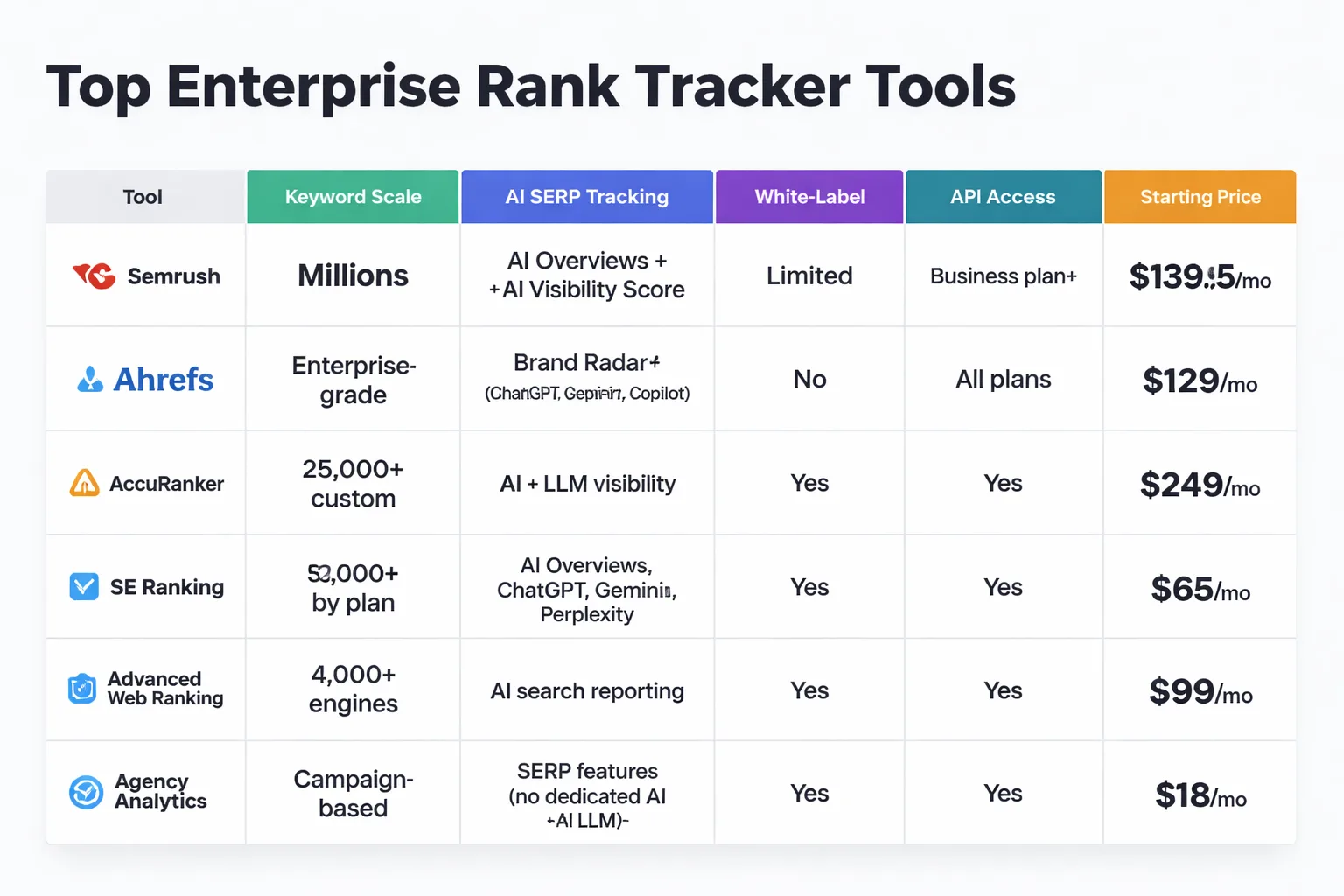
| Tool | Keyword Scale | AI SERP Tracking | White-Label | API Access | Starting Price |
| Semrush | Millions | AI Overviews + AI Visibility Score | Limited | Business plan+ | $139.95/mo |
| Ahrefs | Enterprise-grade | Brand Radar (ChatGPT, Gemini, Copilot) | No | All plans | $129/mo |
| AccuRanker | 25,000+ custom | AI + LLM visibility | Yes | Yes | $249/mo |
| SE Ranking | Scalable by plan | AI Overviews, ChatGPT, Gemini, Perplexity | Yes | Yes | $65/mo |
| Advanced Web Ranking | 4,000+ engines | AI search reporting | Yes | Yes | $99/mo |
| AgencyAnalytics | Campaign-based | SERP features (no dedicated AI LLM) | Yes | Yes | $18/mo/campaign |
| Nightwatch | 3,000+ engines | AI visibility (newer) | No | Yes | $39/mo |
| SEO PowerSuite | Unlimited | Multi-engine (no dedicated AI LLM) | Yes | No | $29.10/mo |
| Moz Pro | Plan-capped | SERP features (limited AI) | No | Yes | $49/mo |
| ProRankTracker | High-volume | Multi-engine | Yes | Yes | $13.50/mo |
1. Semrush — Best for large in-house SEO teams needing one login
Best for: Large in-house SEO teams and enterprise agencies that need a single platform covering rank tracking, backlink analysis, site audits, and AI search visibility in one login.
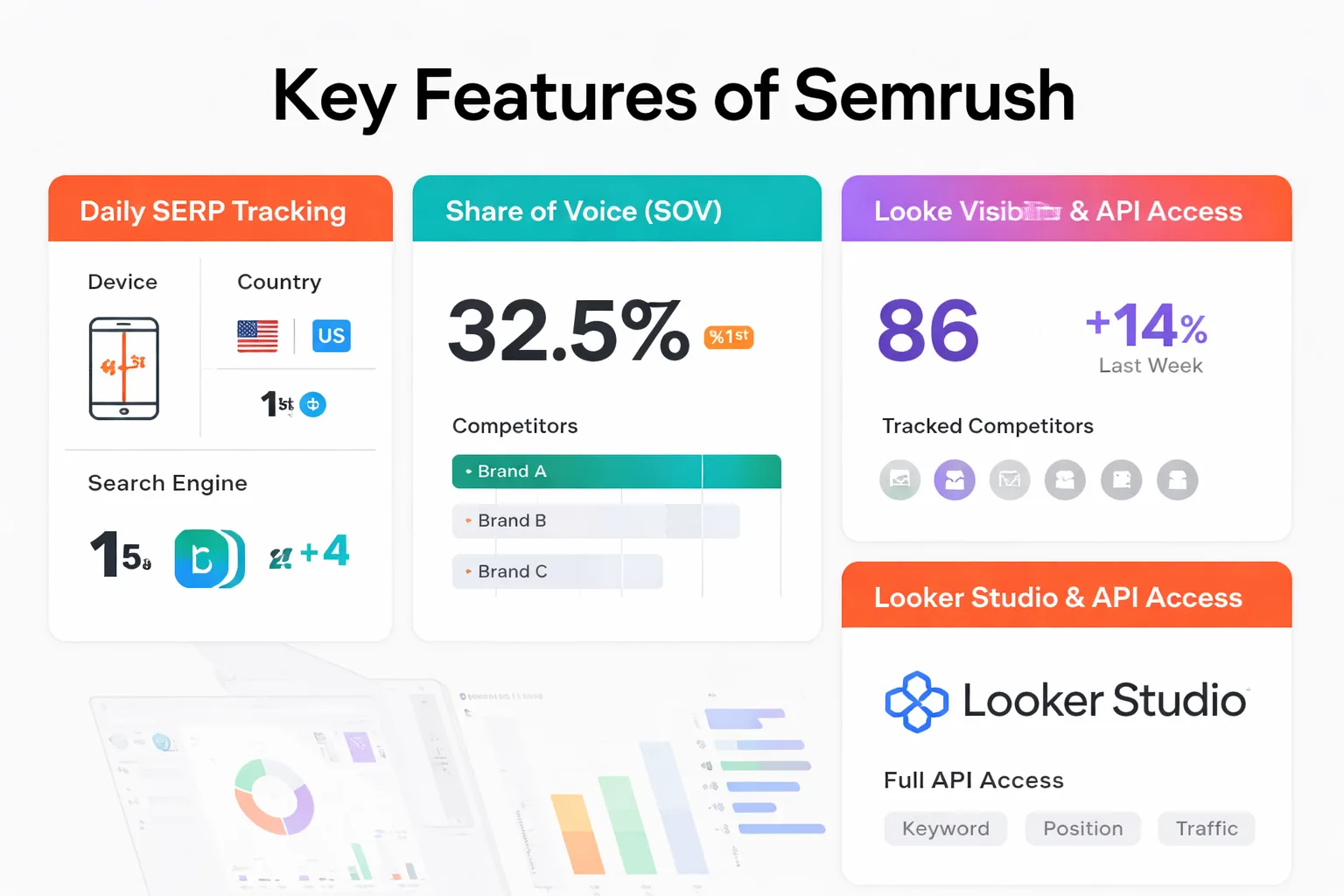
Semrush positions itself as the all-in-one enterprise SEO suite, and at scale, that positioning holds. The platform covers daily SERP tracking by device, country, and search engine, and its Share of Voice metric gives enterprise teams a competitive benchmark that goes beyond individual keyword rankings. The AI Visibility Toolkit. An add-on that tracks brand impressions across AI platforms against up to nine competitors. Is the most direct response Semrush has made to the AI search shift.
Key features: - Daily SERP tracking by device, country, and search engine including Google and Bing. Share of Voice (SOV) metric benchmarked against tracked competitors. AI Visibility Score tracking brand impressions across AI platforms vs up to 9 competitors. Looker Studio connector and full API access on Business plan and above
Pricing: Pro plan starts at $139.95/mo; Guru at $249.95/mo; Business at $499.95/mo; Enterprise custom pricing. AI Visibility Toolkit add-on is $99/mo per domain.
The honest assessment: Semrush is genuinely powerful, but the cost escalation is real. The AI Visibility Toolkit is $99/mo per domain and $99/mo per user on top of an already expensive base plan. For a mid-sized agency managing ten client domains, you're looking at a significant add-on bill before you've tracked a single AI Overview impression. Teams that need the full suite and have the budget will find it hard to beat. Teams that primarily need AI search visibility tracking should evaluate whether they're paying for features they won't use.
2. Ahrefs — Best for enterprise teams where backlink analysis drives strategy
Best for: Enterprise SEO teams and agencies where backlink analysis and keyword research drive strategy and who want rank tracking integrated into that research workflow.
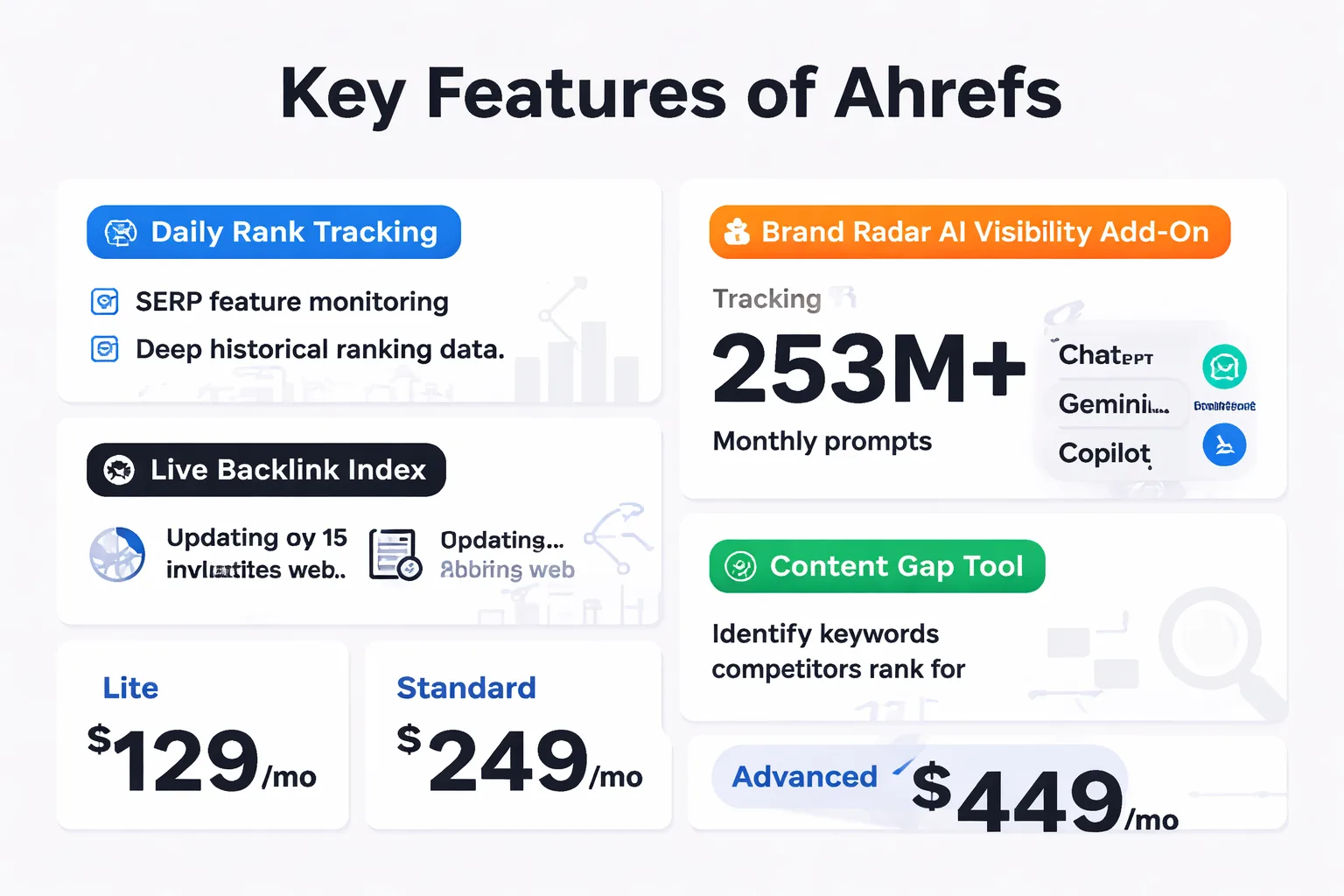
Ahrefs built its reputation on the world's largest backlink index, and that foundation still holds. The Brand Radar AI visibility add-on. Tracking 253 million+ monthly prompts across ChatGPT, Gemini, and Copilot. Represents a serious investment in AI search monitoring. The live backlink index updating every 15 minutes is a genuine differentiator for teams where link acquisition velocity matters.
Key features: - Daily rank tracking with SERP feature monitoring and deep historical ranking data. Brand Radar AI visibility add-on tracking 253M+ monthly prompts across ChatGPT, Gemini, and Copilot. Live backlink index updating every 15 minutes across the web. Content Gap tool to identify keywords competitors rank for that your clients do not
Pricing: Lite starts at $129/mo; Standard $249/mo; Advanced $449/mo; Enterprise starts at $1,499/mo (annual commitment required).
The trade-off with Ahrefs is commitment and cost. Daily rank tracking is an add-on to the default weekly cadence, and the enterprise plan requires an annual commitment. There's no free trial. For teams that are already inside the Ahrefs ecosystem and want AI visibility layered on top of their existing research workflow, Brand Radar is a logical extension. For teams evaluating from scratch, the entry cost and commitment structure deserve careful scrutiny before signing.
3. AccuRanker — Best for agencies managing 10,000+ keywords at speed
Best for: Enterprise agencies managing 10,000+ keywords across multiple clients who prioritize speed, real-time data freshness, and scalable white-label reporting.
AccuRanker is the specialist's choice when data freshness is non-negotiable. The on-demand refresh capability. With two-hour domain refresh and no daily caps. Is the fastest in this field. For agencies that need to diagnose ranking drops in real time or respond to algorithm updates the same day they happen, this architecture is a genuine operational advantage. The AI and LLM visibility tracking adds the forward-looking layer that legacy rank trackers are still scrambling to build.
Key features: - On-demand rank refreshes with two-hour domain refresh capability and no daily caps. Advanced segmentation and local tracking down to GPS-level locations. Support for 50+ SERP features including featured snippets, Local Packs, and knowledge panels. AI and LLM visibility tracking to monitor brand appearance in AI-driven search results
Pricing: Plans start at $249/mo scaling by keyword volume; Professional plan at $224/mo covers 2,000. 5,000 keywords; Enterprise plans for 25,000+ keywords at custom pricing. 10% discount on annual billing.
AccuRanker is not trying to be an all-in-one platform. It is a rank tracking specialist, and that focus shows in the product quality. The trade-off is that teams also needing deep backlink analysis or content gap research will need to pair it with another tool. For agencies where rank tracking speed and data freshness are the primary operational requirement, AccuRanker is the strongest purpose-built option in this list.
4. SE Ranking — Best for growing agencies balancing cost and AI coverage
Best for: Growing agencies managing 3. 10+ clients who need the best balance of pricing, daily accuracy, AI visibility tracking, and white-label reporting without Semrush-level costs.
SE Ranking is the tool I'd recommend first to any agency that's outgrown mid-market tools but isn't ready to absorb Semrush or Ahrefs enterprise pricing. The AI visibility tracking across Google AI Overviews, ChatGPT, Gemini, and Perplexity is genuinely competitive with tools costing three times as much. The 14-day free trial removes the commitment risk that makes evaluating enterprise tools painful.
Key features: - Daily rank tracking across Google, Bing, Yahoo, and YouTube with desktop and mobile separation. AI visibility tracking for Google AI Overviews, ChatGPT, Gemini, and Perplexity alongside traditional rankings. White-label reporting with 12 ready-made SEO templates and client dashboard access. Tracks 37+ SERP features with keyword grouping, tagging, and cached SERP storage
Pricing: Essential plan starts at $65/mo (500 keywords); Pro at $119/mo; Business at $259/mo; Agency Pack available as add-on; 14-day free trial included.
The subscription tiers apply keyword caps and feature restrictions depending on plan level, so larger programs tracking 15,000+ keywords per project should review the limits carefully before committing. But for the majority of growing agencies, SE Ranking hits a price-to-capability ratio that no other tool on this list matches. The AI visibility coverage alone. Tracking four major AI surfaces at the Pro price point. Makes it the most practical choice for teams that need to start monitoring LLM citation tracking without blowing their tool budget.
5. Advanced Web Ranking — Best for multi-engine international SEO
Best for: Enterprise agencies and large organizations managing multi-engine, international SEO campaigns who need deep custom reporting and raw data export into their own BI infrastructure.
Advanced Web Ranking has been in this space long enough to have built something that newer tools haven't: genuine multi-engine depth. Monitoring 4,000+ search engines including Google, YouTube, Amazon, Baidu, and Naver at hyper-specific locations is not a feature you find elsewhere at this price point. The pixel position tracking and above-the-fold analysis give technical SEO teams data that standard rank trackers don't surface.
Key features: - Monitors 4,000+ search engines including Google, YouTube, Amazon, Baidu, and Naver at hyper-specific locations. Pixel position tracking and above-the-fold analysis with SERP HTML source access. AI search reporting with detailed AI search data for competitive intelligence. Developer API exporting rankings in CSV and JSON formats for BI stack integration
Pricing: Free 30-day evaluation; Pro plan starts at $99/mo; Agency and Enterprise packages available at higher tiers with custom dynamic interfaces.
AWR is not the right tool for teams that want a polished out-of-the-box dashboard experience. It rewards teams with the technical capacity to build on top of raw data. The developer API and BI stack integration capability make it a strong choice for enterprise organizations that have in-house analytics infrastructure and want rank data feeding into proprietary reporting. The 30-day evaluation period is the most generous in this list and worth using before committing.
6. AgencyAnalytics — Best for scaling client reporting without per-seat fees
Best for: SEO agencies that need to scale reporting across hundreds of client campaigns without paying per-seat fees or being nickel-and-dimed for extra dashboards.
AgencyAnalytics solves a different problem than most tools on this list. It's not primarily a rank data engine. It's a reporting and aggregation layer that pulls from 80+ native integrations into a single white-label dashboard. For agencies where client reporting is a significant time cost, the campaign-based pricing model (not per-seat) is a genuine structural advantage.
Key features: - White-label dashboards with automated scheduled reporting delivered directly to clients. 80+ native integrations consolidating backlinks, site audits, and Search Console data in one platform. Global roll-up reporting to view total market share across 50+ locations or multi-brand portfolios in one view. Role-based permissions and SERP feature tracking with historical SEO data
Pricing: Starts free (14-day trial); Freelancer plan from $12/mo; Agency plan from $18/mo per campaign; Enterprise plans between $699–$980/mo. Campaigns are the only billing variable.
The honest limitation: AgencyAnalytics does not replace deep SEO research tools. It aggregates and presents data from tools like Ahrefs or Semrush rather than generating its own rank data engine. Teams that want a single source of truth for client reporting. Without rebuilding Looker Studio dashboards from scratch. Will find it valuable. Teams expecting it to compete with AccuRanker on data freshness or SE Ranking on AI visibility coverage will be disappointed.
Is your current rank tracker showing you where your brand appears in ChatGPT and Perplexity — or just traditional SERPs?
7. Nightwatch — Best for multi-location and local SEO campaigns
Best for: Agencies managing multi-location businesses, franchises, or local SEO campaigns that need precise separation of organic and Local Pack ranking data.
Nightwatch built its geo-grid technology around a problem that most rank trackers paper over: organic rankings and Local Pack positions are fundamentally different data points, and conflating them produces misleading client reports. The separation of these two data streams. Tracked independently at GPS-level granularity. Is the core reason to choose Nightwatch over a general-purpose enterprise tool for local SEO work.
Key features: - Geo-grid technology that separates organic rankings from Local Pack and Google Maps positions independently. Tracks rankings across 3,000+ search engines including Google, Bing, YouTube, Amazon, Baidu, and Naver. Integrates with Looker Studio, Google Analytics, Google Search Console, and Bing Webmaster Tools. Cross-project dashboard pulling data from multiple client accounts into one unified view
Pricing: Starter plan from $39/mo; Optimize from $99/mo; Agency from $199/mo; Enterprise custom pricing. Annual billing available.
Nightwatch's AI visibility features are newer and less mature than dedicated AI search tracking platforms. Teams that need deep LLM citation monitoring should pair it with a purpose-built AI visibility tool. For Google AI Mode tracking and conversational search visibility, the platform is still catching up. But for the specific use case of local and multi-location SEO, Nightwatch's geo-grid approach is the most technically precise solution in this list.
8. SEO PowerSuite Rank Tracker — Best for cost-conscious agencies with large keyword volumes
Best for: Solo SEOs and cost-conscious agencies managing large keyword volumes who want unlimited tracking without cloud-based per-keyword pricing models.
SEO PowerSuite's desktop-based model is the most contrarian choice on this list. In a field moving aggressively toward cloud-first SaaS, PowerSuite's local installation approach eliminates per-keyword pricing entirely. Which matters enormously when you're tracking 100,000+ keywords and the cloud alternatives would cost ten times as much.
Key features: - Unlimited keyword tracking even on lower-tier plans with no per-keyword pricing. Supports tracking across Google, Bing, Yahoo, YouTube, Yandex, Baidu, and hundreds of other search engines. Custom dashboards, automated ranking checks, and scheduled white-label reports. Local tracking down to city and street-address level with Google Analytics and Search Console integration
Pricing: Free version available with unlimited keywords but limited features; Professional plan at $29.10/mo (approx. $349/yr); Enterprise plan at $52.50/mo (approx. $699/yr). No per-seat fees.
The desktop-only model is a real constraint for distributed enterprise teams that need cloud access, multi-user collaboration, or API integrations. There is no AI LLM visibility tracking to speak of. For solo SEOs or small agencies where one person owns the rank tracking workflow and cost per keyword is the primary concern, PowerSuite is genuinely hard to beat on price. For enterprise teams with distributed workflows and AI search visibility requirements, it's the wrong architectural choice regardless of the price advantage.
9. Moz Pro — Best for teams anchored to Domain Authority benchmarking
Best for: Enterprise SEO teams that rely on Domain Authority as a core benchmarking metric and need a well-rounded suite combining rank tracking, link analysis, and site auditing.
Moz Pro's enduring advantage is brand trust around Domain Authority. For teams that have built client reporting frameworks and internal benchmarks around DA scores, switching to a different authority metric requires rebuilding stakeholder communication from scratch. Moz's rank tracking, link analysis, and site auditing capabilities are solid and well-integrated, and the custom alert system for ranking changes is genuinely useful for enterprise workflows.
Key features: - Daily rank tracking with custom alerts for ranking changes across target keywords. SERP feature tracking integrated with keyword research and on-page optimization tools. API access and team collaboration features for enterprise SEO workflows. Trusted Domain Authority and Page Authority metrics for competitive benchmarking
Pricing: Starter plan at $49/mo; Standard at $99/mo; Medium at $179/mo; Large at $299/mo; Premium at $599/mo. Annual billing saves ~20%.
The gap that matters for 2026: Moz Pro's AI search visibility tracking is less developed than SE Ranking, AccuRanker, or Semrush. If tracking brand visibility across AI Overviews, ChatGPT, and Perplexity is a priority. And it should be. Moz is behind the curve. It remains a strong choice for teams where DA benchmarking is non-negotiable and AI visibility is a secondary concern. For teams where AI search visibility is moving to the center of their reporting, the platform's current trajectory suggests a gap that won't close quickly.
10. ProRankTracker — Best for high-volume agencies minimizing per-keyword cost
Best for: High-volume SEO agencies that need the lowest possible per-keyword cost at scale with white-label reporting and flexible plan management.
ProRankTracker's value proposition is straightforward: the lowest per-keyword cost in the enterprise tier, with enough white-label and API capability to serve serious agency operations. At $0.055–$0.066 per keyword for high-volume accounts, the cost structure is genuinely different from cloud-based competitors that charge per keyword per day.
Key features: - Unlimited keyword tracking with white-label client reporting and branded dashboards. Historical ranking data with full API access for enterprise SEO agencies. Multi-engine tracking across Google, Bing, Yahoo, and local search engines. Flexible plan structure allowing upgrades, downgrades, or cancellations at any time
Pricing: Starter plan from $13.50/mo; Pro from $89/mo; Agency plans scale by keyword volume; per-keyword cost ranges from $0.055–$0.066 for high-volume accounts. Free trial available.
ProRankTracker is a specialist cost tool, not an all-in-one platform. It lacks built-in backlink analysis, site audits, or content tools, and the interface is more utilitarian than premium enterprise platforms. Teams that need AI search visibility tracking will need to look elsewhere. But for agencies where the primary constraint is keyword volume cost and everything else is handled by other tools in the stack, ProRankTracker fills a specific gap at a price point that no other tool on this list matches.
Making the Right Choice for Your Team Size
The right enterprise rank tracker is not universal. It depends on your operational structure more than any single feature comparison.
Solo agency or freelancer managing 3-5 clients: SE Ranking at the Pro tier is the starting point I'd recommend. The AI visibility tracking across four major surfaces, the 14-day trial, and the price point make it the most practical entry into enterprise-grade tracking without a six-figure tool budget. If local SEO is your primary service, add Nightwatch for its geo-grid precision. If cost per keyword is your binding constraint and you have a single-operator workflow, SEO PowerSuite is the honest alternative.
In-house enterprise team (10+ person SEO department): The choice here splits on whether your team is backlink-research-driven or content-and-visibility-driven. Backlink-research-driven teams belong in Ahrefs, where the live index and Content Gap tool integrate directly into the research workflow and Brand Radar adds AI visibility on top. Content-and-visibility-driven teams should evaluate Semrush, where the AI Visibility Toolkit and Share of Voice metric give leadership-level reporting that justifies the cost. Both tools require honest budget modeling. Add the AI visibility add-ons to your pricing comparison before signing.
Multi-client agency (20+ clients, distributed reporting): This is where AgencyAnalytics earns its place as a reporting layer on top of a primary data engine. The combination I'd trial first: SE Ranking for rank data and AI visibility tracking, paired with AgencyAnalytics for white-label client reporting. That stack covers daily AI SERP tracking, 37+ SERP features, and automated client dashboards at a combined cost well below a single Semrush Business plan. For agencies where data freshness is critical and clients demand same-day ranking diagnostics, replace SE Ranking with AccuRanker.
One framework question worth asking before any trial: does your current tool tell you where your brand appears in ChatGPT, Perplexity, and Google AI Overviews. Not just traditional SERPs? If the answer is no, that's the gap to close first. The mention-citation gap between where your content is cited and where your brand is actually recommended is where AI search strategy lives, and no traditional rank tracker surfaces it. Tools like Meev track that gap directly across ChatGPT, Claude, Gemini, Perplexity, Grok, and Google AI Overviews. Which is a different data layer than what any tool on this list provides, and worth understanding as a complement to your rank tracking stack.
For teams starting to build Generative Engine Optimization (GEO) workflows alongside traditional rank tracking, the practical starting point is instrumenting AI referral traffic in GA4 first. The Conductor 2026 AEO/GEO Benchmarks Report found 1.08% average AI referral traffic across 13,770 enterprise domains. But a critical analysis by Ekamoira argues that figure significantly underrepresents actual opportunity because query fan-out mechanics create 10-16x more retrieval opportunities than the dataset captures. My working assumption is that three to six months of your own GA4 data will tell you more than any industry benchmark.
If you're building out an Answer Engine Optimization (AEO) strategy alongside your rank tracking program, the publisher citation layer matters as much as the tracking layer. Knowing which domains AI engines cite most often for your topics. And closing the gap between citation and recommendation. Requires a workflow that goes beyond what any rank tracker provides. That's the integration worth planning for in 2026.
FAQ
What is enterprise rank tracking?
Enterprise rank tracking is the practice of monitoring keyword positions across thousands to millions of queries, multiple geographic locations, devices, search engines, and increasingly AI search surfaces. At a scale and refresh cadence that standard rank trackers cannot handle. It typically includes features like daily or on-demand refresh, API access for BI stack integration, white-label reporting for client-facing workflows, multi-user access with role-based permissions, and SERP feature detection beyond basic blue-link positions. In 2026, enterprise rank tracking increasingly includes AI Overview monitoring and LLM citation tracking as core features rather than add-ons.
How many keywords do enterprise rank tracking tools support?
It varies significantly by tool and plan. Semrush and Ahrefs support millions of keywords across their enterprise tiers. AccuRanker scales to 25,000+ on standard plans with custom enterprise pricing above that. SE Ranking scales by plan tier, with enterprise-level keyword volumes available on Business and Agency plans. SEO PowerSuite offers unlimited keyword tracking on all plans due to its desktop-based architecture. The key question is not just the keyword cap but the refresh cadence at high volumes. Some tools throttle refresh frequency as keyword counts increase, which can undermine the value of large-scale tracking.
Do any enterprise rank trackers track AI Overview rankings?
Yes, several do. SE Ranking tracks AI Overviews alongside ChatGPT, Gemini, and Perplexity. Semrush offers an AI Visibility Score through its AI Visibility Toolkit add-on. Ahrefs tracks AI search visibility through Brand Radar across ChatGPT, Gemini, and Copilot. AccuRanker includes AI and LLM visibility tracking. Advanced Web Ranking offers AI search reporting. The depth and methodology vary considerably between tools. Some track whether your domain appears in an AI Overview, while others measure brand recommendation frequency across LLM-generated responses. These are different metrics, and understanding which one your tool measures is important before drawing conclusions from the data.
Is there a free enterprise rank tracker?
Not in any meaningful sense. SEO PowerSuite offers a free version with unlimited keywords, but it lacks white-label reporting, API access, and AI visibility features that define enterprise-grade tracking. Advanced Web Ranking offers a 30-day free evaluation. SE Ranking and AgencyAnalytics offer 14-day trials. Moz Pro offers a 30-day trial. For teams that need to evaluate enterprise tools before committing budget, the trial periods from SE Ranking and AWR are the most useful starting points — and our guide to SEO tools with free trials covers additional options. Treating any of these as a long-term free solution is not realistic. The feature gates are significant.
Should I use a standalone rank tracker or an all-in-one SEO platform?
It depends on your team's primary workflow. If rank tracking is one component of a broader SEO operation that includes content research, backlink analysis, and site auditing, an all-in-one platform like Semrush or Ahrefs reduces context-switching and keeps data in one place. If rank tracking speed and data freshness are your primary operational requirements. Particularly for agencies diagnosing algorithm updates in real time. A specialist tool like AccuRanker will outperform an all-in-one platform on those specific dimensions. Many enterprise teams run a hybrid: a specialist rank tracker for daily operational data and an all-in-one platform for research and strategy. The math on that combination often beats paying the all-in-one premium for features you use infrequently.
About the Author
Judy Zhou, Head of Content Strategy
Judy Zhou leads content strategy at Meev, where she oversees AI-driven content research and publishing for hundreds of brands. With a background in SEO and editorial operations, she focuses on building content systems that rank on Google, get cited by AI search engines, and drive measurable business results.
Close the mention-citation gap and track your brand across every major AI search surface — before your competitors do.