

By Judy Zhou, Founder
Key Takeaways
- A Tow Center study of 1,600 queries found that AI search engines failed to retrieve or accurately cite source material in over 60% of cases — making the mention-citation gap the most underreported AEO failure mode.
- E-E-A-T (introduced by Google in 2022) now functions as the quality standard for LLM retrieval: named authorship, inline citations to primary sources, and consistent entity signals across the web are non-negotiable.
- Reddit drives around 27% of ChatGPT search results despite barely registering in explicit citation counts — meaning AI visibility platforms that only count footnotes are missing the dominant influence layer.
- AEO is a living system, not a one-time setup: citation patterns shift with model updates, so monthly monitoring of citation appearances across ChatGPT, Perplexity, Gemini, Claude, and Google AI Overviews is required to maintain and grow citation share.
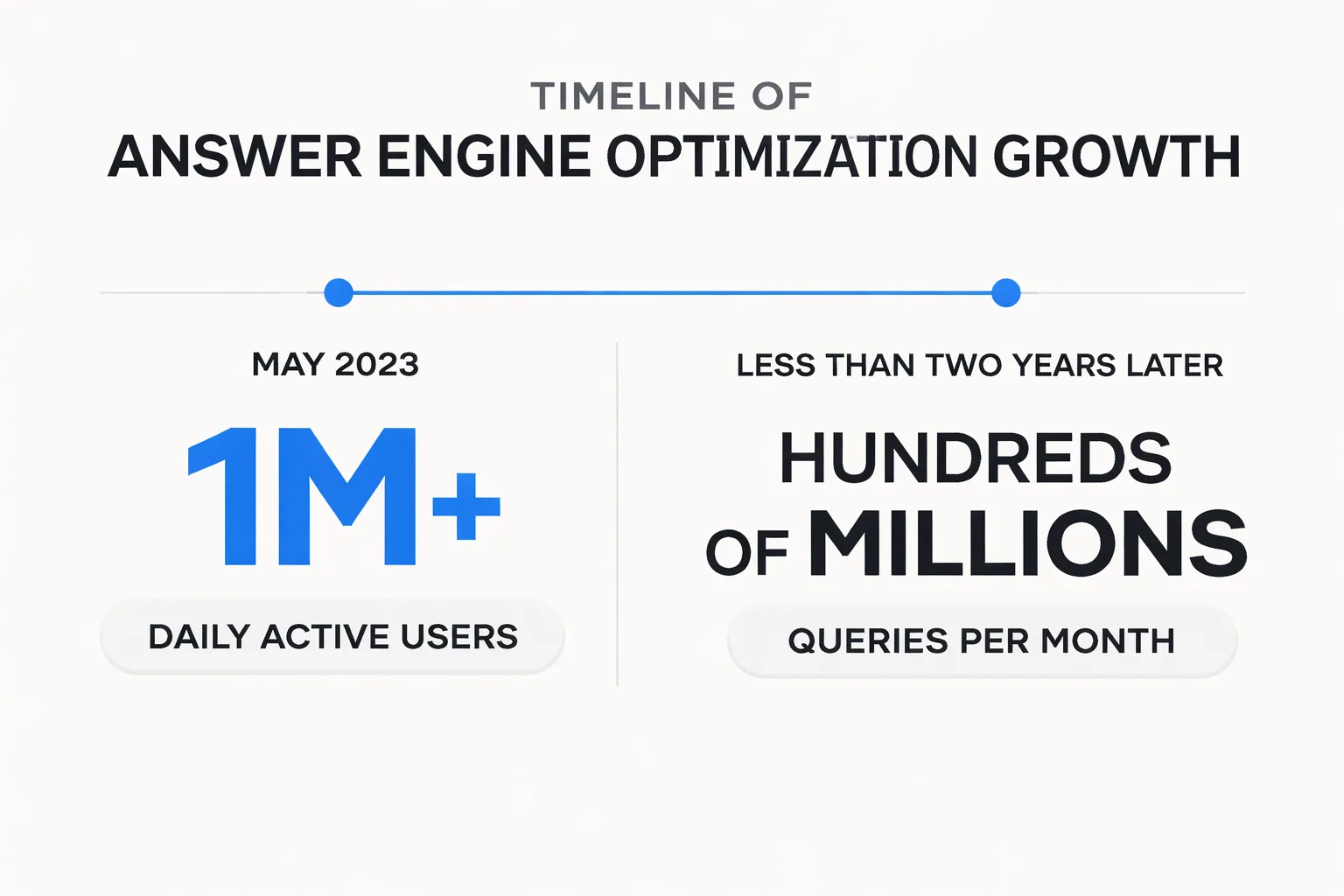
In May 2023, when Perplexity AI quietly crossed one million daily active users, almost no one in the SEO industry was paying attention. Google's Search Generative Experience was still in labs, ChatGPT Browse was a novelty, and 'answer engine optimization' wasn't yet a phrase anyone had coined. Less than two years later, those same engines are fielding hundreds of millions of queries per month. And the publishers who started optimizing early are capturing citation share that latecomers are now struggling to claw back. This AEO checklist is your on-ramp.
The aeo checklist most teams reach for is a list of formatting tips. Bold your answers. Add FAQ schema. Keep paragraphs short. That advice isn't wrong, but it's incomplete in a way that costs you real citation share. Answer engine optimization is the practice of structuring content so AI systems can extract, attribute, and cite it accurately. Google formalized E-E-A-T (Experience, Expertise, Authoritativeness, Trustworthiness) in 2022, and it now functions as the quality standard for both search algorithms and LLM retrieval layers. A Tow Center study from March 2025 tested 1,600 queries across AI search engines and found that source material was either not retrieved or was inaccurately cited in over 60% of cases. A large-scale analysis of 144,284 AI citations across ChatGPT, Google AI Overviews, and Gemini found Reddit drives around 27% of ChatGPT search results — yet barely registers in explicit citation counts. The gap between what earns influence and what gets credited is real, and wide.
This is not a formatting checklist. It's a framework for making content that AI systems trust enough to cite.
The Four Root Causes of AEO Failure
Before running any checklist, it helps to understand why pages fail to get cited. In my work overseeing content strategy across hundreds of brands at Meev, I keep seeing the same failure modes repeat regardless of industry or page type.
The first is authority ambiguity. The page exists, it ranks, but no AI system can confidently attribute it to a named entity. There's no author, no organization schema, no consistent brand signal across the web. LLMs are probabilistic systems. They cite what they can attribute with confidence. Anonymous content, even if accurate, gets passed over.
The second is retrieval friction. The answer to the user's question is buried in paragraph four, after two sentences of preamble and a contextual aside. AI systems extract from the top of sections. If your direct answer isn't in the first 40-60 words of a section, it often won't be extracted at all.
The third is scaled content without quality gates. Enterprise content teams and auto-blog setups that publish at volume without a verification layer produce content that Perplexity's ranking algorithms deprioritize or exclude entirely. Perplexity selects sources with verifiable authority signals. Primary sources, named authors, consistent factual records. Scaled, unvetted content lacks these signals structurally, not incidentally. The pattern I keep seeing is that teams conflate publishing velocity with topical authority. They're not the same thing.
The fourth is the mention-citation gap. A brand earns placements on authoritative domains through outreach. The mentions exist. But the LLM retrieval layer strips or misattributes them before they influence a citation outcome. The outreach worked. The infrastructure it was built for failed. That's a harder problem, and one I'll address directly in the outreach section below.
AEO vs GEO. Two Layers, One Goal
Kathleen Marrero draws a useful distinction in her LinkedIn analysis of AEO vs GEO: AEO optimizes for content clarity and answerability (featured snippets, People Also Ask, AI overviews, zero-click results), while GEO optimizes for context and credibility (the signals that make an AI system trust the source in the first place). Both matter. They address different layers of the same problem.
For the purposes of this checklist, I treat them as sequential. You fix AEO first. Make the content extractable. Then you fix GEO. Make the source trustworthy. Trying to build credibility signals on top of unextractable content is like painting a house with a cracked foundation. If you want a deeper comparison of how these terms relate, AEO vs GEO: Two Names for the Same Shift? covers the definitional debate in detail.
For a foundational definition of what answer engine optimization actually covers before running this checklist, What is AEO? Answer Engine Optimization, Explained is worth reading first.
How Does E-E-A-T Actually Function for AI Retrieval?
Google introduced E-E-A-T as an extension of E-A-T in late 2022, adding "Experience" to the existing Expertise, Authoritativeness, and Trustworthiness framework. For traditional search, E-E-A-T influences quality rater assessments. For AI retrieval, it functions differently: it's the set of signals an LLM uses to decide whether a source is safe to cite.
Here's what that looks like in practice, broken down by signal:
Experience means demonstrable first-hand engagement with the topic. Not just writing about content strategy. Showing specific decisions made, outcomes measured, failures encountered. This is why Wikipedia gets cited so heavily (Profound's citation data shows ChatGPT pulls nearly 48% of its top-10 citations from Wikipedia). Wikipedia is dense, heavily cross-referenced, and built on verifiable primary sources. It doesn't bullet-point its way to authority. It earns it through depth and attribution density.
Expertise means named authorship with verifiable credentials. Author entity profiles. Linked LinkedIn profiles, publication histories, institutional affiliations. Give LLMs a confidence anchor. Anonymous bylines don't.
Authoritativeness means the domain has a consistent record of accurate claims in a defined topic area. This is topical authority for AI search: not just ranking for keywords, but being the source other authoritative sources reference. Backlink profiles matter here, but so does the citation graph within AI systems themselves.
Trustworthiness means the content is factually verifiable and transparently sourced. Every claim should trace to a named, linkable source. Pages with inline citations to primary sources outperform pages that make the same claims without attribution. Because the LLM can verify the chain.
The Technical AEO Checklist
Technical readiness is the floor. Without it, content quality is irrelevant. AI crawlers can't access what they can't reach.
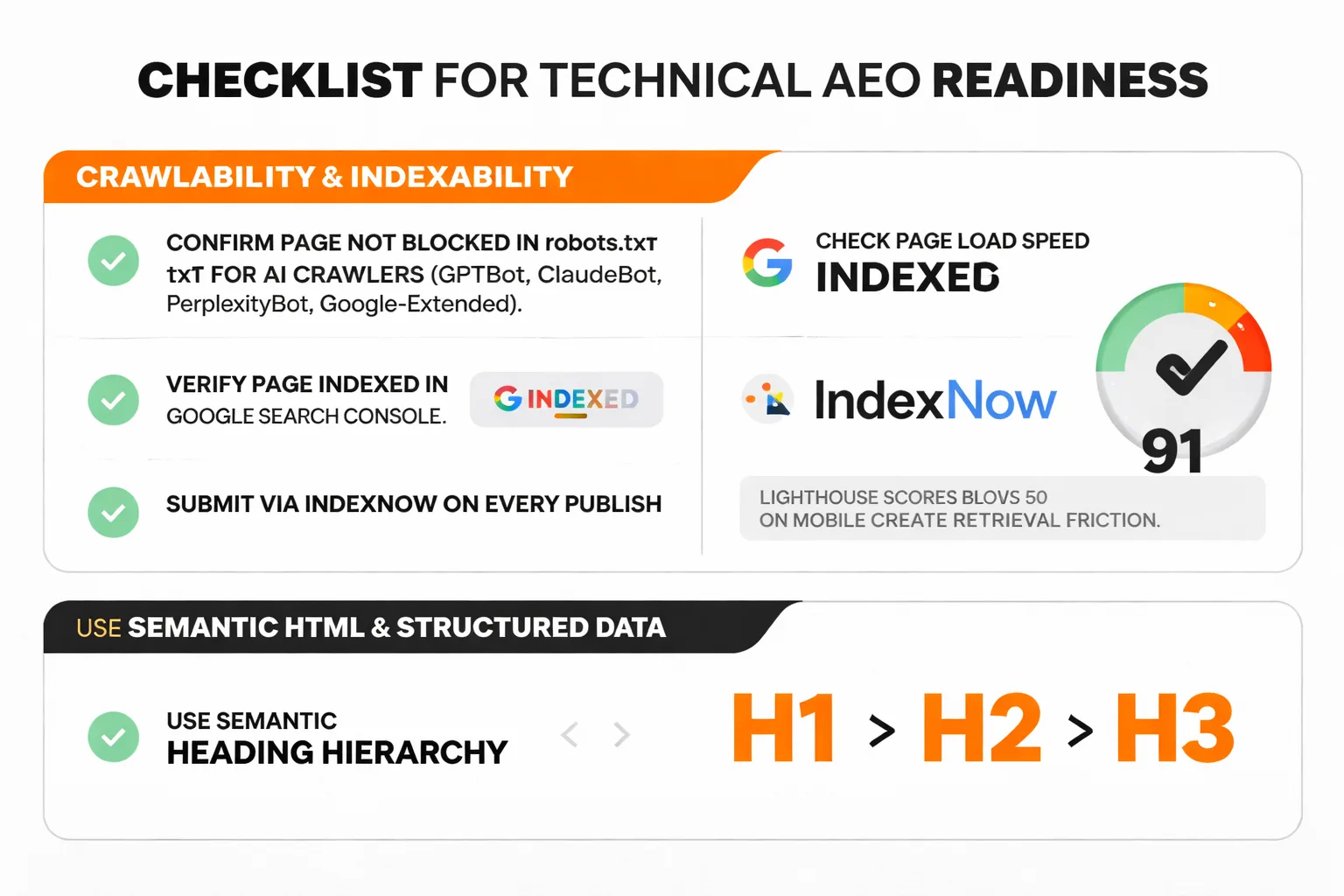
Crawlability and indexability: - Confirm the page is not blocked in robots.txt for AI crawlers (GPTBot, ClaudeBot, PerplexityBot, Google-Extended). Each has its own user-agent string. Check your robots.txt explicitly. A blanket "Disallow: /" blocks all of them. - Verify the page is indexed in Google Search Console. AI Overviews draws from Google's index. If Google hasn't indexed the page, it won't appear in AI Overviews regardless of content quality. - Submit via IndexNow on every publish. Google Search Console sitemap submission plus IndexNow pinging gives the fastest path to fresh indexing. - Check page load speed. Lighthouse scores below 50 on mobile create retrieval friction. AI crawlers have timeout thresholds just like users.
Semantic HTML and structured data:
- Use semantic heading hierarchy (H1 > H2 > H3). AI systems parse heading structure to understand content organization. A flat wall of paragraphs with no heading signals is harder to extract from.
- Implement Article schema with author, datePublished, dateModified, and publisher fields populated. This is the machine-readable version of your E-E-A-T signals.
- Add FAQ schema where you have genuine Q&A pairs. FAQ schema feeds directly into People Also Ask and AI Overviews extraction.
- Add HowTo schema for process-oriented content. Add Speakable schema for content intended to be read aloud by voice assistants.
- Implement a valid llms.txt file at your domain root. This is the emerging standard for signaling to LLMs which content is available for training and citation. Validate yours with the LLMs.txt Validator. Free AI Search Tool.
Entity signals:
- Add Organization or Person schema at the domain level with consistent name, url, logo, and sameAs fields pointing to your LinkedIn, Wikipedia page (if applicable), Wikidata entry, and other authoritative profiles.
- Ensure your brand name, description, and category are consistent across Google Business Profile, Crunchbase, LinkedIn company page, and any industry directories. LLMs triangulate entity identity across sources. Inconsistency creates ambiguity.
How Does Content Structure Affect Citation Rates?
This is where most AEO advice goes wrong. The conventional wisdom says: bullet everything, keep it short, lead with the answer. I followed that logic for a while. Then I started looking at what actually gets cited.
The content earning citations tends to be navigational and comparative: "X vs. Y" pages, "best alternatives to Z" listicles, opinionated takes with a clear point of view. Not because those formats are inherently better, but because they match the decision-state of users who are one step from acting. If LLM-referred visitors convert at 4-6x the rate of Google organic visitors (a pattern practitioners on platforms like Profound have documented), the implication is that AI systems are selecting content that serves high-intent queries. That selection pressure rewards content written for decision-makers, not content written for crawlers.
Here's what the content structure checklist actually looks like:
Answer placement: - Place the direct answer to the page's primary question within the first 40-60 words of the body, and within the first 40-60 words of every major section. AI systems extract from section openings. Preamble kills extraction. - Write self-contained section openings. Each H2 section should make sense if read in isolation. Because AI systems often extract sections without surrounding context. - Use the inverted pyramid structure within each section: conclusion first, supporting evidence second, nuance third.
Depth and information gain: - Include at least one piece of information that cannot be found on any of the top 5 ranking pages for your target query. This is information gain strategy in practice. If your content is a synthesis of what's already indexed, AI systems have no reason to cite you specifically. - Name specific numbers, dates, and named sources. Vague claims ("traffic increased significantly") are not extractable. Specific claims ("traffic rose 34% in 90 days, per Google Search Console") are. - Include first-person experience signals where relevant. "I tested this" with a documented outcome is more citable than "experts recommend."
Factual accuracy and sourcing: - Link every factual claim to a primary source inline. Not at the bottom of the page. Inline, adjacent to the claim. AI systems verify attribution chains. - Avoid hedging language on factual claims. "Studies suggest" without a named study is not verifiable. "The Tow Center's March 2025 study of 1,600 queries found" is. - Update factual content when underlying data changes. Stale statistics with old dates are a trust signal failure. AI systems check publication and modification dates.
Why the Mention-Citation Gap Is the Real Problem
Here's the contrarian take that most AEO guides skip entirely: getting mentioned isn't the same as getting cited, and the gap between the two is larger than most practitioners realize.
I've watched clients spend real budget on brand mention outreach campaigns specifically designed to get cited by AI search engines. The outreach worked. Placements were earned on authoritative domains. And then I had to deliver the uncomfortable news: the LLM retrieval layer is the actual bottleneck. The Tow Center study found that source material was either not retrieved or was inaccurately cited in over 60% of cases across 1,600 queries. That means the majority of successful outreach. Mentions earned, placements secured. Gets stripped or hallucinated away before it ever influences a citation outcome.
The outreach didn't fail. The infrastructure it was built for failed.
What does that mean practically? It means AI citation outreach should be treated as brand awareness spend with uncertain attribution, not as a direct citation-building lever. Before recommending any AI citation outreach program to a client, I now ask two questions: Can we measure whether the placements are being retrieved (not just whether they exist)? And are we being honest with stakeholders that the measurement infrastructure to validate direct causation simply doesn't exist yet?
The answer to the first question usually requires an ai search visibility tool that tracks actual citation appearances across LLMs, not just web mentions. The answer to the second question is usually no. Most agencies selling AI citation packages aren't being that honest.
For the outreach that does make sense, the priority order is: 1. Target publishers that AI engines already cite for your topic area. The cited-source leaderboard for your keywords tells you which domains have existing retrieval authority. Those are your tier-one outreach targets. 2. Pitch content that fills a genuine gap in what those publishers cover. A pitch grounded in your knowledge base and tied to a specific topic the publisher hasn't addressed performs better than a generic "we'd love to contribute" email. 3. Measure citation appearances, not just placements. A placement that doesn't get retrieved is a PR win, not an AEO win.
Not sure which AI engines are citing your brand right now — or missing you entirely?
How Should You Prioritize AEO Actions by Business Type?
Not every business has the same leverage points. The answer engine optimization checklist items above all matter, but the sequence depends on where you're starting from.
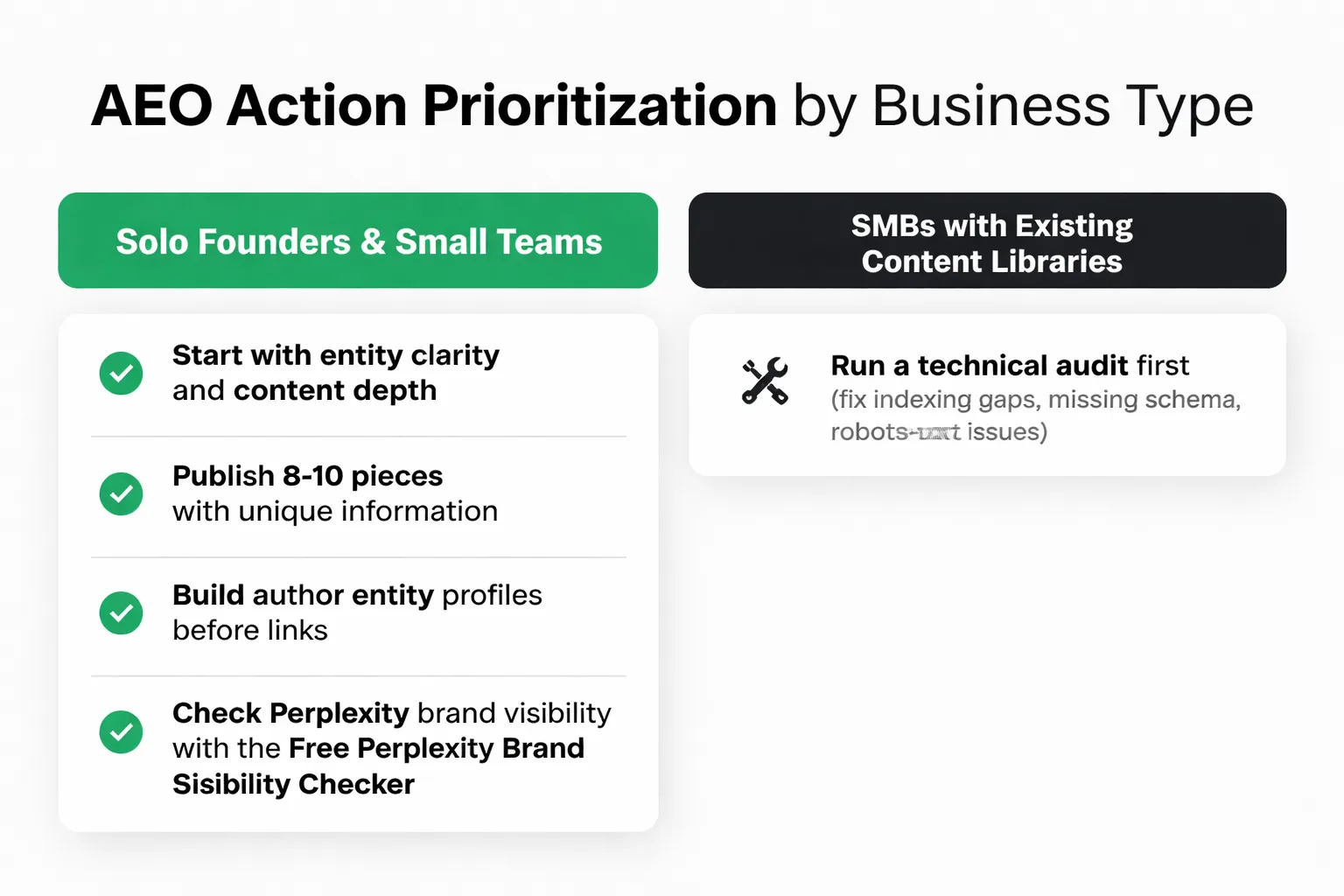
Solo founders and small teams: Start with entity clarity and content depth. You likely don't have domain authority working in your favor, so the fastest path to citation share is becoming the most specific, most verifiable source on a narrow topic. Pick one subject area. Publish 8-10 pieces that each contain information not available elsewhere. Build author entity profiles before you build links. Check your Perplexity brand visibility with the Free Perplexity Brand Visibility Checker to establish a baseline before making any changes.
SMBs with existing content libraries: Run a technical audit first. Most SMBs have indexing gaps, missing schema, and robots.txt configurations that accidentally block AI crawlers. Fix the floor before optimizing the ceiling. Then identify your 10 highest-traffic pages and apply the content structure checklist to those specifically. Don't try to retrofit everything at once.
Agencies managing multiple clients: The prioritization problem is harder at scale. The pattern I keep seeing is agencies applying the same AEO template across clients with different authority profiles and different query intents. A local service business and a B2B SaaS company need different sequencing. For agencies, the right investment is in tracking infrastructure first. You need to know which clients are already being cited, for what queries, and on which surfaces, before you can prioritize where to spend optimization effort. The AEO vs SEO: What's the Difference breakdown is a useful framing tool for client conversations about where AEO investment makes sense relative to existing SEO work.
One structural note on the Reddit influence problem: the large-scale analysis of 144,284 AI citations found Reddit drives around 27% of ChatGPT search results despite barely registering in explicit citation counts. If your AI visibility platform only counts footnoted citations, it's invisible to the influence layer that actually shapes AI-generated narratives about your brand. This is especially consequential for solo founders and SMBs who make content and budget decisions based on dashboards that are, by design, missing the dominant input. Ask your platform provider explicitly: does this tool account for Reddit-sourced influence, or is it counting footnotes?
Treating AEO as a Living System, Not a One-Time Setup
The biggest mistake I see is teams running an AEO checklist once and moving on. AI search is not a static system. The retrieval preferences of ChatGPT, Perplexity, Gemini, Claude, Grok, Google AI Overviews, Google AI Mode, and DeepSeek shift as their underlying models update and as the web's citation graph evolves. A page that earns citations in January may lose them by April without any change to the page itself. Because the competitive citation landscape shifted.
This means AEO requires a monitoring cadence, not just an optimization sprint. Concretely:
- Monthly: Review citation appearances across major AI surfaces. Are you being cited for the queries you optimized for? Are new competitors appearing for those queries? - Quarterly: Audit your top 20 pages against the technical and content checklists above. Schema standards evolve. Crawl configurations change. Content that was accurate six months ago may now be outdated. - On every publish: Submit via IndexNow, verify schema renders correctly, confirm the author entity profile is attached. These are table-stakes steps that auto-publishing workflows often skip. - When AI models update: Re-check citation patterns. Major model updates (GPT-5, Gemini 2.0, Claude 4) change retrieval behavior. What worked before may not work after.
The self-learning principle applies here too. If you're tracking which of your pages earn citations and which don't, you accumulate a dataset over time that tells you what your specific audience and topic area rewards. That's more valuable than any generic AEO checklist. Including this one.
Frequently Asked Questions
Does page length affect AEO citation rates?
Length itself isn't the variable. Information density is. A 600-word page with one genuinely unique, well-sourced claim will outperform a 3,000-word page that synthesizes existing knowledge. The pattern I keep seeing is that AI systems prefer pages where the ratio of novel information to word count is high. That said, longer pages have more surface area for extraction, which increases the probability that at least one section matches a given query. Aim for depth over length, but don't artificially compress content that genuinely requires space to be accurate.
How long does it take to see AEO results after optimization?
For Google AI Overviews, changes can reflect within days if the page is already indexed and the schema validates correctly. For LLM-driven surfaces like ChatGPT and Perplexity, the timeline is less predictable because retrieval depends on crawl schedules and model update cycles. In practice, expect 4-8 weeks before citation pattern changes are measurable. Set a baseline before making changes. Without a pre-optimization benchmark, you can't attribute any change to your work.
Should I block AI crawlers if I don't want my content used for training?
This is a legitimate strategic question with real trade-offs. Blocking GPTBot, ClaudeBot, or Google-Extended prevents your content from being used in training data, but it also reduces the probability of appearing in those systems' citations. If citation visibility is a business goal, blocking AI crawlers works against it. If protecting proprietary content is the priority, blocking is appropriate. But understand you're making a deliberate trade-off, not just a defensive move.
What's the difference between AEO and LLMO?
AEO (answer engine optimization) focuses on making content extractable and answerable for AI-powered search surfaces. The retrieval layer. LLMO (LLM optimization) is a broader concept that includes influencing how large language models represent your brand, product, or topic in their outputs, including in non-search contexts like ChatGPT conversations. AEO is a subset of LLMO. The checklist in this article addresses both layers, but the technical and content items are primarily AEO-focused, while the entity and outreach items address the broader LLMO layer.
Is Reddit part of an AEO strategy?
Indirectly, yes. The 144,284-citation analysis found Reddit drives around 27% of ChatGPT search results despite low explicit citation counts. That means Reddit discussions about your brand, product, or topic area influence AI outputs even when they're not credited. Monitoring Reddit for brand mentions and ensuring the narrative there is accurate and positive is a legitimate AEO-adjacent strategy. Not because Reddit posts get cited by name, but because they shape the training signal that influences what AI systems say about you.
How do I know if my AEO efforts are working?
You need a tracking layer that measures actual citation appearances, not just web rankings or traffic. The key metrics are: (1) citation frequency across named AI surfaces, (2) mention position within AI answers (first, in a list, last), and (3) share of voice relative to competitors for your target queries. Without these measurements, you're optimizing blind. The Best AI Visibility Tools: What to Look For guide covers what to evaluate when choosing a tracking platform.
About the Author
Judy Zhou, Founder
Judy Zhou leads content strategy at Meev, where she oversees AI-driven content research and publishing for hundreds of brands. With a background in SEO and editorial operations, she focuses on building content systems that rank on Google, get cited by AI search engines, and drive measurable business results.
Track your citation appearances across every major AI search surface, find the publishers driving citations in your space, and close the gaps with Meev's Citation Path workflow.