
By Judy Zhou, Founder at Meev
Marcus had spent three years building his agency's content library: 400 articles, strong domain authority, solid rankings. Then one afternoon he searched a question his clients ask him weekly. Gemini answered it in four sentences, cited two competitors he'd never heard of, and didn't mention his agency once. He searched again, rephrased it, tried different angles. Still nothing. His rankings hadn't dropped. His traffic looked fine. But in the answer his prospects were actually reading, he simply didn't exist. That was the moment he realized SEO had quietly changed underneath him.
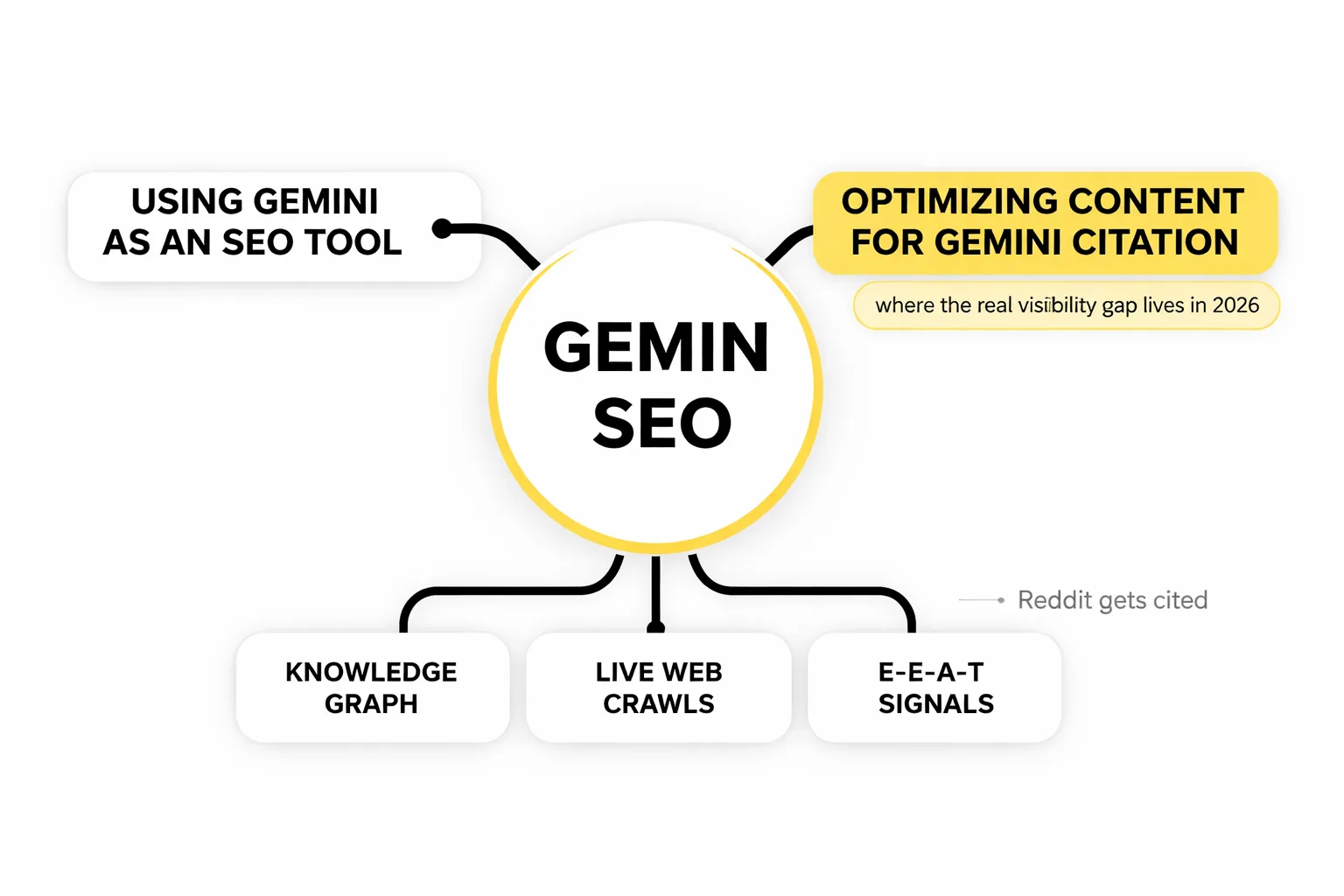
Gemini SEO is now two things at once: using Gemini as an SEO tool, and optimizing your content so Gemini cites you. Most practitioners are doing one or neither. This article covers both, with a specific focus on the citation side. Because that's where the real visibility gap lives in 2026.
Google's Gemini sources answers from its Knowledge Graph, live web crawls, and E-E-A-T signals. Reddit gets cited by major LLMs at roughly 40% frequency. Not because it's structured, but because it reads like real people answering real questions. An Ahrefs panel of 75,000 websites tracked over 10 months found AI search tools gained 0.04 percentage points of traffic share while Google paid search captured 3.2 percentage points. Getting cited by Gemini without a paid search backstop is an incomplete strategy. The citation creates demand you don't automatically capture.
The Two Disciplines Most Teams Conflate
When a founder asks about gemini seo, the first question worth asking is: which half do they mean? The phrase covers genuinely different workflows, and conflating them leads to wasted effort in both directions.
The first is using Gemini as a research and production tool: generating content briefs, running competitive gap analysis, drafting technical SEO recommendations. This is table stakes now. If your team isn't using Gemini (or a comparable LLM) to accelerate content operations, the same work takes twice as long.
The second. And harder. Discipline is optimizing your content so that Gemini cites you when users ask questions in your category. This is Generative Engine Optimization (GEO), and it requires a fundamentally different mental model than traditional SEO. The goal isn't a ranking position. It's selection as a trustworthy source by a probabilistic system that weighs entity recognition, topical depth, E-E-A-T signals, and source reputation simultaneously. The two disciplines share some overlap. Strong content helps both. But the citation side requires additional moves that keyword optimization alone will never deliver.
Most search engine optimization platforms weren't built with this split in mind. They track rankings and traffic. Neither metric tells you whether Gemini is citing your competitors while ignoring you. That blind spot is exactly where Marcus found himself, and it's where most teams are sitting right now.
How Gemini Actually Selects Its Sources
Gemini's source selection isn't a black box, but it's also not a simple checklist. From what's publicly documented and observable, it draws on three layers.
First, Google's Knowledge Graph. Entities that are well-established in Google's entity graph. Brands, people, organizations, concepts. Have a structural advantage. If your brand isn't a recognized entity in Google's ecosystem, Gemini has less signal to work with when deciding whether to cite you. This is why entity-building work (structured markup, Wikipedia presence, consistent NAP data, author entity profiles) matters specifically for AI visibility, not just for traditional SEO.
Second, live web crawl and index quality. Gemini pulls from Google's index, which means crawlability, indexing health, and page quality still matter. A technically broken site or a page that Google has deprioritized in crawl budget won't surface in Gemini answers regardless of content quality. The Google AI Overviews optimization research consistently shows that pages appearing in AI Overviews skew heavily toward pages that already rank in the top 10. Not always position 1, but consistently in the top tier.
Third, E-E-A-T signals interpreted for an AI context. This is where the discipline diverges from traditional SEO most sharply. Google's E-E-A-T framework was designed for human quality raters, but Gemini applies similar logic algorithmically. Named authors with verifiable credentials, first-person experience signals, specific data points with sourced citations, and demonstrated topical depth all contribute. The difference in the AI context is that Gemini can parse the semantic content of a page, not just its metadata. So thin content that looks well-structured doesn't fool it the way it might have fooled older ranking algorithms.
Why "Dense Claim Blocks" Don't Move the Needle
Here's the contrarian take nobody in the GEO vendor space wants to say: the structured optimization playbook most agencies are selling right now is largely theater.
Testing the claim-dense, schema-heavy approach on several pieces in early 2026 produced no meaningful lift in AI visibility. What the data shows instead aligns with citation frequency patterns that have been circulating across research communities: Reddit shows up at roughly 40% citation frequency across major LLMs. Wikipedia sits around 26%. Neither of those platforms is structured like a GEO-optimized asset. Both are messy, conversational, and community-driven. That pattern tells you something important: LLMs are already rewarding the same authentic, user-first signals that Google's Helpful Content System targets. The supposed tension between "write for AI citation" and "write for HCS" is mostly a false dilemma that vendors are exploiting to sell new service lines.
Nathan Poekert, in a widely-shared LinkedIn observation, described Google Gemini AI search results as "the most cataclysmic shift in the marketing funnel and user journey in the past year" and noted there's "no consistent pattern" in which brands get cited. That's not because Gemini is random. It's because the signals are genuinely holistic, and single-variable optimization (add more schema, add more bold claims) doesn't move a holistic system.
The format isn't the lever. The authenticity and specificity of the underlying answer is.
How Does E-E-A-T Work Differently for AI Search?
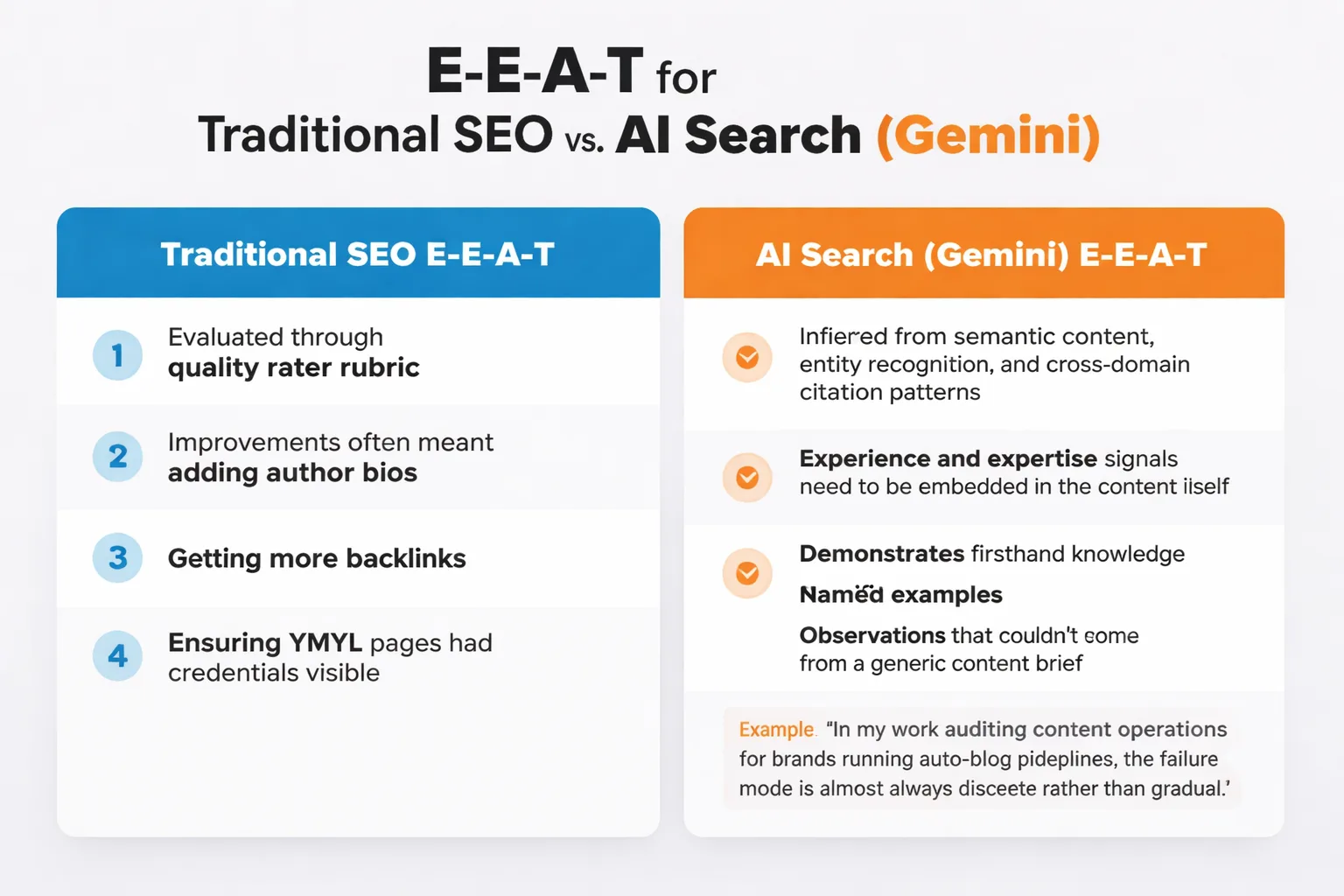
For AI search engines like Gemini, E-E-A-T isn't evaluated through a quality rater rubric. It's inferred from semantic content, entity recognition, and cross-domain citation patterns. That distinction changes what you actually need to produce.
In traditional SEO, E-E-A-T improvements often meant adding author bios, getting more backlinks, and ensuring YMYL pages had credentials visible. Those signals still matter. But for Gemini specifically, the experience and expertise signals need to be embedded in the content itself. Not just in the metadata around it.
Concretely, this means writing in a way that demonstrates firsthand knowledge. Specific numbers. Named examples. Observations that couldn't have come from a generic content brief. A paragraph that says "in auditing content operations for brands running auto-blog pipelines, the failure mode is almost always discrete rather than gradual" carries more E-E-A-T signal than a paragraph that says "experts recommend monitoring content quality regularly." Gemini can tell the difference semantically, and it weights the former more heavily as a citable source.
Author entity profiles matter here too. If your authors have a verifiable web presence. LinkedIn profiles, published bylines on authoritative domains, consistent name-entity associations across your site. Gemini has more signal to work with when evaluating whether to surface your content as a trusted source. At Meev, author entity setup is one of the first things configured before any content goes live, because the downstream citation benefit compounds over months, not days.
Bridging the Mention-Citation Gap
Getting mentioned by Gemini and getting cited by Gemini are different outcomes, and the gap between them is where most brands lose.
A mention means Gemini might reference your brand name in passing. A citation means Gemini surfaces your content as a source, often with a link or a direct attribution that users can follow. The citation is what drives brand recognition and eventual purchase intent. The mention is just noise.
The structural problem is more troubling than most founders realize. When Perplexity or Gemini cites your brand, the user now knows your name but has no automatic click path. They go to Google. If you're not ranking organically for your own brand query. And AI-absorbed intent has eroded that. You end up buying a paid search ad to recapture the demand your AI mention created. The platform that lost the organic traffic monetizes the awareness gap. Getting cited by AI without a paid search backstop isn't a win. It's an incomplete strategy.
Bridging the mention-citation gap requires a specific outreach workflow, not just better content. The pattern that works:
1. Identify the publishers Gemini actually cites for your topic category. These aren't always the obvious ones. Check which domains appear in AI Overviews and Gemini answers for your target queries, not just which domains rank on page one. 2. Map your existing content against those publishers' topic coverage. Find the overlap where you have genuine depth and they have surface-level treatment. 3. Pitch specific contributions. A data point, a case study, a named expert quote. That would make their existing coverage more citable. You're not asking for a backlink. You're offering to improve their answer quality in a way that also associates your brand with the topic. 4. Track whether those placements shift your citation frequency in Gemini answers over the following 4-6 weeks.
This is what Citation Path outreach looks like in practice. It's slower than traditional link building, but the compounding effect on AI visibility is real because you're building the cross-domain citation pattern that Gemini uses as a trust signal.
Using Gemini as an SEO Tool
The tactical side of google gemini seo is genuinely useful and underused. Here's where the highest-leverage applications sit.
Competitive gap analysis. Prompt Gemini with your competitors' core value propositions and ask it to identify the questions it would answer using their content. Then check whether your content covers those questions with more depth. The gaps you find are your content priorities.
Content brief generation. Gemini's ability to synthesize across a topic cluster is strong. Feed it your target keyword, your existing content, and three competitor URLs, then ask for a brief that addresses what none of them cover. The output needs editing, but the structural thinking is often sound.
Technical SEO triage. Gemini can parse crawl log data and site audit exports faster than most humans. Paste in a Lighthouse report or a list of crawl errors and ask for prioritized fixes by impact. It won't replace a technical SEO specialist, but it accelerates the diagnostic phase significantly.
Schema markup drafting. This is one of the highest-fidelity use cases. Gemini generates syntactically correct JSON-LD for Article, FAQ, HowTo, and Speakable schema types reliably. The output still needs validation, but it's dramatically faster than hand-coding.
The HubSpot connector for Google Gemini (currently in Public Beta for joint customers) takes this further by surfacing HubSpot CRM context directly within Gemini answers, letting teams act on that context back in HubSpot without switching tools. It's an early signal of where the tool integrations are heading. AI that can pull from your proprietary data, not just the public web.
Best AI SEO Agent Platforms in 2026
The category of AI SEO agents has matured considerably. In 2026, the distinction that matters most isn't whether a platform uses AI. Nearly all of them do. But whether the AI operates autonomously on your site or requires human approval before anything publishes. That distinction has real consequences for quality control and for your relationship with Google's scaled content policies.
The platforms that have earned serious adoption fall into roughly three archetypes.
The first archetype is the autonomous content agent: platforms that research, write, and publish without a human in the loop. The appeal is obvious. The risk is equally obvious. And it's the risk that's been materializing in 2026. Sites running fully autonomous pipelines without quality gates have seen scaled content actions at a rate that should give any growth-focused team pause. Volume without a quality firewall isn't a strategy. It's a liability.
The second archetype is the approval-gated AI publisher: platforms that do the research and writing but require a human sign-off before anything goes live. This is the model Meev uses. Every article passes a quality check and an owner approval step before it reaches the CMS. The tradeoff is slightly slower throughput, but the downside protection is substantial. And for AI citation specifically, quality-gated content builds the topical authority signal that Gemini rewards, while thin-volume publishing builds the scaled content signal that Gemini (and Google) penalizes.
The third archetype is the visibility and diagnostic layer: platforms that don't write content at all, but measure where your brand appears (or doesn't appear) across AI search surfaces, identify which competitors are being cited instead of you, and surface the specific gaps your content strategy needs to close. This is where AI visibility tools like Meev's monitoring layer sit. For teams that already have a content operation, this diagnostic layer is often the missing piece. Because you can't close a citation gap you can't measure.
The best AI SEO agents in 2026 aren't the ones that publish the most. They're the ones that publish what gets cited. That requires measurement first, then targeted content, then quality-gated publishing. The platforms that do all three in sequence are the ones producing compounding results rather than compounding risk.
For founders evaluating search engine optimization platforms in this space, the right questions are: Does this platform differentiate between AI Overviews and Gemini as separate citation surfaces? Does it require human approval before publishing? Does it track citation frequency, not just rankings? If the answer to any of those is no, the platform is solving yesterday's problem.
What Makes the Best SEO Ranking Software in 2026?
The honest answer is that the best seo ranking software in 2026 is whichever tool measures what actually drives your pipeline. And for a growing share of B2B brands, that's no longer just a position tracker.
Traditional seo ranking software does one thing well: it tells you where a page sits in Google's organic results for a given keyword. That was sufficient when Google's ten blue links were the primary interface between a prospect and your brand. In 2026, those same prospects are getting synthesized answers from Gemini, ChatGPT, Perplexity, and Claude before they ever reach a SERP. A tool that only tracks keyword positions is measuring one lane of a five-lane road.
The search engine ranking software category has responded to this in two ways. Some platforms have bolted AI Overviews tracking onto existing rank-tracking infrastructure. Useful, but incomplete, because AI Overviews is one surface among many. Other platforms have rebuilt from the ground up around citation measurement: which queries cite your brand, on which surfaces, at what frequency, and against which competitors. That second category is where the diagnostic value lives for teams trying to understand their full search visibility picture.
When evaluating any search engine optimization platform today, the feature checklist worth running through looks like this. Does it track traditional keyword rankings? Does it separately track AI Overviews presence? Does it track Gemini, ChatGPT, Perplexity, and Claude citations as distinct surfaces? Does it identify which competitors are cited instead of you? Does it surface which publishers those AI engines are drawing from, so you know where to build cross-domain authority? A platform that checks all five boxes is genuinely rare. Most check two or three and call it AI-ready.
For small teams without a dedicated SEO analyst, the practical priority is different. The most valuable feature isn't the one with the most data. It's the one that tells you the single most important thing to fix next. That's a diagnosis problem as much as a measurement problem. The best seo ranking software for a 10-person B2B SaaS company isn't the same tool a 200-person agency needs. Scale the evaluation criteria to the decision you're actually trying to make.
The recurring pattern among teams that close AI visibility gaps fastest is that they start with measurement, not content production. They know exactly which queries they're missing before they write a single word. That sequencing matters more than the specific tool chosen.
How to Optimize for AI Search Engines in 2026
Optimizing for AI search engines in 2026 is not the same as optimizing for Google in 2022. The mechanics overlap, but the emphasis shifts in three important ways.
Entity clarity over keyword density. AI search engines like Gemini, ChatGPT, Perplexity, Claude, and Google AI Overviews all operate from a model of the world built on entities and relationships, not keyword frequency. The question isn't "does this page contain the phrase 'best project management software'?" It's "is this page clearly about a specific entity (brand, product, concept) with verifiable relationships to adjacent entities?" Structured data helps signal this. Consistent brand mentions across authoritative domains help more. A Wikipedia presence, a Wikidata entry, a Google Knowledge Panel. These are entity signals that AI search engines use to decide whether your brand is a known quantity worth citing.
Answer specificity over topic coverage. The recurring pattern across brands that get cited consistently is that their content answers specific questions with specific answers. Named data points, named examples, named methodologies. A page that says "conversion rates vary by industry" is not citable. A page that says "Unbounce's Conversion Benchmark Report found median landing page conversion rates range from 2.6% in B2B SaaS to 9.8% in catering and restaurants" is citable. AI engines extract and attribute specificity. They skim over generality.
Cross-domain citation building over pure on-site optimization. This is the piece most search engine optimization platforms still don't address. Your own domain's content quality is necessary but not sufficient for AI citation. What matters additionally is whether other authoritative domains reference your brand, your data, or your named experts in the context of your topic category. That cross-domain signal is what AI engines use to triangulate trustworthiness. Building it requires the publisher outreach workflow described above, not just publishing more content on your own site.
The GEO framework synthesizes these three shifts into a practical workflow: identify which AI surfaces are answering your category questions, measure your current citation presence on each, identify the publishers those surfaces are citing, and build the entity and cross-domain signals that make you a natural citation choice. That's the full loop. And it's meaningfully different from the "publish more, optimize more" loop that dominated SEO strategy for the previous decade.
How to Optimize for AI Search Engines. GEO Explained
Generative Engine Optimization (GEO) is the specific discipline of making your content the answer AI engines give. It's distinct from AEO (Answer Engine Optimization), which focuses more narrowly on featured snippets and voice search. GEO addresses the full generative answer. The synthesized response that Gemini, ChatGPT, or Perplexity constructs from multiple sources.
The GEO workflow has five practical stages.
Stage 1: Query mapping. Define the 20-50 queries your prospects are asking AI assistants in your category. Not keyword research. Query research. These are full questions, the kind someone types into Perplexity or speaks to Google Gemini. "What's the best way to track AI search visibility for a B2B SaaS brand?" is a query. "AI search visibility" is a keyword. GEO starts with the query.
Stage 2: Citation audit. Run those queries against every major AI search surface. ChatGPT, Claude, Gemini, Perplexity, Grok, Google AI Overviews, and AI Mode. And record which brands are cited for each. This gives you your current share of voice and your competitor citation map. It also shows you which publishers are being used as sources, which is your outreach target list.
Stage 3: Content gap analysis. For each query where you're not cited, identify why. Is it a content gap (you haven't written about this)? An authority gap (your domain isn't trusted enough on this sub-topic)? An entity gap (your brand isn't recognized as a relevant entity for this category)? Each gap type requires a different fix.
Stage 4: Targeted content and entity building. Fill content gaps with answer-first content that demonstrates genuine expertise. Fill authority gaps with publisher outreach. Fill entity gaps with structured markup, author profile development, and Knowledge Graph signals. Don't try to fix all three simultaneously. Sequence them based on which gap is largest.
Stage 5: Measurement cadence. Re-run your query set every four weeks. Track citation frequency, citation position, and share of voice against competitors. The goal is a measurable shift in those metrics over a 90-day horizon. If you're not seeing movement after 90 days, the content or outreach targeting is wrong. Not the strategy.
This is what AEO vs SEO looks like in practice: two complementary measurement systems that together give you a complete picture of your brand's discoverability in 2026.
Are There Better Search Engines Than Google for Brand Visibility?
This is the question that would have sounded absurd three years ago. In 2026, it's a legitimate strategic consideration.
Google still processes the overwhelming majority of search queries globally. That's not changing in the near term. But the nature of what a "search engine" does has fractured. Perplexity, ChatGPT Search, and Claude.ai are functioning as answer engines for a growing segment of research-intent queries. Particularly among professional and technical users. These aren't Google replacements. They're Google supplements that are capturing the highest-value queries: the ones where a user wants a synthesized answer, not a list of links to evaluate.
For brand visibility specifically, the calculus is interesting. A brand cited in a Perplexity answer to a high-intent research query may generate more qualified awareness than a brand ranking position 4 in a traditional SERP for the same query. The Perplexity user is reading a synthesized answer and absorbing brand associations. The SERP user is scanning ten blue links and probably clicking the first two.
The practical implication is that "better" depends on what you're optimizing for. For raw traffic volume, Google remains dominant. For brand authority signals in high-intent research contexts, the AI answer engines are increasingly where the conversation happens. A gemini ai seo strategy that ignores Perplexity and ChatGPT Search is leaving citation opportunities on the table. And those citations compound into entity recognition that eventually benefits your Google rankings too.
The brands winning in 2026 aren't choosing between Google and AI search engines. They're building the entity and content signals that work across all of them simultaneously, because the underlying trust signals. E-E-A-T, topical depth, cross-domain citation. Are largely shared.
When Should You Track AI Search Visibility?
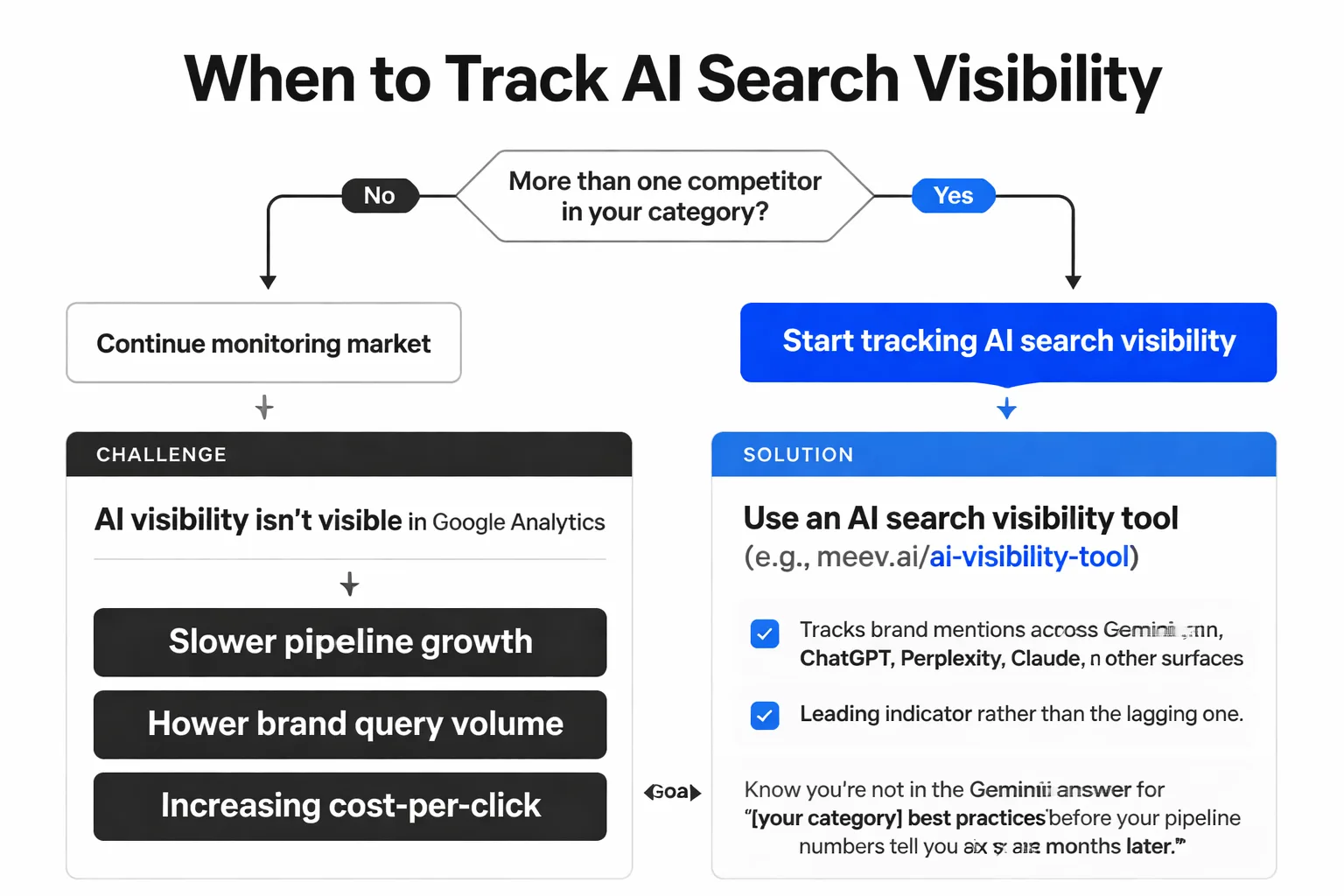
You should start tracking AI search visibility the moment you have more than one competitor in your category. Because Gemini is already answering questions your prospects are asking, and you need to know whether you're in those answers or not.
The challenge is that AI visibility isn't visible in Google Analytics. A Gemini answer that cites your competitor doesn't show up as a lost session in your data. You only see the downstream effect: slower pipeline growth, lower brand query volume, increasing cost-per-click as you buy back demand that AI-absorbed intent created.
An ai search visibility tool that tracks your brand mentions across Gemini, ChatGPT, Perplexity, Claude, and other surfaces gives you the leading indicator rather than the lagging one. You want to know you're not in the Gemini answer for "[your category] best practices" before your pipeline numbers tell you six months later.
The measurement architecture matters too. Tracking Gemini visibility specifically requires querying Gemini directly. Not inferring from Google AI Overviews data, which is a related but distinct surface. Tools that conflate the two give you a blended metric that's hard to act on. When evaluating AI visibility platforms, the first question worth asking is whether they differentiate between AI Overviews and Gemini as separate citation surfaces, because the sourcing logic differs meaningfully between them.
The Quality Gate Problem in AI-Era Content
One failure mode that appears repeatedly in auto-blog pipelines is the assumption that volume compensates for quality gate misconfiguration. It doesn't. It accelerates the damage.
The failure isn't gradual. It's discrete and fast. A prompt that starts producing thin content at volume, a metadata issue that trips a spam signal, a quality threshold that drifts. And Google's response, when it comes, can move you from page one to page seven in days. Recovery is slow and unforgiving of shortcuts. The 3-posts-per-week cadence that drives compounding traffic gains only works if the gate holds every single time.
For AI citation specifically, this matters because Gemini's source selection actively penalizes domains that have triggered scaled content abuse signals. Publishing 50 thin articles to "cover" a topic cluster doesn't build topical authority in Gemini's model. It builds a signal pattern that looks like manipulation. The answer is quality-gated publishing: every article passes a substantive quality check before it reaches your CMS, and the check evaluates for genuine information gain, not just word count or keyword density.
This is the design logic behind the 16-dimension quality firewall Meev built into its publishing pipeline. Articles below 70/100 on the Portfolio Quality Metric are blocked from auto-publishing. The dimensions include information gain signals, E-E-A-T markers, and a Google Penalty Risk Matrix specifically calibrated to catch the patterns that trigger scaled content actions. The upside of AI-era content publishing is real. The downside is faster than the upside, and it doesn't negotiate.
For teams using Answer Engine Optimization (AEO) workflows at scale, the quality gate isn't optional infrastructure. It's the thing that determines whether your content strategy compounds or collapses.
How Do You Measure Gemini SEO Progress?
Gemini SEO progress is measured by citation frequency (what percentage of relevant queries cite your brand), citation position (first mention vs. buried in a list), and share of voice against competitors. Not by rankings or sessions alone.
These metrics require direct measurement against Gemini, not inference from Google Analytics. The workflow is: define a set of 20-50 queries that represent your category, run them against Gemini on a regular cadence, record whether your brand appears, where it appears, and which competitors appear instead of you.
Share of voice across AI engines is the metric most actionable for early-stage brands. If competitors are cited in 60% of category queries and you're cited in 15%, that gap tells you both the scale of the problem and the ceiling of the opportunity. Closing it requires the citation-building workflow described above, not just publishing more content.
For tracking Gemini visibility specifically alongside other surfaces like Claude, the key is keeping the measurement surfaces separate. Each LLM has distinct sourcing patterns, and a blended "AI visibility" score obscures which surfaces you're winning and which you're losing. The AEO vs SEO framing is useful here: SEO tells you about ranking positions, AEO tells you about answer presence. You need both dashboards, and they shouldn't be averaged together.
FAQ
What is Gemini SEO exactly?
Gemini SEO refers to two related practices: using Google's Gemini AI as a tool to accelerate SEO workflows (content briefs, competitive analysis, schema generation), and optimizing your content and brand presence so that Gemini cites you in its answers. Most brands need both, but the citation side is where the larger visibility gap exists in 2026. The discipline sits at the intersection of traditional SEO and Generative Engine Optimization (GEO).
What are the best AI SEO agent platforms in 2026?
The platforms earning serious adoption in 2026 fall into three categories: autonomous content agents (high throughput, high quality risk), approval-gated AI publishers (human sign-off before anything publishes, stronger quality control), and visibility-and-diagnostic layers (measure citation gaps without generating content). The best choice depends on whether your primary problem is content production, quality control, or measurement. Teams with existing content operations often need the diagnostic layer first. You can't close a citation gap you can't see. Meev sits in the second and third categories: it requires owner approval before publishing and tracks citation frequency across every major AI search surface.
What are the best AI SEO agents in 2026 for small teams?
For small teams, the best AI SEO agents are those that sequence diagnosis before production. A tool that publishes 50 articles per month without first identifying which queries your brand is missing from is generating volume, not visibility. The agents delivering results for lean teams in 2026 combine citation measurement (which AI surfaces cite you, which cite competitors), targeted content generation (answer-first articles built around specific citation gaps), and a quality gate that prevents scaled content penalties. Autonomous agents without that quality gate create more risk than they resolve for small teams that can't absorb a Google penalty.
Does ranking on page one guarantee Gemini will cite you?
No. Gemini draws from Google's index, so indexing health matters. But citation selection goes beyond ranking position. E-E-A-T signals, entity recognition, topical depth, and cross-domain citation patterns all influence whether Gemini surfaces your content as a source. Brands that rank positions 3-8 get cited regularly when their content demonstrates stronger expertise signals than the page-one result.
How long does it take to appear in Gemini answers?
The consistent pattern is 4-8 weeks from a meaningful content or outreach intervention to a measurable shift in citation frequency. Entity-building work. Knowledge Graph signals, author profiles, structured markup. Takes longer, typically 3-6 months to compound. Track citation frequency on a defined query set at 4-week intervals to see movement rather than waiting for traffic data to reflect it.
How do you optimize for AI search engines in 2026. What's different from traditional SEO?
Three shifts matter most. First, entity clarity over keyword density: AI engines reason about brands and concepts as entities, not keyword strings. Second, answer specificity over topic coverage: citable content names specific data points, studies, and examples. Generalities don't get extracted. Third, cross-domain citation building: your own site's content quality is necessary but not sufficient. Other authoritative domains need to reference your brand in your topic context. Traditional search engine optimization platforms track the first two poorly and ignore the third almost entirely.
Is schema markup required to be cited by Gemini?
Schema helps but isn't sufficient on its own. Article, FAQ, HowTo, and Speakable schema give Gemini cleaner signal about your content's structure and intent. But Gemini can parse semantic content without schema. So a well-written, deeply expert piece without schema will outperform a thin piece with perfect markup every time. Schema is a signal amplifier, not a citation shortcut.
How is Gemini citation different from Google AI Overviews?
They're related but distinct surfaces with different sourcing logic. AI Overviews is a SERP feature that pulls from Google's ranking index and tends to cite top-10 pages heavily. Gemini (in the Gemini app and Gemini Advanced) uses a broader sourcing model that includes Knowledge Graph data and can cite sources that don't rank in the top 10. Tracking them separately gives you more actionable data than a blended metric. And the optimization levers for each differ enough that a single strategy targeting both simultaneously tends to underperform a sequenced approach.
What's the fastest way to close a Gemini citation gap?
Publisher outreach to domains Gemini already cites for your topic category. Find the 5-10 publishers appearing in Gemini answers for your target queries, identify where your expertise adds to their coverage, and pitch a specific contribution. A data point, case study, or expert comment. This builds the cross-domain citation association that Gemini uses as a trust signal faster than waiting for your own domain authority to compound.
About the Author
Judy Zhou, Founder
Judy Zhou leads content strategy at Meev, where she oversees AI-driven content research and publishing for hundreds of brands. With a background in SEO and editorial operations, she focuses on building content systems that rank on Google, get cited by AI search engines, and drive measurable business results.