

By Judy Zhou, Head of Content Strategy
Key Takeaways
- Perplexity cites sources 97% of the time versus ChatGPT’s 16%, an 81-point gap that should reshape content distribution priorities.
- YouTube has overtaken Reddit as the top-cited platform in AI responses thanks to its structured, sequential formats.
- Select 2026 content tools that track brand mentions in ChatGPT, Perplexity, and Google AI Overviews rather than only keyword rankings.
- LLM-driven referral traffic remains just 1% of total site visits as of mid-2025, so prioritize platforms that close the loop from publish to AI citation.
Your content marketing software probably can't tell you if AI mentions your brand.
That gap matters more than it did 18 months ago. As someone who leads content strategy across hundreds of brand domains at Meev, I watch teams invest heavily in content marketing software that handles publishing, SEO scoring, and editorial calendars beautifully. Then have zero visibility into whether ChatGPT, Perplexity, or Google AI Overviews ever surfaces their brand in a buying-intent query. Content marketing software in 2026 needs to do more than schedule posts and track keyword rankings. The platforms worth buying now are the ones that close the loop between what you publish and where AI search engines actually cite you.
Here's what this guide covers: what separates genuinely useful content marketing software from feature-bloated platforms, which capabilities matter specifically for AI-era content strategies, and how to match a tool to your actual situation. Whether you're a solo founder, an SMB, or an agency running 15 client domains.
Four claims worth extracting before you read further: (1) Perplexity cites a source 97% of the time while ChatGPT cites only 16% of the time. An 81-point gap that changes how you think about content distribution. (2) YouTube has surpassed Reddit as the most cited platform in AI-generated responses, per ADWEEK research, due to structured, sequential content formats. (3) Google's Helpful Content System penalizes SEO-first content qualitatively. There's no published numerical threshold, only self-assessment criteria. (4) LLM-driven referral traffic sits around 1% of total website traffic as of mid-2025, per Statista. Meaningful enough to track, not yet large enough to deprioritize conversion-focused content for.
The Core Problem with Most Content Marketing Stacks
Most content marketing stacks were built for a pre-AI search world. They optimize for keyword density, DA scores, and editorial calendars. Those things still matter. But they don't answer the question your CMO is starting to ask: "Is our brand showing up when someone asks ChatGPT who the best option is in our category?"
The honest answer, for most companies, is: you don't know. Your current content marketing software probably isn't tracking it.
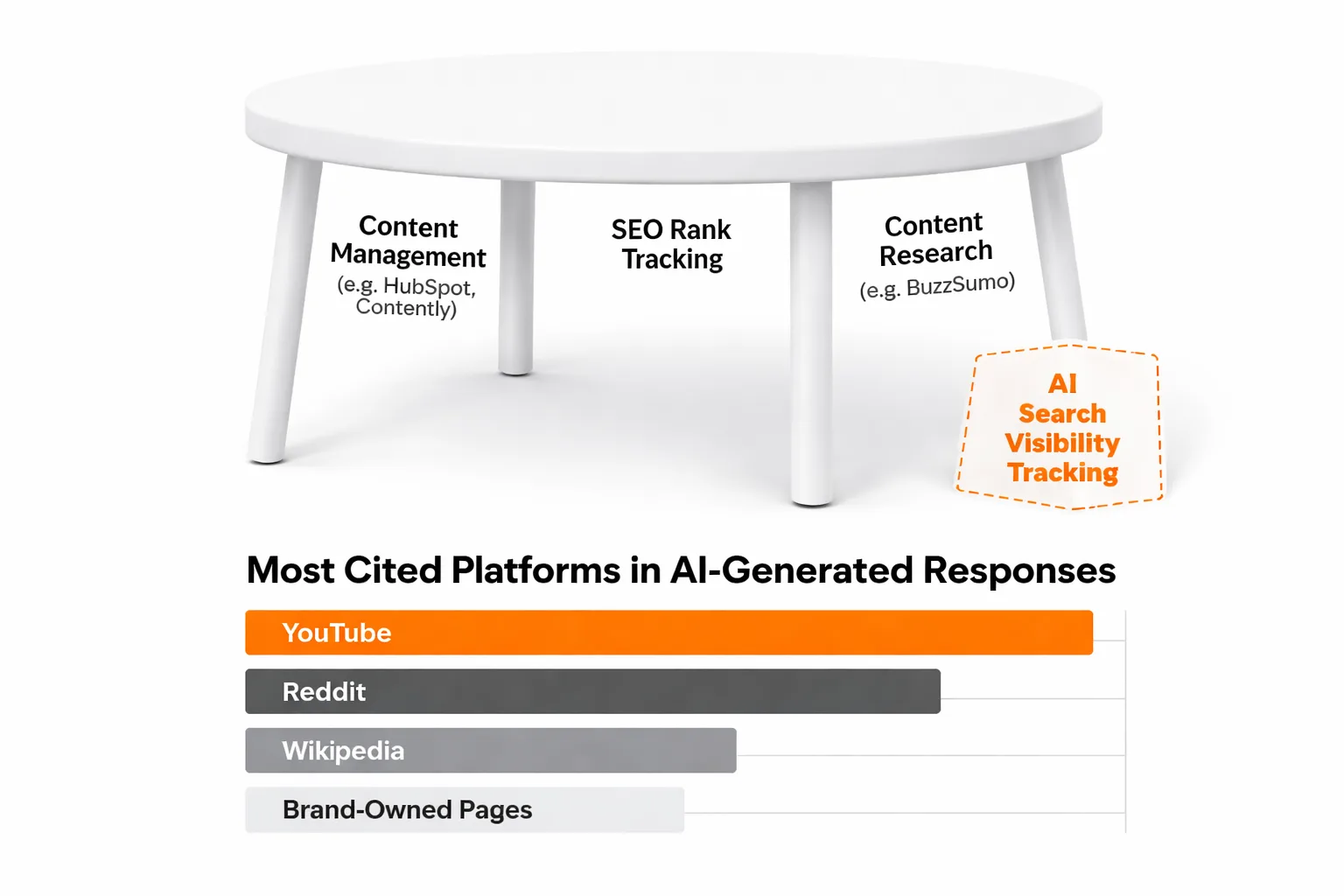
I've audited enough content operations to see the pattern clearly. Teams are running HubSpot or Contently for content management, a separate rank tracker for SEO, maybe BuzzSumo for content research. And nothing for AI search visibility. The stack has three legs but is missing the fourth. When I look at what's actually driving citation decisions in AI engines, the gap becomes uncomfortable. YouTube is now the most cited platform in AI-generated responses, ahead of Reddit, ahead of Wikipedia, ahead of brand-owned pages. That's a structural shift in how knowledge gets surfaced, and most content marketing software has no mechanism to even measure it, let alone respond to it.
Content marketing automation tools need a new evaluation dimension in 2026: do they help you get found by AI, not just by Google's blue links?
Key Features of Content Marketing Software Worth Paying For
Before comparing platforms, it helps to have a clear feature taxonomy. The category has sprawled. Some tools call themselves content marketing software but are really just social schedulers. Others are full editorial suites. Here's how I break down the feature set that actually moves the needle:
Planning and topic discovery. This goes beyond keyword research. The best tools pull from Google Trends, Reddit, Hacker News, Search Console, and RSS feeds simultaneously. Then surface topics where you have a realistic chance of ranking AND getting cited. Cannibalization detection at the planning stage (not just after you've published 40 articles on the same topic) is a feature most platforms still handle badly.
Content creation with quality gates. This is where the gap between auto-blogging tools and serious content marketing workflow software becomes obvious. Tools that generate and immediately publish whatever the model produces are a liability in 2026. Google's spam policies are explicit about scaled content abuse, and the Helpful Content System's qualitative criteria mean that thin, SEO-first content carries real downside risk. A quality gate. Something that scores drafts against multiple dimensions before they reach your CMS. Isn't optional anymore. It's the difference between building topical authority and diluting it.
Distribution and multi-CMS publishing. WordPress is still dominant, but agencies and multi-brand operators need Ghost, Shopify, Wix, and webhook support. Timezone-aware scheduling and automatic IndexNow + Search Console sitemap submission on every publish are small features with outsized impact on how fast new content gets indexed.
Analytics that include AI search visibility. This is the feature most platforms are missing entirely. Tracking where your brand appears across ChatGPT, Claude, Gemini, Perplexity, Grok, Google AI Overviews, and DeepSeek. With mention position tracking and share-of-voice against competitors. Is now a core content marketing function, not a nice-to-have. The 81-point citation rate gap between Perplexity and ChatGPT means these platforms behave very differently, and you need per-engine visibility to understand where your gaps actually are.
Citation building and outreach. Finding which publishers AI engines cite for your topics, verifying contact information, and drafting personalized outreach pitches is a workflow that barely existed two years ago. It's now a legitimate content marketing function. The tools that close this loop. From citation gap identification through to outreach execution. Are genuinely differentiated from everything else in the market.
E-E-A-T signals and author entity management. Google's people-first content guidance emphasizes expertise, experience, authoritativeness, and trustworthiness. Author entity profiles. Real named authors with verifiable credentials attached to content. Are one of the few E-E-A-T signals that content marketing software can actually operationalize at scale.
How Does AI Search Visibility Fit into Content Marketing?
AI search visibility is the measure of how often and how prominently your brand appears in AI-generated answers across the major LLM-powered search surfaces. It's distinct from traditional SEO ranking, though the two are related.
Here's the practical distinction: a page can rank #1 on Google for a keyword and never appear in a Perplexity or ChatGPT answer about that topic. Conversely, a brand can get cited frequently in AI answers based on third-party coverage. Reddit threads, YouTube videos, Wikipedia mentions. Even when their own site ranks modestly. The citation logic in LLMs doesn't map cleanly onto PageRank.
What I've found through tracking this across multiple domains is that the content format matters differently for AI citation than for traditional search. The ADWEEK research finding that YouTube now leads AI citation rates — surpassing Reddit. Makes sense when you think about it. YouTube content is naturally structured: step-by-step visuals, clear sequencing, contextual explanations that map well to how LLMs parse and summarize information. It's not that YouTube is a magic citation channel. It's that structured, sequenced content that explains things clearly gets extracted more reliably by AI models. That principle applies to your written content too.
For content marketing workflow software to genuinely support AI visibility, it needs to track mentions across AI surfaces, identify prompts where competitors are cited but you aren't, and surface the publishers those AI engines are already trusting for your topics. That's a closed loop. Most platforms offer one piece of it. Very few offer all three.
For a deeper look at how specific AI engines differ in their citation behavior, the Meev vs Profound comparison breaks down how AI visibility tracking differs across platforms. Including which engines each tool actually covers.
Want to see where your brand actually appears across ChatGPT, Perplexity, and Google AI Overviews right now?
Why Citation Rates Vary So Wildly Across AI Engines
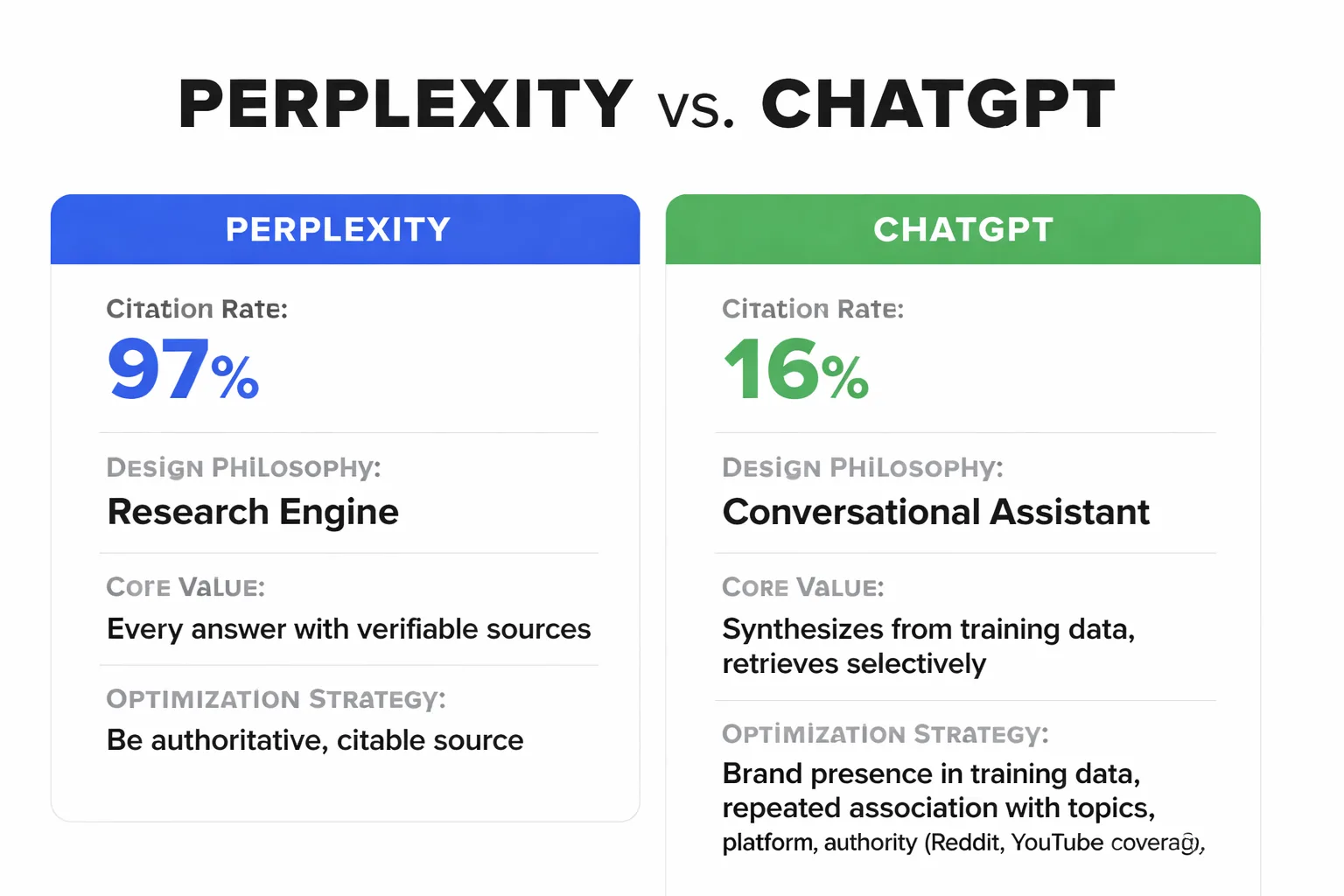
The 97% vs. 16% citation rate gap between Perplexity and ChatGPT isn't a quirk. It reflects fundamentally different design philosophies.
Perplexity is built as a research engine. Its core value proposition is that every answer comes with sources you can verify. The citation is the product. ChatGPT, especially in its default mode, is built as a conversational assistant. It synthesizes from training data and retrieves selectively. Citations appear when the model judges them necessary for credibility or when the user explicitly asks for sources. The implication for content strategy is significant: optimizing for Perplexity citation requires being the kind of authoritative, citable source that a research-oriented engine would surface. Optimizing for ChatGPT mentions requires a different lever. Brand presence in the training data, repeated association with specific topics, and the kind of platform authority that comes from Reddit threads, Wikipedia entries, and YouTube coverage.
This is the contrarian take most content teams aren't sitting with yet: your beautifully structured brand-owned content may be losing citation battles not to competitor content, but to a three-year-old Reddit thread. I went through this realization myself. We spent a quarter tightening FAQ schemas and answer blocks, and when I looked at what LLMs were actually pulling, Reddit was sitting at roughly 40% of sourced content across major models. Our structured definitions weren't losing to competitors. They were losing to platforms LLMs had already decided to trust at a categorical level.
Tracking your brand's citation footprint across DeepSeek and Gemini specifically. Two engines with very different retrieval architectures. Is a useful way to see whether your content strategy is working across the full AI search surface or just on one or two platforms.
Comparing the Main Content Marketing Software Categories
The market has four distinct categories right now. They overlap, but the core value proposition differs enough that buying the wrong category is a real mistake.
All-in-one content marketing platforms (HubSpot, Sprinklr, Salesforce Marketing Cloud): These are built for enterprise teams that need content management, CRM integration, social distribution, and analytics in one place. They're strong on workflow and collaboration. They're weak on AI content generation quality and essentially absent on AI search visibility tracking. If you're a 200-person marketing team and your primary need is orchestration across channels, these make sense. If you're trying to build topical authority and track AI citations, they'll leave you wanting.
Editorial content platforms (Contently, Percolate): Strong on editorial workflow, brand safety, and content quality for human-reviewed publishing. Not designed for AI-assisted content at scale, and not equipped for AI visibility tracking. Good fit for brand journalism and high-touch content programs. Poor fit for content marketing automation at volume.
SEO-first content tools (Semrush Content Marketing, Clearscope, MarketMuse): Built around keyword research, content briefs, and on-page optimization. These are the tools most SEO-focused content teams know well. They're genuinely useful for traditional search optimization. Their AI search visibility features range from nascent to nonexistent. Semrush has begun rolling out AI Overviews tracking, but the depth of per-engine citation analysis is limited compared to dedicated AI visibility platforms.
AI-native content and visibility platforms: This is the emerging category that's most relevant to the 2026 buyer. These tools combine AI-assisted content generation with quality gating, multi-CMS publishing, and AI search visibility tracking in a single workflow. The value proposition is the closed loop: generate content that's optimized for both traditional search and AI citation, publish it with quality controls, then track whether it's actually moving your AI visibility metrics.
For agencies evaluating this last category, the Meev vs Jasper AI comparison is a useful reference point for understanding what quality-gated auto-blogging looks like versus pure content generation.
| Category | Best For | AI Visibility | Content Generation | Quality Gates | Pricing Range |
| All-in-one platforms | Enterprise orchestration | Minimal | Template-based | Manual review | $800–$3,600/mo |
| Editorial platforms | Brand journalism | None | Human-assisted | Editorial workflow | $500–$2,000/mo |
| SEO-first tools | Traditional search | Limited | Brief-based | Scoring only | $100–$500/mo |
| AI-native platforms | AI-era content at scale | Full tracking | Automated + gated | Automated scoring | $49–$599/mo |
When Should You Prioritize AI Visibility Features?
Not every content team needs AI visibility tracking as their primary investment right now. The honest answer depends on your category and your buyer journey.
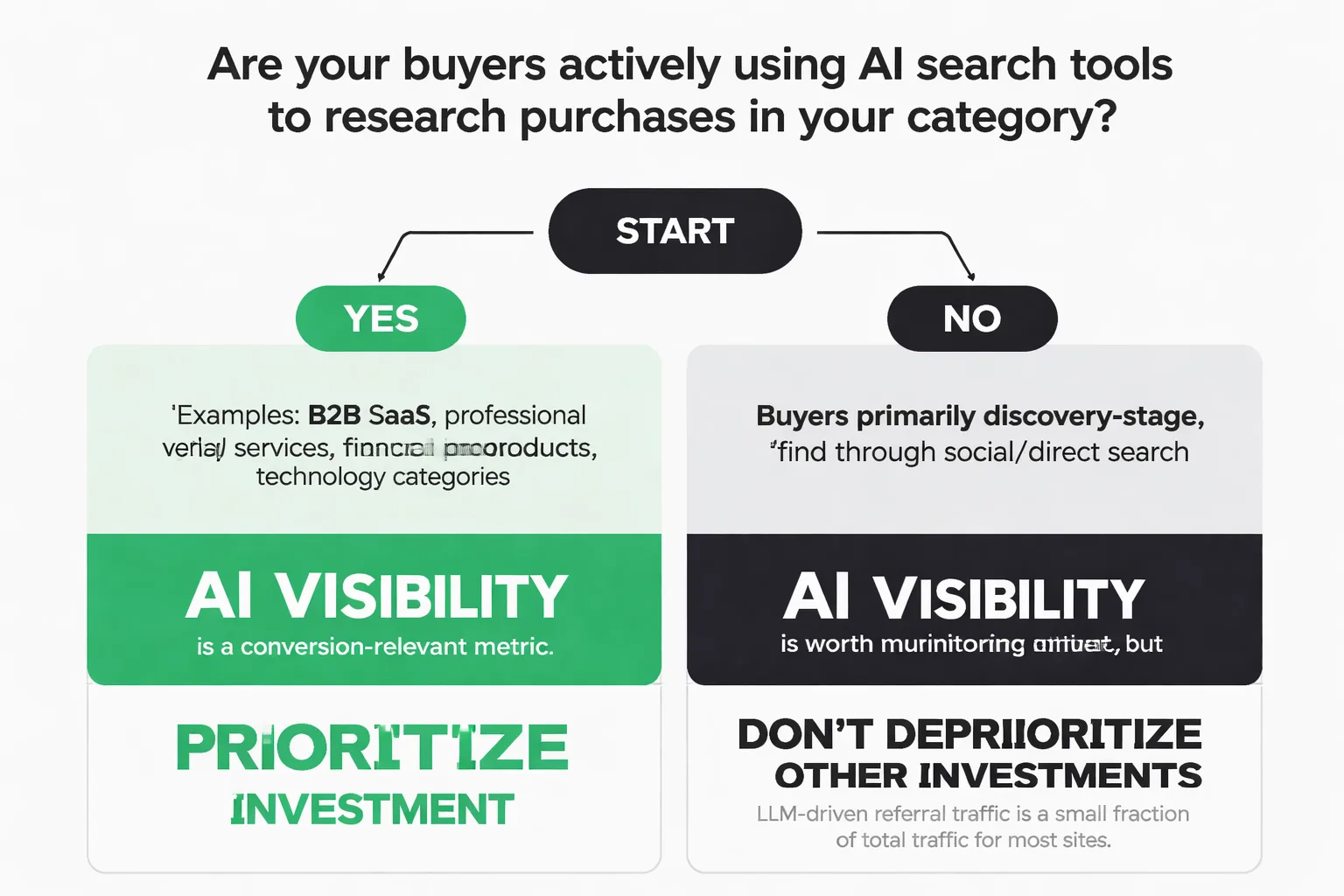
If your buyers are actively using AI search tools to research purchases in your category, AI visibility is already a conversion-relevant metric. B2B SaaS, professional services, financial products, and technology categories see disproportionately high AI search usage among decision-makers. If you're in one of those categories and you're not tracking where you appear in AI-generated answers, you're flying blind on a meaningful portion of the consideration journey.
If your buyers are primarily discovery-stage and find you through social or direct search, AI visibility is worth monitoring but probably not worth deprioritizing other investments for. LLM-driven referral traffic is still a small fraction of total traffic for most sites. I've seen this in our own analytics. Measurable, yes. Business-critical, not yet for every category.
The middle path. And the one I'd recommend for most SMBs and solo founders. Is to choose content marketing software that includes AI visibility tracking as part of the package, rather than buying a separate tool for it. The overhead of managing a fragmented stack isn't worth it when integrated platforms exist at accessible price points.
For solo founders specifically, the AI visibility gap is actually an opportunity. Enterprise brands are slow to adapt their content stacks. A founder who's tracking Grok citation patterns and optimizing for Perplexity source selection right now is building a moat that their larger competitors aren't even measuring yet.
How Does a Quality Gate Actually Work?
A quality gate in content marketing software is a scoring system that evaluates a draft against defined criteria before allowing it to publish. The concept sounds simple. The implementation varies enormously.
At the basic end, some tools run a readability score and a keyword density check. That's not a quality gate. That's a spell-checker with SEO pretensions. A real quality gate for 2026 needs to evaluate information gain (does this article add something that existing content on this topic doesn't?), factual accuracy (are claims source-traceable?), E-E-A-T signals (is there a named author, are sources authoritative, is the content demonstrably written from experience?), and Google Penalty Risk (does the content pattern match known Helpful Content System red flags?).
The information gain question is particularly important and underappreciated. Animalz has written about information gain as the SEO theory that AI made mandatory — the idea that content needs to add genuinely new information to the corpus to deserve ranking. Google's Helpful Content System doesn't publish a numerical threshold for this (I've looked; there isn't one. Only qualitative self-assessment questions). But the direction is clear: content that rehashes what's already available at scale is the exact profile that triggers quality penalties.
For auto-blogging workflows specifically, a quality gate that blocks articles below a threshold score before they reach the CMS isn't just a nice feature. It's the primary risk management mechanism against scaled content abuse. Without it, you're one algorithm update away from a sitewide quality penalty that takes months to recover from.
This is where the Meev vs Peec AI comparison is instructive. It illustrates how quality-gated publishing differs from tracking-only or generation-only approaches in terms of what actually ships to your site.
Pricing Considerations for Different Buyer Types
Content marketing software pricing has stratified sharply. Here's how to think about it by buyer type:
Solo founders need tools that don't require a team to operate. The ideal stack is a single platform covering content generation, quality gating, basic SEO infrastructure, and at least entry-level AI visibility tracking. Budget in the $50–$150/month range is realistic. The key evaluation criteria: how many articles per month, does it publish directly to your CMS, and does it include any AI visibility data (even basic)?
SMBs (5. 50 person marketing teams) typically need multi-domain support, more article volume, and team collaboration features. Budget range: $200–$400/month for an AI-native platform. The evaluation question shifts to: does it support the specific CMS configurations we use, what's the quality gate threshold, and can we track AI visibility per domain?
Agencies have fundamentally different needs: white-label reporting, 10+ domain management, role-based team seats, and client-facing analytics. Budget range: $500–$700/month for a purpose-built agency tier. The non-negotiable features are multi-domain dashboards, team seat management, and the ability to generate client-facing AI visibility reports. A tool that can't show a client their brand's share-of-voice across AI engines in 2026 is a tool that will get replaced.
One pricing consideration that's easy to overlook: cost per article published. A $500/month platform that generates 20 articles is $25/article. A $599/month platform that generates 150 articles is $4/article. Volume economics matter enormously if content at scale is part of your strategy.
FAQ
What's the difference between content marketing software and a CMS?
A CMS (content management system) stores and displays your content. Content marketing software sits upstream. It handles strategy, creation, optimization, and analytics. Most content marketing platforms integrate with your CMS (WordPress, Ghost, Shopify) rather than replacing it. The distinction matters when budgeting: you typically need both, not one or the other.
Does content marketing software help with Google AI Overviews optimization?
The best platforms do, but most don't. Google AI Overviews optimization requires your content to be structured in ways that AI extraction engines can parse cleanly. FAQ schema, clear answer blocks, authoritative inline citations. Look for platforms that auto-generate schema markup (Article, FAQ, HowTo, Speakable) and include author entity profiles for E-E-A-T signals. Generic content tools don't handle this; AI-native platforms increasingly do.
How many AI engines should my content marketing software track?
At minimum: ChatGPT, Perplexity, Google AI Overviews, and Gemini. Those four cover the majority of AI search volume for most B2B and B2C categories. If you're in a technical or developer-facing category, add DeepSeek and Grok. Claude is worth tracking if your buyers skew toward research-intensive workflows. The key is per-engine drill-down. Aggregate "AI mentions" numbers obscure the fact that Perplexity and ChatGPT behave very differently as citation sources.
Can content marketing software help with citation building outreach?
A small number of platforms now include this as a native workflow. The capability involves three steps: identifying which publishers AI engines cite most for your topics, finding verified contact information for those publishers, and drafting personalized outreach pitches. Most content marketing tools stop at content creation and distribution. The citation building loop is a genuine differentiator for platforms that include it. One caution: any outreach operating at high volume carries unquantified risk if quality signals degrade, so build in 30-day review checkpoints.
What should solo founders look for specifically?
Simplicity of operation, direct CMS publishing, and a quality gate that prevents weak content from going live. AI visibility tracking is worth having even at the entry level. The habit of monitoring where your brand appears in AI answers is worth building before the traffic share shifts meaningfully. Look for platforms with a 7-day trial that preserves your data after the trial period ends, so you're not locked into a commitment before you've validated the workflow fits your publishing cadence.
Is content marketing automation safe for E-E-A-T?
It depends entirely on implementation. Automation that publishes without quality gates, without author entity signals, and without fact-verification is a liability under Google's Helpful Content System. Automation that includes a named author profile, source-traced claims, and a multi-dimension quality score before publishing is a defensible E-E-A-T strategy. The tool matters less than the workflow. The question to ask any vendor: what specifically prevents a weak article from publishing automatically?
About the Author
Judy Zhou, Head of Content Strategy
Judy Zhou leads content strategy at Meev, where she oversees AI-driven content research and publishing for hundreds of brands. With a background in SEO and editorial operations, she focuses on building content systems that rank on Google, get cited by AI search engines, and drive measurable business results.
Stop guessing whether AI search engines are citing your brand. Meev tracks your AI visibility across 8 engines, gates content quality before it publishes, and closes the citation gap with built-in outreach — all in one platform.