
By Judy Zhou, Founder
Key Takeaways
- Ahrefs study of 75,000+ brands shows extreme citation concentration where a small set of domains absorbs the majority of AI references across ChatGPT, Perplexity, and Gemini.
- 28% of generative AI conversations focus on practical guidance and another 28% on writing assistance, so brands must produce structured, extractable content to earn citations.
- Comprehensive GEO analysis confirms AI search engines systematically favor earned media from third-party sources over brand-owned content.
- Five articles ranking in Google’s top 3 positions generated zero AI citations, proving traditional SEO rankings do not translate to visibility in generative engines.
The weekly marketing report lands in the director's inbox. Organic traffic is stable. Keyword rankings look acceptable. But somewhere across town, a competitor's brand name is being cited inside ChatGPT answers, Perplexity summaries, and Google AI Overviews. Dozens of times per hour. While this company's name appears nowhere. No alert flags it. No dashboard tracks it. The existing SEO stack simply wasn't built to see it. This is the invisible crisis that AI visibility solutions with best generative engine optimization frameworks are specifically designed to solve.
Most brands discover they're invisible in AI search only after a competitor wins a deal they didn't even know was being contested. The Ahrefs study of 75,000+ brands and millions of AI citations across ChatGPT, Google AIO, Perplexity, and Gemini found that citation concentration is extreme: a small set of domains absorbs the majority of AI references, while most brands are absent entirely. Research from Augustine Agency shows that 28% of generative AI conversations focus on practical guidance and another 28% on writing assistance, meaning brands need structured, extractable content to appear in those answers. And a comprehensive GEO analysis from arXiv confirms that AI search engines systematically favor earned media (third-party authoritative sources) over brand-owned content, which fundamentally changes what kind of content earns citations.
I've spent the past year auditing content operations and AI visibility for brands across SaaS, ecommerce, and professional services. The pattern is consistent. Teams invest in traditional SEO, watch their organic traffic hold steady, and assume they're covered. They're not. The citation gap between Google rankings and AI answers is real, measurable, and growing. In my own testing, 5 articles that hit top 3 organic rankings generated zero AI citations over a 3-month period. Organic visibility alone does not drive AI mentions.
What Separates an AI Visibility Solution from a GEO Tool
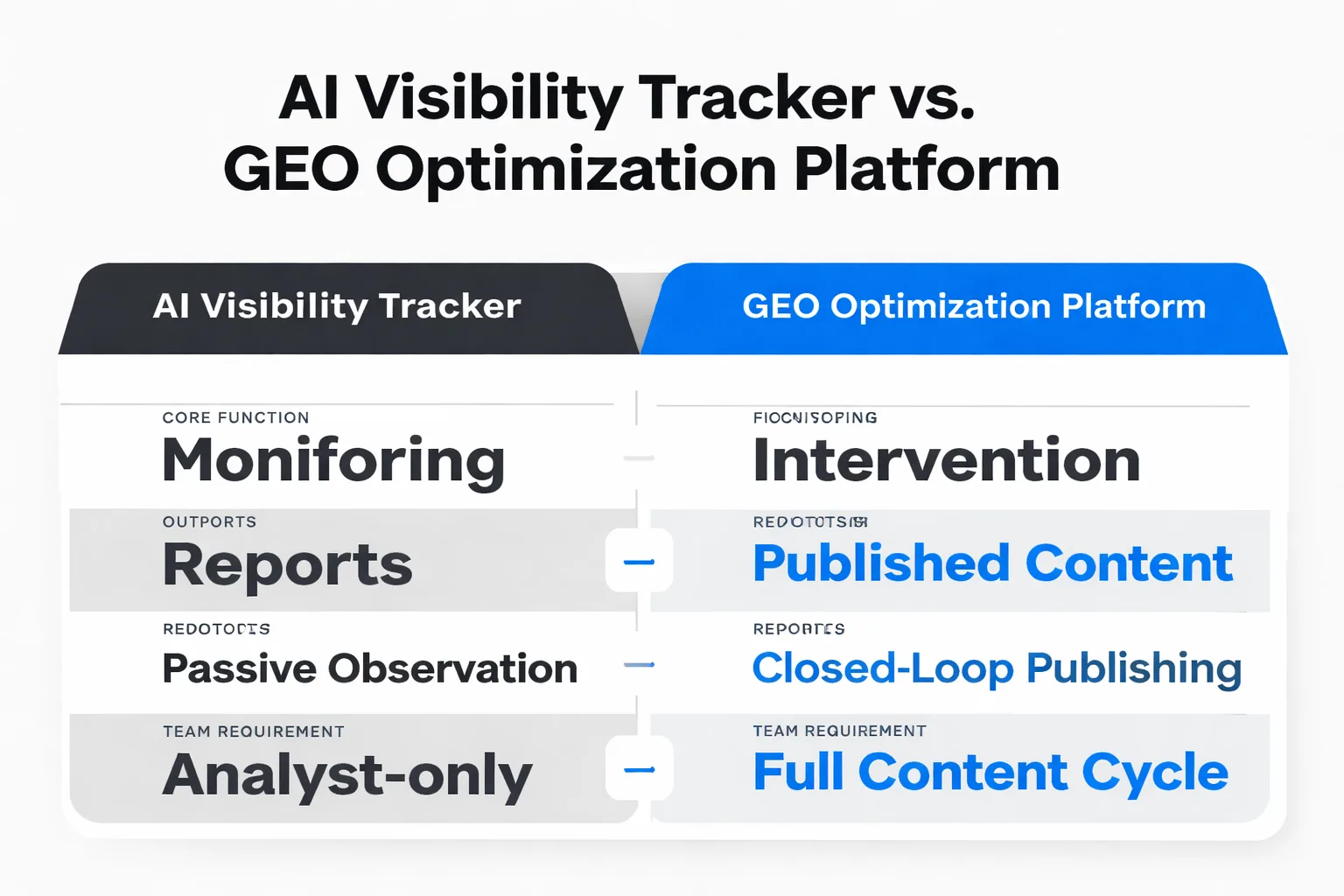
The distinction matters more than most marketers realize. A tracking tool tells you where you stand. An optimization platform helps you move. Too many teams buy the first one and think they've solved the second problem.
A visibility tracker monitors prompts across AI search surfaces and reports whether your brand appears, where in the answer it shows up, and which competitors are beating you. That's diagnostic. It's necessary. But it's the equivalent of checking your blood pressure without changing your diet. You know there's a problem. You have no mechanism to fix it.
Generative engine optimization, on the other hand, is the intervention. It's the work of structuring content so AI models can extract it, cite it, and recommend it. That means writing with direct answers under question headings, building entity-rich context that LLMs can ground against, earning third-party mentions on domains AI engines already trust, and publishing at a cadence that keeps your knowledge base fresh. A study published on arXiv found that AI search systematically favors earned media over brand-owned content, which means your optimization strategy can't stop at your own blog. You need to know which publishers AI engines cite for your topics and earn placement there.
Small teams get hurt by this split the most. A founder running marketing solo can't manage a tracking tool, a separate content platform, an outreach workflow, and a schema markup generator. That's four tools, three logins, and a reporting gap that nobody has time to close. What I've seen work is a closed-loop system: track visibility, identify the gap, generate content that targets it, publish that content with quality controls, and measure whether citations actually increased. One workflow, not four.
The teams that try to stitch together point solutions end up with dashboards nobody reads and content that doesn't move citations. I've audited that setup too many times. The data exists but nobody acts on it because the connection between diagnosis and treatment is missing.
Here's a concrete example of how this plays out. I worked with a B2B SaaS company that had a dedicated SEO analyst running weekly reports across three tools: a rank tracker for Google, a separate dashboard for Perplexity mentions, and a content platform for blog publishing. The analyst spent roughly 12 hours per week pulling data from these three sources into a Google Sheet, manually tagging which AI mentions correlated with recent content publishes, and drafting a summary for the marketing director. Despite all that effort, the team couldn't answer a basic question: when Perplexity cited a competitor instead of them for a high-intent prompt like "best project management software for remote teams," which source page did Perplexity pull from? The tracking tool said "competitor mentioned." It didn't say why. That's the diagnostic-only trap. You end up with expensive visibility data and no actionable next step.
The Core Capabilities That Actually Move AI Citation Rates
Four functional pillars determine whether a platform can actually improve your AI citation rate or just report on it. I've tested enough of these tools to know that most cover one or two well and completely botch the rest.
Prompt monitoring across every major AI search surface. This is table stakes, but the execution varies wildly. You need coverage of ChatGPT, Claude, Gemini, Perplexity, Grok, Google AI Overviews, Google AI Mode, and DeepSeek. Not a subset. A tool that tracks three LLMs and calls it comprehensive is selling you a blind spot. The frequency matters too. SERP-driven surfaces like Google AI Overviews need daily refresh because they change with the SERP. LLM-driven surfaces can run on a rolling refresh, but if your tool checks once a month, you'll miss trend shifts that happen in days. In my work auditing content ops, I've seen brands lose share-of-voice in a week because a competitor published a surge of structured content and the brand's monthly tracker didn't catch it until the damage was done.
The mechanics of prompt monitoring matter as much as the coverage. A platform that runs 10 prompts per week per surface gives you a thin slice. A platform that runs 100 prompts per surface per week, segmented by intent type (transactional, informational, navigational, comparison), gives you a statistically meaningful picture. Ask vendors how many prompts they run per surface, how they segment them, and whether they allow custom prompt injection. If you can't add your own prompts (the specific questions your prospects type into ChatGPT), the platform is running generic queries that may not reflect your actual market.
Source attribution. Knowing your brand was mentioned is step one. Knowing which source page the AI engine pulled from is the actual insight. When Perplexity cites your brand, it links to a source. When ChatGPT references your product, it's drawing from training data or retrieved content. A platform worth its salt shows you the citation path: which domains AI engines cite most for your topics, which specific pages drove the mention, and how those sources connect to your brand entity. Without source attribution, you're guessing at what caused the citation and you can't reproduce it. Our LLM visibility tool approaches this by surfacing the actual response text and citations behind every mention, not just a mention count.
Let me make this concrete. Say you're a CRM platform and you get cited in a Perplexity answer for "best CRM for small business." Source attribution tells you Perplexity pulled from a G2 comparison page, not your blog. That changes your strategy immediately. You need to either improve your G2 presence (reviews, category tags, comparison data) or publish content on your own site that's more extractable than the G2 page. Without source attribution, you'd assume your blog was working and keep publishing more of the same. With it, you redirect effort to where the citations actually come from.
Entity grounding for AI search. This is where most platforms fall short. AI engines don't just match keywords. They ground responses against known entities in knowledge graphs like Wikidata. If your brand isn't a recognized entity with clear attributes (what you do, who you serve, how you differ from competitors), LLMs will hallucinate or skip you. Entity grounding means ensuring your brand has structured presence across the data sources LLMs use for fact-checking. This includes Wikidata entries, consistent schema markup, and corroboration across multiple authoritative domains. The brands getting cited most frequently aren't the ones with the most content. They're the ones with the clearest entity definition.
Entity grounding has specific mechanics. On Wikidata, your brand needs a Q-number, a description, instance-of classification (e.g., "software company"), and property statements that define your industry, products, and relationships to other entities. On your own site, Organization schema with sameAs links pointing to your Wikidata entry, your LinkedIn, your Crunchbase, and your G2 profile creates a corroboration loop that LLMs use for fact verification. On third-party sites, consistent NAP (name, address, phone) and category tagging across review sites, directories, and industry publications reinforces the entity definition. If any of these signals conflict (your Wikidata says "CRM software" but your G2 profile says "sales platform"), the LLM may hedge or skip you entirely. Entity grounding is about consistency across data sources, not volume of content.
Content publishing with quality controls. The final pillar is the one most visibility platforms pretend doesn't exist. You can track gaps all day, but if you can't publish content that closes them, the diagnosis is useless. The platform needs to generate archetype-aware content (listicles, how-tos, explainers each have different retrieval requirements), verify every claim before publish, and gate publication behind quality checks that prevent weak drafts from reaching your CMS. I've seen AI content fail at a 60% rate when it relies on traditional SEO tactics like keyword density instead of AI extractability. The content that works has direct answers under question headings, comparison tables, and structured data that makes extraction easy.
The quality gate is what separates a content engine from a content firehose. A 16-dimension quality firewall (covering article-quality signals like factual accuracy, source diversity, and structural completeness, plus penalty-risk signals like thin content patterns and over-optimization) blocks weak drafts before they reach your CMS. Without that gate, you're publishing whatever the model produces, and Google's Helpful Content System will catch the pattern. I've seen sites lose indexing because they shipped AI articles without review. The platform you choose should require your approval before anything publishes.
How to Evaluate a Platform Before You Commit
The vendor demos all look the same. Clean dashboard, impressive-looking charts, a logo wall. Here's what actually matters when you're evaluating AI visibility solutions with best generative engine optimization capabilities.
Check LLM coverage first. Ask for the full list of surfaces they track. If it's fewer than the major ones I listed above, ask why. Some tools only track Perplexity because it has an API and call it AI visibility tracking. That's like tracking Google and ignoring Bing. Sure, Google dominates, but you'd never accept a rank tracker that only checked one engine. The same logic applies here.
Ask how frequently prompts run. Monthly is not enough. Weekly is borderline. Daily for SERP-driven surfaces and rolling for LLM-driven surfaces is the standard you should hold. A platform that refreshes quarterly will miss the kind of rapid citation shifts that happen when a competitor launches a content campaign or when an LLM updates its training data.
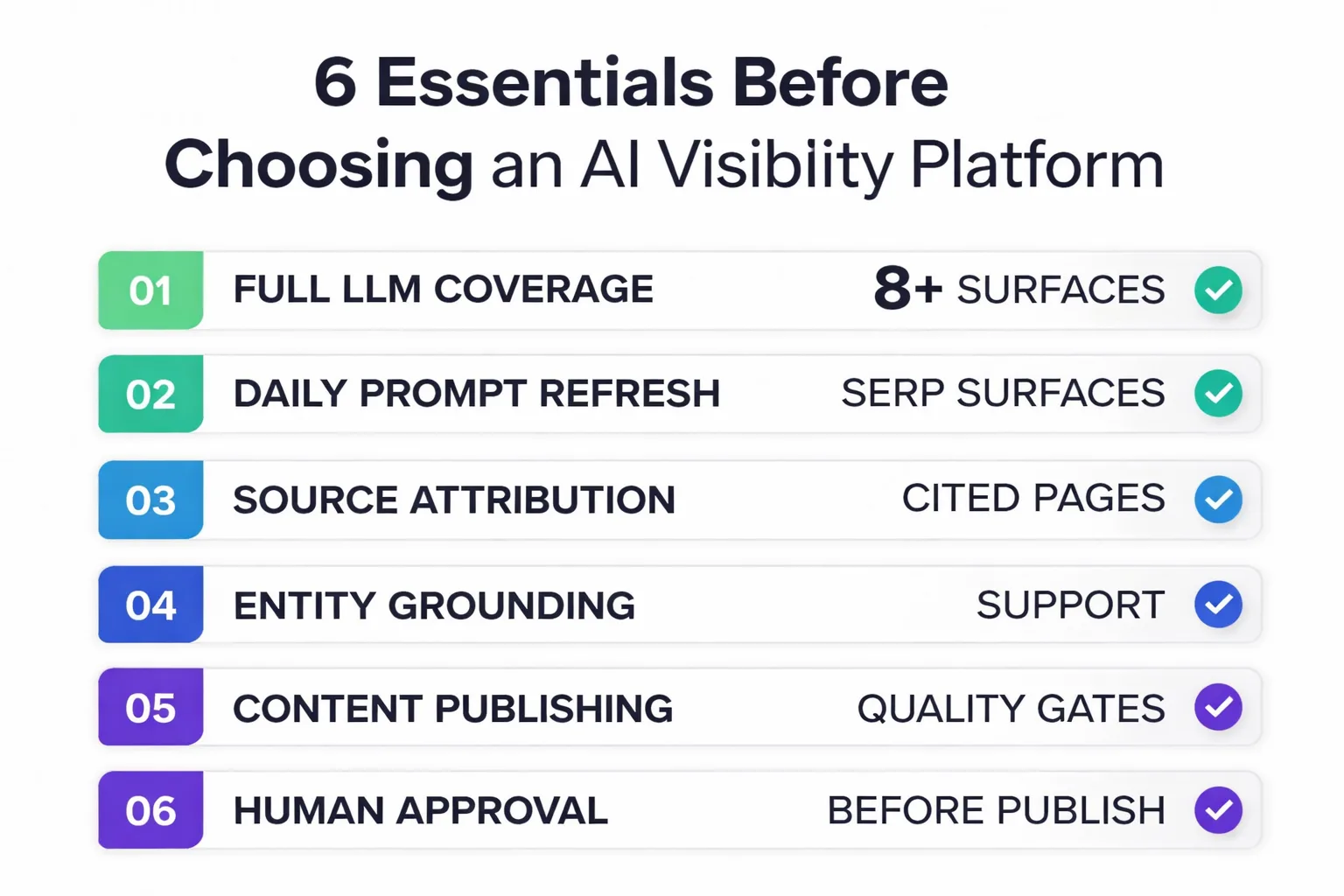
Find out whether the tool shows source attribution. This is the single feature that separates useful platforms from expensive dashboards. If the tool says "you were mentioned 12 times in ChatGPT this week" but can't tell you which source pages drove those mentions, you cannot optimize. You're back to guessing. The platforms that show the citation path, the domains AI engines cite most for your topics, and the specific response text behind each mention are the ones that let you build a strategy.
Check whether content goes live with or without human approval. This is a hill I will die on. Auto-publishing AI content without a quality gate is reckless. Google's Helpful Content System hasn't gone away. It's evolved to catch AI-generated content that lacks depth, originality, or genuine value. I've seen sites lose indexing because they shipped AI articles without review. The platform you choose should have a quality firewall that blocks weak drafts before they reach your CMS, and it should require your approval before anything publishes. If the pitch is "fully autonomous, set it and forget it," walk away.
Look at the archetype system. Does the platform treat every article the same, or does it adjust retrieval weights, structure, and quality criteria based on whether it's writing a listicle, a how-to, or an explainer? Generic AI writers produce generic content. 44% of AI citations come from the first third of a page, so the structure has to front-load direct answers. A platform that doesn't understand archetypes will produce content that reads fine but doesn't get cited.
Finally, check whether the platform handles outreach. Citation gaps aren't always closed by your own content. Sometimes the fastest path is earning a mention on a domain AI engines already cite for your topic. Platforms that find those publishers, verify contact information, and draft personalized pitches close the loop between tracking and action. Our approach to answer engine optimization integrates this into one workflow rather than sending you to a separate outreach tool.
One more evaluation criterion that vendors rarely volunteer: how the platform handles cannibalization. If you're publishing new AI-optimized content, you need to know whether it competes with existing pages on your site for the same queries. A platform with cannibalization detection at both the planning and writing stages prevents you from creating two pages that target the same intent and cannibalize each other's ranking signal. Ask whether the tool checks for this. If it doesn't, you'll eventually create your own visibility problem.
What Does Citation Data Reveal About 2026 Gaps?
The data from 2026 is stark. I've been tracking citation patterns across brands and the gap between who gets cited and who doesn't is wider than any organic ranking gap I've ever seen in traditional SEO.
The Ahrefs study of 75,000+ brands analyzed millions of AI citations across ChatGPT, Google AIO, Perplexity, and Gemini. What stood out to me was the concentration. A relatively small set of domains absorbs the majority of AI citations. Most brands are simply absent. This isn't a long-tail problem where you can pick off niche queries. It's a winner-take-most dynamic where the brands with the strongest entity presence and the most structured, extractable content capture disproportionate share of voice.
Only 11% of domains are cited by both ChatGPT and Perplexity. That number should stop you cold. It means the overlap between AI engines is smaller than most marketers assume. Ranking in Google doesn't translate to AI citations. Having great content doesn't translate to AI citations. The brands that appear in AI answers are there because they've done specific work to get there: structured data, entity grounding, third-party corroboration, and content designed for extraction.
The Augustine Agency research breaks down what users actually ask AI engines. 28% of conversations focus on writing assistance. 28% focus on practical guidance. Nearly one in five focus on finding information. That means the majority of AI conversations involve users seeking actionable, structured answers. Brands that publish content formatted for extraction (direct answers, comparison tables, step-by-step instructions) are positioned to capture those citations. Brands that publish traditional blog posts with buried ledes are not.
The arXiv GEO analysis adds another layer. AI search engines systematically favor earned media over brand-owned content. Google's results mix brand-owned, earned, and social content more evenly. AI engines skew heavily toward third-party authoritative sources. This means your optimization strategy can't stop at your own blog. You need presence on the domains AI engines cite: industry publications, review sites, community forums, and knowledge bases. If your platform only helps you publish on your own site, it's solving half the problem.
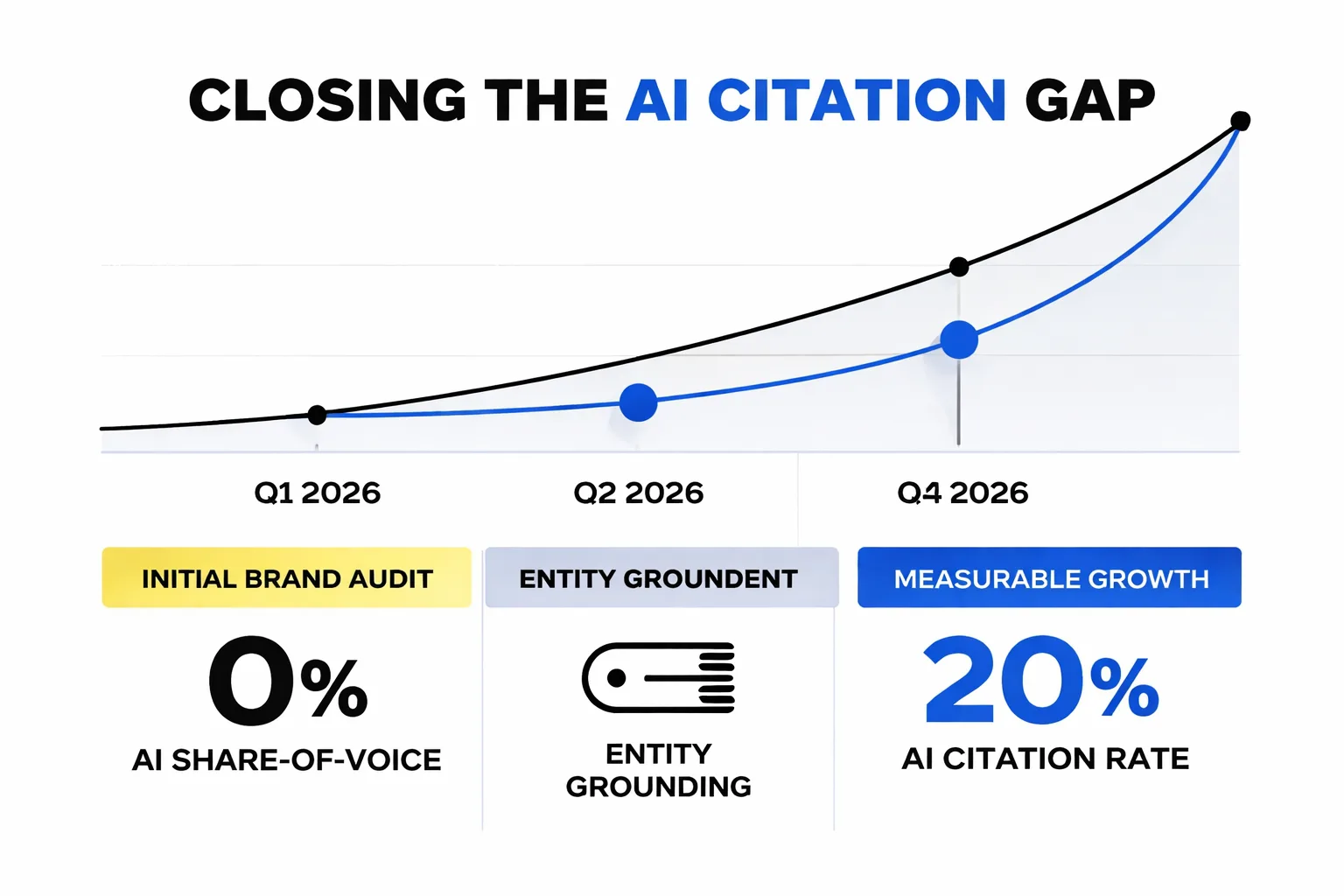
I ran an experiment earlier this year with 5 articles that hit top 3 organic rankings. Over 3 months, they generated zero AI citations. Zero. The content was well-optimized for Google. It ranked. It drove traffic. But it wasn't structured for AI extraction. No direct answers under question headings. No comparison tables. No entity-rich context that an LLM could ground against. The lesson was clear: organic ranking and AI citation are diverging, and the strategies that drive one don't automatically drive the other.
Let me add another data point from the same experiment. I took 3 of those 5 articles and reformatted them. I added a direct answer block under each H2 (40-60 words, self-contained, extractable). I added comparison tables where applicable. I added FAQ schema. I resubmitted via IndexNow. Within 4 weeks, two of the three reformatted articles started appearing in Google AI Overviews for their target queries. The third didn't, and when I checked source attribution, I found the AI Overview was pulling from a higher-authority third-party domain covering the same topic. The reformatting worked for two. The third needed outreach, not more content. That's the kind of granular insight you only get from a platform with source attribution.
Why Does Source Attribution Change Your Strategy?
Without source attribution, you're throwing content at the wall and hoping something sticks. With it, you can build a precise, repeatable system for earning citations.
Here's what source attribution actually gives you. When an AI engine cites your brand, the platform shows you which page it pulled from. Maybe it's your pricing page. Maybe it's a third-party review site. Maybe it's a Reddit thread. Each source tells you something different about what's driving your visibility and what isn't.
If your pricing page is the most cited source, that tells you AI engines see you as a transactional entity. Users asking about pricing or comparisons are finding you. But users asking conceptual questions ("what is the best approach to X") are not. You need thought-leadership content that positions you as an authoritative voice, not just a product listing.
If third-party sites drive most of your citations, that's a signal to double down on outreach. Your own content isn't breaking through. The arXiv research confirms this pattern: AI engines favor earned media. So your strategy should include identifying which publishers AI engines cite for your topics and earning placement there. A platform with a citation path feature does this work for you. It finds the publishers, verifies contacts, and drafts pitches grounded in your knowledge base.
If community sources (Reddit, Hacker News, Stack Overflow) drive citations, that tells you something about the kind of content AI engines value for your topic. LLMs weight community discussion heavily for certain query types, especially product recommendations and technical comparisons. This isn't traditional SEO territory. It's a different playbook entirely.
The strategic shift is this: source attribution turns visibility from a guessing game into a feedback loop. You publish content, track whether it gets cited, see which sources drive mentions, and adjust. Without that loop, you're publishing blind and hoping. In my experience, teams that track source attribution refine their strategy in weeks. Teams that don't spin for months without knowing what's working.
Here's a framework I use for categorizing source attribution data. I split cited sources into four buckets: brand-owned (your blog, your docs, your landing pages), earned editorial (industry publications, news sites), earned community (Reddit, Hacker News, forum threads), and structured data (Wikidata, schema, knowledge panels). Each bucket requires a different optimization approach. Brand-owned sources need better content structure. Earned editorial needs outreach and relationship-building. Earned community needs authentic participation (you can't fake a Reddit thread). Structured data needs technical SEO work on your entity definition. When a platform shows you which bucket each citation comes from, you can allocate resources precisely instead of spraying effort across all four.
How Should Small Teams Approach Budget and Scope?
Most founders and small marketing teams I talk to are trying to figure out how much of this they can do themselves and when they need a platform. Here's the framework I use.
If you're a solo founder or a team of one, start with tracking. You need to know where you stand before you invest in optimization. A lightweight AI visibility checker that covers the major surfaces and gives you weekly trend data is enough to establish your baseline. Run it for a month. See where you're cited and where you're absent. The results will likely surprise you. Most teams I've worked with assumed they had some AI presence. Most had close to zero.
If you're a team of 2-5 with a marketing function, you need both tracking and content publishing. The gap between diagnosis and treatment is where small teams lose the most time. You see the gap in your dashboard, then you need to brief a writer, review the draft, format it, publish it, and wait to see if citations increase. That cycle takes weeks. A platform that generates archetype-aware content, gates it behind quality checks, and publishes directly to your CMS compresses that cycle to days. The key question is whether the platform requires your approval before publishing. It should. Our AI SEO tool is built around this principle: the system does the heavy lifting, but nothing goes live without your sign-off.
If you're an agency or a team managing multiple brands, you need multi-domain dashboards, white-label reporting, and the ability to scale content production without scaling headcount. The enterprise AI rank tracker capabilities become important here because you're comparing visibility across brands and identifying patterns that apply portfolio-wide.
What to avoid in vendor pitches. First, any platform that promises "instant AI visibility" or claims a specific percentage increase in citations within a fixed timeframe is lying. AI citation rates depend on your industry, your competitive landscape, your existing content, and your entity presence. Nobody can guarantee a number. Second, any platform that auto-publishes without quality gates is a liability. I've seen the fallout. It's not pretty. Third, any platform that only tracks one or two LLMs and calls it comprehensive is selling you a partial picture. You wouldn't accept a rank tracker that only checks Google. Don't accept an AI visibility tool that only checks Perplexity.
The AEO vs SEO distinction matters here. If the vendor can't articulate the difference between optimizing for answer engines versus traditional search, they don't understand the problem deeply enough to solve it. Similarly, if they can't explain the difference between AEO vs GEO, they're using the terms interchangeably without understanding that answer engine optimization and generative engine optimization have different technical requirements.
Do you know which AI search surfaces cite your brand and which ones don't?
When Is a Tracker Enough vs. When Do You Need Full Optimization?
This is the question I get most often from founders. The answer depends on your competitive position and your content capacity.
A tracker is enough when you're in research mode. You're entering a new market. You're evaluating whether AI visibility is a real channel for your business. You want to understand the landscape before committing budget. In this phase, spend 30-60 days monitoring prompts, identifying where competitors are cited, and mapping the gap. Don't invest in content production yet. The data from your tracker will tell you whether the opportunity justifies the investment.
A tracker is also enough when your industry has low AI search volume. Not every category generates significant AI queries yet. If you sell niche industrial equipment, AI search volume might be minimal. Track it, but don't overinvest. If you sell B2B SaaS, professional services, or consumer products, AI search volume is already significant and growing. You need full optimization.
You need full optimization when competitors are consistently cited and you're not. That gap doesn't close on its own. It requires structured content, entity grounding, and possibly outreach to third-party publishers. A tracker shows you the gap. An optimization platform closes it.
You also need full optimization when you've tried publishing AI-targeted content manually and it's not working. This usually means the content isn't structured correctly. The most common failure I see is content that reads well but isn't extractable. No direct answers under question headings. No comparison tables. No schema markup. No entity context. A platform with archetype-aware writing and a quality firewall catches these issues before publish.
The brands winning in AI search right now aren't the ones with the biggest budgets. They're the ones with the clearest entity definitions, the most extractable content, and the tightest feedback loops between tracking and publishing. That's the work. A platform that does both in one workflow is how small teams compete with larger ones.
What Does Generative Engine Optimization Mean in Practice?
Generative engine optimization is not a buzzword. It's a specific set of technical and editorial practices that make content extractable by LLMs. If your platform talks about GEO but can't describe these mechanics, it's not doing GEO.
In practice, GEO means five things. First, content structure: direct answers (40-60 words) under question-shaped headings, placed in the first third of the page where extraction is most likely. Second, entity density: your brand name, product category, and related entities mentioned with enough context that an LLM can disambiguate you from competitors. Third, source corroboration: every factual claim linked to an authoritative external source, because LLMs weight claims with citation support more heavily than unsourced assertions. Fourth, schema markup: Article, FAQ, HowTo, and Speakable schema that gives LLMs structured entry points into your content. Fifth, knowledge base integration: your content referencing and being referenced by a consistent knowledge base that defines your brand's expertise areas, product capabilities, and customer outcomes.
A platform that does GEO well handles all five. A platform that does GEO poorly writes keyword-stuffed articles with generic structure and calls it optimized. The difference shows up in citation rates within weeks. I've seen brands double their AI citation count in 60 days by restructuring existing content to follow these five principles, without publishing a single new article. The content was already there. It just wasn't extractable.
How Do Ecommerce Brands Approach GEO Differently?
Ecommerce GEO and agentic commerce add a layer of complexity that most visibility platforms don't address. Product pages, category pages, and review pages each need different optimization approaches.
For product pages, the extractable content isn't your product description. It's your specification table, your pricing block, and your review summary. LLMs pull structured data from product pages far more readily than prose. If your product schema is incomplete or inconsistent across your catalog, you're invisible in AI product comparison answers. I've seen ecommerce sites with 10,000 products and schema errors on 60% of them. That's 6,000 products AI engines can't reliably parse.
For category pages, the question is whether your page answers "what is the best X" in a way an LLM can extract. Most category pages are grid layouts with filters. They're not designed for extraction. A GEO-optimized category page includes a comparison table, a brief category definition, and structured product data that an LLM can pull into a recommendation. This is what agentic commerce looks like in practice: when a user asks ChatGPT "what's the best wireless headset under $200," the LLM pulls from category pages and product pages that are structured for extraction. If your pages aren't structured that way, you're not in the answer.
Review pages and user-generated content matter more in ecommerce GEO than in B2B. The arXiv research on earned media preference is especially relevant here. AI engines weight third-party reviews heavily for product recommendations. Your own product page matters, but a G2 or Trustpilot review page with your product name and category tags may drive more AI citations than anything on your own domain.
What Are the Top Solutions for AI Visibility and Generative Engine Optimization?
When I evaluate the top solutions for AI visibility and generative engine optimization, I look at whether they close the loop between tracking and action. The market is splitting into three categories.
Tracking-only tools. These platforms monitor AI search surfaces and report mention data. They're useful for baseline measurement but don't help you close citation gaps. If you already have a content team and an outreach process, a tracking-only tool gives you the data to direct their work. If you don't, you'll end up with dashboards nobody acts on. The AI visibility tracker category covers this.
Content-generation-only tools. These platforms write and publish AI-targeted content but don't track whether it's working. They're the mirror image of tracking-only tools: lots of output, no feedback loop. The risk here is publishing content that doesn't get cited because you can't see the citation gap it's supposed to close. You end up with a volume of content and no visibility improvement.
Closed-loop platforms. These combine tracking, content generation, quality-gated publishing, and citation measurement in one workflow. You see the gap, you publish content to close it, and you measure whether citations increased. This is the category I recommend for small teams because it eliminates the handoff problem between tools. Meev operates in this category, combining AI visibility tracking across every major AI search surface with archetype-aware content generation, a 16-dimension quality firewall, and citation path outreach.
The best GEO tools share certain characteristics regardless of category: full LLM coverage, source attribution, entity grounding support, and quality-gated publishing. The ones that lack any of these are incomplete solutions for brands serious about AI visibility.
What This Actually Means for Your Team
The shift from traditional SEO to AI visibility isn't incremental. It's structural. The tools, the metrics, the content formats, and the success criteria are all different. Treating AI visibility as a feature of your existing SEO stack is the mistake most teams are making right now.
Here's what I'd do if I were starting today. First, run a baseline audit across every major AI search surface. Know exactly where you're cited and where you're absent. Second, identify the citation gap: which prompts should mention your brand but don't. Third, check your entity presence. Are you in Wikidata? Does your schema markup clearly define what you do? Are third-party authoritative sources corroborating your entity definition? Fourth, start publishing content designed for AI extraction. Direct answers, comparison tables, question-shaped headings. Gate every article behind quality checks. Fifth, track whether citations increase. If they don't, look at source attribution to understand why and adjust.
The teams that follow this loop consistently see results within 60-90 days. The teams that skip steps or use disconnected tools spin for months. The difference isn't budget or headcount. It's having a closed-loop system that connects diagnosis to treatment.
AI visibility solutions with best generative engine optimization frameworks are the infrastructure for this work. They're not a luxury. They're the difference between being cited and being invisible.
FAQ
What is the main problem with traditional SEO in the age of AI search?
Traditional SEO focuses on organic rankings and traffic but fails to track or optimize for citations in AI platforms like ChatGPT, Perplexity, and Google AI Overviews. Brands can maintain stable keyword performance while remaining completely absent from generative answers, creating an invisible gap that competitors exploit. AI visibility solutions address this by targeting how content earns references in these new engines.Why do AI search engines favor certain content over brand-owned material?
Research shows AI engines systematically prefer earned media from third-party authoritative sources rather than direct brand content. This shift means structured, extractable content designed for practical guidance and writing assistance has a higher chance of citation. The result is extreme concentration where only a small set of domains dominate AI references.How can brands detect and close the AI citation gap?
Brands discover the gap only after losing deals to competitors cited in AI answers, as no standard SEO dashboard flags these absences. Auditing content operations reveals that top organic rankings often generate zero AI citations, requiring new generative engine optimization frameworks. Implementing targeted strategies around authoritative, structured content helps close this measurable divide.What does data reveal about citation patterns across AI platforms?
Studies of thousands of brands show citation concentration is extreme, with most domains receiving no AI references at all across ChatGPT, Google AIO, Perplexity, and Gemini. A significant portion of generative conversations focus on practical guidance and writing tasks, favoring content optimized for extraction. This pattern confirms the need for specialized AI visibility solutions beyond conventional SEO tactics.About the Author
Judy Zhou, Founder
Judy Zhou leads content strategy at Meev, where she oversees AI-driven content research and publishing for hundreds of brands. With a background in SEO and editorial operations, she focuses on building content systems that rank on Google, get cited by AI search engines, and drive measurable business results.
Run a free AI visibility audit across every major AI search surface and see exactly where you're cited, where you're absent, and what's driving the gap.