

By Judy Zhou, Founder
Key Takeaways
- Schema-marked pages are cited 2.3x more often in AI Overviews, according to Semrush's AI Visibility Study.
- 68% of marketers are making strategic adjustments for AI search this year, reports BrightEdge Research.
- Marketers spend over $100M annually on AI visibility tracking even though recommendation lists remain highly inconsistent, per SparkToro.
- AI search competitive intelligence must track citation share-of-voice, entity grounding, and mention framing across LLMs instead of keyword rankings.
Most competitive intelligence tools on the market today are useless for AI search. And buying more of them will only deepen your blind spot. The entire category was built around crawling SERPs, counting backlinks, and tracking keyword rankings in a world where Google returned ten blue links and humans clicked them. Generative engines don't work that way. They synthesize, cite, and surface entities based on knowledge graph presence, structured data signals, and LLM training weight. None of which your current stack was designed to measure.
Competitive intelligence tools built for the AI search era must track citation share-of-voice, entity grounding, and mention framing across LLMs, not just keyword positions. Semrush's AI Visibility Study found that schema-marked pages are cited 2.3x more often in AI Overviews, and 16% of US searches now trigger AI Overviews. SparkToro research estimates marketers spend over $100M annually on AI visibility tracking, yet AI recommendation lists are highly inconsistent. BrightEdge Research reports 68% of marketers are making strategic adjustments for AI search this year.
The stakes are existential. You can hold your classic Google rankings and still lose every AI citation to a competitor who invested in answer engine optimization while you were busy monitoring backlinks. The tools on this list represent the ones actually built to surface that gap before it becomes a revenue problem.
Why AI Search Teams Need Competitive Intelligence Now
I've spent my career in content strategy and SEO operations, and the shift happening right now is unlike anything I've seen since the mobile-first index. In my work auditing content ops at Meev, I see the same pattern every week: a brand ranks #3 for a high-intent commercial keyword on Google, but when a prospect asks ChatGPT or Perplexity for a recommendation, that brand is completely absent from the answer. A competitor with weaker domain authority but better entity grounding gets cited instead.
This happens because generative engines don't care about your backlink profile the way classic search did. They care about knowledge graph presence, structured data signals, and whether your content is structured in a way that LLMs can extract and synthesize. The Semrush AI Visibility Study found that Reddit outranks financial experts 176% of the time in ChatGPT finance answers. Let that sink in. User-generated forum content beats professional analysis more often than not. That's not a glitch. That's the system working as designed, and it means your competitive moat is shallower than you think.
Here's what makes this urgent in 2026. BrightEdge Research reports that 54% of companies now assign AI search efforts to SEO or digital marketing teams, and 27% of active marketers are optimizing for both AI Overviews and ChatGPT. If your team isn't using competitive intelligence tools to monitor where you appear (and where competitors are stealing your citations) across AI surfaces, you're flying blind. You can't fix what you can't see.
There's a deeper problem too. Research published on arXiv on citation failure in LLMs demonstrates that RAG systems can generate helpful responses but fail to cite complete evidence. This means a competitor's content might be influencing an AI's recommendation without being cited at all. Users can't verify which sources actually support the recommendation. Uncited competitor mentions appear authoritative by proximity. Traditional competitive intelligence tools that track visible mentions miss this entirely.
The contrarian take nobody in the industry wants to hear: most AI visibility tracking is unreliable right now. SparkToro's research found that AI recommendation lists are highly inconsistent, and no valid visibility metrics existed before their study. They estimate marketers spend over $100M annually tracking AI visibility. That's a staggering number for a category where the underlying data may not be stable enough to optimize against. The tools on this list are the ones making the most honest attempt to solve this problem, but you should approach all AI visibility data with healthy skepticism and look for directional trends, not absolute numbers.
How We Ranked These Tools
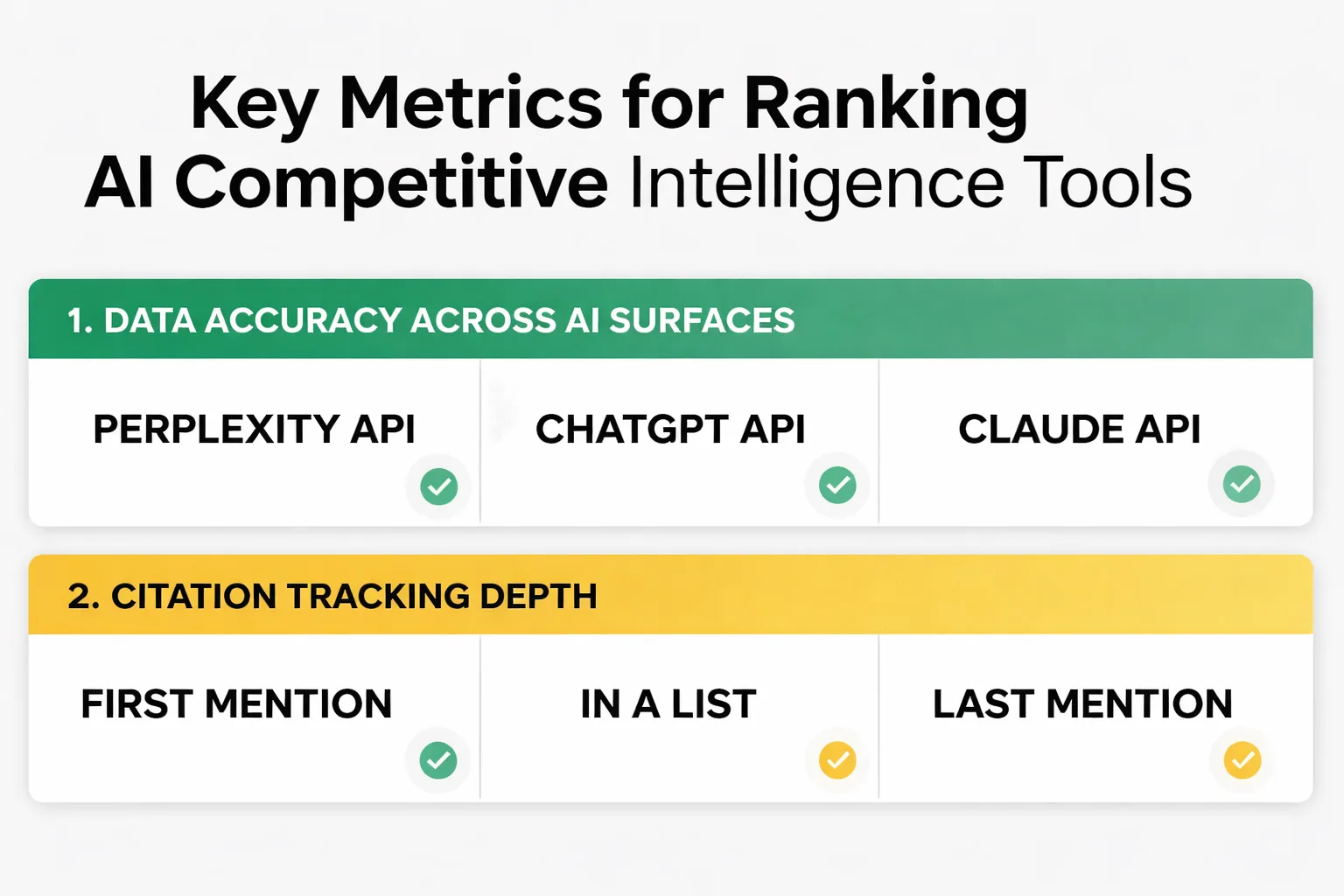
I evaluated every tool on this list against five criteria that matter specifically for AI search teams. Not generic SEO criteria. Not marketing platform criteria. The lens is: does this tool help you understand and improve your presence in AI-generated answers?
Data accuracy across AI surfaces. Does the tool track real LLM responses, or does it estimate visibility based on SERP proxies? Direct API integrations with Perplexity, ChatGPT, and Claude are more reliable than scraped or inferred data. I weighted tools that pull from primary sources higher than those using estimation models.
Citation tracking depth. Does the tool tell you where in an AI answer your brand appears (first mention, in a list, last), or does it just report a binary mentioned/not-mentioned? Mention position matters enormously. I've seen brands cited as a starting point before a more advanced competitor is recommended. That framing funnels users away from you even though you were technically mentioned. Tools that surface framing and context, not just raw mention counts, scored higher.
Ease of use for small teams. Can a two-person marketing team actually use this tool without a dedicated analyst? I penalized tools that require a demo call to see pricing or access basic features. Small teams need self-serve onboarding and transparent pricing.
Pricing transparency. Is pricing published on the website, or do you need to book a call? This is a hard filter for me. Tools that hide pricing behind a sales conversation create friction that small teams can't afford. Published pricing with clear tier differentiation scored higher.
Coverage of both classic SERP and AI surfaces. The best tools bridge the gap between traditional rank tracking and AI citation monitoring. If you have to buy two separate tools, the total cost and workflow complexity go up. Tools that cover both in a unified dashboard scored higher.
How do AI search intelligence platforms compare?
| Tool | AI Visibility Tracking | Classic Rank Tracking | Content Publishing | Pricing Entry | Best For |
| Meev | Yes (ChatGPT, Claude, Gemini, Perplexity, Grok, DeepSeek, AI Overviews, AI Mode) | Yes (GSC integration) | Yes (WordPress, Ghost, Shopify, Wix, webhook) | $49/mo | Small teams needing tracking + content engine |
| Profound | Yes (ChatGPT, Perplexity, Gemini, Claude, more) | Limited | No | Custom/enterprise | Enterprise brands with governance needs |
| AthenaHQ | Yes (ChatGPT, Perplexity, Google AI Overviews) | Limited | No | On request | Mid-market GEO monitoring |
| Ahrefs Brand Radar | Yes (LLM citation tracking) | Yes (full Ahrefs suite) | No | $129/mo | SEO-first teams already in Ahrefs |
| Semrush AI Toolkit | Yes (ChatGPT, AI Overviews, Gemini, Claude, Grok, Perplexity, DeepSeek) | Yes (full Semrush suite) | No | $99/mo add-on | Teams already in Semrush ecosystem |
| AIclicks | Yes (ChatGPT, Perplexity, AI Overviews, Claude, Gemini, Grok, more) | Limited | No | $29/mo | Growth-stage brands on a budget |
| Siftly | Yes (AI citation attribution) | Limited | No | $79/mo | Revenue-focused ecommerce teams |
The table tells you the headline story. Now let's dig into each tool.
Which tool offers AI citation tracking and content engine?
Best for: Teams that want AI citation tracking plus a content engine they can trust to publish, not just a dashboard that surfaces problems. Differentiated by the 12-dimension Quality Matrix and Helpful Content Risk score that gate every article before it ships.
Meev is the platform I build content strategy around, and the reason is simple. Every other tool on this list tells you that you have a citation gap. Meev tells you that you have a citation gap and then writes, quality-checks, and publishes the article designed to close it. That closed-loop workflow is what small teams actually need. A dashboard full of problems without a solution engine is just anxiety at scale.
The platform tracks citations across every major AI search surface (ChatGPT, Claude, Gemini, Perplexity, Grok, DeepSeek, Google AI Overviews, and AI Mode) with daily refresh on SERP-driven surfaces and rolling refresh on LLM-driven surfaces. The AI visibility tracker shows not just whether you're mentioned but where in each answer you appear and what the actual response text says. That framing data is what I use to decide whether a citation is actually helping or subtly funneling prospects toward a competitor.
Key features: - Citation tracking across ChatGPT, Claude, Gemini, Perplexity, and Grok on a rolling cadence; Google AI Overviews and AI Mode refresh daily. 12-dimension Quality Matrix plus Helpful Content Risk score with a 70/100 publish gate on both. Knowledge Base enforcement so articles are grounded in your approved claims, not AI hallucination. Closed-loop Citation Path (roadmap) mapping each article to the citation-rate delta it drove. Autopilot topic pool with gap detection from competitor citation patterns
Pricing: 7-day free trial. After the trial, services pause unless you subscribe. Your account stays open and your data stays readable. Lite $49/mo, Starter $99/mo, Pro $269/mo, Agency $599/mo. 20% annual discount. Cancel anytime; hard-cap quotas with no overage fees.
The honest assessment: Meev is built for teams that need to move from diagnosis to action without hiring a content team. If you already have a full content operation and just want a tracking dashboard, Meev may be more than you need. But if you're a founder or a small marketing team that needs to both see the gap and close it, the combination of citation tracking plus quality-gated content publishing is hard to beat at this price point. The AEO tool capabilities and the AI SEO tool features are designed to work together, not as bolt-ons.
Which tool is best for enterprise governance?
Best for: Large enterprise brands and agency teams that need rigorous AI search research programs, governance workflows, and executive-level reporting.
Profound raised $20M in seed funding in June 2025 and has positioned itself as the enterprise-grade AI search intelligence platform. The tool tracks how your brand is cited, described, and recommended across every major LLM and AI search engine. What stands out is the governance angle. Automated Slack alerts fire when brand sentiment drops or inaccuracy spikes above a threshold. For enterprise teams where brand consistency and legal review matter, that kind of automated guardrail is genuinely valuable.
Key features: - Prompt-level citation tracking across ChatGPT, Perplexity, Gemini, Claude, and more. Automated Slack alerts when brand sentiment drops or inaccuracy spikes above threshold. Competitive share-of-voice benchmarking inside AI-generated answers. Stakeholder-ready reporting dashboards for governance and brand programs
Pricing: Raised $20M seed in June 2025; pricing is custom/enterprise. Contact for a demo. Growth-stage teams are the primary self-serve target.
The trade-off is clear. Profound is powerful but designed for organizations that can afford enterprise contracts and have the headcount to act on governance alerts. If you're a five-person team, the demo-required onboarding and custom pricing create friction that slows you down. For large brands with compliance requirements, though, Profound's governance-first approach is a genuine differentiator.
3. AthenaHQ — Best for mid-market GEO monitoring
Best for: Mid-market to enterprise brand and content teams seeking a dedicated GEO monitoring platform with competitive intelligence built in.
AthenaHQ focuses on the monitoring layer of generative engine optimization. It tracks your presence across major AI search engines including ChatGPT, Perplexity, and Google AI Overviews, and adds competitive benchmarking so you can see where rivals are winning citations you're not. The entity and brand authority tracking is a nice touch because it surfaces gaps in your knowledge graph presence, which is something most traditional SEO tools completely miss.
Key features: - GEO monitoring across major AI search engines including ChatGPT, Perplexity, and Google AI Overviews. Competitor AI visibility benchmarking and share-of-voice analysis. Entity and brand authority tracking to surface gaps in AI knowledge graph presence. Structured reporting for marketing and product teams on AI citation performance
Pricing: Pricing available on request; positioned for mid-market to enterprise teams. No publicly listed self-serve free tier.
The limitation here is transparency. Pricing is not publicly listed, which means you're committing to a sales conversation before you can evaluate whether the tool fits your budget. For mid-market teams with allocated budgets for AI search optimization, that friction may be acceptable. For smaller teams, it's a barrier. The platform itself is solid for monitoring, but it doesn't include content generation or publishing, so you'll need a separate tool to close the gaps it surfaces.
4. Ahrefs Brand Radar — Best for SEO-first teams
Best for: SEO-first teams already using Ahrefs who want to layer AI search visibility and competitor citation intelligence onto their existing workflow without a new tool.
Ahrefs Brand Radar is the AI visibility module inside the Ahrefs ecosystem, and it does something genuinely useful: it connects LLM citation tracking to backlink authority and organic search competitive analysis. If you already live in Ahrefs for your SEO work, adding Brand Radar means you can see your AI citation performance alongside your traditional metrics without switching platforms. The competitive analysis links AI citation share to domain authority and content gaps, which helps you understand why competitors earn AI citations.
Key features: - AI brand mention and citation tracking across major LLMs tied to Ahrefs' backlink and organic data. Competitive analysis linking AI citation share to domain authority and content gaps. Entity and source authority signals to understand why competitors earn AI citations. Unified dashboard connecting traditional SEO rank tracking with AI search visibility
Pricing: Included within Ahrefs paid plans; Lite starts at $129/month, Standard at $249/month, Advanced at $449/month. Brand Radar is accessible on qualifying tiers.
The honest trade-off: Brand Radar is an add-on to a traditional SEO suite, not a GEO-native platform. If you're starting from scratch and your primary goal is AI search visibility, Ahrefs gives you a lot of features you may not need (and charges for them). But if your team already uses Ahrefs daily, the integration value is real. The prompt-level tracking granularity may not match dedicated AI visibility specialists, but the unified workflow is worth the trade-off for teams that don't want another dashboard.
5. Semrush AI Toolkit — Best for Semrush ecosystem teams
Best for: SEO and content teams already in the Semrush ecosystem who want to extend their competitive intelligence into AI search visibility without switching platforms.
Semrush's AI Toolkit is the most comprehensive AI surface coverage on this list. It tracks brand visibility across ChatGPT, Google AI Overviews, Gemini, Claude, Grok, Perplexity, and DeepSeek. The competitive share-of-voice benchmarking with strategic positioning tips is a step beyond raw tracking. The integrated keyword research and content gap analysis tied to AI citation opportunities is where the tool earns its keep for teams doing ai search engine optimization work.
Key features: - AI brand visibility tracking across ChatGPT, Google AI Overviews, Gemini, Claude, Grok, Perplexity, and DeepSeek. Competitive AI share-of-voice benchmarking with strategic positioning tips. Integrated keyword research and content gap analysis tied to AI citation opportunities. Multi-brand and multi-region support on enterprise tiers with API access
Pricing: $99/month as a standalone AI Visibility Toolkit add-on per domain; included in Semrush One at $199-$549/month; Enterprise AIO at custom pricing for multi-brand and agency scale.
The catch is cost stacking. The AI Toolkit is a paid add-on on top of existing Semrush subscriptions. If you don't already have a Semrush plan, the entry cost is higher than standalone AI visibility tools. For teams already deep in the Semrush ecosystem, the integration is seamless. For everyone else, you're paying for two products when you might only need one. The Semrush AI Visibility Study they publish is genuinely valuable research, but you don't need to buy the tool to read it.
6. AIclicks — Best for budget-conscious growth teams
Best for: Growth-stage brands and digital agencies that need actionable AI citation competitive intelligence with content optimization recommendations at an accessible price point.
AIclicks is the most affordable entry point on this list. At $29/month to start, it offers prompt-level brand tracking across ChatGPT, Perplexity, Google AI Overviews, Claude, Gemini, Grok, and more. The GEO Audit feature evaluates crawlability and content readiness for AI search citation, which is a practical diagnostic for teams just starting their generative engine optimization journey. Source intelligence identifying which competitor URLs are cited instead of yours is the kind of actionable data that makes this tool punch above its price class.
Key features: - Prompt-level brand tracking across ChatGPT, Perplexity, Google AI Overviews, Claude, Gemini, Grok, and more. GEO Audit evaluating crawlability and content readiness for AI search citation. Source intelligence identifying which competitor URLs are cited instead of yours. Multi-country prompt tracking with agency Workspaces and Looker Studio connector
Pricing: Starts at $29/month; higher tiers unlock deeper competitive intelligence, multi-brand workspaces, and advanced GEO audit features.
The trade-off is maturity. AIclicks is a newer platform with a smaller track record than legacy SEO suite incumbents. The data may be less battle-tested, and the advanced source-level optimization workflows may require some onboarding time for non-technical teams. But for a growth-stage brand that needs to start monitoring AI citations without a big budget commitment, AIclicks is a legitimate starting point. You can always graduate to a more comprehensive platform as your needs evolve.
Are your competitors being cited by AI engines while your brand is invisible?
7. Siftly — Best for revenue attribution
Best for: Revenue-focused marketing and ecommerce teams that need to connect AI search citation data to actual traffic and conversion outcomes, not just vanity mention counts.
Siftly does something no other tool on this list does well: it reconstructs first-party attribution between AI citations and actual website visits. The platform tracks which AI models, user queries, and answer snippets are driving traffic to specific pages. For ecommerce teams running agentic commerce strategies, knowing which Perplexity or ChatGPT queries send buyers to your site (versus a rival) is the difference between optimizing for vanity metrics and optimizing for revenue.
Key features: - First-party attribution linking AI citations to real website visits and commercial-intent traffic. Tracks which AI models, user queries, and answer snippets are driving traffic to specific pages. Competitive intelligence identifying which comparison queries on Perplexity or ChatGPT send buyers to rivals. Structured data and entity signal recommendations tied directly to citation-driving pages
Pricing: Starter at $79/month; scales to Scale tier at $599/month for full competitive intelligence and revenue measurement. No legacy rank-tracker bolt-on.
The limitation is brand recognition. Siftly is a newer GEO-native platform with less established credibility than the big SEO suite names. The Scale tier at $599/month may also be cost-prohibitive for early-stage or bootstrapped teams. But if you're a revenue-focused marketer who needs to prove that AI search investments drive actual business outcomes (not just mention counts), Siftly's attribution model is the most direct path to that proof.
The Zapier Paradox and What It Means for You
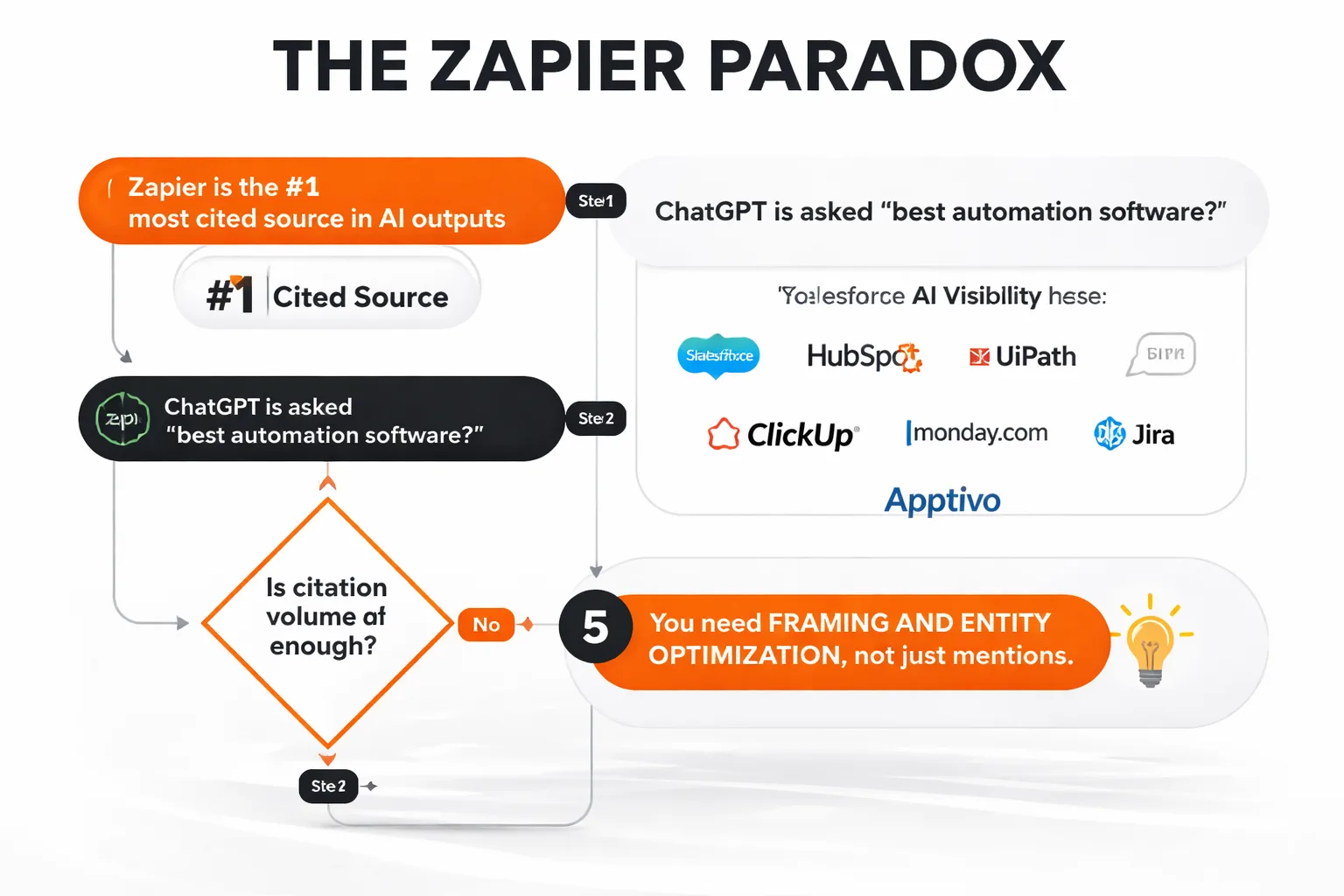
Here's the thing that keeps me up at night. Semrush's AI Visibility Index revealed that Zapier is the #1 most cited source in AI outputs but ranks only #44 for brand mentions. When someone asks ChatGPT for the best automation software, Zapier is completely omitted from the recommendation list despite being the most cited source across all AI outputs. Salesforce, HubSpot, UiPath, ClickUp, monday.com, Jira, and Apptivo all get listed. Zapier does not.
This is the Zapier Paradox, and it should terrify you. Being cited frequently by AI engines does not guarantee being recommended when it matters. Citation volume and brand visibility in recommendation contexts are fundamentally different metrics. A competitor analysis tools approach that only tracks raw citation counts will give you a false sense of security.
The implication for competitive intelligence is clear. You need tools that track not just whether you're cited, but how you're framed in recommendation contexts. Are you listed as the primary recommendation, or are you mentioned as a starting point before a competitor is positioned as the better choice? That framing data is what separates tools that help you win from tools that help you feel good while losing.
How Does Citation Tracking Actually Work?
Citation tracking across AI engines works by sending prompts to LLM APIs (ChatGPT, Perplexity, Claude, Gemini, Grok, DeepSeek) at regular intervals and parsing the responses for brand mentions, competitor mentions, and source citations. The tool records where in the response each brand appears, what the surrounding text says, and which URLs the AI cites as sources. Google AI Overviews and AI Mode are tracked through SERP-level analysis since they surface directly in Google search results.
The technical challenge is that LLM responses are non-deterministic. Ask the same question twice and you may get different answers. This is why SparkToro's research found that AI recommendation lists are highly inconsistent. A tool that tracks your visibility based on a single prompt per week is giving you a snapshot, not a reliable trend. The best tools run multiple prompts across variations and aggregate the results to smooth out the noise.
When Should You Run Competitor Audits?
Run competitor audits for AI search visibility on a rolling weekly cadence, not quarterly. AI engine responses shift faster than classic SERP rankings because LLM training data updates and ranking algorithm changes happen continuously. A competitor who was absent from ChatGPT recommendations last month might dominate them this month after publishing a single well-structured piece of content that gets picked up by the model's retrieval system.
I recommend tracking a fixed set of 25-50 high-intent prompts related to your product category. Run them weekly across ChatGPT, Perplexity, and Google AI Overviews at minimum. Look for directional trends: is your share-of-voice increasing or decreasing over a 4-week rolling window? Don't panic over single-week fluctuations. The Perplexity AI visibility checker and ChatGPT AI visibility checker are good starting points if you want to spot-check before committing to a paid tool.
What Metrics Actually Matter for AI Search?
Forget raw mention counts. Here are the metrics I track and recommend to every team I work with:
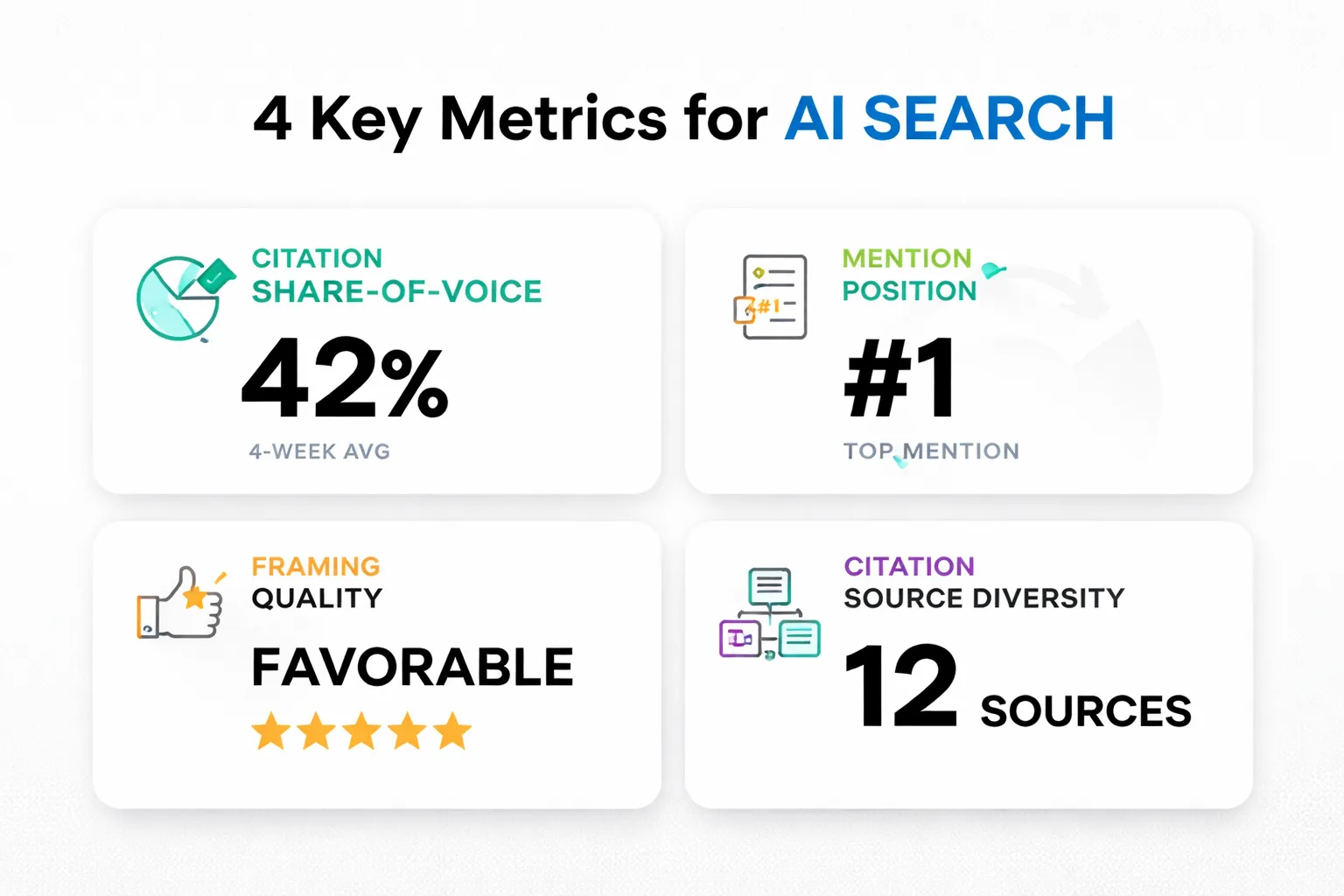
Citation share-of-voice. What percentage of AI answers in your topic space cite you versus each competitor? This is the AI equivalent of organic search market share. Track it as a rolling 4-week average to smooth out LLM inconsistency.
Mention position. Where in the AI answer does your brand appear? First mention carries more weight than being listed fifth in a comparison. Tools that report position data help you understand whether you're winning or just participating.
Framing quality. Is your brand described favorably, neutrally, or as a secondary option? This is the hardest metric to track automatically, but it's the most important one for B2B teams. I learned this the hard way when I saw our brand cited as a good starting point before a more advanced competitor was recommended. Being seen isn't enough. You need to be seen in the right light.
Citation source diversity. Are AI engines citing your own content, or are they citing third-party sources that mention you? If an AI recommends your product based on a G2 review, you need to know that. Your LLM visibility tool should surface which domains are being cited as sources for your mentions.
Making the Right Choice for Your Team
The decision framework is simpler than the tool comparison suggests. You need to answer one question: what stage of AI search maturity is your team at?
If you only need SERP and classic SEO data, stay with your existing SEO suite. Ahrefs and Semrush both have strong traditional rank tracking, backlink analysis, and keyword research. Adding their AI modules (Brand Radar or AI Toolkit) gives you a lightweight AI visibility layer without switching platforms. This is the lowest-friction path for teams that are AI-curious but not yet AI-committed.
If you need AI citation tracking as a primary focus, choose between Profound (enterprise governance), AthenaHQ (mid-market monitoring), or AIclicks (budget-friendly entry). These tools are built specifically for AI search visibility and offer deeper prompt-level tracking than the SEO suite add-ons. The trade-off is that none of them include content generation, so you'll need a separate tool to close the gaps they surface.
If you need both tracking and content output, Meev is the only platform on this list that combines AI citation monitoring with quality-gated content publishing. The closed-loop workflow (track citations, identify gaps, write articles, publish, measure the delta) is what small teams need to actually move the needle without hiring a content team. The best GEO tools landscape is fragmented, but the tracking-plus-publishing combination is rare.
If you need revenue attribution, Siftly is the specialist. Its first-party attribution model connects AI citations to actual website visits and conversions. For ecommerce and revenue-focused marketing teams, this is the missing link between AI visibility data and business outcomes.
FAQ
What is competitive intelligence in SEO?
Competitive intelligence in SEO is the practice of monitoring competitors' search visibility, content strategies, and ranking movements to identify opportunities and threats. In the AI search era, it extends to tracking competitor citations across LLMs, analyzing their entity grounding and knowledge graph presence, and understanding how AI engines frame rival brands in recommendation contexts. Traditional competitive intelligence focused on keyword rankings and backlinks. Modern competitive intelligence must include ai search visibility metrics.
How often should you run competitor audits?
For AI search, run competitor audits weekly. LLM responses shift faster than classic SERP rankings because model updates and retrieval changes happen continuously. Track a fixed set of 25-50 high-intent prompts across ChatGPT, Perplexity, and Google AI Overviews. Look at 4-week rolling trends rather than single-week snapshots to account for AI response inconsistency. Quarterly audits are too slow for the pace of change in generative search.
Can a small team afford competitive intelligence tools?
Yes. AIclicks starts at $29/month, Meev starts at $49/month, and Siftly starts at $79/month. These are accessible price points for small teams and solopreneurs. The key is choosing a tool that matches your maturity stage. Start with a budget-friendly monitoring tool like AIclicks if you're just beginning. Upgrade to a platform like Meev when you need both tracking and content output. Enterprise tools like Profound are designed for larger budgets and governance-heavy workflows.
What is the 80/20 rule in SEO as it applies to competitor research?
The 80/20 rule in SEO competitor research means that 80% of your competitive visibility comes from 20% of your content and entity signals. In practice, this means identifying the small set of high-impact pages, structured data implementations, and knowledge graph entries that drive most of your AI citation share. Focus your competitive intelligence efforts on understanding why those specific assets earn citations and optimizing your equivalent assets rather than trying to match a competitor's entire content footprint.
The competitive intelligence tools on this list each solve a different piece of the AI search puzzle. The right choice depends on your team size, budget, and whether you need tracking alone or tracking plus content output. Whatever you choose, the worst decision in 2026 is to keep monitoring classic SERP rankings while your competitors quietly dominate the AI answers your prospects actually read.
About the Author
Judy Zhou, Founder
Judy Zhou leads content strategy at Meev, where she oversees AI-driven content research and publishing for hundreds of brands. With a background in SEO and editorial operations, she focuses on building content systems that rank on Google, get cited by AI search engines, and drive measurable business results.
Start tracking your AI citations today and close the gaps before competitors lock in their share-of-voice.