

Why Your Brand Never Shows Up in AI Recommendations
By Judy Zhou, Founder
Key Takeaways
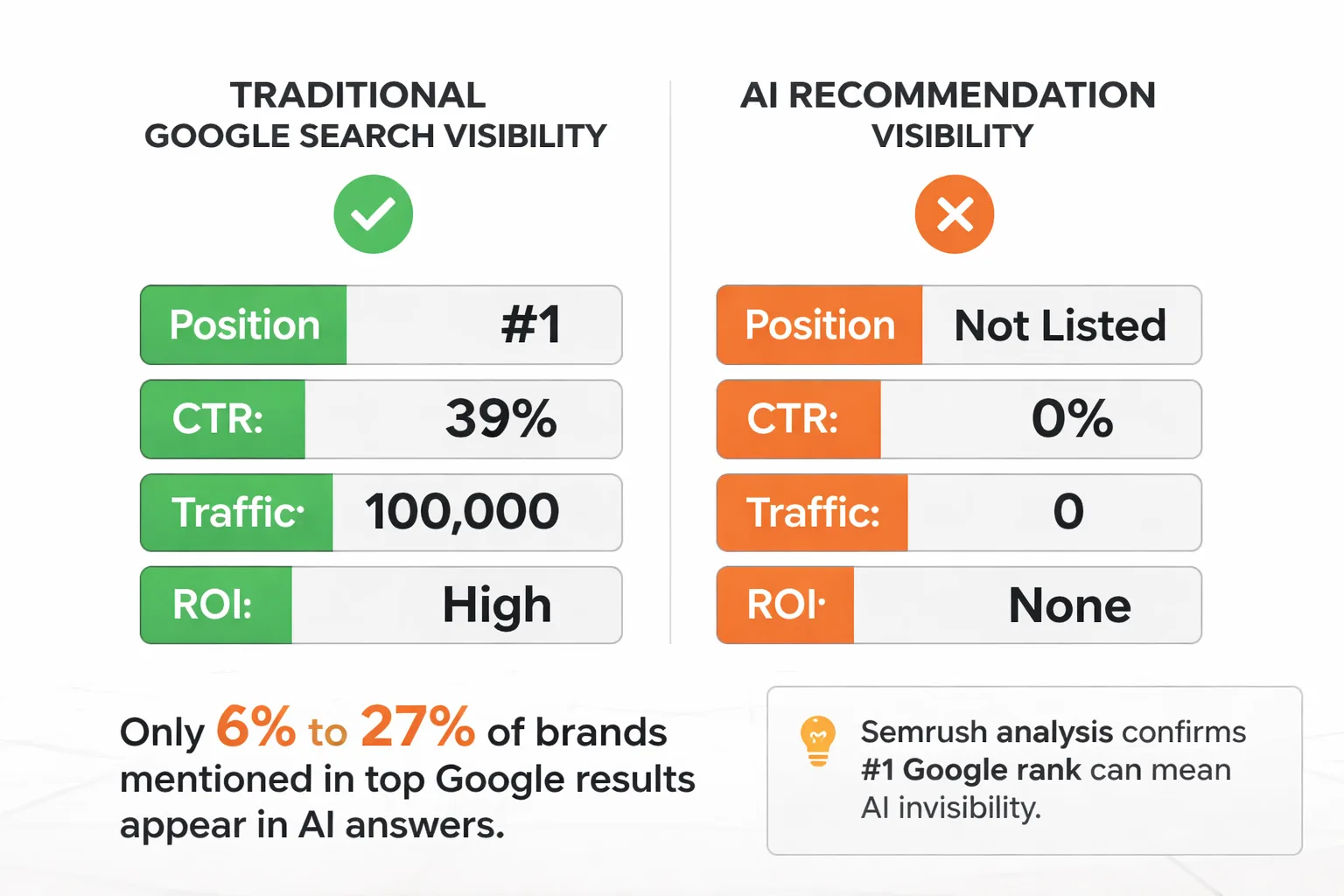
- Brands ranking #1 on Google can still be completely invisible in AI answers across ChatGPT, Perplexity, and Google AI Mode, per Semrush analysis.
- Only 6% to 27% of brands mentioned in AI responses are cited as the source, creating the gap where most brands lose authority.
- 89.2% of frequently-cited Wikipedia pages carry visible author bylines versus 31.4% of rarely-cited pages, according to the Hashmeta AI Search Citation Study.
- Build external entity signals and provenance in authoritative sources rather than obsessing over on-page optimization to appear in AI recommendations.
The brands showing up in AI recommendations aren't smarter than you. They're just better grounded in the sources AI engines actually retrieve from. A Semrush analysis confirms that a brand can rank #1 on Google and still be completely invisible in AI-generated answers across ChatGPT, Perplexity, and Google AI Mode. The problem isn't your content quality or your backlink profile. The problem is that AI engines don't read the web the way Google's crawler does. They retrieve answers from a narrow set of authoritative sources, and if your brand isn't referenced in those sources, you don't exist.
I've spent my career in SEO and editorial operations, and in my work auditing content ops at Meev, I see the same blind spot over and over. Teams obsess over on-page optimization while ignoring the external entity signals that actually drive AI recommendations. Only 6% to 27% of brands mentioned in AI responses are also cited as the source, according to Semrush's research. That gap between being mentioned and being the cited authority is where most brands lose.
The Hashmeta AI Search Citation Study, which analyzed 20,000 pages, found that 89.2% of frequently-cited Wikipedia pages carry visible author bylines, compared to just 31.4% of rarely-cited pages. That's not a correlation you can ignore. AI engines reward provenance, transparency, and external authority signals. If your brand lacks those, no amount of on-page keyword optimization will fix your invisibility.
The Real Reason AI Engines Skip Your Brand
When I first started investigating why brands vanish from AI answers, I assumed the culprit was thin content or weak technical SEO. I was wrong. The root cause is almost always entity ambiguity. AI engines like ChatGPT and Perplexity don't just match keywords. They resolve entities. They look for a consistent, verifiable identity for your brand across multiple authoritative sources, and if that identity is fragmented or missing, the engine can't confidently recommend you.
Think of it this way. Google's crawler indexes pages. AI engines retrieve answers. The difference is enormous. Google reads your page, extracts keywords, and ranks you based on relevance and authority signals. An AI engine receives a user prompt, searches its training data and live web sources for relevant information, and synthesizes an answer. If your brand isn't clearly defined in the sources the AI retrieves from, it won't appear in the answer. Period.
The second root cause is absence from authoritative third-party sources. I used to believe that perfecting on-site schema markup was the key to AI visibility. My team spent significant time structuring brand data meticulously for AI systems. What I learned is that even with flawless internal optimization, it's insufficient. AI models triangulate understanding from a much broader set of credible third-party sources: Wikipedia, G2, Reddit, TechCrunch, and other publications that AI engines treat as high-trust references. Your schema helps the engine interpret your page. But your external entity authority is what makes the engine confident enough to recommend you.
The third root cause is what I call the citation footprint gap. This is the difference between your brand being mentioned somewhere on the web and your brand being cited as an authoritative source on a specific topic. The Semrush finding that only 6% to 27% of brands mentioned in AI responses are also cited as the source should stop you cold. It means the vast majority of brands are footnotes, not authorities. AI engines mention them in passing but don't cite them as the definitive answer. If you want to understand how to be recommended by AI, you need to close this gap.
The fourth root cause is content format mismatch. LLMs retrieve information differently than search engine crawlers. They prefer scannable, structured, fact-dense content with clear answers near the top. If your content is buried in long-form prose with no clear summary, no structured data, and no extractable claims, the AI engine will skip you in favor of a source that's easier to parse. This is why answer engine optimization matters as a distinct discipline from traditional SEO.
Let me give you a concrete example of how this plays out. I observed a nearly fully automated blog that had published 46 helpful AI-generated articles. The content was genuinely useful. But it failed to get double-digit views. When I looked closer, the problem was obvious: the AI-generated titles lacked any compelling hook. There was no human in the loop refining the crucial entry point. The content was fine, but it was invisible because the packaging was generic. This same principle applies to AI recommendations. Your brand might be the best at what it does, but if the packaging (entity signals, source authority, content structure) doesn't give the AI engine a clear reason to cite you, you remain invisible. You're generating what amounts to AI slop that achieves zero SERP visibility and zero AI citation.
How AI Engines Decide What to Recommend
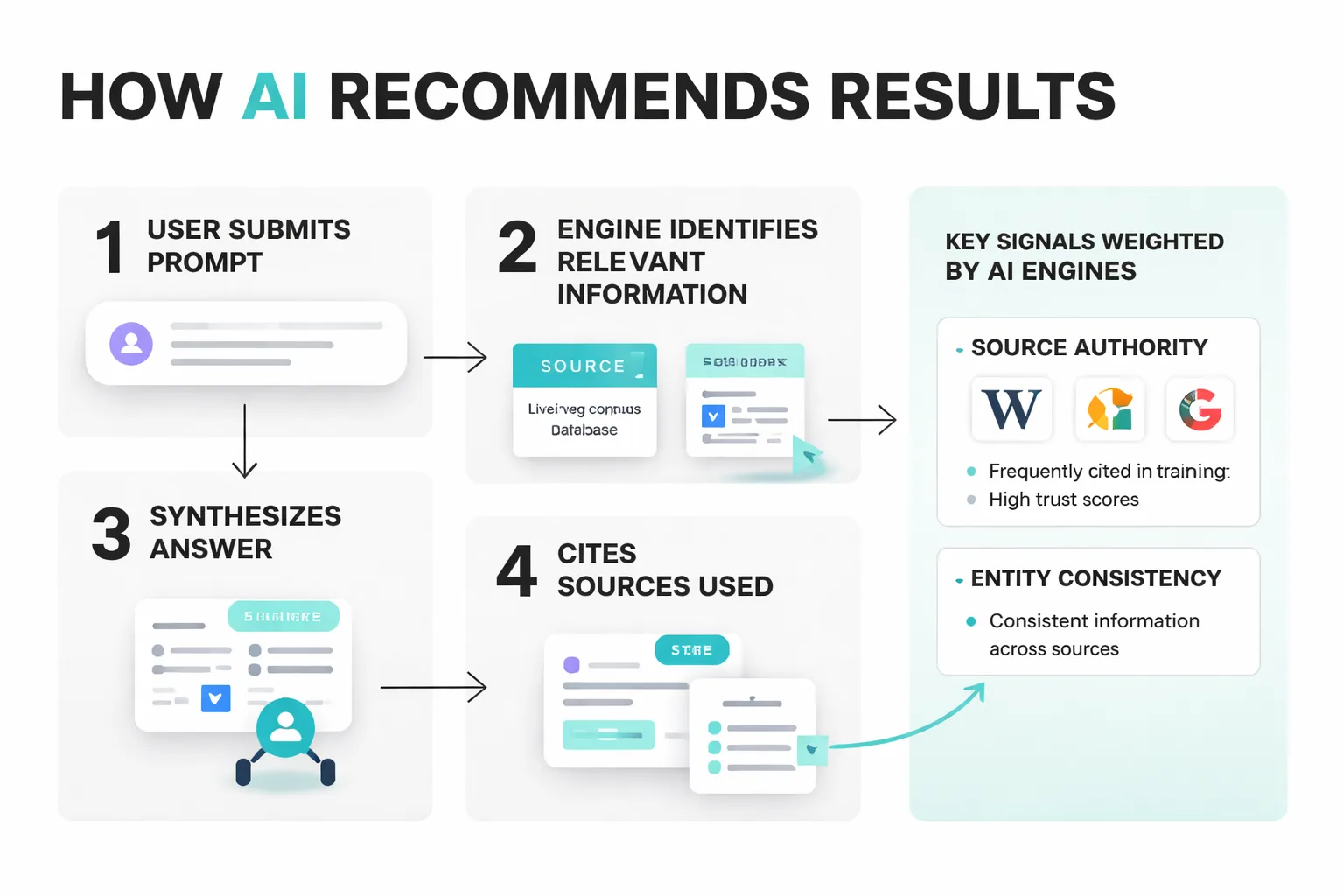
Understanding how AI engines decide what to recommend requires unpacking the retrieval and ranking logic behind systems like ChatGPT, Perplexity, and Google AI Overviews. These engines don't crawl and index the web the way Google does. They use a combination of pre-trained knowledge and real-time retrieval to generate answers. The process looks roughly like this: the user submits a prompt, the engine identifies relevant information from its training corpus and live web sources, it synthesizes an answer, and it cites the sources it used.
What signals do these engines weight? First, source authority. AI engines prioritize sources they've seen cited frequently in their training data and that have high trust scores. Wikipedia, major news publications, and established review platforms like G2 rank highly here. If your brand is referenced in these sources, you're more likely to be recommended.
Second, entity consistency. The engine needs to find consistent information about your brand across multiple sources. If your brand name, description, and category are consistent across your website, Wikipedia, Wikidata, G2, and press coverage, the engine can confidently resolve your entity. If the information is fragmented or contradictory, the engine hedges or omits you entirely.
Third, content retrievability. AI engines prefer content that's structured for easy extraction. This means clear headings, concise answers near the top, structured data markup, and scannable formatting. A Semrush study analyzed 200,000 queries and found that AI Overviews pull from pages with strong structural signals. Pages with FAQ schema, clear H2 headings, and summary blocks get cited more often than pages with the same information buried in prose.
Fourth, citation density. AI engines look at how often your brand is cited as a source across the web. Brands with high citation density in authoritative contexts get recommended more often. This is why PR, thought leadership, and being referenced in industry publications matters more for AI visibility than for traditional SEO.
Here's what most brand pages get wrong. They're optimized for human readers and Google crawlers but not for LLM retrieval. They lack structured data. They bury key facts in long paragraphs. They don't have consistent entity definitions across the web. They're absent from the authoritative third-party sources that AI engines trust. And they have a thin citation footprint because no one else cites them as an authority on their topic.
This is why I keep telling teams that ai search visibility requires a fundamentally different approach than traditional SEO. You're not optimizing for a crawler that reads your page. You're optimizing for a retrieval system that synthesizes answers from multiple sources. The difference between AEO and SEO is the difference between being readable and being citable.
What Retrieval-Augmented Generation Actually Does
To understand why your brand is invisible, you need to understand the mechanics of Retrieval-Augmented Generation, or RAG. This is the process that powers real-time citation in AI search engines. When you ask Perplexity or ChatGPT a question, the engine doesn't just rely on what it learned during training. It queries a live search index, retrieves the top relevant documents, reads them, and synthesizes an answer with citations.
The critical implication is this: if your brand's content isn't in the retrieval index, or if it isn't structured in a way the retriever can parse, you won't be cited. The retriever acts as a gatekeeper. It decides which sources get read by the synthesis layer. This is why content format matters so much. A page with clear headings, concise factual statements, and structured data is easier for the retriever to parse and pass to the synthesis layer. A page that's a wall of prose, no matter how insightful, gets skipped because the retriever can't efficiently extract useful information from it.
This is also why being cited in the sources the retriever favors (major publications, Wikipedia, established review sites) matters more than publishing on your own blog. The retriever prioritizes sources it has learned are reliable. If your brand is mentioned in those sources, the synthesis layer receives that information and can include it in the answer. If your brand is only mentioned on your own blog, the retriever may never read it.
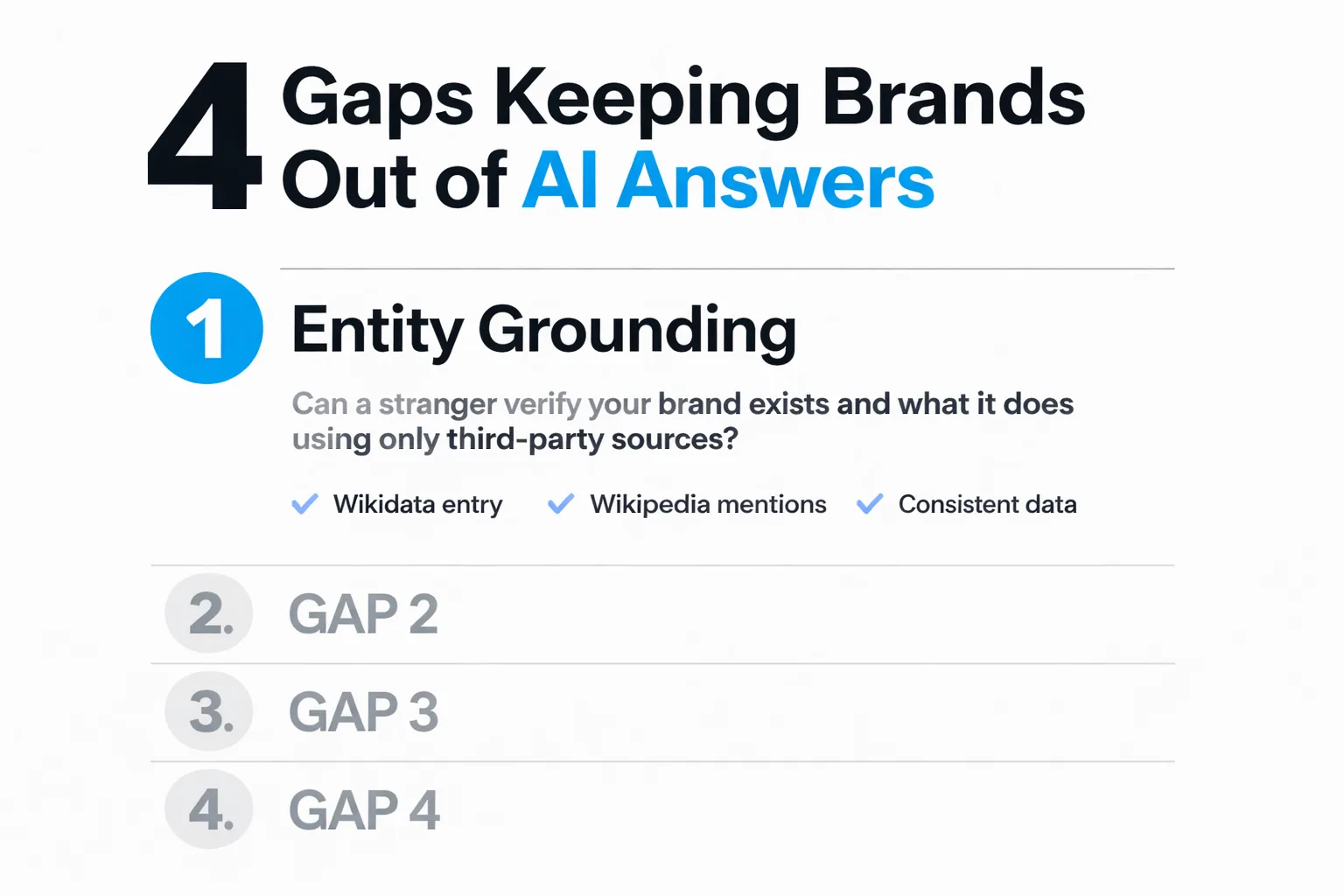
The 4 Gaps That Keep Brands Out of AI Answers
After auditing multiple brands' AI visibility, I've identified four consistent gaps that prevent brands from appearing in AI recommendations. Each gap has a concrete diagnostic question you can answer about your own brand right now.
Gap 1: Entity Grounding
Diagnostic question: Can a stranger verify your brand exists and what it does using only third-party sources?
Entity grounding is the foundation of AI visibility. It means your brand has a clear, consistent, verifiable identity across multiple authoritative sources. AI engines use entity resolution to determine whether your brand is a real, trustworthy entity or just a website. If your brand lacks a Wikidata entry, a Wikipedia page (or at minimum, mentions in Wikipedia), consistent NAP (Name, Address, Phone) information across directories, and structured data on your site defining your organization, you have an entity grounding gap.
The fix starts with Wikidata. Wikidata is described by researchers as a premier knowledge graph for AI visibility because it's the structured data backbone that many AI systems reference for entity resolution. Creating a Wikidata entry with your brand's key properties (founding date, industry, leadership, official website) gives AI engines a machine-readable definition of who you are.
But Wikidata alone isn't enough. Your entity needs to be consistent everywhere. If your G2 profile says you're a "project management tool" but your website says you're a "work management platform," that inconsistency weakens entity resolution. Pick one canonical description and use it everywhere.
The research community takes Wikidata seriously as an entity backbone. A peer-reviewed study published in eLife positioned Wikidata as a foundational knowledge graph for the life sciences, demonstrating that it serves as a machine-readable, interoperable entity definition system. The same principle applies to brands. When you create a Wikidata entry for your company, you're not just filling out a profile. You're contributing to the structured data layer that AI engines query when they need to resolve what your brand is, what category it belongs to, and how it relates to other entities in your space.
Gap 2: Source Authority
Diagnostic question: When AI engines retrieve information about your category, which sources do they cite? Are you referenced in any of them?
This is the gap that frustrates me most because it's the hardest to close and the most impactful. AI engines don't just look at your website. They retrieve from a set of authoritative sources they've learned to trust for each category. For B2B SaaS, that might be G2, Capterra, TechCrunch, and industry-specific publications. For ecommerce, it might be review sites, buyer's guides, and comparison articles.
The Hashmeta study found that 89.2% of frequently-cited Wikipedia pages carry visible author bylines. This tells you something critical: AI engines reward transparency and provenance. Sources with named authors, editorial standards, and clear attribution get cited more often. If your brand is only mentioned on your own blog and in a few low-authority guest posts, you have a source authority gap.
Closing this gap requires a shift from content marketing to reputation building. You need to be referenced in the sources AI engines trust. This means PR campaigns that land coverage in major publications. It means review profiles on G2, Capterra, and TrustRadius with enough volume to matter. It means contributing thought leadership to industry publications that AI engines have learned to cite.
I've seen teams pour budget into on-page optimization while ignoring this gap entirely. That's like polishing your storefront while the road to your shop doesn't exist. AI engines need to find you on the roads they actually travel.
Let me be specific about what this looks like in practice. If you're a B2B SaaS company in the project management space, go to Perplexity right now and search for "best project management tools for small teams." Look at the sources it cites. You'll likely see G2, Capterra, maybe a TechCrunch article, possibly a Reddit thread. Those are the sources Perplexity's retrieval layer trusts for that category. If your brand isn't on G2, isn't reviewed on Capterra, and hasn't been covered by TechCrunch, you're absent from the exact sources the AI engine is reading. No amount of blog content will fix that.
Gap 3: Content Format
Diagnostic question: Can an AI engine extract a clear, factual answer from your page in under 5 seconds?
LLMs retrieve information differently than human readers. They prefer content that's structured for extraction. This means clear headings that map to common queries. Concise summary answers near the top of the page. FAQ schema that explicitly marks Q&A pairs. Tables and lists for comparative data. And bolded key facts that are easy to identify and cite.
If your content is a 2,000-word essay with no headings, no summary, and no structured data, you have a content format gap. The information might be excellent. But it's not retrievable by an AI engine that's scanning for extractable answers.
The fix is structural. Start every page with a 40-60 word summary that directly answers the page's core question. Use H2 headings that match how users phrase queries to AI engines. Add FAQ schema for any question-based content. Use tables for comparisons and lists for steps. And make sure every key claim is sourced and verifiable, because AI engines increasingly prioritize content with clear provenance.
This is where tools like an AI SEO tool can help. The right tool will audit your content for retrievability and flag pages that lack the structural signals AI engines look for. But the tool is just a diagnostic. The fix is editorial work.
The stakes for getting content format right are higher than most people realize. I've been wary of AI writing tools for content generation, and my skepticism has only grown stronger watching early adopters walk into a trap. Consider the cautionary tale of IBM's Watson for Oncology. A $62 million investment got scrapped because it was making unsafe treatment recommendations. That's a catastrophic failure in a complex domain, and it mirrors the risks in AI article writing. If an AI generates factual inaccuracies, even seemingly minor ones, it can lead to severe reputational damage and SEO penalties that are much harder to recover from than the initial time saved. I've personally advised clients to prioritize human oversight on factual accuracy, even if it means slower content velocity. The same principle applies to content format: a human editor needs to ensure the page is structured for extraction, not just for readability.
Gap 4: Citation Footprint
Diagnostic question: How often is your brand cited as an authoritative source on a specific topic across the web?
Your citation footprint is the web of references that point to your brand as an authority on a particular topic. This is different from backlinks. Backlinks are about link equity. Citations are about topical authority. When AI engines retrieve information about "best CRM for startups" and your brand is cited as a source in multiple authoritative contexts, you get recommended.
The Semrush finding that only 6% to 27% of brands mentioned in AI responses are also cited as the source reveals how wide this gap is. Most brands are mentioned but not cited. They appear in listicles and comparison posts but aren't positioned as the definitive answer to a specific question.
Closing this gap requires what I call citation-focused content strategy. Instead of creating content about your brand, create content that answers specific questions in your category. Become the source that AI engines retrieve when someone asks about your topic. This means publishing original research, creating definitive guides on niche topics, and ensuring your content is the most citable source for specific queries.
This is also where generative engine optimization diverges from traditional SEO. In traditional SEO, you optimize pages to rank. In GEO, you optimize content to be cited. The distinction matters because AI engines don't rank pages. They synthesize answers from multiple cited sources.
Is your brand showing up in AI answers, or are competitors getting cited instead?
How to Start Fixing AI Recommendation Gaps This Week
You don't need to close all four gaps at once. You need to identify which gap is costing you the most visibility and fix that one first. Here's how to start this week.
Step 1: Audit Your Current AI Visibility
Before you fix anything, you need to know where you stand. Run your brand through an AI visibility checker across every major AI search surface. You want to know: which AI engines mention you? Which ones cite you as a source? What topics are you mentioned for? What topics are you absent from? And how does your share of voice compare to competitors?
This audit gives you your baseline. Without it, you're guessing. I've seen teams spend months creating content without knowing whether their brand appears in AI answers at all. Run the audit first. The results will tell you which gap to prioritize.
If you're specifically concerned about individual platforms, you can use a ChatGPT AI visibility checker or a Perplexity AI visibility checker to drill down. The point is to get specific data before you act.
Step 2: Identify Which Sources AI Engines Pull From
Once you know where you stand, find out which sources AI engines are citing for your category. This is the cited-source leaderboard. When you search for your target topics in ChatGPT or Perplexity, look at the sources they cite. Are they citing Wikipedia? G2? Industry publications? Competitor blogs?
This tells you exactly where you need to be referenced. If AI engines are citing G2 for your category and you don't have a G2 profile, that's your highest-leverage fix. If they're citing industry publications you've never pitched, that's your next PR campaign.
In my work at Meev, I've seen brands go from invisible to cited in weeks by simply identifying the right sources and getting referenced in them. Not because their content was better. Because they showed up where the AI was already looking.
Step 3: Prioritize the Highest-Leverage Fix
Not all gaps are equal. The highest-leverage fix depends on your situation. If you have zero entity presence (no Wikidata, no Wikipedia, no consistent entity definition), start there. Entity grounding is the foundation. Without it, nothing else matters because the AI engine can't resolve who you are.
If you have entity presence but no third-party authority, focus on source authority. Get referenced in the sources AI engines cite for your category. This means PR, review profiles, and thought leadership in publications the AI trusts.
If you have entity presence and third-party authority but poor content format, focus on restructuring your content. Add FAQ schema. Create summary blocks. Use tables and lists. Make your content extractable.
If you have all three but a thin citation footprint, focus on becoming the most citable source for specific topics in your category. Publish original research. Create definitive guides. Answer questions no one else has answered well.
Step 4: Track and Iterate
AI visibility isn't a one-time fix. It's an ongoing process. AI engines update their training data, new sources emerge, and competitors are working on the same gaps. You need to track your visibility over time and iterate.
Use an AI visibility tracker to monitor your mention rate, citation rate, and share of voice across platforms. Set a weekly review cadence. When you make a change (like creating a Wikidata entry or publishing a research report), check whether your visibility moves in the following weeks.
This is where the LLM visibility tool approach pays off. You're not just tracking whether you appear. You're tracking the context of your appearance. Are you cited as the primary source or a footnote? Are you recommended favorably or with caveats? The framing of your mention matters as much as the mention itself.
The Framing Problem: When Mentions Hurt You
Here's something most AI visibility tools won't tell you: a mention isn't always a win. My early attempts to leverage AI visibility tools were focused on boosting raw mention rates, thinking more mentions equaled more leads. This was a significant misstep. The critical insight I've learned is that the context or framing of an AI's citation is paramount.
For example, an AI could recommend your brand as a "good starting point" before suggesting a more "advanced" competitor. That framing effectively funnels users away from you. You're the stepping stone, not the destination. In B2B marketing, where decisions are heavily narrative-driven, this kind of framing is actively harmful. It positions your solution as secondary.
This is why tracking raw mention rate is a red herring. An AI might cite my brand, but if the framing of that mention subtly steers the user towards a competitor or positions my solution as a lesser alternative, it's not driving business outcomes. We're not selling impulse buys. B2B decisions are heavily narrative-driven, and favorable framing is the true, much harder-to-track metric.
I'm now convinced that optimizing for favorable framing, rather than just sheer volume of mentions, is the real challenge in AI search visibility. It's not about being seen. It's about being seen in the right light, with the right narrative, to genuinely influence a buying decision. This means re-evaluating your content to focus heavily on narrative control within AI interactions. You need to ensure that when AI engines describe your brand, they use the descriptors you want them to use. That starts with consistent entity definitions across all your external sources.
Why Most Brands Stay Invisible
Here's my contrarian take on this whole problem. Most brands stay invisible in AI recommendations not because the problem is hard, but because the solution is unglamorous.
The work that moves the needle is tedious. It's creating a Wikidata entry with 15 carefully sourced properties. It's pitching 20 journalists to get one mention in a publication AI engines trust. It's restructuring 50 pages of content to add summary blocks and FAQ schema. It's building a G2 profile and getting 30 reviews from real customers.
None of that is exciting. None of it feels like growth hacking. And none of it shows immediate ROI in your analytics dashboard. So teams skip it. They buy an AI search optimization promise or chase the latest AI SEO hack. And they stay invisible.
The brands that show up in AI recommendations aren't doing anything secret. They've done the unglamorous work of building entity presence, getting referenced in authoritative sources, structuring their content for retrieval, and building a citation footprint. They've closed the four gaps I described above. And they did it methodically, not magically.
The pattern I keep seeing is this: brands that treat AI visibility as an infrastructure problem, not a content problem, are the ones who get recommended. They build the foundation first. Then they create content on top of that foundation. The content performs better because the foundation exists.
Brands that skip the foundation and go straight to content creation are building on sand. Their content might be excellent. But AI engines can't confidently cite it because the entity signals, source authority, and citation footprint don't support it.
What This Actually Means for Your Team
If you've read this far, you know the problem. Your brand is invisible in AI recommendations because AI engines can't resolve your entity, don't find you in the sources they trust, can't extract answers from your content, and don't see enough citation density to recommend you with confidence.
The fix isn't more content. The fix is the right infrastructure. Start with entity grounding. Build your Wikidata entry. Get consistent across directories. Then move to source authority. Get referenced in the publications and platforms AI engines cite for your category. Then fix your content format. Add structured data, summary blocks, and FAQ schema. Then build your citation footprint through original research and definitive guides.
This is a sequential process. Each step builds on the last. Skip a step and the whole structure is weaker.
If you take one thing from this article, let it be this: AI visibility is earned through external authority signals, not internal content optimization. Your website is one source. AI engines retrieve from dozens. You need to be present and authoritative in the sources they actually use.
Start with the audit. Find your biggest gap. Close it. Then move to the next one. That's how you go from invisible to recommended. That's how to be recommended by AI in 2026.
FAQ
Can I just use AI content generation tools to fix my visibility?
No. AI content generation without human oversight on factual accuracy and structural formatting produces what amounts to AI slop. I've seen automated blogs with 46 helpful articles fail to get double-digit views because the titles and packaging were generic. The bottleneck isn't content volume. It's entity grounding, source authority, and citation footprint. Those are infrastructure problems, not content production problems.How long does it take to see results from fixing these gaps?
In my experience, entity grounding fixes (like creating a Wikidata entry) can show results within weeks as AI engines index the new structured data. Source authority gains take longer because they depend on PR cycles and editorial calendars at third-party publications. Content format fixes can show results quickly if you're restructuring existing pages. Citation footprint building is the longest-term play because it requires publishing original research and getting others to reference it.What's the difference between AI visibility and traditional SEO ranking?
Traditional SEO ranking is about optimizing pages to appear in search results. AI visibility is about being cited as a source in AI-synthesized answers. You can rank #1 on Google and still be invisible in AI answers because AI engines retrieve from authoritative third-party sources, not just your website. The difference between AEO and SEO is the difference between being readable and being citable.Should I hire an agency or do this in-house?
It depends on your team's bandwidth and expertise. The entity grounding and content format gaps are technical and can be done in-house with the right tools. The source authority gap requires PR and relationship-building skills, which is where an agency or consultant with existing media relationships can accelerate results. The citation footprint gap requires a content strategy that most teams can handle in-house if they have a strong editorial process.How do I track which AI engines are citing my brand?
Use an AI visibility tracker that monitors your brand across every major AI search surface. You want to track mention rate, citation rate, share of voice, and the framing of your mentions. A simple keyword tracker won't work because AI answers are synthesized, not ranked. You need a tool that reads the actual response text and identifies where and how your brand appears.About the Author
Judy Zhou, Founder
Judy Zhou leads content strategy at Meev, where she oversees AI-driven content research and publishing for hundreds of brands. With a background in SEO and editorial operations, she focuses on building content systems that rank on Google, get cited by AI search engines, and drive measurable business results.
Run a free AI visibility audit and see exactly which gaps are keeping your brand out of AI recommendations.