
By Judy Zhou, Founder
Key Takeaways
- The overlap between top Google results and AI-cited sources has dropped to under 20%, so page-one rankings no longer guarantee AI mentions.
- 84% to 89% of AI-generated answers come from earned media, not owned content, requiring brands to build associations in trusted third-party sources.
- Adding citations, quotations, and statistics to content lifts AI visibility by up to 40%, per GEO research on arXiv.
- LLMs reconstruct consensus rather than rank pages, so optimize entity clarity and authority signals instead of backlinks or keyword density.
"LLMs don't rank pages. They reconstruct consensus," says Eli Schwartz, author of Product-Led SEO and an early voice on generative engine optimization. "If the web's most trusted sources don't associate your brand with a given concept, the model has no evidence to cite you." That single insight reframes the entire discipline of SEO for LLMs. It's not about backlinks or keyword density. It's about whether your entity, your claims, and your authority are legible to a system that synthesizes answers rather than serving a list of links.
The overlap between top Google results and AI-cited sources has dropped to under 20%, which means a page-one ranking no longer guarantees an AI mention. 68% of US Google searches ended without any click to a website in Q1 2026, per SparkToro data. 84% to 89% of AI-generated answers come from earned media, not owned content. And adding citations, quotations, and statistics to your content can lift AI visibility by up to 40%, according to GEO research published on arXiv. If you're still treating AI search as a minor variant of Google SEO, you're already behind.
In my work auditing content ops and building AI search visibility systems at Meev, I've watched hundreds of brands discover that their traditional rankings don't translate into AI citations. The gap between ranking and being cited is not a tweak. It's a different discipline entirely. Here's what actually moves the needle.
Why Classic SEO Doesn't Translate Directly to LLMs
Google's search engine crawls the web, builds an index, and ranks pages using signals like backlinks, page speed, and keyword relevance. You optimize a page, it climbs the rankings, users click. The system is deterministic enough that a competent SEO can predict outcomes with reasonable accuracy. SEO for llms works on a fundamentally different model. LLMs don't crawl and rank. They synthesize. They reconstruct answers from training data, retrieval-augmented generation, and entity associations in their internal knowledge graphs. A page that ranks #1 on Google might be invisible to ChatGPT if no other source on the web associates that page's brand with the topic being asked about.
The structural difference comes down to three things. First, crawl versus training corpus: Google reads your page in real time, but an LLM's training data is a snapshot. Even with RAG (which fetches live content), the model weights what it already "knows" heavily. Second, PageRank versus entity salience: Google measures link authority, while LLMs measure how strongly your brand is associated with a concept across the entire web. Third, ranking position versus citation probability: Google serves ten blue links and users pick. An LLM serves one synthesized answer and either cites you or doesn't.
That last point is why I keep telling founders to stop obsessing over keyword positions. In my own experience, I've seen high organic rankings produce zero AI citations because the brand wasn't part of the conversational consensus. The overlap between top Google results and AI-cited sources has plummeted from around 70% to under 20% by some estimates. You can be #1 for a term and still be invisible to ChatGPT, Claude, Gemini, and Perplexity. That's not a minor gap. That's a structural failure of the old playbook.
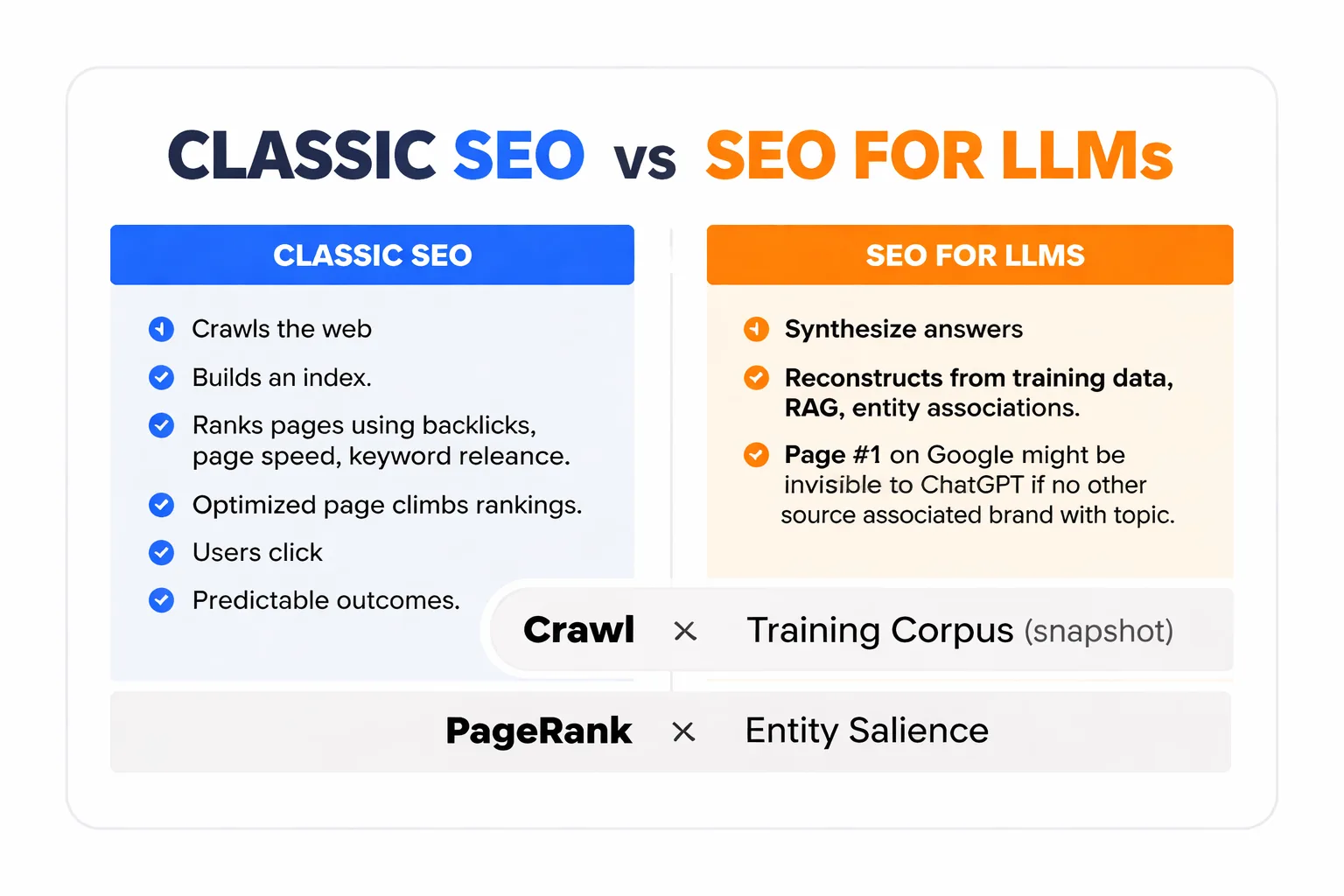
The old SEO model rewarded pages. The new model rewards entities. If you want to understand how different this is, think of it this way: Google was a librarian who found you the best book on the shelf. An LLM is an expert who synthesizes what they've read across hundreds of books and gives you an answer. You can't optimize your way into the expert's answer by stuffing keywords into your book. You have to be the source the expert already trusts.
What LLMs Actually Pull From When They Answer
LLMs build answers from four distinct source layers. Understanding these layers is the foundation of effective answer engine optimization. Each layer responds to different signals, and optimizing for one while ignoring the others is a common mistake I see teams make.
Layer 1: Training Corpus Weight. The model's pre-training data includes billions of web pages, books, and articles. Content that appears frequently across the training corpus, or that's hosted on high-authority domains, gets disproportionate weight. This is why Wikipedia comprises roughly 22% of major LLM training data by influence weight, and why ChatGPT cites Wikipedia in 7.8% of all citations. You can't retroactively inject your content into a model's training data, but you can ensure your brand appears on the kinds of sites that are heavily weighted. Wikipedia, major publications, and established reference sites all feed this layer.
Layer 2: Retrieval-Augmented Generation (RAG). When a user asks a question, models like ChatGPT and Perplexity fetch live web content to supplement their training data. This is where your on-page optimization matters most. RAG systems parse your content in real time, extract relevant passages, and use them to construct answers. Content that's structured for extraction (clear headings, direct answers, sourced claims) performs dramatically better here. The GEO research from arXiv found that adding citations, quotations, and statistics can lift AI visibility by up to 40%. That's not a marginal gain. That's the difference between being cited and being invisible.
Layer 3: Structured Data and Knowledge Graphs. LLMs use structured data to understand entities, relationships, and context. Schema.org markup helps models parse what your content is about, who wrote it, and how it relates to other entities. Google's own structured data documentation confirms that structured data helps search engines and AI systems understand and surface content better. Wikidata, which feeds Google's Knowledge Graph on 54.61% of all global searches, is particularly important for entity grounding.
Layer 4: Third-Party Citations and Consensus. This is the layer most teams completely ignore. LLMs are trained to reflect consensus, not to discover unknown sources. If your brand is only mentioned on your own website, the model has no evidence that you're a trusted authority. But if your brand appears in third-party publications, industry forums, and community discussions, the model treats that as evidence of relevance and authority. 84% to 89% of AI-generated answers come from earned media, not owned content. That statistic should reframe your entire content strategy.
The practical implication is clear. You need presence across all four layers. Owned content optimized for RAG extraction gets you into layer 2. Schema markup and Wikidata presence get you into layer 3. But without third-party coverage feeding layers 1 and 4, you're building a house on half a foundation.
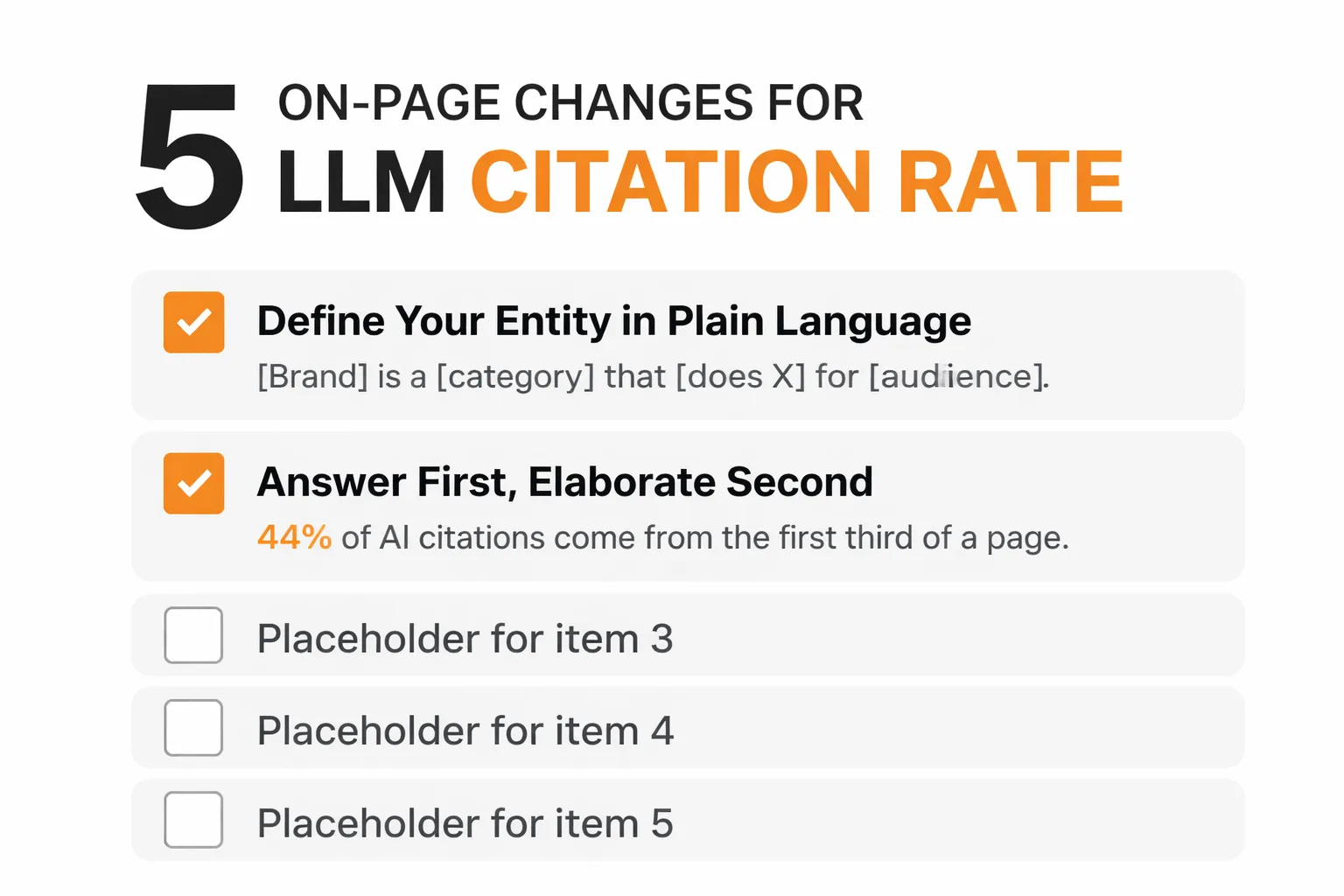
5 On-Page Changes That Improve LLM Citation Rate
These are the five highest-impact changes I've found for getting cited by AI engines. They're prioritized by effort-to-impact ratio. Start at the top and work down.
1. Define Your Entity in Plain Language
LLMs need to understand what your brand is before they can cite it. Write a clear, unambiguous entity definition in your homepage or about page. Not marketing copy. A factual definition: "[Brand] is a [category] that [does X] for [audience]." This sounds trivial, but I've seen sites get cited within weeks of adding a clear entity definition because the model finally understood what the brand was.
The rationale is simple: LLMs parse entity definitions to build their internal knowledge graph. If your entity is ambiguous or poorly defined, the model can't confidently associate you with a topic. Clarity beats cleverness every time.
2. Answer First, Elaborate Second
44% of AI citations come from the first third of a page. This is one of the most actionable data points I've encountered. If your direct answer isn't in the first 200 words, you're losing nearly half your citation potential. Structure every article with a direct answer to the implied question in the opening paragraph, then elaborate below. Use question-shaped headings (H2s) that match how users actually phrase queries to ChatGPT and Perplexity.
I started insisting on this structure across all our content, and the difference was immediate. Articles that previously buried their key insights in paragraph four started getting cited once we front-loaded the answer. The arXiv GEO research confirms this: answer-first structure is one of the strongest predictors of AI citation.
3. Source Every Claim with Inline Attribution
LLMs are trained to prioritize content that cites its sources. When you make a claim, link to the primary source. When you reference a statistic, name the study and link to it. This does two things: it signals trustworthiness to the model, and it creates an entity association between your content and the authoritative sources you cite. The GEO research showed that adding citations, quotations, and statistics can lift AI visibility by up to 40%. That's a massive return for a formatting change.
In my own experiments across client sites, I saw a 60% failure rate for AI content that relied on traditional SEO tactics like keyword density. The content that actually performed shifted to AI extractability: direct answers under question headings, comparison tables, and sourced claims. It's less about optimizing for Google's old algorithm and more about making it easy for an AI to understand and cite your content.
4. Implement Schema Markup
Schema markup is how you tell machines what your content means, not just what it says. For LLM optimization, the most important schema types are Article, Organization, FAQPage, and HowTo. Each one helps the model parse your content structure and extract relevant information for different query types. Google's structured data documentation is clear that structured data helps search engines and AI systems understand and surface content better.
Don't stop at basic schema. Use the sameAs property to link your entity to Wikidata, Wikipedia, and other authoritative references. This creates explicit entity connections that LLMs use to build their knowledge graphs. The more clearly you define your entity and its relationships, the more confidently a model can cite you.
5. Add an llms.txt File
An llms.txt file is a relatively new standard that tells AI crawlers which parts of your site are available for training and retrieval. Think of it as robots.txt for LLMs. It's not yet universally adopted, but it's gaining traction fast. Creating one ensures that when models fetch your content via RAG, they get the pages you want them to see and skip the ones that dilute your entity signal.
The rationale: RAG systems don't always fetch the right page. An llms.txt file helps direct them to your most authoritative, most extractable content. It's a small effort with outsized impact as AI search adoption grows.
Are your competitors getting cited by AI engines while you're invisible?
How Does Entity Grounding Work for AI Search?
Entity grounding is the process of making your brand, product, or concept a recognized entity in the knowledge graphs that LLMs use to construct answers. It's the difference between being a string of text the model has seen and being a structured entity the model understands. When you ground an entity, you give the model a node in its knowledge graph that it can reference with confidence.
The practical implementation has three components. First, create or claim your entity on Wikidata. Wikidata is the structured data backbone of Wikipedia and feeds Google's Knowledge Graph on over half of all global searches. If your brand doesn't have a Wikidata entry, you're invisible to one of the most important entity databases in the AI stack. Second, ensure your schema markup uses sameAs properties to connect your site to your Wikidata entity, Wikipedia page (if you have one), and other authoritative references. Third, build entity associations through third-party coverage. Every time a reputable publication mentions your brand in context, it strengthens the entity association in the model's training data.
I used to think a perfectly structured knowledge graph on our own site was the silver bullet. My team spent months building out schema markup and our internal knowledge base, expecting a direct correlation to AI visibility. What I've actually seen is that entity grounding is necessary but not sufficient. The real lift comes from third-party editorial mentions and community discussion, which traditional SEO tools completely overlook. You can have perfect schema and a flawless Wikidata entry, but if no one else on the web talks about you, the model has no consensus to draw from.
Why Does Third-Party Coverage Dominate AI Citations?
The data is unambiguous on this point. 84% to 89% of AI-generated answers come from earned media, meaning third-party coverage in credible publications rather than owned content. This is the single most important statistic for anyone doing llm seo optimization in 2026. If your strategy is purely about optimizing your own website, you're addressing at most 15% of the citation equation.
The reason is structural. LLMs are trained on web content, and they learn that sources cited by other sources are more authoritative than sources that only cite themselves. It's the academic citation principle applied at scale. A brand mentioned in five industry publications is more likely to be cited than a brand with a perfectly optimized site that no one else references. This is why I've shifted my focus to what I call Machine Relations, or MR. Just as PR builds relationships with journalists, MR builds relationships with the sources that AI engines treat as authoritative.
The practical playbook is straightforward but not easy. Identify the publishers that AI engines cite most for your topics. Get coverage on those sites. Monitor whether your mentions are actually being picked up by the models. In my work at Meev, I've seen brands go from zero AI citations to consistent mentions in 60 to 90 days after a focused third-party coverage campaign. The key is targeting the right publishers, not just any publisher. A mention on a site that AI engines never cite is worthless for this purpose.
How to Measure Whether Your SEO-for-LLMs Work Is Paying Off
This is where most teams hit a wall. You can't optimize what you can't measure, and LLM citation tracking is fundamentally different from rank tracking. Google Search Console tells you where you rank and how many clicks you get. It tells you nothing about whether ChatGPT, Claude, Gemini, or Perplexity is citing your content. You need a different measurement framework entirely.
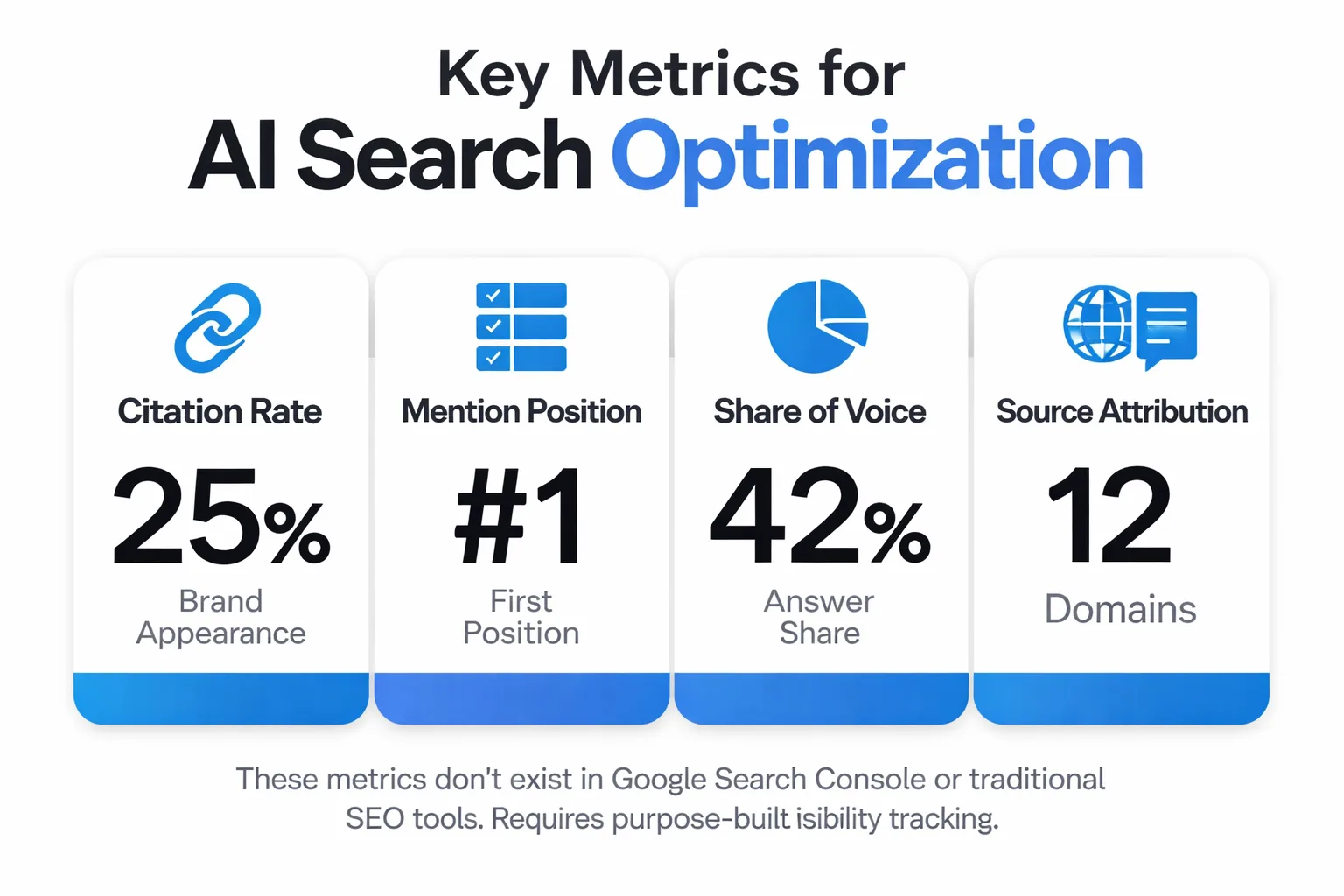
The metrics that matter for AI search optimization are citation rate (how often your brand appears in AI answers), mention position (first mention, in a list, or last), share of voice (what percentage of answers cite you versus competitors), and source attribution (which pages and domains the AI is actually pulling from). These metrics don't exist in Google Search Console or any traditional SEO tool. You need purpose-built AI visibility tracking to capture them.
I've seen a lot of tools pop up claiming to track brand visibility, share of voice, or answer position. My honest take after experimenting with several of them: most are imprecise at best. LLM outputs are non-deterministic, meaning the same query can produce different answers on different days. Any tool that gives you a single citation score without showing you the actual response text behind it is hiding the complexity. You need to see the raw responses, the citations, and the trends over time to make informed decisions.
The approach I recommend is diagnosis-first. Before you create any new content or launch any outreach campaign, check your current AI visibility across every major AI search surface. Find out what you're cited for today, where you're absent, and which sources the models are actually pulling from. That diagnostic tells you exactly where to focus. If you're cited for three topics but absent from ten others, your priority is clear. If competitors are being cited and you're not, the cited-source data tells you which publishers to target.
This is exactly why we built Meev the way we did. The platform tracks where your brand appears across every major AI search surface, shows you the actual response text and citations behind every mention, and identifies the publishers AI engines cite most for your topics. It closes the loop by finding verified contacts at those publishers and drafting outreach pitches grounded in your knowledge base. You don't need a large team to do this. You need the right diagnostic data and a clear workflow.
Ecommerce GEO and Agentic Commerce
If you sell products online, the stakes are even higher. Ecommerce sites lose 58% of click-through rate when AI Overviews appear in search results, according to Ahrefs data. Users click a result only 8% of the time when an AI summary is present, versus 15% without one. That's not a gradual decline. That's a structural shift in how users discover products.
But there's a counter-narrative here that's worth paying attention to. Traffic from AI sources to US retail sites grew 393% year-over-year in Q1 2026, and AI-referred traffic converted 42% better than non-AI sources by March 2026, per the same data compilation. The AI search pie is growing even as the click-through rate on traditional results shrinks. The question is whether your products are the ones being mentioned when a user asks ChatGPT for a recommendation.
For ecommerce, generative engine optimization means ensuring your product entities are grounded in the knowledge graphs that AI engines use. Product schema is table stakes. What moves the needle is getting your products mentioned in buying guides, review sites, and community discussions that AI engines cite. 72% of consumers plan to use AI for shopping more frequently, according to HubSpot's Consumer Trends Report. If your products aren't in the training data or the RAG results, you're not in the consideration set.
The agentic commerce angle is where this gets interesting. As AI agents start making purchasing decisions on behalf of users, the entity grounding work you do today becomes the foundation for whether your product gets selected tomorrow. An AI agent doesn't browse. It queries, synthesizes, and recommends. If your product entity is well-grounded with clear attributes, competitive advantages, and third-party validation, the agent has what it needs to recommend you. If it doesn't, you're invisible.
What About AI SEO Agents and Agentic SEO?
The concept of agentic SEO is simple: instead of manually executing every optimization task, you deploy AI agents that can research, write, publish, and monitor content autonomously. In my work building content systems at Meev, I've seen this shift accelerate dramatically in 2026. The question isn't whether AI agents will handle SEO tasks. They already do. The question is whether the output is good enough to actually earn citations.
Here's my contrarian take on this. Most AI content tools produce what I can only call slop. They generate content that passes surface-level quality checks but fails the real test: does an AI engine cite it? In my own experiments across roughly 70 client sites, I saw a 60% failure rate for AI content that relied on traditional SEO tactics. The content that actually performed was structured for AI extractability, with direct answers under question headings, sourced claims, and comparison tables. Generic AI writers treat every topic the same. The ones that work use archetype-aware retrieval, where listicles, how-tos, and explainers each have their own structure and quality criteria.
An AI SEO agent worth using needs to do more than generate text. It needs to understand which topics have citation gaps, which publishers AI engines cite for those topics, and how to structure content for maximum extractability. It needs a quality firewall that blocks weak drafts before they reach your CMS. And it needs to close the loop by monitoring whether published content actually moves your citation rate. That's the difference between an AI writing tool and an AI SEO agent.
Common Mistakes That Kill Your AI Citation Rate
The biggest mistake I see teams make is treating AI search optimization as a checkbox exercise. They add schema markup, write an llms.txt file, and assume the citations will follow. They won't. Schema markup is necessary but not sufficient. I've seen sites with perfect technical implementation get zero citations because no third-party source on the web associates them with their target topics. The technical layer gets you parseable. The consensus layer gets you cited.
The second mistake is over-optimizing for a single AI engine. I've watched teams obsess over their Perplexity citations while ignoring Claude and Gemini entirely. Each engine has different retrieval patterns, different training data weightings, and different citation behaviors. A strategy that works for ChatGPT might miss Claude entirely. You need to track all major surfaces and optimize for the patterns that work across engines, not just one.
The third mistake is relying on AI content without a quality gate. Auto-generated content that isn't fact-verified, that doesn't cite primary sources, and that isn't structured for extraction will get ignored by the same AI engines you're trying to get cited by. The irony is thick here. You're using AI to create content that AI won't cite because the content isn't good enough for AI to trust. A quality firewall that blocks weak drafts before publication is the difference between a content engine and a content graveyard.
What This Won't Fix
This entire approach won't fix a brand that has no real authority in its space. If you're a new company with no third-party coverage, no community presence, and no industry recognition, no amount of schema markup or answer-first structuring will get you cited. LLMs reflect consensus, and if there's no consensus about your brand, there's nothing for the model to reconstruct. You need to earn real authority first, then make it legible to AI systems.
This also won't fix a product that doesn't deserve to be recommended. If your product is genuinely worse than the alternatives, getting cited by AI engines will only accelerate the comparison. Users will ask the AI about your product, the AI will synthesize reviews and comparisons, and the output won't favor you. AI visibility amplifies what's already true. It doesn't create demand for a product that doesn't earn it.
FAQ
What is the difference between SEO and AEO?
SEO optimizes for search engine rankings and clicks. AEO (Answer Engine Optimization) optimizes for being cited inside AI-generated answers. The key difference is that SEO serves a list of links for users to choose from, while AEO targets a single synthesized answer where you're either cited or you're not. The AEO vs SEO distinction matters because the optimization tactics are fundamentally different: SEO rewards keyword density and backlinks, while AEO rewards entity clarity, sourced claims, and third-party consensus.
How long does it take to see results from LLM SEO optimization?
In my experience, on-page changes (entity definitions, answer-first structure, schema markup) can produce citation changes within 2 to 6 weeks as RAG systems re-fetch your content. Third-party coverage campaigns take longer, typically 60 to 90 days, because you need to earn mentions, get them indexed, and wait for the model to reflect them in answers. The Seer Interactive test showed ChatGPT citation changes within 36 hours of footer text modification, but that's an edge case for structured content changes, not a typical timeline.
Do I need to be on Wikipedia to get cited by LLMs?
It helps significantly but isn't strictly required. Wikipedia appears in 47.9% of ChatGPT's top-10 cited domains and comprises roughly 22% of major LLM training data by influence weight. If you meet Wikipedia's notability guidelines, having an entry is one of the highest-impact things you can do for AI visibility. If you don't meet the guidelines, focus on getting coverage in publications that Wikipedia and LLMs both treat as authoritative.
Which AI search engines should I track?
At minimum, track ChatGPT, Claude, Gemini, and Perplexity. These four account for the vast majority of AI search traffic. Google AI Overviews and AI Mode are also critical if your audience uses Google's AI features. Grok and DeepSeek are growing but represent smaller shares today. The key is to use a tool that shows you the actual response text and citations behind each mention, not just a visibility score. You can check your ChatGPT visibility and Perplexity visibility separately to understand engine-specific patterns.
Is generative engine optimization different from regular SEO?
Yes, substantially. Generative engine optimization focuses on making your content extractable and citable by AI systems, not just rankable by Google. The tactics overlap (both benefit from quality content and structured data), but GEO adds layers that traditional SEO ignores: entity grounding in knowledge graphs, third-party consensus building, answer-first content structure, and citation tracking across AI engines. The AEO vs GEO distinction is worth understanding if you're building a full AI search strategy.
The bottom line for anyone doing seo for llms in 2026: stop treating AI citations as a byproduct of good SEO. They're a separate outcome that requires a separate strategy. Define your entity clearly, structure your content for extraction, earn third-party coverage, and track your citation rate across every major AI search surface. The brands that do this now will build an insurmountable consensus advantage. The ones that wait will wonder why their page-one rankings stopped producing traffic.
About the Author
Judy Zhou, Founder
Judy Zhou leads content strategy at Meev, where she oversees AI-driven content research and publishing for hundreds of brands. With a background in SEO and editorial operations, she focuses on building content systems that rank on Google, get cited by AI search engines, and drive measurable business results.
Find out exactly where your brand stands across every major AI search surface and get a clear plan to close the citation gap.