
By Judy Zhou, Founder
Key Takeaways
- 98.8% of local businesses are completely invisible in AI-generated recommendations while AI-referred sessions jumped 527% year-over-year.
- 73% of B2B websites lost significant traffic between 2024 and 2025 as AI answers replaced traditional organic clicks.
- Start any AI search optimization effort with a visibility diagnosis across prompts instead of producing new content.
- Brands that secure first-mover advantage in AI citation optimization will pull ahead before competitors finish reading this article.
In 2016, Google quietly introduced featured snippets. A single answer box that began siphoning clicks away from even the top-ranked organic results. Marketers spent years learning to optimize for that format. Then came voice search, then People Also Ask, then SGE. Each shift rewarded the brands that adapted early and punished those who noticed too late. The arrival of AI answer engines. ChatGPT, Perplexity, Gemini, Claude. Is the largest version of that same pattern yet, and the window for first-mover advantage in AI citation optimization is open right now, for exactly as long as it takes your competitors to read articles like this one.
98.8% of local businesses are completely invisible in AI-generated recommendations, and 73% of B2B websites experienced significant traffic losses between 2024 and 2025 as AI answers cannibalized traditional organic clicks. Meanwhile, AI-referred sessions jumped 527% year-over-year in early 2025, and 58% of marketers say AI-referred visitors convert at higher rates than traditional organic traffic. The gap between brands that AI engines cite and brands they ignore is widening fast, and most teams don't even know which side they're on.
I've spent my career auditing content operations and building systems to close this exact gap. In my work at Meev, where I oversee AI-driven content research and publishing, I see the same pattern every week: a founder or marketing lead assumes their brand shows up in ChatGPT because they rank on page one for their category keyword. Then we run a visibility check and discover they're cited in maybe one out of twenty relevant prompts, always positioned as a secondary option behind a competitor who invested in answer engine optimization six months earlier. The best accurate data platform for ai search optimization starts with diagnosis, not content production. You need to know what AI engines actually see before you can change it.
Why Most Brands Don't Know They're Missing
The assumption is logical but wrong. If you rank well on Google, you must appear in AI answers too. Both systems crawl the web, index content, and serve results. How different can they be?
Very different, it turns out.
Google's search engine returns ten blue links (or, now, an AI Overview with some links). The user clicks, lands on your page, and you have a chance to convert. AI answer engines operate on a fundamentally different model. They don't return links. They synthesize answers from their training data, from real-time web search when available, and from entity databases like Wikidata and Google's Knowledge Graph. When ChatGPT recommends a product, it's not reading your meta description and deciding you're relevant. It's pulling from a compressed representation of what the internet says about your brand, and that representation is built on entity recognition, not keyword matching.
This is why I keep seeing companies with strong organic rankings show up as completely absent in AI citations. They optimized for the crawl-and-rank model. They never optimized for the entity-and-grounding model. AI engines don't care that your title tag says "best project management software." They care whether their training data and retrieval sources consistently associate your brand name with the concept "project management software" in a way that surfaces during generation.
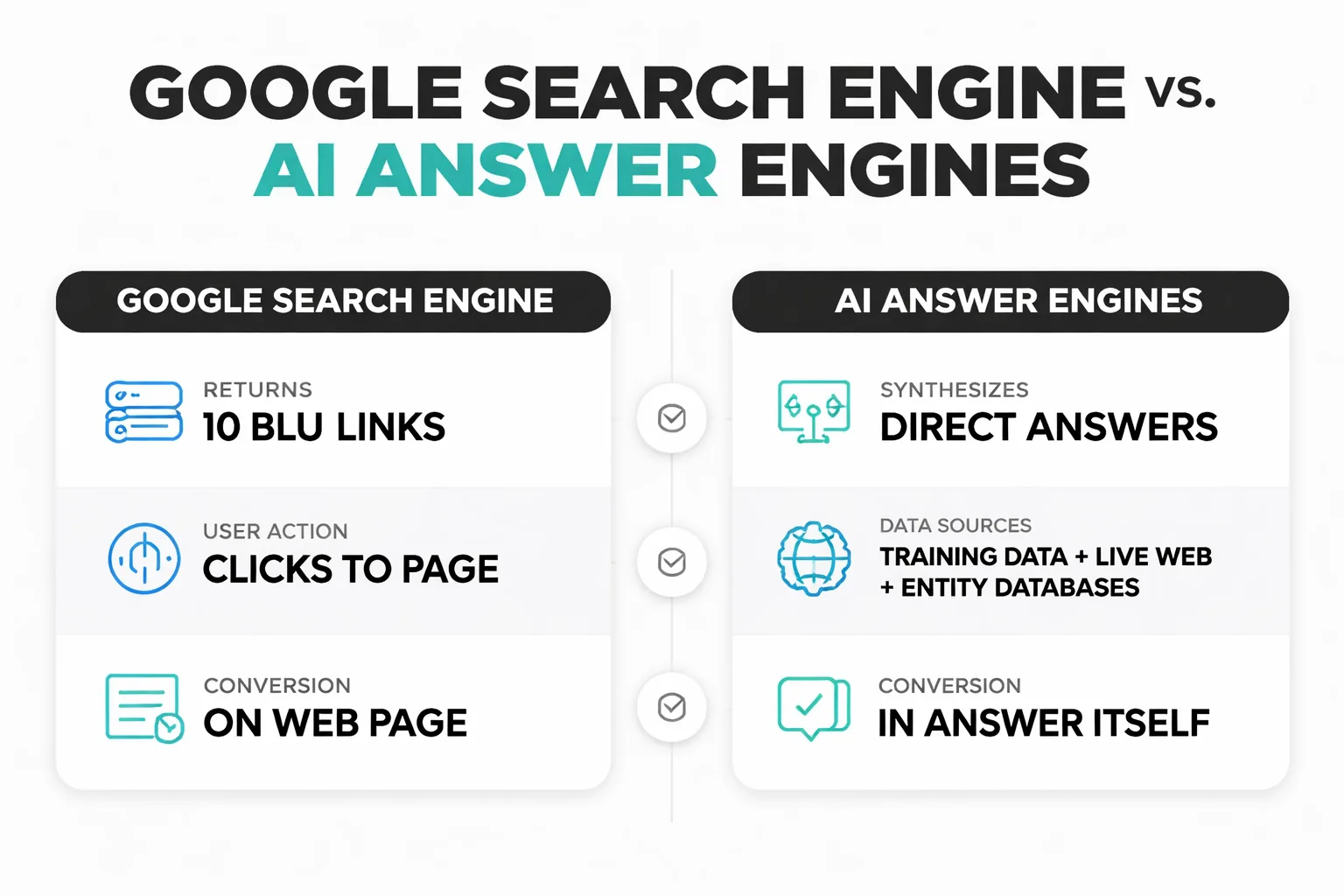
Here's the structural problem: AI engines cite only 3 to 5 sources per response, according to research analyzed by Seer Interactive. If your brand isn't one of those 3 to 5, you don't exist in that answer. There's no page-two consolation prize. No "also consider" list. You're either cited or invisible.
The Pew Research Center found that Google users are less likely to click links when an AI summary appears. And research from Digital Applied projects AI search traffic could hit 40% by 2027. The clicks that remain are concentrated among the handful of brands that AI engines choose to cite. Everyone else is fighting for scraps.
In my own experience working with ai and search engine optimization strategies, the most dangerous thing about AI invisibility is that it's silent. When you lose a Google ranking, you see it in Search Console. Traffic drops, impressions fall, you get an alert. When you lose AI visibility, nothing tells you. No dashboard flashes red. Your competitor gets the recommendation, the user never clicks through to your site, and you don't even know the conversation happened. You're losing deals to brands you've never heard of, in prompts you've never tested.
That silence is the core problem. And it's why I'm writing this.
Let me give you a concrete example of how this plays out. A SaaS company I worked with ranked in the top three Google results for "best inventory management software for ecommerce." They'd held that position for two years. Their traffic was steady. Their pipeline was predictable. Then, in a single quarter, their demo requests dropped 30%. No Google ranking change. No algorithm penalty. No competitor outranked them. What happened was that their prospects started asking ChatGPT and Perplexity for recommendations instead of Googling. And in those AI answers, this company wasn't mentioned at all. Three competitors were. The prospect never visited their site because the AI answer was self-contained. No click meant no visit, no visit meant no demo, no demo meant no deal. By the time they noticed the pipeline dip, they'd already lost three months of pipeline.
This is the new reality of ai search engine optimization. The funnel doesn't start at your landing page anymore. It starts inside the AI answer, and if you're not in the answer, you're not in the funnel.
What Accurate AI Visibility Data Looks Like
Before you can fix your AI visibility, you need to measure it. And this is where most teams go wrong, because they measure the wrong thing.
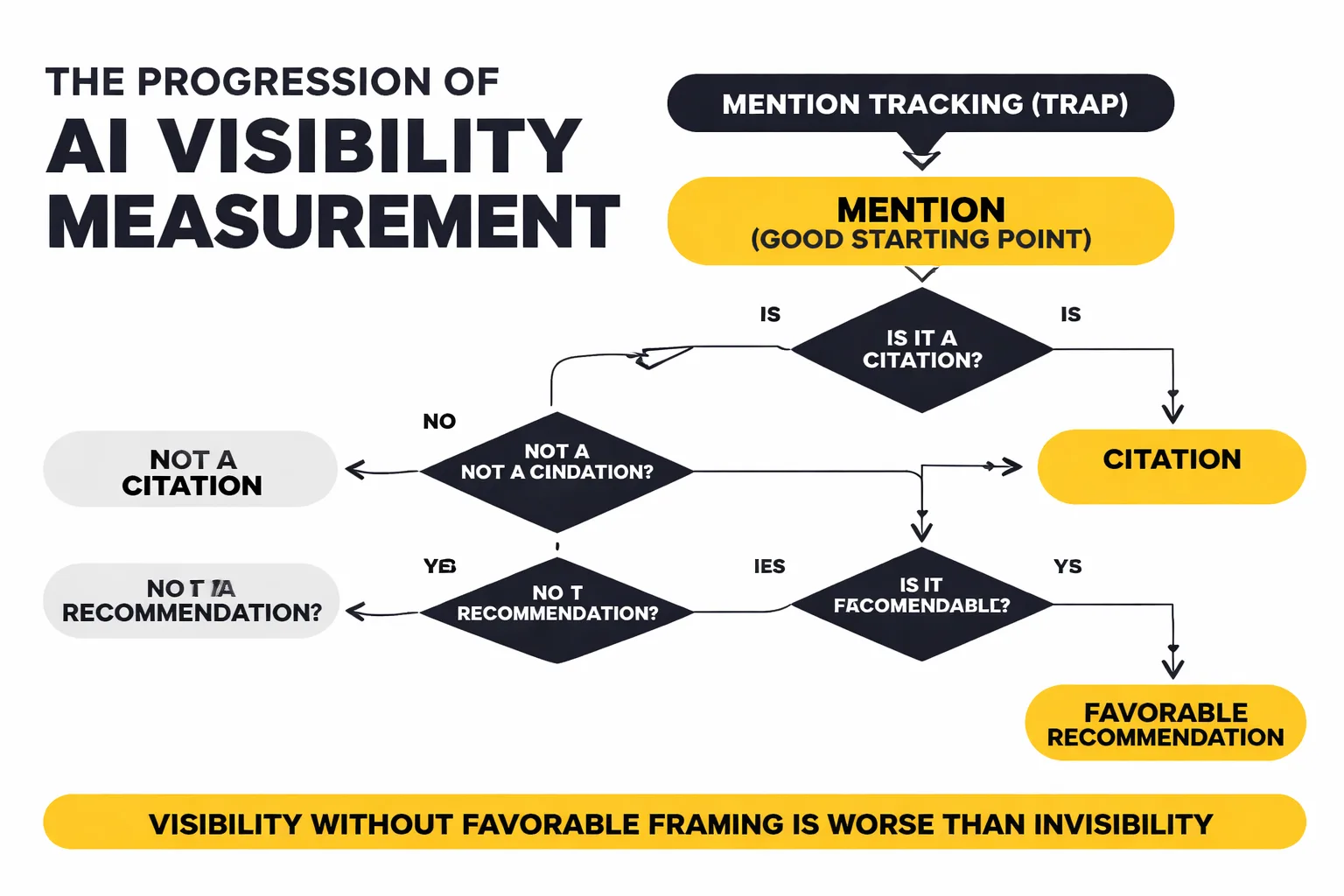
Mention tracking is the trap. You search your brand name in ChatGPT, see it mentioned, and think you're visible. But a mention is not a citation. A citation is not a recommendation. And a recommendation is not a favorable recommendation.
I learned this the hard way. My early attempts to track AI visibility focused on raw mention rate, thinking more mentions equaled more pipeline. This was a significant misstep. An AI could mention my brand as a "good starting point" before suggesting a more advanced competitor, effectively funneling users away. The mention was technically present, but the framing was actively harmful. Visibility without favorable framing is worse than invisibility, because it creates the illusion of progress while you're losing ground.
The 2026 HubSpot State of Marketing Report defines the AI visibility score across six dimensions: platform coverage, mention frequency, citations, sentiment, consistency, and share of voice. A reliable measurement baseline needs all six, not just one. Here's what each means in practice:
Platform coverage means you're checking every major AI search surface, not just ChatGPT. Perplexity, Gemini, Claude, Google AI Overviews, Google AI Mode, and DeepSeek all use different retrieval models and training data. A brand that's cited in Perplexity might be absent in Gemini. You need per-LLM drill-down, not a single aggregate number.
Mention frequency tracks how often you appear across a set of category-relevant prompts. If you show up in 2 out of 20 prompts, your frequency rate is 10%. That's a baseline, not a goal.
Citations are different from mentions. A mention is your brand name appearing in the text. A citation is a linked source the AI explicitly attributes information to. Only 7% of U.S. ChatGPT responses include citations, according to Similarweb data referenced in tracking analysis by Gregory Druck. When you get a citation, it carries more weight than a plain mention because the AI is vouching for your content as a source.
Sentiment and framing is the dimension most tools skip. Is your brand mentioned positively, neutrally, or as a secondary option? Is your competitor listed first? The order of mentions in an AI response matters enormously, because users anchor on the first recommendation. I've seen cases where a brand was mentioned in 80% of prompts but was always listed last, behind the same two competitors. Their mention rate looked great. Their share of voice was 15%. Their first-position rate was 0%. They were technically present and functionally invisible.
Consistency means your brand appears across different phrasings of the same question. If you're cited for "best CRM for startups" but absent for "top CRM tools for early-stage companies," you have a consistency gap. AI engines don't treat prompt variations as equivalent. Different phrasings trigger different retrieval paths, and your brand might be in one retrieval path but not the other. This is why you need to test 15 to 20 prompt variations, not just 3 or 4.
Share of voice is the percentage of AI answers in your category that cite you versus competitors. This is the metric I prioritize most, because it directly reflects competitive position. If your competitor has 40% share of voice and you have 5%, you have a structural problem that content volume alone won't fix.
The GEO research paper from arXiv showed that research-backed generative engine optimization strategies can boost AI visibility by up to 40%. But that 40% lift only materializes when you're measuring accurately enough to know what's working. If your tracking is limited to searching your brand name once a week and eyeballing the results, you can't tell whether your optimization efforts moved the needle.
This is why I push teams toward a structured ai visibility tool rather than manual spot-checks. Manual checks are fine for a first pass. But they don't scale across 20 prompts across 7 AI surfaces across weekly trend lines. You need systematic tracking with the actual response text and citation sources stored behind every data point, so you can trace why you're cited (or not cited) and what changed.
How to Run a Brand Visibility Check
You don't need a platform to do a first pass. You need 30 minutes, a spreadsheet, and a set of prompts that mirror how real users ask about your category. Here's the exact process I use and recommend.
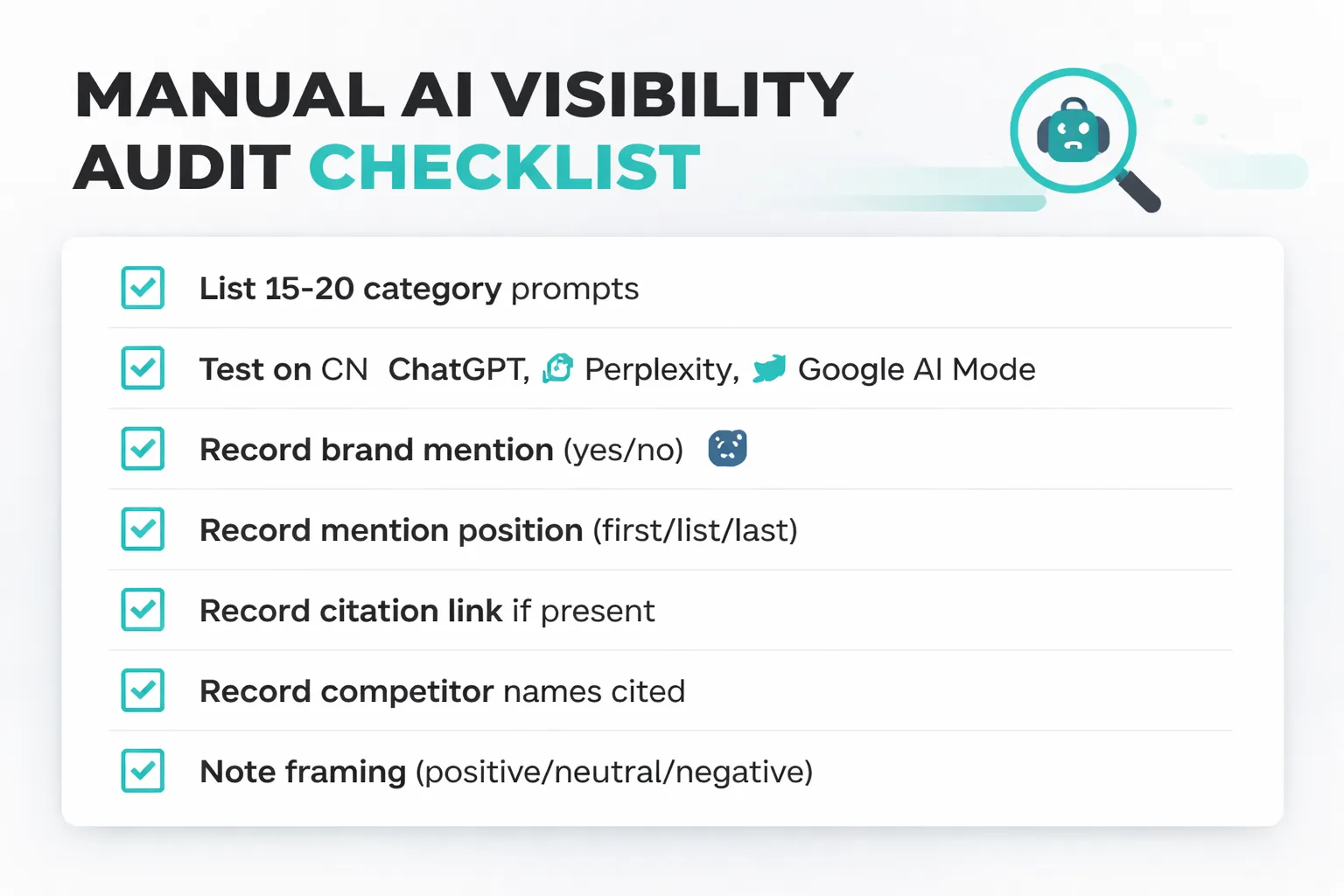
Step 1: Build your prompt set. Write 15 to 20 prompts that represent how a potential customer would ask an AI about your category. Not keyword-stuffed queries. Natural-language questions. If you sell accounting software for freelancers, your prompts should sound like: "What's the best accounting software for freelance designers?" and "How do freelancers handle taxes without an accountant?" and "Compare Wave vs. QuickBooks for solo freelancers." Include comparison prompts, category prompts, and problem-oriented prompts. The mix matters because AI engines retrieve differently depending on prompt type.
Here's a concrete prompt framework I use. Split your 15 to 20 prompts into three categories:
1. Category prompts (6-8): "What's the best [product category] for [audience]?" These test whether you appear in broad recommendation queries. 2. Comparison prompts (5-7): "Compare [your brand] vs. [competitor]" and "[Competitor A] vs. [Competitor B] for [use case]." These test how AI positions you head-to-head. 3. Problem prompts (4-5): "How do I [solve specific problem] without [common workaround]?" These test whether your brand surfaces in solution-oriented queries where the user hasn't named a product category yet.
The problem prompts are the ones most teams skip, and they're the most valuable. When a user asks "how do I track my team's AI spending across multiple tools," they're not searching for a product category. They're searching for a solution. If your brand surfaces in that answer, you've captured demand before the user even knows what to search for. That's the highest-intent placement you can get.
Step 2: Test across every major AI search surface. At minimum, check ChatGPT, Perplexity, Gemini, and Google AI Mode. Each surfaces different sources. Perplexity relies heavily on real-time web search and tends to cite recent content. ChatGPT leans more on training data unless web search is enabled. Gemini pulls from Google's index and Knowledge Graph. Google AI Mode synthesizes across the full Google ecosystem. If you only check ChatGPT, you're seeing maybe 20% of the picture.
You can use our free ChatGPT AI visibility checker and Perplexity AI visibility checker to streamline this step. They're built to standardize the prompt set and surface the response text, citations, and competitor mentions in one view.
Step 3: Record what you find. For each prompt and each AI surface, capture five data points:
1. Is your brand mentioned? (Yes/No) 2. Where does it appear? (First recommendation, in a list, last, or only in a comparison table) 3. Is there a citation link to your site? (Yes/No, and which page) 4. Which competitors are mentioned, and in what order? 5. What's the framing? (Recommended as best option, mentioned as a budget alternative, listed as an also-ran, or actively dismissed)
This is the raw data. It's not pretty, but it tells you exactly where you stand.
Step 4: Calculate your baseline numbers. Across all prompts and all surfaces, calculate:
- Mention rate: percentage of prompts where you appear at all. Citation rate: percentage of prompts where you're a linked source. First-position rate: percentage of prompts where you're the first brand mentioned. Share of voice: your mentions divided by total brand mentions (yours plus competitors)
If your mention rate is below 20% across category prompts, you have a severe visibility problem. If it's above 50% but your first-position rate is under 10%, you're present but poorly positioned. Both require different fixes.
Step 5: Check your entity presence. This is the step most guides skip, and it's the one that matters most for long-term visibility. Go to Wikidata and search for your brand. If you don't have a Wikidata entry, AI engines have no structured entity to ground their references to. Check Google's Knowledge Graph by searching your brand name on Google and looking for a knowledge panel. If there's no panel, Google doesn't recognize you as a distinct entity.
I've seen brands with strong backlink profiles and good organic rankings completely absent from AI answers because they had no entity presence. Their brand name appeared on thousands of pages, but no structured database confirmed they were a real, distinct entity associated with a specific category. AI engines, especially in their retrieval-augmented generation (RAG) step, prefer to cite sources that resolve to known entities. If your brand doesn't resolve, the AI skips you and cites a competitor who does.
You can also validate your site's AI-readiness with our LLMs.txt validator, which checks whether your site provides the structured guidance AI crawlers need to understand your content.
What the Data Tells You
Once you've run the visibility check, you'll land in one of four quadrants. Each requires a different response.
Quadrant 1: Absent entirely. Your brand doesn't appear in any AI answers for category-relevant prompts. This is the most common outcome for mid-market B2B companies. The fix isn't more blog posts. The fix is entity grounding. Create a Wikidata entry. Ensure your Wikipedia page (if you have one) is accurate and well-sourced. Build internal linking structures that clearly define what your brand does and what category it belongs to. Then publish content that AI engines can cite: comparison guides, how-to articles, and category overviews that are structured for extraction, not just for reading.
Quadrant 2: Present but poorly positioned. Your brand appears but never first. Competitors consistently outrank you in AI recommendations. The fix here is citation source building. AI engines cite the same 3 to 5 domains repeatedly for a given topic. You need to identify which domains those are (your cited-source leaderboard shows this) and get your brand mentioned on those domains. Not guest posts. Not press releases. Actual mentions in actual content that AI engines retrieve during generation.
Quadrant 3: Present but wrong framing. This is the most insidious quadrant. Your brand is mentioned, but the AI positions you as a budget option, a starter tool, or a secondary choice before recommending a competitor. I've been here, and it's frustrating because the raw mention data looks like progress. The fix is narrative control. You need content that establishes your brand's positioning in the terms you want AI engines to repeat. If you want to be known as the most advanced option, your content needs to consistently use language that frames you that way, and that content needs to be on the domains AI engines actually retrieve.
Quadrant 4: Present, well-positioned, and cited. Congratulations, but don't get comfortable. AI visibility is not a set-and-forget metric. Training data updates, retrieval source changes, and competitor content pushes can shift citations within weeks. You need ongoing monitoring with weekly trend lines to catch declines early.
The arXiv GEO research demonstrated that specific optimization strategies, including citing sources inline, using relevant statistics, and adding quotation-friendly phrasing, measurably increased AI visibility. These aren't guesses. They're tested techniques. But they only work if you apply them to the right gaps, which means you need to know which quadrant you're in first.
In my work building content systems at Meev, I've found that the gap between quadrant 1 and quadrant 4 is usually 3 to 6 months of focused effort. Not because the work is technically complex, but because most teams are doing the wrong work. They're publishing more blog posts when they should be building entity presence. They're chasing backlinks when they should be chasing citation sources. They're tracking mentions when they should be tracking framing.
The contrarian take here is this: most brands don't need more content. They need better-structured content on the right surfaces. A single well-structured entity entry on Wikidata and three mentions on the domains AI engines actually cite will move your visibility more than fifty blog posts on your own domain. I've seen this pattern repeat enough to be confident in it.
If you're evaluating whether to work with an ai search optimization agency or build the capability in-house, the question isn't about budget. It's about whether you have the diagnostic data to know what's broken. Without a baseline, any investment in content or optimization is a guess. With a baseline, every decision is grounded in evidence.
Do you know which AI engines cite your brand and which ones don't?
Why Entity Grounding Is the Missing Foundation
Here's something I keep coming back to. Every time I audit a brand that's invisible in AI answers, the root cause traces back to the same thing: the AI doesn't know they exist as a distinct entity.
Entity grounding is the process of establishing your brand as a recognized, resolvable entity in the structured databases that AI engines reference during generation. Think of it this way: when an AI generates a recommendation, it doesn't scan the open web in real time for every possible brand that might fit the query. It retrieves from a compressed set of known entities that have been grounded through training data, knowledge graphs, and retrieval sources. If your brand isn't in that compressed set, it's not in the answer. Period.
The Microsoft Learn documentation on grounding data design for AI workloads describes grounding as the process of connecting AI models to specific, authoritative data sources that improve accuracy and relevance. In the context of brand visibility, your grounding sources are: Wikidata, Google's Knowledge Graph, Wikipedia (if you have a page), your own structured content (schema markup, entity descriptions), and the high-authority third-party domains that consistently mention your brand in category context.
When I check a brand's entity presence, here's what I look for:
1. Wikidata entry exists and is complete. Not just a stub. A real entry with a description, industry classification, official website URL, and key properties that associate your brand with its category. 2. Google Knowledge Panel appears for brand name search. If Google doesn't show a knowledge panel when you search your own brand name, Google hasn't established your entity. This is a red flag for Gemini and Google AI Mode visibility too, since they draw from the same Knowledge Graph. 3. Schema markup on your site includes Organization schema. Not just Article schema or BreadcrumbList. You need Organization schema with your brand name, description, URL, logo, and sameAs links pointing to your Wikidata entry, Wikipedia page, and official social profiles. This creates the connective tissue that lets AI crawlers resolve your brand across surfaces. 4. Consistent NAP-C (Name, Address, Phone, Category) across the web. If your brand is described as "marketing platform" on some sites and "CRM software" on others, AI engines get confused about which category to associate you with. Consistency matters.
I've seen the entity grounding gap play out specifically in ecommerce. Brands selling on their own Shopify stores with no Wikidata presence, no schema markup beyond product schema, and no third-party entity references are functionally invisible to AI shopping recommendations. The concept of ecommerce GEO and agentic commerce is becoming real as AI agents start making purchasing decisions on behalf of users. If your product data and entity presence aren't structured for AI retrieval, you're not just invisible in search. You're invisible in the agent layer where transactions actually happen.
Ben Salomon frames AI visibility as a new "commerce signal layer" requiring audit, connective tissue building, agent deployment, and citation cultivation. I agree with that framing, and I'd add that the connective tissue piece is where most brands fail. They jump straight to content production without building the entity foundation that makes content retrievable.
What an AI SEO Agent Actually Does
There's a lot of buzz about ai search engine optimization tools and the concept of an "AI SEO agent" that autonomously optimizes your visibility. Let me be specific about what this means in practice, because the term is being used loosely.
An AI SEO agent, in the way I use the term, is a system that combines three capabilities: diagnosis (tracking where you're cited and where you're not), decision (identifying the specific gaps that would move visibility if filled), and execution (producing the content, entity updates, or outreach that fills those gaps). The concept of agentic SEO is that these three steps run in a closed loop without manual handoffs between tools.
In my experience, most platforms that claim to be AI SEO agents only do step one. They track mentions. They show you a dashboard. They stop there. The diagnostic data is useful, but without the decision and execution layers, you still need a human to interpret the gaps, plan the content, write it, publish it, and track whether it moved the needle. That's not an agent. That's a tracker with extra steps.
A real agentic SEO workflow looks like this: the system identifies that you're cited in 15% of prompts for "best project management tool" but your competitor is cited in 65%. It identifies that the gap is concentrated in comparison prompts where the AI cites a specific review site you're not mentioned on. It drafts an outreach pitch to that site's editor, grounded in your knowledge base. It also identifies that you lack a Wikidata entry and drafts one for your review. It generates a comparison article structured for AI extraction, runs it through a quality firewall to ensure it meets the generative engine optimization criteria, and publishes it to your CMS. Then it tracks whether your citation rate moves over the next two weeks.
That's the closed loop. Diagnosis to decision to execution to measurement. No manual handoffs. No spreadsheet tracking. No guessing whether the work you did last week is working.
The arXiv GEO research provides the academic foundation for why specific content strategies boost AI visibility. The research found that adding relevant statistics, citing authoritative sources, and using quotation-friendly phrasing increased content visibility in AI-generated responses by up to 40%. An AI SEO agent operationalizes these findings by applying them systematically across your content pipeline rather than relying on individual writers to remember the rules.
I want to be clear about something, though. The agent doesn't replace human judgment. In my work building content systems, I've found that the best results come from an agent that drafts and a human that approves. The system identifies the gap, proposes the fix, and produces the draft. The human reviews it, edits if needed, and approves it for publication. This is how we built the workflow at Meev, and it's the pattern I recommend to any team evaluating agentic SEO tools. Full autonomy is a recipe for AI slop. Guided autonomy with a quality gate is the pattern that actually produces results.
What to Look for in an AI Visibility Platform
If you've run the manual check and decided you need systematic tracking, here's what I'd look for in a platform. I'm writing this from the perspective of someone who builds one, so I'll be specific about what matters and what doesn't.
Per-LLM drill-down, not aggregate scores. A single "AI visibility score" that averages across all AI engines is useless. You need to see that you're cited in 45% of Perplexity prompts but 5% of Gemini prompts. Different engines, different retrieval models, different fixes. An aggregate score hides the gaps that matter.
Actual response text stored behind every data point. When your mention rate drops from 40% to 25% in a week, you need to know why. Was it a specific prompt where you disappeared? Was it a specific LLM? Did a competitor publish content that displaced you? Without the stored response text and citation sources, you're guessing. With them, you can trace the cause.
Citation source identification. The platform should tell you which domains AI engines cite most for your topics. This is your hit list for outreach and content placement. If G2 and Capterra are the top-cited domains for your category, you need to be mentioned on G2 and Capterra. Not in a guest post on a random marketing blog.
Competitor benchmarking. You need to see your share of voice alongside your competitors. Not just "are you cited" but "who else is cited, how often, and in what position." A generative engine optimization agency or platform that can't show you competitive share of voice is giving you half the picture.
Trend tracking with alerting. Weekly trend lines minimum. Alerts on significant changes. If your citation rate drops 15 points in a week, you should know before your pipeline does.
Mention position tracking. Not just "mentioned yes/no" but "mentioned first, in a list, or last." Position matters. First-position mentions drive the majority of user action. Last-position mentions are barely better than absence.
Outreach workflow integration. This is the differentiator between a tracking tool and a closed-loop platform. If the platform identifies citation gaps and the domains that could fill them, it should also help you reach out to those domains. Contact discovery, email verification, and pitch drafting grounded in your knowledge base. Without this, you're tracking the problem but not solving it.
The HubSpot AI visibility score guide outlines the measurement framework. The platforms that operationalize that framework with diagnosis, execution, and measurement in one loop are the ones worth investing in. Everything else is a dashboard.
FAQ: AI Visibility Measurement Questions
How do I increase AI visibility today?
Start with entity grounding. Create a Wikidata entry for your brand, ensure your Google Business Profile is complete, and verify your site is crawlable by AI engines using an llms.txt file. Then publish one piece of content structured for AI extraction: a comparison guide or category overview with clear headings, inline citations to authoritative sources, and quotation-friendly phrasing. These three steps take a weekend and move the needle more than any other quick action.
How do I boost my AI citation in 2026?
Focus on source diversity. AI engines cite 3 to 5 domains per response, and they prefer domains they've cited before. Identify which domains are cited for your topic using a cited-source leaderboard, then get your brand mentioned on those domains through contributed content, expert quotes, or partnerships. Inline citations in your own content also help: the GEO research paper found that citing sources within content measurably increases the likelihood of AI engines citing that content back.
How to be recommended by AI?
AI engines recommend brands that appear consistently across multiple independent sources with consistent framing. To be recommended, you need: (1) entity presence in structured databases like Wikidata, (2) mentions on the 3 to 5 domains AI engines cite most for your category, (3) content on your own site that uses the language you want AI engines to repeat, and (4) consistent positive sentiment across those sources. It's a consistency game, not a volume game.
What's the difference between AI visibility and traditional SEO ranking?
Traditional SEO ranks pages. AI visibility ranks entities. Google decides which page best answers a query. AI answer engines decide which brand best fits a concept. You can rank #1 for "best project management tool" and still be absent from ChatGPT's recommendation, because ChatGPT isn't reading your page. It's synthesizing what the internet collectively says about your brand. AEO vs. SEO is not an either-or choice. It's a both-and, but the strategies are different.
How often should I check my AI visibility?
Weekly. AI engines update their retrieval sources and training data continuously. A citation you have today can disappear next week if a competitor publishes better-structured content on a domain the AI prefers. Monthly checks are too slow. Daily checks are overkill for most teams. Weekly trend tracking with alerting on significant changes is the sweet spot for small teams that need to stay visible without dedicating a full-time role to it.
Do I need a platform to track AI visibility, or can I do it manually?
You can do a first pass manually in 30 minutes using the process in this article. But manual tracking doesn't scale past 20 prompts across 7 AI surfaces. If you're serious about AI visibility as a channel, you need systematic tracking with stored response text, citation sources, and trend lines. The question isn't whether to use a platform. It's whether your business depends on being found in AI answers. If it does, manual tracking will leave you blind to shifts that happen between checks.
The window for first-mover advantage in AI search optimization is open right now. AI-referred sessions grew 527% year-over-year, and 58% of marketers report those visitors convert at higher rates than traditional organic traffic. The brands that invest in diagnosis and entity grounding today will be the ones AI engines cite tomorrow. The brands that wait will wonder why their pipeline dried up.
Don't wait for the competitor's case study. Run your visibility check this week, find your quadrant, and start closing the gap. The best accurate data platform for ai search optimization is the one that tells you the truth about where you stand, then helps you move.
About the Author
Judy Zhou, Founder
Judy Zhou leads content strategy at Meev, where she oversees AI-driven content research and publishing for hundreds of brands. With a background in SEO and editorial operations, she focuses on building content systems that rank on Google, get cited by AI search engines, and drive measurable business results.
Run a free AI visibility check across every major AI search surface and see exactly where your brand is cited, where it's missing, and what to fix first.