

By Judy Zhou, Founder
Key Takeaways
- AI brand visibility depends on three layers—entity confidence, source authority, and retrieval relevance—with 68% of US Google searches now ending without a click.
- Wikipedia supplies 22% of ChatGPT's training data and 26-48% of its top-10 citations, rendering brands without Wikidata entries functionally invisible to generative engines.
- When AI Overviews appear, the top organic result loses 58% of its click-through rate, forcing brands to optimize for inclusion in the summary itself.
- Mention rates that swing from 40% on Perplexity to 0% on ChatGPT reveal exactly which recognition layer is failing rather than indicating broken tools.
When Google first introduced Knowledge Graph in 2012, most SEOs dismissed it as a cosmetic feature. A sidebar curiosity that surfaced facts about celebrities and landmarks. Few recognized it as the early infrastructure for something far larger: a machine-readable map of which entities the web considers authoritative. A decade later, that same graph logic sits at the heart of how large language models decide which brands to cite in AI-generated answers. Understanding how we got here explains exactly why AI brand visibility works the way it does today.
AI brand visibility is determined by three interacting layers: entity confidence (how well the model recognizes your brand as a distinct entity), source authority (which third-party pages corroborate your claims), and retrieval relevance (how well your content matches the prompt's informational need). A SparkToro study found that 68% of US Google searches ended without a click in early 2026, meaning brands that don't appear in the AI summary itself have already lost the user. Wikipedia accounts for 22% of ChatGPT's training data and represents 26-48% of its top-10 citation share, which is why brands without Wikidata entries are functionally invisible to generative engines. When AI Overviews appear, the top organic result loses roughly 58% of its click-through rate.
In my work auditing content ops at Meev, I see the same confusion every week. Teams track their brand mentions across AI engines, see wild variance (cited 40% on Perplexity, 0% on ChatGPT), and assume the tools are broken. They're not broken. The variance is the signal. It tells you exactly which layer of entity recognition is failing.
Why Brand Mention Rate Varies So Much Across AI Engines
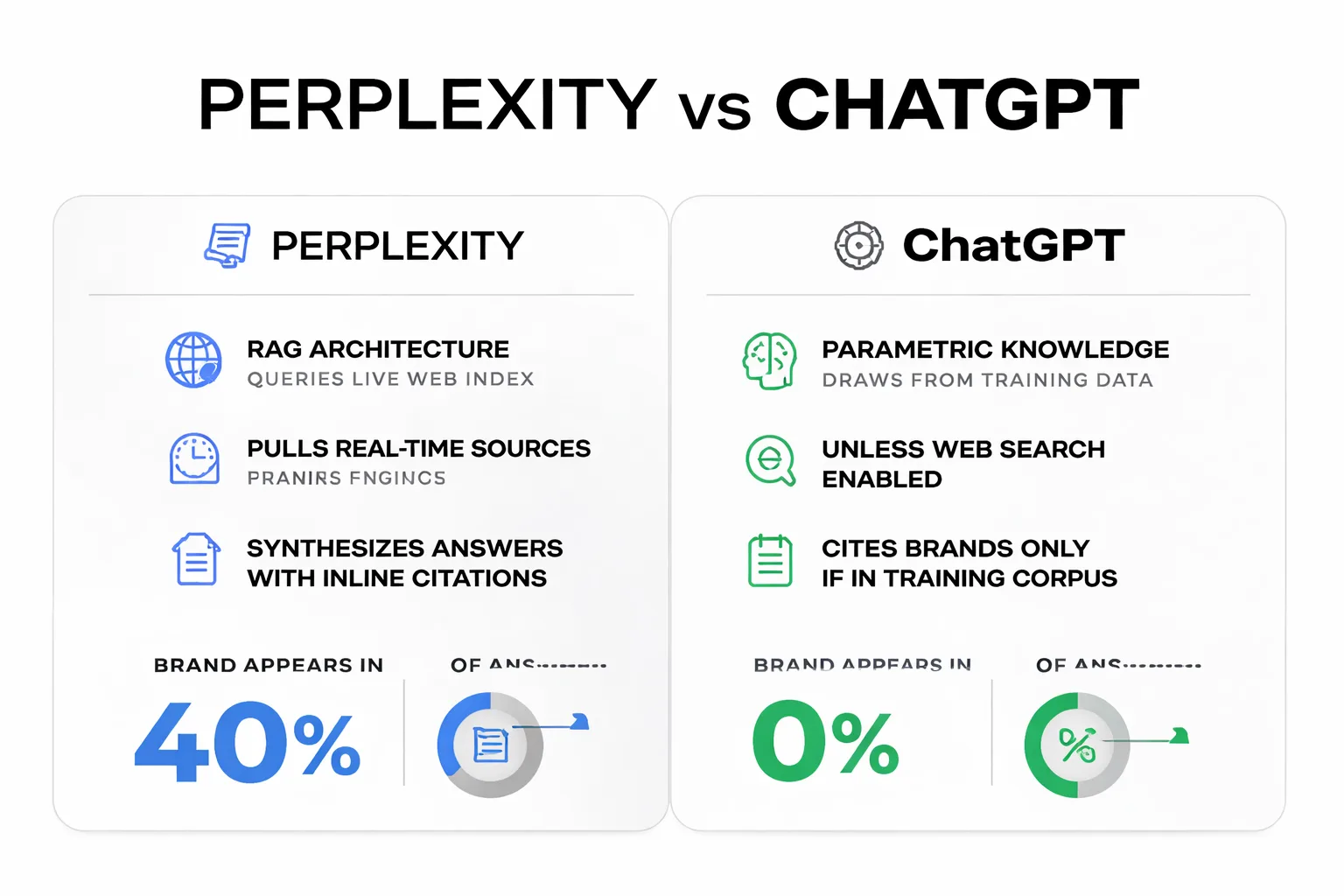
The same brand can appear in 40% of Perplexity answers and zero percent of ChatGPT responses for the same query set. This isn't a tracking error. It's a structural difference in how each engine retrieves and weights information.
Perplexity runs on a retrieval-augmented generation (RAG) architecture. It queries a live web index, pulls real-time sources, and synthesizes answers with inline citations. If your brand is mentioned on high-authority pages that rank for the target query, Perplexity can find and cite you even if its underlying language model has never "heard" of you. The Perplexity AI visibility checker we built tracks exactly this: which live web sources are feeding your brand into answers.
ChatGPT operates differently. Its default mode relies on parametric knowledge, meaning it draws from its training data unless web search is explicitly enabled. If your brand wasn't well-represented in the training corpus (which, remember, is 22% Wikipedia and heavily weighted toward established publishers), the model simply doesn't know you exist. No amount of great on-page SEO will fix that in the short term.
Then there's Google AI Overviews, which blends both approaches. It uses Google's Knowledge Graph (built from structured data, Wikidata, and years of web crawling) plus real-time retrieval from top-ranking pages. When AI Overviews appear, users click organic results only 8% of the time versus 15% without them, according to data highlighted in the Hello Retail GEO guide. That click-through collapse means being cited inside the AI summary is worth dramatically more than ranking #1 organically beneath it.
The variance puzzle comes down to three factors interacting: source indexing (which pages the engine can actually retrieve), entity confidence (whether the model recognizes your brand as a distinct, defined entity), and prompt phrasing (small wording changes trigger entirely different retrieval paths). A user asking "best CRM for startups" gets a different answer than "what's a good CRM" because the first prompt triggers comparison-style retrieval while the second triggers definitional retrieval. Your brand might be cited in one and absent from the other.
I've watched teams waste months optimizing on-page schema when the real problem was that no third-party source had ever defined their brand. The engine can't recommend what it can't define.
What AI Visibility Tools Actually Measure
Most AI visibility tools surface a single metric: brand mention rate. How often does your brand appear in AI-generated answers? It's the easiest thing to measure, which is why every tool leads with it. It's also the most misleading number in the entire space.
There are three distinct layers of measurement, and most platforms only show you the first.
Layer 1: Mention rate. How often does your brand appear in responses to a set of prompts? This is a raw count. It tells you nothing about position, framing, or whether the mention was positive. A brand mentioned as "a budget alternative to [competitor]" scores the same as one recommended as "the best option for [use case]." In my experience, teams optimize for this number, watch it climb, and wonder why pipeline doesn't move. It's because mentions without favorable framing don't convert.
Layer 2: Citation source. When an AI engine cites your brand, which page does it link to? Is it your homepage, a blog post, a G2 review page, a Reddit thread, or a Wikipedia article? This layer matters because it reveals which sources the engine trusts for your category. I've seen brands get cited 30% of the time but always through a competitor's comparison page. The mention exists, but the narrative control belongs to someone else. The Search Engine Journal analysis on AI visibility tracking makes this point directly: brands are tracking visibility but many are measuring the wrong things.
Layer 3: Entity confidence. This is the deepest layer and the hardest to measure. It asks: does the model actually understand what your brand is, or is it pattern-matching on surface-level mentions? High entity confidence means the model can define your brand, categorize it, and recommend it contextually. Low confidence means you appear only when someone searches for you by name. The difference is like being a noun in the language versus being a proper noun the model had to look up.
The Semrush finding that only 6% to 27% of brands mentioned in AI responses are also cited as the source illustrates this gap perfectly. Being mentioned and being cited as an authority are different achievements. The first means the model has heard of you. The second means it trusts you.
In my work at Meev, I've pushed our tracking architecture to measure all three layers because decisions made on layer 1 alone are actively dangerous. You end up celebrating mentions that position your brand as a secondary option, or chasing volume in engines where your audience doesn't actually search.
The Signals That Move AI Brand Visibility
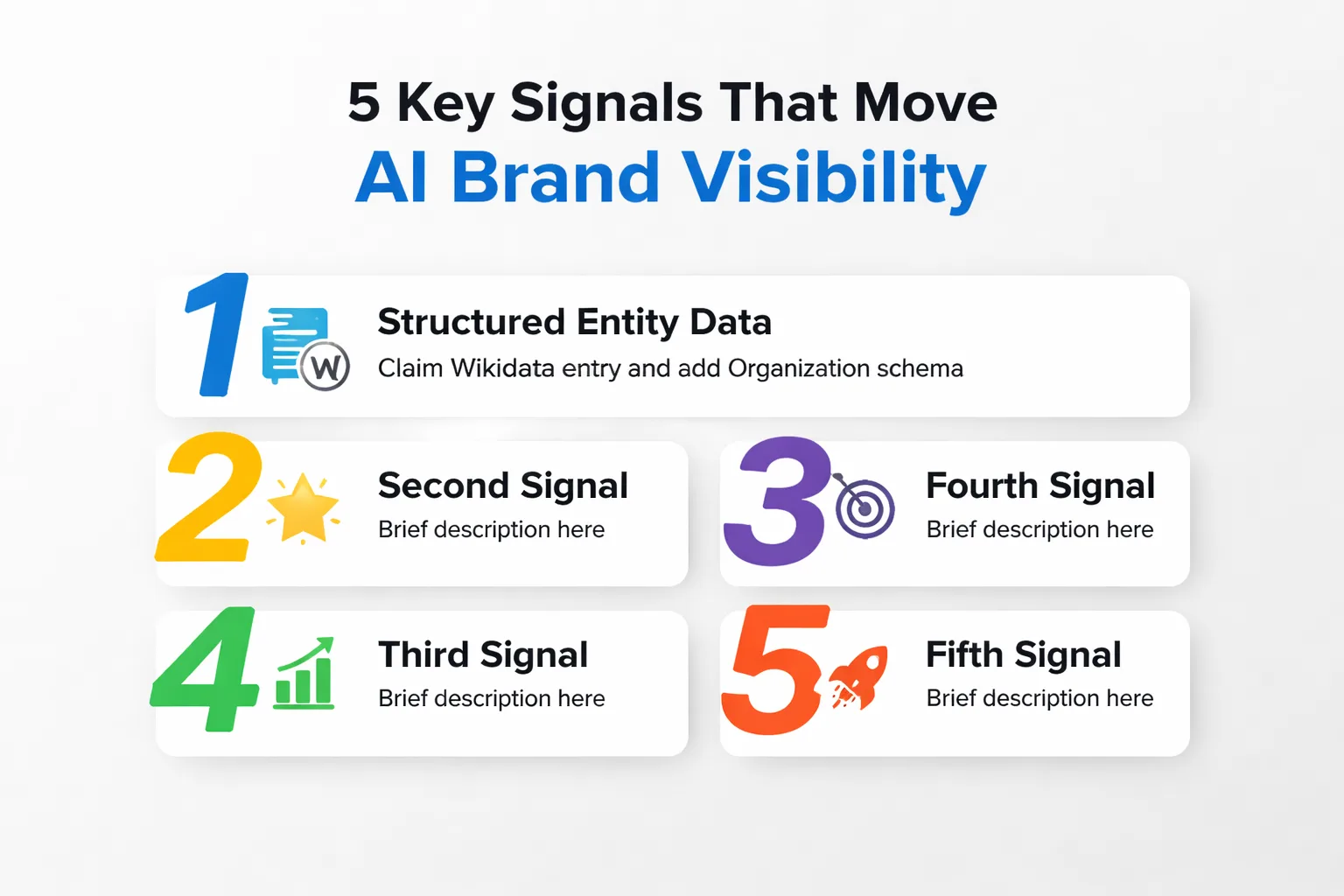
Here's where most content about AI optimization goes wrong. It tells you to "create great content" and "build authority" as if those are actionable instructions. They're not. Let me break down the five concrete signals that actually move whether an LLM cites your brand, each with a specific action you can take this week.
Structured Entity Data
Your brand needs to exist as a defined entity in the data sources LLMs actually consult. That means a Wikidata entry with a QID, a Wikipedia article (if you meet notability thresholds), and Organization schema on your site that matches the entity definition. Wikipedia represents 12-13% of all ChatGPT citation events, on par with Reddit at roughly 12%. If you're not in Wikidata, you're asking the model to define you from scattered web mentions. That's like asking someone to describe a person they've only seen in a crowd.
Action: Claim or create your Wikidata entry. Ensure your Organization schema properties (name, sameAs, url, logo, founder, foundingDate) match exactly across your site and knowledge graph entries. Use the LLMs.txt validator to check whether your site is exposing the right signals to AI crawlers.
Third-Party Citations
LLMs triangulate brand understanding from multiple sources. Your own site is one voice. Wikipedia, G2, Reddit, TechCrunch, and industry publications are the chorus. The model's confidence in your brand increases proportionally with the number and authority of independent sources that define and discuss you. I learned this the hard way: my team spent months perfecting on-site schema and entity grounding, only to realize that Perplexity was still citing competitors because those competitors had broader third-party coverage.
Action: Audit which sources AI engines cite for your category using a cited-source leaderboard. If competitors own citations on G2 and Reddit and you don't, that's your gap. Build presence on those specific platforms with detailed, factual content (not marketing copy).
Answer-Optimized Content
Traditional SEO content is written to rank. Answer-engine optimized content is written to be extracted. The difference matters: ranking content can be 2,000 words of narrative prose. Extractable content is structured with clear claims, specific numbers, and quotable sentences that an LLM can pull directly into a response. Adding citations, quotations, and statistics to your content can lift AI visibility by up to 40%, according to research cited in the Hello Retail GEO guide.
Action: Restructure your highest-traffic pages to include bolded claim sentences, statistic-backed assertions, and FAQ blocks. Every page should have at least one sentence that works as a standalone answer to "What is [your brand]?" or "Why choose [your product]?" Our answer engine optimization framework breaks this down further.
Knowledge Graph Presence
This is distinct from structured data on your site. Knowledge graph presence means your brand entity exists in the graphs that AI engines actively query: Google's Knowledge Graph, Wikidata, and increasingly specialized graphs like Amazon's Product Graph. Without a Wikidata QID, AI shopping systems can't recommend your products. In Q1 2026, AI-referred traffic to US retail sites grew 393% year-over-year and converted 42% better than traditional channels, per data from Hello Retail. Brands absent from knowledge graphs are losing both discovery and high-intent traffic.
Action: If you sell physical products, ensure your product catalog is structured with schema that includes brand, GTIN, and category attributes. If you're a B2B service, focus on Wikidata and industry-specific directories that LLMs are likely to scrape.
Source Authority and Domain Trust
LLMs weight citations by domain authority, just like Google's algorithm does. A mention on nytimes.com carries more entity-building weight than a mention on a random blog. This is why PR and digital outreach matter more for AI visibility than for traditional SEO. A single mention in a top-tier publication can do more for your entity confidence than fifty mentions on low-authority sites.
Action: Prioritize outreach to the specific domains that AI engines cite most for your topics. If TechCrunch shows up in 30% of AI answers for your category, that's where you need coverage. Stop chasing domain authority in the abstract and start chasing authority on the exact domains feeding AI citations.
Which AI engines are citing your competitors instead of you?
How Does Entity Grounding Actually Work?
Entity grounding is the process by which an LLM connects a brand name to a specific, well-defined entity in its knowledge base. It's the difference between the model recognizing "Notion" as a productivity tool with specific features and simply seeing the word "notion" as a common noun in context.
Grounding happens through repeated, consistent association across training data. When Wikipedia, G2, Reddit threads, TechCrunch articles, and your own site all describe your brand using similar language and categorization, the model builds a stable internal representation. That representation includes your category, key features, competitors, and use cases. When a user asks a question that touches your category, the model retrieves that representation and decides whether to cite you.
The grounding process has three stages. First, entity recognition: the model identifies your brand as a named entity (not just a word). Second, entity linking: the model connects that name to its internal knowledge graph entry. Third, entity retrieval: when a relevant query arrives, the model pulls your entity into the response. If you fail at stage one, you're invisible. If you fail at stage two, you're mentioned but undefined. If you fail at stage three, you're defined but never recommended.
Most brands fail at stage two. They're mentioned across the web, but the mentions are inconsistent. One source calls them a "platform," another calls them a "tool," a third calls them a "service." The model can't form a stable entity representation, so it falls back to citing brands with clearer definitions. Consistency in how the web describes you is more important than volume of mentions.
Let me give you a concrete example of how this plays out. Say you're a B2B analytics platform. Your homepage says "analytics platform." Your G2 listing says "business intelligence tool." A TechCrunch article from 2024 called you a "data visualization service." A Reddit thread refers to you as a "dashboard app." The LLM encounters all four descriptions and has to reconcile them. If it can't form a stable definition, it defaults to the entity with the most consistent external description. That's usually the category leader, not you.
Now compare that to a competitor who is consistently described as "a cloud-based analytics platform for mid-market companies" across Wikipedia, G2, major publications, and their own site. The model has a clear, stable entity to retrieve. When someone asks "what's a good analytics platform for mid-market companies," that competitor gets cited. You don't. Not because their product is better. Because their entity definition is clearer.
Why Do Some Brands Get Cited But Never Recommended?
This is the question that kept me up at night. You see competitors cited as "the leading option" while your brand appears as "another alternative." Both are mentions. Only one drives business.
The answer is framing bias. LLMs develop preferences based on the sentiment and context of their training data. If your brand is consistently mentioned alongside phrases like "budget-friendly" or "good for beginners," the model internalizes that positioning. When it generates recommendations, it reproduces that framing. You're not just fighting for mentions. You're fighting for the narrative around those mentions.
I initially thought that boosting raw mention rate would solve our visibility problem. It didn't. An AI can cite your brand as "a good starting point" before suggesting a "more advanced" competitor. That mention doesn't just fail to help. It actively funnels users away from you. Six out of ten consumers have already replaced traditional search engines with generative AI, which means the framing AI engines use to describe your brand is becoming the primary narrative your prospects encounter.
The fix isn't more mentions. It's controlling the context of those mentions. That means actively shaping how third-party sources describe you. If G2 categorizes you as "budget," every AI engine that scrapes G2 inherits that label. Fix it at the source.
Think of it this way. Each third-party source that mentions your brand is feeding the LLM a training signal. If the signal is "reliable but basic," the model learns to position you as the entry-level option. If the signal is "innovative and enterprise-ready," the model positions you as the advanced choice. You're not just building presence on these platforms. You're writing the label the AI will attach to your brand for years. Every G2 review, every Reddit comment, every press mention is a training signal. Treat them accordingly.
How to Use an AI Visibility Platform to Close the Gap
Knowing the signals is half the battle. Acting on them systematically is where most teams stall. Here's the diagnostic-to-content loop I use, which any team can replicate with the right AI SEO tool.
Step 1: Run a Brand Audit Across All AI Surfaces
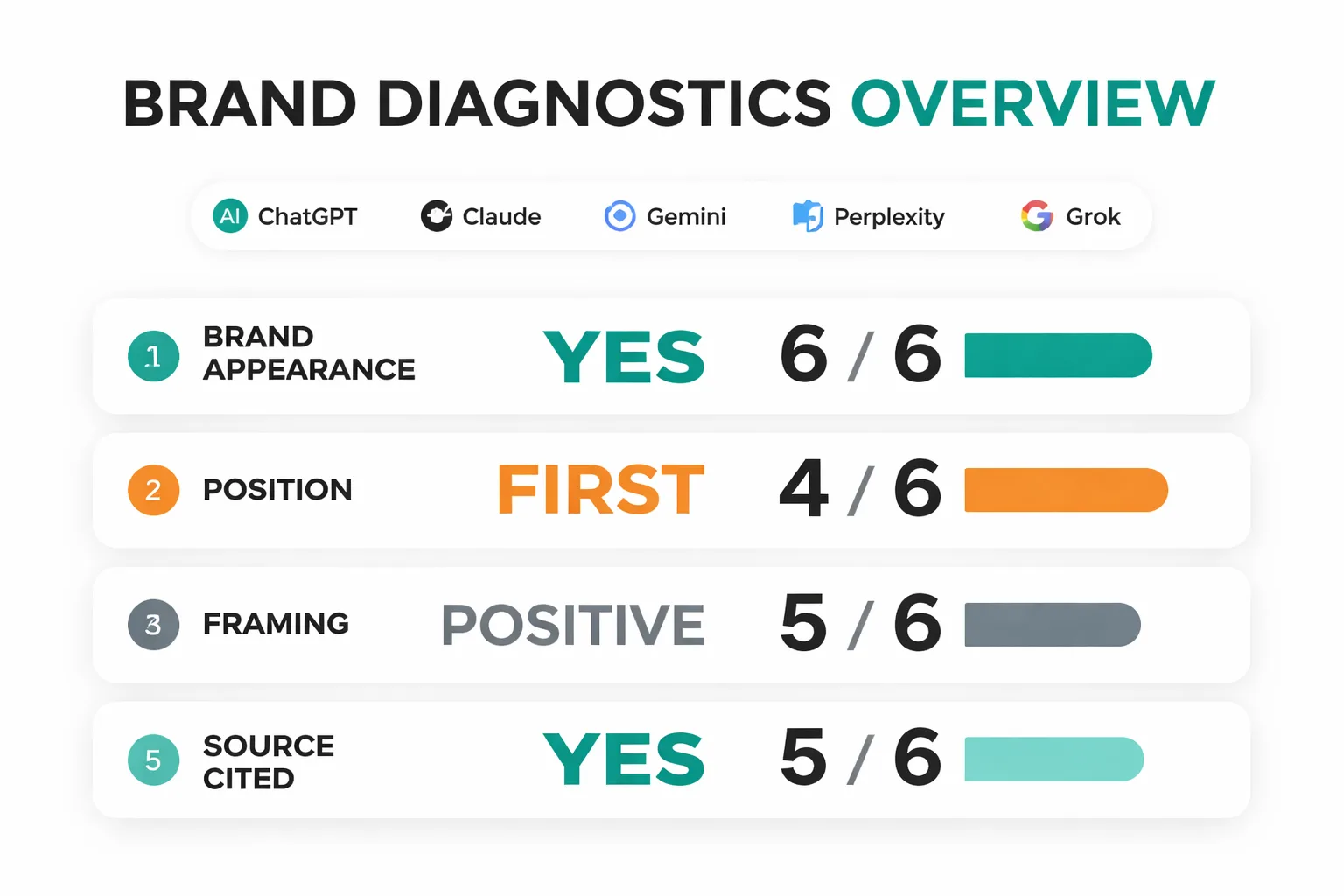
Start with a comprehensive audit. Run your brand name and category-relevant prompts across every major AI search surface: ChatGPT, Claude, Gemini, Perplexity, Grok, Google AI Overviews, and AI Mode. For each prompt, capture four data points: does your brand appear, where in the response (first, middle, last), what's the framing (positive, neutral, negative), and what source does the engine cite.
This baseline tells you exactly where you stand. Most teams are surprised by at least one finding. Either they're cited more than expected on an engine they weren't watching, or they're completely absent from an engine where their audience actively searches.
A practical example: I worked with a SaaS company that was spending heavily on Google Ads but had zero presence in Google AI Overviews for their top five commercial keywords. Their organic rankings were fine (positions 3-7), but AI Overviews were summarizing the topic and citing two competitors exclusively. Every time an AI Overview appeared, which was roughly 60% of the time for those keywords, they lost the click entirely. The audit revealed the problem wasn't their content quality. It was that the two cited competitors had Wikipedia entries and strong G2 presences, while they had neither. The AI engine had higher entity confidence in the competitors because it could define them.
Step 2: Identify Which Prompts Cite Competitors Instead
Compare your presence against competitors prompt by prompt. Where are they cited and you're not? This gap analysis reveals two things: which topics AI engines associate with your category, and which competitors own the entity space for those topics.
The prompts where competitors appear and you don't are your highest-priority opportunities. Each one represents a real user question where the AI engine has decided your competitor is the answer and you don't exist. Closing those specific gaps is more valuable than broadly increasing mention rate.
Step 3: Find the Source Pages Powering Competitor Citations
For every prompt where a competitor is cited, trace the citation back to its source. Which page did the AI engine quote or reference? Is it a blog post, a review site, a Wikipedia article, a Reddit thread? This is your target list.
If Perplexity cites a competitor and links to their G2 review page, you need a G2 presence. If ChatGPT recommends a competitor based on a TechCrunch article from two years ago, you need coverage on TechCrunch. The sources powering citations tell you exactly where to build presence.
Step 4: Publish Content That Competes for Those Citations
This is where the loop closes. You've identified the gaps, found the sources, and now you need content that AI engines will extract and cite. This content needs to be structurally different from traditional SEO content. It needs clear, quotable claims. It needs statistics with named sources. It needs FAQ blocks that directly answer the prompts you're targeting.
The AEO vs SEO distinction matters here. SEO content ranks by accumulating authority. AEO content gets cited by being extractable. Your content strategy needs to serve both, but the extractability piece is what most teams miss.
When we publish content through Meev, every article goes through a 16-dimension quality firewall before it reaches the CMS. That's not a luxury. It's a necessity because AI engines penalize content that makes factual claims it can't verify. One unsupported statistic can tank your entity confidence for months.
Step 5: Monitor and Iterate
AI visibility isn't a one-time fix. Models update, training data shifts, and competitor activity changes the landscape weekly. Run your audit on a rolling basis. Track which prompts you've gained citations on and which you've lost. When you lose a citation, trace it back to the source and figure out what changed.
The enterprise AI rank tracker approach is to treat AI visibility like rank tracking. You wouldn't check your Google rankings once and call it done. AI visibility demands the same cadence.
When Does Agentic SEO Enter the Picture?
Agentic commerce is coming faster than most brands realize. Consumer adoption of agentic shopping is expected to jump from 19% to 46% by end of 2026, according to Braze's retail report. Only 10% of consumers are willing to let agents operate fully independently, which means the agents are still making recommendations, not autonomous purchases. That distinction matters because it means your AI visibility directly shapes what agents recommend to human buyers.
The problem is that no primary research yet quantifies how agentic commerce optimizations specifically impact LLM citations. The concept is real, the adoption curve is steep, but the measurement framework doesn't exist yet. 71% of marketing leaders say AI agents have already weakened their ability to engage customers directly, per Braze. That's an engagement problem, not a citation problem, but they're related. If agents are mediating the customer relationship, the brand those agents recommend wins.
Agentic SEO extends traditional AI visibility into the agent layer. It asks: when an AI agent is tasked with finding the best solution in your category, does it recommend you? The answer depends on the same three layers I described earlier: entity confidence, source authority, and retrieval relevance. The difference is that agents have stricter extraction requirements. They need structured data, clear pricing, and actionable specifications. Pretty prose doesn't help an agent. Structured entity data does.
Gartner projects that 33% of enterprises will include agentic AI by 2028, up from less than 1% today (Gartner). The brands that build entity confidence now will be the ones agents recommend when that adoption curve hits. The ones that wait will be invisible to the agent layer entirely.
Let me make the agentic commerce stakes concrete. When a user asks an AI agent to "find me a project management tool under $20 per user that integrates with Slack," the agent doesn't browse SERPs the way a human does. It queries its entity database for tools matching those constraints. If your brand lacks a structured pricing page with machine-readable data, the agent can't evaluate you against the constraint. If your Wikidata entry doesn't list your integrations, the agent doesn't know you connect to Slack. You lose not because your product is worse but because your entity data is incomplete. The agent layer rewards brands that have invested in structured, queryable definitions of who they are and what they offer.
How Do Training Data Biases Shape Citation Decisions?
LLMs don't treat all sources equally. The training corpus has structural biases that directly affect which brands get cited and which get ignored. Understanding these biases helps explain why some brands punch above their weight in AI answers while others with stronger traditional SEO footprints get shut out.
The first bias is recency weighting. Models trained on data cuts from a specific point in time will favor brands that were prominent around that cutoff. If your brand gained significant market presence after the training data was collected, the model has weaker entity confidence in you. This is why newer brands often struggle to get cited in ChatGPT's default mode even when they rank well on Google. Perplexity, with its live retrieval, doesn't have this problem to the same degree.
The second bias is source diversity. A brand mentioned across five different high-authority domains (Wikipedia, G2, Reddit, a major publication, and an industry blog) will have higher entity confidence than one mentioned fifty times on a single domain. The model treats cross-source corroboration as a stronger signal than volume from one source. This is why buying a bundle of sponsored posts on a single publisher network doesn't move AI visibility. The model sees all the mentions coming from one domain and discounts them as potentially coordinated.
The third bias is linguistic consistency. If the training data consistently describes your brand using specific terminology ("AI-powered," "no-code," "enterprise-grade"), the model associates those terms with your entity. When a user's prompt includes those terms, your brand is more likely to be retrieved. If the web describes you inconsistently, the model's entity representation is fuzzy, and retrieval becomes unreliable.
The practical implication is that you should audit not just whether you're mentioned across the web but how you're described. Are the same category terms, feature descriptions, and use cases appearing across Wikipedia, G2, review sites, and press coverage? If not, that inconsistency is eroding your entity confidence even if your mention volume is high.
Stop Optimizing for Mention Rate Alone
Here's my contrarian take. The entire AI visibility industry is optimizing for the wrong metric. Mention rate is a vanity number. It feels good to see it climb. It looks impressive in a dashboard. And it tells you almost nothing about whether AI search is driving business outcomes.
What matters is citation quality. Are you cited as the primary recommendation or the fallback option? Is the framing positive, neutral, or subtly negative? Are you cited on prompts that map to buying intent or on prompts that map to casual research? A brand cited 15 times on high-intent prompts with positive framing will outperform one cited 100 times on low-intent prompts with neutral framing.
The teams winning at AI visibility aren't the ones with the highest mention rates. They're the ones who know exactly which prompts matter, which sources feed those prompts, and how to shape the narrative around their mentions. That's the work. Everything else is noise.
What This Actually Means for Your Brand
AI brand visibility isn't a new channel to optimize. It's a different system with different rules. The brands that win in this system are the ones that understand the mechanism, not just the tactics.
If you take one thing from this article, let it be this: AI engines don't cite brands because those brands have great content. They cite brands because those brands are recognizable entities with consistent definitions across high-authority sources. Your job is to make your brand definable, verifiable, and extractable. Every tactic flows from those three requirements.
Start with entity grounding. Build third-party presence on the sources AI engines actually cite. Create content that's structured for extraction, not just for ranking. And measure all three layers: mention rate, citation source, and entity confidence. Not just the first one.
The brands that do this work now will own the AI search results for the next decade. The ones that keep optimizing for mention rate alone will watch competitors take that space. 68% of searches already end without a click. The AI summary is the new front page. Make sure your brand is in it.
Frequently Asked Questions
What is AI brand visibility?
AI brand visibility measures how often and in what context AI search engines (ChatGPT, Perplexity, Google AI Overviews, Claude, Gemini) mention and cite your brand in response to relevant user prompts. It goes beyond mention count to include citation position, framing sentiment, and which source pages the AI engine references.
Why does my brand appear on Perplexity but not ChatGPT?
Perplexity uses real-time web retrieval (RAG), so it can cite your brand if high-authority pages mention you, even if the model wasn't trained on your data. ChatGPT's default mode relies on parametric knowledge from training data. If your brand wasn't well-represented in the training corpus, ChatGPT won't cite you unless web search is enabled.
How does Wikipedia affect AI citations?
Wikipedia accounts for 22% of ChatGPT's training data and represents 12-13% of all ChatGPT citation events. Brands without Wikipedia or Wikidata entries lack structured entity definitions, making it harder for LLMs to recognize and recommend them. Building a Wikidata entry with a QID is one of the highest-impact actions for AI visibility.
What's the difference between AI visibility and traditional SEO?
Traditional SEO optimizes for rankings and clicks on search engine results pages. AI visibility optimizes for mentions, citations, and framing within AI-generated answers. The key difference is that AI engines extract and synthesize content rather than just ranking pages, so content needs to be structured for extraction with clear claims and sourced statistics.
How often should I track my AI visibility?
AI visibility should be tracked weekly at minimum, similar to rank tracking for traditional SEO. Models update, training data shifts, and competitor activity changes citation patterns regularly. A single audit gives you a snapshot. Ongoing tracking reveals trends and lets you respond when citations shift.
Can I optimize for AI citations without a Wikipedia page?
Yes, but it's harder. Without Wikipedia or Wikidata, you need stronger presence on other sources LLMs trust: G2, Reddit, industry publications, and high-authority third-party sites. Focus on building consistent brand definitions across multiple independent sources. Wikidata entries have lower notability thresholds than Wikipedia, so start there.
What role does structured data play in AI citations?
Structured data (schema markup, Wikidata entries, knowledge graph presence) gives LLMs machine-readable definitions of your brand. Without it, the model has to infer your entity from unstructured text, which is less reliable. Organization schema with matching sameAs links to Wikidata and authoritative profiles is the minimum viable entity definition for AI visibility.
About the Author
Judy Zhou, Founder
Judy Zhou leads content strategy at Meev, where she oversees AI-driven content research and publishing for hundreds of brands. With a background in SEO and editorial operations, she focuses on building content systems that rank on Google, get cited by AI search engines, and drive measurable business results.
Run a free AI visibility audit and see exactly where your brand is missing from AI-generated answers.