By Judy Zhou, Founder
Key Takeaways
- Direct URL typing signals absolute brand certainty and bypasses search entirely, while searching reveals exploratory intent that predicts lower AI citation.
- 58% of Google users encountered AI summaries in March 2025 and clicked fewer result links, per Pew Research.
- Brands were absent or buried 82.5% of the time in AI answers across 177 buyer-intent prompts in Digital Elevator's audit of 33 businesses.
- Track "search or type URL" behavior as a navigational intent signal instead of obsessing over keyword rankings to predict real brand recall and AI visibility.
Your users aren't typing URLs. They're asking questions disguised as destinations.
The omnibox prompt to search or type url is the most basic signal in all of web browsing, and it reveals more about brand authority than any backlink audit I've ever run. When a user types a URL directly, they signal absolute certainty: they know your brand, they trust your domain, and they bypass search entirely. When they search instead, they signal exploratory intent. Semrush's AI Mode study found 51% domain overlap between AI Mode sidebar links and Google's top 10 traditional results, which means traditional ranking signals still feed AI citation. But here's what most teams miss: Pew Research found 58% of Google users encountered AI summaries in March 2025, and those users clicked fewer result links. Digital Elevator's audit of 33 businesses across 177 buyer-intent prompts found brands were absent or buried 82.5% of the time in AI answers. The gap between direct navigation and AI citation is where modern brand visibility lives or dies.
In my work auditing content ops at Meev, I see the same pattern across every brand we track: companies obsess over keyword rankings while ignoring the navigational intent signals that actually predict AI citation. The search or type url choice is not just a browser mechanic. It is a behavioral fingerprint that tells you whether your brand has real recall or is just renting traffic from Google.
What 'Search or Type URL' Actually Tells You About User Behavior
Every time someone faces that omnibox, they make a binary choice that reveals their psychological state. Typing a URL means they have already decided where they want to go. Searching means they have not. That distinction maps directly to two very different stages of the customer journey, and it tells you exactly how much brand equity you actually hold.
Direct navigation is the purest form of brand recall. When someone types meev.ai into the address bar, they are not discovering me. They are returning to me. They remember the brand, they trust the domain, and they are bypassing the entire search results page. This is the highest-intent traffic you can get. It converts better, bounces less, and stays longer. In the traditional SEO world, we called this "direct traffic" and treated it as a vanity metric. In the AI search era, direct navigation is an entity trust signal that feeds knowledge graphs.
Search queries, on the other hand, reveal uncertainty. When someone types "best AI visibility tool" into Google or ChatGPT, they are asking the search engine (or the LLM) to make a recommendation. They have not decided on a brand. They want options. This is where answer engine optimization becomes critical, because if your brand is not cited in that AI-generated answer, you do not exist for that user.
What is ranking in AI? Ranking in AI search refers to how often and how prominently a brand or source is mentioned in AI-generated answers. Unlike traditional SEO, which ranks pages by relevance and authority for a given query, AI ranking is driven by entity recognition, citation frequency, and how well a brand's content answers the specific question an LLM is synthesizing a response for. A brand that ranks #1 on Google may be entirely absent from a ChatGPT answer if the LLM does not recognize it as a trusted entity for that topic.
The overlap between traditional ranking and AI citation is shrinking fast. I have seen estimates that put the overlap between top Google results and AI-cited sources at under 20%, down from around 70%. That means you can dominate traditional search and still be invisible when a user asks ChatGPT or Perplexity for a recommendation. The AEO vs SEO distinction is not academic anymore. It is the difference between being found and being forgotten.
Here is what makes this behavioral split so powerful for diagnosis: the ratio of branded search queries to direct URL navigation tells you whether your brand is gaining or losing recall. If branded search volume is rising but direct traffic is flat, users are hearing about you but not remembering you. They are searching for your name because they forgot your URL. That is a weak brand signal. If direct traffic is rising alongside branded search, users are both discovering and returning to you. That is the signal LLMs look for when deciding which entities to cite.
Consider what happens inside the browser itself. Chrome, Safari, and Firefox all use predictive URL completion. When a user starts typing "ama," Chrome suggests "amazon.com" based on the user's browsing history and the global popularity of that domain. This autocomplete behavior is itself a navigational signal. If your brand appears in a user's autocomplete suggestions, you have won the recall battle for that user. If it does not, the user will either type the full URL (if they remember it) or fall back to search. Most users fall back to search. That search query, branded or generic, is what feeds the entity graph.
This is also why the omnibox is not really a single input field. It is two fields fused into one UI element, and the browser decides which path to take based on heuristics. If the input matches a URL pattern (contains dots, no spaces, ends in a TLD), the browser treats it as navigation. If it does not, the browser treats it as a search query. That heuristic split is invisible to the user but creates two entirely different data trails. The navigation trail feeds browser telemetry and direct traffic analytics. The search trail feeds query logs, keyword data, and ultimately the entity recognition models that power AI search.
How to Pull Navigation Intent Data From Google Search Console
Google Search Console is where I start every navigational intent audit. You already have the data. You just need to know how to filter it.
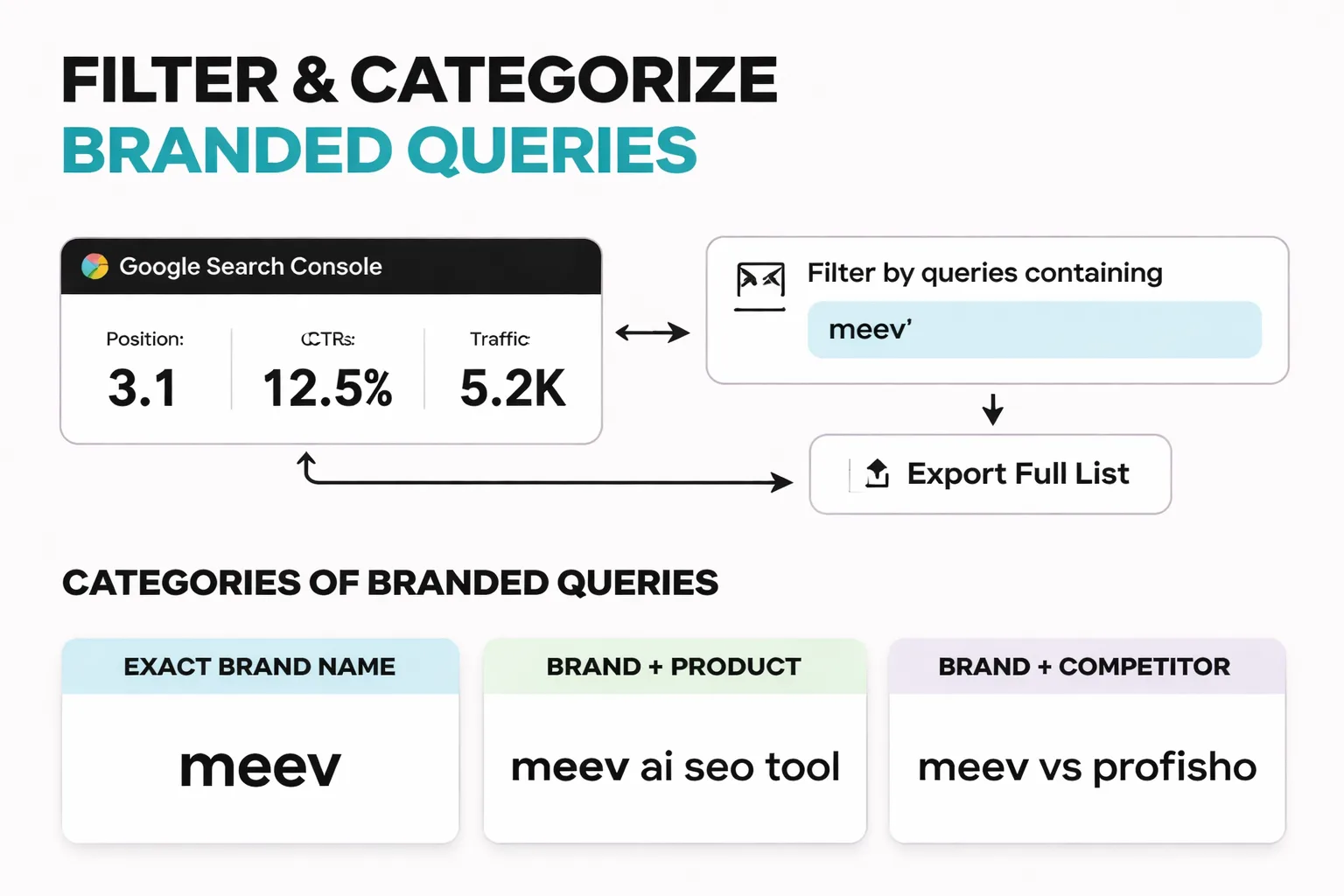
Step 1: Filter for branded queries. Go to Search Results in GSC and filter by queries containing your brand name. If your brand is "Meev," filter for queries containing "meev." Export the full list. These branded queries represent users who know your brand name but are searching for it instead of typing the URL directly. High branded search volume with low direct traffic means people know your name but do not trust themselves to type your URL. That is a recall gap.
But do not stop at exact brand name matches. Users search for brands in ways that are messier than you expect. They type misspellings, partial names, brand-plus-product combos, and brand-plus-competitor comparisons. When I audit branded queries, I look for four categories: exact brand name ("meev"), brand plus product ("meev ai seo tool"), brand plus competitor ("meev vs profisho"), and misspellings ("mev ai"). Each category tells you something different. Exact brand searches confirm recall. Brand-plus-product searches confirm product awareness. Brand-plus-competitor searches confirm consideration. Misspellings confirm that users are typing your brand from memory rather than copying it, which is actually a strong recall signal even though the query is wrong.
Step 2: Look at your top pages by clicks and compare against direct traffic in Google Analytics. Pages with high search clicks but low direct traffic are pages users find through exploration, not navigation. Pages with high direct traffic are pages users bookmark or remember the URL for. The ratio between these two groups tells you which pages have brand recall and which are just riding search demand.
Pay special attention to pages where direct traffic is declining but search traffic is stable or growing. That pattern means users are still finding the page through search, but they are no longer returning to it directly. Something broke the recall loop. Maybe the page title changed. Maybe the URL changed during a migration. Maybe a competitor launched a better version. I tracked one client whose direct traffic to their flagship guide dropped 40% after a site redesign changed the URL from /guide/seo to /resources/seo-guide. Users who had memorized or bookmarked the old URL hit a 404. Search traffic recovered within weeks because Google reindexed the new URL. Direct traffic never came back. Those users were gone.
Step 3: Compare branded query volume against your AI citation rate. This is the step most teams skip because they do not have AI citation data in the same tool. I use Meev's AI visibility tracker to pull citation rates across ChatGPT, Claude, Gemini, Perplexity, Grok, Google AI Overviews, and AI Mode. When I lay branded query volume next to AI citation rate, the correlation is visible. Brands with rising branded search volume see AI citation rates climb within weeks, not months.
A healthy navigational signal looks like this: branded query volume growing 5-10% month over month, direct traffic share above 30% of total sessions, and branded queries making up at least 15-20% of total search queries in GSC. A weak signal looks like branded queries flat or declining, direct traffic under 15%, and branded queries under 5% of total search volume. That weak signal means users are finding you through generic keywords, not through brand recall. In the AI search era, that is a vulnerability.
The reason this matters now more than ever is that AI search engines use entity recognition to decide which brands to mention. If users are not searching for your brand name, the LLM has less behavioral data to associate your brand with a given topic. Branded search volume is a proxy for entity strength. Direct navigation is a proxy for entity trust. You need both.
One more thing about GSC data: pay attention to the geographic distribution of your branded queries. If branded search volume is concentrated in one country or region, your entity signal is geographically bounded. LLMs trained on global data may not recognize your brand as a relevant entity for users in other regions. I worked with a UK-based SaaS company whose branded search volume was strong in the UK but nearly zero in the US. Their AI citation rate in US-facing prompts was under 2%. In UK-facing prompts, it was 23%. Same brand, same product, different entity recognition. Geographic distribution of branded queries is a leading indicator of geographic AI visibility.
Why Navigation Intent Matters for AI Search Visibility
This is where the topic gets interesting and where most SEO advice falls flat.
LLMs do not just crawl the web and pick the top result. They synthesize answers from entities they recognize. Entity recognition is built on repeated exposure: how often the brand appears in authoritative sources, how often users search for it by name, and how consistently it is described across the web. Direct navigation is the strongest behavioral signal of all because it shows the user already trusts the entity.
Think of it this way. If you ask a friend for a restaurant recommendation and they immediately say "go to Tony's on 5th Street," that is direct navigation. Your friend did not need to look anything up. Tony's is a trusted entity in their mind. If your friend says "let me look up Italian restaurants near you," that is search. The restaurant that gets named from memory is the one that wins. LLMs work the same way. They cite brands they "remember" from training data and real-time retrieval. Brands with high navigational demand get remembered.
I will give you a concrete example from my own work. I audited two SaaS companies in the same niche last quarter. Company A had 3x more backlinks than Company B and ranked higher for most generic keywords. Company B had stronger branded search volume and higher direct traffic share. When I ran AI visibility audits across ChatGPT, Perplexity, and Claude using our AI visibility checker, Company B was cited 2.5x more often than Company A in answer to "best [niche] software." Company A had more authority signals in the traditional SEO sense. Company B had more entity trust signals. The LLMs chose Company B.
Digital Elevator's research found that 82.5% of the time when buyers ask AI search engines which business to choose, the brand that answers the question best is absent from the AI-generated answer or buried inside a competitor's response. Only 17.5% of answers named the audited brand at all, and just 5.1% put it first. That is not a content quality problem. That is an entity recognition problem. These brands are not being cited because the LLMs do not recognize them as trusted entities for the topic being asked about.
The Semrush AI Mode study adds another layer. They found 92% of AI Mode responses featured a sidebar with approximately 7 unique domains, and those sidebar links showed 51% domain overlap with Google's top 10 traditional results. That means traditional SEO still matters as a foundation. But the 49% of domains that appear in AI Mode sidebars without being in the top 10? Those are domains with strong entity signals that LLMs recognize independently of traditional ranking. Navigational intent is one of those signals.
The mechanism here is entity grounding. When an LLM generates an answer, it does not just retrieve documents. It retrieves entities and their relationships from a knowledge graph. That knowledge graph is built from structured data (Wikidata, schema markup), unstructured data (web pages, articles), and behavioral data (search queries, click patterns, direct navigation). Brands with strong behavioral signals get stronger entity representations in the knowledge graph. Stronger entity representations mean higher probability of being cited in a generated answer. This is why a brand with fewer backlinks but higher navigational demand can outperform a competitor in AI citations. The knowledge graph does not count backlinks the way Google's PageRank does. It counts entity strength, and navigational intent is a core component of entity strength.
Is your brand being cited in AI answers, or are competitors taking your share of voice?
5 Steps to Strengthen Your Brand's Navigational Signal
Here is the workflow I use with every brand I audit. Five steps, each with a concrete output.
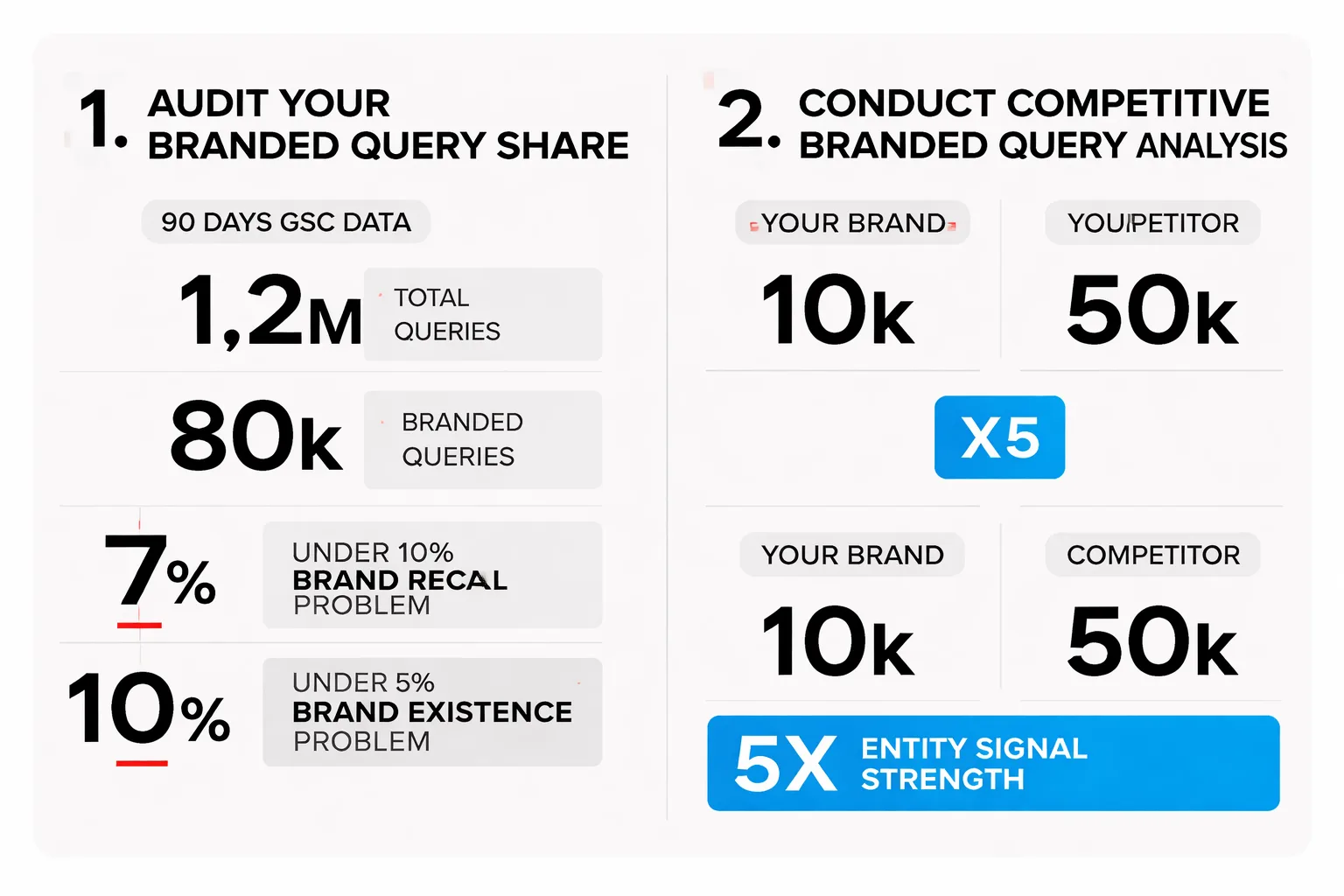
1. Audit your branded query share. Pull 90 days of search query data from GSC. Calculate what percentage of your total queries contain your brand name. If it is under 10%, you have a brand recall problem. If it is under 5%, you have a brand existence problem. Export the list of non-branded queries driving the most traffic and ask yourself: would any of these users remember my brand name after they leave? If the answer is no, your content is not building recall. It is just capturing demand.
The audit should also include a competitive branded query analysis. Search for your competitors' brand names in GSC (if you appear in those SERPs) and in a keyword research tool. Compare their branded search volume to yours. If a competitor has 5x your branded search volume, they have 5x your entity signal strength in the topics where you compete. That gap will show up in AI citations. I have seen brands with inferior products win AI recommendations purely because their branded search volume dwarfed the competition. The LLM does not evaluate product quality. It evaluates entity strength.
2. Identify pages losing direct traffic. In Google Analytics (or whatever analytics tool you use), sort pages by direct traffic and look at the trend over 6 months. Pages that are losing direct traffic are losing brand recall. Investigate why. Did you change the URL structure? Did a competitor launch a similar page with better branding? Did you stop promoting that page in channels that drive direct visits? Every page losing direct traffic is a page where your entity signal is weakening.
3. Fix entity consistency across the web. This is the most tedious step and the one most teams skip. Your brand name, description, and category need to be consistent across Wikidata, Wikipedia (if you have a page), your website's schema markup, and major third-party directories. Inconsistent entity descriptions confuse LLMs. If Wikidata says you are a "marketing platform" but your schema says you are an "SEO tool," the LLM has to guess which is correct. Make them match. Use the LLMs.txt validator to check whether your site is properly signaling its entity to AI crawlers.
Entity consistency goes beyond schema markup. It includes your Google Business Profile description, your Crunchbase entry, your GitHub organization page, your LinkedIn company page, and any other structured profile where your brand is described. I audited one company whose Wikidata entry listed them as "defunct" because a former employee had marked the company as closed during a rebrand. The company was very much alive, but LLMs were reading "defunct" from Wikidata and omitting the brand from recommendations. It took three weeks to get the Wikidata entry corrected, and AI citation rates recovered within two weeks after that. Entity consistency is not a nice-to-have. It is a prerequisite for AI visibility.
4. Publish answer-engine optimized content that reinforces brand recall. This is where generative engine optimization comes in. Every article you publish should do two things: answer a specific question that your audience asks AI search engines, and mention your brand in a way that reinforces the entity association. I am not talking about stuffing your brand name into every paragraph. I am talking about structuring content so that when an LLM reads it, the association between your brand and the topic is unambiguous. Direct answers under question headings. Comparison tables that include your brand. Case studies with specific numbers. That is what LLMs extract and cite.
The content you publish should also target the prompts users actually type into AI engines. These are not the same as Google search queries. AI prompts tend to be longer, more conversational, and more specific. "Best CRM for a 5-person agency with hourly billing" is an AI prompt. "best crm" is a Google query. Your content needs to answer the AI prompt, not just rank for the Google query. This is the core difference between traditional SEO and what is AEO. AEO targets the question, not the keyword.
5. Monitor AI citation rate alongside navigational query trends. This is the step that closes the loop. If you are doing steps 1-4 but not tracking whether your AI citation rate is improving, you are flying blind. I track this in Meev because it puts branded query trends and AI citation rates in the same dashboard. When branded search volume ticks up, I expect AI citations to follow within 2-4 weeks. If they do not, something is blocking the entity signal. Usually it is inconsistent schema, weak third-party mentions, or content that does not directly answer the prompts users are asking AI engines.
How Does AI Search Interpret Direct Navigation?
AI search engines interpret direct navigation as a strong entity trust signal. When millions of users type a specific URL, that behavioral data feeds back into the search engine's understanding of which entities matter. Google has always used direct navigation as a ranking signal (it is part of why brand searches correlate with organic rankings). LLMs take this further by using entity recognition as a primary filter for which sources to cite.
Here is the mechanism. When an LLM receives a query like "best project management tool," it does not rank pages the way Google does. It identifies entities associated with "project management tool" and then evaluates which of those entities to recommend. The entities it recognizes are those with strong presence in its training data and in real-time retrieval. Direct navigation volume is one of the behavioral signals that strengthens entity presence in training data.
Google's own AI optimization guide confirms that traditional SEO fundamentals remain relevant for AI features, including crawlability, structured data, and quality content. But the guide does not mention navigational intent explicitly. That is because Google treats direct navigation as an implicit signal baked into its entity graph, not as something you optimize for directly. You optimize for it by building brand recall through every other channel: content, PR, social, word of mouth.
The implication for marketers is clear. If you are only investing in content that captures generic search demand, you are building a house on rented land. You need content that builds brand recall so users search for you by name. That branded search volume is what feeds the entity signal that gets you cited by AI.
There is a second layer to this that I want to be precise about. AI search engines do not just read the LLM's training data. They also do real-time retrieval, pulling fresh content from the web to supplement their pretrained knowledge. This means your entity signal is not frozen at training time. It updates continuously based on what the retrieval system finds. If your brand gets mentioned in a major publication today, the next time someone asks ChatGPT about your topic, the retrieval system may surface that mention and include your brand in the answer. This is why continuous content publishing and PR matter for AI visibility. You are not just building a static entity profile. You are feeding a dynamic retrieval system that refreshes its understanding of your brand with every new mention.
When Navigation Signals Mislead You
Not all direct traffic is navigational intent. I have seen teams celebrate a spike in direct traffic only to discover it was an email campaign, a Slack link, or a podcast mention that Analytics classified as direct because it had no referrer. Direct traffic in Google Analytics is a bucket of last-resort attribution. It includes everything the tracker cannot identify. Do not treat it as a pure navigational signal.
The same goes for branded search volume. A spike in branded queries might mean your brand recall is improving. It might also mean a competitor is running ads on your brand name and users are clicking through to search results instead of your site. Or it might mean a PR crisis is driving people to search for your name to see what happened. Volume alone does not tell you the intent. You need to look at the pages those branded queries lead to. If branded queries are landing on your homepage, that is navigational. If they are landing on a press release or a controversy page, that is something else entirely.
The fix is to triangulate. Use GSC for branded query volume, Analytics for direct traffic trends, and an AI visibility tool for citation rate. When all three move in the same direction, you have a real signal. When one diverges, investigate before you celebrate or panic.
What Role Does Entity Grounding Play in AI Citations?
Entity grounding is the process by which an LLM connects a mention of your brand to a real-world entity in its knowledge graph. Without grounding, your brand is just a string of characters. With grounding, your brand is an entity with attributes: a description, a category, relationships to other entities, and a trust score. AI citations require grounding. An LLM will not recommend a brand it cannot ground.
The grounding process works like this. When the LLM encounters your brand name in a source document, it checks its knowledge graph for an entity that matches. If it finds a match, it retrieves the entity's attributes and uses them to decide whether the entity is relevant to the query. If it does not find a match, the brand name is treated as ungrounded text and is unlikely to be included in the generated answer.
This is why Wikidata and knowledge graph presence are so critical. Wikidata is the primary structured data source for many LLMs. If your brand has a Wikidata entry with accurate attributes (description, category, official website, logo), the LLM can ground your brand with high confidence. If your brand has no Wikidata entry, the LLM has to infer the entity from unstructured text, which is less reliable and more likely to fail.
I have seen brands get cited in AI answers within days of creating a Wikidata entry. The entry does not magically boost your ranking. It gives the LLM the grounding it needs to recognize your brand as a legitimate entity. Without that grounding, no amount of content or backlinks will get you cited. With it, your content and navigational signals have a foundation to build on.
How to Track Whether Your Fixes Are Working
Three metrics tell you whether your navigational signal is strengthening and whether that strength is translating into AI visibility.
Branded query volume trend. Track this monthly in GSC. You want steady growth, not spikes. Spikes are usually driven by external events (press, ads, crises). Steady growth means brand recall is compounding. Set a baseline and track the 3-month moving average. If it is trending up 5% or more month over month, you are building recall.
AI citation rate by engine. This is the metric that traditional SEO tools do not give you. You need to know: of the prompts users ask ChatGPT, Perplexity, Claude, Gemini, and Grok that are relevant to your topic, what percentage cite your brand? I track this across every major AI search surface using Meev's enterprise AI rank tracker, which shows not just whether you are cited but where in the answer you appear (first mention, in a list, or buried at the bottom). Position matters. Digital Elevator's study found only 5.1% of AI answers put the audited brand first. Being cited seventh in a list of ten is barely better than not being cited at all.
Direct-traffic share. Track what percentage of your total sessions come from direct traffic. This is your crudest navigational signal, but it is still useful as a trend. If direct traffic share is rising, your brand recall is likely improving. If it is falling, you are becoming more dependent on search and less on recall. In the AI era, that is a risky direction.
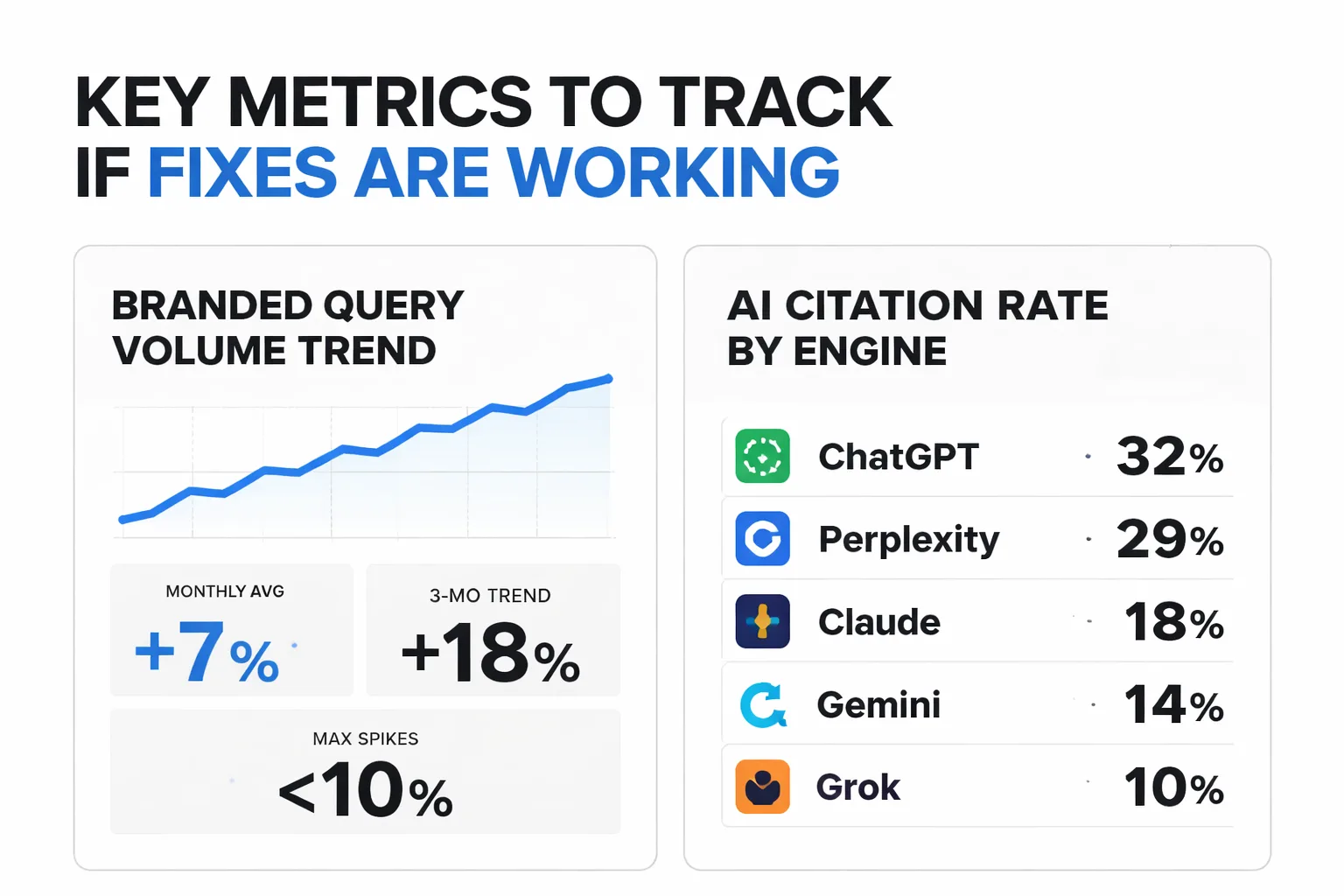
The connection between these three metrics is what I monitor in Meev's dashboard. When branded query volume rises, AI citation rate should follow within 2-4 weeks. When direct traffic share rises, branded query volume usually follows within a month. If any of these correlations break down, it tells me something specific is wrong. If branded queries rise but AI citations do not, the entity signal is not reaching the LLMs. Usually that means inconsistent schema or weak third-party mentions. If direct traffic rises but branded queries do not, the traffic is probably not navigational. It is probably a misattributed campaign.
This is why I do not recommend tracking these metrics in isolation. The value is in the correlation. Navigational intent is not a single number. It is a pattern of signals that, when read together, tell you whether your brand is gaining or losing the entity trust that AI search engines reward.
There is one more metric I track that is harder to quantify but equally important: mention position. When your brand is cited in an AI answer, where does it appear? First mention carries the most weight. Users read AI answers top to bottom, and the first brand mentioned is often perceived as the recommendation. I use the ChatGPT AI visibility checker to see exactly where my brand appears in each response. If I am consistently cited third or fourth, I know I have work to do on entity strength. If I move from fourth to second, that is a meaningful improvement even if my overall citation rate stays the same.
How Does Agentic SEO Change Navigation Intent?
Agentic SEO is the next evolution, and it changes how we think about navigational intent. In traditional search, a human types a query and clicks a result. In agentic search, an AI agent interprets a user's request, decides which sources to consult, and synthesizes an answer without the user ever seeing a search results page. The user does not type a URL. The user does not type a search query. The user says "find me the best AI visibility tool for a 5-person team" and the agent does the rest.
This means navigational intent shifts from the user to the agent. The agent decides which URLs to visit. The agent decides which entities to recommend. The agent's decision is based on the same signals we have been discussing: entity strength, citation frequency, content quality, and third-party mentions. But the agent also considers factors that human searchers do not: API compatibility, structured data accessibility, and machine-readable content formats.
For brands, this means the search or type url dichotomy expands. It is no longer just about whether a human types your URL or searches for your brand. It is about whether an AI agent recognizes your brand as the right destination for a given task. Agents do not browse. They retrieve. They do not click links. They consume structured data. Your navigational signal now needs to speak to machines as fluently as it speaks to humans.
This is where AI search engine optimization tools become essential. You cannot track agent behavior with traditional SEO tools. You need tools that monitor how AI agents cite your brand, which sources they pull from, and how your entity profile changes over time. The brands that win in agentic search will be the ones that build entity signals strong enough for both human and machine navigation.
What This Won't Fix
This framework will not fix a product that people do not want. If your brand recall is low because your product is undifferentiated, no amount of entity optimization will save you. I have seen teams spend months fixing schema markup and publishing AEO content only to see AI citation rates stay flat. The problem was not the signal. The problem was that users had no reason to remember the brand.
This also will not fix a brand that is invisible in third-party sources. LLMs build their entity understanding from the web at large. If no one mentions your brand on Reddit, in industry publications, or on authoritative third-party sites, your schema markup and branded search volume will not be enough. Entity trust is built externally. Your content can reinforce it, but it cannot create it from nothing.
FAQ
What does 'search or type url' mean in a browser?
The "search or type url" prompt in a browser's omnibox is a dual-function input field. If you type a web address (like meev.ai), the browser navigates directly to that site. If you type anything else, the browser sends the text to your default search engine as a query. This single interface handles both direct navigation and search, and the choice users make reveals their intent: certainty and brand recall (URL) versus exploration and discovery (search).
How does direct navigation affect SEO?
Direct navigation does not directly affect rankings because Google has stated it does not use Google Analytics data for ranking purposes. However, direct navigation correlates strongly with branded search volume, which is a signal Google uses. Brands with high direct traffic also tend to have strong entity signals, consistent NAP information, and more branded backlinks, all of which support SEO performance.
Can I track who types my URL directly?
You cannot track individual users who type your URL. But you can measure direct traffic in aggregate through Google Analytics, and you can track branded query volume in Google Search Console. The ratio between these two metrics tells you whether users are navigating directly (high trust) or searching for your brand name (moderate trust) or not finding you at all (no trust).
Why is my brand not cited in AI answers even though I rank well?
Ranking well on Google does not guarantee AI citation. LLMs cite entities they recognize from training data and real-time retrieval, not just pages that rank well. If your brand has weak entity signals (inconsistent schema, few third-party mentions, low branded search volume), the LLM may not recognize you as a trusted entity for the topic. Fix entity consistency, build third-party mentions, and monitor your AI citation rate using an AI SEO tool.
How often should I audit my navigational signal?
I recommend a monthly review of branded query volume and direct traffic share, and a weekly check of AI citation rate. The monthly cadence catches slow trends before they become problems. The weekly cadence on AI citations catches sudden drops that usually indicate an entity signal issue or a competitor gaining share of voice in AI answers.
What is the difference between AEO and GEO?
Answer Engine Optimization (AEO) focuses on getting your brand cited in AI-generated answers. Generative Engine Optimization (GEO) is a broader term that covers optimizing for all generative AI surfaces. The distinction matters because different engines have different citation behaviors. Learn more about the AEO vs GEO differences to understand which framework applies to your strategy.
The search or type url choice is the most fundamental signal in web behavior. In the AI search era, it is also one of the most predictive. Brands that users navigate to directly are the brands that LLMs cite. Build your navigational signal, track it alongside AI citation rate, and close the gap between being ranked and being recommended.
About the Author
Judy Zhou, Founder
Judy Zhou leads content strategy at Meev, where she oversees AI-driven content research and publishing for hundreds of brands. With a background in SEO and editorial operations, she focuses on building content systems that rank on Google, get cited by AI search engines, and drive measurable business results.
See exactly where your brand appears across every major AI search surface and close the citation gap before competitors lock in your topics.