

By Judy Zhou, Founder
Key Takeaways
- AI crawlers consume content at a rate 38,000 times higher than they refer traffic back, decoupling traditional SEO metrics from actual brand visibility.
- Semrush's AI Visibility Index analysis of 126 million US prompts found brand mentions correlate more strongly with AI visibility than backlinks do.
- Replacing thin promotional copy with structured entity-rich guides doubled citation rates from below 5% to 20-40% within 60-90 days.
- When AI Overviews appear, the top organic result loses 58% of its click-through rate as users click results only 8% of the time versus 15% without one.
Most SEO agencies are optimizing for a search engine that's already losing.
The market for generative engine optimization companies has fractured into three distinct tiers, and most buyers are picking wrong. Research from Cloudflare's 2025 AI crawler analysis found that AI crawlers consume content at a rate 38,000 times higher than they refer traffic back to sources, which means traditional SEO metrics like organic click-through are becoming decoupled from actual brand visibility. Meanwhile, Semrush's AI Visibility Index analyzed 126 million real US AI search prompts across 22 industries and found that brand mentions correlate more strongly with AI visibility than backlinks do. The companies worth knowing in 2026 are not the ones that slapped "AI" onto their pitch deck. They are the ones that measure citation rates across every major AI surface, ground content in entity data, and publish answer-optimized articles that LLMs actually cite.
The stakes are concrete. According to Hello Retail's GEO for ecommerce guide, 68% of US Google searches ended without a click to any website in the first four months of 2026. When AI Overviews appear, the top organic result loses roughly 58% of its click-through rate. Users click a result just 8% of the time when an AI summary is present, compared to 15% without one. Brands that replaced thin promotional copy with structured, entity-rich guides saw citation rates double or more, moving from below 5% to 20-40% within 60-90 days. The gap between companies that get cited by AI and companies that don't is widening fast, and the right partner can close it.
What Separates a Real GEO Company from a Rebranded SEO Agency
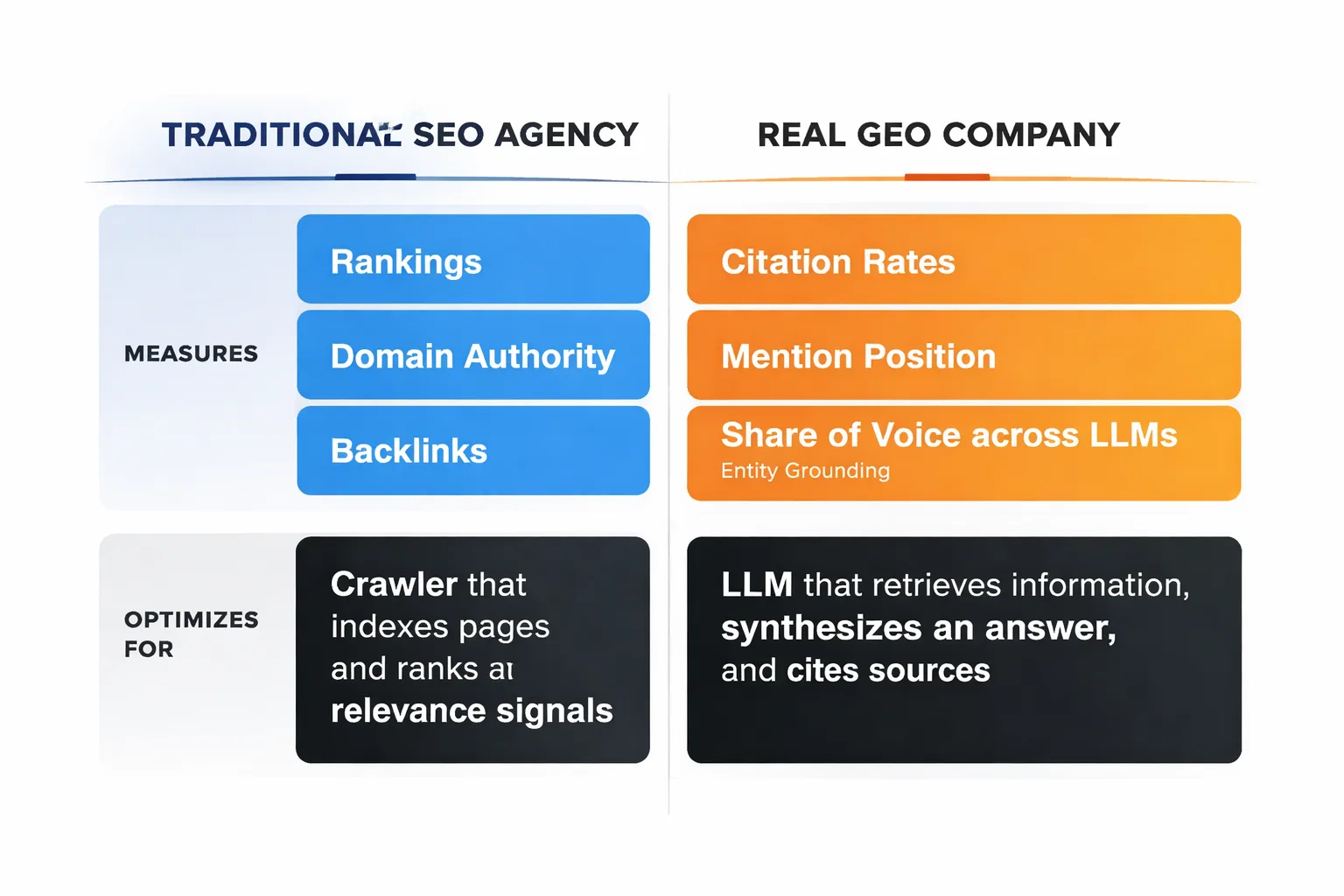
The easiest way to spot a fake GEO company: look at what they measure. A rebranded SEO agency talks about rankings, domain authority, and backlinks. A real generative engine optimization company talks about citation rates, mention position, share of voice across LLMs, and entity grounding.
The difference is not semantic. It is structural. Traditional SEO optimizes for a crawler that indexes pages and ranks them by relevance signals. Generative engine optimization optimizes for an LLM that retrieves information, synthesizes an answer, and cites sources. The mechanics are different, the signals are different, and the measurement framework is different. A company that cannot tell you where your brand appears in ChatGPT's answers, which sources those citations come from, and how your share of voice compares to competitors is not doing GEO. They are doing SEO with a new label.
Real GEO companies do four things that rebranded agencies don't.
First, they measure AI citations across multiple surfaces. ChatGPT, Claude, Gemini, Perplexity, Grok, Google AI Overviews, and AI Mode each retrieve and cite content differently. The overlap between ChatGPT and Perplexity citations is only 11%, according to research from the Nature Communications 2025 LLM citation accuracy study. A company that only tracks one or two surfaces is giving you a fraction of the picture. Consider the practical implication: if your GEO partner tracks only ChatGPT, you are blind to how Perplexity, Claude, and Gemini frame your brand. A competitor could be dominating citation share on three surfaces you don't monitor, and your monthly report would show everything looking fine.
Second, they ground content in entity data. Entity grounding means making sure AI engines can identify your brand as a distinct entity with specific attributes, relationships, and authority signals. This goes beyond schema markup. It involves Wikidata and knowledge graph presence, structured data that defines what your company is and does, and content that establishes factual density around your core topics. Seer Interactive demonstrated that AI systems like ChatGPT extract and cite specific structured data from footers and templates within 36 hours of publication. That means the structured data you add today can influence citations in under two days, but only if the data is entity-rich and machine-readable.
Third, they publish answer-optimized content. Not blog posts optimized for keywords. Content structured for AI extraction: clear heading hierarchies, semantic HTML, conversational patterns, fact-verified claims with inline citations to primary sources. Research from the arXiv GEO paper presented at KDD '24 found that content with proper schema markup shows 30-40% higher AI visibility. Structure optimization alone improves citation rates by 40%. The content that earns citations shares five attributes: thorough research with verifiable data, clear structure for AI parsing, authoritative voice with expert credentials, citations to primary sources, and unique perspectives that give LLMs a reason to cite you over a competitor.
Fourth, they track citation changes over time. When you publish a new article or update an existing page, does your citation rate go up? Which prompts trigger the change? How long is the lag between content publication and citation lift? The data shows a 2-4 week lag between content structure changes and AI citation data reflecting those changes. A real GEO company tracks this loop and can tell you which content investments are driving citation growth and which are dead weight.
The rebranded agencies will tell you they "also do AI search." Ask them to show you a dashboard with your brand's citation rate across ChatGPT, Perplexity, and Google AI Overviews for the last 30 days. If they can't, they don't do GEO.
The Categories of GEO Companies in 2026
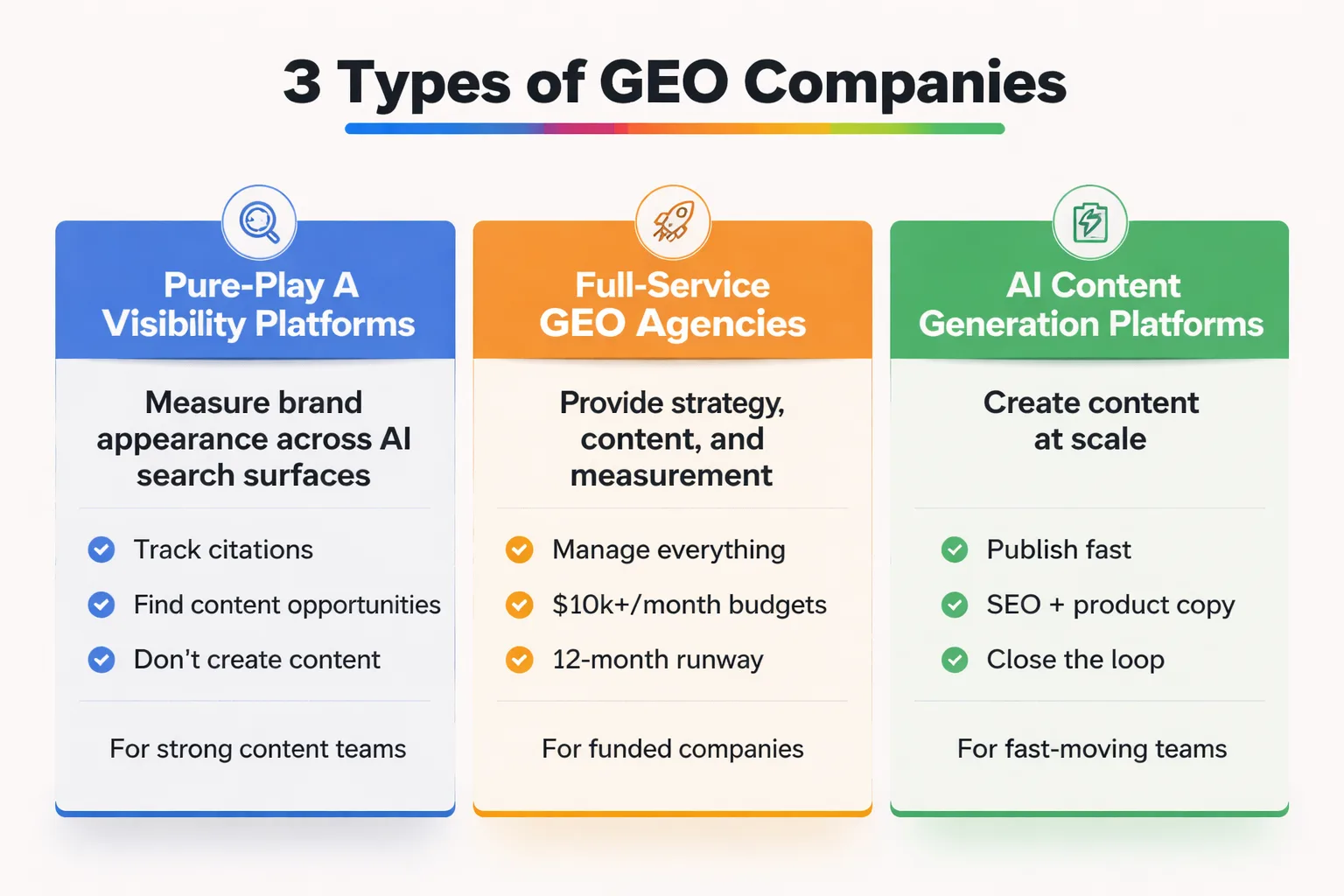
The market has split into three categories. Each serves a different buyer, and picking the wrong category wastes money.
Pure-Play AI Visibility Platforms
These companies focus on measurement. They track where your brand appears across AI search surfaces, show you which sources those citations come from, and surface content opportunities where competitors are cited but you aren't. They are the right choice for teams that already have strong content operations and need intelligence to guide it.
The limitation is that they don't create content. They tell you where the gaps are, but you still need a writer, an editor, and a publishing workflow to fill them. For small teams without a content operation, this creates a gap between diagnosis and action. You get a beautiful dashboard showing 47 prompts where competitors are cited and you aren't. Then you close the tab and go back to your day job. The gap remains.
An ai visibility tool in this category typically offers dashboards with per-LLM drill-downs, mention position tracking, and industry share-of-voice benchmarks. The best ones also surface cited-source leaderboards, showing which domains AI engines cite most often for your topics. Reddit leads citations at 40.1% and Wikipedia at 26.3%, which means community-sourced and encyclopedic content dominates AI retrieval. If your brand isn't present on those platforms or cited by those sources, a pure-play platform will show you the gap but won't help you close it.
Full-Service GEO Agencies
These companies combine strategy, content creation, and measurement. They typically offer prompt mapping (identifying the questions users ask AI engines in your category), benchmarking (where you stand vs competitors), content optimization, and agentic commerce strategies aligned with how LLMs retrieve and cite content.
Go Fish Digital's GEO case study documented a 3X lead increase over three months using four key levers: prompt mapping, benchmarking, content optimization, and agentic commerce strategies. Virayo's generative engine optimization strategies showed a SaaS client generating 20+ free trial signups per month directly from ChatGPT citations by doubling down on the right content types, clustering, and internal linking.
The limitation here is cost and speed. Full-service agencies typically charge $5,000-15,000 per month, and the content production cycle is slow because it goes through account managers, strategists, and writers. A typical agency workflow involves a kickoff call, a strategy document, a content brief, a writer draft, an editor pass, a client review cycle, and then publication. That's 3-4 weeks per content cluster. For teams that need to move fast or test multiple content angles, the agency model can feel like steering a ship. The results can be strong, but the timeline is long.
Hybrid Tracking-and-Publishing Platforms
This is the newest category, and it exists because the gap between measurement and action is where most GEO efforts die. You get a report showing 47 prompts where competitors are cited and you aren't. Then what? You need to research, write, optimize, and publish 47 articles. Most teams never get past step one.
Hybrid platforms close that loop. They track AI visibility across every major surface, identify citation gaps, generate archetype-aware articles grounded in your knowledge base, and publish directly to your CMS with quality controls that block weak drafts before they go live. The answer engine optimization workflow becomes a single system: diagnose, write, publish, measure.
The advantage is speed and cost efficiency. A hybrid platform can take a citation gap identified on Monday, research and draft an article by Tuesday, run it through a 16-dimension quality firewall by Wednesday, and have it published and submitted to Google Search Console and IndexNow by Thursday. That same workflow through an agency takes a month. The tradeoff is control. Some teams want a human writer for every piece. Others want the volume and speed that automated publishing enables, as long as quality gates prevent garbage from reaching their site.
Do you know which AI surfaces cite your brand today?
How to Evaluate a GEO Company's Methodology
Most buyer guides for generative engine optimization companies stop at a feature checklist. That is the wrong frame. Features tell you what a tool does. Methodology tells you whether it works.
The core question is: does this company understand how LLMs actually retrieve, evaluate, and cite content? Or are they applying SEO logic to a system that doesn't work like Google?
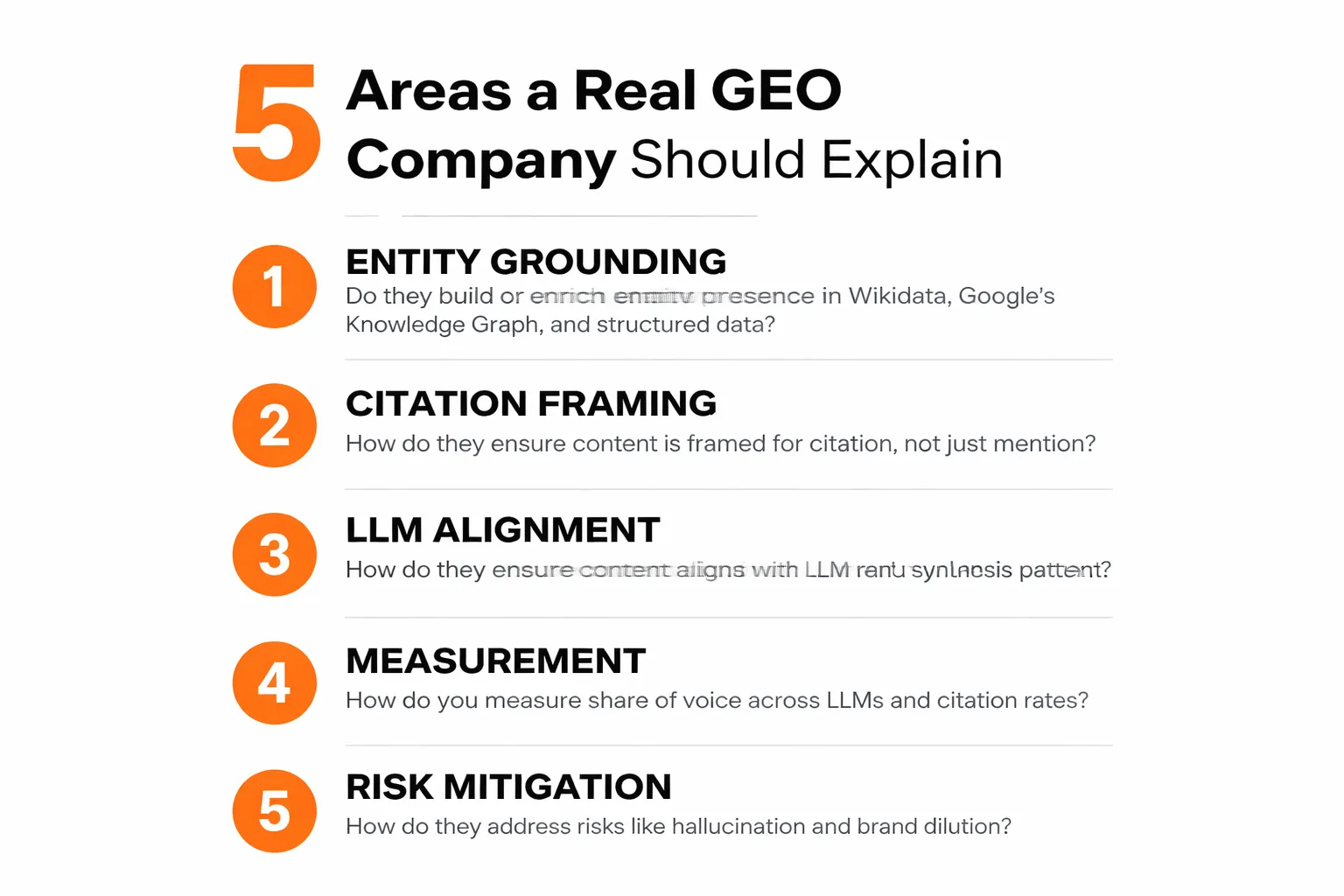
Here's the test. A real GEO company should be able to explain, in concrete terms, how they approach these five areas.
Entity grounding. Do they build or enrich your entity presence in Wikidata, Google's Knowledge Graph, and structured data across your site? Do they ensure your brand is a recognized entity with attributes, relationships, and authority signals that LLMs can independently verify? Or do they just write content with your brand name in it? Entity grounding is the difference between being a brand LLMs recognize as a distinct entity and being a string of text that appears in content. The former gets cited as a source. The latter gets paraphrased without attribution.
Citation-worthy content structure. Do they structure content for AI extraction? This means heading hierarchies that map to common query patterns, semantic HTML, conversational phrasing in headers, fact-verified claims with inline source links, and unique perspectives that give LLMs a reason to cite you over a competitor. Research shows citation-worthy content sees 30-40% higher visibility in LLM responses. The structure matters because LLMs parse content differently than traditional crawlers. They look for self-contained answer blocks, clear factual statements with source attribution, and semantic relationships between sections. A wall of prose with your brand name scattered through it won't get cited. A structured guide with clear sections, data points, and source links will.
Multi-surface tracking. Do they monitor every major AI search surface, or just the ones that are easy to track? The Perplexity AI visibility checker and ChatGPT AI visibility checker are different surfaces with different citation behaviors. A company that only tracks Google AI Overviews is missing the picture. Each surface has its own retrieval logic. ChatGPT responds to entity authority and training-data signals. Perplexity responds to freshness and structured content. Google AI Overviews responds to FAQ schema markup. A company that treats them all the same will optimize for one and miss the others.
Citation path analysis. Do they identify which publishers AI engines cite for your topics, and help you build relationships with those sources? This is the closed-loop version of link building, adapted for AI search. Instead of chasing backlinks, you chase citations from the domains LLMs already trust. If Reddit leads at 40.1% and Wikipedia at 26.3%, your citation path strategy needs to account for those sources. Can you contribute to Reddit threads authentically? Can you ensure your Wikipedia entry is accurate and well-sourced? Can you get cited by the trade publications and industry blogs that LLMs use as training and retrieval sources?
Attribution and reporting. Can they show you, month over month, how your citation rate changed, which content drove the change, and what the revenue impact was? Traffic from AI sources to US retail sites grew 393% year-over-year in Q1 2026, and AI-referred traffic converted 42% better than non-AI sources by March 2026. Revenue per visit from AI referrals ran 37% above non-AI traffic. If your GEO company can't connect citations to revenue, they're reporting on activity, not outcomes.
What to Ask Before Hiring a GEO Company
Five questions. Each one filters out a different type of pretender.
Which AI surfaces do you monitor?
The right answer includes every major AI search surface: ChatGPT, Claude, Gemini, Perplexity, Grok, Google AI Overviews, and Google AI Mode. If they name three or fewer, they are either early-stage or cutting corners. The overlap between ChatGPT and Perplexity citations is only 11%, which means tracking one does not approximate tracking the other. Each surface has its own retrieval logic, citation behavior, and content preferences. ChatGPT responds to entity authority and training-data signals. Perplexity responds to freshness and structured content. Google AI Overviews responds to FAQ schema markup. A company that treats them all the same will optimize for one and miss the others.
How do you attribute citation changes?
This is the hardest question, and the answer separates real operators from pretenders. When your citation rate goes up 12% in a month, what caused it? Was it the new article you published? The schema markup you added? The external mention on a high-authority site? The algorithm update that shifted retrieval patterns?
A real GEO company has a framework for this. They track content publication dates against citation lift, with the understanding that there's a 2-4 week lag. They isolate variables when possible. They acknowledge when they can't attribute a change and don't pretend they can. A company that says "we drove a 12% citation increase" without explaining how they know is selling you correlation as causation.
Do you publish content or just advise?
This determines whether you're buying a consultant or a partner. Advisory-only companies give you a report and a content brief. You still need a writer, an editor, a CMS workflow, and an indexing strategy. For teams with a content operation, that's fine. For teams without one, it's a recipe for a report that sits unread.
Companies that publish content close the loop. They research, write, and publish answer-engine-optimized articles directly to your site. The best ones gate publication behind quality controls, because AI search engine optimization tools that publish without quality gates produce the kind of thin, unverified content that Google's Helpful Content System flags and removes.
What does a monthly report look like?
Ask to see a sample report. Not a mockup. A real report from a real client (redacted).
The report should include: citation rate by surface, mention position trends, share of voice vs competitors, new content published and its citation impact, citation path opportunities (publishers to target), and revenue or pipeline attribution from AI-referred traffic. If the report is just a rank tracker with an "AI" column added, you're paying for SEO reporting with a new label.
How long before I see citation lift?
The honest answer is 4-8 weeks for initial citation movement, and 60-90 days for meaningful, sustained citation rate improvement. The data shows that brands implementing structured content saw citation rates move from below 5% to 20-40% within 60-90 days. Content structure changes have a 2-4 week lag in AI citation data.
Any company promising citation lift in under two weeks is either lying or describing a temporary spike from a fresh-content signal that will decay. Real citation authority compounds over time as LLMs encounter your content repeatedly across multiple surfaces.
Why Citation Framing Matters More Than Mention Count
Here is the contrarian take that most GEO companies won't tell you.
A high brand mention rate in AI answers can actively hurt your business if the framing is negative or positions you as a secondary option.
Raw mention count is a vanity metric. What matters is the context of the mention. An AI engine that says "[Your Brand] is a good starting point for small teams, though [Competitor] offers more advanced features" is not helping you. That mention is a funnel directing users to your competitor.
This is especially dangerous in B2B, where buying decisions are heavily narrative-driven. A buyer who asks ChatGPT for a recommendation is not looking for a list. They are looking for a narrative that helps them decide. If the AI's narrative positions your brand as the budget option, the starter tool, or the "also worth considering" mention, you are losing deals despite having high visibility.
The Nature Communications study on LLM citation accuracy found that between 50% and 90% of LLM-generated citations don't fully support the claims they're attached to. Citation accuracy ranges from roughly 66% on the best platform to below 50% on the worst. This means that even when your brand is cited, the context around that citation may be inaccurate, misleading, or framed in a way that undermines your positioning.
The implication for choosing a GEO company is clear. You need a partner that tracks mention framing, not just mention count. They should be able to show you the actual response text behind every mention, analyze whether the framing is favorable, neutral, or negative, and help you build content that shapes the narrative AI engines construct around your brand.
This is the hardest problem in GEO, and most companies don't solve it. They track whether you're mentioned. They don't track whether the mention helps you win deals. The companies worth knowing in 2026 are the ones that have moved beyond mention counting into narrative control.
The Technology Stack Behind Real GEO
Understanding a GEO company's technology stack tells you whether they built for this problem or adapted an SEO tool for it.
Tracking architecture. Real GEO platforms use direct API integrations with AI search surfaces rather than scraping. Direct integrations preserve measurement validity and allow per-surface drill-downs. The cost difference is significant: direct Perplexity Sonar API calls run about $0.005 per query, while alternative data sources charge $0.027 or more. Companies that scrape are limited in depth, freshness, and accuracy. A scraping approach might capture a snapshot of a ChatGPT response once a week. A direct API integration can capture daily refreshes on SERP-driven surfaces and rolling refreshes on LLM-driven surfaces, giving you a more current and more accurate picture of your citation landscape.
Content quality systems. The best hybrid platforms gate content publication behind multi-dimension quality firewalls. This means evaluating articles on 10+ quality signals before they reach your CMS, blocking weak drafts that would dilute your site's authority. A generative engine optimization agency that publishes without quality gates is gambling with your domain's reputation. The quality signals should cover both article quality (factual accuracy, source density, structural completeness, archetype adherence, originality) and Google penalty risk (thin content indicators, keyword stuffing patterns, AI-slop signals). Articles scoring below a threshold should be blocked, not published and fixed later.
Knowledge base integration. Content generation that's grounded in your existing knowledge base produces factually accurate, on-brand articles. Generic AI writers that don't retrieve from your knowledge base produce content that sounds right but gets details wrong. For B2B companies with technical products, this is the difference between content that builds authority and content that undermines it. The knowledge base should support archetype-aware retrieval, meaning different content types (listicles, how-tos, explainers) pull different information from your knowledge base based on what's most relevant for that format.
Indexing infrastructure. Publishing content that doesn't get indexed is wasted effort. The best GEO platforms integrate with Google Search Console for sitemap submission and ping IndexNow on every publish. This dual approach maximizes indexing speed across Google and Bing, which have different philosophies: Google prioritizes content quality and entity recognition, while Bing is more reactive to direct submission. Pages submitted via Google Search Console can languish in "Crawled. Currently not indexed" for months if they lack strong internal linking and mobile optimization. The best GEO platforms handle this by ensuring every published article has robust internal links and is mobile-optimized from day one.
Multi-language support. If your audience spans multiple languages, your GEO partner needs native-tuned content generation, not English articles run through a translation API. The difference is measurable in citation rates. LLMs retrieve and cite content in the user's language, and content that reads natively in that language gets cited more often than content that reads like a translation.
How to Decide
The decision framework comes down to three factors: your team size, your content operation, and your timeline.
If you have a content team and need intelligence to guide it, choose a pure-play ai visibility tracker. You'll get the data you need to direct your existing writers and editors toward citation-worthy content. This is the right choice for companies with an in-house content team that just needs better intelligence about where AI surfaces are citing competitors instead of them.
If you have budget but no content team, choose a full-service GEO agency. You'll pay more, but you'll get strategy, content, and measurement in one package. The agency model works best for companies that want a managed service and can absorb the cost and timeline. If you have a 12-month runway and $10,000/month to spend, an agency can build you a citation-worthy content library that compounds over time.
If you need to move fast and close the loop between diagnosis and action, choose a hybrid tracking-and-publishing platform. You'll get visibility tracking, content generation, and publishing in one system. This model works best for small teams that need to be found and cited by AI answers without running a full content operation. The hybrid model is also the most cost-efficient: you're paying for one platform that does what would otherwise require a tracking tool, an agency, and a publishing workflow.
The aeo vs geo distinction matters here. Answer engine optimization and generative engine optimization overlap but aren't identical. AEO focuses on structuring content for AI extraction. GEO focuses on the broader system of getting cited across AI surfaces. The best companies do both, but they should be able to tell you which they emphasize and why.
The Risks Nobody Talks About
GEO is not without risk, and the companies that don't acknowledge this are the ones to avoid.
Algorithm volatility. AI search surfaces update their retrieval and citation logic frequently. A citation strategy that works today may stop working next month when ChatGPT updates its training data or Perplexity changes its retrieval algorithm. The best GEO companies monitor for these shifts and adapt. The worst ones keep running the same playbook until results collapse. Ask any GEO company you're evaluating how they detected and responded to the last major AI algorithm shift. If they can't name a specific shift and a specific adaptation, they're not monitoring closely enough.
Content quality dilution. Publishing large volumes of AI-generated content without quality gates is the fastest way to get flagged by Google's Helpful Content System. The data on this is clear: sites that published unvetted AI content saw sharp traffic declines after algorithm updates. A GEO company that publishes content without a quality firewall is putting your domain at risk. The quality firewall should evaluate articles on multiple dimensions before they reach your CMS, blocking weak drafts that would dilute your site's authority and trigger penalty signals.
Citation accuracy gaps. With 50-90% of LLM-generated citations not fully supporting claims, your brand may be cited in contexts that misrepresent your product or positioning. A good GEO company tracks the actual response text behind every citation and flags misrepresentations. They also build content that gives LLMs accurate, specific information to cite, reducing the chance of misrepresentation. The worst case is an AI engine citing your brand for a feature you don't offer, sending unqualified traffic that bounces and signals to the LLM that your content isn't helpful.
Platform dependency. If your entire GEO strategy depends on one platform (say, ChatGPT), you're exposed to that platform's changes. The 11% overlap between ChatGPT and Perplexity citations means that success on one surface doesn't guarantee success on others. Diversification across surfaces is risk management. Your GEO strategy should target at least three surfaces with distinct optimization approaches for each.
The Ethical Line in AI Content Creation
A topic most GEO companies avoid: where does optimization end and manipulation begin?
AI search engines are designed to surface the most helpful, accurate answers. When GEO companies create content specifically to be cited, they're participating in the system as intended. But there's a line. Creating content that's technically accurate but misleading in context, or content that's structured to game citation patterns without providing genuine value to the reader, crosses it.
The ethical GEO companies are the ones that create content a human reader would find genuinely useful, structured in a way that also happens to be easy for LLMs to extract and cite. The unethical ones create content that's basically keyword stuffing for LLMs: strings of factually accurate but contextually empty statements designed to trigger citation patterns without delivering real insight.
The risk isn't just ethical. It's practical. AI search engines are getting better at detecting low-value content. Content that's structured for citation but doesn't deliver value to the reader will eventually be deprioritized. The companies that win long-term are the ones that create content worth citing because it's actually helpful, not just because it's structured for extraction.
What This Means for 2026 and Beyond
The generative engine optimization companies worth knowing in 2026 are the ones that have moved past the hype phase and built real infrastructure. They track citations across every major AI surface. They ground content in entity data. They publish answer-optimized articles with quality gates. They measure mention framing, not just mention count. And they connect AI visibility to revenue.
The market is consolidating fast. First-mover brands captured 35-55% of category share of voice in AI search, according to Hello Retail's research. The companies that move now are building citation authority that compounds. The companies that wait are fighting for the remaining 45-65%.
AI search traffic is still small relative to traditional search, currently at 0.1-0.15% of total search traffic. But it's doubling every six months. AI adoption jumped from 14% to 29.2% in six months. ChatGPT reached 800 million weekly active users by October 2025 and has continued growing. The curve is steep, and the companies that build citation authority now will benefit disproportionately as AI search volume scales.
The question is not whether to invest in GEO. The question is whether the company you hire actually does GEO or just says they do. Use the five questions above. Demand methodology, not features. Ask for sample reports. And track mention framing, because a high mention rate with bad framing is worse than no mentions at all.
The generative engine optimization companies worth knowing are the ones that earn the label through infrastructure, not marketing.
FAQ
What is Generative Engine Optimization and why does it matter in 2026?
Generative Engine Optimization focuses on getting brands cited in AI-generated answers rather than ranking in traditional search results. AI crawlers now consume content at rates 38,000 times higher than they refer traffic back, decoupling old SEO metrics from actual visibility. Companies that optimize for entity data and answer formats see citation rates rise from under 5% to 20-40% within 60-90 days.How can you tell a real GEO company from a rebranded SEO agency?
Real GEO firms measure citation rates across AI surfaces and ground content in entity data, while rebranded agencies still emphasize rankings, domain authority, and backlinks. The article notes that brand mentions now correlate more strongly with AI visibility than backlinks do. Buyers should check whether the agency tracks how often LLMs actually cite their content.What effect are AI Overviews having on traditional search traffic?
AI Overviews cause the top organic result to lose roughly 58% of its click-through rate, with users clicking results only 8% of the time when a summary appears. Overall, 68% of US Google searches in early 2026 ended without any website click. This shift makes citation-focused strategies essential for maintaining brand presence.What content changes improve citation rates in AI engines?
Replacing thin promotional copy with structured, entity-rich guides doubles or more citation rates within two to three months. These answer-optimized articles align with how LLMs select and reference sources across major AI platforms. Tracking citation performance rather than backlinks reveals which content actually gets used.About the Author
Judy Zhou, Founder
Judy Zhou leads content strategy at Meev, where she oversees AI-driven content research and publishing for hundreds of brands. With a background in SEO and editorial operations, she focuses on building content systems that rank on Google, get cited by AI search engines, and drive measurable business results.
See your AI citation rate across every major surface, then close the gaps with answer-optimized content your team approves before publish.