

By Judy Zhou, Founder
Key Takeaways
- A mid-sized e-commerce brand saw Perplexity referral traffic surpass Bing without any deliberate optimization.
- AI Overview citations overlap with organic rankings just 54.5% of the time, up from 32.3% sixteen months ago.
- 76.95% of 153,425 AI-cited URLs fell outside the organic top 10, proving Google page-one rankings do not guarantee AI visibility.
- Profound answer engine optimization wins by using entity grounding, earned media, and structured content so AI engines can identify, trust, and extract clean answers.
Last quarter, a mid-sized e-commerce brand noticed something strange in their analytics: referral traffic from Perplexity had quietly surpassed referral traffic from Bing. Their CMO had never heard of Perplexity. Their SEO lead had never optimized for it. Nobody on the team had done anything deliberately to earn those citations. Which meant nobody knew how to get more of them, or how to stop a competitor from taking their place. That accidental win was the moment the company realized profound answer engine optimization wasn't a future problem. It was already happening without them.
Profound answer engine optimization is the practice of making your brand citable by AI search engines through entity grounding, earned media, and structured content. The brands winning right now aren't the ones with the most backlinks or the highest Domain Authority. They're the ones that AI engines can identify, trust, and extract clean answers from. And the gap between ranking on Google and getting recommended by AI is wider than most marketers realize.
According to BrightEdge's 16-month study, AI Overview citations now overlap with organic rankings 54.5% of the time, up from 32.3% sixteen months ago. That convergence sounds like good news for SEO teams. It isn't. It means 45.5% of AI citations pull from sources outside the traditional top 10. OrganiKPI's analysis of 153,425 citations found 76.95% of cited URLs were outside the organic top 10. Your page-one Google ranking does not guarantee you a seat at the AI table.
I've spent my career in SEO and editorial operations, and in my work auditing content ops at Meev, I see the same pattern every week: brands with strong Google rankings, solid traffic, and zero presence in ChatGPT or Perplexity answers. The problem isn't their SEO. It's that they haven't built the signals AI engines use to decide who to recommend.
This article walks through five steps to close that gap. No tool is required to start. You need a browser, a spreadsheet, and the willingness to do work most teams skip.
Why AI Engines Skip Your Brand (Even When You Rank on Google)
The citation gap is real, and it's measurable. A peer-reviewed arXiv paper from University of Toronto researchers found that AI search engines (ChatGPT, Perplexity, Gemini) show systematic and overwhelming bias toward earned media (third-party, authoritative sources) over brand-owned and social content. Your beautifully optimized product page, your 2,000-word blog post, your carefully crafted landing page. AI engines often skip all of it in favor of a third-party review, a Wikipedia entry, or a Reddit thread.
This fundamentally changes what "visibility" means. Traditional SEO rewards you for owning your narrative. You publish, you optimize, you rank. AI search rewards you for being talked about by others. The Sparktoro research on influence makes this explicit: influence happens everywhere, not just in search results. AI engines synthesize that influence into recommendations.
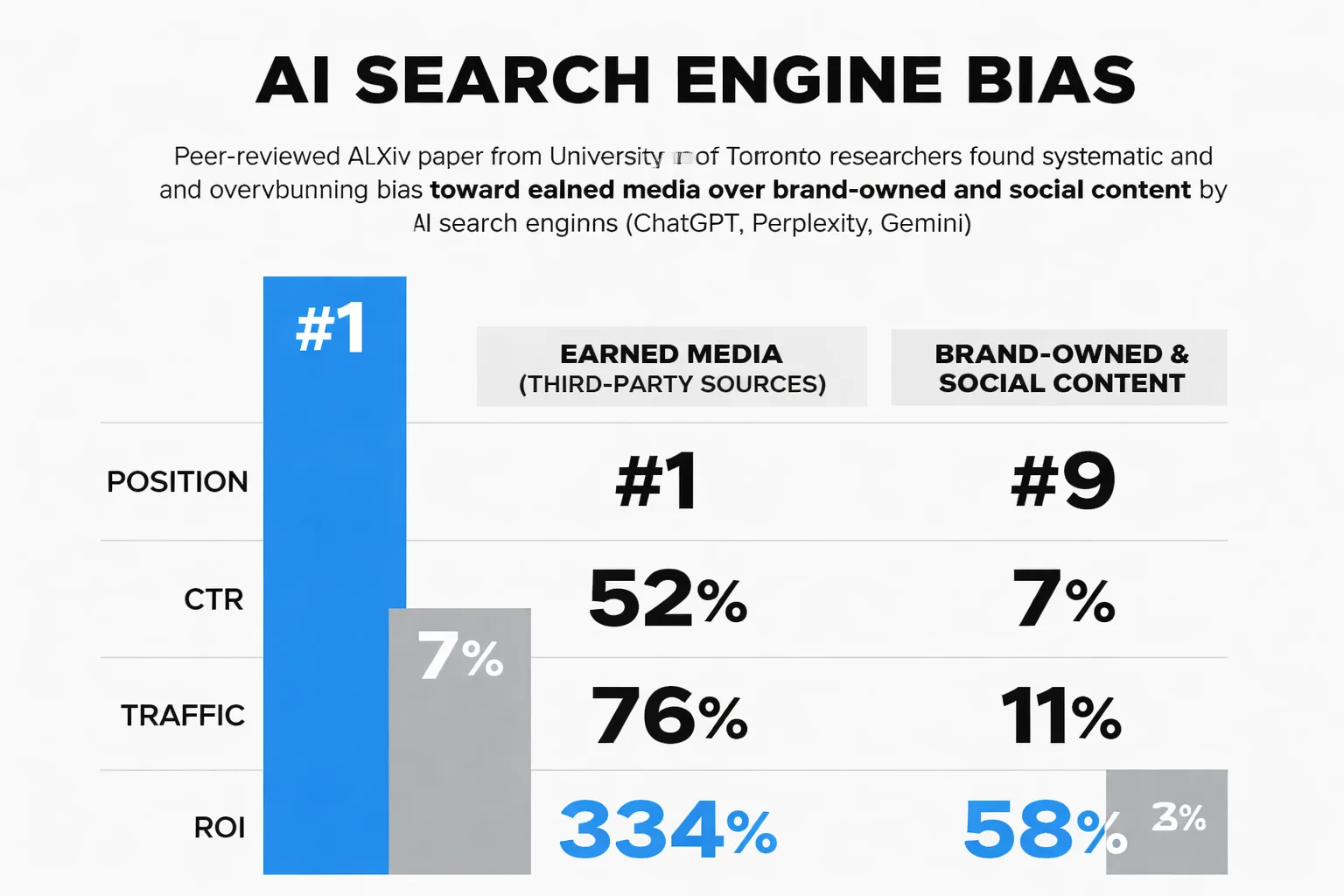
Here's what that means in practice. If you sell project management software and someone asks ChatGPT "what's the best project management tool for small teams," the answer won't come from your homepage. It'll come from G2 reviews, from a blog post by a productivity consultant, from a Wikipedia comparison page, or from a Reddit thread where users debate your product versus a competitor. Your job in profound answer engine optimization isn't to rank your own page. It's to make sure the sources AI engines trust are talking about you in the right way.
That distinction matters more than any keyword density check or meta tag optimization. I've seen brands pour budget into on-page SEO while their competitors quietly built relationships with the publishers and platforms that actually feed AI training data and citation pipelines. The brands getting recommended aren't smarter. They're playing a different game.
The BrightEdge data tells a second story that should worry anyone relying on platform-specific tactics. Their research found that 96.8% of cited domains saw zero week-over-week citation changes, and of the 3.2% that moved, 87% saw declines. Only 13% saw gains. AI citation patterns are mostly stable, but when they shift, the shift usually hurts. Stability is the baseline. Growth requires deliberate work.
The industry breakdown in that same BrightEdge study reveals something I find fascinating. Healthcare and Education categories saw AI Overview citation overlap with organic rankings reach 75% or higher. If you're in those industries, traditional SEO still does heavy lifting for AI visibility. But E-commerce overlap sat flat at 22.9%. If you sell products online, your Google rankings are almost irrelevant to your AI citation chances. You need a fundamentally different playbook. The 53.2 percentage point surge in Education overlap over 16 months was the largest industry shift in the study. That volatility means the rules are still being written.
Step 1: Audit Where You Are and Are Not Being Cited
Before you write a single word of new content, you need to know exactly where your brand appears and doesn't appear across AI search surfaces. This is the step most teams skip because it feels tedious. It is tedious. It also saves you from spending three months publishing content that doesn't move the needle.
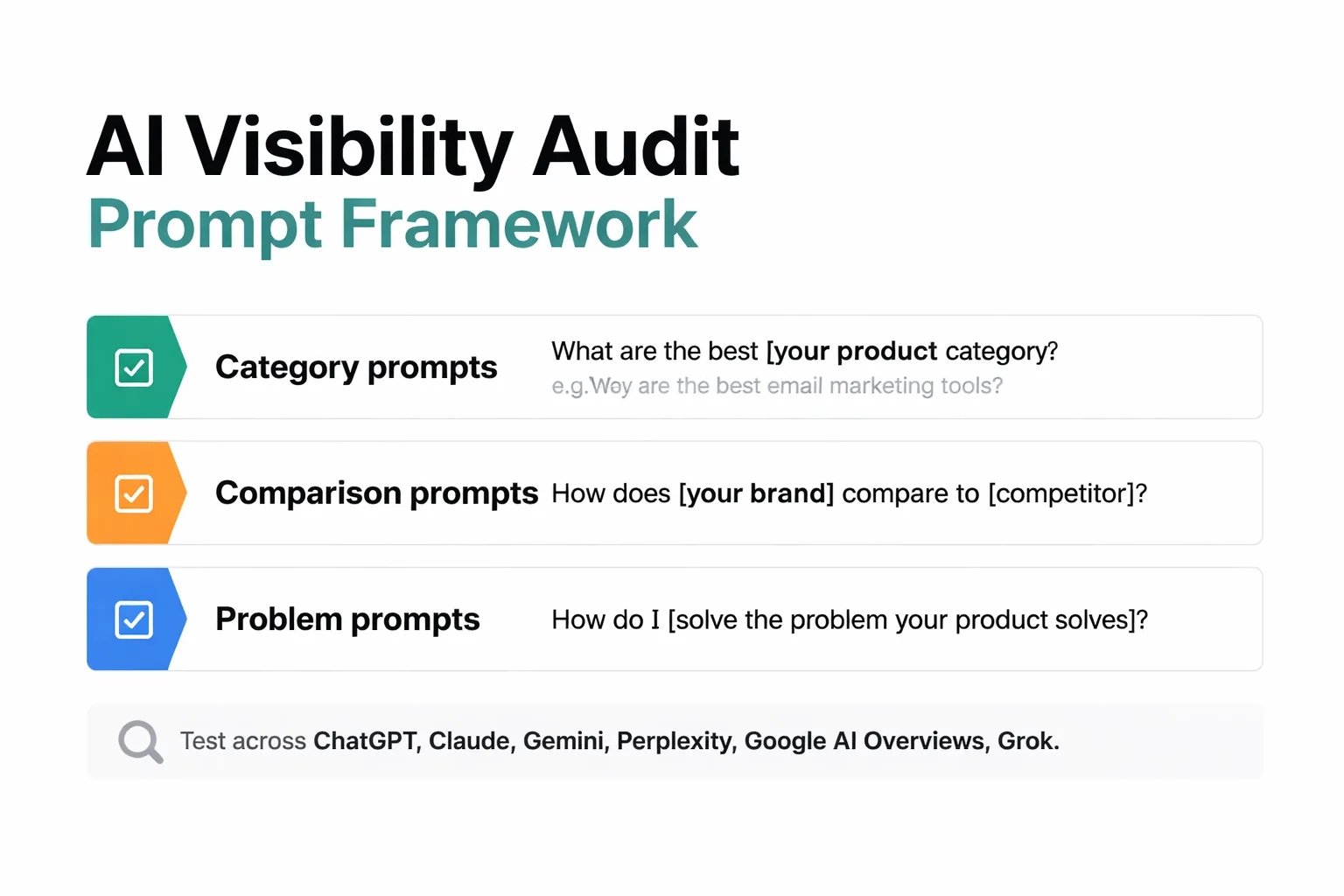
Start by testing a consistent set of prompts across every major AI search surface: ChatGPT, Claude, Gemini, Perplexity, Google AI Overviews, and Grok. You can use Meev's AI visibility checker to automate this, but a manual audit works for getting started. The key is consistency. Use the same prompts every time, run them in incognito mode, and log the results.
Here's the prompt framework I use:
1. Category prompts: "What are the best [your product category] tools?" (e.g., "What are the best email marketing tools?") 2. Comparison prompts: "How does [your brand] compare to [competitor]?" 3. Problem prompts: "How do I [solve the problem your product solves]?" 4. Feature prompts: "What tools have [specific feature your product is known for]?"
Run each prompt across every AI surface and record: (a) is your brand mentioned at all, (b) where in the answer does it appear (first, in a list, last), (c) what framing does it get (recommended, mentioned as an alternative, criticized), and (d) what sources does the AI cite alongside your mention.
That fourth data point is the goldmine. When ChatGPT recommends your competitor but not you, it's citing something. A G2 listicle. A Capterra review. A blog post from a consultant. Those are your target sources. Write them down. Every source an AI engine cites for your category is a source you need to be present on.
A 0% mention rate across all surfaces tells you something specific: your brand lacks entity recognition. The AI doesn't know who you are well enough to recommend you. No amount of content publishing will fix that until you build the entity signals I cover in Step 2. I've seen this with early-stage companies constantly. They publish great content, build solid backlinks, and still get zero AI mentions because they haven't established themselves as recognizable entities in the knowledge sources AI engines rely on.
The Perplexity AI visibility checker and ChatGPT AI visibility checker can help you track specific surfaces, but the audit methodology matters more than the tool. Run the same prompts weekly. Track changes. The goal isn't a perfect snapshot. It's a baseline you can measure improvement against.
One critical mistake I see in audits: teams test only one phrasing per intent. AI engines parse language differently based on phrasing. "Best CRM for startups" and "what CRM should a startup use" can produce entirely different citation sets. Test at least three phrasing variants per intent. Log which sources appear across multiple phrasings. Those are your highest-priority targets. A source cited across multiple phrasings is deeply embedded in the AI's retrieval path for your category.
Also, pay attention to the "citation chain." When Perplexity cites a blog post, that blog post cites a study, and that study references your competitor. You need to insert your brand into that chain. That means getting cited by the blog post, getting mentioned in the study, or creating your own original research that becomes a new link in the chain. The deeper you go into the citation chain, the more you understand why certain brands get recommended and others don't.
How Does Entity Grounding Work for AI Search?
Entity grounding is the process of making your brand recognizable as a distinct entity in the structured data sources AI engines use for disambiguation and retrieval. Think of it this way: when an AI engine encounters your brand name, it needs to know exactly who you are, what you do, and how you relate to other entities in your space. Without that grounding, your brand is just a string of characters. With it, your brand becomes a node in a knowledge graph the AI can traverse.
The most accessible entity grounding lever is Wikidata. No Wikipedia-level notability threshold is required to create a Wikidata entry. You can create a QID (Wikidata's unique identifier) for your company and populate it with structured properties: official website, industry, founded date, headquarters location, key people, and sameAs links to your other profiles. This gives AI engines a machine-readable identity for your brand.
Wikipedia accounts for 22% of ChatGPT training data and represents 12-15% of ChatGPT citations, according to Similarweb's analysis of 600,000 citation events. The variance in these numbers (5WPR's separate analysis found Wikipedia accounts for 26-48% of top-10 citation share) reflects different measurement scopes, but the direction is clear. Wikipedia and Wikidata presence correlates with AI recommendations.
But here's the nuance that matters. The same research found that underrepresented entities with weak structured data and limited knowledge graph presence suffer invisibility despite content optimization efforts. Wikidata presence alone isn't enough. You need proper entity infrastructure: sameAs schema links on your own pages pointing to your Wikidata entry and Wikipedia page, Organization schema markup with all relevant properties, and consistent NAP (name, address, phone) data across the web.
In my experience, the brands that move from zero mentions to consistent AI citations almost always start here. They create their Wikidata entry. They add Organization schema to their homepage. They make sure their sameAs links point to authoritative profiles (Crunchbase, LinkedIn, GitHub for tech companies). Then they wait. Entity recognition takes time to propagate through AI training and retrieval systems, but it's the foundation everything else rests on.
You can validate your structured data setup using the LLMs.txt validator to ensure your pages are readable by AI crawlers, and check your schema implementation with Google's Rich Results test. The technical bar isn't high. The consistency bar is. Every page on your site should reference the same organizational entity with the same properties.
Let me give you a concrete example of how this plays out. Say you run a company called "TaskFlow" that makes project management software. Without a Wikidata entry, when ChatGPT encounters "TaskFlow" in a prompt, it has to guess. It might confuse you with a similarly named app, a feature in another tool, or a concept. With a Wikidata QID (say, Q12345678), the AI can resolve "TaskFlow" to your specific entity: a software company founded in 2021, headquartered in Austin, TX, in the project management software industry, with an official website at taskflow.com. That disambiguation is what makes recommendation possible.
The sameAs property is where most teams stop too early. Don't just link to your homepage. Link to your LinkedIn company page, your Crunchbase profile, your GitHub organization (if applicable), your G2 profile, and any other authoritative platform where your brand has a verified presence. Each sameAs link reinforces your entity identity across the knowledge graph. The more nodes that connect to your entity, the more confident the AI becomes in recommending you.
Step 3: Reverse-Engineer the Sources AI Engines Already Trust
This is where profound answer engine optimization diverges from traditional SEO. In classic SEO, you optimize your own pages to rank. In AEO, you need to understand which sources AI engines are already citing in your category and ensure your brand is present on those sources with the right framing.
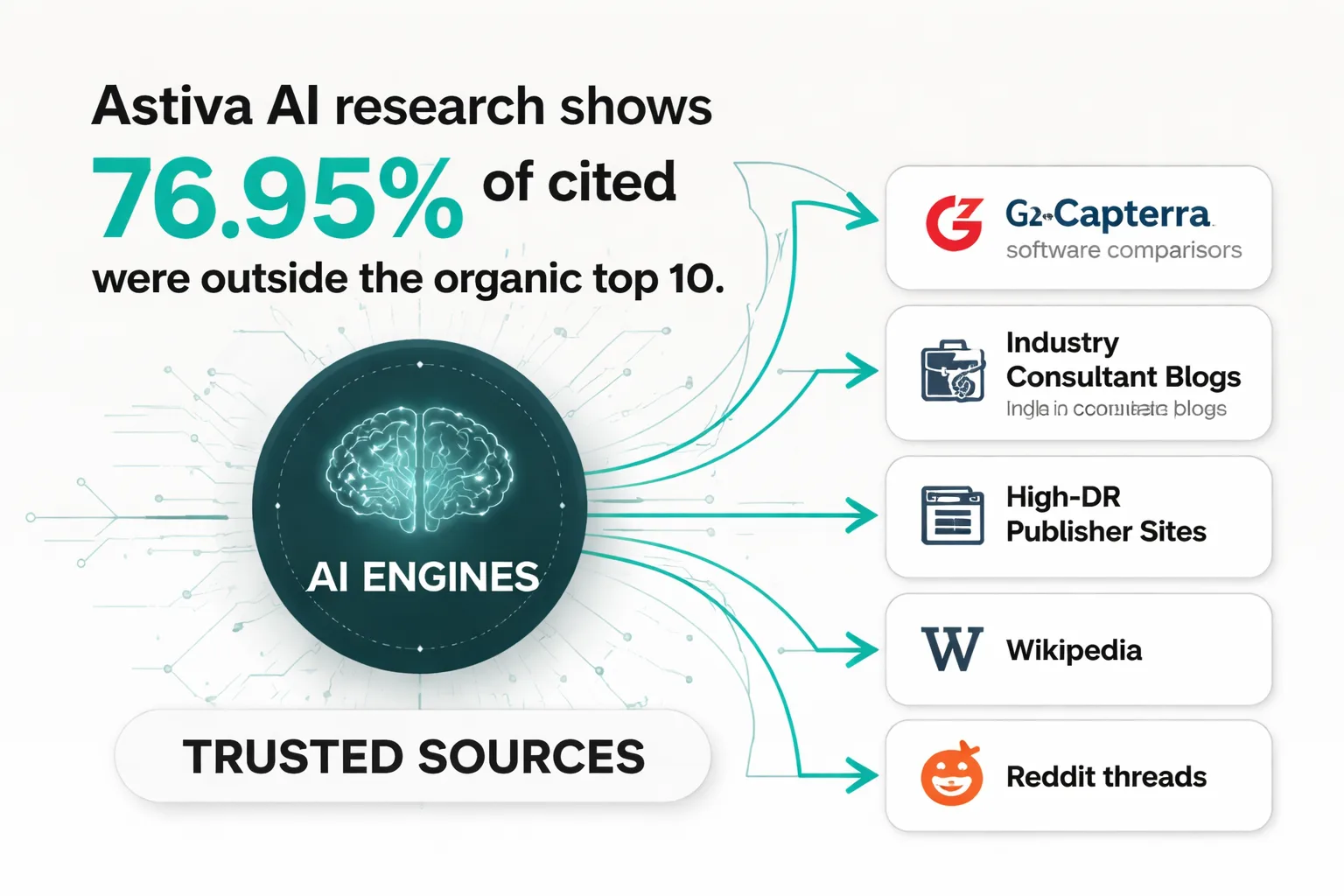
Go back to your audit data from Step 1. Look at the sources cited alongside every mention (or non-mention) of your brand. You'll start seeing patterns. ChatGPT might consistently cite G2 and Capterra for software comparisons. Perplexity might lean toward blog posts from industry consultants. Google AI Overviews might pull from high-DR publisher sites.
Astiva AI's research shows that 76.95% of cited URLs were outside the organic top 10, which means the sources AI engines trust aren't always the sources that rank highest on Google. This is the most important data point in this entire article for understanding why your Google rankings don't translate to AI recommendations.
Create a source map. List every domain that AI engines cite for your category prompts. Then for each source, note: (a) is your brand present on that source, (b) what does it say about you, (c) what would it take to improve or establish your presence.
For software companies, this usually means claiming and optimizing profiles on G2, Capterra, TrustRadius, and Sourceforge. For consumer brands, it means ensuring presence on Reddit (with the caveat I'll discuss below), review sites, and relevant publications. For B2B companies, it means getting cited in industry reports, analyst publications, and consultant blogs.
The University of Toronto arXiv paper on Generative Engine Optimization formalized what I've been observing in practice: AI engines show systematic bias toward earned media over brand-owned content. Your product page, your blog, your landing page. These matter for traditional SEO. They matter less for AI citations. The sources that move the needle are the ones you don't control directly.
This is why answer engine optimization services and generative engine optimization strategies that focus purely on publishing more content miss the point. You can publish 100 blog posts and still not get cited by ChatGPT if the third-party sources AI engines trust aren't talking about you. The work happens in two places: on your own site (entity grounding, structured content) and off your site (source presence, earned media, relationship building).
Let me walk through a concrete reverse-engineering example. Say you sell accounting software for freelancers. You run the prompt "best accounting software for freelancers" across ChatGPT, Perplexity, and Gemini. ChatGPT recommends FreshBooks, QuickBooks, and Wave. It cites a NerdWallet comparison article and a Forbes Advisor review. Perplexity recommends the same three plus Xero, citing a Reddit thread in r/freelance and a blog post by a tax accountant.
Your source map now has four domains: nerdwallet.com, forbes.com, reddit.com, and the accountant's blog. For each, you check: is your brand there? If not, what's the path to getting included? NerdWallet's comparison article is updated quarterly. You need to get listed there, which likely means reaching out to their editorial team with a compelling case for inclusion. The Reddit thread is organic. You can't control it, but you can ensure your brand has a presence in freelance communities where these recommendations originate. The accountant's blog is a relationship play. You offer them a free account, ask for an honest review, and if it's positive, they may include you in future content.
This is slow, unglamorous work. It's also the work that actually moves AI citation rates. Every source you get added to is a new potential citation path for every future prompt in your category.
Step 4: Publish Content Structured for AI Extraction
Once your entity signals are in place and you know which sources to target, the next step is publishing content that AI engines can extract clean answers from. This is where answer engine optimization meets content strategy.
AI engines don't read content the way humans do. They look for extractable answer units: concise definitions, direct answers to questions, and cited data points they can synthesize. The AEO vs SEO distinction matters here. Traditional SEO rewards depth and comprehensiveness. AEO rewards extractability.
Here's the structure that works:
Open with a 40-60 word direct answer. When someone asks a question that your content answers, the AI engine looks for the first extractable answer block. Put it at the top. Don't bury the answer under 200 words of context.
Use question-shaped H2s. AI engines extract from question headings. "How does entity grounding work for AI search?" is more extractable than "Entity Grounding Fundamentals."
Cite specific sources with numbers. AI engines prefer to cite content that itself cites authoritative sources. When you reference data, link to the primary source. When you make a claim, attribute it. This creates a citation chain the AI can follow and trust.
Use structured data. Article schema, FAQ schema, HowTo schema. These markup formats explicitly tell AI engines what your content is and how it's organized. The best GEO tools can help automate this, but you can also implement schema manually.
I've seen the difference this makes firsthand. Content structured with direct-answer openings and question-shaped H2s gets extracted by AI engines at a noticeably higher rate than traditional long-form content with the same information buried mid-paragraph. The information is identical. The structure is what changes.
For teams publishing at scale, this is where an AI SEO tool with quality controls becomes valuable. The risk with AI-generated content isn't just quality. It's structure. Most AI writers produce walls of prose without extractable answer blocks. You need content specifically architected for AI extraction, with direct answers, cited sources, and proper schema. Without those structural elements, you're publishing content that humans might read but AI engines will skip.
Let me get specific about what "extractable" means. An AI engine like ChatGPT processes your page by chunking it into semantic units. It looks for sentences or paragraphs that directly answer a question. If your H2 is "How to choose a project management tool" and the first paragraph below it starts with "Choosing a project management tool requires careful consideration of several factors," the AI has to read further to find the actual answer. But if that paragraph starts with "To choose a project management tool, evaluate team size, budget, integration needs, and complexity. Small teams under 10 people should prioritize ease of use over advanced features," the AI can extract that entire sentence as a self-contained answer unit.
This is why I push for direct-answer openings in every piece of content. Not because humans don't need context. They do. But because AI engines extract from the top. If the first 50 words of any section don't contain an extractable answer, the AI moves on to the next source that does.
The same principle applies to data points. "According to BrightEdge's 16-month study, AI Overview citations overlap with organic rankings 54.5% of the time" is extractable. "Research shows that AI and search engine optimization are increasingly connected" is not. Specific numbers, named sources, and clear attribution. That's what AI engines pull.
Do you know which AI engines are citing your brand right now?
Step 5: Measure Citation Lift and Iterate
The final step is measurement. You can't improve what you don't track, and AI citation patterns shift in ways that traditional SEO tracking completely misses.
Re-run your citation audit weekly. Same prompts, same surfaces, same logging format. Track three metrics:
1. Mention rate: percentage of prompts where your brand appears at all. 2. Mention position: where in the answer your brand appears (first, in a list, last). 3. Mention framing: the context around your mention (recommended, compared, mentioned as alternative).
The third metric is the one most teams miss, and it's the one I've come to believe matters most. In my work, I initially focused on boosting raw mention rates, thinking more mentions equaled more visibility. That was a significant misstep. An AI could recommend your brand as a "good starting point" before suggesting a more "advanced" competitor, effectively funneling users away from you. It's not about being seen. It's about being seen in the right light, with the right narrative, to genuinely influence a buying decision.
This is why AI visibility tracking needs to go beyond binary mention counting. You need the actual response text behind every mention, the sentiment, and the competitive context. A 15% mention rate with positive framing is worth more than a 40% mention rate where you're consistently positioned as the budget alternative.
The BrightEdge data on citation stability is relevant here too. Their finding that 96.8% of cited domains saw zero week-over-week changes means you're playing a long game. Citation patterns don't shift dramatically week to week. Improvement happens slowly, then sometimes suddenly when an AI model updates. Patience and consistency matter more than any quick hack.
One measurement trap I want to warn against: the IQRush paper published April 2026 found that AI visibility rankings show statistical noise and instability. What looks like a 5% mention rate improvement might be random variation. You need at least 4-6 weeks of consistent data before drawing conclusions about whether a specific change moved the needle. Single-week jumps or drops are usually noise. Look for sustained directional shifts over a month or more before declaring victory or panicking.
The Similarweb analysis of answer engine optimization queries found a 78% zero-click rate for AEO-related searches. That means even when people search for information about answer engine optimization, most don't click through to any source. The AI answer satisfies them. This is the future of all search. If your brand isn't in the AI answer, you don't exist for that query. Measurement isn't optional. It's the only way to know if your work is reaching anyone at all.
How to Increase AI Visibility Today: Quick Wins
Three actions you can take this week without a full content team:
1. Create your Wikidata entry. Go to wikidata.org, create an account, and add a QID for your company. Populate it with your official website, industry, founded date, and sameAs links to your LinkedIn, Crunchbase, and other profiles. This takes 30 minutes and gives AI engines a machine-readable identity for your brand. No notability threshold required.
2. Claim and optimize your G2/Capterra profiles. If AI engines are citing review sites for your category (and they almost certainly are), your brand needs to be there with complete, accurate information. Claim your profile, add detailed product descriptions, and ensure your categorization is correct. This is low-effort, high-impact.
3. Add Organization schema to your homepage. Use schema.org/Organization markup with your official name, logo, website, founding date, and sameAs links to your Wikidata entry, Wikipedia page (if you have one), and social profiles. This gives AI crawlers structured entity data on every visit. Test it with Google's Rich Results test.
These three actions won't get you cited overnight. They establish the entity infrastructure that makes future citations possible. Without them, every other AEO effort is built on sand.
A fourth quick win that most guides won't mention: check if your brand has a presence on the platforms that feed AI training data. Reddit is the obvious one, but also consider Stack Overflow (for developer tools), Quora, and industry-specific forums. I'm not saying you should spam these platforms. I'm saying that if your brand is genuinely discussed on them, those discussions become part of the AI's knowledge base. The key word is genuinely. Forced, promotional content gets ignored or downvoted. Real user experiences and honest recommendations are what AI engines extract and synthesize.
When This Fails: Where AEO Strategies Break Down
This five-step process doesn't work everywhere. Three scenarios where it falls apart:
New brands with zero category presence. If nobody knows your company exists, no AI engine will recommend it. Entity grounding helps, but if you launched last month and have no third-party coverage, no reviews, and no analyst mentions, you're invisible. The fix isn't more content. It's PR, partnerships, and getting listed on the directories and review platforms your category relies on. AEO builds on existing brand awareness, not the other way around.
Highly niche B2B categories. If your product serves a market so specialized that AI engines rarely get asked about it, citation opportunities are inherently limited. You can't optimize for prompts nobody asks. In these cases, focus on adjacent topics where your expertise is relevant and where AI engines do get questions. A company making specialized compliance software for healthcare shouldn't expect to be cited for "best compliance software." But they might get cited for "how to comply with HIPAA requirements for medical devices."
Volatile AI model updates. The Reddit example is instructive here. Reddit held a steady 3.8% share of ChatGPT citations until a ChatGPT update around August 7 caused a sudden visibility drop. Founders who built entire strategies around Reddit mentions lost visibility without warning. The lesson: any strategy that depends on a single platform or source is fragile. Diversify your entity presence across multiple sources so a single model update doesn't erase your progress.
What Is Answer Engine Optimization, Really?
Let me define this clearly because the term gets thrown around loosely. Answer engine optimization is not just SEO with a new label. It's a distinct discipline that targets a fundamentally different retrieval mechanism.
Traditional SEO optimizes for ranked lists. Google returns ten blue links, and you fight for position one. AI search engines return synthesized answers. They don't rank pages. They extract information from multiple sources, combine it, and present a single answer with citations. The AEO vs GEO distinction is subtle but real. AEO focuses on getting your brand cited in those synthesized answers. GEO (Generative Engine Optimization) is the broader academic framework that describes the systematic optimization of content for AI search engines' retrieval patterns.
The practical difference matters. In traditional SEO, you can rank position one for "best CRM for startups" and capture 30% of the clicks. In AI search, if ChatGPT recommends three CRMs and you're not one of them, you get zero. There's no position four. There's no page two. You're either in the answer or you don't exist.
This binary outcome is what makes profound answer engine optimization so high-stakes. The Similarweb data showing a 78% zero-click rate for AEO queries tells you everything about where search is going. If the AI answer satisfies the user, they never click. They never visit your site. They never become a lead. Unless you're in the answer.
That's why I push teams to think about AEO not as a channel addition but as a survival strategy. The brands that get recommended by AI engines will capture demand that used to flow through Google organic results. The brands that don't will see their organic traffic erode as AI answers satisfy more queries without any click-through.
FAQ
What is answer engine optimization?
Answer engine optimization (AEO) is the practice of structuring your brand's online presence so AI search engines (ChatGPT, Perplexity, Gemini, Google AI Overviews) can identify, trust, and cite your brand in their answers. It differs from traditional SEO because it focuses on entity recognition, earned media presence, and content structured for AI extraction rather than keyword ranking alone.
How long does it take to see AI citation improvements?
Based on the BrightEdge data showing 96.8% weekly citation stability, AI citation patterns are sticky. Expect 2-3 months before seeing measurable shifts from new entity grounding and content efforts. Model updates can cause sudden changes in either direction, which is why consistent weekly tracking matters.
Do I need a Wikipedia page to get cited by AI engines?
No. While Wikipedia accounts for a significant share of AI citations, Wikidata entries (which don't require Wikipedia's notability threshold) provide the entity disambiguation AI engines need. Organization schema on your own site and sameAs links to authoritative profiles also help AI engines recognize your brand.
What's the difference between AEO and GEO?
AEO (answer engine optimization) focuses on getting your brand cited in AI-generated answers. GEO (generative engine optimization) is a broader academic framework from University of Toronto researchers that describes optimizing for AI search engines' systematic bias toward earned media. The AEO vs GEO distinction is mostly academic. In practice, both require the same work: entity grounding, source authority, and structured content.
Can I track AI visibility without a paid tool?
Yes. Run the same set of prompts across ChatGPT, Perplexity, Gemini, and Google AI Overviews weekly. Log mentions, position, and framing in a spreadsheet. It's manual but effective for getting started. Paid tools like an enterprise AI rank tracker add automation, trend tracking, and competitive analysis at scale.
What should I do if my brand is mentioned but framed negatively?
This is where framing matters more than mention rate. If an AI engine cites your brand as the "budget alternative" or "less advanced option," you need to change the narrative on the sources the AI is citing. That means improving your presence on review sites, getting featured in industry reports with the right positioning, and publishing content that establishes your brand's strengths in areas the AI currently positions you as weak.
Profound answer engine optimization isn't a one-time project. It's a continuous practice of building entity signals, earning third-party coverage, publishing extractable content, and measuring what changes. The brands that commit to this process are the ones AI engines will recommend. The ones that don't will watch competitors take their place in every answer that matters.
About the Author
Judy Zhou, Founder
Judy Zhou leads content strategy at Meev, where she oversees AI-driven content research and publishing for hundreds of brands. With a background in SEO and editorial operations, she focuses on building content systems that rank on Google, get cited by AI search engines, and drive measurable business results.
Run a free AI visibility audit across every major AI search surface and see exactly where your brand is missing.