

By Judy Zhou, Founder
Key Takeaways
- Organic click-through rates for informational queries have dropped 61% due to AI Overviews, so any SEO platform limited to Google blue-link tracking leaves you blind to where buyers now research.
- Perplexity cites sources in 60.6% of responses versus ChatGPT’s 32.6%, making engine-specific segmentation the single biggest optimization lever most dashboards hide.
- Global brands like Stripe and Nike appear in 73% of relevant AI answers on first run, proving you must measure your own citation rate or risk losing visibility to unknown competitors.
- Audit your platform today by adding AI-answer monitoring, because the overlap between top Google results and AI-cited sources has already fallen below 20%.
A head of SEO at a mid-size e-commerce brand typed her own company's flagship product into Perplexity last October. The AI returned a confident, sourced, three-paragraph answer recommending two competitors and citing a blog post from a site she'd never heard of. Her brand. Despite ranking second on Google for the same query. Wasn't mentioned once. She spent the next morning clicking through every tab of her search engine optimization platform dashboard. None of them had a single metric that would have warned her this was happening.
If your SEO platform only tracks Google blue-link positions, you are flying blind on the channels where your buyers actually research. Organic click-through rates for informational queries have dropped 61% due to AI Overviews, and the overlap between top Google results and AI-cited sources has fallen below 20% by some estimates. A study of 543 real AI answers across four engines found that Perplexity cites sources in 60.6% of responses while ChatGPT cites in only 32.6%, meaning a platform that doesn't segment by engine is hiding the biggest optimization lever you have. Global household brands like Stripe and Nike appear in 73% of relevant AI answers on first run, according to an arXiv study analyzing 100K+ prompt responses. If your platform can't tell you where you stand on that ladder, it's not built for 2026.
Why Your SEO Platform Misses AI Search Entirely
Most search engine optimization platforms were architected for a world that no longer exists. They crawl SERPs, count backlinks, track keyword positions, and generate reports about your Google performance. That was sufficient when Google was the only search surface that mattered. It is not sufficient now.
The problem isn't that these platforms are broken. They do what they were built to do. The problem is that the job changed and nobody told them. Buyers now ask ChatGPT for product recommendations. They type questions into Perplexity and read the cited sources. They see Google AI Overviews above the blue links they used to click. Your platform tracks none of this.
I've been auditing content operations for years, and the pattern I keep seeing is the same: a team invests heavily in a search engine optimization platform, builds dashboards, trains staff, and then discovers their brand is invisible on the channels their audience actually uses. The Seer Interactive data showing a 61% drop in organic CTR for informational queries should make every SEO lead question whether their platform is measuring the right things. That number represents real traffic that used to arrive via Google blue links and now gets absorbed by AI Overviews before the user ever scrolls.
Here's what makes this urgent. The ZenoX citation study analyzed 543 real AI answers across four engines and found dramatically different citation behaviors. Perplexity cites sources in 60.6% of answers. ChatGPT cites in 32.6%. Claude in 32.4%. Gemini in 43.5%. If your platform reports a single "AI visibility score" without breaking it down by engine, you cannot diagnose why you're cited on Perplexity but invisible on ChatGPT. You cannot optimize for engines that behave differently if your tool treats them as one monolithic channel.
And the gap is wider than you think. Two out of three ChatGPT answers contain no citation link at all. 34% of the time when ChatGPT doesn't cite your brand, it answered from memory with no web search. Your freshly published, perfectly optimized blog post doesn't matter to ChatGPT if it wasn't in the model's training data. That's not a content quality problem. It's a platform measurement problem.
Step 1. Map What Your Platform Measures Today
Before you can identify gaps, you need an honest inventory of what your current tool actually does. Most teams have never done this. They bought the platform two years ago, learned the features they needed at the time, and stopped exploring.
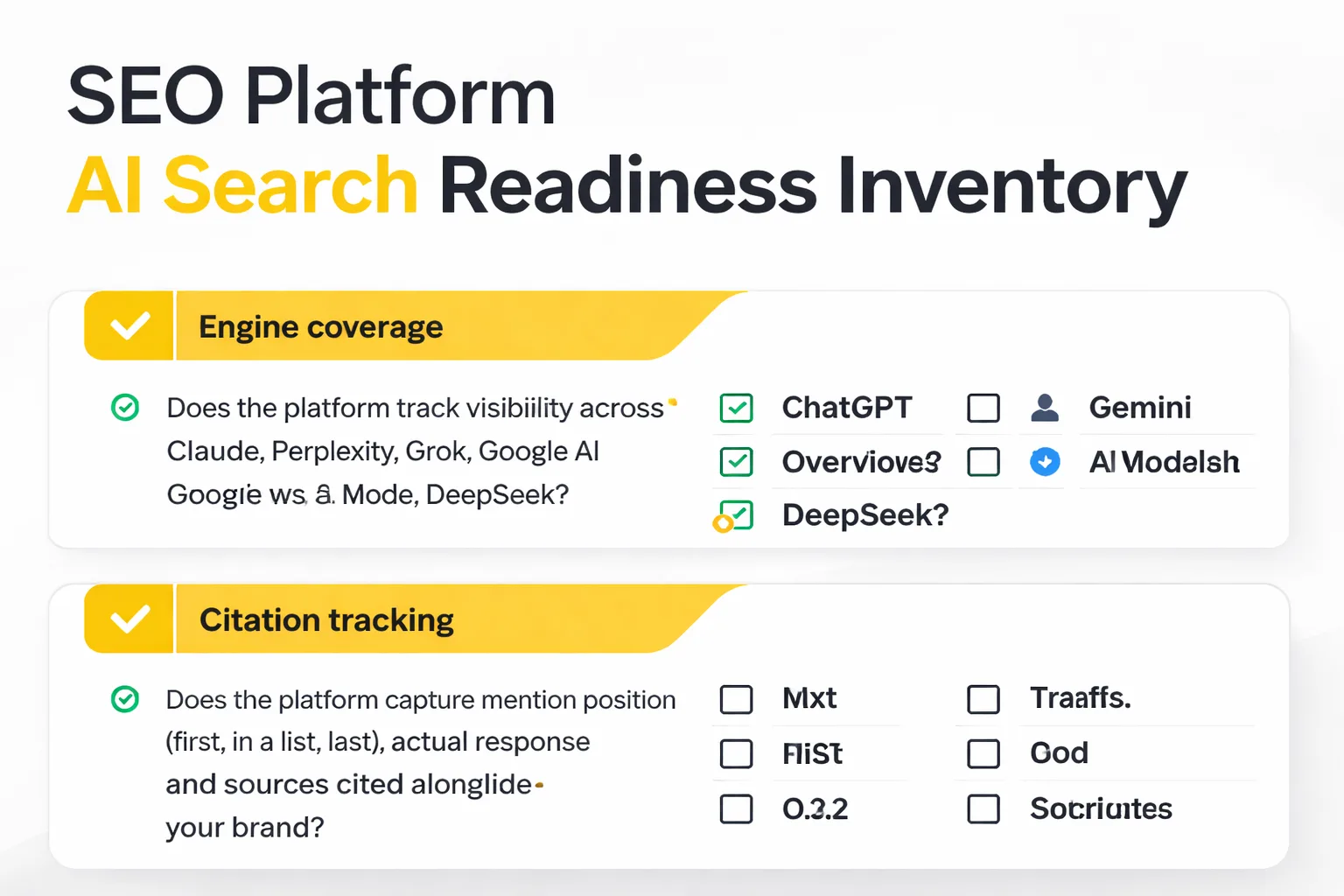
Here's the inventory checklist I use when auditing a search engine optimization platform for AI search readiness:
Engine coverage. Does the platform track visibility across every major AI search surface? List them: ChatGPT, Claude, Gemini, Perplexity, Grok, Google AI Overviews, Google AI Mode, DeepSeek. If the answer is "we track Google AI Overviews" and nothing else, you have a coverage gap. Most platforms added AIO tracking in 2025 and stopped there.
Citation tracking. When an AI engine mentions your brand, does the platform capture whether you're mentioned first, in a list, or last? Does it store the actual response text and the sources cited alongside you? If you can only see a mention count without the context of what was said and who else was cited, you're missing the data that drives optimization decisions.
Source attribution. This is the one almost every platform misses. When an AI answer cites a source, which domain gets the citation? Is it your blog, a competitor's blog, a Reddit thread, a Wikipedia page? The arXiv GEO study found that global household brands appear in 73% of relevant AI answers, which means brand stature (built through external mentions) matters more than on-page optimization. If your platform doesn't show you which domains AI engines cite for your topics, you can't build a strategy to earn those citations.
Competitor benchmarking. Can you see your share of voice across AI engines compared to specific competitors? Not a generic "domain authority" score. Actual mention frequency, citation position, and share of AI answers where you appear versus they do.
Prompt-level tracking. Does the platform let you track specific prompts (not just keywords) across engines? AI search doesn't map cleanly to keyword rankings. The same query phrased three different ways can produce three different answers with three different citation sets. If your tool only tracks keyword-to-position mappings, it's measuring the wrong unit.
Reporting. Can you generate a report that shows AI visibility trends over time, segmented by engine, with the actual answer text behind each data point? If your AI visibility report is a single number with no drill-down, it's not actionable.
Run this inventory yourself. Open your platform right now and try to answer each question. If you can't find the feature, it either doesn't exist or is buried so deep that nobody on your team uses it. Both are failures.
How Do AI Citation Patterns Differ Across Engines?
This is the question your platform needs to answer, and most can't. AI engines don't behave like Google. They don't rank pages. They generate answers by retrieving and synthesizing information, and each engine does this differently.
The ZenoX study tested 193 queries across four engines and analyzed 543 real AI answers. The citation rate differences are stark:
- Perplexity: 60.6% of answers cite sources - Gemini: 43.5% - ChatGPT: 32.6% - Claude: 32.4%
What does this mean for your audit? If your audience skews toward ChatGPT users (and in B2B, many do), your platform needs to account for the fact that two-thirds of ChatGPT answers contain zero citation links. 34% of the time ChatGPT doesn't cite your brand, it answered from memory with no web search at all, according to the ZenoX analysis. No amount of fresh content optimization will fix that. You need entity-level presence in the model's training data, which means you need a platform that tracks entity grounding and knowledge graph presence, not just content publishing.
Perplexity is the opposite. It almost always retrieves and cites. Your freshly published, well-optimized content has a real shot at earning citations there. But your platform needs to track Perplexity separately from ChatGPT because the optimization strategies are fundamentally different.
A platform that lumps these engines together into one "AI visibility" metric is hiding the most important strategic insight: you need different tactics for different engines. This is why AI search optimization tools that segment by engine are becoming essential infrastructure, not nice-to-have add-ons.
Step 2. Identify the AI Visibility Blind Spots
Now you need to find the gaps your platform can't see. This is a manual exercise. It takes about 90 minutes and it will change how you think about your search strategy.
Phase 1: Run 10 buyer-intent prompts across three engines. Open ChatGPT, Perplexity, and Google (with AI Overviews enabled). Type prompts that mirror how real buyers search. Not keyword strings. Natural language questions.
Examples for a B2B SaaS company:
- "What's the best tool for tracking AI search visibility?" - "How do I know if my brand shows up in ChatGPT answers?" - "Alternatives to [your competitor] for AI SEO" - "Who are the top providers for generative engine optimization?"
For each prompt, record: which brands are mentioned, which sources are cited, where your brand appears (or doesn't), and what the answer recommends.
Phase 2: Compare against your platform's data. Pull your platform's ranking report for the same topics. You'll likely see a disconnect. Your platform says you rank #3 for "AI visibility tool." ChatGPT doesn't mention you at all. Perplexity cites a competitor you outrank on Google. This disconnect is the gap.
Phase 3: Map the gap pattern. Look for patterns across the 10 prompts. Is your brand consistently absent from ChatGPT but present on Perplexity? That suggests an entity grounding problem. ChatGPT is answering from memory and your brand isn't in the training data strongly enough. Is your brand cited but always listed last? That suggests a topical authority problem. You're in the conversation but not authoritative enough to lead it.
If your search engine optimization platform can't explain these discrepancies, that's the gap. The platform is measuring a world (Google SERP positions) that no longer fully represents your search visibility.
I've run this exercise with teams and the reaction is always the same: shock, followed by a frantic search through their platform's feature list for something they missed. They didn't miss it. It's not there.
Is your SEO platform showing you where ChatGPT and Perplexity cite your competitors instead of you?
Step 3. Score Against the New Baseline
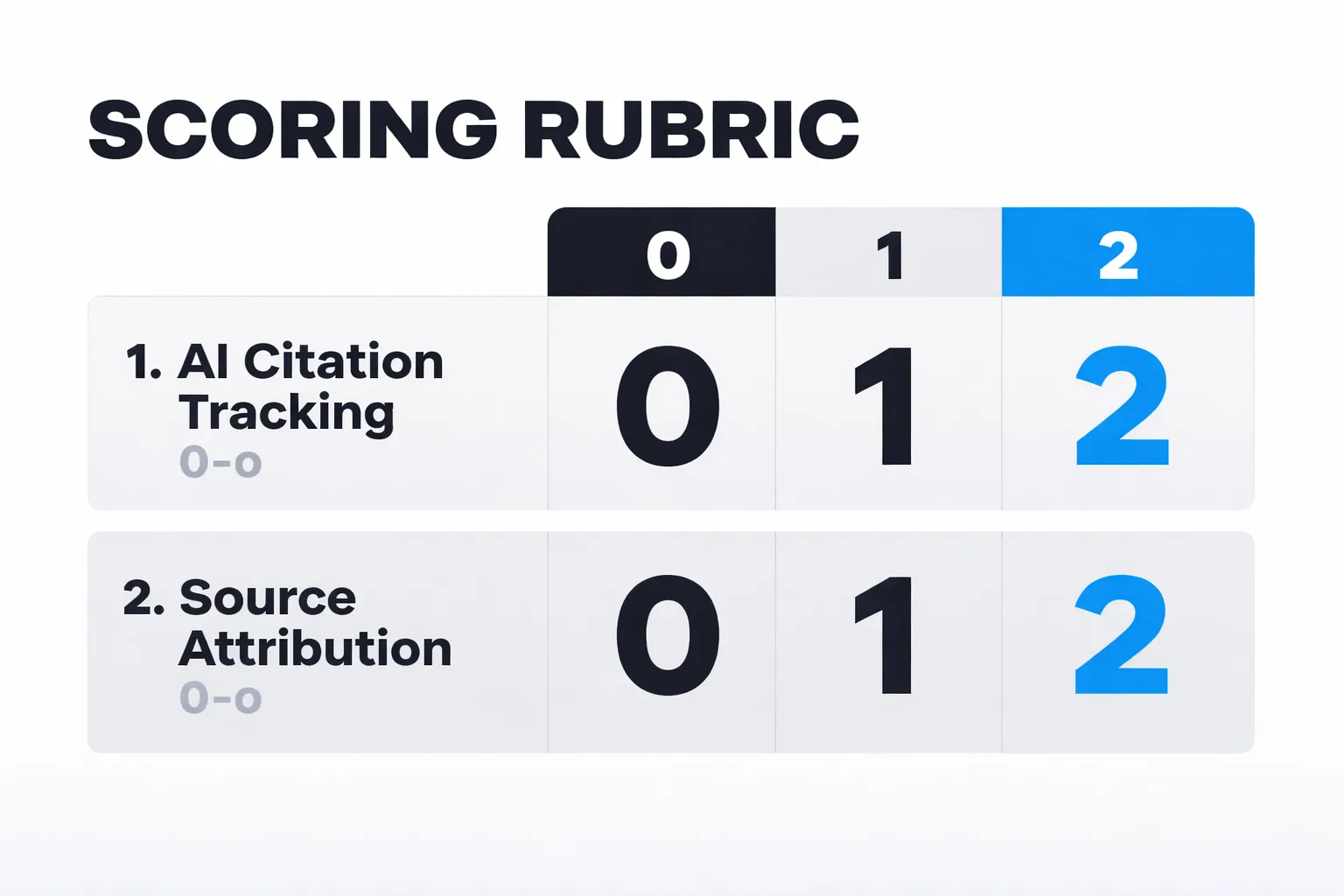
Now you need a structured way to evaluate whether your current platform can be augmented or needs to be replaced. I use a five-point scoring rubric. Score each dimension 0 (missing), 1 (partial), or 2 (fully covered).
1. AI citation tracking (0-2). Does the platform track brand mentions across every major AI search surface, segmented by engine, with mention position data (first, in a list, last)? A score of 0 means it tracks only Google. A score of 1 means it tracks some AI engines but without position or segmentation. A score of 2 means full coverage with drill-down to actual response text.
2. Source attribution (0-2). Can you see which domains AI engines cite most often for your topics? Does the platform surface a "cited-source leaderboard" showing where AI answers pull their information? This is critical because the arXiv study found a three-tier brand-stature ladder in AI citation visibility. Global household brands appear in 73% of relevant AI answers. Mid-market and emerging brands appear far less. Your platform needs to show you where you sit on that ladder and which sources you'd need to earn citations from to climb.
3. Content publishing workflow (0-2). Does the platform include a content workflow that produces answer-engine-optimized content, or does it only analyze existing content? A platform that can diagnose gaps but can't help you close them through answer engine optimization is only doing half the job.
4. Entity and knowledge graph coverage (0-2). Does the platform track your entity presence in Wikidata, Wikipedia, and major knowledge graphs? Does it monitor whether your brand entity is correctly grounded in LLM training data? This is the dimension most platforms score 0 on, and it's the one that matters most for ChatGPT visibility (where 34% of answers come from memory, not web search).
5. Reporting clarity (0-2). Can you generate a report that a CFO or CMO would understand? Does it show AI visibility trends, competitor share of voice, and specific citation gaps with recommended actions? Or is it a data dump that requires an SEO analyst to interpret?
| Dimension | Score 0 | Score 1 | Score 2 |
| AI citation tracking | Google only | Some engines, no segmentation | All engines, position data, response text |
| Source attribution | Not available | Shows mentions, not cited sources | Cited-source leaderboard with domain-level data |
| Content workflow | Analysis only | Recommendations, no publishing | Full AEO content generation and publishing |
| Entity/knowledge graph | Not tracked | Brand mentions only | Wikidata, knowledge graph, LLM training data presence |
| Reporting clarity | Data dump | Internal team only | Executive-ready with action items |
Total your score. 0-3: Your platform is a Google-only tool in an AI search world. You need to augment or replace immediately. 4-6: Your platform has partial AI coverage but significant blind spots. Layer in specialized AI visibility tooling. 7-10: Your platform covers the new baseline. Focus on execution.
Most traditional search engine optimization platforms score 2-4 on this rubric. They were built for Google. The AI features were bolted on as an afterthought.
What to Do When Your Platform Fails the Audit
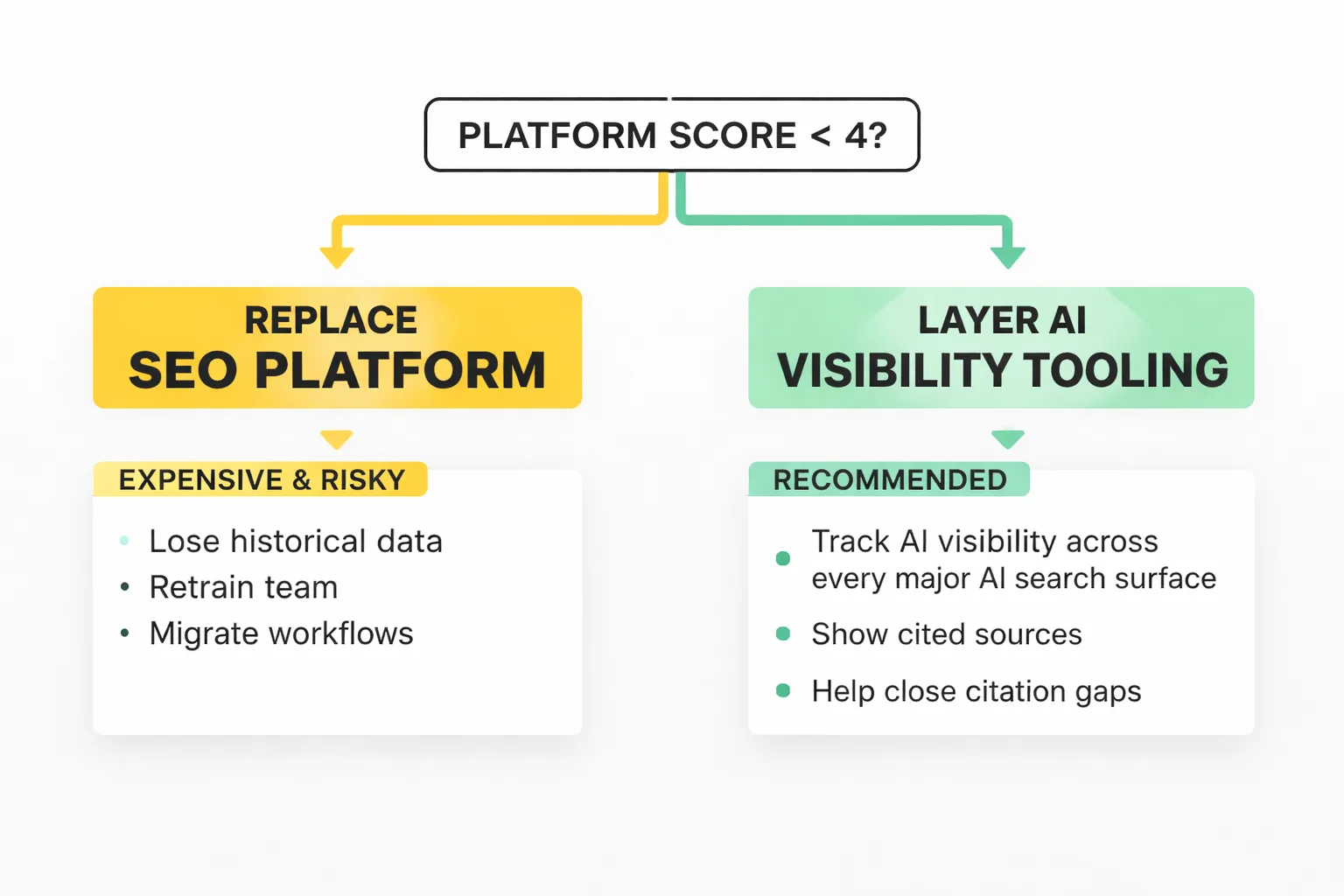
If your platform scored below 4, you have two options: replace it or layer AI visibility tooling on top. I almost always recommend layering. Here's why.
Replacing your SEO platform is expensive and risky. You lose historical data, retrain your team, and migrate workflows. The switching cost is real, and the platform you switch to might not be better. Most traditional SEO platforms are excellent at what they do (Google rank tracking, technical audits, backlink analysis). You don't need to throw that away.
What you need is to add a layer that covers what your platform misses. That layer should track AI visibility across every major AI search surface, show you which sources AI engines cite for your topics, and help you close citation gaps through content and outreach.
At Meev, I've built this layer specifically for teams that need AI search visibility without abandoning their existing SEO stack. The approach is diagnostic first: we show you what your brand is cited for today across ChatGPT, Claude, Gemini, Perplexity, Grok, Google AI Overviews, AI Mode, and DeepSeek, where you're absent, and which sources move the needle. Then we close the gap with answer-engine-optimized content that gets published through a quality-gated workflow.
The point isn't to sell you a platform. The point is that you need this capability somewhere in your stack. If your current search engine optimization platform doesn't have it, you need to add it. The arXiv study showing that global brands appear in 73% of AI answers while emerging brands are largely invisible should make this clear. The gap between you and the brands AI engines prefer is growing every day you don't measure it.
How Does Entity Grounding Affect AI Visibility?
Entity grounding is the concept most SEO teams haven't grappled with yet, and it's the one that will determine your ChatGPT visibility for the next two years.
When ChatGPT answers a question without searching the web (which happens 34% of the time according to the ZenoX study), it pulls from its training data. Your brand's presence in that training data depends on how strongly your entity is represented across the web. Not your blog posts. Your entity.
An entity is your brand as a structured, identifiable thing in the knowledge graph. It's your Wikidata entry. Your Wikipedia page (if you have one). Your presence in structured data across high-authority sites. The consistency of your NAP (name, address, phone) information. The richness of your schema markup. The third-party mentions that establish you as a recognized entity.
If your SEO platform doesn't track entity grounding, it can't explain why ChatGPT doesn't mention you even when you rank #1 on Google for the same query. The two systems use different signals. Google ranks pages. LLMs reference entities. Your platform measures the former and is blind to the latter.
This is where AI and search engine optimization diverge most sharply from traditional SEO. You can have perfect on-page optimization, flawless technical SEO, and a strong backlink profile, and still be invisible to ChatGPT because your entity isn't grounded in the model's training data. The fix isn't more blog posts. It's structured entity building: Wikidata entries, knowledge graph presence, consistent schema markup, and third-party mentions on authoritative sites.
Your platform audit needs to ask: does my tool track any of this? If the answer is no, you're missing the dimension that matters most for the engine (ChatGPT) that most B2B buyers use.
When This Audit Framework Doesn't Work
This framework assumes your audience uses AI search engines for research. That's true for most B2B SaaS, professional services, and technology companies in 2026. It's not universally true.
If you sell commodity products where buyers search exclusively on Amazon, Google Shopping, or marketplaces, AI search visibility matters less. Your audit will show gaps that don't affect revenue. You'll spend time and budget closing citation gaps in ChatGPT when your customers never ask ChatGPT about your product category.
If you're in a highly regulated industry (healthcare, financial services, legal), AI engines often decline to answer or provide generic responses without citing sources. The citation rates in the ZenoX study (60.6% for Perplexity, 32.6% for ChatGPT) drop significantly for YMYL (your money, your life) topics. Your audit will show low AI visibility, but the fix isn't better tooling. It's understanding that AI engines are structurally less likely to cite sources in your category.
Finally, if your total addressable market is small (under 1,000 potential buyers) and you reach them through direct sales, AI search visibility is a brand-awareness signal, not a pipeline driver. Track it, but don't overinvest in closing gaps that won't move revenue.
What to Do When Your Platform Fails the Audit
You've scored your platform. You've found the gaps. Now what?
Option 1: Layer, don't replace. Keep your existing search engine optimization platform for what it does well: Google rank tracking, technical audits, backlink monitoring. Add a specialized AI visibility tool that covers the dimensions your platform misses. This is the path I recommend for 90% of teams. The cost of a new layer is far lower than the cost of replacing your entire stack, and you keep your historical data and team workflows intact.
Option 2: Press your vendor. If you're locked into an annual contract with a major SEO platform, contact your account manager and ask specifically about their AI search roadmap. When will they support Perplexity citation tracking? When will they add entity grounding data? When will they segment AI visibility by engine? If they can't answer, that tells you what you need to know. Many vendors are scrambling to add these features. Some will. Some won't. You need to know which camp your vendor is in.
Option 3: Build a manual tracking system. If budget is tight, you can track AI visibility manually. Run the same 10-20 prompts weekly across ChatGPT, Perplexity, and Google AI Overviews. Record mentions, citations, and competitor presence in a spreadsheet. It's time-consuming and won't scale, but it's better than flying blind. The Perplexity AI visibility checker and ChatGPT AI visibility checker are free starting points if you want to test specific engines before investing in a full platform.
Option 4: Evaluate AI-native platforms. If your current platform scored 0-2 and your vendor has no credible AI roadmap, it's time to evaluate replacements. Look for platforms built from the ground up for AI search, not platforms that bolted on AI features. The best GEO tools in the market now combine visibility tracking, source attribution, and content generation in a single workflow. At Meev, I've seen teams replace three separate tools (rank tracker, content platform, outreach tool) with one platform that covers both Google and AI search. The consolidation saves money and, more importantly, gives you a unified view of your search visibility across all surfaces.
How Do You Build an AI Search Action Plan?
Your audit is done. You know your gaps. Now you need a plan to close them. Here's the framework I use, organized by priority.
Priority 1: Fix entity grounding (weeks 1-4). This is the highest-impact, lowest-cost fix. Create or expand your Wikidata entry. Ensure your schema markup includes Organization, Brand, and relevant entity types. Audit your NAP consistency across the web. Pursue mentions on authoritative third-party sites. This work compounds: once your entity is grounded, it affects every future ChatGPT answer about your category.
Priority 2: Close Perplexity citation gaps (weeks 2-6). Perplexity cites sources 60.6% of the time, which means your content has a real shot at earning citations there. Identify the prompts where competitors are cited and you aren't. Create content that directly answers those prompts with unique data, original research, or expert perspective. The Yotpo guide on content gap analysis makes a point I agree with: the most valuable gap often isn't a missing keyword. It's a missing perspective.
Priority 3: Build cited-source relationships (weeks 4-12). The arXiv study found that AI engines disproportionately cite certain domains. If your platform shows a cited-source leaderboard (or if you've built one manually), identify the top 10 domains AI engines cite for your topics. Then pursue mentions and citations on those domains through outreach, guest content, or PR. This is the modern equivalent of link building, but instead of building PageRank, you're building citation equity.
Priority 4: Monitor and iterate (ongoing). AI search is not static. Engines update their models, citation patterns shift, and new competitors enter the conversation. You need weekly monitoring of your AI visibility across engines, with trend data that shows whether your actions are moving the needle. This is where a platform like Meev earns its keep: daily refresh on SERP-driven surfaces, rolling refresh on LLM-driven surfaces, and the actual response text behind every mention so you can see exactly what changed.
The teams that win in AI search aren't the ones with the best content. They're the ones with the best feedback loop: measure visibility, identify gaps, close them, measure again. Your search engine optimization platform needs to be part of that loop, not a reporting tool that tells you what happened last month on Google.
What This Won't Fix
This audit framework has limits, and pretending otherwise would be dishonest.
If your product is genuinely inferior to competitors, no amount of AI visibility optimization will fix that. AI engines synthesize information from multiple sources. If the consensus across those sources is that your competitor is better, the AI will say so. You can earn citations. You can't control what the AI says once it cites you. That's a product problem, not a platform problem.
If your brand has negative sentiment across the web, AI engines will surface that sentiment. An audit will show you're mentioned, but the mentions will hurt. Fix the sentiment first (customer experience, reviews, public perception), then optimize for visibility. Amplifying a bad reputation doesn't help.
FAQ
Can I just use Google Search Console to track AI search visibility?
No. Google Search Console tracks Google search performance (impressions, clicks, position). It doesn't track ChatGPT, Perplexity, Claude, or any other AI engine. GSC is essential for Google SEO but blind to AI search. You need a separate tool for AI visibility tracking.
How often should I audit my SEO platform for AI search gaps?
Quarterly. AI search engines update their models and citation behavior frequently. A platform that covers your needs today may fall behind in six months. Run the 5-point scoring rubric every quarter and check whether your vendor has shipped new AI features.
What's the minimum AI engine coverage I should look for?
At minimum, your platform should track ChatGPT, Perplexity, and Google AI Overviews. These three cover the majority of AI search traffic. Full coverage should include Claude, Gemini, Grok, Google AI Mode, and DeepSeek. If your platform tracks fewer than three AI engines, it's not sufficient.
Should I replace my SEO platform or add an AI visibility tool on top?
Add on top, in most cases. Your existing platform is still valuable for Google SEO. Replacing it means losing historical data and retraining your team. Layering an AI visibility tracker on top gives you AI coverage without disrupting your existing workflow. Replace only if your platform scored 0-2 on the audit and has no credible AI roadmap.
Does entity grounding really matter if I publish great content?
Yes, especially for ChatGPT. The ZenoX study found that 34% of ChatGPT answers come from memory with no web search. Your content can't be cited if the engine doesn't search the web. Entity grounding ensures your brand exists in the model's training data so you're mentioned even when no search occurs. Content publishing and entity building serve different engines and need to work together.
How long does it take to see results from closing AI search gaps?
For Perplexity and Google AI Overviews, you can see citation improvements within 4-8 weeks of publishing optimized content. For ChatGPT, entity grounding work takes 3-6 months to show results because it depends on model updates. Set expectations accordingly. Don't expect a week-one turnaround.
About the Author
Judy Zhou, Founder
Judy Zhou leads content strategy at Meev, where she oversees AI-driven content research and publishing for hundreds of brands. With a background in SEO and editorial operations, she focuses on building content systems that rank on Google, get cited by AI search engines, and drive measurable business results.
Run a free AI visibility scan across every major AI search surface and see exactly where your brand is cited, where it's missing, and which sources you need to earn citations from.