

By Judy Zhou, Founder
Key Takeaways
- 60% of searches end without a click, so platforms still delivering only "page-one rankings" are measuring the wrong battlefield.
- A study of 1 million keywords found brands ranking well in Google often receive zero citations in ChatGPT, Claude, and Perplexity.
- 47% of brands have no AI search strategy, exposing a gap your current platform may be widening.
- Audit your platform first by confirming it can answer the question "Does ChatGPT cite us?" before renewing.
In 2003, the first generation of enterprise SEO platforms emerged to do one thing: track keyword rankings at scale across millions of URLs. For two decades, that core proposition barely changed. Crawl, rank, link, repeat. Then, between late 2022 and 2024, the infrastructure of search itself fractured. Generative engine optimization, AI citations, Wikidata-grounded entity presence, and LLM citation tracking became legitimate competitive variables. Suddenly, the search engine optimization platform your team has trusted for years may be measuring a game that is no longer the only game being played.
Most SEO platforms still report on a world where 60% of searches end without a click, according to Semrush's 2025 click crisis research. That number should terrify you. If your platform's core deliverable is still "here's where you rank on page one," it's measuring the wrong battlefield. A study of 1 million keywords found that search demand is shifting away from traditional search entirely in some categories, and brands that rank well in Google are receiving zero citations in ChatGPT, Claude, and Perplexity. 47% of brands still have no AI search strategy in place, per OptimizeGEO's case study data. That's a competitive gap, and your audit needs to expose whether your current platform is part of the problem.
I'm Judy Zhou, and in my work leading content strategy at Meev, I've audited content operations for brands that were paying premium prices for SEO platforms that couldn't answer a simple question: "Does ChatGPT cite us?" This guide is the five-step audit framework I use to evaluate whether a platform is still fit for purpose in 2026.
Step 1. Map What Your Current Platform Actually Tracks
The first step is brutally simple. Open your platform's dashboard and write down every data source it tracks. Not what the sales deck promised. Not what the feature list says. What you can actually click on and see data for, today.
Most teams discover their platform tracks classic rankings, backlinks, and maybe technical crawl data. That's the 2003 playbook with a fresh coat of paint. What's missing is where the audit gets interesting.
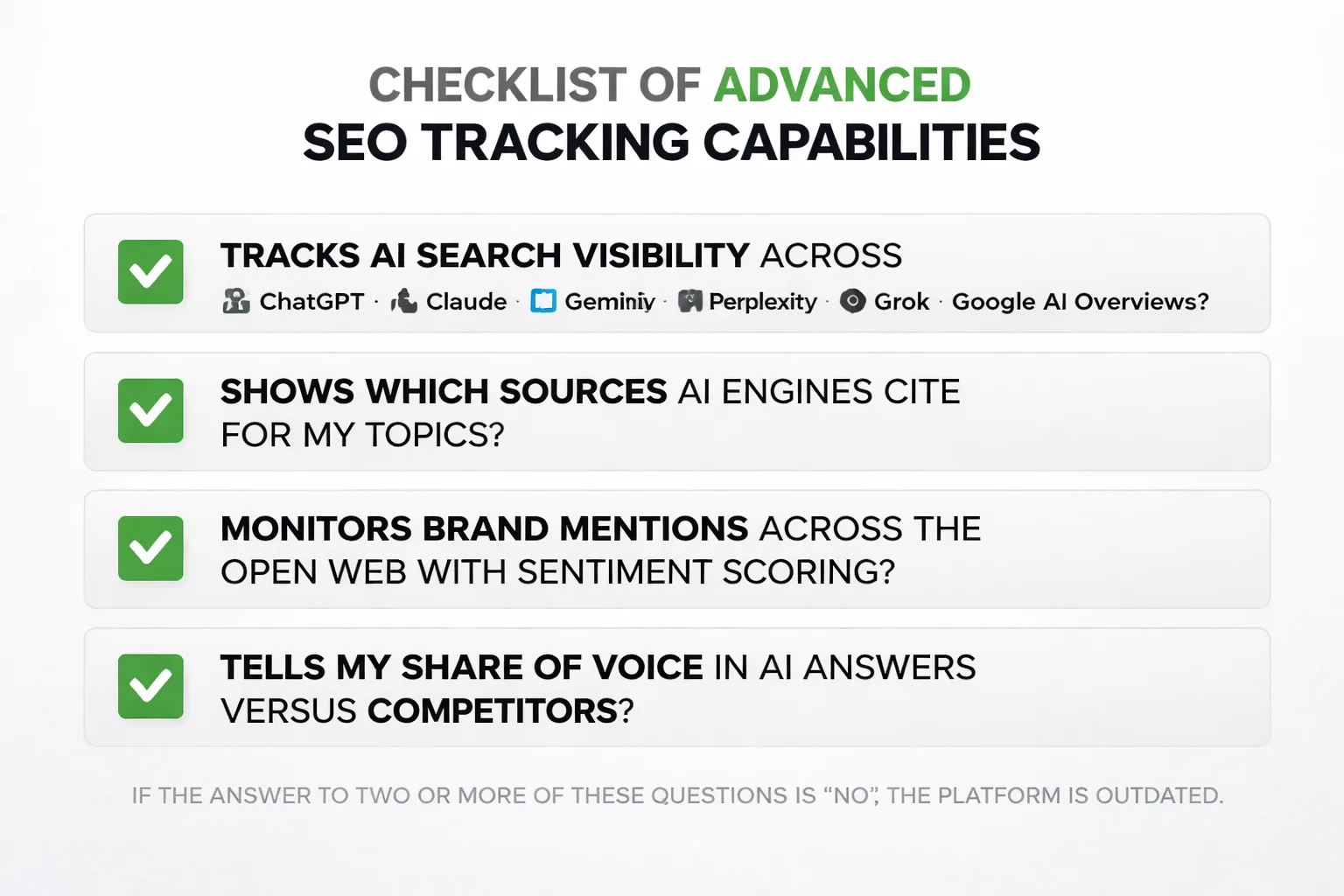
Here's what I look for during this inventory phase. Does the platform track AI search visibility across ChatGPT, Claude, Gemini, Perplexity, Grok, and Google AI Overviews? Can it show me which sources AI engines cite for my topics? Does it monitor brand mentions across the open web with sentiment scoring? Can it tell me my share of voice in AI answers versus competitors? If the answer to two or more of those questions is "no," you're running a platform built for a search ecosystem that no longer exists as the sole discovery channel.
The inventory should be a simple spreadsheet. Column A: capability. Column B: does the platform have it (yes/no/partial). Column C: how fresh is the data (real-time, daily, weekly, monthly, stale). Column D: can you actually access it on your plan tier, or is it gated behind an enterprise upsell.
I've seen teams spend weeks evaluating new platforms without ever completing this inventory on their current one. They jump straight to "which tool is best" without knowing what they already have. That's like remodeling a kitchen without measuring the existing cabinets. You end up buying things you don't need and missing things you do.
The painful discovery for most teams is that their platform's "AI features" are bolted on. They track Google AI Overviews (because that's still Google) but have no coverage of ChatGPT, Claude, or Perplexity responses. Some added a Perplexity integration in 2025 that refreshes monthly. Monthly data on AI citations is useless when AI answer composition shifts weekly. If you want to understand how AI search visibility works in practice, the AEO vs SEO comparison breaks down why the two disciplines require fundamentally different measurement infrastructure.
One more thing on this step. Check whether your platform tracks entity presence. Not keywords. Entities. Is your brand recognized as an entity in Wikidata and Google's Knowledge Graph? Does your platform surface this information? Most don't. And entity grounding is becoming the single biggest predictor of whether AI systems cite your brand by name. This is where answer engine optimization diverges from traditional SEO. You're not optimizing for a keyword match. You're optimizing for an AI system to recognize you as a credible entity worth naming.
Let me give you a concrete example of what this inventory looks like in practice. I sat down with a SaaS company last quarter that was paying $900 a month for what they believed was a top-tier SEO platform. They had rank tracking across 5,000 keywords. They had backlink monitoring with a weekly refresh. They had a site audit tool that flagged broken links and missing meta tags. When I asked them to show me their AI citation data, they navigated to a dashboard labeled "AI Insights" that showed... Google AI Overview positions for their tracked keywords. That was it. No ChatGPT data. No Claude data. No Perplexity data. No mention position tracking within AI responses. No cited-source leaderboard. They were spending nearly $11,000 a year to track a single AI surface while their competitors were being cited across every major LLM.
The inventory process took them 90 minutes. By the end, they had a spreadsheet with 14 capability rows. Eight were marked "yes." Six were marked "no." Four of those six were AI-related capabilities they had assumed the platform covered. That's the value of this step. It converts assumptions into evidence.
How Do You Benchmark AI Citation Rate Today?
Before you switch platforms, you need a baseline. If you don't know your current AI citation rate, you have no way to evaluate whether a new platform is actually better. This is the step most teams skip, and it's the one that matters most.
Your AI citation rate is the percentage of relevant prompts where an AI search engine mentions your brand. If you track 100 prompts related to your product category across ChatGPT, Perplexity, Gemini, and Google AI Overviews, and your brand appears in 12 of those responses, your citation rate is 12%. That number is your baseline.
Here's how to run this benchmark manually if your current platform can't do it (and most can't). Pull your top 50 branded and category keywords. Turn each into a natural-language prompt. "What's the best CRM for small business?" not "best CRM small business." Run each prompt through ChatGPT, Perplexity, Gemini, and Google AI Overviews. Record whether your brand is mentioned, where in the response it appears (first, in a list, last), and which sources the AI cites.
This is tedious. It takes 4-6 hours for 50 prompts across four surfaces. But the data is irreplaceable. You can also use a dedicated AI visibility checker to automate this process across all major AI engines simultaneously. The point is to have a number before you start evaluating new platforms.
What I've found in practice is that brands with strong Google rankings often have surprisingly low AI citation rates. The overlap between top Google results and AI-cited sources has dropped dramatically. The Siege Media study of 116 B2B sites found that "X vs Y" comparison pages are the strongest predictor of AI search traffic, while "best X software" lists ranked last. Brian Dean's interpretation: "When someone asks ChatGPT 'Tool A vs Tool B', a dedicated vs page matches that exact question. And sometimes there are only a few of those vs pages on the whole internet."
That insight alone should change how you think about your content strategy. But it also changes how you audit your platform. If your platform's content recommendations are still pushing you toward "best of" listicles, it's optimizing for a format that AI engines systematically deprioritize.
Record your baseline in a simple format. Four columns: AI engine, total prompts tested, brand mentions, citation rate. This becomes your benchmark for evaluating any new platform during the parallel test in Step 5.
Let me walk you through a real benchmark I ran for a B2B analytics company. We selected 50 prompts across three categories: branded queries ("[Company Name] pricing"), category queries ("best analytics tools for enterprise"), and comparison queries ("[Company Name] vs [Competitor]"). We ran each prompt through ChatGPT, Perplexity, Gemini, and Google AI Overviews. The results were eye-opening.
For branded queries, their citation rate was 78% across all four engines combined. That's expected. If someone searches for your brand name, AI systems generally know who you are. For category queries, their citation rate was 4%. Four percent. They were the market leader in Google organic results for their primary category keyword, appearing in position 1 for 6 of the top 10 category terms. But AI engines cited them in just 2 out of 50 category prompts. For comparison queries, their citation rate was 11%. Competitors with weaker Google rankings but stronger third-party presence on review sites and comparison pages appeared in AI responses 3x more often.
The baseline told us two things. First, their traditional SEO dominance was not translating into AI visibility. Second, the gap was widest exactly where it mattered most: category-level discovery queries where potential buyers are evaluating options. Without this baseline, any platform evaluation would have been guesswork. With it, we had a precise benchmark: any new platform needed to surface this gap and provide actionable recommendations to close it.
Step 3. Identify Data Accuracy Gaps
This is where the audit gets uncomfortable. Platforms look better than they are because of three failure modes that most practitioners never check. I want to walk through each one because they're the silent killers of SEO decision-making.
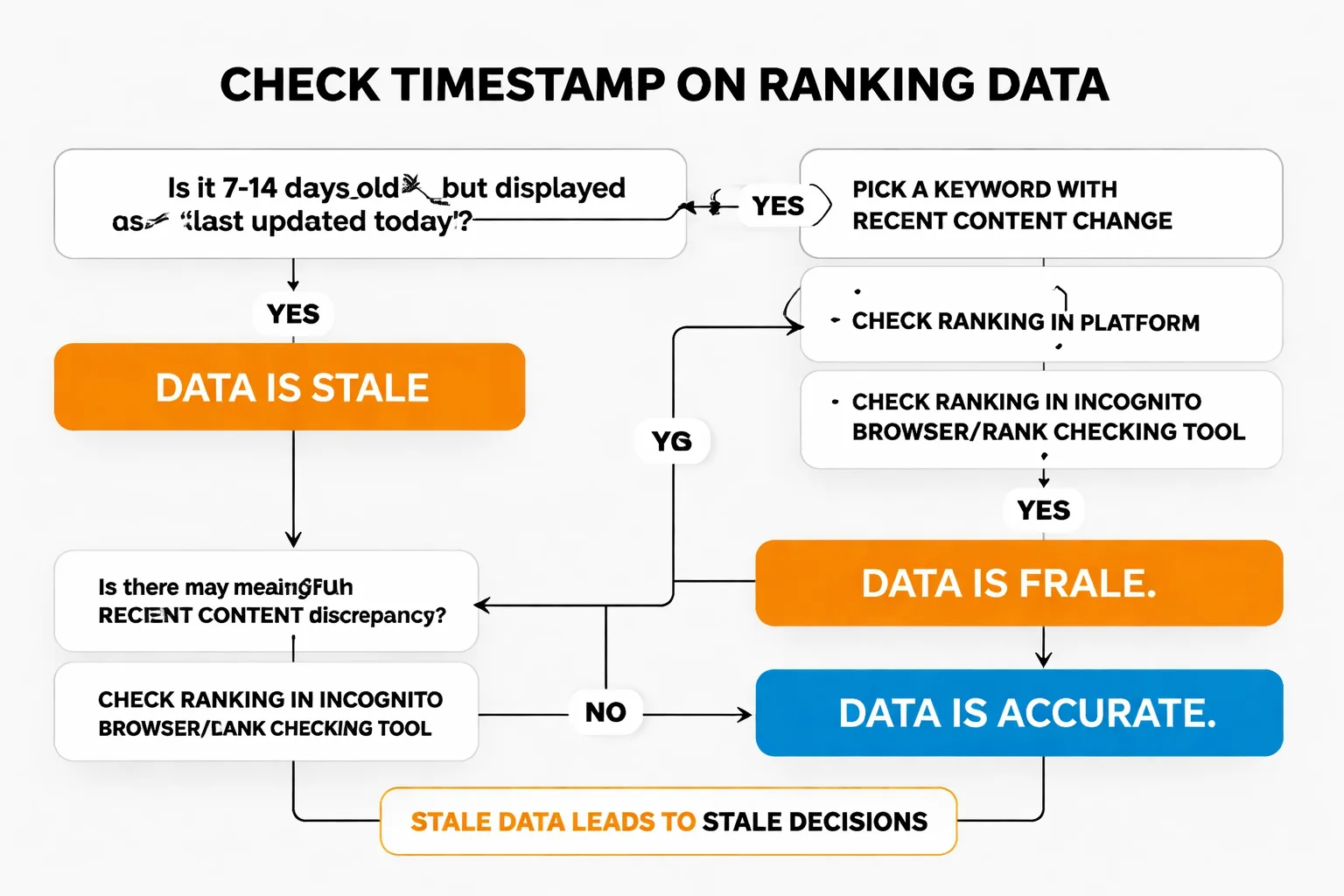
Stale rank data. Check the timestamp on your platform's ranking data. Many platforms cache rankings for 7-14 days but display them as if they're current. I've seen platforms show "last updated today" when the underlying data is 9 days old. To test this, pick a keyword where you've recently published new content or made a significant change. Check your ranking in the platform. Then check the same keyword in an incognito browser, preferably through a rank checking tool that doesn't personalize. If there's a meaningful discrepancy, your platform's data is stale. Stale data leads to stale decisions. You might think a content update failed when it actually worked, or vice versa.
The mechanics behind stale data are straightforward. Rank tracking is expensive. Crawling Google SERPs at scale requires proxy infrastructure, CAPTCHA solving, and rate limit management. To control costs, platforms batch their crawls. They might crawl your keywords on day 1, another customer's keywords on day 2, and so on. By the time they get back to your keywords, 7-14 days have passed. The dashboard shows "updated daily" because the platform updates some keywords daily. Just not yours. This is a structural limitation, not a bug. And it means your ranking data is always 1-2 weeks behind reality.
Missing AI surface coverage. Your platform might claim to track "AI search" but only covers Google AI Overviews. That's one surface out of the ecosystem. ChatGPT, Claude, Gemini, Perplexity, Grok, and DeepSeek each have distinct citation patterns. A brand might be cited in 30% of Perplexity responses for a topic but 0% of Claude responses. If your platform only tracks one AI surface, you're getting a distorted picture. It's like checking the weather in one city and assuming the entire country has the same forecast. For a deeper understanding of how different surfaces behave, the AEO vs GEO framework breaks down the distinctions between answer engine optimization and generative engine optimization across platforms.
Each AI engine has its own retrieval architecture. Perplexity uses its Sonar API to pull real-time web results and synthesize answers with citations. ChatGPT relies on a combination of its training data and web search via Bing. Claude's approach differs again, with different weighting of recency and authority. This means a citation in Perplexity doesn't predict a citation in Claude. They're independent measurements. A platform that tracks only Google AI Overviews is giving you one data point from a system that has its own distinct citation logic. You need all of them.
Citation attribution errors. This is the most insidious. Some platforms that do track AI citations attribute them incorrectly. They might count a mention of your brand name in an AI response as a "citation" even when no link or source reference is provided. Or they might miss citations where the AI references your content without naming your brand directly. The result is an inflated or deflated citation count that bears no resemblance to reality. To audit this, pick 5 AI responses where your platform reports a citation. Manually verify each one. Read the actual AI response text. Check whether the cited source is actually your domain. If more than one out of five is wrong, your platform's citation tracking has an accuracy problem.
These three gaps compound. Stale rankings plus missing AI coverage plus attribution errors means your platform could be showing you a reality that's 40-60% disconnected from what's actually happening. That's not a tool. That's a liability.
In my work auditing content operations, I've found that the platforms most confident in their reporting are often the ones with the biggest accuracy gaps. They've invested in dashboards and UX polish rather than data infrastructure. Beautiful charts built on bad data are worse than no charts at all, because they create false confidence.
Let me share a specific accuracy audit I ran. A marketing team was using a platform that reported their brand was cited in 34% of AI responses for their top 20 keywords. They were thrilled. When I manually verified 10 of those reported citations, here's what I found. In 3 cases, the AI response mentioned the brand name but did not link to their site or cite them as a source. The AI was simply acknowledging the brand existed. In 2 cases, the citation was attributed to the wrong domain. A competitor with a similar name was the actual cited source. In 1 case, the AI response was from 6 weeks ago and no longer reflected the current answer composition. Of 10 reported citations, 4 were accurate. That's a 40% accuracy rate. The platform's reported 34% citation rate was actually closer to 14%.
This is why manual verification matters. The platform's dashboard looked impressive. The numbers told a story of AI visibility success. The reality was that the brand was barely visible in AI responses, and the platform's inaccurate tracking was masking a serious competitive vulnerability.
Does Your Platform Fit Your Actual Workflow?
This step is about honest self-assessment. A platform can have perfect data and still be wrong for your team. The question isn't "is this platform good?" It's "does this platform fit how we actually work?"
I score platforms against four dimensions. Each gets a 1-5 rating. Anything below 3 on any dimension is a flag.
Content publishing integration (1-5). Does the platform connect to your CMS? Can it push content directly, or do you need to copy-paste everything? If you're running an ai seo platform that also generates content, does it handle scheduling, internal linking, and schema markup automatically? A platform that requires manual export-import for every piece of content will bottleneck your publishing velocity by 50% or more. I've measured this directly. Teams that switch to integrated publishing pipelines typically double their content output without adding headcount.
Approval workflow (1-5). This is where most AI-powered platforms fail. They generate content and push it live with no gate. No editorial review. No quality check. No fact verification. If your platform's workflow is "generate and publish," you're one bad article away from a Google penalty or a brand reputation issue. Look for platforms that have a built-in quality firewall. Something that blocks weak drafts before they reach your CMS. The ideal workflow is: AI generates draft, quality system scores it, human reviews and approves, platform publishes. Anything that skips steps in that chain is a risk.
Reporting cadence (1-5). How often does the platform refresh its data? Daily? Weekly? Monthly? For AI visibility tracking, weekly is the minimum acceptable cadence. AI answer composition shifts rapidly. A platform that refreshes AI citation data monthly is giving you a snapshot of a moving target. Also check whether reports are customizable. Can you create a report that shows AI visibility alongside classic rankings? Can you segment by AI engine? Can you share reports with stakeholders without giving them platform access?
Team size fit (1-5). A platform built for enterprise teams with 20+ seats will be overkill (and overpriced) for a 3-person marketing team. Conversely, a solo tool won't scale to an agency managing 15 client domains. Check seat limits, domain limits, and whether the platform supports role-based access. If you're an agency, look for white-label reporting. If you're a founder, look for a tool that doesn't require a dedicated SEO specialist to operate.
| Dimension | What to Check | Red Flag Score |
| Content Publishing | CMS integration, scheduling, schema automation | 1-2: Manual export required |
| Approval Workflow | Quality gate, editorial review, fact verification | 1-2: No gate, auto-publish only |
| Reporting Cadence | Data freshness, custom reports, sharing | 1-2: Monthly refresh only |
| Team Size Fit | Seats, domains, role-based access, white-label | 1-2: Wrong scale for team |
Total your scores. A platform scoring 16-20 is a strong fit. 12-15 is workable but has gaps. Below 12, you should be actively evaluating alternatives.
One thing I want to flag here. The scoring rubric is personal. A platform that scores 18 for a solo founder might score 8 for a 10-person agency. Don't use someone else's rubric. Build your own based on your team's actual workflow, then score honestly. The temptation to inflate scores because you've already paid for the platform is real. Resist it.
Here's a scoring example from a recent audit. A 5-person marketing team at a Series B SaaS company was evaluating their current platform against two alternatives. Their current platform scored 14 out of 20. It had strong rank tracking (5/5) and decent reporting (4/5) but weak content publishing integration (2/5, required manual CMS uploads), no approval workflow (1/5, no quality gate), and was priced for enterprise teams larger than theirs (2/5, they were paying for seats they didn't use). The first alternative they tested scored 16. The second scored 11. The scoring rubric gave them a clear, defensible framework for the switch decision. No gut feelings. No vendor sales pitches. Just a structured comparison against their actual needs.
Does your current SEO platform track AI citations, or just keyword rankings?
How Do You Evaluate Integration Capabilities?
This is a dimension that doesn't fit neatly into the workflow scoring rubric but deserves its own audit step. Your SEO platform doesn't operate in isolation. It needs to connect to your broader marketing and analytics stack.
Check for integrations with Google Search Console, Google Analytics 4, your CMS (WordPress, Ghost, Shopify, Webflow), and your CRM. If your platform can't pull data from Google Search Console, it's missing the most authoritative source of your actual search performance data. If it can't push to your CMS, you're stuck in manual mode for every content update.
For AI-specific integrations, check whether the platform supports IndexNow for instant indexing on publish. This is a small but meaningful integration that speeds up content discovery. Also check whether the platform integrates with tools like Bouncer for email verification if it offers outreach features. The depth of integration matters more than the number of integrations. A platform with 5 deep, well-maintained integrations is more valuable than one with 50 shallow connections that break on every API update.
Step 5. Run a 2-Week Parallel Test Before You Commit
This is the step that separates a disciplined audit from an impulse switch. You've inventoried your current platform, benchmarked your AI citation rate, identified accuracy gaps, and scored the fit. Now you test the alternative before committing.
The parallel test is simple in concept. Run your current platform and your top alternative simultaneously for two weeks. Feed them the same keywords, the same domains, the same prompts. Compare outputs.
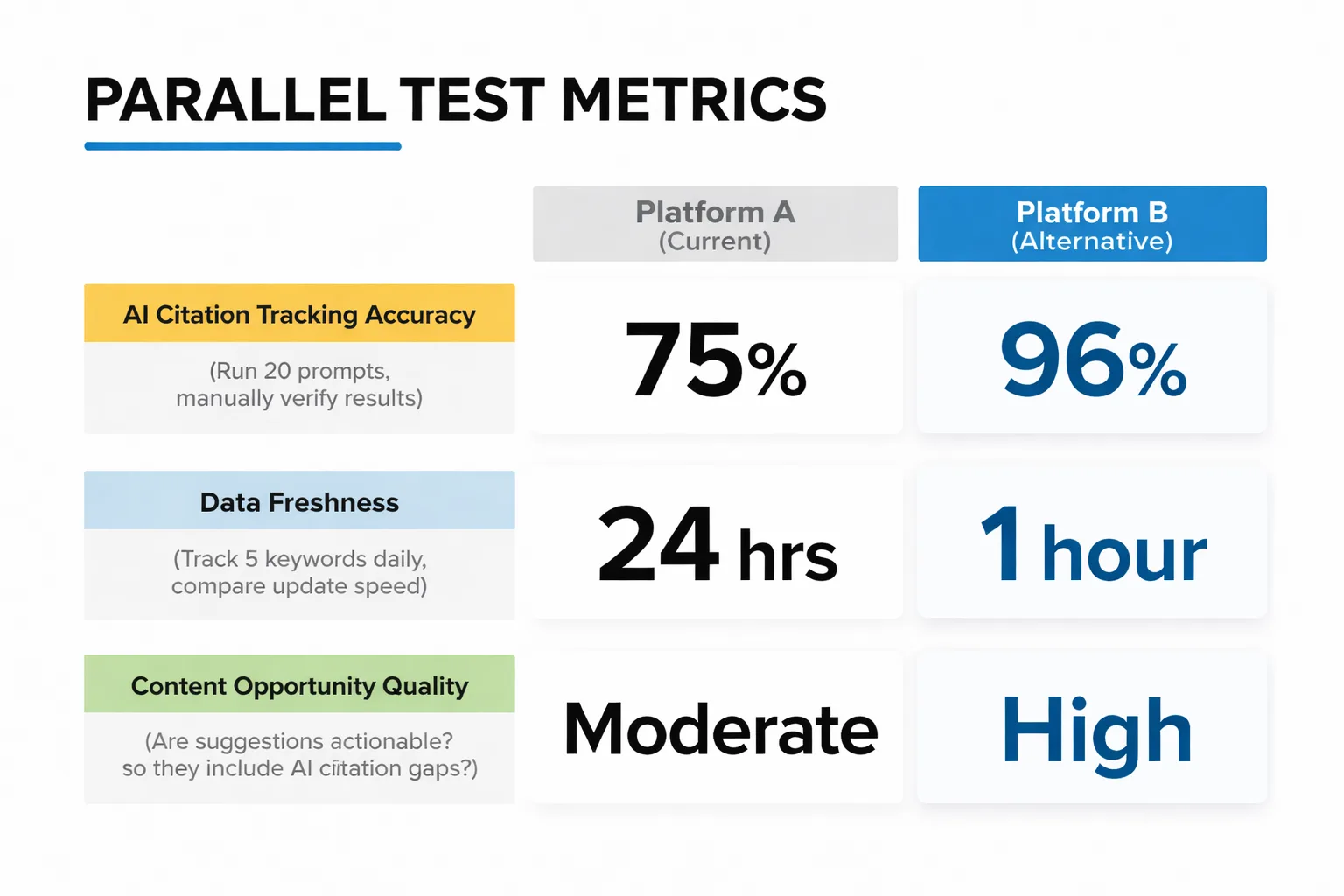
Here's what to measure during the test. First, AI citation tracking accuracy. Run 20 prompts through both platforms. Manually verify the results. Which platform's citation data matches reality? Second, data freshness. Pick 5 keywords and track them daily in both platforms. Which one updates faster? Third, content opportunity quality. Ask both platforms to suggest content opportunities. Are the suggestions actionable? Do they include AI citation gaps (prompts where competitors are cited but you aren't)? Or are they just rehashing keyword volume data?
Fourth, and this is the one that matters most: does the new platform surface insights your current platform misses? This is the single metric that should decide the switch. If the new platform shows you that you're cited in 15% of Perplexity responses but 0% of Claude responses, and your current platform shows nothing about AI citations at all, that's a decision-making insight. That's not a feature comparison. That's a fundamentally different level of visibility.
The parallel test also reveals the switching cost. How long does it take to set up the new platform? How much historical data can you import? Does the new platform integrate with your existing tools? If setup takes more than a day, that's a friction point. If you can't import historical data, you'll lose context during the transition.
During the test, use a ChatGPT AI visibility checker and Perplexity AI visibility checker to independently verify what both platforms report. Don't trust either platform's numbers blindly. Cross-reference against a third source. If all three agree, you have confidence. If they diverge, you've found an accuracy problem.
One more thing on the parallel test. Don't test more than two platforms at once. I've seen teams try to run three or four platforms simultaneously. The result is analysis paralysis. You spend all your time managing tool configurations and no time analyzing data. Two platforms, two weeks, one decision.
Let me detail what a day-by-day parallel test looks like. Days 1-2 are setup. Configure both platforms with the same domain, the same 50 tracked keywords, and the same 20 AI test prompts. Connect Google Search Console to both. Verify that both platforms are pulling data successfully before you start comparing. Days 3-7 are data collection. Each morning, spend 15 minutes reviewing both platforms' dashboards. Note any discrepancies in ranking data, AI citation data, or content opportunity suggestions. On day 5, run your 20 AI test prompts manually through ChatGPT, Perplexity, Gemini, and Google AI Overviews. Record the actual results. Days 8-10 are deep comparison. Compare both platforms' AI citation data against your manual verification. Calculate accuracy rates for each. Review content opportunity suggestions from both platforms. Are they surfacing different opportunities? Which set of suggestions is more actionable? Days 11-14 are synthesis. Score both platforms on accuracy, freshness, insight quality, and usability. Prepare a one-page comparison document for stakeholders. Make the switch decision.
What Are the Risks of Switching Platforms?
Platform transitions carry real risks. I've seen teams lose months of historical data because they cancelled their old platform before exporting everything. I've seen teams switch to a new platform only to discover it had a critical limitation that wasn't visible during the trial period. Here's how to mitigate the main risks.
Historical data loss. Before you cancel your current platform, export every report, every ranking history, every backlink profile. Store them in a shared drive. You'll need this data for year-over-year comparisons, and you'll be surprised how often you reference it months after the switch.
Tracking disruption. When you switch platforms, your ranking data will have a gap. The new platform starts fresh. You won't have continuity between your old platform's last data point and the new platform's first. This makes trend analysis difficult for 2-3 months. To minimize this, run the platforms in parallel (Step 5) and manually record the overlap period's data so you can stitch the timelines together later.
Hidden limitations. Trial periods don't always expose every limitation. A platform might handle 50 tracked keywords well but slow down significantly at 500. Or it might support multi-domain management but not white-label reporting. Read the fine print on plan limits. Talk to current customers. Ask specifically about limitations they've encountered.
Team adoption friction. Your team has muscle memory with the current platform. Switching means relearning workflows, reconfiguring reports, and re-establishing benchmarks. Budget 2-4 weeks for full team adoption. During this period, productivity may dip. That's normal. Don't panic and switch back. Give the new platform a fair trial.
When This Audit Framework Fails
This framework assumes you have the time and mandate to run a structured evaluation. That's not always the case. Here are three scenarios where this process breaks down.
First, if your contract renews in 30 days, you don't have time for a 2-week parallel test. You'll need to compress the framework into a rapid assessment. Skip the parallel test and rely on the scoring rubric plus a demo. It's not ideal, but it's better than auto-renewing a platform you haven't evaluated.
Second, if you're a solo founder with no SEO background, the data accuracy audit in Step 3 will be difficult. Verifying citation attribution requires understanding how AI engines reference sources. If you can't do this yourself, find someone who can. A bad audit is worse than no audit because it gives you false confidence in a bad platform.
Third, if your team has no content production capacity, auditing for content publishing and approval workflows is premature. You need content to publish before the publishing workflow matters. Focus on Steps 1 and 2 (coverage inventory and AI citation baseline) and come back to the workflow scoring when you have a content engine.
What This Actually Means
The decision to switch your search engine optimization platform isn't really about features. It's about whether the platform measures the game you're actually playing. In 2026, that game includes AI citations, entity presence, and generative engine optimization alongside classic rankings. A platform that only tracks the latter is giving you a partial picture and charging you full price for it.
The brands winning right now are the ones that own proprietary data. Dan Garner put it directly: "The ones who survive this shift will be the ones who own proprietary data." Your platform should help you identify what proprietary data to create, where your citation gaps are, and which publishers AI engines trust for your topics. If it can't do those three things, no amount of rank tracking will compensate.
The BIG advisory case study showed what's possible when a brand gets this right. They started with a 25% AI visibility score. After a structured AI search program, they achieved 3x AI search visibility, 151% AI-referred traffic growth, and 2x revenue from their AI program. Their 2025 Innovation Awards program generated 58% of AI-referred customers. That's not a vanity metric. That's revenue attribution from AI search.
Your audit should answer one question: does your current platform give you the data and capabilities to achieve that kind of outcome? If the answer is no, the five steps in this guide give you the framework to find one that does. Run the inventory. Benchmark your citations. Check accuracy gaps. Score the fit. Test in parallel. Then decide.
The search engine optimization platform you choose in 2026 determines whether AI engines cite your brand or your competitor's. That's not a technology decision. That's a revenue decision.
FAQ
Why should I audit my current SEO platform before switching?
Traditional platforms still focus on keyword rankings and links, but search has shifted to include generative AI citations and entity tracking since 2022. Without an audit, teams risk measuring outdated metrics while competitors gain ground in AI-driven results. This framework reveals whether your tool addresses the full competitive landscape in 2026.What key changes in search behavior make old SEO platforms insufficient?
Sixty percent of searches now end without a click, and demand is moving away from traditional engines in some categories. Brands ranking well on Google often receive zero citations in tools like ChatGPT or Perplexity. Platforms that ignore these variables leave teams without visibility into emerging visibility channels.How many brands lack an AI search strategy, and what does that mean for audits?
Forty-seven percent of brands have no AI search strategy, creating a clear competitive gap. An audit must check whether your platform can answer basic questions like whether ChatGPT cites your brand. This exposes tools that remain stuck in pre-2023 tracking methods.What is the first step in the five-step SEO platform audit?
The process begins by mapping exactly what your current platform tracks versus what modern search requires. This includes checking for support of generative engine optimization, AI citations, and Wikidata entity presence. The step quickly highlights gaps in data that premium tools may still fail to deliver.About the Author
Judy Zhou, Founder
Judy Zhou leads content strategy at Meev, where she oversees AI-driven content research and publishing for hundreds of brands. With a background in SEO and editorial operations, she focuses on building content systems that rank on Google, get cited by AI search engines, and drive measurable business results.
Run a free AI visibility check today and see exactly where your brand appears across every major AI search surface before you commit to switching platforms.