
By Judy Zhou, Founder
Key Takeaways
- In the first four months of 2026, 68% of Google searches ended without a click while ChatGPT reached 700M weekly active users and Google AI Mode hit 100M+ users across 200+ countries.
- HubSpot recorded an 1,850% increase in leads from AI after a 7-month answer engine optimization implementation.
- 58% of marketers report that AI-referred visitors convert at higher rates than traditional organic traffic.
- Replace page-ranking SEO with answer engine optimization to capture the smaller but higher-intent traffic now flowing through AI search engines.
The next two years will produce more change in search than the previous twenty," Rand Fishkin told an audience at MozCon 2025. And twelve months later, that forecast looks conservative. AI search engines in 2026 are not a niche alternative to Google; they are a parallel ecosystem with their own citation logic, entity grounding requirements, and ranking signals that traditional SEO tools were never built to measure. For anyone responsible for organic visibility, understanding this new landscape isn't optional. It's the job.
The conventional wisdom about search in 2026 is wrong. Google is not the only game in town, and the data proves it: 68% of Google searches ended without a click in the first four months of 2026, while ChatGPT has grown to 700M weekly active users and Google AI Mode reached 100M+ users across 200+ countries within months of launch. The question is no longer whether AI search engines 2026 are viable alternatives. They are the alternative. The real question is which ones matter for your brand, how they differ, and what to do about it.
The shift from keyword-matched links to generated answers means the old playbook of ranking pages is giving way to a new discipline: answer engine optimization. Teams that adopt AEO see measurable results. HubSpot reported a 1,850% increase in leads from AI after a 7-month AEO implementation. That number should stop you cold. Meanwhile, 58% of marketers say AI-referred visitors convert at higher rates than traditional organic traffic. The traffic is smaller. The intent is sharper.
The Four Forces Dismantling Google's Monopoly
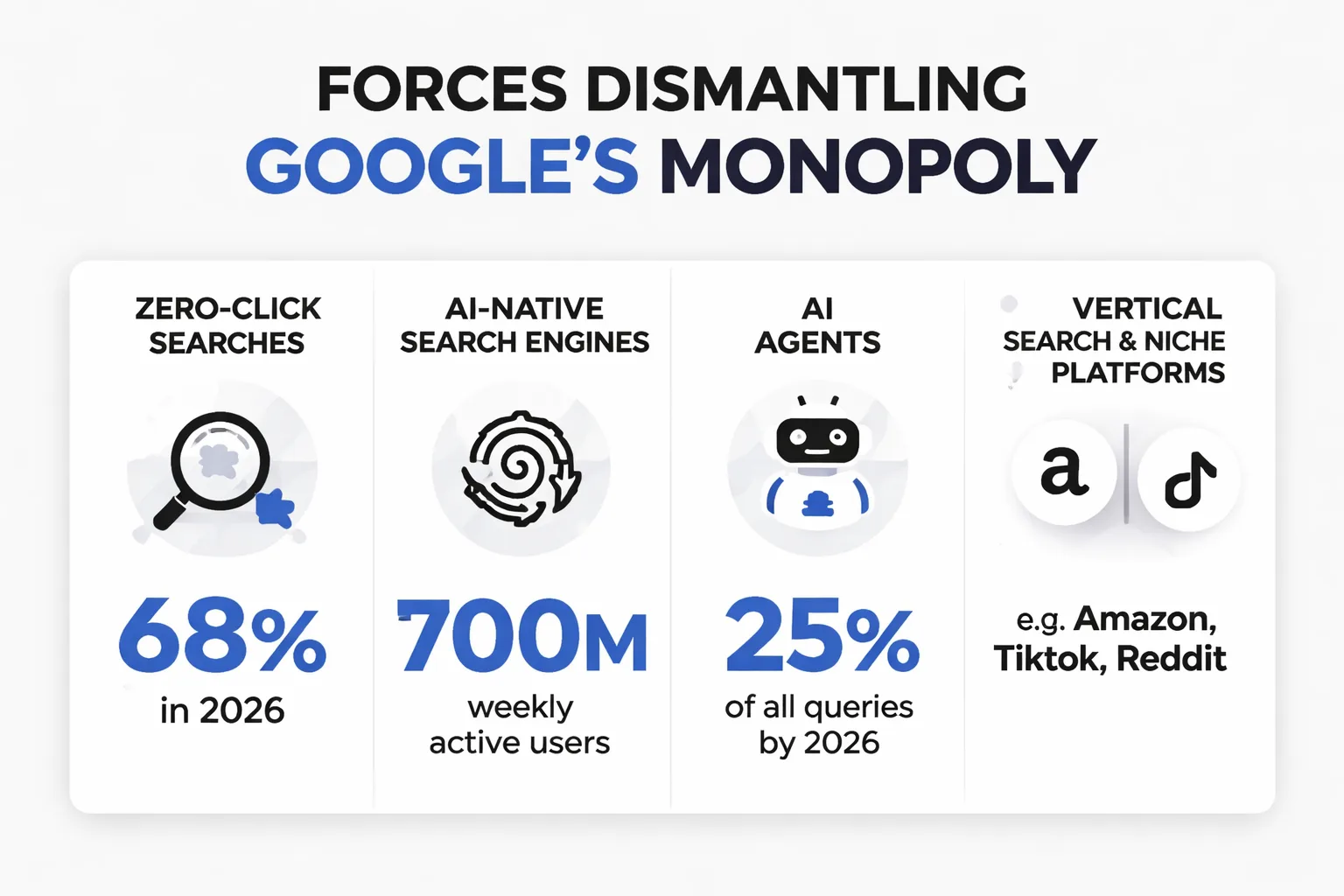
Google still processes more queries than any single competitor. That fact is not in dispute. But monopoly is about control over the information journey, not raw query volume. Four forces are eroding that control simultaneously.
First, zero-click searches have reached 68% in 2026. When Google serves the answer directly in AI Overviews or featured snippets, the user never reaches a publisher's site. Google wins the query. The publisher loses the visit. This is not a bug. It is the design.
Second, AI-native search engines have built parallel ecosystems with their own user bases. ChatGPT's 700M weekly active users are not searching Google. They are asking questions in a conversational interface that synthesizes answers from multiple sources, cites them inline, and rarely sends traffic back. Cloudflare's 2025 analysis found that AI crawlers consume content at rates 38,000 times higher than they refer traffic back to sources. That ratio should terrify any publisher whose business model depends on click-through traffic.
Third, the citation logic is fundamentally different. Traditional Google search ranks pages. AI search engines synthesize answers from multiple sources and cite them. The Nature Communications 2025 study by Wu et al. found that citation accuracy across AI platforms ranges from roughly 66% for the best performers to below 50% for the worst. Between 50% and 90% of LLM-generated citations do not fully support their attached claims. This means getting cited is necessary but not sufficient. The citation must actually support the claim the AI engine attributes to the source.
Fourth, the optimization toolkit has split. Traditional SEO tools were built to track keyword rankings on Google. They cannot measure brand mentions inside ChatGPT responses, citation positions in Perplexity answers, or share-of-voice across Claude and Gemini. The teams still relying on rank trackers are flying blind across the fastest-growing segment of search. This is why ai visibility tool platforms have emerged as a distinct category. They solve a measurement problem that SEO tools were never designed to address.
Which AI Search Engines Actually Matter in 2026?
Not every AI search engine deserves equal attention. The field has stratified into tiers based on user base, citation behavior, and business relevance. Here is the landscape as it stands in mid-2026.
Google AI Overviews and AI Mode remain the largest single source of AI-generated answers. Google AI Mode reached 100M+ users in 200+ countries within months of launch. AI Overviews appear at the top of traditional SERPs for an expanding set of query types. The citation model favors domains that already rank well organically, which means traditional SEO still provides a baseline. But the zero-click rate means fewer visitors even when the citation is present.
ChatGPT Search operates at a different scale. With 700M weekly active users, it is the fourth most-visited website globally. ChatGPT's search behavior is conversational. Users ask multi-turn questions, refine prompts, and expect synthesized answers with inline citations. The citation overlap between ChatGPT and Perplexity is only 11%, according to Digital Bloom's 2025 analysis. This means optimizing for one does not guarantee visibility in the other. Each engine has its own source preferences.
Perplexity has positioned itself as the research-grade alternative. Developer-focused testing consistently finds that Perplexity wins for depth, citations, and reproducible research. It cites inline with higher density than Google AI Overviews and provides source links that users can verify. For B2B brands and technical content, Perplexity citations carry outsized influence because the user base skews toward researchers, developers, and decision-makers.
Claude, Gemini, and Grok round out the major surfaces. Claude's conversational depth makes it a preferred tool for analysis and synthesis. Gemini benefits from Google's ecosystem integration. Grok serves a smaller but vocal audience. Each has distinct citation patterns and source preferences that require individual tracking.
The practical implication is clear: a brand that tracks only Google AI Overviews is invisible to the 700M weekly users on ChatGPT, the research audience on Perplexity, and the professional users on Claude. Multi-engine tracking is not a luxury. It is the minimum viable measurement standard for 2026.
How Do AI Search Engines Build Their Answers?
Understanding how AI search engines construct answers is the foundation of effective optimization. The process differs fundamentally from traditional search ranking, and the differences explain why some brands appear in AI answers while others do not.
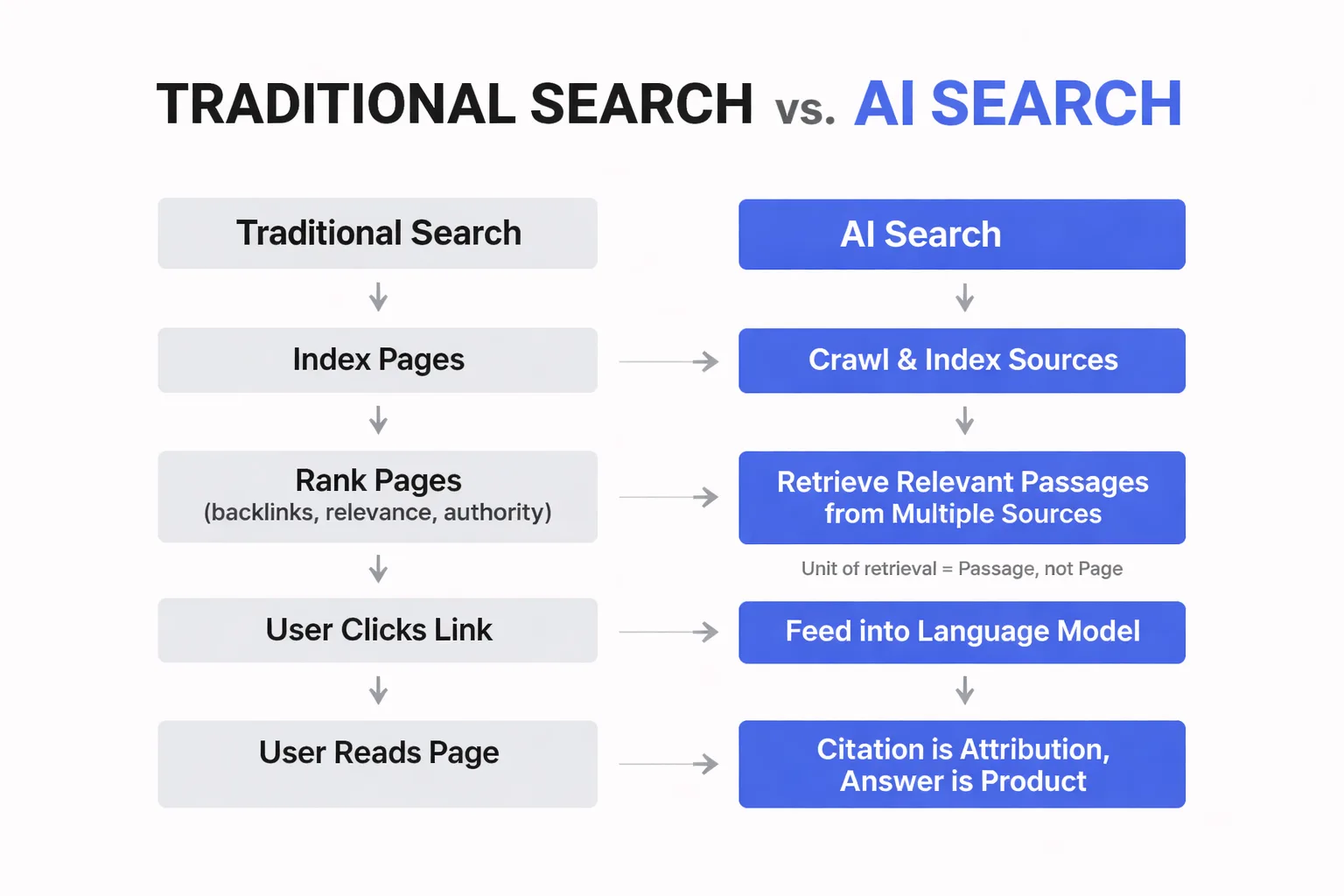
Traditional search engines crawl pages, index them, and rank them using signals like backlinks, content relevance, and page authority. The user clicks a link and reads the page. AI search engines add a synthesis layer on top of retrieval. They crawl and index sources, but instead of ranking pages, they retrieve relevant passages from multiple sources, feed them into a language model, and generate a coherent answer that weaves together information from those sources. The citation is the attribution. The answer is the product.
This architecture has three implications for optimization. First, the unit of retrieval is not the page. It is the passage. A well-structured page with clear, citable statements is more likely to be sourced than a long-form article where the key claim is buried in paragraph twelve. Second, the model synthesizes. If three sources say the same thing, the model may cite one and paraphrase the others. Being correct is not enough. Being first, most specific, and most citable matters. Third, the citation must support the claim. The Nature Communications study found that 50-90% of LLM citations do not fully support their attached claims. If the AI engine cannot verify that the source supports the claim, it may drop the citation entirely.
Why Does Entity Grounding Determine AI Visibility?
Entity grounding is the mechanism AI search engines use to verify that a mentioned entity (a brand, person, product, or concept) actually exists and is what the answer claims it is. Without entity grounding, the model has no way to distinguish between a real company and a hallucinated one.
The knowledge graph is the backbone of entity grounding. Google's Knowledge Graph, Wikidata, and similar structured data repositories provide the canonical definition of entities. When an AI search engine encounters a brand name in a source, it checks the knowledge graph to verify the entity exists, retrieve its attributes (industry, founding date, description), and confirm the context matches. If the brand is not in the knowledge graph, the AI engine may still mention it based on source text, but the mention is fragile. It can be overridden by a competing source that references a better-grounded entity.
This is where Wikidata and knowledge graph presence become a competitive advantage. A brand with a complete, accurate Wikidata entry that includes key facts (founding date, industry, leadership, website) gives AI search engines a verifiable entity to ground their answers. A brand without that entry is relying entirely on third-party sources to establish its existence. The former is more citable. The latter is more vulnerable.
The practical steps are straightforward but often overlooked. Claim or create a Wikidata entry. Ensure the brand's Wikipedia presence (if eligible) is accurate and well-sourced. Implement schema markup on the brand's website that defines the organization, its products, and its relationships. Build consistent NAP (name, address, phone) citations across authoritative directories. These are not traditional SEO tactics. They are entity grounding tactics, and they directly influence whether AI search engines can and will cite the brand.
The Citation Accuracy Problem Nobody Talks About
Here is the contrarian take that most AI search content misses: getting cited by an AI search engine is not a win if the citation does not support the claim. The industry celebration of brand mentions in AI answers is premature. A citation that misattributes a claim, strips context, or fabricates a connection is worse than no citation at all. It builds false authority on a foundation the user can debunk with one click.
The Nature Communications 2025 study measured this directly. The best-performing AI platforms achieve roughly 66% citation accuracy. The worst performers fall below 50%. Between 50% and 90% of LLM-generated citations do not fully support their attached claims. This is not a marginal error rate. It is a structural reliability problem.
For brands, this means LLM citation tracking 2026 must measure not just whether the brand is cited, but whether the citation is accurate. A mention in a ChatGPT answer that mischaracterizes the product is not a visibility win. It is a reputation risk. A Perplexity citation that links to the brand's page but attributes a claim the page does not make is a credibility problem waiting to be discovered.
This is why sophisticated teams treat citation tracking as a quality function, not a vanity metric. They monitor the actual response text behind every mention. They check whether the cited source supports the attributed claim. They flag misattributions and correct the underlying content. The ai visibility checker approach that captures the full response text, not just the mention count, is the only reliable way to do this.
How to Track AI Visibility Without Losing Your Mind
LLM citation tracking in 2026 is a multi-surface, multi-dimensional problem. The brand needs to know where it appears across every major AI search surface, what position it appears in (first mention, in a list, last), what the actual response text says, and whether the citation is accurate. Doing this manually is not feasible. The prompt space is too large, the surfaces are too many, and the responses change over time.
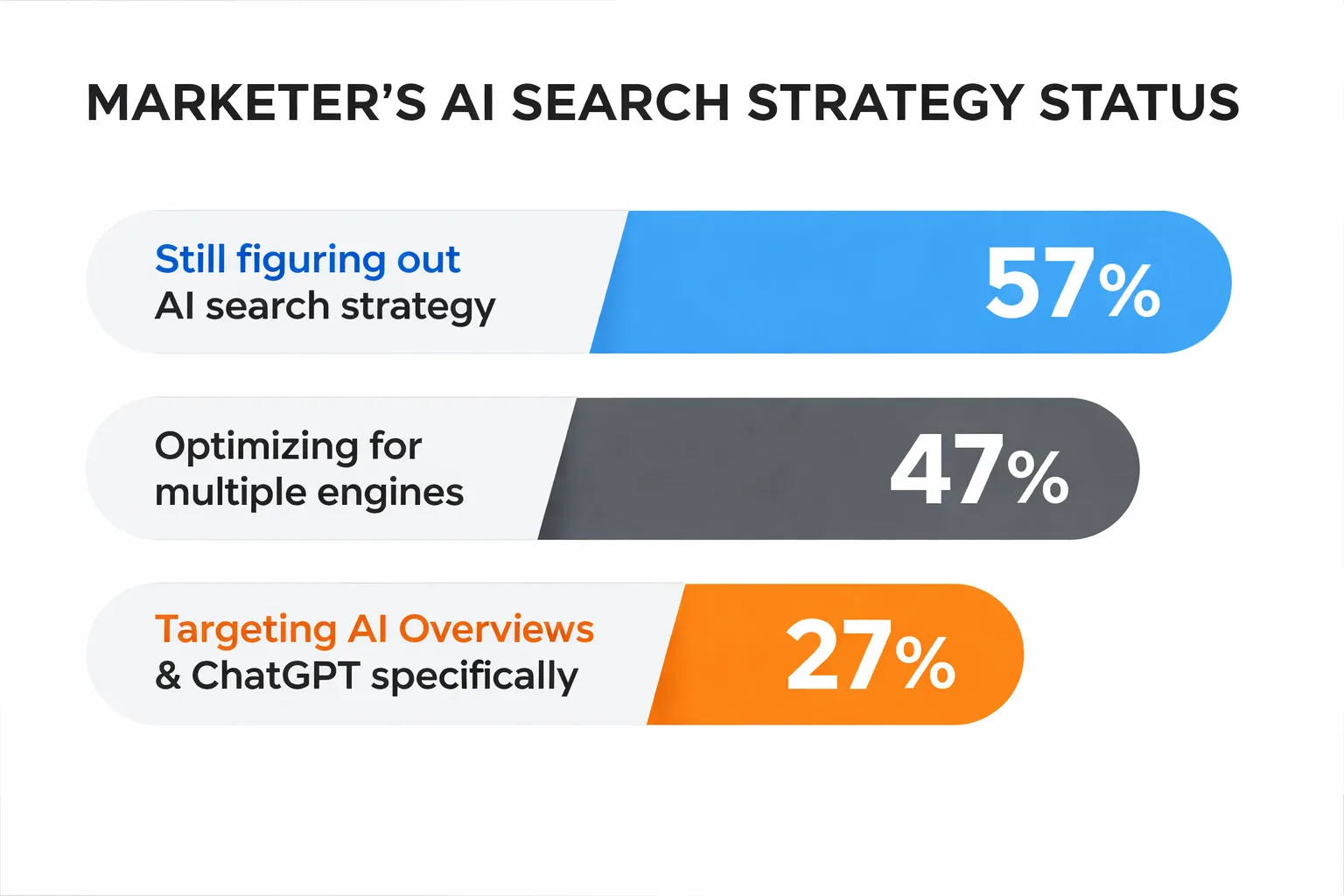
The BrightEdge research on generative engine optimization teams found that 57% of marketers are still figuring out their AI search strategy. Meanwhile, 47% are optimizing for multiple engines, and 27% are targeting both AI Overviews and ChatGPT specifically. The teams that have moved beyond figuring it out share a common pattern: they use dedicated tracking tools that monitor brand mentions across surfaces, provide drill-down dashboards with trend data, and capture the full response text behind every mention.
The measurement architecture matters. Direct API integrations with Perplexity, DeepSeek, and Grok preserve measurement validity because they query the actual models users interact with. Simulated or scraped results introduce noise. Per-surface drill-down is essential because citation patterns vary dramatically across platforms. The 11% citation overlap between ChatGPT and Perplexity means a brand could dominate one surface and be invisible on the other. Aggregate scores hide that gap.
Industry share-of-voice across AI engines adds a competitive dimension. Knowing the brand is cited in 30% of relevant prompts is useful. Knowing the brand is cited in 30% while the top competitor is cited in 65% is actionable. That gap is the content strategy. Every prompt where the competitor is cited and the brand is not represents a content opportunity.
Generative Engine Optimization vs Traditional SEO
Generative engine optimization 2026 is not SEO with a new label. It is a distinct discipline with different inputs, different outputs, and different success metrics. Understanding the difference is the prerequisite to doing either one well.
Traditional SEO optimizes pages to rank for keywords on search engine results pages. The inputs are keyword research, on-page optimization, backlinks, and technical SEO. The outputs are rankings, click-through rates, and organic traffic. The success metric is traffic that converts.
Generative engine optimization optimizes content to be sourced and cited by AI search engines when they generate answers to user questions. The inputs are entity grounding, passage-level clarity, third-party authority signals, and knowledge graph presence. The outputs are brand mentions, citation positions, and share-of-voice across AI surfaces. The success metric is visibility in answers that influences purchase decisions.
The overlap is real but partial. Pages that rank well on Google are more likely to be sourced by AI engines that use Google's index (like AI Overviews). Backlinks remain a proxy for authority that AI models consider. Technical SEO ensures crawlability, which is a prerequisite for being sourced. But the divergence is where the action is.
The aeo vs seo distinction matters because it changes the content strategy. SEO rewards comprehensive pages that target keyword clusters. AEO rewards citable passages that directly answer specific questions. A 2,000-word guide may rank well for a keyword. A 200-word passage with a clear, specific, verifiable answer is more likely to be cited by an AI engine. The two goals are not always aligned.
The pattern that keeps showing up is this: brands that treat AEO and SEO as the same discipline achieve neither. They produce long-form content that is too diffuse to be cited and too generic to rank. The teams that separate the two, with distinct content types for each goal, see better results in both channels.
What Role Do AI Agents Play in Search?
The next phase of AI search is agentic. AI agents do not just answer questions. They take actions. They compare products, fill carts, book appointments, and submit forms. The user does not visit a website. The agent does it on their behalf.
This shift has profound implications for visibility. When a human user searches, the brand's website is the destination. When an agent searches, the brand's API, schema markup, and structured data are the interface. The agent reads the schema, compares attributes, and makes a recommendation. The human sees the result, not the process.
Agentic SEO is the practice of optimizing for agent-mediated search. It requires structured data that agents can parse, API endpoints that agents can query, and entity definitions that agents can verify. The brand's website becomes a data source for agents, not just a destination for humans. This is a fundamental architectural shift.
The timeline is not hypothetical. HubSpot's 2026 State of Marketing report found that 42% of CRM software buyers now use AI search as part of their evaluation process. That evaluation increasingly includes agent-mediated comparison. The buyer asks the agent to compare options. The agent retrieves structured data from each brand's presence and synthesizes a comparison. The brand with the richest, most accurate, most agent-readable data wins.
This is where the ai seo tool landscape is heading. The first generation of AI SEO tools focused on content generation. The next generation focuses on agent readiness. Can an AI agent read the brand's product specifications? Can it verify the brand's pricing? Can it compare the brand's features against competitors using structured data? If the answer is no, the brand is invisible to agentic search.
The Earned Media Discovery
Here is the finding that should reorient every content strategy in 2026: 84% to 89% of AI-generated answers come from earned media, not owned content. Third-party coverage in credible publications is the dominant source for AI search engine answers.
This changes the optimization calculus entirely. The traditional SEO playbook says: publish authoritative content on the brand's website, build internal links, earn backlinks, and rank. The AEO playbook says: get mentioned by the sources that AI engines actually cite. Those sources are primarily third-party publications.
The Cloudflare analysis adds a brutal data point: AI crawlers consume content at rates 38,000 times higher than they refer traffic back. Even when the brand's owned content is sourced, the traffic return is negligible. The value is in the citation, not the click. And the citations go disproportionately to earned media.
This is why the cited-source leaderboard matters. Knowing which domains AI engines cite most often for a given topic tells the brand where to focus its earned media efforts. If AI engines cite industry publications, review sites, and authoritative blogs for a topic, the brand's PR strategy should target those specific domains. Not because they drive traffic. Because they drive citations.
The practical workflow is: identify the domains AI engines cite for the brand's topics, find the verified contacts at those domains, and pitch them with content grounded in the brand's knowledge base. This is machine relations. The brand is not just optimizing for human readers. It is optimizing for the AI models that synthesize answers from those third-party sources.
How to Build an AI Search Optimization Strategy
Building an AI search optimization strategy in 2026 requires four phases. Each phase has specific inputs, outputs, and success metrics.
Phase 1: Diagnose. Measure where the brand appears across every major AI search surface. Track mention position, response text, and citation accuracy. Calculate industry share-of-voice. Identify the prompts where competitors are cited and the brand is not. This is the gap analysis. Without it, every subsequent effort is guesswork. The ai visibility checker is the starting point.
Phase 2: Ground. Build the entity foundation. Claim or update the Wikidata entry. Implement organization schema markup. Ensure NAP consistency across directories. Build the knowledge graph presence that AI engines use to verify the brand exists. This is the prerequisite for being cited accurately.
Phase 3: Create. Produce citable content. This means answer-engine-optimized articles with clear, specific, verifiable claims. Each article should address a specific question the target audience asks AI search engines. The content should be structured for passage-level retrieval, not just page-level ranking. Fact-verify every claim before publish. The what is aeo framework provides the structure.
Phase 4: Earn. Pursue mentions from the domains AI engines actually cite. Use the cited-source leaderboard to identify targets. Build relationships with those publishers. Pitch content that is grounded in the brand's expertise. This is the earned media play that drives the majority of AI citations.
The phases are sequential but not linear. Diagnosis is continuous. Grounding is foundational. Creation and earning are ongoing. The strategy is a loop: measure, ground, create, earn, measure again.
The Quality Firewall Problem
The temptation in 2026 is to scale content production using AI. The technology exists. The tools exist. The results, for teams that tried it without quality controls, are catastrophic.
The pattern is consistent across case studies. Teams that deployed autonomous content generation at scale saw initial gains followed by sharp declines. Google's quality systems are sophisticated enough to detect low-value automated content. The sites that published hundreds of unedited AI articles saw rankings drop. The sites that maintained quality controls saw stable or improving performance.
The issue is not AI itself. Google has stated that AI-generated content is not penalized per se. The issue is quality. AI content that is generic, inaccurate, or unhelpful is penalized regardless of how it was produced. The aeo vs geo distinction matters here because GEO content must meet a higher bar. It must be citable. It must be accurate. It must be specific enough that an AI engine can extract a passage and attribute it correctly.
This is why a quality firewall is essential. Every AI-generated draft must pass through a multi-dimensional quality check before publish. The check should evaluate factual accuracy, source verification, content depth, structural clarity, and penalty risk. Drafts that fail are blocked, not published. This is the difference between an ai seo tool that builds visibility and one that destroys it.
The teams winning in 2026 use AI to amplify quality, not just quantity. They generate drafts, subject them to rigorous quality checks, edit for brand voice and accuracy, and publish only what passes. The volume is lower than fully autonomous generation. The results are dramatically better.
Ethical Considerations and Bias in AI Search
AI search engines inherit the biases of their training data, their retrieval indices, and their ranking algorithms. These biases are not theoretical. They shape which sources get cited, which entities get grounded, and which brands appear in answers.
The citation accuracy problem documented in the Nature Communications study is partly an ethics issue. When 50-90% of citations do not fully support their claims, the AI engine is not just making factual errors. It is shaping user understanding with unreliable attributions. Brands cited inaccurately face reputation damage. Brands not cited at all face invisibility.
The source selection bias is equally concerning. AI engines cite the sources they can access and verify. Sources behind paywalls, sources in non-English languages, and sources from smaller publishers are underrepresented. This creates a citation ecosystem that favors large, English-language, well-indexed publications. The diversity of information sources narrows.
For brands, the ethical implication is twofold. First, accuracy matters. Brands that publish misleading or exaggerated claims may be cited by AI engines, but the citation will be inaccurate. This is not a win. It is a liability. Second, transparency matters. Brands that disclose their methodologies, cite their own sources, and provide verifiable data are more likely to be cited accurately. The AI engine can verify the claim because the source is transparent.
What This Means for Your Brand in 2026
The AI search landscape in 2026 is not a passing trend. It is a structural shift in how information is discovered, evaluated, and cited. The brands that adapt will thrive. The brands that do not will become invisible.
The adaptation requires three commitments. First, commit to multi-surface measurement. Tracking only Google is no longer sufficient. The brand needs visibility across every major AI search surface, with drill-down capability and response-text capture. Second, commit to entity grounding. The knowledge graph presence is the foundation of AI visibility. Without it, the brand is a ghost that AI engines cannot reliably cite. Third, commit to earned media. The data is clear: 84-89% of AI answers come from third-party sources. The brand's owned content matters, but the earned media strategy is what drives citations at scale.
The teams that have made these commitments are seeing results. HubSpot's 1,850% increase in AI-sourced leads is not an outlier. It is the product of a disciplined AEO strategy built on real customer language, prompt tracking, and content that answers the questions buyers actually ask. The ChatGPT visibility checker and Perplexity visibility checker are the diagnostic tools that make this discipline possible.
The question in the title was whether there are better search engines than Google in 2026. The answer depends on the use case. For raw query volume, Google still leads. For conversational depth, ChatGPT dominates. For research-grade citations, Perplexity wins. For ecosystem integration, Gemini is strong. The better question is not which search engine is best. It is whether the brand is visible across all of them. Because the AI search engines 2026 have collectively become the parallel ecosystem that Rand Fishkin predicted. And the teams still optimizing for Google alone are optimizing for a shrinking share of attention.
Is your brand cited across ChatGPT, Perplexity, and Google AI Overviews, or are competitors capturing those mentions?
FAQ
Can traditional SEO tools track AI search visibility?
No. Traditional SEO tools track keyword rankings on Google SERPs. They cannot monitor brand mentions inside ChatGPT responses, citation positions in Perplexity answers, or share-of-voice across Claude and Gemini. AI visibility requires dedicated tracking tools with direct API integrations to each AI search surface. The measurement architecture is fundamentally different.
How often do AI search engine results change?
AI search results change frequently because the underlying language models are updated regularly and the retrieval indices refresh continuously. SERP-driven surfaces like Google AI Overviews refresh daily. LLM-driven surfaces like ChatGPT and Claude refresh on rolling cycles. Weekly tracking with trend sparklines is the minimum viable frequency for catching meaningful shifts.
What is the difference between AEO and GEO?
Answer Engine Optimization (AEO) focuses on optimizing content to be cited by AI search engines when they generate answers. Generative Engine Optimization (GEO) is a broader term that encompasses AEO plus the technical infrastructure (entity grounding, schema markup, knowledge graph presence) that makes citations possible. AEO is the content strategy. GEO is the full-stack approach.
How long does it take to see results from AI search optimization?
The HubSpot case study showed meaningful results after 7 months of disciplined AEO implementation. The timeline depends on the starting point. Brands with existing authority and third-party coverage see faster results. Brands starting from near-zero visibility should expect 6-12 months of consistent effort before measurable gains compound.
Is AI-generated content safe for AI search visibility?
AI-generated content is safe if it passes quality controls. The risk is not AI itself but low-quality content. Every draft should be fact-verified, checked for accuracy, and reviewed for brand voice before publish. A quality firewall that blocks weak drafts is essential. Unedited AI content at scale is a visibility risk, not a visibility strategy.
Which AI search engine drives the most business value?
It depends on the audience. ChatGPT's 700M weekly active users represent the largest audience. Perplexity's research-focused user base drives higher-intent B2B traffic. Google AI Overviews benefit from existing organic authority. The answer is multi-surface tracking to identify which engine drives the most citations and conversions for the brand's specific audience.
About the Author
Judy Zhou, Founder
Judy Zhou leads content strategy at Meev, where she oversees AI-driven content research and publishing for hundreds of brands. With a background in SEO and editorial operations, she focuses on building content systems that rank on Google, get cited by AI search engines, and drive measurable business results.
Stop guessing about your AI search visibility. Run a free diagnostic across every major AI search surface and see exactly where your brand appears, where it doesn't, and what to fix first.