
By Judy Zhou, Founder
Key Takeaways
- Only 36 brands reached "Universal" AI visibility status every month in Semrush's analysis of 126 million US prompts across 22 industries.
- Measure AI visibility by tracking mentions, content citations, and especially framing, since a "budget alternative" mention counts as a loss against competitors.
- Brands that begin monitoring AI presence now lock in self-reinforcing citation patterns; those that wait will face hardened answer sets built around rivals.
- AI brand visibility is now the single most under-tracked B2B revenue metric, as LLMs have become primary research tools since late 2022.
In 2012, Google's Knowledge Graph quietly redrew the rules of brand visibility. Suddenly, appearing in a structured entity panel mattered as much as ranking for keywords. Most brands missed the shift until rivals had already claimed the territory. We're at an identical inflection point today. Since late 2022, large language models have become primary research tools for millions of buyers. And the brands that get cited in AI-generated answers are gaining a compounding visibility advantage that traditional rank trackers cannot see, measure, or report on. History is repeating itself, faster.
AI brand visibility measures how often a brand is mentioned and cited across AI answer surfaces, and it is now the single most under-tracked revenue metric in B2B marketing. The Semrush AI Visibility Index 2026 study analyzed 126 million real US AI search prompts across 22 industries and 4 major AI platforms. Only 36 brands achieved "Universal" status, winning visibility every single month. That means the field is wide open, but it is closing fast. If you are not tracking this, you are flying blind.
The HubSpot marketing team defines AI search visibility as measuring how often a brand is mentioned, how owned content is cited, and how mentions are framed in model responses. That third dimension, framing, is where most tracking efforts collapse. A mention is not a win if the AI positions your brand as a budget alternative before recommending a competitor.
I have spent the last two years building systems to track this at scale. The pattern is clear: brands that start monitoring their AI presence now will lock in citation patterns that become self-reinforcing. Brands that wait will spend years trying to break into answer sets that have already hardened around their competitors.
What AI Brand Visibility Actually Measures
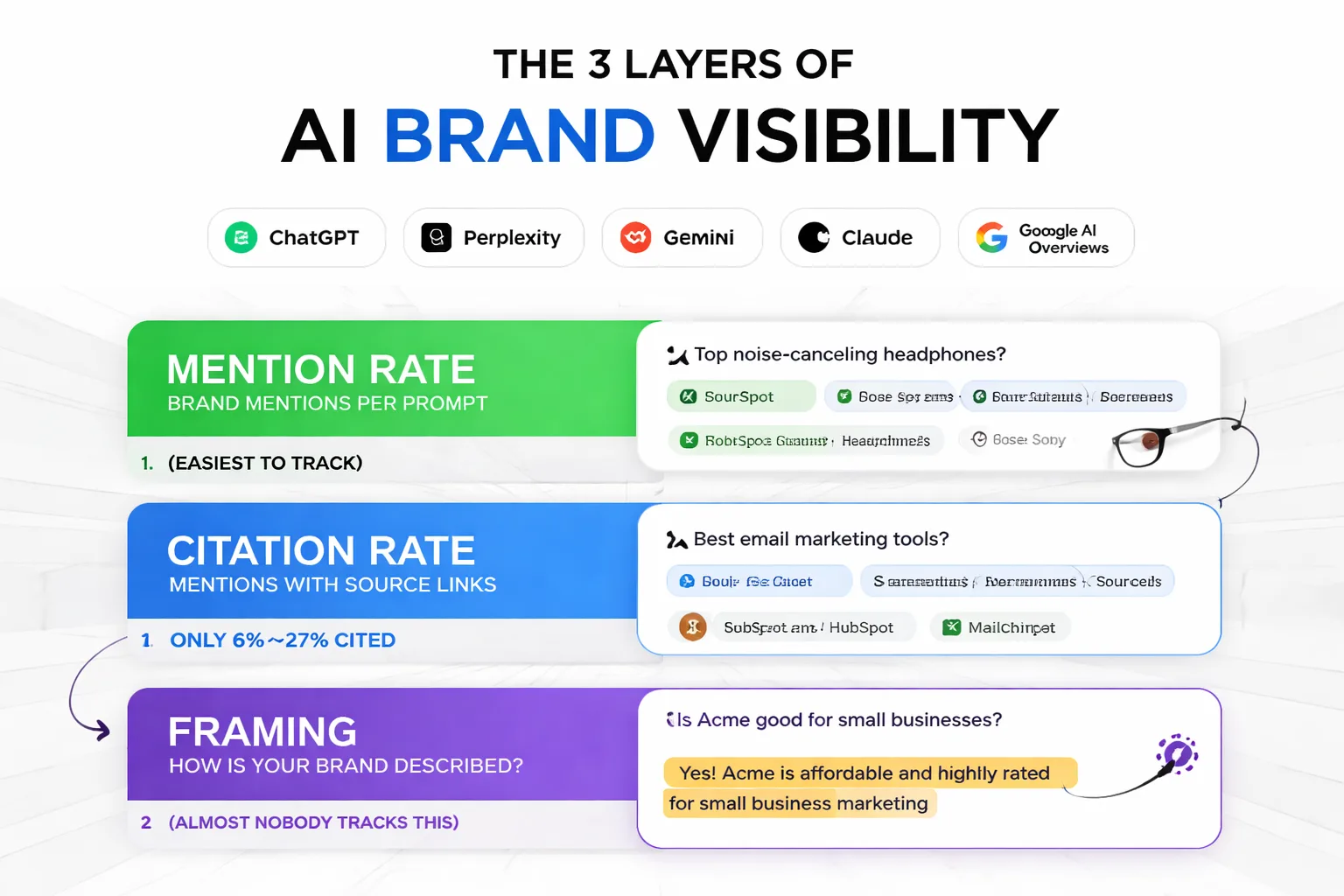
Most marketers confuse visibility with mentions. They are not the same thing. AI brand visibility is the rate at which a brand is mentioned, cited as a source, and favorably framed across AI answer surfaces like ChatGPT, Perplexity, Gemini, Claude, Grok, and Google AI Overviews. It is a composite metric with three distinct layers, and each requires its own measurement approach.
The first layer is mention rate. This is the simplest to track: does your brand name appear in the AI's response at all? It is binary per prompt but becomes meaningful when aggregated across hundreds of buyer-intent prompts. The second layer is citation rate. This is where it gets interesting. Semrush found that only 6% to 27% of brands mentioned in AI responses are also cited as the source backing the claim. That gap is enormous. A mention without a citation is a rumor. A citation is an endorsement backed by a linkable source.
The third layer, and the one almost nobody tracks, is framing. This is the contextual narrative the AI constructs around your brand. In my own work auditing content operations, I have seen brands celebrate a high mention rate while completely missing that the AI was framing them as a "good starting point" before steering users toward a more "advanced" competitor. That is not visibility. That is a funnel disguised as a compliment.
Here is why citation rate matters more than raw impressions. When an AI engine cites your domain as a source, it is making a trust decision. It is telling the user, "This brand's content is authoritative enough to back my answer." That trust signal feeds back into the model's training data and retrieval pipeline. Citations compound. Mentions without citations do not.
Think of it like traditional PR. A journalist mentioning your company name in a roundup article is nice. A journalist linking to your research as the primary source for their story is transformative. The same dynamic applies to AI engines, except the "journalist" is a retrieval-augmented generation pipeline that will reference the same trusted sources repeatedly.
The practical implication: stop tracking mentions alone. Start tracking the triple metric of mention rate, citation rate, and framing sentiment. If your AI visibility tool only reports mentions, you are missing two-thirds of the picture.
Why Standard Analytics Miss the AI Layer
Google Analytics 4 will not save you here. Search Console will not save you. Your favorite rank tracker will not save you. None of these tools can tell you whether ChatGPT cited your brand last week, which source Perplexity pulled from, or where you were completely absent from Gemini's response.
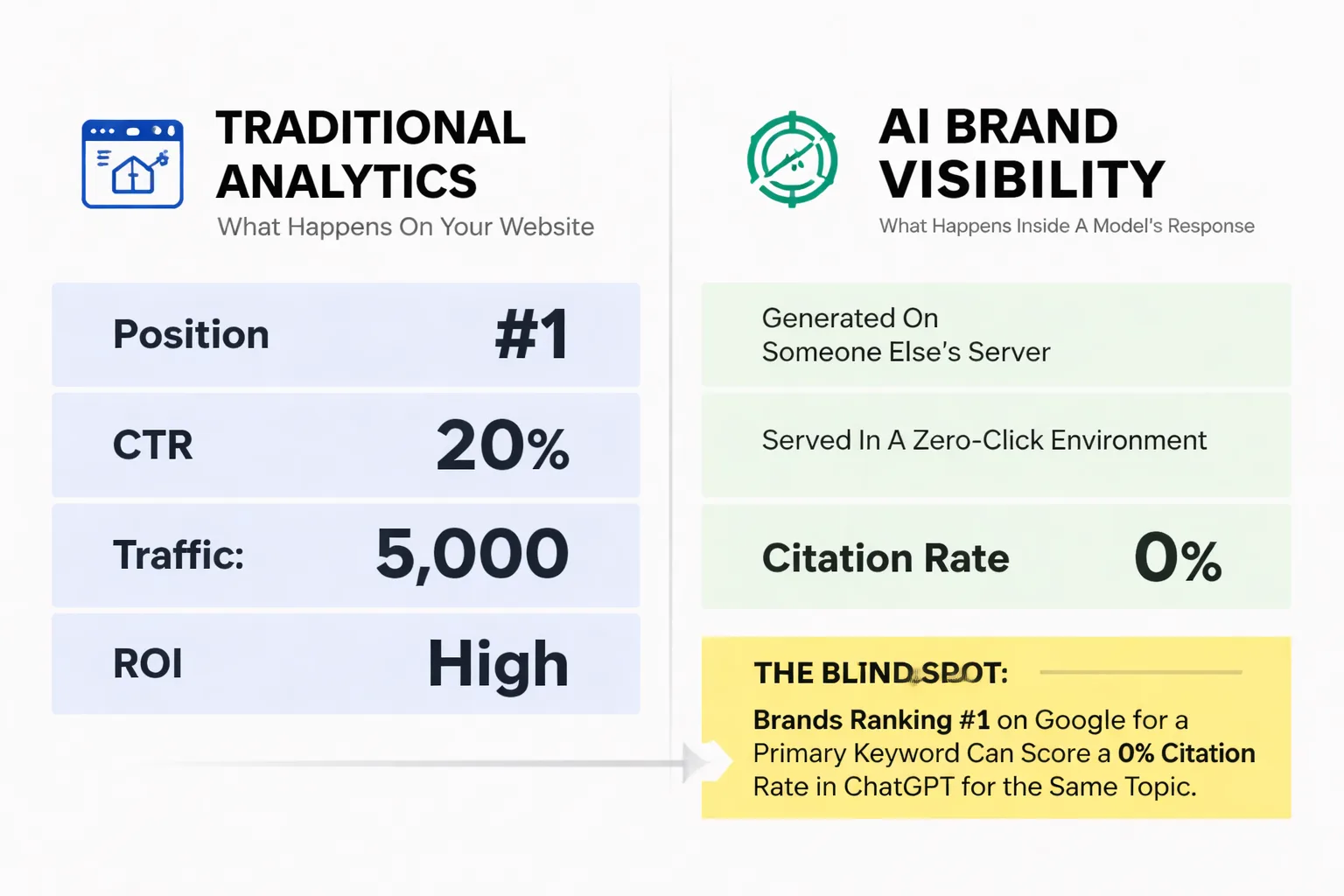
This is the blind spot that keeps me up at night. I have seen brands that rank #1 on Google for their primary keyword score a 0% citation rate in ChatGPT for the same topic. Their SEO is flawless. Their AI visibility is nonexistent. They are winning a game that fewer people are playing while losing a game they do not even know exists.
The mechanics explain why. Traditional analytics measure what happens on your website: clicks, impressions, positions, bounce rates. AI brand visibility measures what happens inside a model's response, which is generated on someone else's server and served in a zero-click environment. GA4 sees the rare click that escapes the AI answer. It does not see the 99 times your brand was never mentioned.
Consider this scenario. A buyer types "best CRM for small B2B SaaS" into Perplexity. Perplexity retrieves sources, synthesizes an answer, and cites three brands with linked sources. Your CRM is objectively excellent for this use case. You have 200 case studies, a #1 Google ranking, and a pristine G2 profile. But Perplexity did not cite you because no high-authority third-party source explicitly connects your brand to "small B2B SaaS CRM" in a way the retrieval pipeline can surface. Your competitor, who has half your features but was mentioned in a TechCrunch article with that exact phrasing, got the citation.
Google Search Console would show you ranking #1 for "CRM for small B2B SaaS." It would show a healthy CTR. It would show nothing about the Perplexity answer that just steered a buyer to your competitor. That is the gap.
The Search Engine Journal reported on this exact problem: brands are tracking AI visibility, but many are measuring the wrong things. They are tracking raw mention counts without context, without citation attribution, and without competitive benchmarking. It is like tracking website traffic without knowing your conversion rate. The number looks impressive and tells you nothing useful.
This is why I consider answer engine optimization a fundamentally different discipline from traditional SEO, not an extension of it. The tools, the metrics, the signals, and the timelines are all different. If you try to measure AI visibility with SEO tools, you will get SEO answers. And SEO answers do not explain why your brand disappeared from ChatGPT's responses last Tuesday.
How to Run an AI Brand Visibility Audit in 5 Steps
An audit is the starting point. You cannot improve what you have not measured, and you cannot measure what you have not structured. Here is the exact five-step process I use, designed for a small team that needs answers this week, not next quarter.
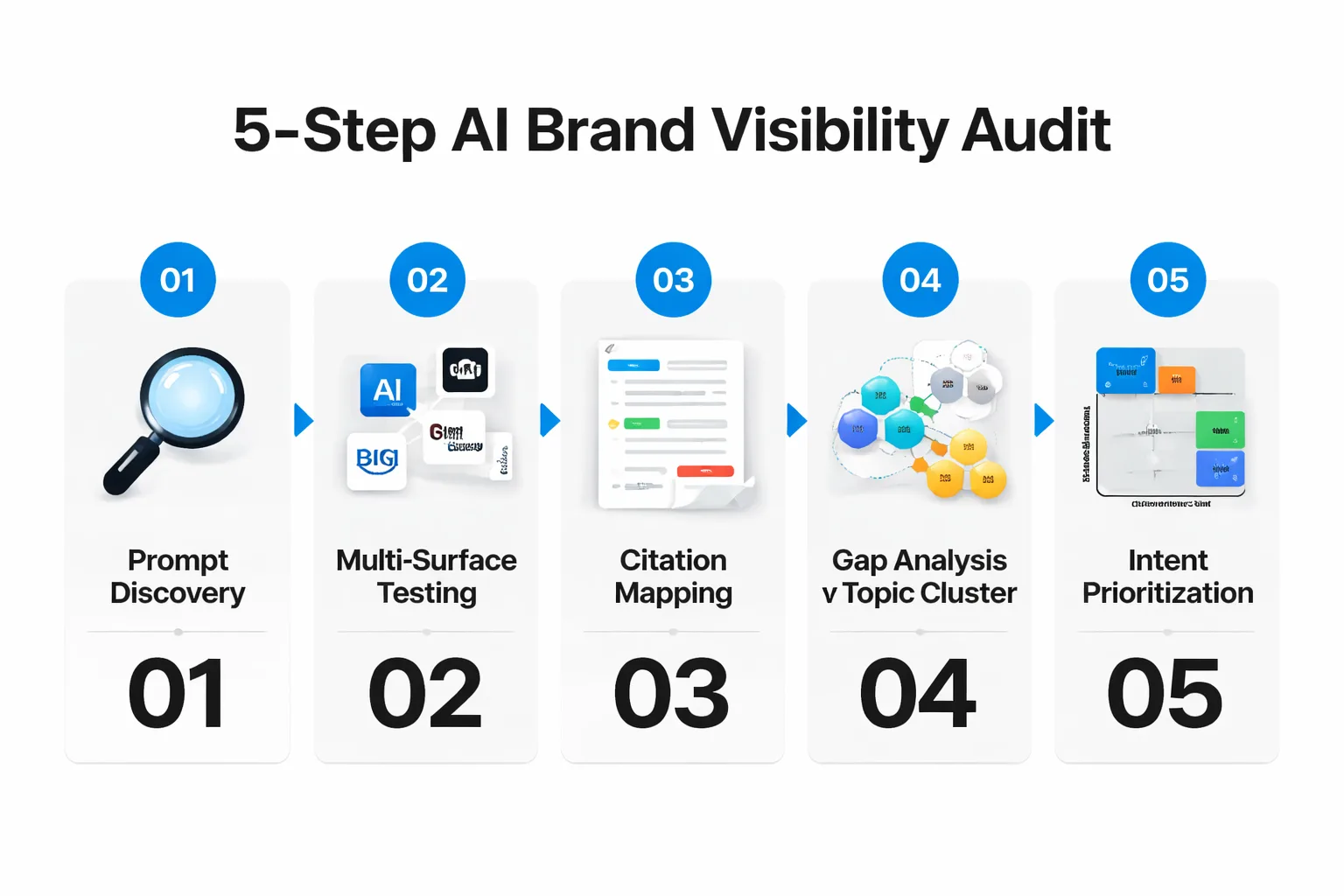
Step 1: Identify the Prompts Your Buyers Actually Type
This is the step everyone skips, and it is the one that determines whether your entire audit is valid. Do not guess what your buyers ask AI engines. Do not use your SEO keyword list as a proxy. AI prompts are structurally different from Google queries. They are conversational, specific, and often include context that a Google search would not.
"Best project management software" is a Google query. "I run a 12-person remote agency and need a project management tool that integrates with Slack and handles client portal access. What do you recommend?" is an AI prompt. The difference matters because the AI's answer will be shaped by the specific constraints in that prompt, and your brand may be relevant to one but not the other.
Start by surveying your sales team. Ask them: what questions do prospects ask in discovery calls? What comparison points come up? What objections do they raise? Then check Reddit, G2 reviews, and sales call transcripts (if you have them). Build a list of 50-100 real prompts that reflect actual buyer intent. Group them into topic clusters: feature comparison, use-case fit, pricing questions, alternative searches, and problem-aware queries.
Step 2: Run Those Prompts Across Every Major AI Surface
This is where the manual approach gets painful but necessary for your first audit. You need to run each prompt across every major AI search surface: ChatGPT, Perplexity, Gemini, Claude, Grok, Google AI Overviews, and Google AI Mode. Each engine has a different retrieval pipeline, different training data, and different citation behavior. A prompt that cites your brand in Perplexity may produce a completely different answer in ChatGPT.
Run each prompt three times per surface to account for response variance. LLMs are non-deterministic, meaning the same prompt can produce different answers on different runs. If your brand appears in two of three runs, that tells you something different than appearing in zero of three.
For teams that want to skip the manual labor (and you should, after your first audit), an AI visibility checker automates this across surfaces with daily or weekly refresh cadences. But I strongly recommend doing one manual audit first so you understand exactly what the data represents.
Step 3: Record Which Brands Are Cited and Which Sources Back Them
For every prompt response, log five data points: which brands are mentioned, which brands are cited as sources (with URLs), the position of each brand in the answer (first, in a list, last), the framing of each mention (positive, neutral, negative), and which third-party sources the AI used to ground its response.
That last data point is the gold mine. When Perplexity cites a brand, it links to a source. That source might be the brand's own website, but it might also be a G2 review, a Reddit thread, a TechCrunch article, or a Wikipedia entry. Recording these source domains tells you exactly which publishers are feeding the AI's understanding of your category. If you want to improve your AI visibility, you need to earn citations from those specific publishers.
I maintain a spreadsheet with columns for prompt, surface, run number, brand mentioned, citation URL, source domain, position, framing, and notes. It is low-tech and it works. After 50 prompts across 7 surfaces with 3 runs each, you have over 1,000 data points. That is enough to see patterns.
Step 4: Map Your Citation Gaps by Topic Cluster
Now the data tells a story. Group your results by topic cluster and calculate your citation rate for each. You will likely find that your brand is well-cited in some clusters (maybe your branded queries and direct comparison queries) and completely absent in others (maybe use-case queries and problem-aware queries).
Those absent clusters are your citation gaps. They represent topics where buyers are asking AI engines for recommendations, and your brand is not in the conversation. Every gap is a revenue leak.
The most common pattern I see: brands have strong citation rates for "[brand name] vs [competitor]" prompts but weak rates for "best [category] for [use case]" prompts. Buyers who already know your brand will find you. Buyers who are problem-aware but not solution-aware will not. That second group is where AI visibility matters most because it is where purchase decisions are being influenced.
Step 5: Prioritize the Gaps With the Highest Buyer Intent
Not all gaps are equal. A citation gap for "what is [your category]" is less urgent than a gap for "best [your category] for [your ideal customer profile]." The first is informational. The second is transactional. Prioritize gaps where the prompt signals high purchase intent: comparison queries, use-case fit queries, budget-conscious queries, and alternative-finding queries.
Score each gap on three dimensions: search volume (how often this type of prompt is likely asked), buyer intent (how close to a purchase decision the prompter is), and competitive intensity (how many competitors are already cited). Prioritize high-volume, high-intent, low-competition gaps first. These are your quick wins.
This five-step audit gives you a baseline. It tells you where you stand, where you are absent, and where to focus. The next question is what to do about it.
Do you know which AI engines are citing your competitors right now?
Which Signals Move AI Brand Visibility the Fastest
This is where I need to push back on the conventional wisdom. Most advice about improving AI visibility focuses on tactics that sound good but do not actually move the needle. Meta tags will not fix your citation rate. Schema markup helps, but it is table stakes, not a competitive advantage. Link velocity alone, without context, will not get you cited by Perplexity.
The signals that actually shift citation rate fall into three categories: entity grounding, answer-engine optimized content, and source authority. Let me break each one down with the specific mechanics of why they work.
Entity Grounding: Wikidata and Knowledge Graph Presence
AI models do not "read" the internet in real time. They retrieve information from indexed sources and ground their responses in entities they recognize. An entity is a discrete, identifiable thing: a person, a company, a product, a concept. If your brand is not a recognized entity in the knowledge graphs that feed AI models, you are invisible to them regardless of how good your content is.
This is why entity grounding for AI search matters. The primary knowledge graphs that feed AI models are Wikidata, Google's Knowledge Graph, and proprietary entity databases maintained by each model provider. If your brand has a Wikidata entry with accurate structured data (founding date, industry, key people, products), AI models can ground their responses in that entity. If it does not, the model has to infer your existence from unstructured text, which is less reliable and less likely to result in a citation.
I used to think that perfecting on-site schema was the key. My team spent significant time ensuring our brand data was meticulously structured. Then I realized that AI models like Perplexity triangulate understanding from a much broader set of credible third-party sources: Wikipedia, G2, Reddit, TechCrunch. On-site schema helps the model interpret your content. External entity authority helps the model trust your brand. The latter is a stronger driver of citations.
The practical steps: create or improve your Wikidata entry. Ensure your Wikipedia page (if you have one) is accurate and well-sourced. Claim and optimize your G2, Capterra, and TrustRadius profiles. Get listed in industry-specific directories that AI models are likely to crawl. These are not quick wins. They are foundational wins that compound over time.
Answer-Engine Optimized Articles
This is where generative engine optimization diverges from traditional SEO. Traditional SEO optimizes for crawlers that index pages and rank them by relevance and authority. Generative engine optimization optimizes for retrieval pipelines that extract information and synthesize answers. The content formats that win are different.
AI engines favor content that directly answers questions in extractable formats. Definitions, step-by-step processes, comparison tables, and FAQ blocks are highly extractable. Long narrative paragraphs with buried answers are not. If your article takes 500 words to get to the point, an AI engine will find a source that gets there faster.
The content that moves citation rate fastest is what I call "answer-first" content. Lead with the direct answer in the first 50 words. Support it with evidence. Then elaborate. This is the opposite of the traditional SEO approach of building context before delivering the answer. AI engines do not need context. They need extractable, citable claims backed by sources.
I have seen this work firsthand. When we restructured articles to lead with bolded, specific claims in the first paragraph and supported them with linked sources, citation rates from AI engines increased measurably within weeks. The AI retrieval pipeline found the claims, verified them against the linked sources, and started citing the articles as backing for its synthesized answers.
Source Authority Signals
The third lever is the one most brands underestimate. AI engines do not just cite any source. They cite sources they trust. Trust is determined by domain authority, topical relevance, and citation density (how often other authoritative sources link to this source).
This means that earning a mention on a high-authority third-party site is worth more for your AI visibility than publishing ten articles on your own blog. A single TechCrunch article that names your brand in the context of your category can feed Perplexity's retrieval pipeline for months. A Reddit thread where users recommend your product can influence ChatGPT's responses if that thread is part of the model's training or retrieval data.
The implication for ai and search engine optimization strategy: your PR and link-building efforts are not just for Google anymore. They are direct inputs to AI visibility. But the targeting changes. Instead of chasing high-DR domains for link equity, you need to earn mentions on the specific domains that AI engines cite most often for your topics. Those are the publishers feeding the retrieval pipeline.
Here is a quick comparison of what works and what does not:
| Signal | Impact on AI Citations | Why |
| Wikidata entry with structured brand data | High | Creates a machine-readable entity AI models can ground responses in |
| Third-party mentions on cited domains | High | Feeds retrieval pipelines with trusted external validation |
| Answer-first content with linked sources | High | Directly extractable by RAG pipelines |
| On-site schema markup | Medium | Helps interpretation but does not build external trust |
| Meta tag optimization | Low | AI engines do not parse meta tags for entity grounding |
| Link velocity without context | Low | Links without topical relevance do not feed retrieval pipelines |
How to Monitor AI Brand Visibility on an Ongoing Basis
An audit is a snapshot. Monitoring is a motion. The brands that win AI visibility are not the ones who did one audit and called it done. They are the ones who built a repeatable monitoring cadence and stuck with it.
The challenge with monitoring is that AI responses are non-deterministic and constantly evolving. A prompt that cites your brand today may not cite it tomorrow because the model was updated, the retrieval index changed, or a competitor published content that shifted the source landscape. Without ongoing monitoring, you will not know you lost a citation until a competitor tells you about the deal they won.
Build a Prompt Set and Stick With It
Your monitoring program needs a fixed prompt set: the same 50-100 prompts you identified in your audit, run on a consistent schedule. Consistency is the entire point. If you change the prompts every week, you cannot compare results over time. The prompt set is your control variable.
Run the full set weekly. Daily is overkill for most brands and will burn you out. Monthly is too slow. Weekly gives you enough data points to spot trends without drowning in noise. Log the same five data points from your audit: brands mentioned, citation URLs, source domains, position, and framing.
Track Competitor Movement Weekly
Your monitoring is not just about you. It is about the delta between you and your competitors. If your citation rate holds steady at 20% but a competitor jumps from 15% to 30%, you are losing ground even though your numbers did not change. Competitive benchmarking is the only way to know whether you are actually winning or just standing still while the field moves.
The Semrush study tracked 126 million prompts and found that only 36 brands achieved consistent visibility across all months. That means the vast majority of brands are gaining and losing visibility month over month. The brands that monitor these shifts weekly can respond before the pattern hardens.
Automate the Loop
Manual monitoring works for a first audit. It does not scale. At some point, you need a system that runs the prompts, logs the results, tracks the deltas, and surfaces the insights without human intervention.
This is where a dedicated AI visibility tracker becomes essential. The right tool should track your brand across every major AI search surface, show you which sources are driving your citations (and which are driving your competitors'), and alert you when a citation gap appears or widens. It should also connect diagnosis to action: when it finds a gap, it should tell you which publishers to target, which content to create, and which prompts to optimize for.
In my work at Meev, I have seen how this closed-loop approach transforms outcomes. A brand discovers they are absent from ChatGPT responses for a high-intent prompt cluster. The system identifies which sources ChatGPT is citing for those prompts. The brand creates answer-engine optimized content targeting those specific prompts and earns a mention on one of the cited publisher domains. Within two monitoring cycles, the brand appears in ChatGPT's responses with a citation. That is the loop: diagnose, act, measure, repeat.
The ChatGPT AI visibility checker and Perplexity AI visibility checker are examples of surface-specific tools that can get you started. But the real value comes from a unified view across all surfaces, because citation patterns vary dramatically between engines. A brand might dominate Perplexity and be invisible in Gemini. Without cross-surface monitoring, you would never know.
The Contrarian Take: Stop Optimizing for Mention Rate
Here is what everyone gets wrong about AI brand visibility. They optimize for mention rate. They celebrate when their brand name appears in more AI responses. They build dashboards with a big number that goes up and to the right. And they are optimizing for the wrong metric.
Mention rate is a vanity metric. It is the AI equivalent of tracking impressions without tracking clicks. Yes, your brand is being seen. But is it being cited? Is it being framed favorably? Is it appearing in response to prompts that actual buyers type, or just prompts that your marketing team fabricated to make the dashboard look good?
The brands that win AI visibility are not the ones with the highest mention rate. They are the ones with the highest citation rate on high-intent prompts with favorable framing. That is a much harder metric to optimize, and that is exactly why it is the right one. It correlates with revenue, not with vanity.
I learned this the hard way. Early in my work with AI visibility tracking, I focused on boosting raw recommendation rates, thinking more mentions equaled more leads. I was wrong. An AI can recommend your brand as a "good starting point" before suggesting a more "advanced" competitor, and your mention rate goes up while your pipeline goes down. The framing is what matters. The narrative context around the mention is what influences a buying decision.
If you take one thing from this article, let it be this: track citation rate and framing, not just mentions. Build your monitoring program around the triple metric. Optimize for being cited as a trusted source on prompts that real buyers type. Everything else is noise.
What This Actually Means for Your Team
AI brand visibility is not a passing trend. It is a structural shift in how buyers discover, evaluate, and select products. The brands that recognize this now and build tracking systems will establish citation patterns that compound over time. The brands that wait will find themselves locked out of answer sets that have hardened around their competitors.
The five-step audit gives you your baseline. The signal hierarchy (entity grounding, answer-engine content, source authority) tells you where to invest. The monitoring cadence keeps you informed. The triple metric (mention rate, citation rate, framing) keeps you honest.
Start with the audit. Do it manually if you have to. The act of running 50 prompts across 7 surfaces and logging the results by hand will teach you more about your AI visibility than any dashboard ever could. You will see patterns that data alone cannot reveal. You will feel the absence of your brand in responses where it should be. That visceral experience is what motivates the work that follows.
Then automate. Find a tool that tracks across every major AI surface, benchmarks against competitors, and connects diagnosis to action. Use the time you save to create answer-engine optimized content, earn mentions on cited publisher domains, and build the entity grounding that makes your brand a recognized, trusted node in the knowledge graphs that feed AI models.
The window is open. The Semrush data shows that only 36 brands have achieved consistent visibility across all months. That means the field is wide open for proactive teams. But windows close. Every month you wait is a month your competitors have to establish citation patterns that become harder to displace. AI brand visibility is a compounding asset, and the earlier you start tracking and building it, the more defensible it becomes.
Do not be the brand that missed the Knowledge Graph shift in 2012 and is missing the AI visibility shift in 2026. The tools exist. The methodology exists. The data exists. The only question is whether you start before your rivals do.
FAQ
What is the difference between AI brand visibility and traditional SEO ranking?
Traditional SEO ranking measures your position on Google's search results pages for specific keywords. AI brand visibility measures whether your brand is mentioned, cited, and favorably framed in AI-generated answers across surfaces like ChatGPT, Perplexity, and Gemini. The key difference: SEO tracks clicks and positions on one search engine. AI visibility tracks mentions, citations, and framing across every major AI answer surface, many of which operate in zero-click environments where traditional analytics are blind.
How often should I audit my AI brand visibility?
Run a full audit quarterly and monitor your core prompt set weekly. Quarterly audits give you a deep snapshot of citation patterns, source domains, and competitive positioning. Weekly monitoring catches shifts early: if a competitor suddenly appears in responses where you used to be cited, you want to know within days, not months. AI models update their retrieval pipelines frequently, and citation patterns can shift overnight.
Which AI surfaces should I track?
Track every major AI search surface: ChatGPT, Perplexity, Gemini, Claude, Grok, Google AI Overviews, and Google AI Mode. Each has a different retrieval pipeline and citation behavior. A brand might dominate Perplexity and be invisible in Gemini. Tracking only one surface gives you a false sense of your visibility. At minimum, track ChatGPT and Perplexity, as they account for the majority of AI search traffic.
Can I track AI brand visibility for free?
Yes, for your first audit. Run prompts manually across each AI surface, log the results in a spreadsheet, and analyze the patterns. This works for a one-time snapshot with 50-100 prompts. For ongoing monitoring across multiple surfaces with competitor benchmarking and trend tracking, manual methods become unsustainable quickly. Dedicated tools automate the prompt execution, data logging, and analysis.
What is a good AI brand visibility citation rate?
Based on the Semrush data showing that only 6-27% of mentioned brands are cited as sources, a citation rate above 20% is above average. Brands with strong entity grounding, high-authority third-party mentions, and answer-engine optimized content typically achieve 30-40% citation rates. The goal is not a specific number but continuous improvement: higher citation rate this quarter than last, on higher-intent prompts, with more favorable framing.
How long does it take to improve AI brand visibility?
Entity grounding improvements (Wikidata, knowledge graph presence) can show results within 2-4 weeks as models refresh their entity databases. Answer-engine optimized content typically takes 4-8 weeks to be crawled, indexed, and surfaced by AI retrieval pipelines. Third-party mentions on cited publisher domains can influence responses within 1-2 weeks if the publisher is already part of the AI's trusted source set. The compounding effect takes 3-6 months to become measurable.
About the Author
Judy Zhou, Founder
Judy Zhou leads content strategy at Meev, where she oversees AI-driven content research and publishing for hundreds of brands. With a background in SEO and editorial operations, she focuses on building content systems that rank on Google, get cited by AI search engines, and drive measurable business results.
Run your first AI brand visibility audit today and discover the citation gaps costing you pipeline.