

By Judy Zhou, Founder
Key Takeaways
- Entity-rich, fact-dense content improves AI citation visibility by up to 40%, per Princeton and IIT Delhi research.
- AI-sourced visitors convert at 4.4 times the rate of traditional organic traffic, according to Semrush data.
- Define your brand entity so cleanly that AI retrieval systems can pull, attribute, and integrate specific passages into generated answers.
- Treat AEO as core infrastructure, not a bolt-on of schema to existing SEO posts, to win citations in ChatGPT, Perplexity, and Google AI Overviews.
In 2016, Google quietly introduced Featured Snippets at scale. A small, radical experiment in answering questions directly on the results page rather than routing users to a website. Most SEOs dismissed it as a curiosity. A few optimized for it obsessively. In hindsight, Featured Snippets were the first tremor before the earthquake. By 2024, generative AI had transformed that experiment into the dominant paradigm of information retrieval. The discipline that emerged to address it has a name: Answer Engine Optimization. And in 2026, it is no longer optional infrastructure. It is the game itself.
Answer Engine Optimization (AEO) is the practice of structuring content, entities, and source authority so that AI-powered answer engines cite your brand when answering relevant questions. It differs from traditional SEO because it optimizes for citation inside a synthesized answer, not a click on a blue link. Research from Princeton and IIT Delhi found that entity-rich, fact-dense content can improve AI citation visibility by up to 40%, and a Semrush AI search traffic study found that AI-sourced visitors convert at roughly 4.4 times the rate of traditional organic traffic. In my work auditing content operations and AI visibility at Meev, I have seen that brands winning citations in ChatGPT, Perplexity, and Google AI Overviews are not keyword-stuffing. They are the ones whose entity is so cleanly defined that an AI retrieval system can pull a passage, attribute it correctly, and fit it into a generated answer.
That conversion rate should stop you cold. 4.4x is not an incremental bump. It is a signal that the people who ask AI engines questions are further along in a buying journey than someone typing a keyword into Google.
Here is where it gets interesting. Most teams treat AEO as a bolt-on to their existing SEO workflow. They publish a blog post, add some schema, and hope ChatGPT picks it up. That approach fails because answer engines do not rank pages. They retrieve passages, synthesize them, and cite sources. The entire retrieval pipeline is different.
In my work building content systems at Meev, I have become convinced that the gap between brands cited by AI engines and brands ignored by them comes down to four things: entity clarity, answer-structured content, source authority, and citation monitoring. Most teams do zero of these well. This guide breaks down each pillar, distinguishes AEO from adjacent terms like GEO and LLM SEO, and gives you a first-week checklist to start closing your own citation gaps.
What Is Answer Engine Optimization?
Answer Engine Optimization (AEO) is the discipline of structuring content, entity data, and source authority so that AI-powered answer engines (ChatGPT, Perplexity, Google AI Overviews, Claude, Gemini, Grok) cite your brand when answering relevant questions. It replaces the old goal of ranking in the top ten blue links with a new goal: being the source an AI engine retrieves, synthesizes, and attributes when it generates an answer.
The shift is mechanical. A traditional search engine returns a list of pages. An answer engine returns a synthesized response built from retrieved passages, and it cites the sources it used. Your job in AEO is to make your content the passage that gets retrieved and attributed. That means writing in answer-shaped formats, defining your entity unambiguously, and building the kind of source authority that an AI retrieval system trusts.
The Princeton and IIT Delhi GEO research (arXiv preprint) established the academic foundation for this field. Their work on Generative Engine Optimization demonstrated that specific content modifications, including citation inclusion, quotation usage, and statistical data, increase citation visibility in generative engines. That paper, published in late 2023, framed the problem. The industry has spent the time since then catching up to what it described.
AEO is not a rebrand of SEO. It is a different optimization target. SEO optimizes for a crawler that ranks pages by relevance and authority signals. AEO optimizes for a retrieval-augmented generation (RAG) pipeline that chunks content, retrieves relevant passages, and synthesizes them into an answer with citations. The pipeline does not care about your title tag. It cares about whether your content contains a clean, extractable answer to the question it is trying to resolve.
If you want to go deeper on the definitional split between AEO and traditional SEO, I wrote a detailed breakdown of AEO vs. SEO that covers the structural differences in how each discipline approaches content, measurement, and technical infrastructure.
How Answer Engines Differ from Search Engines
The fundamental difference between a search engine and an answer engine is what they return. A search engine returns a list of pages. An answer engine returns a synthesized answer built from retrieved passages, and it cites the sources it used.
This changes everything about how you optimize.
A search engine ranks pages using signals like backlinks, content relevance, and user engagement. Position one gets the most clicks. Position ten gets almost none. The entire SEO industry was built around this ranking ladder. Answer engines do not have a ranking ladder. They have a retrieval pipeline. When a user asks ChatGPT or Perplexity a question, the engine retrieves relevant passages from its index, feeds them to a language model, and generates a synthesized answer with inline citations. Your brand appears if your content was retrieved, if it was selected for synthesis, and if the model decided to attribute it.
That is a three-stage gate, not a ranking. You can rank number one on Google for a query and never appear in the AI answer for that same query. I have seen this happen repeatedly. The reason is that ranking well on Google does not guarantee that your content is structured in a way that an AI retrieval system can chunk it, retrieve a relevant passage, and synthesize it into an answer. The two systems use different retrieval logic.
Google's AI Overviews sit at the intersection. They pull from the search index but use generative synthesis to build the answer. A study by Semrush found that AI Overviews appear for roughly 47% of informational queries in the US, and that AI-sourced visitors convert at 4.4x the rate of traditional organic traffic. That conversion gap is the business case for AEO in one number.
The citation problem is where things get messy. A 2025 study published in Nature Communications found that 50-90% of LLM-generated citations do not fully support the claims they are attached to. Separate research from Venkit et al. (arXiv 2024) found that citation accuracy ranges from 39-77% across frontier LLMs, with the best platform scoring around 66% and the worst under 50%. This means that even when your brand IS cited, the citation may not accurately represent what you said or what you stand for.
This is why I tell every team I work with that citation monitoring is not optional. You cannot assume that being cited means being cited correctly. An AI engine might cite your brand but frame you as a starter tool before recommending a more advanced competitor. In B2B, that framing is actively harmful. It funnels buyers away from you even though your brand name appears in the answer. Raw mention rate is a red herring. Framing is what matters.
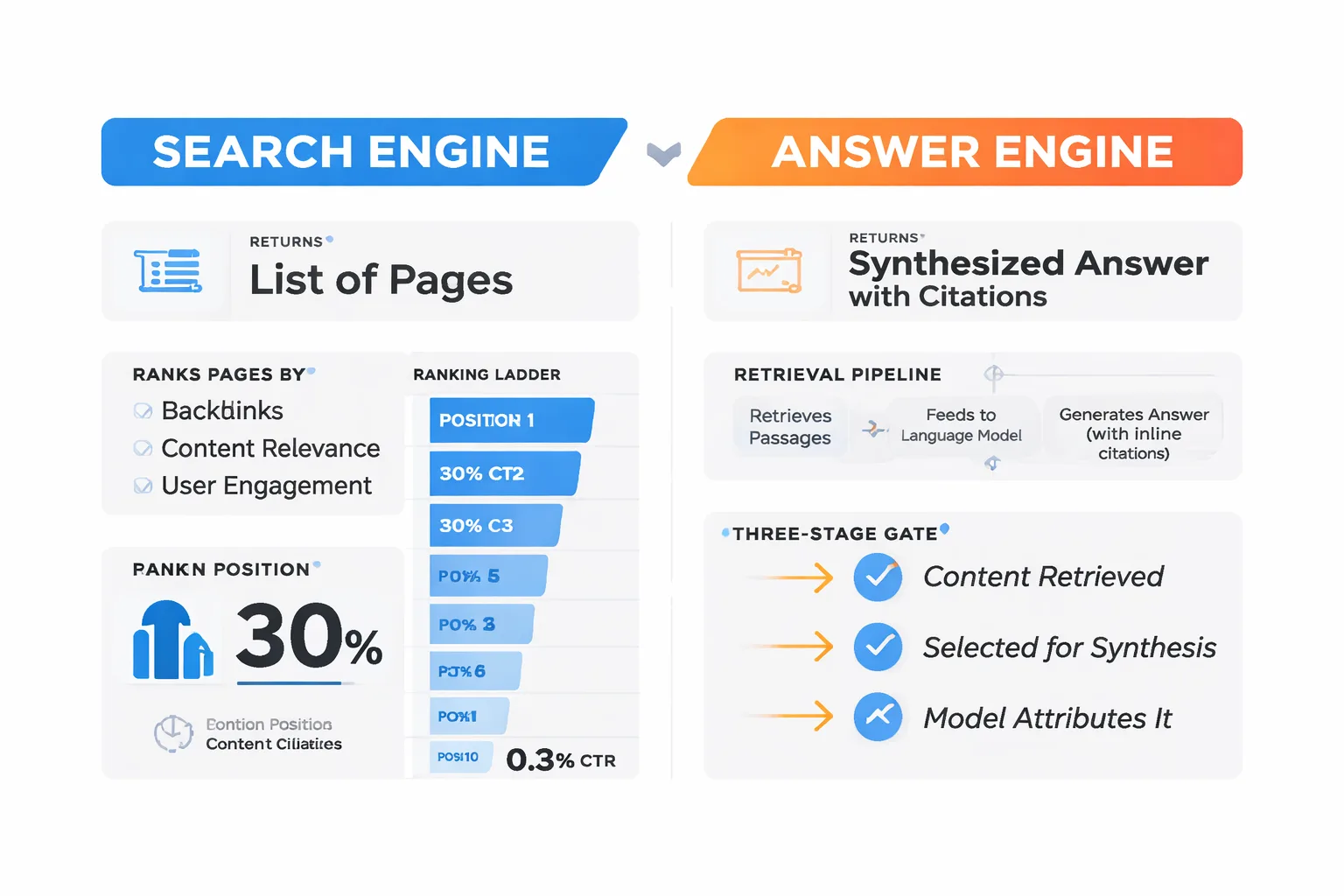
Traditional SEO vs. Answer Engine retrieval
The practical implication is that you need to track not just whether you appear in AI answers, but where you appear, how you are framed, and what sources the AI engine used to build that framing. That requires a different toolset than rank tracking. It requires AI visibility tracking across every major AI search surface, with the ability to drill into the actual response text and citations behind each mention.
The Core Tactics of AEO in 2026
AEO in 2026 rests on four pillars. Each one addresses a specific stage of the AI retrieval pipeline. Skip any of them and you create a gap that prevents your brand from being cited, or cited correctly.
Pillar 1: Entity Grounding
Entity grounding is the foundation. Without it, AI systems might confuse your brand with a competitor, a different product, or an unrelated entity. The research literature gives a concrete example: without proper entity disambiguation, an AI system might confuse a product called "Apex platform" with a mountain peak. That sounds absurd until you realize it happens at scale across millions of entities.
Entity grounding means defining your brand, your products, and your key people as unambiguous entities that an AI retrieval system can identify, attribute, and connect to the correct knowledge graph node. This involves six steps: defining entity recognition, implementing disambiguation strategies, improving entity recognition accuracy, connecting schema design to downstream AI performance, structuring content for AI retrieval systems, and maintaining presence in knowledge graphs like Wikidata.
Siteimprove's analysis of schema and entity grounding makes an important point that I agree with: schema alone does not guarantee visibility in AI-driven search results. Schema is a signal, not a guarantee. The AI retrieval system uses it as one input among many. But without it, your entity is undefined, and undefined entities do not get cited.
In my experience, the teams that get entity grounding right focus on three things. First, they maintain a Wikidata entry with accurate, sourced statements about their brand. Second, they use schema markup (Organization, Product, Person) consistently across their site. Third, they build internal linking structures that clearly define relationships between content, products, and people. Google prioritizes content-driven entity recognition for AI visibility. Internal links that clearly define entity relationships matter more than sitemap submissions for getting your content recognized and indexed.
Pillar 2: Answer-Structured Content
Answer engines retrieve passages, not pages. If your content does not contain clean, extractable answers to questions your audience asks, it will not be retrieved. This is the pillar most teams get wrong because it requires a fundamental shift in how you write.
Most content is written to rank. It targets a keyword, hits a word count, and covers a topic comprehensively. Answer-structured content is written to be extracted. It opens with a direct answer to a question. It uses question-shaped headings. It puts the most important information first, not buried in the fourth paragraph.
The Princeton GEO research found that including citations, quotations, and statistical data in content increases citation visibility in generative engines. This is not surprising when you think about how RAG pipelines work. They retrieve passages that contain relevant information and are structured in a way that can be synthesized. A passage that says "our research found that 34% of marketers use AEO tools" with a linked source is more retrievable than a passage that says "many marketers are adopting AEO tools."
In my work at Meev, I have seen that archetype-aware writing matters. A listicle, a how-to guide, and an explainer each need different retrieval weights, structures, and quality criteria. Generic AI writers treat every topic the same. That is why they produce content that does not get cited. The structure has to match the intent behind the question the user is asking the AI engine.
Pillar 3: Source Authority Building
Answer engines cite sources they trust. Trust is built through the same signals that have always mattered in search: authoritative backlinks, consistent entity presence, and being cited by other authoritative sources. But the mechanism is different. Answer engines do not just count backlinks. They use the linking context to understand what your brand is an authority on.
This is where the closed-loop citation building becomes critical. You need to find the publishers that AI engines actually cite for your topics, get your brand mentioned on those publishers, and ensure the mentions are framed favorably. This is not traditional link building. It is citation building within the sources that feed AI retrieval pipelines.
Research from Volpini et al. (arXiv 2026) on structured linked data as a memory layer for agent-orchestrated retrieval suggests that the connection between your entity and authoritative sources is becoming more important, not less, as AI agents become more sophisticated in how they retrieve and synthesize information.
Pillar 4: Citation Monitoring
You cannot optimize what you do not measure. Citation monitoring means tracking where your brand appears across every major AI search surface, how it is framed, and what sources the AI engine used to build that framing. This is the pillar where most teams have zero infrastructure.
The citation accuracy problem makes this non-negotiable. With 50-90% of LLM-generated citations not fully supporting claims (per the Nature Communications study), you need to know not just whether you are cited, but whether the citation is accurate and favorable. A citation that frames your brand as a secondary option is worse than no citation at all in a B2B context.
I have seen teams celebrate a high "recommendation rate" only to discover that the AI engine was recommending them as a good starting point before suggesting a more advanced competitor. That is not a win. That is a leak. Citation monitoring has to go beyond mention counting to framing analysis. You need to see the actual response text, understand the sentiment and positioning, and track it over time.
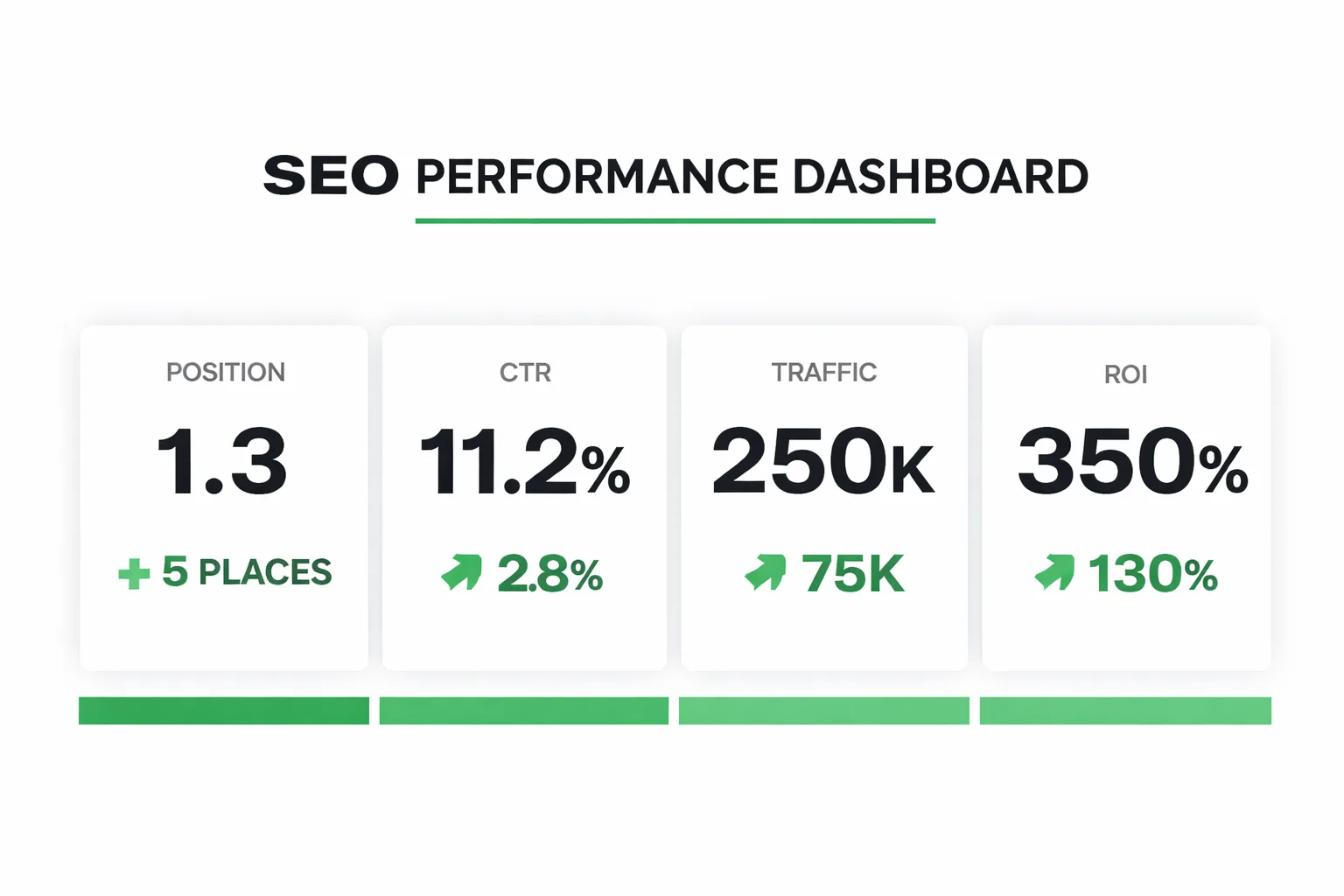
The four pillars of AEO in 2026
Do you know which AI engines are citing your brand right now?
What Is Answer Engine Optimization AEO vs. GEO vs. LLM SEO?
The terminology landscape is a mess. AEO, GEO, LLM SEO, AI SEO, generative SEO. Teams use these terms interchangeably, and it creates confusion about what they are actually optimizing for. Let me clarify.
Answer Engine Optimization (AEO) is the broadest term. It covers optimizing for any answer engine that synthesizes responses with citations. That includes ChatGPT, Perplexity, Google AI Overviews, Claude, Gemini, Grok, and Google AI Mode. AEO is about being cited in synthesized answers.
Generative Engine Optimization (GEO) is the academic term coined in the Princeton and IIT Delhi paper. It refers specifically to optimizing for generative engines, which the paper defines as AI systems that generate responses using retrieval-augmented generation. GEO is technically a subset of AEO, but in practice, the terms are used to describe the same activity. If you want a deeper comparison, I wrote about AEO vs. GEO with specific breakdowns of where the terms diverge.
LLM SEO is a narrower term that refers to optimizing content specifically for large language models. It tends to focus on the retrieval and generation mechanics of LLMs rather than the broader answer engine ecosystem. LLM SEO is useful as a technical framing when you are thinking about how a specific model (GPT-4, Claude, Gemini) chunks and retrieves your content.
Here is where they converge and diverge in practice. All three share the same goal: getting your brand cited in AI-generated answers. They share the same core tactics: entity grounding, answer-structured content, source authority, and citation monitoring. Where they diverge is in emphasis. AEO is the broad practice. GEO is the academic framing. LLM SEO is the technical implementation.
My recommendation is to use AEO as your primary term. It is the most intuitive, it covers the full ecosystem, and it is what your stakeholders will search for. If you are writing for an academic or technical audience, use GEO. If you are working on the retrieval mechanics of a specific model, use LLM SEO. But do not waste time debating the terminology. The work is the same.
For teams that want to understand what is answer engine optimization aeo in practical terms, the answer is simple. It is the work of making your brand citable by AI systems. Everything else is labels.
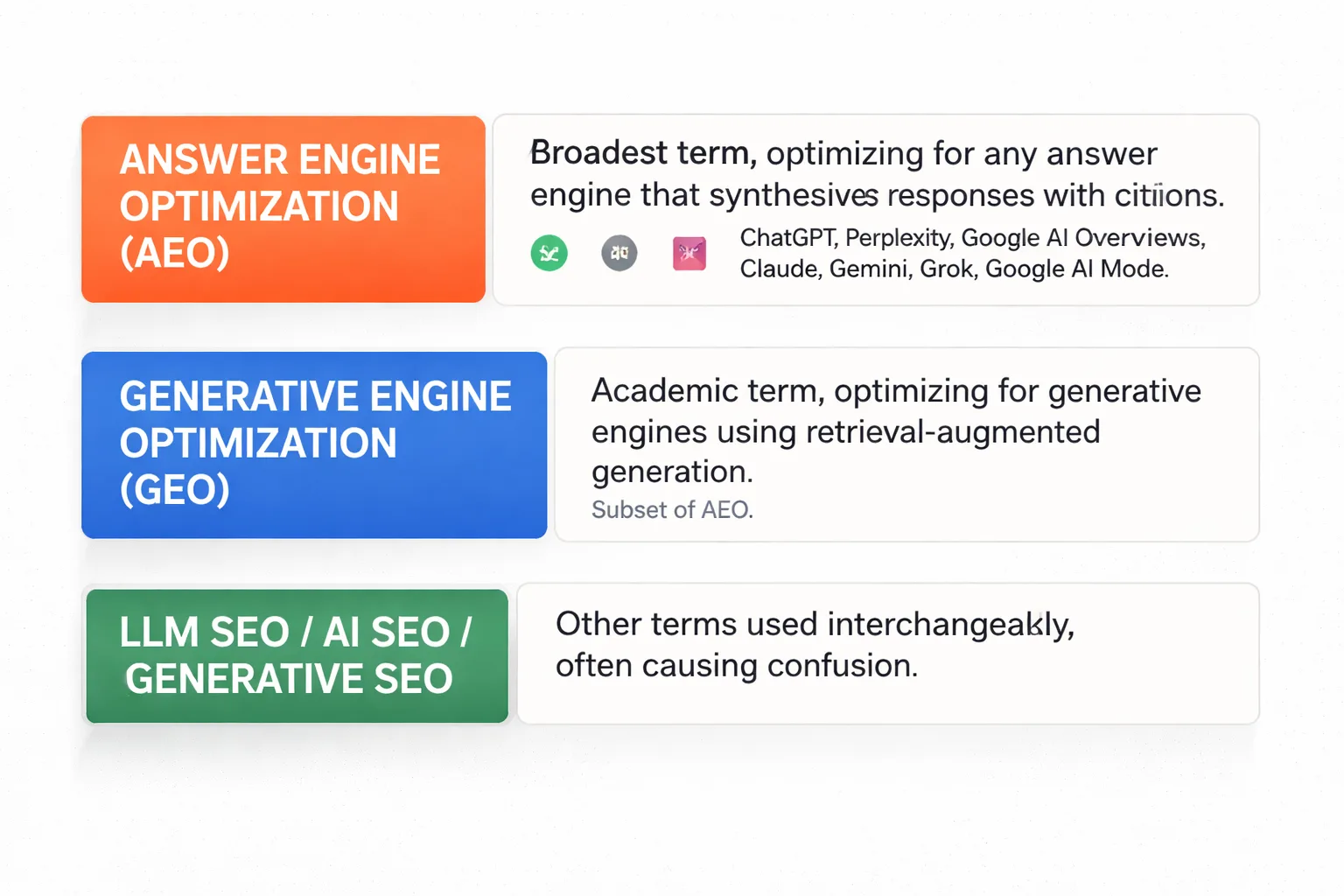
AEO, GEO, and LLM SEO compared
How to Start with AEO Today
You do not need a six-month strategy to start AEO. You need a first week. Here is the checklist I give every team I work with.
Day 1-2: Run a citation audit. Pick ten prompts that represent questions your customers would ask an AI engine about your product or industry. Run them through ChatGPT, Perplexity, Claude, and Google AI Overviews. Record whether your brand appears, where it appears (first, in a list, last), how it is framed, and what sources the AI engine cited. This gives you a baseline. You can use a dedicated AI visibility checker to automate this, but a manual audit on day one is faster and more instructive. You need to see the raw responses with your own eyes to understand the framing problem.
Day 3: Identify three high-intent prompts. These are prompts where your target customer is asking a question that leads to a buying decision. Not "what is X" (informational). But "what is the best X for [use case]" or "X vs. Y for [scenario]" (commercial). These are the prompts where citation visibility drives revenue. The Semrush data showing 4.4x conversion rates for AI-sourced traffic is concentrated in these commercial and transactional prompts, not informational ones.
Day 4-5: Publish one answer-optimized article. Pick one of the three high-intent prompts. Write an article that directly answers it. Open with a 40-60 word answer in the first paragraph. Use question-shaped H2s. Include specific numbers with linked sources. Add schema markup (Article, FAQ). Make every claim traceable to a primary source. This is your first AEO-optimized content asset. If you want to see how an AI SEO tool can automate the research and structuring, that is an option, but the first article should be manual so you understand the mechanics.
Day 6: Set a baseline metric. You need one number to track over time. I recommend share-of-voice: what percentage of AI answers for your target prompts cite your brand vs. competitors. This is harder to calculate manually but more meaningful than raw mention count. If you are using a tool, track share-of-voice across all major AI search surfaces. If you are doing it manually, track your presence and framing across your ten audit prompts and recalculate weekly.
Day 7: Identify your citation gaps. Look at the prompts where competitors are cited but you are not. What sources did the AI engine use to build those answers? Those are the publishers you need to build relationships with. This is where citation building becomes an ongoing practice, not a one-time audit.
This first week will not transform your AI visibility. But it will give you the infrastructure to measure, iterate, and improve. The teams that win at AEO are the ones that treat it as an ongoing practice, not a one-time project. AI engines update their retrieval logic. New competitors enter the space. Citation accuracy shifts. You need continuous monitoring and iteration.
One more thing. If you are publishing content as part of your AEO strategy, and you should be, the quality of that content matters more than the quantity. Google's Helpful Content System updates have been ruthless to AI-generated content that lacks human oversight. I have seen sites lose traffic and revenue because they published AI slop without editorial review. The differentiator is not the AI. It is the degree of human intervention and the quality of the editorial process behind it. A quality firewall that blocks weak drafts before they reach your CMS is not a nice-to-have. It is the difference between content that gets cited and content that gets penalized.
The Agentic Future of AEO
Here is my contrarian take. Most teams are optimizing AEO for today's answer engines. They should be optimizing for tomorrow's AI agents.
The distinction matters. An answer engine synthesizes a response and cites sources. An AI agent synthesizes a response, makes a decision, and takes an action. When a user asks an AI agent "find me the best project management tool for a 20-person remote team and set up a trial," the agent does not just return an answer. It evaluates options, makes a recommendation, and initiates a trial. Your brand needs to be cited in the evaluation, recommended in the decision, and structured for the action.
This is what the industry is calling agentic SEO. Siteimprove describes it as "turning search visibility from chance into certainty." Frase frames it as a system that "acts, not just reports." Both descriptions are directionally correct, but neither has empirical citation data to prove agentic SEO outperforms traditional optimization in generative engines. The concept is ahead of the evidence.
That said, the direction is clear. AI agents are becoming the decision layer on top of answer engines. If your AEO strategy only optimizes for citation in synthesized answers, you are optimizing for the current state. You also need to optimize for agent decision-making. That means structuring your content to include decision-relevant information: pricing, feature comparisons, integration compatibility, and trial signup flows. It means making your entity actionable, not just citable.
For ecommerce brands, this is already happening. Agentic commerce is the next evolution of ecommerce GEO. When an AI agent can compare products, evaluate reviews, and complete a purchase on behalf of a user, your product data needs to be structured for agent retrieval and decision-making. Product schema, review schema, pricing data, and availability signals become the inputs to an agent's decision pipeline, not just a search engine's ranking algorithm.
The research from Volpini et al. on structured linked data as a memory layer for agent-orchestrated retrieval (arXiv 2026) points in this direction. As agents become more sophisticated, they will rely on structured, linked data to build their memory of entities, relationships, and attributes. Your presence in knowledge graphs like Wikidata, your schema markup, and your entity definitions become the foundation for how agents understand and interact with your brand.
This is not theoretical. It is the logical extension of the retrieval pipeline. Today, answer engines retrieve passages and synthesize answers. Tomorrow, agents will retrieve entities and synthesize decisions. The teams that build their entity infrastructure now will be the ones that agents recommend tomorrow.
The evolution from search to answer to action
Why Most AEO Strategies Fail
Most AEO strategies fail for one reason. They treat citation as the finish line instead of the starting point.
Getting cited by an AI engine is not a win. Getting cited favorably, accurately, and in a way that influences a buying decision is a win. The distinction sounds obvious, but I see teams miss it constantly. They celebrate a high mention rate without looking at the framing. They optimize for presence without optimizing for positioning. They track volume without tracking sentiment.
The Nature Communications study found that 50-90% of LLM-generated citations do not fully support the claims they are attached to. That means even when you are cited, the citation may be wrong. It may attribute a claim to you that you did not make. It may frame you in a context that is technically accurate but commercially disadvantageous. You need to monitor the actual response text, not just the mention count.
The second reason AEO strategies fail is that teams treat it as a content problem when it is an infrastructure problem. Publishing answer-optimized articles is necessary but not sufficient. If your entity is undefined in knowledge graphs, your schema is inconsistent, and your source authority is weak, your content will not get cited regardless of how well it is structured. AEO is a systems problem. It requires entity infrastructure, content infrastructure, and measurement infrastructure working together.
The third reason is that teams do not build citation monitoring into their workflow. They run a one-time audit, make some changes, and move on. AI engines update their retrieval logic continuously. Competitors publish new content. Knowledge graphs get updated. Your citation visibility is not a static state. It is a moving target. You need continuous monitoring with weekly trend analysis at minimum.
If you are serious about AEO, you need a tool that tracks your visibility across every major AI search surface, shows you the actual response text and citations behind every mention, and gives you share-of-voice data against competitors. A dedicated LLM visibility tool or an AI visibility tool that covers ChatGPT, Claude, Gemini, Perplexity, Grok, Google AI Overviews, and AI Mode is the infrastructure layer. Without it, you are guessing.
Putting It Into Practice with Meev
I built Meev because the tools for tracking AI visibility either did not exist or were bolted onto traditional SEO platforms as an afterthought. Meev tracks where your brand appears across every major AI search surface, shows you the actual response text and citations behind every mention, and then closes the gap by researching, writing, and publishing answer-engine-optimized articles that you approve before anything goes live.
The workflow is simple. First, you run a citation audit to see where you stand. Meev shows you your mention position, share-of-voice against competitors, and the framing of each mention. Second, you identify citation gaps where competitors are cited but you are not. Third, you close those gaps by publishing answer-optimized content that is gated by a 16-dimension quality firewall. Articles below 70 out of 100 are blocked from publishing. No weak drafts reach your CMS. Fourth, you find the publishers that AI engines cite for your topics and build relationships with them through personalized outreach grounded in your knowledge base.
This is the closed-loop system. Track visibility, identify gaps, publish content, build citations, measure again. It is not complicated. But it requires infrastructure that most teams do not have. If you are running AEO with a mix of manual audits, a generic AI writer, and a rank tracker, you are stitching together a workflow that will not scale.
The Perplexity AI visibility checker and ChatGPT AI visibility checker are good starting points if you want to see how you are performing on specific surfaces. But the real value is in having a single platform that tracks all of them, shows you the trends over time, and lets you act on the data.
If there is one thing I want you to take away from this guide, it is this. Answer Engine Optimization is not a new name for SEO. It is a different discipline with a different optimization target, a different measurement framework, and a different set of tactics. The teams that understand this distinction and build the infrastructure to support it will be the ones that AI engines cite. The teams that do not will watch their competitors get cited instead.
The 4.4x conversion rate for AI-sourced traffic is the number that should drive your urgency. Every day you are not cited in AI answers for your high-intent prompts, you are leaving revenue on the table. Start with the first-week checklist. Run your citation audit. Publish your first answer-optimized article. Set your baseline. Then iterate.
AEO is not the future of search. It is the present.
FAQ
What is Answer Engine Optimization (AEO)?
Answer Engine Optimization is the practice of structuring content, entities, and source authority so that AI-powered answer engines cite your brand when answering relevant questions. It emerged from the evolution of Google's Featured Snippets into generative AI systems like ChatGPT and Perplexity. In 2026, it has become essential infrastructure rather than an optional tactic.How does AEO differ from traditional SEO?
AEO optimizes for citation inside a synthesized AI answer rather than driving clicks on a blue link. Traditional SEO focuses on rankings and traffic, while AEO emphasizes entity clarity and fact density that retrieval systems can accurately attribute. Research shows entity-rich content can boost AI citation visibility by up to 40%.What results can brands expect from effective AEO?
Brands that win citations in AI engines see visitors who convert at roughly 4.4 times the rate of traditional organic traffic. These users are typically further along in the buying journey because they ask direct questions to answer engines. Success comes from cleanly defined entities that AI systems can pull and integrate into generated responses.How should teams approach AEO in their content strategy?
Teams should avoid treating AEO as a simple bolt-on to existing SEO workflows like adding schema to blog posts. Instead, they must focus on making their brand entity precise and authoritative so AI systems can reliably extract and cite passages. This requires dedicated content operations focused on fact density and entity definition.About the Author
Judy Zhou, Founder
Judy Zhou leads content strategy at Meev, where she oversees AI-driven content research and publishing for hundreds of brands. With a background in SEO and editorial operations, she focuses on building content systems that rank on Google, get cited by AI search engines, and drive measurable business results.
Run a free AI visibility audit and see exactly where your brand appears, how it is framed, and which competitors are stealing your citations.