By Judy Zhou, Founder
Key Takeaways
- The 'search or type url' signal shows whether users type your brand directly or discover it via search, exposing AI visibility gaps that most tools miss.
- 91% of ecommerce queries now trigger AI-generated results, so low direct-navigation share signals your brand is invisible in AI answers.
- Organic CTR drops 61% when Google shows an AI Overview, making the Omnibox navigation ratio a leading diagnostic for entity grounding.
- When direct URL typing dominates brand-name searches, it indicates strong recall; audit this split to fix weak AI citations before they compound.
When Google Analytics first introduced the 'Search or Type URL' label as a sub-classification within direct traffic, the intent was modest: give analysts a slightly cleaner way to separate navigational browser behavior from truly dark traffic. That was well before ChatGPT, before Perplexity, before AI Overviews rewired how millions of people discover brands. Fast-forward to today, and that same humble classification has quietly become one of the earliest diagnostic instruments available for understanding whether your brand has genuine presence inside the AI answer layer. And where the gaps in that presence actually live.
The 'search or type url' signal in your analytics tells you something most AI visibility tools miss: whether users know your brand well enough to type it directly, or whether they're still discovering you through search. That distinction matters more than ever because 91% of ecommerce queries now trigger AI-generated results (Eyeful Media), and organic CTR drops 61% when Google shows an AI Overview (Orbit Media). If your direct-navigation share is low, your brand is likely invisible in AI answers too. I've watched this pattern repeat across the brands I audit: weak direct traffic, weak AI citations, weak entity grounding. They travel together.
What 'Search or Type URL' Navigation Intent Actually Tells You
Every time someone types your brand name (or URL) into Chrome's Omnibox, Google classifies that behavior. If they type a URL directly, it's pure navigational intent. If they type a brand name and hit Enter, Google routes it as a search query. The 'search or type url' classification captures both, and the ratio between them reveals something specific about brand recall strength.
Here's what I look for. When direct URL typing dominates, users know exactly where they want to go. They've seen your brand enough times (in AI answers, in social, in word of mouth) that the URL is locked in their memory. When brand-name searches dominate instead, users know your name but not your URL. That's weaker recall. And when neither signal is growing, your brand has a discovery problem that will show up in AI search visibility too.
The connection to AI visibility gaps is direct. LLMs like ChatGPT and Perplexity cite brands that have strong entity presence across the web. Strong entity presence correlates with strong brand recall. Strong brand recall shows up as direct navigation. So when I see a brand with low direct-navigation share in analytics, I already know what I'll find when I check their AI citation rate: not much. The pattern is consistent enough that I treat the 'search or type url' split as a leading indicator. If direct navigation is shrinking relative to organic search, your brand is losing the recall battle, and AI engines are probably not citing you either.
Brands with high direct-navigation share tend to have stronger entity grounding in knowledge graphs, which makes them more likely to be cited by AI engines. The causal chain runs from brand recall to entity recognition to AI citation. Break any link in that chain and the whole thing falls apart.
Think of it like a credit score. You don't see the internal algorithm, but you can see the inputs. Payment history, credit utilization, length of credit history. The 'search or type url' data is the same kind of input for AI visibility. You can't see how ChatGPT's model weights your brand entity internally. But you can see whether humans type your URL directly, whether branded search volume is growing, and whether your entity appears in knowledge graphs. Those are the inputs. When the inputs are weak, the output (AI citation) is weak.
I also pay attention to the ratio between direct URL typing and brand-name searching within the 'search or type url' bucket. If 80% of your 'search or type url' traffic comes from people typing your full URL (like 'meev.ai/blog/aeo-guide'), that's strong recall. They know your domain, your site structure, maybe even specific page URLs. If 80% comes from people typing just your brand name and letting Google resolve it, that's moderate recall. They know your name but rely on Google to get them there. Both are better than zero, but the URL-typing signal is the one that correlates most strongly with entity grounding in my experience. When people type your URL, they're reinforcing a specific, unambiguous entity connection in browser logs. When they type just a name, there's room for ambiguity (especially if your brand name is shared with other entities).
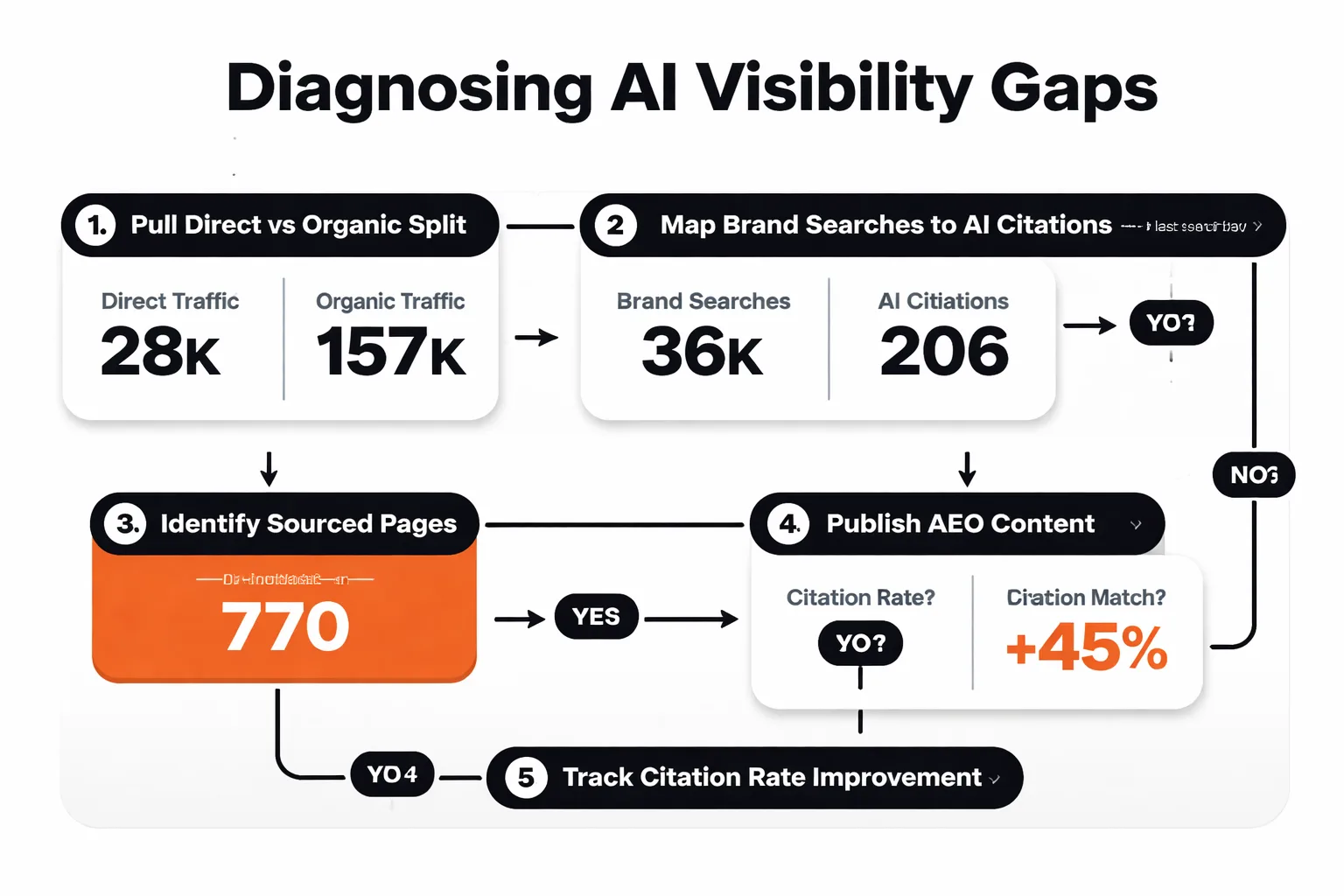
How to pull direct vs organic traffic split?
Before you can diagnose anything, you need the raw data. Start with Google Search Console and Google Analytics 4. In GA4, look at the Traffic Acquisition report and filter for the 'Direct' channel. Within that channel, Google further classifies sessions where the browser bar was used. That's your 'search or type url' bucket.
In Search Console, pull your branded query report. Filter for queries containing your brand name (and common misspellings). Export the last 90 days. Now do the same for your top 50 non-branded queries. The ratio between branded and non-branded search volume tells you whether people are finding you by name or by category.
What does a healthy ratio look like? For a small B2B SaaS company, I'd expect branded search to account for 30-40% of total organic search volume. If you're below 15%, your brand recall is weak. If you're above 60%, you may be over-reliant on brand searches and failing to capture category-level discovery queries. Both extremes signal problems, but the low-branded-share scenario is the one that correlates with AI visibility gaps.
Here's why. When branded search volume is low, it means few people are searching for you by name. AI engines learn about brands from the web. If few people search for your brand name, fewer pages mention you contextually. Fewer contextual mentions mean weaker entity signals in knowledge graphs. Weaker entity signals mean AI engines are less likely to recommend you. The 'search or type url' data is the earliest visible symptom of this chain reaction.
Let me give you a concrete example of how this plays out. Say you run a project management tool called 'Taskflow.' You pull your Search Console data and see 2,000 monthly branded searches (variations of 'taskflow,' 'taskflow app,' 'taskflow login') and 15,000 monthly non-branded searches ('project management software,' 'task tracker,' 'team collaboration tool'). That's a branded share of about 12%. Now you run 30 category-relevant prompts through ChatGPT and Perplexity: 'best project management tools for small teams,' 'taskflow alternatives,' 'how to choose a project management tool.' Your brand appears in zero responses. That's not a coincidence. The same weakness that keeps branded search low (lack of external mentions, weak entity signals, limited third-party coverage) is what keeps AI engines from citing you.
Now compare that to a brand with 40% branded search share. That brand has strong external coverage, a Wikidata entry, review site presence, and category-specific comparison pages. When I run the same 30 prompts for that brand, it appears in 8-12 responses across ChatGPT and Perplexity. The correlation isn't perfect, but it's strong enough to be actionable.
To make this concrete for your own diagnostic: pull a 90-day comparison. Look at week-over-week branded search volume. Is it growing, flat, or declining? Then cross-reference with your AI visibility tracker data. If branded search is flat or declining AND your AI mention rate is also flat or declining, you have a compounding visibility problem. If branded search is growing but AI mentions aren't, you have a content extractability problem (which we'll fix in Step 4).
The specific GA4 report path matters here. Go to Reports > Acquisition > Traffic Acquisition. Set the dimension to 'Session default channel group' and filter for 'Direct.' Within Direct, look at the 'Session source/medium' breakdown. You'll see entries like '(direct)' and 'direct / (not set).' The 'search or type url' classification sits within these. If GA4 doesn't break it out cleanly in your view (Google has changed this labeling multiple times), you can approximate it by looking at direct sessions with a landing page that isn't your homepage. Users who type a deep-link URL directly are the strongest recall signal. Track that segment over time.
Step 2: Map the Gap Between Brand Searches and AI Citations
This is where the diagnostic gets interesting. You now have two datasets: branded search volume from Search Console, and AI mention rate from your visibility tracking tool. The gap between them is your AI visibility gap.
Let me walk through how I do this. I pull the last 90 days of branded search volume from Search Console. Then I pull the last 90 days of AI mention data. In my work at Meev, I use our platform to track brand mentions across every major AI search surface: ChatGPT, Claude, Gemini, Perplexity, Grok, Google AI Overviews, AI Mode, and DeepSeek. For each surface, I look at how often the brand appears in responses to category-relevant prompts.
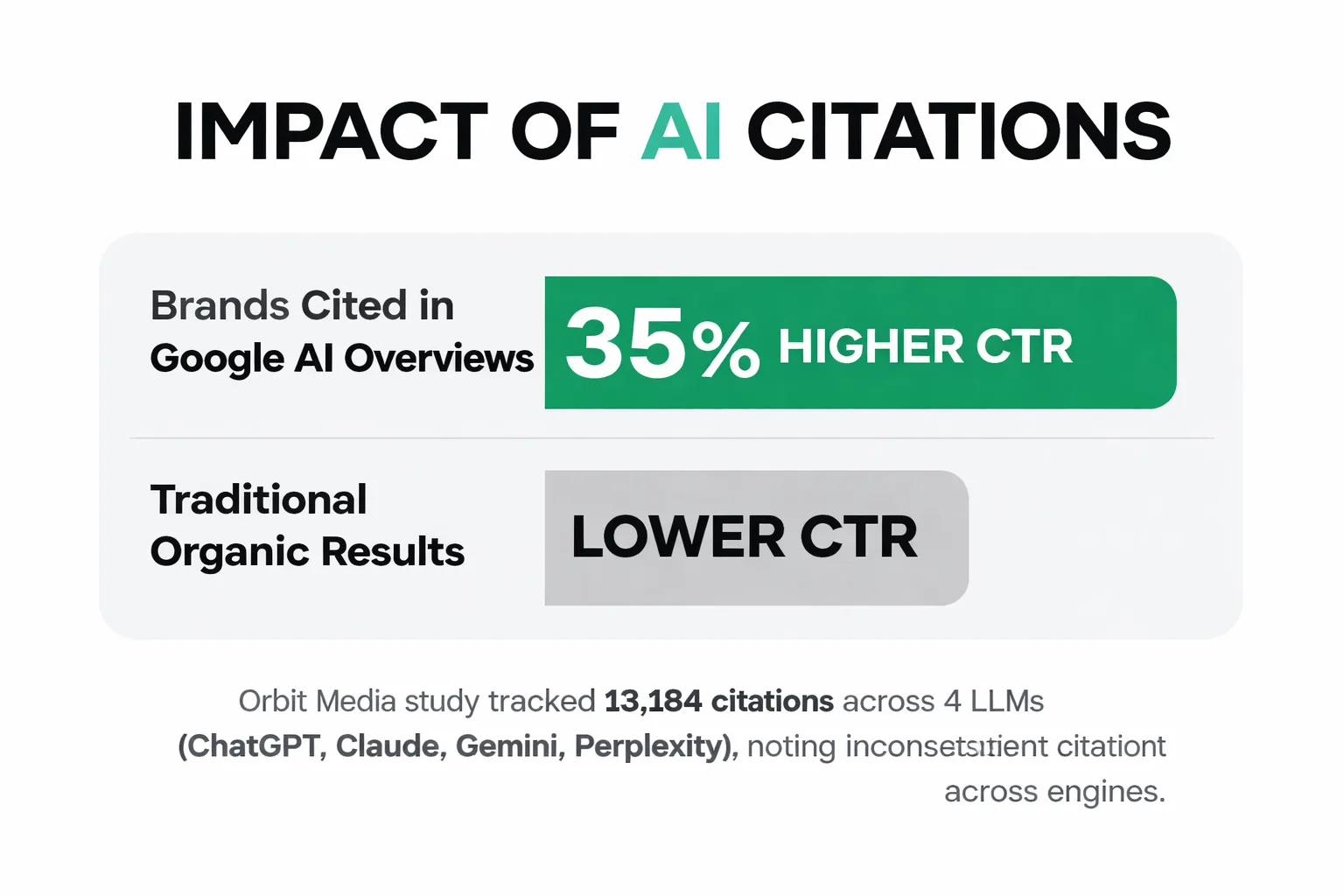
The Orbit Media study tracked 13,184 citations across 4 LLMs (ChatGPT, Claude, Gemini, Perplexity) and found that different engines cite different sources inconsistently. Brands cited in Google AI Overviews see 35% higher CTR than traditional organic results, yet organic CTR drops 61% when an AI Overview is present. That means the citation gap isn't just about visibility. It directly impacts click-through rate and traffic.
The diagnostic framework is simple. Create a two-column table. Column A: branded search volume by month. Column B: AI mention rate by month (percentage of prompts where your brand appears). If Column A is high and Column B is low, you have a citation gap. People know your brand, but AI engines don't cite you. If both are low, you have a brand awareness problem that precedes the AI visibility problem. If both are high, you're in good shape but should still audit which pages AI engines are sourcing (Step 3).
The most common pattern I see is the citation gap. Branded search volume is decent because existing customers and warm leads search for the brand. But AI mention rate is near zero because the brand lacks the external signals and structured content that AI engines use to generate answers. This is the gap that answer engine optimization is designed to close.
If people search your brand name but AI engines never cite you, that gap is your highest-leverage opportunity. Every branded search that doesn't convert into an AI citation is a missed chance to capture the growing share of users who start their research in ChatGPT or Perplexity instead of Google.
Let me break down the specific math I use. Say you're tracking 50 category-relevant prompts across 3 AI engines (ChatGPT, Perplexity, Google AI Overviews). That's 150 prompt-engine combinations. Your brand appears in 12 of 150. That's an 8% mention rate. Now look at your branded search volume: 3,000 monthly searches. The ratio I calculate is mention rate divided by branded search share. If your branded search share is 25% of total organic search but your AI mention rate is 8%, you have a 17-point gap. That gap is your target. Every piece of content you publish should be designed to close it.
I also track this gap over time to see whether it's widening or narrowing. A widening gap means your brand is losing ground in AI answers faster than it's gaining brand awareness. A narrowing gap means your AEO efforts are working. I check this monthly. Weekly is too noisy because AI engines update their responses on irregular cycles. Monthly gives you a stable enough signal to spot real trends.
One subtlety worth noting: the gap looks different depending on which AI engine you measure against. In the Orbit Media study, ChatGPT and Perplexity showed different citation patterns for the same prompts. ChatGPT tends to cite more editorial and publisher sources. Perplexity cites a broader mix of sources including forums and product pages. Google AI Overviews tends to cite high-ranking organic results. So your mention rate will vary by engine, and your gap will too. I recommend tracking the gap per-engine, not just in aggregate. An aggregate number hides the fact that you might be cited well by Perplexity but completely absent from ChatGPT.
Step 3: Identify Which Pages AI Engines Are Actually Sourcing
Now you need to figure out what AI engines are reading when they generate answers for your category. This requires a different kind of audit.
Start by running 20-30 category-relevant prompts through each major AI search surface. For a B2B SaaS company, these might be prompts like 'best [category] tools for small teams' or 'how does [category] work.' For an ecommerce brand, try 'best [product category] under $X' or 'what are the top [product] brands.' Record every citation the AI engine provides. Each citation is a URL that the LLM chose to source.
Build a spreadsheet. Column A: the prompt. Column B: the AI engine. Column C: the cited URL. Column D: the domain. Column E: whether the cited URL is yours, a competitor's, or an independent publisher. After 30 prompts across a few engines, patterns emerge fast.
What I typically find is that AI engines source from a small set of publisher domains. These aren't always the top-ranking Google results. The overlap between top Google results and AI-cited sources has dropped from around 70% to under 20% by some estimates. AI engines favor pages that are structured for extractability: direct answers under question headings, comparison tables, clear entity definitions, and sourced claims.
Now compare the cited URLs against your own top direct-traffic pages. Your top direct-traffic pages are the ones users type URLs for or bookmark. These are your strongest pages by brand recall. If none of them appear in AI citations, you have a structural content gap. Your best pages (by human standards) aren't optimized for AI extraction.
This is where tools like our Perplexity AI visibility checker and ChatGPT AI visibility checker become essential. They show you exactly which prompts trigger citations for your brand and which don't. You can drill into the actual response text and see the citations behind every mention. That level of granularity is what separates a real diagnostic from a vanity metric.
The pages AI engines cite most often are structured for extractability, not for traditional SEO. If your top pages are long-form blog posts without clear Q&A structure, they're probably invisible to AI extraction even if they rank well on Google.
Here's a concrete auditing workflow I use. Take your top 10 direct-traffic pages from GA4. For each page, ask three questions. Does it open with a direct, self-contained answer to a question? Does it use structured data (schema markup, tables, lists)? Does it cite authoritative external sources inline? If the answer to any of these is no, that page is not extractable by AI engines. It doesn't matter how good the content is or how much traffic it gets from Google. AI engines extract from structure, not from prose quality.
I'll give you a real example pattern I've seen. A SaaS company had a 3,000-word ultimate guide that ranked #3 for their primary category keyword. It got 4,000 organic visits per month. But when I ran category prompts through ChatGPT and Perplexity, the guide was never cited. Why? It was a wall of prose. No question headings. No tables. No bolded answer sentences. The content was excellent for human readers but completely opaque to AI extraction. Meanwhile, a competitor's 800-word comparison page with a clean table and Q&A structure was cited in 6 out of 10 prompts. Shorter page, more citations. That's the extractability principle in action.
The cited-source leaderboard concept is useful here. When you run your 30 prompts, track which domains appear most often in citations. You'll typically see 5-10 domains that account for 60-70% of all citations. Those are the publishers AI engines trust for your category. If your domain isn't on that list, you need to understand what those publishers are doing that you aren't. Usually it comes down to three things: they publish frequently on the topic, they structure content for extraction, and they have strong domain-level entity associations with the category.
Are your AI visibility gaps showing up in your direct traffic data?
Step 4: Fix the Gap With Answer-Engine Optimized Content
You've diagnosed the gap. Now you close it. This step is about publishing content that AI engines can actually extract and cite.
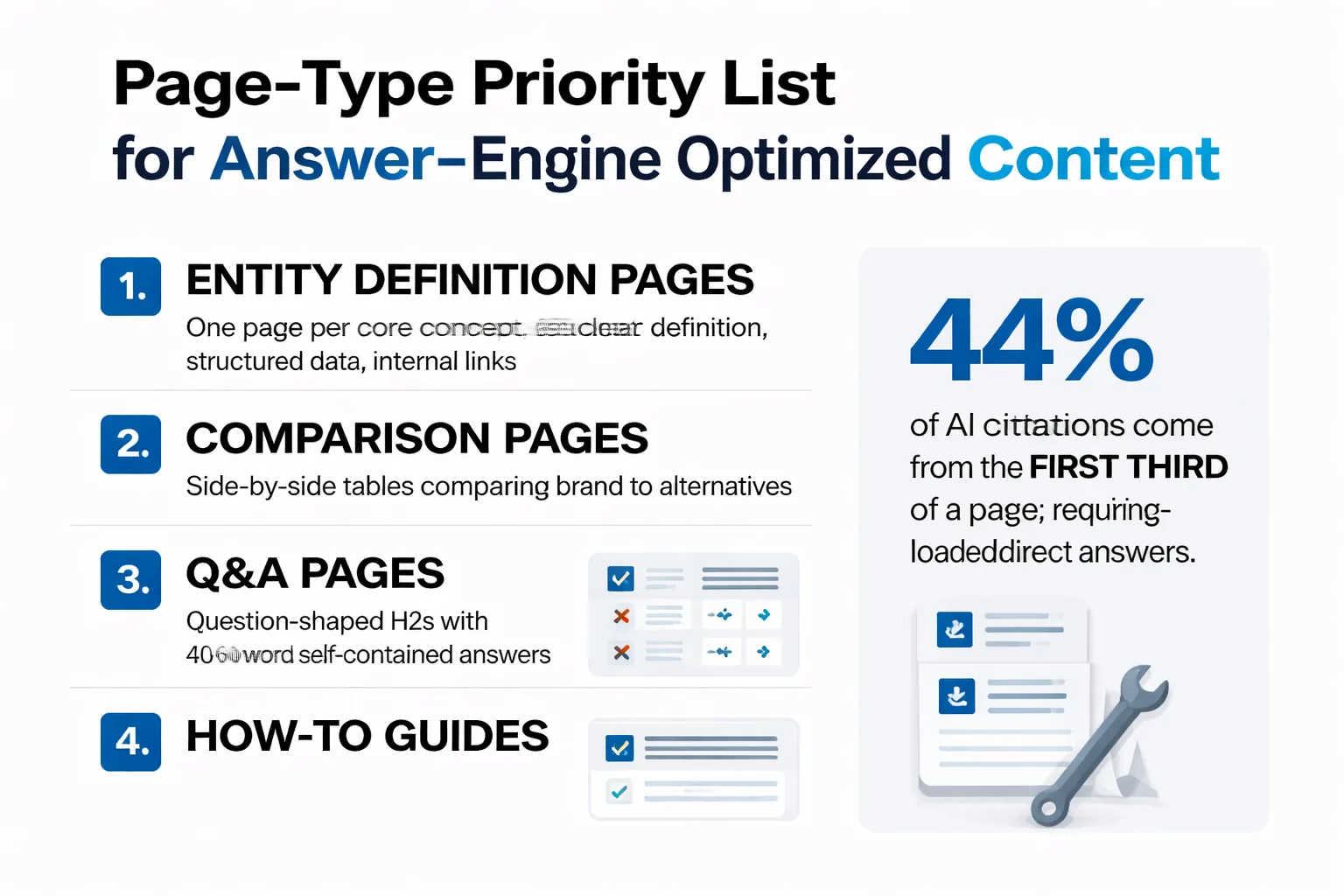
Based on what I've seen across content audits, 44% of AI citations come from the first third of a page. That means front-loading direct answers is non-negotiable. Every article you publish should open with a bolded, self-contained answer to the question the article addresses. Follow that with supporting evidence, sourced claims, and structured data.
Here's the page-type priority list I use:
1. Entity definition pages. One page per core concept your brand owns. Clear definition, structured data, internal links to related topics. These pages feed knowledge graphs. 2. Comparison pages. Side-by-side tables comparing your brand to alternatives. AI engines love tables because they're easy to extract. 3. Q&A pages. Question-shaped H2s with 40-60 word self-contained answers. These map directly to how users prompt AI engines. 4. How-to guides. Numbered steps with clear outcomes. Structure them so each step is extractable on its own.
For entity grounding specifically, make sure your brand has a Wikidata entry and that your schema markup connects your brand entity to relevant concepts. As Siteimprove notes, schema alone doesn't guarantee AI search visibility, but without it, AI systems may confuse your brand with something else entirely. I've seen cases where a brand name shared with a geographic feature caused AI engines to cite the wrong entity entirely.
The publishing workflow I recommend at Meev is straightforward. Research which prompts trigger zero citations for your brand. Write articles that directly answer those prompts with sourced, structured content. Gate every article through a quality check before publishing. Then track whether your AI citation rate improves over the following 30-60 days.
This is where the AEO vs SEO distinction becomes practical. Traditional SEO optimizes for ranking position. AEO optimizes for citation. The two require different page structures, different content priorities, and different success metrics. If you're still measuring success by keyword rankings alone, you're measuring the wrong thing for the AI search era.
Let me get more specific about the content structure that works. Every page you publish for AI citation should follow what I call the 'extractable skeleton.' At the top: a 40-60 word bolded answer that stands alone if extracted. Below that: a comparison table or data element that an AI engine can pull as structured information. Below that: question-shaped H2s, each with a self-contained 40-60 word answer. Below that: sourced claims with inline links to authoritative sources. At the bottom: schema markup (Article, FAQ, HowTo as relevant). This structure isn't about reading comfort for humans. It's about making your content machine-readable for LLM extraction.
The generative engine optimization research paper (arXiv:2311.09735) demonstrated that pages with structured formatting, citations, and authoritative sources saw significantly higher citation rates in AI-generated answers compared to unstructured content. The methodology was clear: they tested different page formats against the same LLMs and measured which ones got cited. Structure won. Not length. Not keyword density. Structure.
I also recommend building a content calendar that maps directly to your citation gaps. For each prompt where your brand isn't cited, create a content brief that answers that prompt. Prioritize prompts with high search volume (check Google Trends and Search Console) and low current citation presence. This is the opposite of traditional SEO content planning, where you target keywords with high volume and low difficulty. In AEO, you target prompts with high volume and zero citation. The difficulty metric is different: it's not about ranking difficulty, it's about extraction probability.
Why Does Brand Recall Predict AI Citation Rate?
Brand recall and AI citation rate are correlated because they share a common root cause: entity strength across the web. When users type your URL directly, it means your brand entity is strongly represented in their memory. That memory was built by repeated exposure across channels. AI engines build their understanding of brand entities the same way, by encountering repeated mentions across web sources.
The Orbit Media study tracked 13,184 citations across 4 LLMs and 1,765 total answers. They found that brands with strong third-party editorial coverage appeared in citations far more often than brands with only self-published content. The brands that AI engines cite most frequently are the ones that humans also recall most easily. Both signals point to the same underlying entity strength.
This is why I treat the 'search or type url' data as a proxy for entity strength. It's not a perfect proxy, but it's available in every analytics platform, it updates daily, and it doesn't require any specialized AI tracking tool to access. When I need a quick read on whether a brand is likely to be cited by AI engines, I look at direct navigation trends first. If direct navigation is growing, entity strength is probably growing too. If it's shrinking, I know I need to invest in entity grounding and third-party mentions before expecting AI citations to improve.
The Orbit Media study used 72 prompts across 3 B2B brands in their methodology. That's a useful sample size for understanding citation patterns. What they found was that citation consistency varied dramatically by engine. A brand might be cited in 40% of ChatGPT responses but only 10% of Claude responses. This means your 'search or type url' diagnostic needs to be paired with per-engine citation tracking to get the full picture. A single aggregate mention rate hides the engine-specific gaps that matter most.
I also want to address a common misconception. Some practitioners I've talked to assume that if they rank #1 on Google for their brand name, they're automatically cited by AI engines. That's wrong. Ranking for your own brand name is trivially easy and tells you nothing about AI citation. The question isn't whether you rank for your brand name. The question is whether AI engines cite your brand when users ask category-level questions. Those are fundamentally different queries, and they require fundamentally different signals.
How Do Knowledge Graphs Connect to Direct Navigation?
Knowledge graphs are the structured databases that AI engines use to understand entities and their relationships. Google has its own Knowledge Graph. Wikidata feeds many LLMs. These graphs connect your brand name to attributes like your industry, your products, your founders, and your competitors.
When your brand has a strong knowledge graph presence, two things happen. First, AI engines can confidently identify your brand when it appears in source text. They don't confuse your 'Apex platform' with a mountain peak or a competitor's product. Second, AI engines can generate answers about your brand even when they don't have a direct citation, by drawing on structured entity data.
Direct navigation signals feed this loop. When users type your URL, search engines log that behavior. High direct-navigation volume for a brand name reinforces the entity's importance in search logs. That reinforcement feeds back into knowledge graph confidence scores. It's a feedback loop: strong brand recall drives direct navigation, direct navigation reinforces entity strength, entity strength improves AI citation probability, AI citations increase brand exposure, and brand exposure drives more direct navigation.
The research on structured linked data as a memory layer for agent-orchestrated retrieval (Volpini et al., arXiv:2603.10700) tested entity-centric page designs across four domains: editorial, legal, travel, and e-commerce. The findings suggest that structured linked data aligns with principles for improved retrieval, though the authors note that no studies have directly validated the impact on citation rates. Still, the directional evidence is clear enough that I recommend entity grounding as a foundational step.
Let me explain what 'entity grounding' actually means in practice. It's not just adding schema markup to your homepage. Entity grounding is the process of creating an unambiguous, machine-readable identity for your brand across the web. It has three layers. Layer one: your own site. You need Organization schema with a matching Wikidata entry, a verified Google Knowledge Panel, and consistent NAP (name, address, phone) information. Layer two: third-party publishers. Your brand needs to appear on review sites, industry directories, and editorial publications with consistent entity attributes (same industry classification, same product descriptions, same founder names). Layer three: community signals. Reddit threads, forum discussions, and social media mentions where real users reference your brand by name in context. AI engines read all three layers. If they conflict (different industry classifications, different product descriptions), the engine's confidence in your entity drops. Consistency across all three layers is what creates strong entity grounding.
The Siteimprove article on schema and entity grounding makes a point I want to emphasize: without proper entity grounding, AI systems may confuse your brand with something else. They give the example of an 'Apex platform' being confused with a mountain peak. I've seen this happen with real brands. A B2B SaaS company shared a name with a popular consumer product. AI engines consistently cited the consumer product when users asked about the B2B category. The fix wasn't more content. The fix was disambiguation: explicit entity definitions, 'about' pages with structured data, and Wikidata entries that clearly separated the two entities.
What This Won't Fix
This diagnostic framework has real boundaries, and pretending otherwise does nobody favors.
First, it won't fix a product-market fit problem. If nobody searches for your brand because nobody wants what you built, no amount of entity grounding or AEO content will save you. I've seen founders mistake a visibility gap for a demand gap. They're different problems. The 'search or type url' data can help you tell them apart (if branded search volume is genuinely zero, you have a demand problem, not a visibility problem), but the framework itself only addresses visibility.
Second, it won't fix a reputation problem. If AI engines mention your brand but in a negative context, improving your citation rate without addressing the underlying reputation issue just amplifies the damage. I've watched brands celebrate their first AI mentions only to realize the mentions were pulling from review sites and complaint forums.
Third, this framework assumes you have at least some direct traffic to analyze. Pre-revenue startups with zero brand awareness won't have meaningful 'search or type url' data. For those brands, the first step is building initial brand awareness through content, PR, and community engagement before worrying about AI citation optimization.
The Agentic Commerce Dimension
Here's where this gets forward-looking. Agentic commerce is accelerating fast. According to Braze's Retail Customer Engagement Review, consumer adoption of agentic shopping is expected to jump from 19% to 46% by end of 2026. The agentic AI in retail market is projected to grow from $60.43B in 2026 to $218.37B by 2031 at a 29.29% CAGR.
When AI agents shop on behalf of humans, they don't type URLs. They query knowledge graphs and LLMs for product recommendations. Your brand's presence in those knowledge graphs determines whether agents recommend you. And your knowledge graph presence is built on the same entity signals that drive direct navigation in human users.
This means the 'search or type url' diagnostic I've described in this article is also an early indicator of agentic commerce readiness. If humans aren't typing your URL, AI agents probably aren't recommending your products either. The fix is the same: strengthen entity grounding, publish extractable content, and earn third-party mentions that reinforce your brand entity across the web.
71% of marketing leaders say AI agents have already weakened their ability to control brand visibility (Braze). The brands that will survive the shift to agentic commerce are the ones that start treating entity strength as a first-class metric today.
Let me connect this to ecommerce specifically. The Eyeful Media research found that 91% of ecommerce queries trigger AI-generated results, with 94-95% AI coverage for fashion and beauty queries specifically. If you're an ecommerce brand and you're not tracking your AI visibility, you're flying blind in a channel that already serves 91% of your category's queries. The 'search or type url' data is your starting signal. If direct navigation to your product pages is declining, your brand is losing the entity strength that AI agents need to recommend your products.
The Braze report also notes that only 10% of consumers are willing to let agents operate fully independently. That means 90% of consumers still want oversight of agent decisions. When an agent recommends a product and the consumer recognizes the brand (because they've seen it before, because they've typed the URL, because they've searched for it), the consumer approves the recommendation. When the consumer doesn't recognize the brand, they override the agent. Brand recall isn't just about AI citation. It's about consumer trust in agent-mediated recommendations. The 'search or type url' data measures exactly this: whether consumers recognize and trust your brand enough to navigate directly.
For ecommerce brands specifically, I'd add one more diagnostic step. Track direct navigation to specific product pages (not just your homepage). If users type 'yourstore.com/products/specific-item' directly, that's a strong signal that your product has brand-level recognition. AI agents are more likely to recommend products with strong direct-navigation signals because those signals indicate established consumer trust. If your product pages only receive traffic from category searches (like 'blue widget size large'), your products lack the entity strength that agents need to recommend them.
How Do You Track AI Citation Improvements Over Time?
Once you've published answer-engine optimized content, you need to measure whether it's working. This is where many teams drop the ball. They publish content and then never check whether AI citation rates improved.
The tracking methodology I use is straightforward. Before publishing, record your baseline: how many prompts cite your brand, across which engines, and at what position in the answer (first mention, in a list, last). Then publish your content. Wait 30 days. Run the same set of prompts again. Compare.
I track three metrics over time. First, mention rate: the percentage of prompts where your brand appears. Second, mention position: whether your brand appears first, in a list, or last in the AI response. Third, citation source: whether the AI engine cites your own pages or only third-party pages that mention you. All three matter. A rising mention rate with poor mention position means you're being cited but not prioritized. A rising mention rate with citations pointing to third-party sites (not your own content) means you have brand awareness but not content authority.
The LLMs.txt validator is a useful tool here. It checks whether your site has a properly formatted LLMs.txt file that helps AI engines understand your content structure. While not a direct ranking factor, it improves how efficiently AI engines can crawl and extract from your site. I've seen brands fix their LLMs.txt file and see citation improvements within 2-3 weeks as AI engines re-crawl and re-index their content.
I recommend tracking weekly but reporting monthly. Weekly tracking catches early signals (like a new citation appearing in ChatGPT after publishing a comparison page). Monthly reporting smooths out the noise from AI engine updates and gives you a reliable trend line. The key is consistency. Run the same prompts every time. Don't change your prompt set mid-tracking because you'll lose your baseline.
Frequently Asked Questions
What does 'search or type url' mean in Google Analytics?
It's a sub-classification within the Direct traffic channel. When a user types a URL or brand name into the browser's address bar (Omnibox), Google labels that session as 'search or type url.' It separates navigational browser behavior from other types of direct traffic like bookmarks or hardcoded links. This label gives you a cleaner view of how many users actively navigate to your site by typing.
Can I use 'search or type url' data to predict AI citation rate?
Not directly, but it's a strong leading indicator. Brands with high direct-navigation share tend to have stronger entity grounding, which correlates with higher AI citation rates. If your direct-navigation share is declining, your AI citation rate will likely follow. Use it as an early warning signal, not a predictive model.
How is AEO different from traditional SEO?
Traditional SEO optimizes for ranking position on search engine results pages. AEO (Answer Engine Optimization) optimizes for citation in AI-generated answers. The two require different page structures, different content formats, and different success metrics. A page can rank #1 on Google and never be cited by an AI engine if it isn't structured for extractability. You can learn more about this distinction in our AEO vs GEO guide.
What's the minimum data I need to run this diagnostic?
You need 90 days of Google Search Console data (branded vs. non-branded queries) and 30 days of AI visibility tracking data across at least ChatGPT, Perplexity, and Google AI Overviews. If you don't have an AI visibility tracking tool yet, you can start with our AI visibility checker to get baseline mention data.
How long does it take to close an AI visibility gap?
In my experience, you need 30-60 days after publishing answer-engine optimized content to see measurable citation rate improvements. AI engines don't index and cite content instantly. The knowledge graph updates that drive citation improvements happen on their own schedule. Plan for a 90-day cycle from diagnosis to measurable improvement.
Should I prioritize entity grounding or content publishing first?
Do both in parallel. Entity grounding (Wikidata, schema markup, knowledge graph presence) is foundational and takes time to propagate. Content publishing gives AI engines something to cite in the shorter term. If you can only do one, start with entity grounding because without it, your published content may not be correctly attributed to your brand.
The 'search or type url' data sitting in your analytics right now is more valuable than you think. It's the earliest signal of whether your brand has the entity strength to be cited by AI engines. Pull the data. Map the gap. Fix it with structured, extractable content. Then track whether your AI citation rate moves. That's the workflow, and it starts with a metric you already have.
About the Author
Judy Zhou, Founder
Judy Zhou leads content strategy at Meev, where she oversees AI-driven content research and publishing for hundreds of brands. With a background in SEO and editorial operations, she focuses on building content systems that rank on Google, get cited by AI search engines, and drive measurable business results.
Stop guessing whether AI engines cite your brand. Run the diagnostic, close the gap, and track your citation rate with a tool built for the AI search era.