
By Judy Zhou, Founder
Key Takeaways
- 62% of AI citations omit any brand name, so real SEO budgets must add answer engine optimization line items or risk zero visibility in ChatGPT and Perplexity.
- AI crawlers consume content 38,000 times faster than they refer traffic, requiring every SEO cost calculator to include AEO production and monitoring beyond Google rankings.
- Mid-level in-house SEO roles cost $85,000–$130,000 all-in annually while agency retainers run $2,500–$10,000 monthly, yet 7 in 10 US companies still report AI cost overruns from incomplete budgets.
Most SEO budgets are built on assumptions that AI search just made obsolete.
The real cost of SEO in 2026 isn't just your agency retainer or your content production budget. It's the hidden cost of missing AI search visibility entirely, which 62% of AI citations don't even mention a brand by name. Nearly 7 in 10 US companies report AI cost overruns. AI crawlers now consume content at rates 38,000 times higher than they refer traffic back. If your SEO cost calculator only accounts for Google rankings and content production, you're budgeting for half the search landscape.
The pattern I keep seeing in my work auditing content operations is that teams build budgets around traditional ranking factors, then act surprised when ChatGPT and Perplexity cite competitors instead of them. The budget was never wrong for Google. It was wrong because it didn't account for answer engine optimization at all.
This article is my attempt to fix that. I'll walk through how to build a real seo cost calculator that accounts for both traditional SEO and the AI search layer, with concrete numbers at every step.
How Much Does SEO Cost? The Honest Answer
Let's start with the question everyone asks. How much does SEO typically cost in 2026?
The honest answer depends on who does the work and what scope you're buying. Here's what I see across the market right now:
Monthly retainers from SEO agencies typically run $2,500 to $10,000 per month for small-to-mid businesses. Enterprise engagements start at $10,000 and can exceed $30,000 monthly. Freelance SEO consultants charge $75 to $200 per hour, with project-based engagements landing between $1,000 and $7,500 depending on scope.
In-house SEO looks cheaper on paper but isn't. A mid-level SEO specialist costs $65,000 to $95,000 annually (base salary, US market). Add benefits, tools, and management overhead and you're at $85,000 to $130,000 all-in. That's $7,000 to $10,800 per month before you've written a single piece of content.
Tool-only approaches are the cheapest entry point. Ahrefs or Semrush run $100 to $500 per month. A purpose-built AI SEO tool starts at around $99 monthly. But tools without strategy are just dashboards. You still need someone to interpret the data and act on it.
Here's the number that should stop you. According to research on affordable AI search optimization platforms, purpose-built AI search optimization platforms start at $99/month compared to $3,000+ for traditional SEO agencies. That's a 30x cost gap for the AI-specific layer of your search visibility. It doesn't mean you should fire your agency. It means you should understand what each dollar buys.
The question isn't really "how much does SEO cost." The question is what you're actually buying. Are you buying Google rankings? Content production? Link building? AI citation presence? Entity grounding? Most agencies bundle these together and quote one number, which makes it impossible to tell if you're overpaying for one component and underinvesting in another.
Let me give you a concrete example of why this matters. I once reviewed a proposal from a mid-tier agency charging $6,500 monthly for a B2B SaaS client. The proposal included "technical SEO optimization," "content strategy," "link building," and "reporting." When I broke it down line by line, the actual content production budget was $1,200 (four articles at $300 each). Link building was $1,500. The remaining $3,800 was spread across "strategy," "account management," and "reporting." That's not necessarily wrong, but the client had no idea they were spending 58% of their budget on overhead and only 18% on content. If your content gap is the biggest problem, that allocation is inverted.
This is why building your own cost model matters. When you understand what each lever costs, you can evaluate any proposal against it. You can see if an agency is overcharging for content and undercharging for technical work, or vice versa. You can negotiate from a position of knowledge instead of accepting a bundled number on faith.
The 5 Variables That Drive Your Actual SEO Cost
Every SEO budget I've reviewed comes down to five variables. Understanding these lets you build a real cost model instead of accepting a generic agency quote.
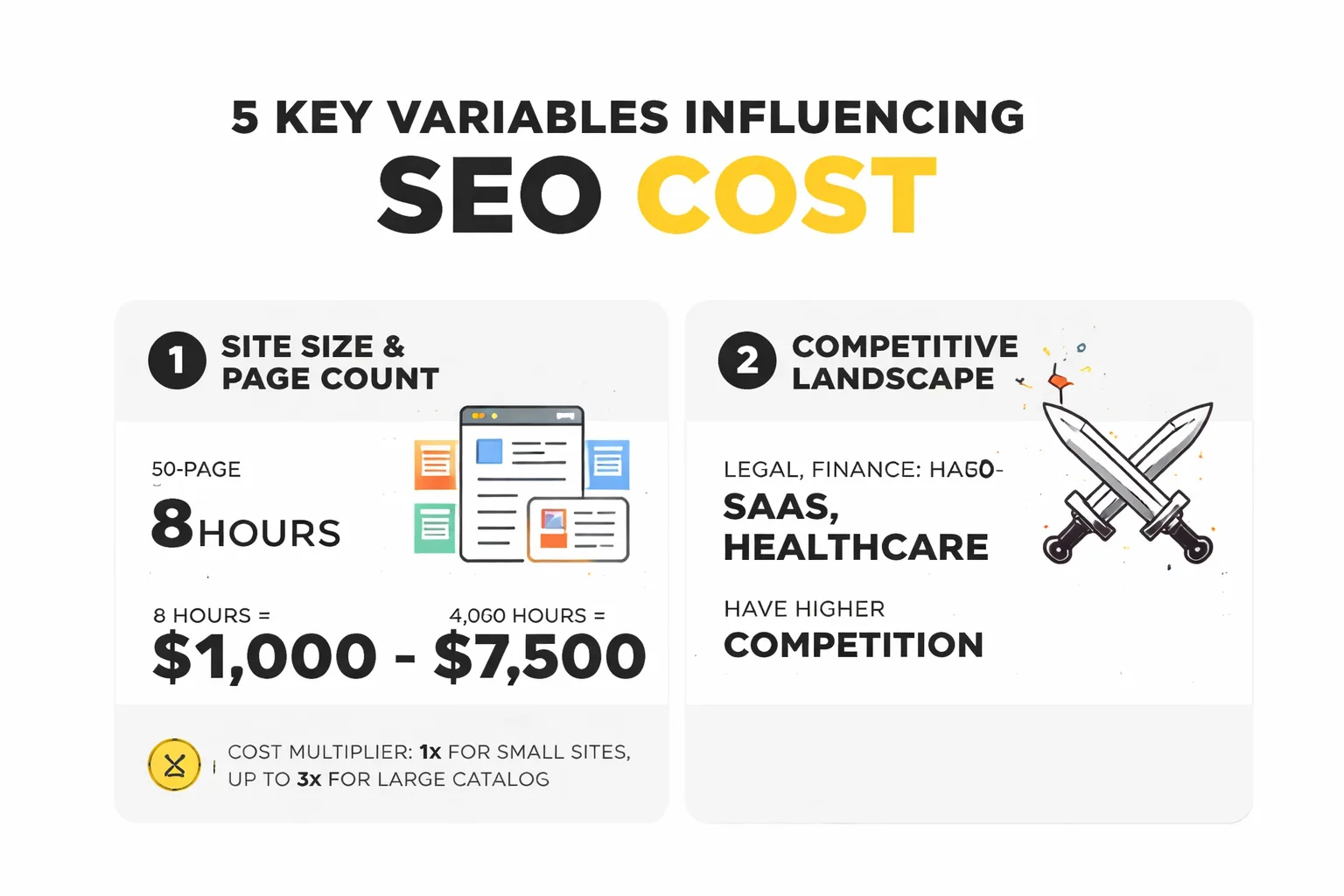
Variable 1: Site size and page count. A 50-page site needs fundamentally different work than a 5,000-page ecommerce catalog. Technical audits scale with URL count. Content gap analysis takes longer. Internal linking architecture is more complex. I've seen agencies charge 2-3x more for sites over 1,000 pages because the crawl alone takes days instead of hours. A 50-page site audit might take 8 hours of analyst time (roughly $1,000 at $125/hr). A 2,000-page site audit can take 40-60 hours ($5,000-7,500). The same task, different scale. Cost multiplier: 1x for small sites, up to 3x for large catalogs.
Variable 2: Competitive landscape. If you're in legal, finance, SaaS, or healthcare, you're competing against teams with dedicated content operations and years of accumulated authority. Ranking for "personal injury lawyer Chicago" costs more than ranking for "artisanal candle maker Portland" because the entities competing for that space have deeper content footprints, stronger link profiles, and established entity grounding for AI search signals. A competitive analysis for a low-competition niche might take 4 hours. In a high-competition vertical like SaaS CRM, it can take 20+ hours just to map the content footprint of your top 10 competitors. Cost multiplier: 1x in low-competition niches, 2-4x in high-competition verticals.
Variable 3: Content volume needed. This is where most budgets blow up. A site that needs 10 articles per month has a very different cost profile than one that needs 50. At $200-400 per article (quality freelance rates with editing), 50 articles monthly adds $10,000-20,000 in content costs alone. AI-assisted content production can compress this, but I've learned the hard way that purely automated content without human oversight gets flagged by Google's Helpful Content System. The differentiator isn't the AI. It's the degree of human intervention. A realistic blended rate using AI-assisted drafting with human editing runs $150-250 per article. Pure human-written content from specialist writers runs $300-500. The cost difference between 10 articles at $200 each ($2,000 monthly) and 30 articles at $200 each ($6,000 monthly) is significant. Cost multiplier: 1x for 5-10 articles/month, 3-5x for 30-50 articles/month.
Variable 4: Technical debt. Sites with years of accumulated problems (duplicate content, broken redirects, slow Core Web Vitals, missing schema, crawl errors) need remediation before any content strategy works. Technical SEO audits run $1,000-5,000 one-time. Implementation can double that if your dev team is backlogged. I've seen sites with 300+ broken redirects that were bleeding link equity for months. The audit found them in a day. Fixing them took the client's dev team three weeks because they had a product release in flight. The cost of technical debt isn't just the audit. It's the implementation time, which depends on your engineering team's bandwidth. Cost multiplier: 1x for clean sites, 2-3x for sites with significant technical debt.
Variable 5: Whether AI search visibility is included. This is the variable most budgets miss entirely. Tracking where your brand appears in ChatGPT, Claude, Gemini, Perplexity, Grok, and Google AI Overviews requires different tools and workflows than traditional rank tracking. Optimizing for those surfaces requires content structured for extraction, entity signals, and knowledge graph presence. If your current agency doesn't mention AEO vs SEO in their proposal, this layer is absent from your budget. The cost of adding this layer ranges from $99-500 monthly for tools to $1,000-3,000 monthly if an agency handles it. Cost multiplier: 1x if excluded (but you're invisible in AI search), 1.3-1.6x if included as an add-on.
That last variable is the one I want to spend time on. Because ignoring it doesn't save you money. It just moves the cost from your budget into lost opportunity.
How to Build a Simple SEO Cost Calculator for Your Situation
This is the section where most articles give you a generic range and send you on your way. I'm going to give you an actual framework you can run yourself. Grab a spreadsheet.
The goal is to arrive at a defensible monthly budget figure that accounts for both traditional and AI search visibility. Here's the process:
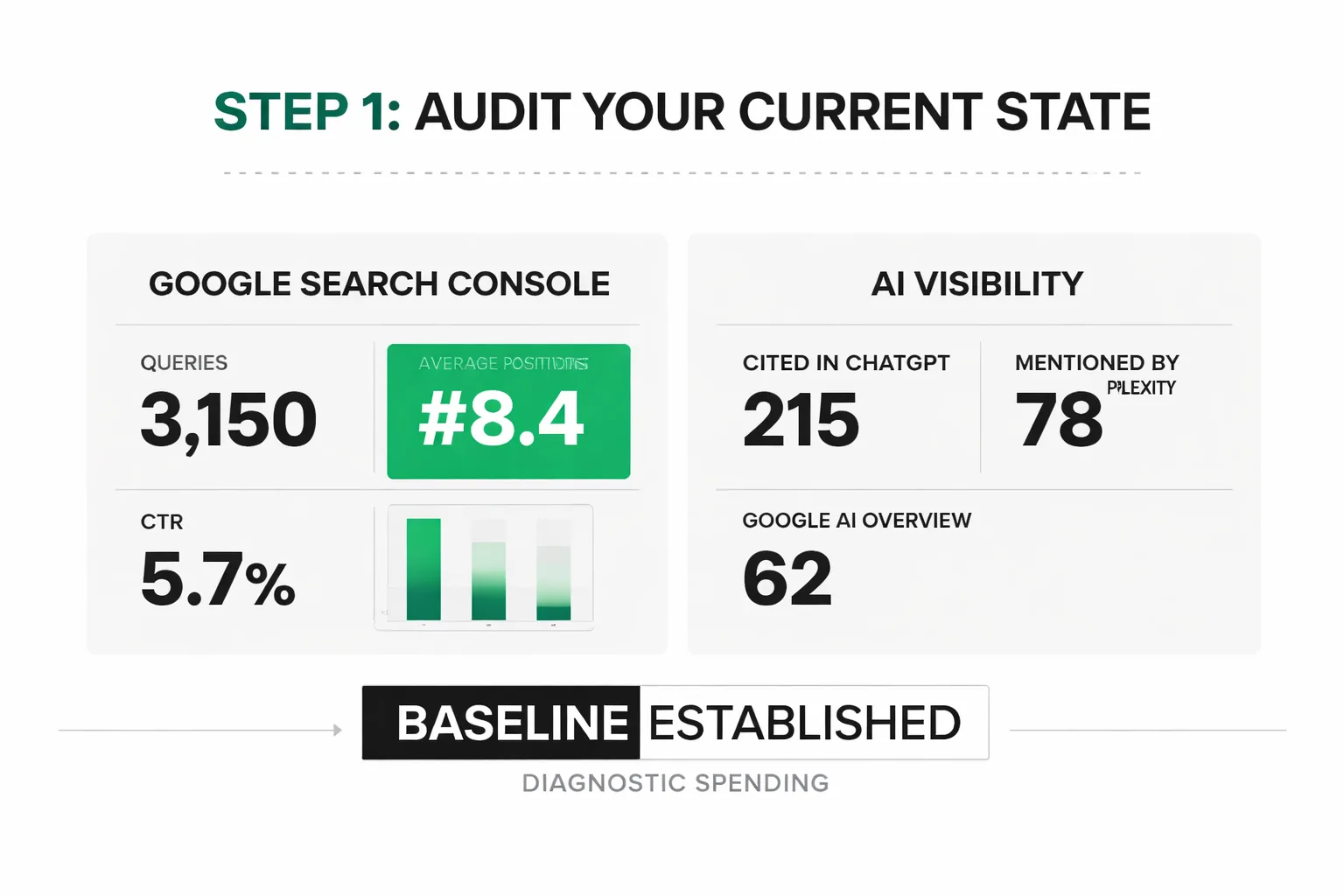
Step 1: Audit your current state. Before you spend anything, you need to know where you stand. Pull your Google Search Console data for the last 90 days. How many queries do you rank for? What's your average position? What's your CTR at each position? Then check your AI visibility. Are you cited in ChatGPT responses for your core topics? Does Perplexity mention you? Does Google AI Overview reference your content? If you don't know, that's your first cost: an AI visibility checker to establish baseline. This is diagnostic spending. It tells you the size of the gap before you try to close it.
The baseline audit should produce three outputs. First, a keyword inventory: every query where you currently appear in Google's top 100, with search volume and your ranking position. Second, an AI citation inventory: every prompt where your brand appears (or doesn't) across ChatGPT, Perplexity, Claude, and Gemini, with the actual response text and which sources the AI cited. Third, a content inventory: every page on your site mapped to a target keyword, with its current ranking, word count, and content quality score. These three inventories take 4-8 hours to compile if you have the right tools. Without tools, expect 20-40 hours of manual work.
Step 2: Estimate your content gap. Look at the top 20 keywords you want to own. How many of those have dedicated, comprehensive pages on your site? How many of your competitors have content targeting those keywords? The difference between what you have and what you need is your content gap. Multiply that gap by your cost per article ($150-400 depending on quality and AI assistance). That's your one-time content investment to close the gap.
Here's where it gets concrete. Let's say you identify 40 keywords where competitors rank and you don't. At $250 per article (blended rate for AI-assisted + edited content), that's $10,000 in one-time content production. Spread over 6 months, it's $1,667 monthly in content costs alone.
But the content gap isn't just about missing keywords. It's also about content quality. If you have a page targeting a keyword but it ranks on page 3, that page needs to be rewritten or expanded. Count those pages separately. A full rewrite costs 60-80% of a new article. A content expansion (adding 500-1,000 words to an existing thin page) costs 30-50% of a new article. Track these as separate line items in your calculator.
Step 3: Price each lever separately. Don't accept a bundled agency quote. Break it down:
1. Technical SEO audit and remediation: $1,500-5,000 one-time 2. Content production (gap-filling): $1,000-3,000 monthly ongoing 3. Link building / digital PR: $1,000-3,000 monthly 4. Rank tracking and reporting tools: $100-500 monthly 5. AI visibility tracking and optimization: $99-500 monthly for tools, $500-2,000 monthly if done by an agency 6. Entity grounding and knowledge graph work: $500-2,000 one-time setup, $200-500 monthly maintenance
Each of these levers can be sourced independently. You can hire a freelance technical SEO for the audit ($1,500-3,000). You can use an AI content platform for production ($99-269 monthly). You can do link building in-house if you have the relationships. The point of pricing each lever separately is to see where bundling adds overhead and where it adds value.
Step 4: Calculate your monthly run rate. Add up the ongoing costs from Step 3. Add amortized one-time costs (divide by 6 or 12 months). That's your true monthly SEO cost.
A realistic example: A 200-page B2B SaaS site in a moderate competition niche, with a 30-article content gap, moderate technical debt, and no current AI visibility tracking. One-time costs: $3,000 technical audit + $7,500 content gap (30 articles at $250) + $1,000 entity setup = $11,500. Monthly ongoing: $1,667 content + $1,500 link building + $200 rank tracking + $269 AI visibility tool = $3,636. Amortized one-time over 12 months: $958. Total true monthly cost: approximately $4,594.
That number is specific. It's defensible. And it accounts for AI search visibility, which most budgets ignore entirely.
Let's run a second example to show how the variables shift the total. Consider a 1,500-page ecommerce site in a highly competitive vertical (skincare) with a 60-article content gap, significant technical debt (200 broken redirects, missing schema on product pages, Core Web Vitals failing on mobile), and no AI visibility tracking. One-time costs: $5,000 technical audit + $12,000 content gap (60 articles at $200) + $2,000 entity setup = $19,000. Monthly ongoing: $2,000 content + $2,500 link building + $300 rank tracking + $269 AI visibility tool = $5,069. Amortized one-time over 12 months: $1,583. Total true monthly cost: approximately $6,652.
Notice what drove the difference. The ecommerce site costs 45% more monthly. But the biggest delta isn't content volume. It's the technical audit ($5,000 vs $3,000) and the entity setup ($2,000 vs $1,000) because the larger site has more complex schema requirements and a bigger knowledge graph footprint. The content gap is 2x, but the technical and entity costs are also 2x. That's why a generic "SEO costs $3,000-5,000 per month" answer is useless. Your variables determine your cost.
Step 5: Validate against expected ROI. If your average customer value is $5,000 and you need 10 customers per month from organic search to break even, you need 10 conversions from your SEO investment. At a 2% conversion rate from organic traffic, that's 500 monthly visitors. Can your budget deliver 500 qualified visitors? That's the question that determines whether $4,594 monthly is too much or too little.
The ROI validation step is where most budgets fail. Teams calculate what they want to spend, not what they need to spend to hit their revenue target. Work backward from revenue: if you need $50,000 monthly revenue from organic search and your average order value is $500, you need 100 conversions. At 2% conversion rate, that's 5,000 monthly visitors. At 5% conversion rate, you need 2,000. Your traffic target depends on your conversion rate, which depends on your landing page quality, which is itself an SEO cost. The calculator is circular because the inputs are interdependent. That's not a bug. It's the reality of search optimization.
Do you know how often AI search engines cite your brand right now?
Where AI Search Visibility Changes the Cost Equation
This is where the budget conversation gets interesting. And where most SEO cost calculators are fundamentally broken.
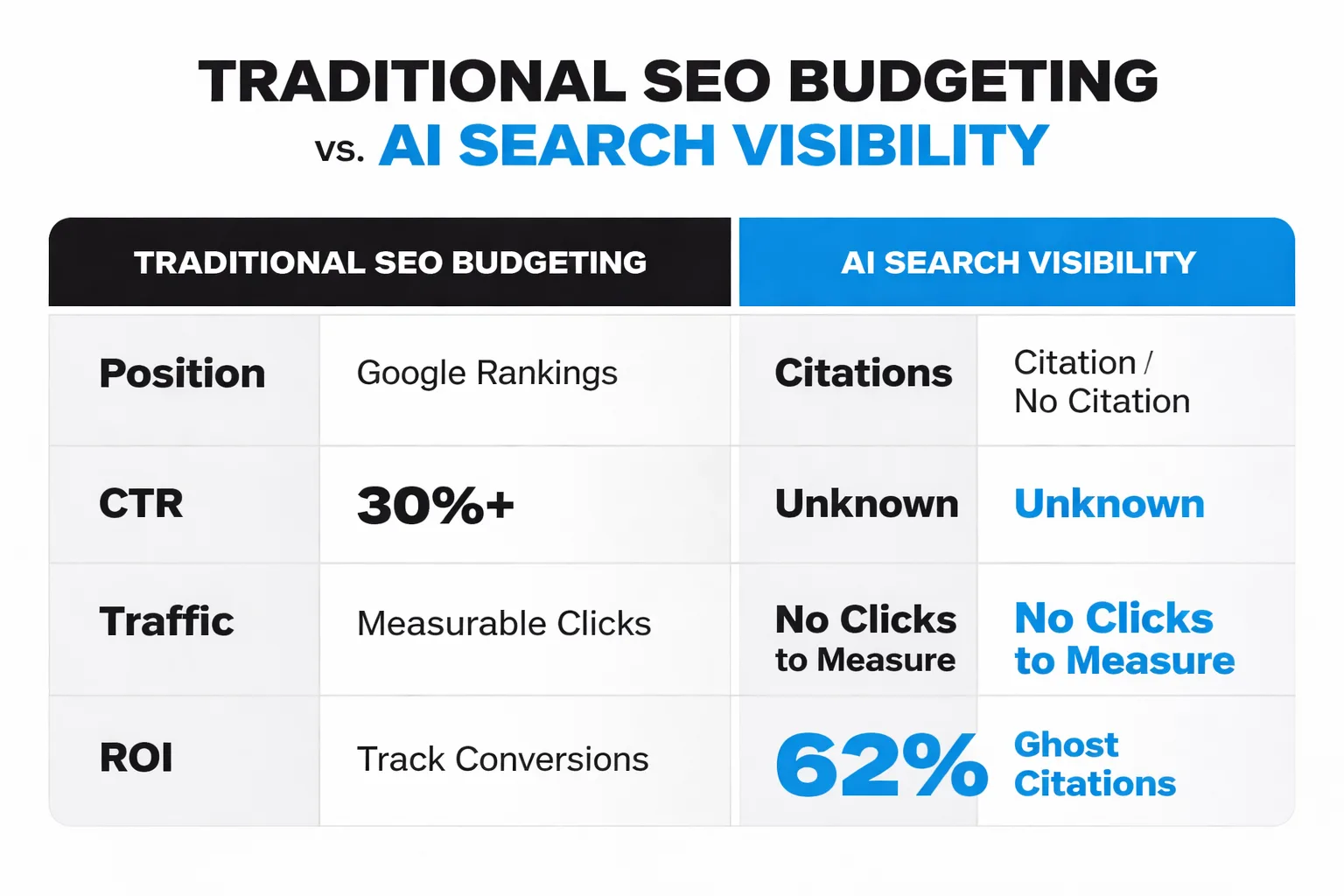
Traditional SEO budgeting assumes one search surface: Google's organic results. You rank for keywords, traffic flows, you measure clicks and conversions. The math is clean.
AI search broke that model. When someone asks ChatGPT "what's the best CRM for a 50-person team," there's no click to measure. When Perplexity synthesizes an answer from multiple sources, your brand either appears in the citation or it doesn't. When Google AI Overview summarizes a topic at the top of the SERP, it can cannibalize your organic click before the user ever scrolls.
The Semrush ghost citations study found that 62% of AI citations are what they call "ghost citations": the AI references a source but doesn't mention the brand by name. That means even when your content is being used to construct AI answers, you may not get credit. 62% of AI citations don't mention a brand by name, meaning your content can power AI answers without your brand ever appearing in the response.
This changes the cost equation in three specific ways.
First, you need a new measurement layer. Traditional rank trackers don't capture AI search visibility. You need to monitor where your brand appears (or doesn't) across ChatGPT, Claude, Gemini, Perplexity, Grok, Google AI Overviews, and AI Mode. That's a new tool cost. Purpose-built platforms like an LLM visibility tool or a ChatGPT visibility checker run $99-500 monthly depending on query volume and surface coverage.
The measurement layer isn't just about tracking mentions. It's about tracking context. I learned this the hard way. An AI can cite your brand as "a good starting point" before recommending a "more advanced" competitor. That mention counts as visibility in most tools, but it's actively funneling users away from you. The framing of the citation matters more than the citation itself. This is why I now look at mention position (first, middle, last in a list), sentiment of the surrounding context, and whether the AI positions your brand as the primary recommendation or a secondary option. A cheap tool that only counts mentions gives you a false positive. A tool that tracks framing gives you the real picture.
Second, you need content structured for extraction, not just for ranking. AI engines don't read content the way Google's crawler does. They extract entities, relationships, and claims. A Nature Communications study found that 50-90% of LLM-generated citations don't fully support their attached claims. That means AI engines are extracting information from your content and using it in ways you didn't intend. Your content needs to be structured so clearly that the extraction is accurate. That's a writing and editing cost, not a tool cost.
The practical implication here is that your content needs explicit, self-contained claims. Instead of writing "our platform helps teams collaborate," you write "TeamFlow is a project management platform for teams of 10-500 people that integrates with Slack, GitHub, and Google Calendar." The first sentence is vague enough that an AI engine might extract it incorrectly. The second sentence gives the entity (TeamFlow), the category (project management platform), the audience (teams of 10-500), and the integrations (Slack, GitHub, Google Calendar) in a single extractable unit. This kind of structured writing takes 20-30% longer than conventional blog writing. That's a real cost line in your calculator.
Third, you need entity grounding work. This is the work of making sure AI search engines understand who you are as an entity. It involves Wikidata and knowledge graph presence, structured data on your site, consistent NAP (name, address, phone) across the web, and building the kind of entity relationships that help AI models place you in the right category. This is not traditional SEO work. It's closer to data engineering meets brand strategy.
Entity grounding has three components. First, your own site's structured data: Organization schema, Product schema, FAQ schema, and author entity profiles. A developer can implement this in 4-8 hours ($500-1,000). Second, your Wikidata entry: creating or updating your entity record so AI models can resolve your brand identity. This requires a Wikidata editor with established track record (community-managed, not paid). Third, your presence on authoritative third-party sites: Wikipedia (if notable enough), Crunchbase, industry directories, and publisher sites that AI engines cite as sources. Building this footprint takes 20-40 hours of work upfront and 2-4 hours monthly to maintain. At $100-150/hr, that's $2,000-6,000 one-time and $200-600 monthly.
The cost of adding this layer ranges from $300 to $2,500 monthly depending on whether you use tools, an agency, or a combination. For small teams, tools like Meev compress this cost because they combine AI visibility tracking, content production, and citation gap analysis in one platform. At $269/month (Pro tier), you get tracking across every major AI search surface plus archetype-aware content generation with a 16-dimension quality firewall. That replaces what would otherwise be 3-4 separate tools and a content writer.
The point isn't that tools replace agencies. The point is that the AI search layer has a cost, and that cost is lower than most people think if you choose the right approach. Ignoring it doesn't make the cost zero. It makes the cost invisible until you realize your competitors are being cited in AI answers and you're not.
How Does AI Search Visibility Differ from Traditional Rank Tracking?
This is a question I get constantly, and the answer has direct cost implications.
Traditional rank tracking monitors your position in Google's organic results for specific keywords. You input a keyword, the tool checks where your page ranks, and you track that position over time. The cost is predictable: $100-500 monthly for tools like Ahrefs, Semrush, or smaller rank trackers. The workflow is linear: keyword to URL to position to traffic.
AI search visibility tracking is fundamentally different. You're not tracking where your page ranks. You're tracking whether your brand is mentioned in a synthesized response that may draw from dozens of sources. The query isn't a keyword. It's a natural language prompt. The result isn't a ranked list of URLs. It's a generated answer with citations that change every time the model reprocesses. This requires a different tool stack entirely.
An AI visibility tracker sends prompts to ChatGPT, Perplexity, Claude, Gemini, and other AI engines, captures the responses, and analyzes whether your brand appears, where it appears (first mention, middle of a list, last), what context surrounds the mention, and which sources the AI cited. This is more computationally expensive than traditional rank tracking because each query requires an API call to an LLM, not just a SERP scrape. That's why AI visibility tools cost $99-500 monthly instead of $99-200 for traditional rank trackers.
The cost difference is real but justified. You're monitoring a different surface with different infrastructure. And the insights you get are different. A traditional rank tracker tells you where you rank for "project management software." An AI visibility tracker tells you whether ChatGPT recommends your brand when someone asks "what's the best project management tool for a remote team of 20." The second query is longer, more conversational, and more likely to represent an actual buying decision. The cost of tracking it is higher. The value of tracking it is also higher.
What Should You Ask Before Hiring an SEO Agency?
Before you hire anyone, you need to pressure-test their proposal against your cost model. Here are the questions that separate serious practitioners from order-takers.
Question 1: How do you measure AI search visibility? If the agency can't answer this, they're operating in the pre-AI search era. A competent agency in 2026 should be able to tell you which AI surfaces they monitor, how often they check, and what metrics they report. If they say "we track Google rankings," that's not wrong, but it's incomplete. You need both.
Question 2: What's your content production cost per article? This sounds like an odd question, but it reveals a lot. If they say "$50-100 per article," they're using low-cost writers or pure AI generation without editing. If they say "$300-500," they're investing in quality. If they can't answer, they're marking up content costs significantly. Compare their answer to your own cost model from Step 3 above.
Question 3: Do you handle entity grounding and knowledge graph work? Most agencies don't. They'll say "we do technical SEO" and assume schema markup covers it. Entity grounding is more than schema. It's about making your brand a recognized entity across the web. If the agency doesn't do this, you need to budget for it separately (see the $500-2,000 one-time cost in Step 3).
Question 4: How do you report on citation presence in AI answers? If the agency claims to do AI search optimization, they should be able to show you a report of where your brand appears in AI-generated answers. Ask to see a sample report. If they can't produce one, they're not actually tracking AI visibility. They're just saying the words.
Question 5: What's included in your retainer vs. what costs extra? This is the most important question. Get a line-item breakdown. Technical audit: included or extra? Content production: how many articles, at what quality? Link building: included or add-on? AI visibility tracking: included or not mentioned? The retainer that looks expensive at $5,000 might be comprehensive. The one that looks cheap at $2,500 might exclude everything that matters.
When This Cost Framework Breaks Down
I want to be honest about where this calculator fails, because every framework has edges where it stops working.
Scenario 1: Brand-new sites with zero domain authority. If you're starting from scratch, the content gap calculation doesn't work because you don't have a baseline. Every keyword is a gap. The technical audit is trivial because there's nothing to audit. But the entity grounding work is enormous because you don't exist in any knowledge graph yet. For new sites, multiply the AI visibility layer cost by 2-3x and expect 6-12 months before seeing any citation presence.
Scenario 2: Highly regulated industries. In healthcare, legal, or financial services, content needs expert review before publication. AI-assisted content that works fine for a SaaS blog can create liability in regulated spaces. The cost per article doubles or triples because you need subject matter expert review. Your seo cost calculator needs to account for $500-1,000 per article instead of $150-400.
Scenario 3: Pure ecommerce with thin content. Product pages don't naturally answer informational queries. If your site is 500 product pages with no blog, no guides, and no comparison content, the content gap is massive. But the fix isn't just writing articles. It's building generative engine optimization into your product schema, category descriptions, and buying guides. The cost model shifts from "how many articles do I need" to "how do I restructure my entire content architecture for AI extraction."
None of these scenarios mean the framework is wrong. They mean you need to adjust inputs. The structure holds. The variables change.
The Cost of Doing Nothing
Here's the number I keep coming back to. Cloudflare's 2025 analysis found that AI crawlers consume content at rates 38,000 times higher than they refer traffic back. AI crawlers consume content 38,000 times more than they send traffic back to source sites. That ratio means AI engines are reading your content, extracting your information, and constructing answers with it. But they're not sending users to your site.
If your content is being consumed by AI crawlers but your brand isn't being cited in the answers, you're subsidizing your competitors' AI visibility. Your content feeds the models. Your competitors get the citations.
McKinsey projects that agentic commerce will generate $900 billion to $1 trillion in the US alone by 2030. Braze reports consumer adoption of agentic shopping is expected to jump from 19% to 46% by end of 2026. If your SEO budget doesn't account for AI search visibility, you're budgeting for a world that's already shrinking.
The cost of doing nothing isn't zero. It's the cost of losing share-of-voice in the fastest-growing search channel since Google launched. And that cost compounds. Every month you're absent from AI answers, your competitors strengthen their citation presence. AI models learn from patterns. The more a competitor is cited, the more likely the model is to cite them again. You're not just behind. You're falling further behind every day.
What This Actually Means for Your Budget
Let me synthesize what we've covered into something you can act on today.
Your real SEO cost has two layers. The traditional layer (technical SEO, content production, link building, rank tracking) costs $2,000-7,000 monthly for a typical small-to-mid business. The AI search visibility layer (AI visibility tracking, answer-engine-optimized content, entity grounding, citation gap analysis) adds $300-2,500 monthly depending on whether you use tools, an agency, or a hybrid.
The total? $2,300-9,500 monthly for a comprehensive search visibility program that covers both Google and AI engines. That's the number your seo cost calculator should produce.
If your current spend is below that range, you're either missing the AI layer entirely (most common) or underinvesting in content production (also common). If your spend is above that range, you need to audit what each dollar buys and whether you're paying for redundant tools or services.
The most expensive SEO budget isn't the one that costs $10,000 monthly. It's the one that costs $5,000 monthly and ignores AI search entirely. Because that budget is buying visibility in a channel that's shrinking while ignoring the channel that's growing.
Build your calculator. Price each lever. Include the AI layer. Then make a decision based on real numbers, not agency boilerplate.
FAQ
What is a good SEO budget for a small business?
A small business should budget $2,300-5,000 monthly for a comprehensive SEO program that includes both traditional SEO and AI search visibility. This breaks down to roughly $1,500-3,000 for content production and link building, $200-500 for rank tracking and AI visibility tools, and $500-2,000 for technical SEO and entity grounding work amortized over time. Budgets below $1,000 monthly typically only cover tool subscriptions without the strategy and execution needed to move rankings or AI citations.
How much does SEO cost per month on average?
The average monthly SEO retainer from a reputable agency runs $2,500-10,000. Freelance consultants charge $75-200 per hour. Tool-only approaches cost $100-500 monthly but require internal time to execute. The wide range reflects scope differences: a $2,500 retainer usually covers basic on-page optimization and content, while $10,000+ includes technical SEO, content production, link building, and increasingly AI search visibility tracking.
Is SEO worth the cost in 2026?
Yes, but only if your budget includes AI search visibility. Traditional Google SEO still drives qualified traffic, but AI search is cannibalizing clicks. If your SEO spend only covers Google rankings and ignores whether ChatGPT, Perplexity, or Google AI Overview cites your brand, you're investing in a shrinking channel. The brands that see positive ROI in 2026 are the ones tracking and optimizing for both surfaces.
Can I do SEO myself to save money?
You can handle basic SEO yourself using tools like Google Search Console (free) and Ahrefs or Semrush ($100-500/month). But you'll spend 10-20 hours weekly on research, content, and technical work. If your time is worth $75+ per hour, DIY SEO costs more in opportunity cost than hiring a specialist. The exception is AI visibility tracking, where purpose-built tools like an AI visibility tracker let small teams monitor their presence across AI search surfaces without an agency.
What's the cheapest way to get AI search visibility?
The cheapest entry point is a purpose-built AI search visibility platform starting at $99/month. These tools track where your brand appears across ChatGPT, Perplexity, Claude, and other AI engines, and some generate answer-engine-optimized content. Compared to $3,000+ monthly for an agency to do this work manually, tools are the most cost-effective way for small teams to start closing the AI citation gap. The tradeoff is that tools require you to act on the data yourself.
How long until I see ROI from SEO?
Traditional SEO typically shows results in 3-6 months for existing sites with some authority, and 6-12 months for new sites. AI search visibility can appear faster if you're producing well-structured, entity-rich content that AI engines can extract from. But sustained citation presence requires building entity authority over time. Set a 6-month checkpoint: if you're not seeing movement in either Google rankings or AI citations by month 6, something in your strategy or execution needs to change.
Should I hire an agency or use tools for AI search optimization?
It depends on your team size and bandwidth. If you have someone who can spend 5-10 hours weekly interpreting data and acting on it, a tool-first approach at $99-269 monthly gives you the tracking and content generation infrastructure you need. If you have zero internal capacity, an agency that includes AI visibility in their retainer makes sense. The worst option is paying an agency that doesn't track AI visibility at all. You're getting traditional SEO at a premium price with the most important layer missing.
About the Author
Judy Zhou, Founder
Judy Zhou leads content strategy at Meev, where she oversees AI-driven content research and publishing for hundreds of brands. With a background in SEO and editorial operations, she focuses on building content systems that rank on Google, get cited by AI search engines, and drive measurable business results.
Run a free AI visibility scan to see exactly where your brand appears and doesn't across ChatGPT, Perplexity, Claude, and Google AI Overviews. The gap might be bigger than you think.