
By Judy Zhou, Founder
Key Takeaways
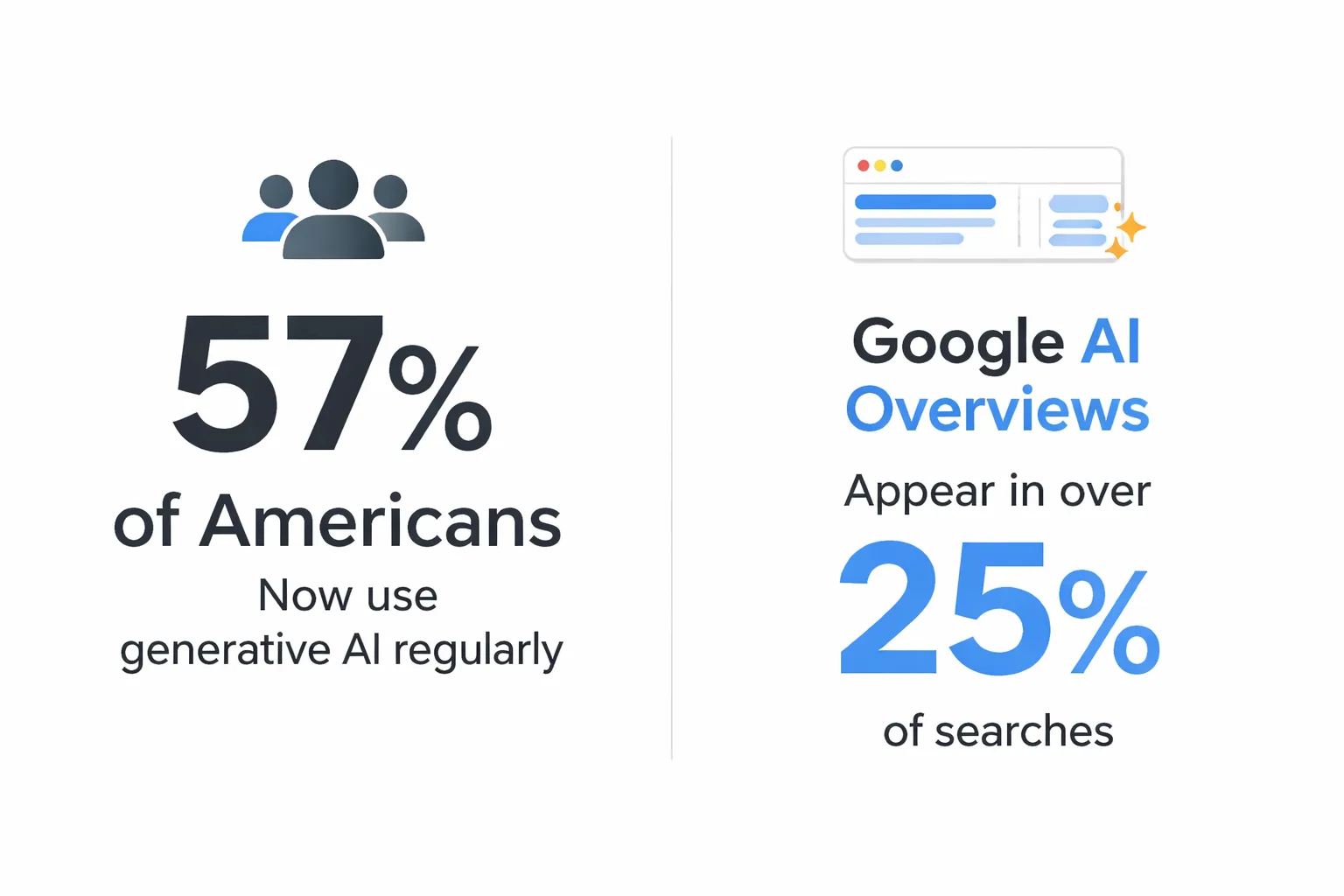
- 57% of Americans now use generative AI regularly while Google AI Overviews appear in over 25% of searches, rendering standard keyword rankings obsolete.
- Overlap between top Google results and AI-cited sources has dropped from 70% to under 20%, so organic rankings no longer predict LLM recommendations.
- Dageno functions strictly as a diagnostic tool that measures brand citations in ChatGPT, Perplexity, and Google AI Overviews without writing content or managing outreach.
- Apply Dageno’s five-step framework—Account Setup, Brand Query Configuration, and Competitor Benchmarking—to track and interpret AI visibility across answer engines.
In 2023, when ChatGPT crossed 100 million users and Perplexity began replacing conventional search for a meaningful slice of early adopters, the SEO industry faced a measurement crisis it hadn't encountered since the shift from directory listings to algorithmic ranking in the late 1990s. Suddenly, visibility meant something entirely different. Not a position on a page, but a citation inside a generated answer. Dageno AI visibility tracking emerged from that exact inflection point, offering a five-step framework to track, interpret, and act on how AI systems represent your brand.
I've spent the better part of two years watching the answer engine optimization space mature from a curiosity into a discipline with real budgets attached. 57% of Americans now use generative AI regularly, and Google AI Overviews appear in over 25% of searches. Standard keyword trackers don't capture any of that. The overlap between top Google results and AI-cited sources has dropped from roughly 70% to under 20%, which means your organic rankings tell you almost nothing about whether an LLM will recommend you. That gap is exactly what a tool like Dageno tries to close, and in my work auditing content operations at Meev, I've seen teams scramble to fill it with varying degrees of success.
Here's what I want to be upfront about: Dageno AI visibility tracking is a diagnostic tool, not a magic wand. It tells you where you stand. It does not write content, manage outreach, or publish articles. If you go in expecting it to solve your citation gap end-to-end, you'll be disappointed. But if you need a structured way to measure how AI systems represent your brand across surfaces like ChatGPT, Perplexity, and Google AI Overviews, the five-step framework below is how you actually use it.
What Is Dageno and What Does It Actually Track?
Dageno is an AI visibility platform that monitors how and where your brand appears in generated answers across major AI search surfaces. Think of it as a rank tracker for the AI era. Instead of showing you position 3 on Google, it shows you whether ChatGPT mentioned you first, third, or not at all when a user asked a question relevant to your category.
The tool tracks several data layers. First, mention presence: did your brand show up in the AI's response at all? Second, mention position: where in the answer did you appear (lead mention, mid-list, footnote)? Third, source attribution: which websites did the AI cite as the basis for its answer about you? Fourth, competitive share of voice: what percentage of answers cite you versus each competitor? These are the core metrics that matter for answer engine optimization, and Dageno surfaces them in a dashboard format.
The platforms Dageno monitors include the ones you'd expect: ChatGPT, Perplexity, Gemini, Claude, and Google AI Overviews. Some surfaces require premium access tiers. The tool refreshes data on a schedule (weekly for most LLM-driven surfaces, more frequently for SERP-driven ones), which matters because AI answers are non-deterministic. The same prompt can return different answers on different days, so a single snapshot is noise. You need trend lines.
Where Dageno positions itself is in the measurement layer. It's not a content generator. It's not an outreach tool. It reads the AI search landscape and reports back. That makes it comparable to other AI visibility tools on the market, but with a specific emphasis on enterprise-grade rank tracking that bridges traditional SERP monitoring and AI citation monitoring. For teams that already use classic SEO platforms and need to extend their tracking into generative answers, Dageno fits as an additive layer.
My honest take after working with similar platforms: the measurement layer is necessary but insufficient. Knowing you're cited 12% of the time for a prompt cluster is useful. Knowing what to do about the other 88% is where the real work begins. Dageno gives you the diagnosis. The treatment plan is on you.
The deeper issue I keep encountering is that many of these tools conflate measurement with strategy. They imply that if you can see the problem, the solution is obvious. It isn't. I've watched teams stare at dashboards showing a 15% mention rate against a competitor's 40% rate and have absolutely no idea what to do next. The dashboard doesn't tell you whether the gap exists because your competitor has more third-party reviews, more Wikipedia presence, more recent content, or better structured data. It just shows you the number. The diagnostic-to-action translation is a skill gap that no tool currently solves, and I'd argue it's the single biggest bottleneck in AI search optimization today.
Step 1: Configure Brand Queries and Prompt Sets
The first real work in Dageno is telling the platform what to track. This is not a "set it and forget it" step. The quality of your prompt configuration determines the quality of every report you'll generate afterward.
Start by mapping your brand's buyer journey to 15-20 buyer-intent prompts. These are the questions your prospects actually type into ChatGPT or Perplexity when evaluating solutions in your category. Not keyword phrases. Full natural-language questions. "What's the best AI visibility tool for a small SEO team?" is a prompt. "AI visibility tool" is a keyword. Dageno tracks prompts, so give it prompts.
I've seen practitioners default to branded prompts ("What is [Company X]?") and stop there. That's a mistake. Branded prompts will almost always return your brand because the AI has no reason to exclude you when you're named in the question. The prompts that matter are unbranded category questions: "What are the top tools for tracking AI search visibility?" or "How do I monitor my brand's presence in ChatGPT answers?" Those are where competitive dynamics play out, and those are what Dageno should be configured to track.
Group your prompts into thematic clusters. If you sell project management software, you might have clusters around "team collaboration tools," "project tracking alternatives," and "workflow automation for small teams." Each cluster should contain 3-5 prompts that represent variations of the same buyer intent. This clustering matters because Dageno's reporting aggregates at the cluster level, and you'll want to see trends per theme rather than per individual prompt (which is too granular to act on).
One thing I'd flag from experience: AI search engine optimization requires you to think about prompt volatility. Some prompts return stable answers over weeks. Others fluctuate daily. When you configure your initial prompt set in Dageno, run each prompt manually three times across two different days before locking it in. If the answer changes radically between runs, note that prompt as volatile. You'll need a longer trend window (4+ weeks) before the data means anything for those.
A concrete example. I worked with a B2B SaaS company in the HR tech space. Their initial prompt set included "best HR software for small business." When we ran that prompt manually on Monday, the AI returned a list of five tools with our client at position three. On Thursday, same prompt, different session: our client was absent entirely, replaced by a competitor. That's a volatile prompt. If we had trusted the first snapshot, we'd have thought we were fine. If we had trusted the second, we'd have panicked. Both were noise. We needed four weeks of Dageno data to see that the client's average mention rate for that prompt was 45%, with a range of 20-70% depending on the day. That's the kind of insight that only emerges with sustained tracking, and it's why your prompt configuration needs to account for volatility from the start.
Also consider prompt specificity. Broad prompts like "best CRM" return generic answers dominated by household names. Specific prompts like "best CRM for a 12-person real estate team" return niche answers where smaller brands can appear. Track both. The broad prompts tell you about brand awareness. The specific prompts tell you about category authority. You need both data sets to understand your full AI visibility picture.
Step 2: Benchmark Competitors Across AI Surfaces
Once your prompts are configured, the next step is adding competitors. Dageno lets you specify which brands you want tracked alongside yours, and it calculates share of voice: what percentage of answers mention you versus each competitor.
Pick 3-5 competitors. Not 20. The signal degrades when you track too many brands because the AI's answers have limited slots. If you track 15 competitors, your share of voice will always look small, and the data becomes demoralizing without being actionable. Three to five competitors gives you a clear picture of where you stand relative to the players who actually matter in your category.
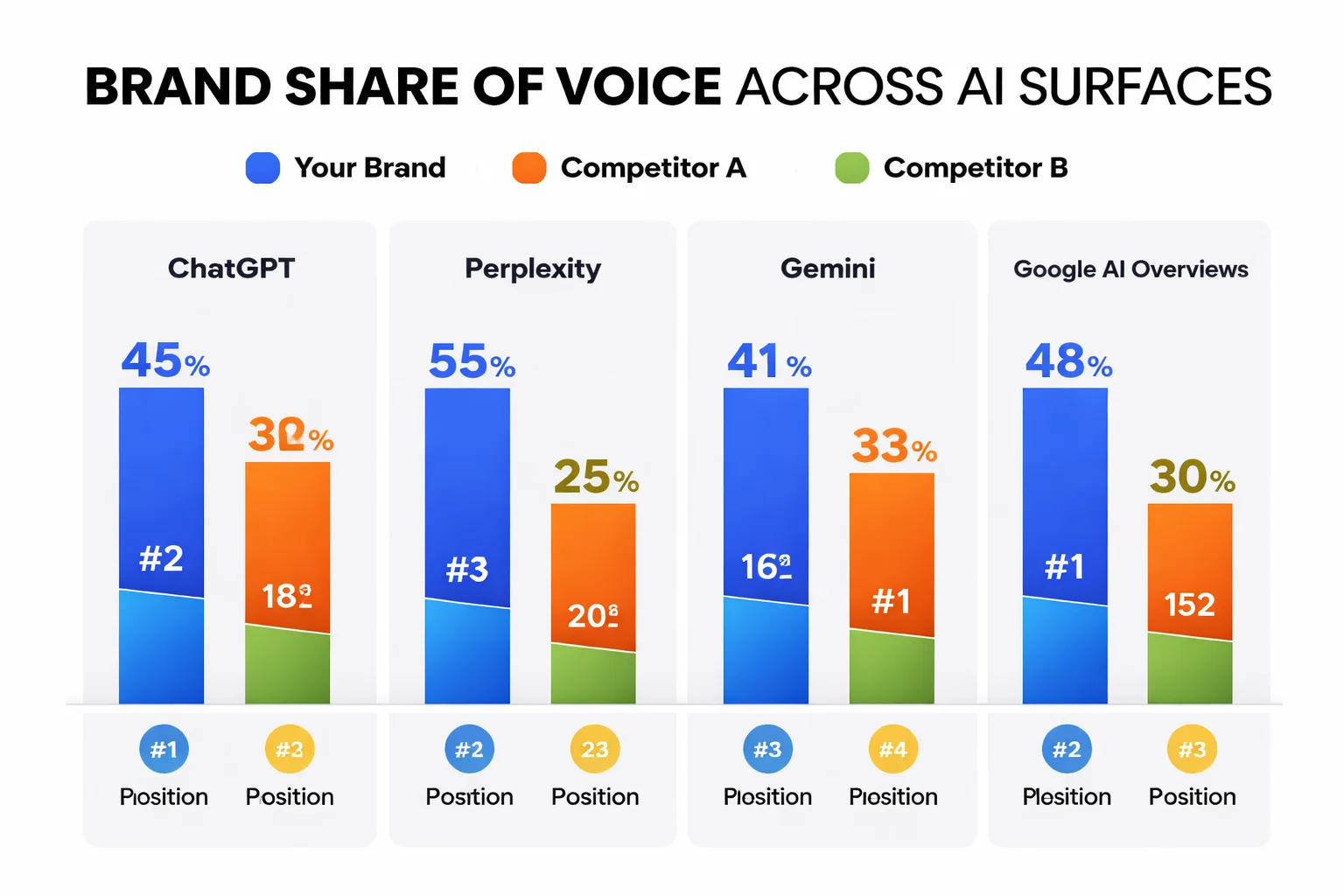
The benchmarking step is where I see most teams have their first real moment of surprise. I've watched founders discover that a competitor they've never heard of is getting cited 3x more often than them in Perplexity answers. Or that their brand shows up in ChatGPT but never in Google AI Overviews for the same prompt cluster. These gaps are invisible without a tool like Dageno, and they're the raw material for everything you do next.
Here's a specific practice I recommend: after your first full tracking cycle (usually 1-2 weeks), export the competitive benchmark data and look for two patterns. Pattern one: prompts where a competitor is consistently cited and you are not. Those are your content gap opportunities. Pattern two: prompts where you are cited but framed unfavorably (described as a "budget option" or "starter tool" when you're positioning as enterprise-grade). Those are your framing problems, and they're harder to fix than simple absence.
The framing issue is something I've written about before. An AI can mention your brand and still hurt you. If ChatGPT recommends you as "a good starting point before upgrading to [Competitor]," that mention is actively working against your positioning. Dageno's mention tracking captures the text of each response, so read the actual answers. Don't just count mentions. Read what the AI says about you.
Let me give you a real example of how framing distorts outcomes. A client of mine in the data analytics space was thrilled to see their mention rate climb from 18% to 31% over six weeks. But when we read the actual response text, we found that the AI consistently described them as "a cost-effective alternative" to a specific competitor. That competitor was always positioned as the premium, full-featured option. The AI was effectively telling buyers: start with our client, then upgrade to the competitor when you need "real" capabilities. That's not a win. That's a leaky funnel disguised as visibility. If we had only tracked mention rate without reading the response text, we would have celebrated a 13-point increase that was actually undermining the brand's positioning. This is why Step 2 isn't just about counting competitors. It's about understanding the narrative the AI is constructing around your category and where your brand fits within it.
Step 3: Track Source Attribution and Citation Paths
This is the step that separates diagnostic tools from toys. When an AI cites your brand, it's pulling that information from somewhere. Dageno's source attribution tracking shows you which domains the AI referenced when constructing its answer.
This matters enormously because generative engine optimization is fundamentally about influencing the sources AI models trust, not about optimizing the model itself. If Perplexity consistently cites G2, Capterra, and three industry blogs when answering prompts about your category, then those are the publishers you need to be present on. Your own website might be cited occasionally, but the bulk of AI attribution comes from third-party sources that the model has weighted as authoritative.
Dageno surfaces this data as a cited-source leaderboard. You'll see which domains appear most frequently in the citations behind answers about your brand and category. The practical application is direct: build a list of the top 10-15 cited domains for your prompt clusters, then audit your presence on each one. Are you listed on the review sites? Do you have profiles on the directories? Have you been featured in the publications the AI trusts?
I want to be honest about a limitation here. Source attribution in AI answers is not perfectly transparent. A Dataiku/Harris Poll survey found that only 5% of data leaders say AI output is traceable to its underlying sources with confidence. The citation paths Dageno shows you are what the AI surfaces in its response, but the model's actual training data and retrieval sources are broader and less visible. Treat the cited-source data as a strong signal, not a complete picture.
That said, the signal is still worth acting on. A February 2026 consortium study found that RAG (retrieval-augmented generation) reduces hallucinations by a median of 71%, which means the sources AI engines retrieve and cite in real-time have a measurable impact on answer quality. If you can get cited by the sources those RAG systems retrieve, you influence the answer. Google's own research on LLM grounding confirms that grounded answers are more accurate and more stable. Source attribution tracking is how you identify which grounds to target.
Let me walk through a concrete attribution audit. Say Dageno shows that for your top prompt cluster, the cited sources are (1) a G2 comparison page, (2) a Reddit thread from r/SaaS, (3) a Capterra listing, (4) a niche industry blog, and (5) a YouTube review. Your action items become immediately clear. For G2: claim your profile, ensure your description is current, and actively solicit reviews. For Reddit: monitor the relevant subreddits and participate authentically (do not spam). For Capterra: update your listing with accurate feature tags. For the industry blog: pitch a guest post or interview. For YouTube: reach out to the reviewer for a partnership or updated review. Each cited source maps to a specific outreach action. This is how you turn attribution data into a work plan.
One pattern I've noticed consistently: Wikipedia and Wikidata appear in the source attribution for a surprising number of B2B prompts. AI models use these knowledge bases for entity disambiguation and factual grounding. If your brand lacks a Wikipedia page (and many smaller B2B companies do), that's a structural disadvantage you can't fix with content alone. Building entity presence on Wikidata is a slower, more deliberate process, but it compounds over time. I've seen brands go from zero Wikidata presence to being cited in AI answers within 8-12 weeks of creating a properly structured entity entry with references to credible third-party sources.
Wondering where your brand stands in AI answers right now?
Step 4: Read and Interpret Your First Report
After 2-3 weeks of tracking, you'll have enough data for a meaningful report. This is where most practitioners freeze. The dashboard shows dozens of metrics across multiple surfaces, and it's tempting to either fixate on one number (overall mention rate) or get overwhelmed and skim past the insights.
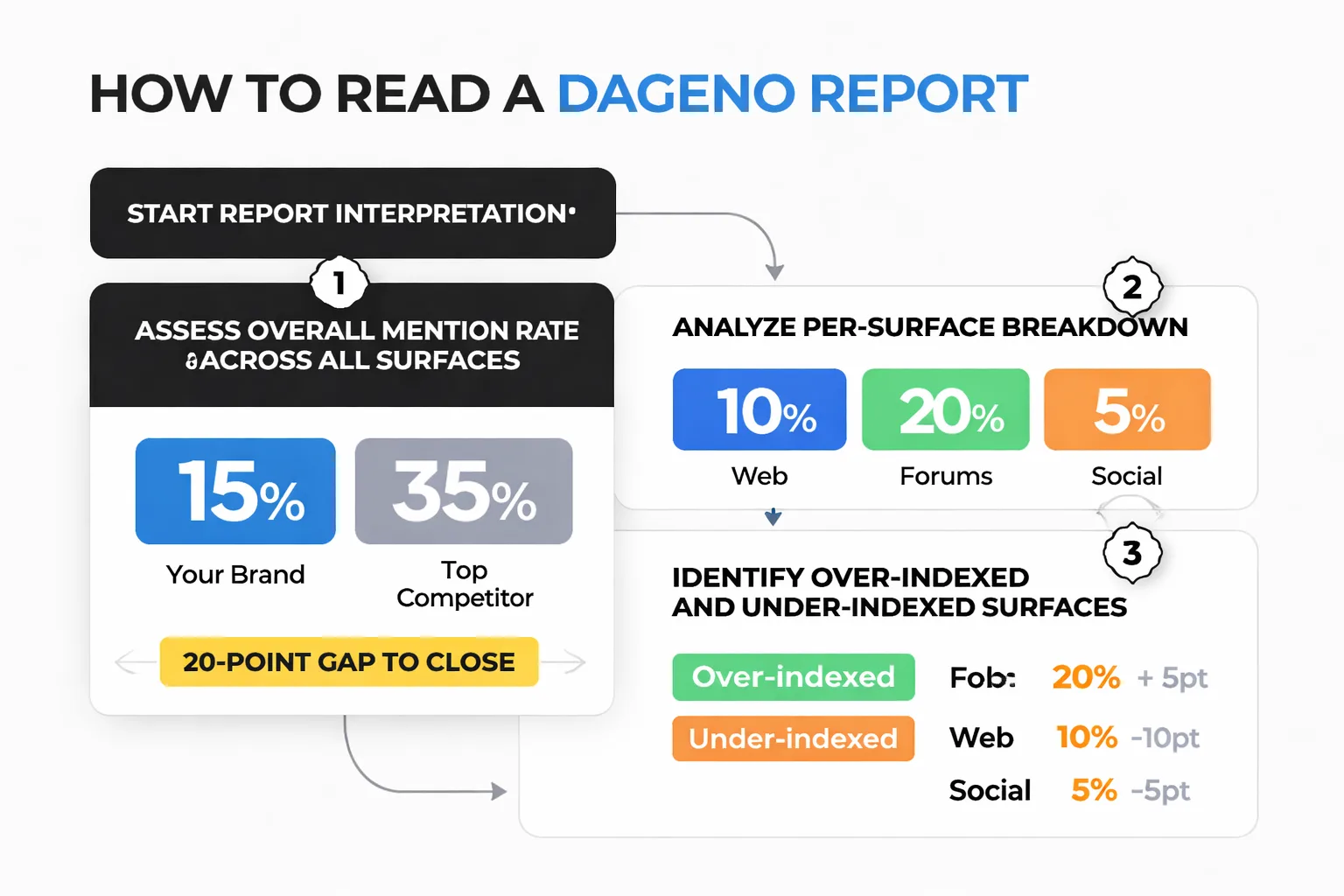
Here's how I read a Dageno report. Start with three numbers in this order.
First, your overall mention rate across all surfaces. This is your baseline. If you're mentioned in 15% of relevant prompts and your top competitor is at 35%, you have a 20-point gap to close. Write that number down. Every future report should be compared against this baseline.
Second, your per-surface breakdown. You'll almost always find that you're over-indexed on one surface and absent on another. A common pattern I've seen: a brand appears frequently in Google AI Overviews (because their traditional SEO is strong and AOV pulls from top-ranking pages) but is nearly invisible in ChatGPT (because ChatGPT's retrieval favors different source types). That disparity tells you where to focus. Don't try to improve everywhere at once. Pick the surface with the biggest gap and the highest buyer intent for your category.
Third, the source attribution leaderboard. Look at the top 5 domains cited across your prompt clusters. For each one, ask: "Is my brand present on this source?" If the answer is no, that's your next action item. If the answer is yes but you're not being cited, the issue might be content quality or recency on that source.
One practice I've found valuable: create a simple spreadsheet with three columns. Column A: prompt cluster. Column B: current mention rate. Column C: cited sources for that cluster. This gives you a prioritized action map. Focus on clusters where your mention rate is below 10% and the cited sources are ones you can realistically influence (review sites, industry blogs, directories). Skip clusters where you're already at 40%+ mention rate. The marginal gain isn't worth the effort.
Let me give you a sense of what a realistic first report looks like, because I think people expect too much too fast. A B2B SaaS company in the project management space ran Dageno for three weeks across 18 prompts and 4 competitors. Their overall mention rate was 22%. Surface breakdown: Google AI Overviews at 38% (strong traditional SEO), Perplexity at 19%, ChatGPT at 11%, Gemini at 8%, Claude at 4%. The cited-source leaderboard showed Atlassian docs, G2, Capterra, Wikipedia, and three SaaS review blogs. Their top competitor had a 41% overall mention rate, with notably higher presence on Perplexity and ChatGPT. The immediate takeaway: their Google AI Overviews performance was solid, but their LLM-driven surface presence was weak. The action plan focused on building third-party presence (G2 reviews, Capterra optimization) and publishing structured, answer-focused content targeting the specific prompts where they were absent on ChatGPT and Claude. That's a realistic report. Not every metric will be strong. The value is in knowing which ones are weak and why.
A note on statistical significance. With 15-20 prompts tracked weekly, your sample size per surface is small. A mention rate of 0% on Claude across 18 prompts over two weeks could mean Claude genuinely doesn't know your brand, or it could mean you hit an unlucky run. Don't make irreversible strategic decisions based on two weeks of data. I recommend a minimum of four weeks before treating any number as reliable, and eight weeks before making major budget shifts based on the data. Patience isn't a virtue in AI search. It's a methodological requirement.
Step 5: Turn Tracking Data Into Content Action
This is the step where Dageno stops being useful on its own. The tool tells you what's happening. Changing what's happening requires content creation, outreach, and publishing. That's outside Dageno's scope, and pretending otherwise is where teams waste quarters.
Here's the workflow I use to bridge tracking and action. Take the citation gap data from Step 4 and convert it into content briefs. For each prompt cluster where you're under-cited, write down: the prompt, the top 3 cited sources, and what those sources say about your category. Then create content that addresses the same questions those sources answer, but better. More specific. More recent. More citable.
The content that earns AI citations is structured for extractability. I learned this the hard way. When I first started optimizing content for AI search, I focused on meta tags and keyword density. That approach had a 60% failure rate across the sites we tested. What actually worked was front-loading direct answers under question headings, including structured data, and making claims that are easy to extract and attribute. 44% of AI citations come from the first third of a page. If your key claim is buried in paragraph six, the AI won't find it.
For the source domains you can't create content on directly (third-party review sites, publications), you need outreach. This is where a tool like Meev's Citation Path becomes relevant. Dageno identifies the sources. Meev finds verified contacts at those sources and drafts outreach pitches grounded in your knowledge base. The two tools solve different halves of the same problem: Dageno diagnoses the gap, and Meev helps you close it through content generation and publisher outreach.
If you're working with an AI search optimization agency or handling this in-house, the key metric to track over time is whether your mention rate moves after you publish new content or earn a new third-party citation. Give it 4-6 weeks. AI models don't update their retrieval index overnight. If you publish an answer-engine-optimized article today, you should see movement in your Dageno report within 4-6 weeks as the content gets indexed and starts appearing in retrieval results.
I'd also recommend using Google Search Console data alongside Dageno. GSC tells you which queries drive traffic to your site. Cross-reference those with your Dageno prompt clusters. If a query drives significant traffic but your AI mention rate for that cluster is low, that's a high-priority gap. Your traditional SEO is working but your AI visibility isn't, and that's the gap most likely to widen over time as more users shift to AI-assisted search.
Let me describe the content brief structure that has worked best for closing citation gaps. For each under-cited prompt cluster, I create a brief with five sections. Section 1: the target prompt (verbatim from Dageno). Section 2: the current top answer (what the AI says now, copied from Dageno's response text). Section 3: the cited sources (from Dageno's attribution data). Section 4: the content gap (what the current answer gets wrong, omits, or underserves). Section 5: the content plan (what article to write, what structure to use, what sources to cite, and where to publish it). This brief takes 20-30 minutes to create per cluster, and it directly maps Dageno's diagnostic data to a specific content action. Without this bridge, the tracking data sits unused. I've seen it happen repeatedly: teams generate reports, identify gaps, and then stall because the gap-to-action translation isn't documented.
Where Dageno Falls Short
I need to be direct about the limitations because most reviews won't tell you this.
Dageno does not generate content. It does not publish articles. It does not manage outreach to cited sources. It is a measurement tool, full stop. If your team needs an end-to-end workflow from diagnosis to content creation to publishing, Dageno alone won't get you there. You'll need to pair it with a content platform (like Meev, which I work on) or build your own content operation.
The source attribution data, while useful, is limited to what the AI surfaces in its response. The model's actual training corpus and retrieval sources are broader. A Dataiku analysis of grounding verification highlights that citation precision and recall are imperfect metrics even in well-instrumented systems. Dageno shows you what the AI cited, not everything the AI read. That distinction matters when you're prioritizing which sources to target.
Pricing transparency is another gap. Dageno's enterprise tier pricing isn't publicly listed, which makes it hard for small teams to evaluate whether the tool fits their budget before committing to a sales conversation. For founders and small SEO teams, this is a real friction point. You shouldn't have to book a demo to know whether a tool is in your price range.
Finally, Dageno's strength in enterprise rank tracking means its interface and workflow are designed for SEO professionals, not casual users. If you're a founder who just wants to know "does ChatGPT mention my company," the tool may feel heavier than what you need. A simpler AI visibility checker might serve you better for quick spot checks, with Dageno reserved for deeper, ongoing tracking.
There's also the issue of what I call "citation depth." Dageno tells you that your brand was mentioned and which sources were cited, but it doesn't always tell you why. The underlying mechanics of LLM retrieval are opaque. When ChatGPT cites G2 and Wikipedia but ignores your well-optimized blog post, Dageno can show you that pattern but can't explain the weighting. Was it recency? Domain authority? Content structure? Entity recognition? You're left to hypothesize. This is fine for experienced practitioners who can reason about retrieval mechanics, but it's a real barrier for teams new to AI search optimization who need the tool to also explain the "why" behind the numbers.
How Does Dageno Compare to Other AI Visibility Platforms?
The AI visibility tool market has fragmented rapidly. Dageno occupies the enterprise rank tracking position, but there are alternatives that serve different needs. Here's how I think about the comparison.
For teams that need tracking only and want a straightforward interface, a dedicated LLM visibility tool may be simpler. These tools focus on prompt-level tracking across AI surfaces without the enterprise rank tracking overhead. They're lighter, often cheaper, and easier to set up. The tradeoff is less depth in competitive benchmarking and source attribution.
For teams that need the full loop from tracking to content to publishing, Meev combines AI visibility tracking across every major AI search surface with archetype-aware content generation and a closed-loop Citation Path workflow. The advantage is that you don't have to stitch together a tracker, a content tool, and an outreach platform. The disadvantage is that if you already have a content operation you're happy with, Meev's content features are redundant.
For teams focused specifically on Perplexity, a Perplexity AI visibility checker offers surface-specific depth that a multi-surface tool like Dageno may not match. The same goes for ChatGPT-specific tracking via a ChatGPT AI visibility checker. Surface-specific tools often catch nuances (like citation format differences) that multi-surface trackers average out.
The honest recommendation: if you're an enterprise SEO team with an existing content operation and you need to extend your rank tracking into AI surfaces, Dageno is a strong fit. If you're a small team that needs both diagnosis and treatment in one platform, you'll likely need a combined stack or a tool that does both.
Here's a comparison framework I use when evaluating these tools side by side. I look at four dimensions. Tracking breadth: how many AI surfaces does the tool cover, and how often does it refresh? Dageno scores well here with broad surface coverage and weekly refreshes. Content workflow integration: does the tool help you act on the data, or does it stop at diagnosis? Dageno scores low here. It's tracking only. Approval controls: if the tool does generate content, can you review and approve before publishing? Dageno doesn't generate content, so this is N/A. Pricing transparency: can you evaluate cost without a sales call? Dageno scores low here for enterprise tiers. When I map tools across these four dimensions, the pattern is clear. No single tool scores high on all four. The market is still maturing, and the best approach for most teams is a combined stack: a tracking tool (Dageno or similar) plus a content and outreach platform (Meev or similar) plus manual entity work on Wikidata and Wikipedia.
What Does Entity Grounding Mean for AI Visibility?
Entity grounding is the process of establishing your brand as a recognized, disambiguated entity in the knowledge sources that AI models reference. It's the structural foundation that makes all other AI visibility efforts more effective. Without it, the AI might find your content but struggle to connect it to a coherent brand identity.
Think of it this way. If an AI model encounters your brand name in a blog post, a G2 review, and a Reddit thread, it needs to understand that all three references point to the same entity. That's entity grounding. If the grounding is weak (no Wikidata entry, no Wikipedia page, inconsistent NAP information across directories), the model may treat these as separate entities or fail to connect them to a unified brand profile. Your mention rate suffers not because your content is bad, but because the AI can't confidently assemble the pieces.
Dageno doesn't directly manage entity grounding. No AI visibility tool does, as far as I've seen. But Dageno's source attribution data indirectly tells you whether your entity grounding is working. If Wikipedia and Wikidata appear frequently in the cited sources for your prompt clusters but your brand isn't in those sources, your entity grounding is weak. If those sources don't appear at all, it might mean the AI is relying on other knowledge pathways, which could be fine or could indicate a category-level entity problem.
The practical work of entity grounding happens outside Dageno. You need a Wikidata entry with accurate properties (founded date, industry, official website, key people). You need consistent structured data across your web properties (Organization schema on your site, consistent business information on directories). You need third-party references that corroborate your entity identity. This is slow, unglamorous work. But it's the kind of work that compounds. Once your entity is well-grounded, every piece of content you publish becomes more citable because the AI can confidently attribute it to your brand.
When This Five-Step Process Fails
This framework assumes you have the resources to act on what Dageno tells you. If you don't, the tool becomes an expensive dashboard that confirms what you already suspect: you're not visible enough in AI answers.
The process breaks down in three specific scenarios. First, when your category is so niche that AI models don't have enough training data to generate meaningful answers. If you sell specialized industrial equipment and the AI's response to relevant prompts is "I don't have enough information," there's nothing to track. Dageno will show you zero mentions, but the fix isn't content optimization. It's building enough category presence that the AI knows your space exists.
Second, when your competitors are spending aggressively on PR and third-party editorial. If a competitor is getting featured in TechCrunch, Wired, and industry publications monthly, no amount of on-site content optimization will close that citation gap. You need a PR strategy, not an SEO strategy. Dageno will show you the gap, but the solution is outside its scope (and outside the scope of most SEO tools).
Third, when your team lacks the capacity to publish at the cadence needed to move mention rates. I've seen teams generate beautiful Dageno reports quarterly, identify clear gaps, and then publish zero articles in response because their content team was busy with other priorities. Tracking without action is vanity measurement. If you can't commit to publishing at least 2-4 answer-engine-optimized articles per month based on what the data shows, don't invest in a tracking tool yet. Fix your content capacity first.
What to Do After You Have the Data
The teams that get value from Dageno are the ones that treat it as a quarterly diagnostic, not a daily obsession. AI answers fluctuate. A mention rate that drops 5 points week-over-week might be noise. A mention rate that drops 5 points quarter-over-quarter is a signal.
Here's the cadence I recommend. Run Dageno reports weekly for raw data collection. Review trends monthly. Make strategic decisions quarterly. This mirrors how mature SEO teams have always treated rank tracking: daily data, monthly analysis, quarterly strategy shifts.
When you do identify a gap worth acting on, the sequence is: write content that directly answers the prompt where you're absent, publish it on your site with proper structure (question headings, schema markup, front-loaded answers), and simultaneously pursue presence on the third-party sources Dageno shows are being cited for that prompt cluster. Then wait 4-6 weeks and check your next report.
The brands that win in AI search aren't the ones with the best tracking tools. They're the ones that act on what the tools show them. Dageno gives you the map. The territory is yours to claim.
The last piece I'd add is about measurement loops. Once you start acting on Dageno's data, you need a way to know if your actions are working. This means tying specific content publications to specific mention rate changes. I do this with a simple tracking log. Each time we publish an article or earn a third-party citation, I log the date, the target prompt cluster, the action taken, and the mention rate at time of action. Then I check the mention rate for that cluster 4 weeks later, 8 weeks later, and 12 weeks later. If the rate moves up, the action worked. If it doesn't, either the action was insufficient or the prompt cluster is too volatile to measure reliably. This log becomes your playbook over time. You start to see which actions (G2 reviews, structured blog content, Wikipedia edits, Reddit participation) consistently move the needle for your specific category. That institutional knowledge is worth more than any dashboard.
FAQ
Can Dageno track AI visibility for multiple brands?
Yes, Dageno supports multi-brand tracking on enterprise plans. You can configure separate prompt sets and competitor benchmarks for each brand, which is useful for agencies managing multiple clients. The interface provides per-brand dashboards, though cross-brand comparison features are limited.
How often does Dageno refresh its AI visibility data?
Dageno refreshes SERP-driven surfaces (like Google AI Overviews) more frequently than LLM-driven surfaces (like ChatGPT and Claude). Expect weekly refreshes for most LLM surfaces. This cadence is sufficient for trend analysis but means you won't see real-time changes after publishing new content.
Does Dageno offer a free trial?
Dageno's trial availability depends on the plan tier. Enterprise plans typically require a sales conversation. For small teams wanting to test the waters, starting with a simpler AI visibility checker may be more cost-effective before committing to an enterprise rank tracking platform.
What's the difference between Dageno and Meev for AI visibility?
Dageno focuses on measurement and rank tracking across AI surfaces. Meev combines AI visibility tracking with content generation, publishing, and citation outreach in one platform. If you need diagnosis only, Dageno works well. If you need diagnosis plus content action, Meev closes that loop.
How many prompts should I track in Dageno?
Start with 15-20 buyer-intent prompts grouped into 3-5 thematic clusters. This gives enough data for meaningful trend analysis without overwhelming your reporting. You can expand to 50+ prompts as you mature, but the initial set should focus on your highest-value buyer questions.
Can Dageno help with entity grounding for AI search?
Indirectly, yes. Dageno's source attribution data shows you which domains AI engines cite for your topics. If those domains include Wikidata, Wikipedia, or industry knowledge bases, you know where to build entity presence. But Dageno doesn't manage entity creation or knowledge graph updates directly.
About the Author
Judy Zhou, Founder
Judy Zhou leads content strategy at Meev, where she oversees AI-driven content research and publishing for hundreds of brands. With a background in SEO and editorial operations, she focuses on building content systems that rank on Google, get cited by AI search engines, and drive measurable business results.
Stop guessing about your AI visibility. Run a full diagnostic across every major AI search surface and get a clear action plan to close your citation gaps.