Agencias SEO vs AI Visibility Tools: What Actually Works
By Judy Zhou, Founder
Key Takeaways
- The overlap between top Google results and AI-cited sources has dropped from 70% to under 20%, so ranking #1 no longer guarantees visibility in ChatGPT or Perplexity.
- AI-referred sessions jumped 527% year-over-year in the first five months of 2025, making entity grounding and AI citation tracking the new priority over traditional links.
- Research-backed generative engine optimization strategies can boost AI visibility by up to 40%, according to the arXiv GEO paper.
- Individual expert voices now drive 77% of LLM citations rather than brands, so prioritize who is talking about you over company blog content.
In 2012, when Google rolled out the Knowledge Graph and began pulling structured entity data directly into search results, a small number of forward-thinking agencias SEO recognized that search was no longer purely about links and keywords. It was about whether Google understood who you were as an entity. Most agencies ignored the signal. A decade later, the same pattern is repeating itself, this time at a far greater speed. Large language models have made entity grounding, Wikidata presence, and AI citation tracking the new frontier of search visibility, and the agencies that see it early will define the next era of the discipline.
The overlap between top Google results and AI-cited sources has dropped from roughly 70% to under 20% by some estimates. You can rank #1 for a keyword and still never appear in a ChatGPT or Perplexity answer. AI-referred sessions jumped 527% year-over-year in the first five months of 2025, and research-backed generative engine optimization strategies can boost AI visibility by up to 40%, according to an arXiv GEO research paper. Meanwhile, individual expert voices account for 77% of LLM citations rather than brands, which means your company blog matters less than who's talking about you. The old agencias SEO playbook was built for a world of blue links. That world is shrinking.
What Agencias SEO Actually Deliver in 2026
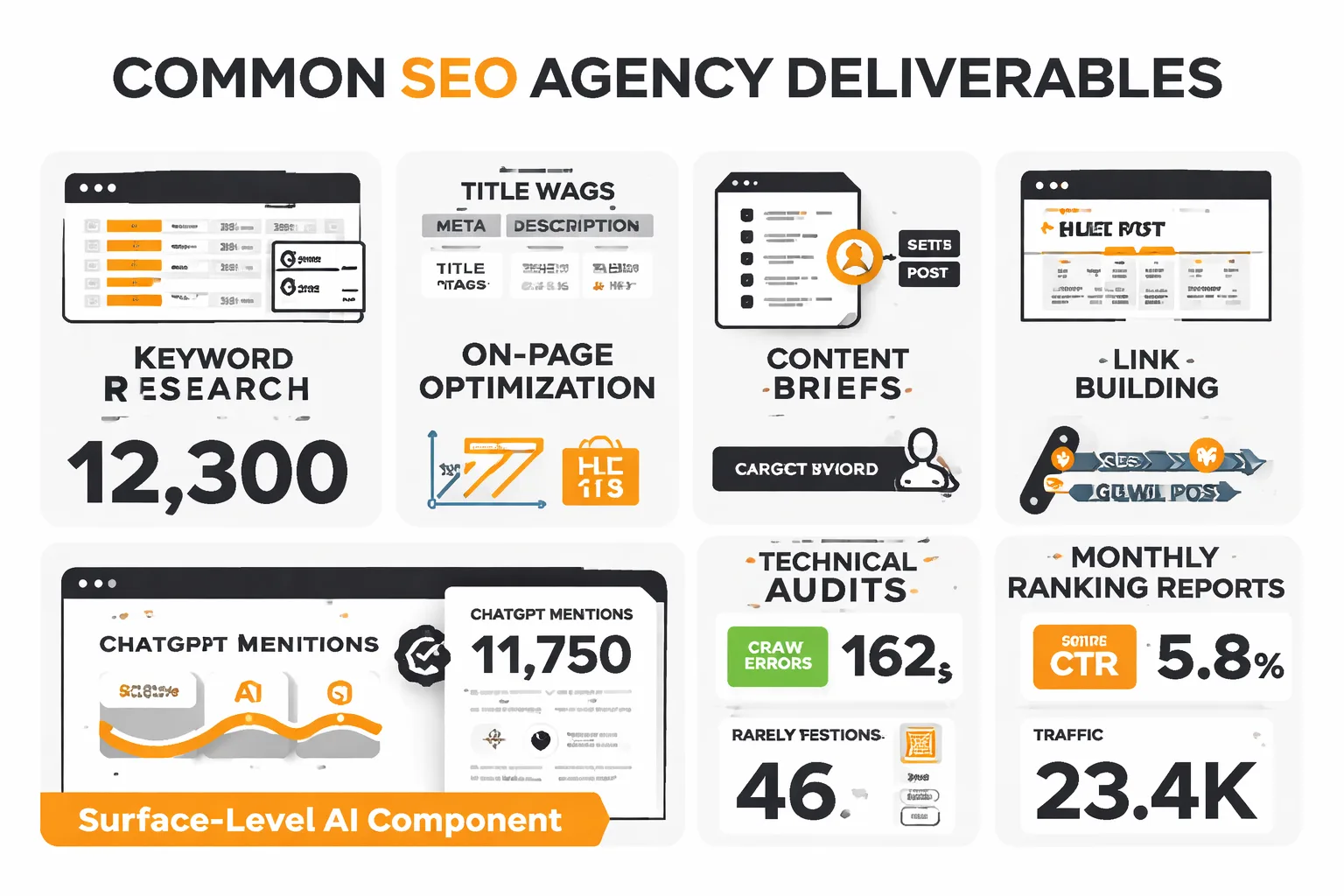
Most agencias SEO still sell the same package they sold five years ago. The deliverables are familiar: keyword research with search volume spreadsheets, on-page optimization (title tags, meta descriptions, header structure), content briefs for writers, link building through outreach or guest posts, technical audits covering Core Web Vitals and crawlability, and monthly ranking reports. Some have bolted on an AI component, usually a dashboard that shows whether ChatGPT mentions your brand. That bolt-on is surface-level. It rarely traces which sources the LLM pulled from, and it almost never connects citation gaps to a content production workflow that closes them.
In my work auditing content operations, I see the same reporting structure repeated. An agency sends a monthly PDF with keyword positions, organic traffic trends, backlinks acquired, and a list of completed tasks. What's missing is any measurement of how the brand appears across AI search surfaces. The report doesn't tell you whether Perplexity cites you for your core product category. It doesn't show whether Gemini includes you in comparison answers. It doesn't surface the domains that AI engines actually rely on when answering questions about your industry. The agency tracks Google positions because that's what their tools were built for. AI search visibility requires a fundamentally different measurement layer, and most agencies haven't built it.
The scope breakdown matters because it reveals where the gap is. A traditional agency retainer typically runs $2,500 to $10,000 per month for a small business. That buys you 10-30 hours of human attention, a handful of published articles, and a backlink target. What it doesn't buy you is daily monitoring of your brand's presence in ChatGPT, Claude, Gemini, Perplexity, Grok, Google AI Overviews, AI Mode, and DeepSeek. It doesn't buy you citation source tracing, which shows exactly which third-party domains AI engines cite when answering queries about your space. And it doesn't buy you entity grounding work, which is the process of ensuring your brand exists as a recognized entity in the knowledge graphs that LLMs use for fact retrieval. These are the deliverables that move the needle in AI search, and they're not in the standard agency scope of work.
Where Classic SEO Falls Short for AI Citations
The fundamental disconnect is this: Google ranks pages. LLMs synthesize answers. These are different mechanisms that reward different signals. When Google evaluates a page, it looks at relevance, authority (largely through links), and user experience signals. When an LLM generates an answer, it retrieves information from its training data and real-time search results, then synthesizes a response that may cite multiple sources or none at all. The LLM doesn't rank you. It either mentions you or it doesn't, and that decision is driven by factors that traditional SEO barely touches.
The overlap between top Google results and AI-cited sources has plummeted from around 70% to under 20%. I keep coming back to this number because it should reframe how you think about your SEO investment. If you're spending $5,000 a month on an agency that's moving you from position 4 to position 2 on Google, you're optimizing for a channel that no longer maps to where people are actually discovering brands. The Semrush AI Overviews study analyzed 200,000 queries and found that AI Overviews appear for a significant percentage of informational queries, and when they do, they push organic results below the fold. Being #1 matters less when the answer box sits on top and cites a different source.
I tried doubling down on traditional SEO tactics for some of our newer content, hoping to boost AI citations. The results were underwhelming. We optimized title tags, built internal links, and targeted high-volume keywords. Google traffic ticked up. AI citations didn't move. The reason is that LLMs don't care about your title tag. They care about whether your brand is mentioned in the sources they retrieve, whether your entity is recognized in their knowledge graph, and whether the content they find about you is specific enough to be useful in a synthesized answer. Keyword optimization is table stakes. It gets you into Google's index. It does not get you into an LLM's answer.
The tactics that agencias SEO rely on, link building and on-page optimization, are still necessary. I'm not arguing you should abandon them. But they're no longer sufficient. A backlink from a high-DA site helps Google trust your domain. It does nothing to make ChatGPT mention your brand when someone asks "what's the best tool for X." That mention depends on whether your brand appears in the training data, in the real-time search results the LLM retrieves, and in the knowledge graph entities it references. Traditional SEO doesn't address any of those layers.
Here's the contrarian take that most agencies won't tell you: the link building that agencies sell is becoming decoupled from AI visibility, and they know it. Links still matter for Google. But the domains that AI engines cite most frequently are not the domains that agencies build links on. An arXiv study on Generative Engine Optimization found that AI search exhibits a systematic bias toward earned media over brand-owned content. That means PR coverage, expert quotes in third-party articles, and community discussions on Reddit and forums matter more for AI citations than guest posts on medium-authority blogs. If your agency is still pitching you 10 guest posts a month, they're selling you 2018 tactics in a 2026 landscape.
What AI Visibility Tools Actually Measure
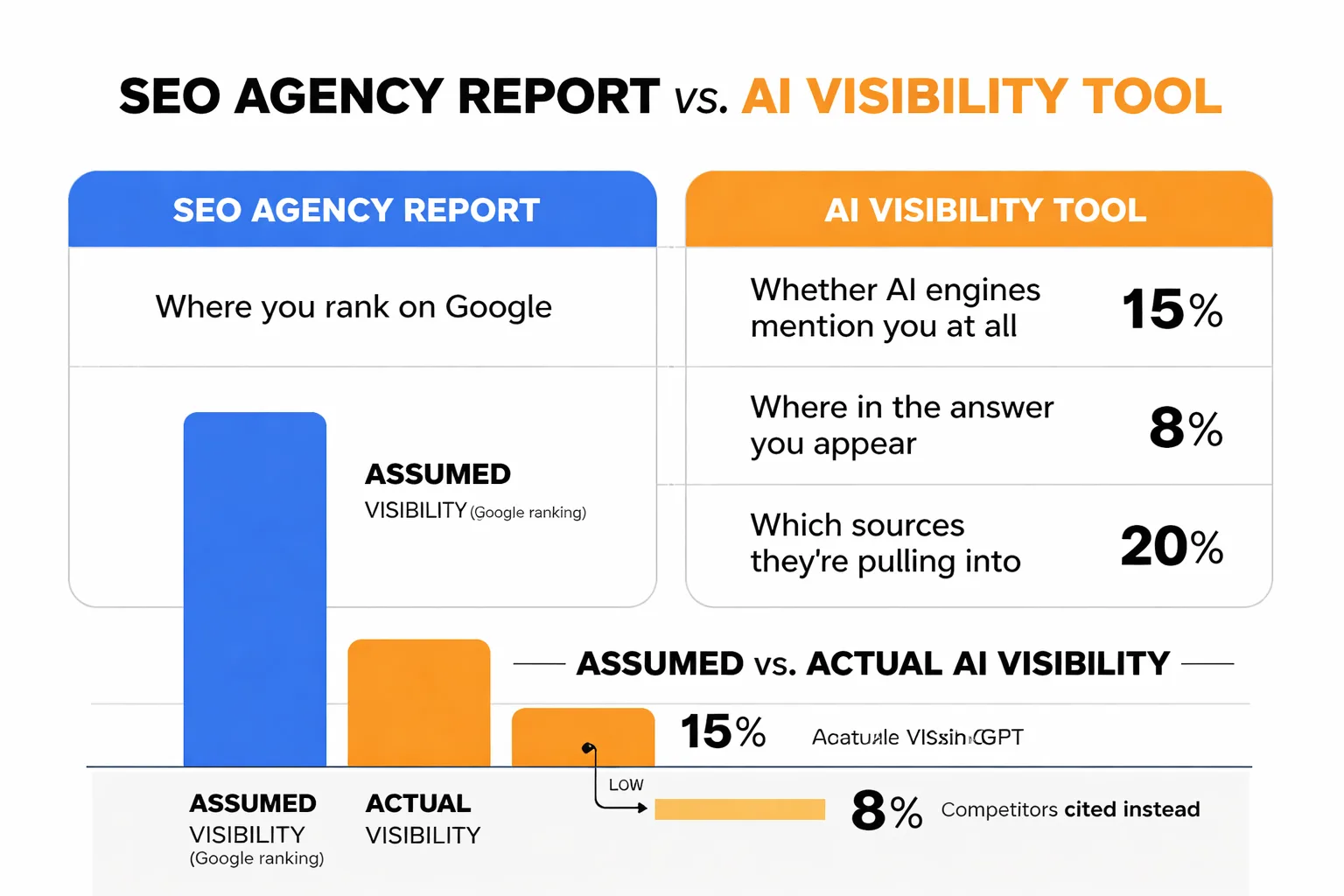
An AI visibility tool answers a different question than an agency report. The agency report tells you where you rank on Google. The AI visibility tool tells you whether AI engines mention you at all, where in the answer you appear, and which sources they're pulling from to build that answer. These are not minor variations on the same metric. They're fundamentally different measurements that require different infrastructure.
In my work at Meev, I've seen what happens when a brand gets its first real look at AI visibility data. The reaction is almost always surprise. They assumed that ranking well on Google meant they were visible in AI answers. They weren't. The brand might appear in 15% of relevant ChatGPT queries and 8% of Perplexity queries, and the sources cited alongside or instead of them are competitors they've never heard of. That gap, between assumed visibility and actual visibility, is what AI visibility tools exist to surface.
The core measurements break down into four layers. First, brand mention rate: what percentage of relevant prompts across AI surfaces include your brand? Second, mention position: when you do appear, are you first, in a list, or mentioned last? Third, citation source tracing: which domains are AI engines citing when they answer questions about your space? And fourth, share of voice: what percentage of AI answers cite you versus each competitor? These four metrics give you a diagnostic picture that no agency monthly report provides. You can track these with a dedicated LLM visibility tool or through AI visibility tracking that monitors every major AI search surface.
What makes this measurement hard, and why most agencies don't do it, is that AI answers are non-deterministic. Ask ChatGPT the same question twice and you may get different sources cited. Ask it a third time and the answer structure changes. This means you need to run prompts at scale, across multiple surfaces, on a rolling basis, to get a statistically meaningful picture of your visibility. That's an engineering problem, not a strategy problem. Most agencies don't have the infrastructure for it.
The Semrush AI Visibility Index 2026 tracked 180 million-plus AI answers across 22 industries and 9 markets. That scale of measurement is what's needed to understand patterns in AI citation behavior. A human analyst at an agency running manual prompts in ChatGPT can't match that volume. They can give you a snapshot. They can't give you a trend.
How Does Entity Grounding Change the Game?
Entity grounding is the process of ensuring your brand exists as a recognized entity in the knowledge structures that LLMs use for fact retrieval. Think of it this way: when you ask ChatGPT "what are the best project management tools," it doesn't search the web and read 10 blog posts. It retrieves a set of entities it recognizes as project management tools, then synthesizes an answer based on what it knows about each one. If your brand isn't an entity in that knowledge structure, you're invisible regardless of how good your content is.
Wikidata contains over 112 million machine- and human-readable entries. It's one of the primary structured data sources that open-source AI models use for entity recognition. If your brand has a Wikidata entry with accurate attributes (founding date, industry, key people, product category), LLMs are more likely to recognize you as a distinct entity. If you don't have a Wikidata entry, or if it's sparse and inaccurate, you're relying entirely on being mentioned in training data. That's a much higher bar.
I used to think that a robust knowledge graph and perfectly structured content were the silver bullet for getting LLMs to cite my work. My team spent months meticulously integrating schema markup and building out our internal knowledge base, expecting a direct correlation to AI visibility. What I'm seeing now is that while semantic SEO is foundational, the real lift comes from factors like community discussion and third-party editorial mentions. Entity grounding gets you into the knowledge structure. It doesn't get you recommended. Recommendation rate, not discoverability, is what drives AI citations. You need both: entity grounding to be recognized, and earned media to be recommended.
This is where the agency versus tool debate gets interesting. Entity grounding is a technical task that requires structured data expertise. It's not something most content-focused agencies do well. It's also not something most AI visibility tools handle end-to-end. The tools can tell you whether you're missing entity presence. They can show you the gap. Closing that gap requires Wikidata editing, schema markup implementation, and knowledge graph optimization, which is a specialized skill set. Some answer engine optimization services are starting to bundle this work, but it's still early.
Do you know how often AI engines cite your brand versus competitors?
When Should You Use Each Approach?
The decision isn't binary. It depends on three factors: your current AI search exposure, your team size, and your budget. Here's the framework I use.
If you're a brand that gets significant traffic from Google but has never checked whether AI engines mention you, start with measurement. You need an AI visibility checker to establish a baseline before you invest in either an agency or a content production workflow. Running a one-time audit takes minutes and tells you whether you have a problem worth solving. If your brand appears in fewer than 20% of relevant AI queries, you have a visibility gap that no amount of traditional SEO will close.
If you're a small team (1-3 people handling marketing) with a limited budget ($1,000-$3,000 per month for search visibility), an AI visibility platform gives you more bang for your buck than an agency retainer. You get daily monitoring across AI surfaces, citation gap identification, and content production to close those gaps. An agency at that price point will give you a few hours of attention per month and a basic report. The AI visibility platform gives you continuous data and automated content production.
If you're a larger team with a $5,000+ monthly budget and complex SEO needs (multi-location, e-commerce, enterprise site with thousands of pages), run both. Use an agency for technical SEO, content strategy, and link building. Use an AI visibility tool for the measurement layer the agency can't provide. The agency handles Google. The tool handles AI. They're complementary, not competitive, as long as you're clear about what each one delivers.
What AI Visibility Tools Add That Agencies Miss
The core gap is diagnostic. Agencies are built to execute campaigns. They produce content, build links, and optimize pages. What they don't do well is tell you, with precision, where you're invisible in AI search and why. That diagnostic capability is what AI visibility tools are built for.
Consider citation source tracing. When ChatGPT answers a question about your industry, it cites specific domains. Those domains might include review sites, publications, forums, or competitor blogs. If you knew which domains AI engines cite most often for your topics, you could focus your outreach and content efforts on getting mentioned on those specific sites. That's a data-driven PR strategy, not a generic link building campaign. An AI SEO tool that surfaces this data gives you a roadmap for where to invest your earned media efforts.
The arXiv GEO research found that AI search exhibits systematic bias toward earned media over brand-owned content. This means the domains AI engines cite are predominantly third-party sources, not the brand's own website. An agency that focuses on optimizing your website is working on the wrong asset for AI visibility. The work that moves the needle is getting mentioned on the right third-party domains. AI visibility tools identify those domains. Agencies don't.
Another gap is content archetype awareness. Different types of content perform differently in AI answers. Structured formats like guides, comparisons, lists, and frameworks perform especially well in AI systems because they're easy to parse and extract from. An agency writing generic blog posts isn't optimizing for this. A platform that understands archetype-aware content production, where listicles, how-tos, and explainers each have their own retrieval weights and quality criteria, produces content that's structurally more likely to be cited by AI engines.
I've seen this firsthand. When we shifted our content production to archetype-aware formats with fact-verified claims and outbound citations to authoritative sources, AI citation rates improved. Not because we published more content, but because the content was structured in a way that LLMs could actually use. The format of your content matters as much as the topic. Agencies that produce content in a single generic format are leaving AI citation opportunities on the table.
Generative Engine Optimization vs Traditional SEO
Generative engine optimization is the practice of optimizing content and brand presence for AI answer engines rather than traditional search results. The distinction matters because the optimization tactics are different. Traditional SEO optimizes for crawlers that index and rank pages. GEO optimizes for LLMs that retrieve, synthesize, and cite information.
The tactics that work for GEO include: structuring content with clear, extractable answers (not buried in paragraph 4), building entity presence in knowledge graphs, earning mentions on the third-party domains that AI engines cite, and formatting content with comparison tables, lists, and frameworks that LLMs can parse. None of these are standard agency deliverables. They require a different mindset and different tooling.
Research-backed GEO strategies can boost AI visibility by up to 40%, according to the arXiv GEO paper. That's a significant lift, and it comes from tactics that most agencies don't implement. The Go Fish Digital GEO case study documented a 3X increase in leads using GEO strategy, though their methodology focused on prompt mapping, benchmarking, and content alignment with LLMs rather than isolating any single tactic like Wikidata entity grounding.
The point isn't that GEO replaces SEO. The point is that GEO addresses a layer of visibility that SEO doesn't touch. If you're only doing traditional SEO, you're visible on Google but invisible in AI answers. If you're only doing GEO, you might be cited by AI engines but missing the organic traffic that Google still drives. You need both, and the question is whether your agency or your tooling is equipped to deliver both.
What This Won't Fix
This framework has limits, and I want to be honest about them. AI visibility tools won't fix a product that nobody wants to talk about. If your brand has zero organic mentions anywhere on the web, no amount of entity grounding or content optimization will make ChatGPT recommend you. LLMs synthesize from what exists. If nothing exists, there's nothing to synthesize. You need genuine market presence, real customers, and authentic third-party discussion before any of this matters.
AI visibility tools also won't replace the strategic thinking that a good agency provides. A good SEO strategist looks at your business goals, your competitive landscape, and your content assets, then builds a plan that connects search visibility to revenue. That's not something a tool does. A tool gives you data. The strategy is still human. If you have a complex business with multiple product lines, international markets, or regulatory constraints, you need a human strategist. The tool supports the strategy. It doesn't replace it.
Finally, neither an agency nor a tool will help you if you can't execute on the recommendations. If the tool tells you that you need mentions on five specific domains and you have no PR resources to pursue those mentions, the data is interesting but not actionable. If the agency recommends a content overhaul and you don't have writers to produce the content, the strategy is theoretical. The bottleneck is rarely the data or the strategy. It's the execution capacity.
How to Decide Which Approach Fits Your Stage
Let me make this concrete. Here's the decision framework I use when advising teams on this question.
Stage 1: You've never checked your AI visibility. Start with a free ChatGPT AI visibility checker or a Perplexity AI visibility checker. These give you a snapshot of whether AI engines mention you at all. If you're invisible, you have a problem. If you're visible, you have a baseline to improve from. Cost: $0. Time: 10 minutes.
Stage 2: You know you have a gap and want to close it. This is where you need a platform that combines measurement with action. You need to know which prompts you're missing from, which sources AI engines cite instead of you, and what content you need to produce to close the gap. This is the stage where an AI visibility platform with content production capabilities outperforms an agency, because the platform closes the loop between diagnosis and execution. An agency will diagnose and recommend. A platform diagnoses, recommends, and produces.
Stage 3: You have complex SEO needs beyond AI visibility. If you're managing a site with thousands of pages, dealing with technical SEO issues like site migrations or crawl budget optimization, or running link building campaigns at scale, you need an agency (or an in-house SEO) for that work. Layer an AI visibility tool on top. The agency handles the traditional search infrastructure. The tool handles the AI visibility layer. Budget allocation: 60-70% agency, 30-40% AI visibility tool.
Stage 4: You're an agency yourself. If you're running an agency and your clients are asking about AI visibility (and they will, if they haven't already), you need to add AI visibility measurement to your service offering. White-label AI visibility reporting lets you deliver this without building the infrastructure yourself. This is where the market is heading. Agencies that can't answer "am I visible in ChatGPT?" will lose clients to agencies that can.
The Hybrid Model Is the Answer
The honest answer to "agencias SEO vs AI visibility tools" is that the question is framed wrong. It's not either-or. The brands that win in 2026 will run both. They'll use agencies (or in-house SEOs) for the work that traditional SEO requires: technical optimization, content strategy, link building, Google ranking. And they'll use AI visibility tools for the work that agencies can't do: multi-surface AI monitoring, citation source tracing, entity grounding, and archetype-aware content production optimized for LLM retrieval.
The market is moving fast. AI search traffic is projected to reach 40% of total search traffic by 2027, according to Digital Applied's analysis. Ben Salomon from Yotpo notes that ecommerce teams "feel" the shift in search before they can measure it. If you're waiting for your agency to tell you it's time to invest in AI visibility, you're already behind. The agencies that recognize this shift are the ones that will thrive. The ones that don't will keep sending you keyword ranking reports while your potential customers ask ChatGPT for recommendations and never hear your name.
Individual expert voices account for 77% of LLM citations rather than brands, according to research shared by Chris Hackney. That statistic should reframe your entire approach. It's not enough to optimize your own content. You need to be the source that experts cite, the brand that communities discuss, and the entity that knowledge graphs recognize. That's a fundamentally different strategy than ranking for keywords, and it requires fundamentally different tools.
In my work at Meev, I've seen what happens when brands take this seriously. The ones that invest in AI visibility measurement, close citation gaps with targeted content, and build entity presence across knowledge graphs are the ones that show up in AI answers. The ones that keep doing traditional SEO and hope for the best are watching their visibility erode. The data is clear. The tools exist. The question is whether you'll act on it before your competitors do.
FAQ
Can an SEO agency handle AI visibility tracking?
Some agencies are starting to offer AI visibility as an add-on service, but most lack the infrastructure for continuous multi-surface monitoring. They typically run manual prompts in ChatGPT or Perplexity and report snapshots. That's not the same as daily tracking across every major AI search surface with citation source tracing and share-of-voice measurement. If your agency offers AI visibility, ask them specifically which surfaces they track, how often they refresh data, and whether they trace citation sources. If they can't answer those questions in detail, they're not equipped for it.
What does generative engine optimization cost compared to an agency retainer?
GEO-focused tools typically range from $49 to $599 per month depending on features and volume. A traditional agency retainer runs $2,500 to $10,000 per month. The cost difference reflects the difference in what you're buying: the tool gives you data and automated content production, while the agency gives you human strategy and execution. For small teams, a GEO tool at $99-$269 per month delivers more measurable AI visibility impact than a $3,000 agency retainer that doesn't include AI surface monitoring.
Should I stop doing traditional SEO if I invest in AI visibility tools?
No. Google still drives significant traffic, and traditional SEO signals (links, technical health, content quality) contribute to AI visibility indirectly. The AEO vs SEO relationship is complementary, not competitive. Keep doing traditional SEO. Add AI visibility measurement and GEO on top. The brands that perform best maintain strong Google rankings while also building entity presence and earning citations across AI surfaces.
How long does it take to see results from AI visibility work?
Unlike traditional SEO, where ranking improvements can take 3-6 months, AI visibility changes can appear faster because LLMs retrieve information in real time. If you publish content that gets cited by AI engines or earn mentions on domains that AI engines frequently cite, you may see visibility improvements within weeks. However, building entity presence in knowledge graphs like Wikidata takes longer, as edits need to be reviewed and accepted by the community.
Do AI visibility tools work for ecommerce brands?
Yes, and arguably they're more urgent for ecommerce. AI visibility for ecommerce is shifting fast as shoppers increasingly ask AI engines for product recommendations. If someone asks ChatGPT "what's the best CRM for a small agency" and your product isn't mentioned, you've lost that customer before they ever search Google. Ecommerce brands need to track AI visibility for product category queries, not just brand name queries.
About the Author
Judy Zhou, Founder
Judy Zhou leads content strategy at Meev, where she oversees AI-driven content research and publishing for hundreds of brands. With a background in SEO and editorial operations, she focuses on building content systems that rank on Google, get cited by AI search engines, and drive measurable business results.
Stop guessing about your AI search visibility. Get a baseline measurement today and see exactly where you're being cited and where you're invisible.