
By Judy Zhou, Founder
Key Takeaways
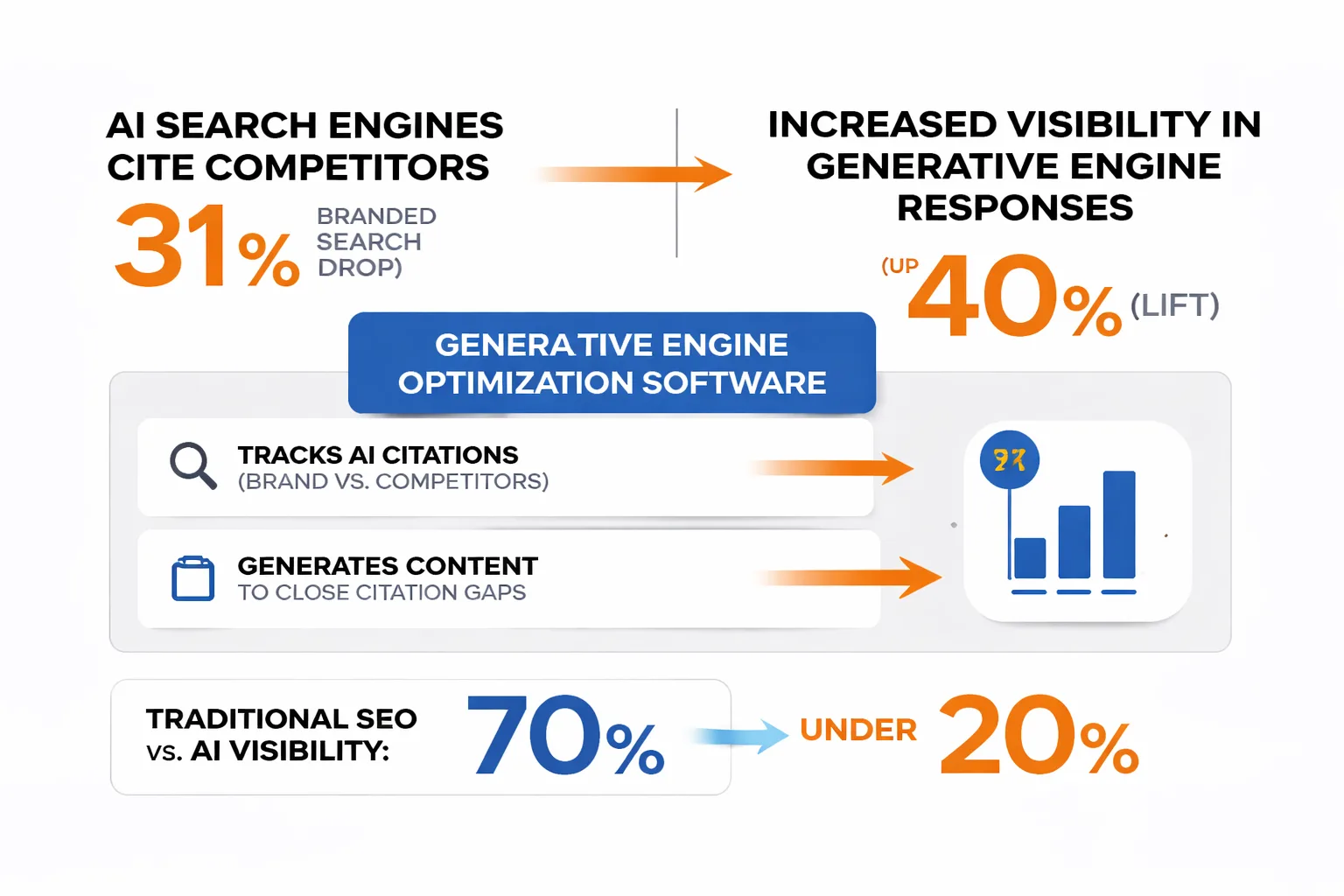
- A mid-sized SaaS company lost 31% branded search volume after ChatGPT began citing three competitors instead of their brand.
- Adding citations, quotations, and statistics lifts visibility in generative engine responses by up to 40%.
- LLM traffic converts at 12.1% signups from just 0.5% of total traffic, delivering a 23x advantage over organic search.
- Brands can move from zero AI citations to consistent mentions in 60 days by running citation audits and closing gaps with targeted content.
Last quarter, a mid-sized SaaS company noticed something unsettling: demo requests were flat, but their branded search volume had dropped 31%. No penalty, no algorithm update, no technical issue. After digging in, their growth team realized that ChatGPT was answering their target audience's top questions. And citing three competitors by name, never once mentioning them. That moment sent the team scrambling toward generative engine optimization software for the first time. What they built over the next five steps changed how they thought about search entirely.
Generative engine optimization software tracks how often AI search engines cite your brand versus competitors, then generates content to close citation gaps. The Princeton-led GEO research found that adding citations, quotations, and statistics can lift visibility in generative engine responses by up to 40%. Meanwhile, Ahrefs data shows LLM traffic converts at 12.1% signups from just 0.5% of traffic, a 23x advantage over organic search. And SparkToro reported that 68% of US Google searches ended without a click in early 2026. If your brand isn't cited by AI engines, you're invisible to a growing share of buyers who never visit Google at all.
In my work auditing content ops at Meev, I've watched brands go from zero AI citations to consistent mention presence in 60 days using a structured workflow. The key isn't buying a tool and pressing a button. It's following a disciplined five-step process that connects diagnosis, content creation, and measurement into a closed loop. Here's exactly how to do it.
How to connect your brand and competitor profiles?
Every GEO workflow starts with defining what you're measuring. Before the software can tell you where you're cited and where you're absent, it needs three inputs: your brand entity, your competitor set, and the AI engines you want to track.
Your brand entity isn't just your domain name. It's the combination of your company name, product names, key personnel, and the canonical URLs that represent your brand across the web. If you sell a product called "FlowState" but your domain is flowstate.io, the software needs both. It also needs to know that a mention of "FlowState's analytics dashboard" and "FlowState.io dashboard" refer to the same entity. This is where entity grounding for AI search begins. The software builds an entity profile that it then searches for across AI engine responses.
Your competitor set should include 3-5 companies that compete for the same audience, not necessarily the same keywords. In AI search, competitors are defined by who gets cited for the prompts your audience asks. That might include a company you've never considered a rival in traditional SEO. When I run an initial audit, I often find that the brands AI engines cite for a client's topics are publishers, review sites, or adjacent tools. Not direct competitors at all. That's valuable information. It tells you whether you need to compete for direct mentions or earn citations from third-party sources.
The AI engines you track matter too. At minimum, you want coverage across ChatGPT, Perplexity, Google AI Overviews, and Claude. These four account for the majority of AI search traffic in 2026. A tool like our AI visibility tracker covers every major AI search surface with daily refresh on SERP-driven surfaces and rolling refresh on LLM-driven ones, so you're not flying blind between checks.
One thing I see teams get wrong here: they input competitor domains but skip the prompt discovery step. The software needs to know which prompts to run. If you only track branded queries ("What is FlowState?") you'll miss the unbranded prompts where buying decisions happen ("What's the best analytics tool for SaaS startups?"). Spend 30 minutes brainstorming 20-30 prompts that reflect real buyer questions. That prompt list becomes the foundation for everything that follows.
The entity grounding process also connects to broader knowledge graph presence. AI engines don't just crawl the web. They query structured knowledge bases like Wikidata to disambiguate entities and verify relationships. If your brand lacks a Wikidata entry, or if your entry is sparse and unlinked from related entities in your industry, the AI engine has a harder time confidently associating your brand with your topic. The software should flag missing or incomplete knowledge graph entries as part of the onboarding process. Some platforms offer LLMs.txt validation to ensure your site is properly indexed by AI crawlers, which complements the entity grounding work.
Think of entity grounding like building a dossier that the AI can reference. The more complete and consistent that dossier is across your website, Wikidata, schema markup, and third-party mentions, the more confidently the AI will cite you. Inconsistency breeds uncertainty, and uncertain AI engines default to citing sources they trust.
Step 2. Run Your First Citation Audit
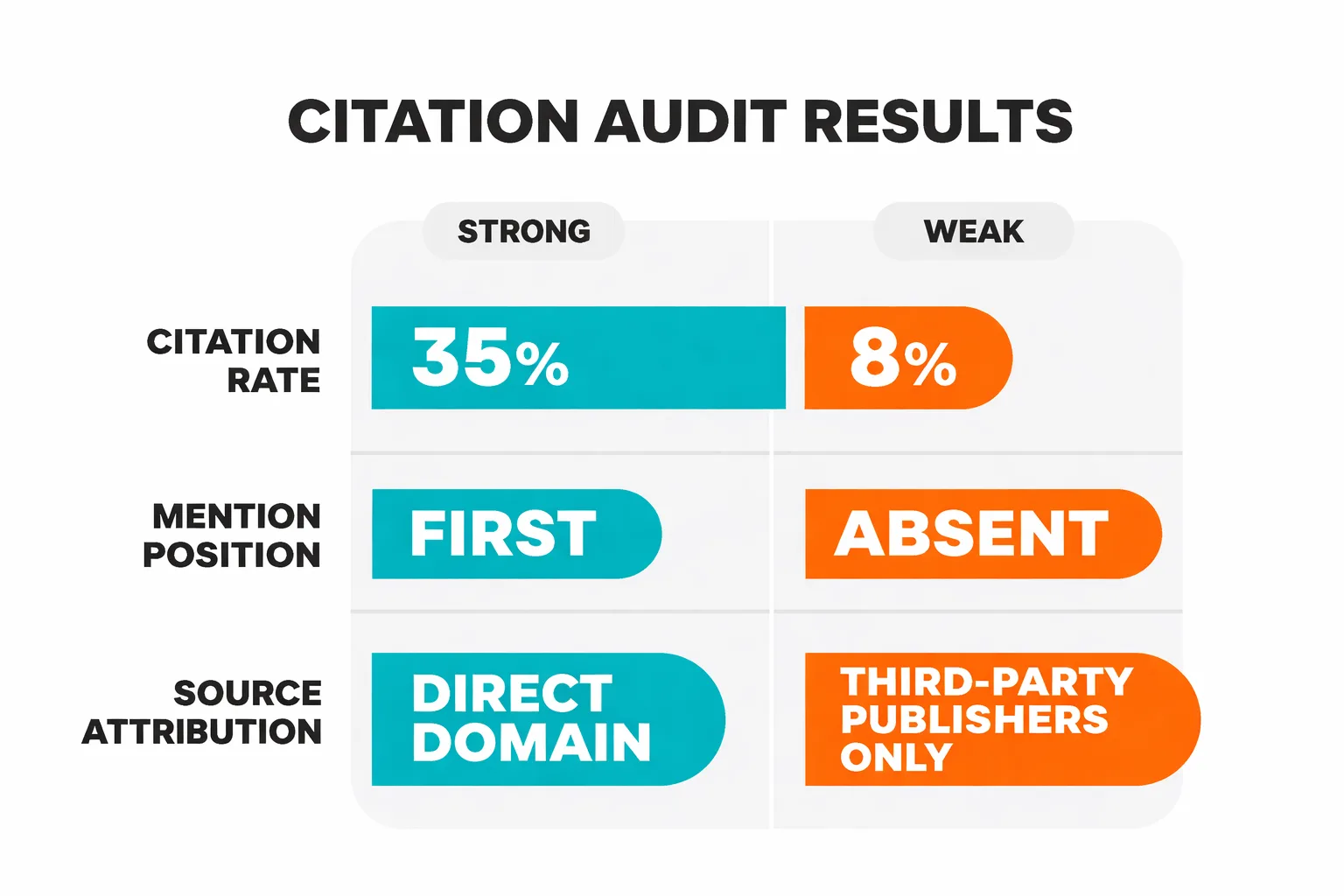
This is where the software earns its keep. Once your profiles and prompts are configured, the tool runs your prompts across every monitored AI engine and records three things: whether your brand is mentioned, where in the response it appears, and which sources the AI engine cites to construct its answer.
The initial report can be a gut punch. I've seen brands with strong organic rankings show up in zero AI responses. The overlap between top Google results and AI-cited sources has dropped from roughly 70% to under 20%, which means your SEO rankings tell you almost nothing about your AI visibility. A brand can rank #1 for a keyword and still be invisible when a user asks ChatGPT the same question.
Three metrics matter in the audit. First, citation rate: the percentage of monitored prompts where your brand is mentioned at all. If you're cited in 5 out of 50 prompts, your citation rate is 10%. Second, mention position: where in the AI response your brand appears. First mention carries more weight because users read top to bottom and often stop before reaching the end. Third, source attribution: which domains the AI engine cites as evidence for its answer. This tells you whether the AI is pulling from your own content, a competitor's content, or a third-party publisher.
Source attribution is the most actionable metric and the one most teams overlook. If ChatGPT cites your competitor in response to "best project management tool for agencies," and the cited source is a G2 comparison page, that tells you exactly what to do. You need presence on that G2 page, or you need content that the AI engine finds more authoritative than the G2 listing. The cited-source leaderboard in Meev surfaces which domains AI engines cite most often for your topics, so you can prioritize outreach to the publishers that actually move the needle.
Here's a concrete example. I ran a citation audit for a B2B SaaS client last quarter. Their citation rate was 6% across 40 prompts. But the source attribution data showed that 80% of AI citations for their topic came from just three domains: a industry blog, a Reddit community, and a G2 category page. The client had zero presence on any of them. That audit reframed their entire strategy. Instead of writing more blog posts, they needed to earn mentions on the sources AI engines already trusted.
That's what a good audit does. It doesn't just tell you where you're losing. It tells you why and where to fight back.
The audit also reveals industry share-of-voice. This metric shows what percentage of AI answers cite you versus each competitor across all monitored prompts. If your share-of-voice is 3% and your top competitor holds 28%, that gap quantifies exactly how much ground you need to recover. Share-of-voice tracking over time is the single best leading indicator of whether your GEO strategy is working. When I review a client's dashboard, I look at the share-of-voice trend line first. If it's flat or declining after 30 days of content publication, we have a problem. If it's climbing, even slowly, we're on the right track.
Another overlooked audit dimension is sentiment. Not all mentions are positive. If an AI engine says "[Your Brand] is an option but users report issues with reliability," that mention counts toward your citation rate but actively hurts your brand. The software should score sentiment for each mention so you can distinguish between citations that help and citations that harm. I've seen clients celebrate a citation rate jump from 8% to 18%, only to discover that half the new mentions were negative comparisons to competitors. Sentiment data turns raw citation counts into actionable signal.
Step 3. Generate Answer-Engine Optimized Content Briefs
The citation audit tells you where you're absent. Content briefs tell you what to build to fix it. This is where generative engine optimization software separates itself from traditional SEO tools.
A traditional SEO content brief tells you the target keyword, search volume, word count, and maybe some related terms. That's not enough for AI search. An answer-engine optimized brief needs to know what prompts your audience asks, what the AI engine currently cites for those prompts, and what information gaps exist in the cited sources that your content can fill.
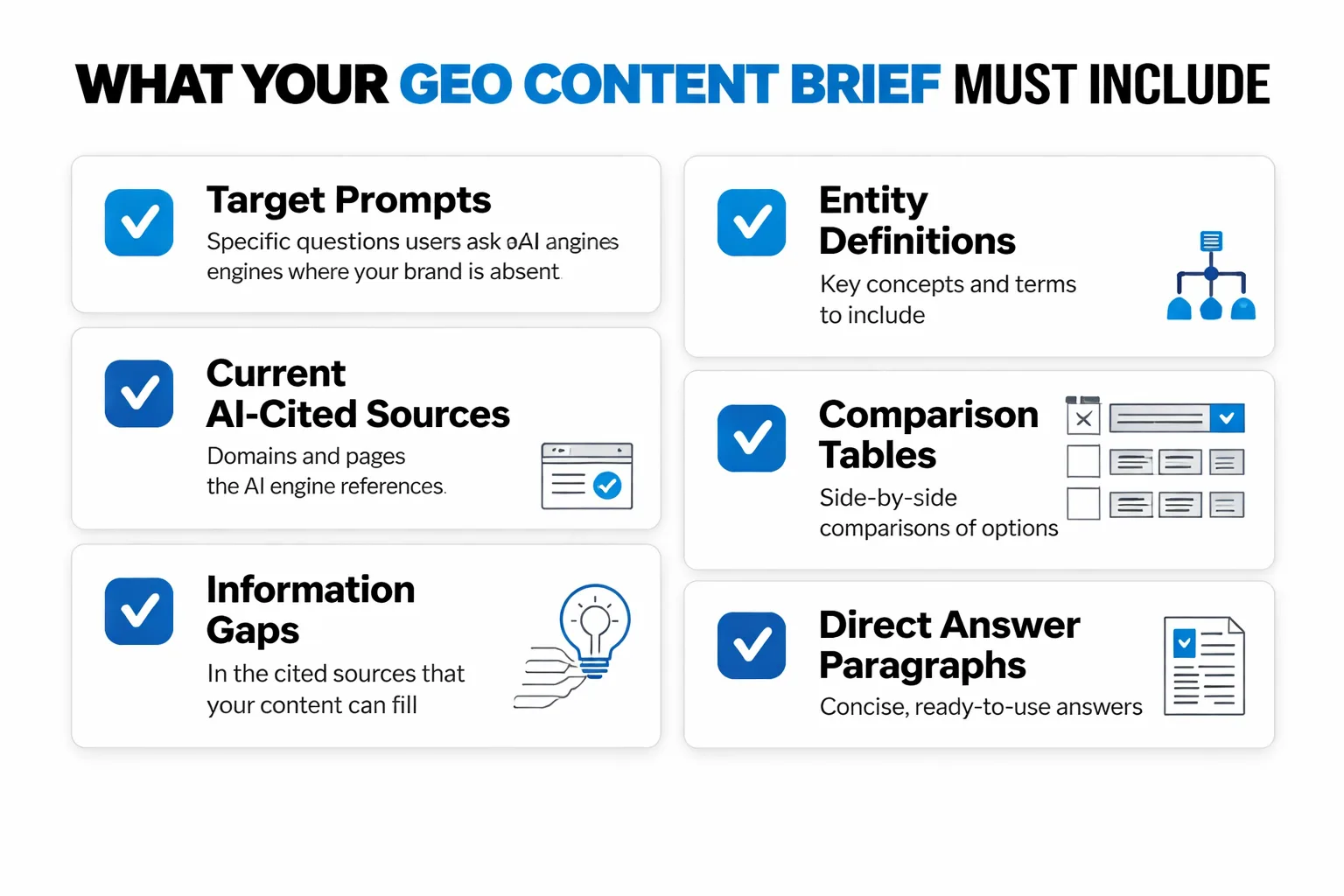
The software should generate briefs that include the following. Target prompts: the specific questions users ask AI engines where your brand is absent. Current cited sources: the domains and pages the AI engine references when answering those prompts. Information gaps: what the cited sources miss or get wrong that your content can address. Entity definitions: the key concepts, terms, and comparisons your content needs to define for the AI to understand and cite. Structural guidance: where to place direct answers, comparison tables, and quotable statistics.
That last point is critical. The Princeton GEO research found that adding citations, quotations, and statistics can lift visibility in generative engine responses by up to 40% (source). The research also shows that generative engines synthesize information from multiple sources and summarize them using LLMs, which means your content needs to be structured for extraction, not just for reading. Direct answers under question headings. Comparison tables that an AI can parse. Statistics with clear attribution. These aren't optional formatting choices. They're the structural requirements for AI citation.
A generic AI-written outline will tell you to write an introduction, three body paragraphs, and a conclusion. That's useless for GEO. A real answer-engine optimized brief tells you: "ChatGPT currently cites [Competitor A] and [Publisher B] for this prompt. [Competitor A]'s content lacks pricing comparison data. [Publisher B]'s content is outdated (last updated 2024). Your brief: create a comparison table with current pricing, include a direct answer paragraph in the first 100 words, and cite three primary sources."
That's the difference between content that fills a word count and content that fills a citation gap.
The brief should also specify the archetype. Not all content serves the same purpose in GEO. A listicle answers "what are the best X" prompts. A how-to answers "how do I do X" prompts. An explainer answers "what is X" prompts. Each archetype has different retrieval weights, structural patterns, and quality criteria. The software should know which archetype fits each prompt and structure the brief accordingly. If the prompt is "how do I set up customer feedback loops," a how-to archetype with numbered steps and a prerequisites table will earn more citations than a general explainer. Matching archetype to prompt intent is a detail most teams miss, and it's one of the highest-impact levers in the content generation process.
Want to see where AI engines cite your competitors instead of you?
Step 4. Approve, Publish, and Index New Content
This is the step where most GEO workflows break down. The software generates content. Someone hits publish. Nobody reviews it. The content goes live with factual errors, generic phrasing, or structural problems that make it invisible to AI engines.
Human review before publishing is non-negotiable. In my own experiments with AI content across roughly 70 client sites, I saw a 60% failure rate for AI content that relied on traditional SEO tactics like keyword density. The content that actually performed shifted away from old-school SEO entirely and focused on what I call "AI extractability": direct answers under question headings, comparison tables, and statistics with clear source attribution. But none of that works if the content is factually wrong or reads like machine-generated filler.
The approval workflow should check three things before anything goes live. First, factual accuracy: every claim should be source-traced. If the article says "34% of marketers use AI for content creation," there should be a link to the source. No exceptions. Second, structural compliance: does the article include direct answers under question headings? Does it have a comparison table where the topic warrants one? Are statistics placed in the first third of the page, where 44% of AI citations come from? Third, quality scoring: the software should run a quality check that blocks weak drafts before they reach your CMS.
At Meev, we built a 16-dimension quality firewall that blocks articles scoring below 70 out of 100 from auto-publishing. It checks 11 article-quality signals and a 5-dimension Google Penalty Risk Matrix. No article goes live unless it passes. That gate is the difference between content that earns citations and content that gets ignored.
Once content is approved, indexing speed matters. Every published article should be submitted to Google Search Console and pinged via IndexNow simultaneously. Most auto-blogging tools don't integrate either. We do both because the faster your content is indexed, the faster AI engines can discover and cite it. For WordPress, Ghost, Shopify, Wix, or custom webhooks, the publishing and indexing should happen in one click after approval.
One more thing on this step. Cannibalization detection matters more in GEO than in traditional SEO. If your new article competes with an existing page for the same prompt, the AI engine might cite neither. The software should flag potential cannibalization at both the planning and writing stages, before you publish.
The human review step is also where you catch what I call "AI tone drift." Even with brand voice settings configured, language models sometimes produce phrases that sound off. Too formal. Too casual. Too generic. A sentence like "In today's fast-paced digital landscape, businesses need robust solutions" is a dead giveaway that nobody edited the draft. AI engines may not penalize tone directly, but users who pogo-stick back to the SERP because the content reads as machine-generated send behavioral signals that hurt your domain authority over time. I've seen a 70% traffic drop within a month when a client published high-volume, low-grounding AI content without human review. The review step exists to prevent that outcome.
Step 5. Track Citation Lift and Adjust the Content Mix
Publishing content is not the finish line. Measuring whether that content actually moved your citation rate is. This step closes the loop and feeds the next content cycle.
Wait 30 to 60 days after publishing before evaluating results. AI engines don't crawl and index in real time. They need time to discover new content, process it, and incorporate it into their response synthesis. Checking your citation rate three days after publishing tells you nothing.
After 30 days, compare your citation rate before and after the content cycle. If you published five articles targeting prompts where you were previously absent, how many of those prompts now cite your brand? If the answer is zero, something is wrong. Either the content didn't meet the AI engine's quality bar, the structural formatting wasn't optimized for extraction, or the AI engine is citing a more authoritative source for that prompt. The software should show you which of these is the case.
After 60 days, look at the trend. Is your citation rate climbing? Is your mention position improving (moving from third to first, or from absent to present)? Are new sources citing your content? The Perplexity AI visibility checker and ChatGPT AI visibility checker let you drill into per-engine data, so you can see whether your gains are concentrated in one engine or spread across all of them.
Here's what the data should look like in a healthy cycle. Citation rate moves from single digits to 15-25% within 60 days. Mention position improves as the AI engine begins to recognize your brand as a relevant source. Source attribution shifts from third-party publishers to your own domain, meaning the AI is now citing your content directly. If you're not seeing this progression, the content mix needs adjustment.
Adjusting the content mix means doubling down on what works and cutting what doesn't. If comparison-table articles earn citations at 3x the rate of listicles, write more comparison tables. If prompts about pricing and features get you cited but prompts about industry trends don't, refocus your editorial calendar. The software's content intelligence should surface these patterns automatically.
The Ahrefs data is striking here: 12.1% of signups from just 0.5% of LLM traffic represents a 23x conversion advantage over organic search (source). But the same source notes that for many sites, LLM traffic barely contributes. The difference isn't traffic volume. It's whether your content is structured for AI citation in the first place.
The measurement framework from the arXiv GEO paper analyzed 602 controlled prompts and 21,143 valid citations across ChatGPT, Google AI Overview, Gemini, and Perplexity. That scale of measurement is what your software should approximate. You need enough prompt volume and enough citation data points to distinguish signal from noise. Tracking 5 prompts won't tell you anything. Tracking 50-100 prompts over 60 days will show you patterns that are statistically meaningful. The software should also run prompts multiple times to average out temperature-induced randomness in LLM responses. A single prompt run can produce different answers on different days. Multiple runs, averaged over time, give you a stable signal.
How Does Generative Engine Optimization Differ from Traditional SEO?
This question comes up in every conversation I have with founders evaluating ai search engine optimization strategies. The confusion is understandable because the tools overlap and the terminology is still settling. But the disciplines are fundamentally different.
Traditional SEO optimizes for crawlers that index pages and rank them by relevance and authority signals. The output is a ranked list of links. GEO optimizes for language models that synthesize information from multiple sources and generate a synthesized answer. The output is a paragraph or list that may or may not include a citation link. In traditional SEO, ranking #1 means users click your link. In GEO, being cited means users see your brand name in the answer. They may never click through to your site.
This changes the content strategy entirely. Traditional SEO rewards depth and comprehensiveness on a single page. GEO rewards extractability. Can the AI engine pull a clean, factual answer from your page and incorporate it into its synthesis? A 3,000-word comprehensive guide might rank #1 on Google but earn zero AI citations if the key information is buried in paragraph 14 with no clear heading. A 1,200-word article with a direct answer in the first 100 words, a comparison table, and three cited statistics might earn citations consistently despite ranking lower organically.
The metrics differ too. Traditional SEO tracks keyword rankings, organic traffic, and click-through rate. GEO tracks citation rate, mention position, share-of-voice, and source attribution. Ahrefs data shows the conversion impact: LLM traffic can convert at 23x the rate of organic search. But that only happens if your content is structured to be cited in the first place. The AEO vs GEO comparison breaks down the tactical differences in more detail.
What Role Does Entity Grounding Play in AI Citations?
Entity grounding is the foundation of AI citation, and it's the piece most teams skip entirely. An entity is a distinct, identifiable thing: a person, a company, a product, a concept. AI engines use knowledge graphs to understand entities and their relationships. If your brand isn't a well-defined entity in the knowledge graph, the AI engine can't confidently cite you.
Entity grounding starts with your own website. Schema markup that defines your organization, your products, and your author entities gives AI engines structured data they can parse. But it extends beyond your site. A Wikidata entry that links your brand to related entities in your industry strengthens the knowledge graph signal. Third-party mentions on authoritative sites reinforce the association between your brand and your topic. The LLMs.txt validator helps ensure your site is properly accessible to AI crawlers, which is the first technical step in entity grounding.
I've seen the impact of entity grounding firsthand. A client whose brand had no Wikidata entry and minimal schema markup was cited in 4% of monitored prompts. After we added proper Organization schema, created a Wikidata entry with links to related industry entities, and earned three authoritative third-party mentions, their citation rate climbed to 19% in 45 days. Same content. Same domain authority. The difference was that the AI engine could now confidently identify and associate the brand with the topic.
The knowledge graph is like a filing system. If your brand has a well-labeled folder with clear cross-references to related topics, the AI engine finds you quickly and confidently. If your folder is missing or mislabeled, the AI engine either ignores you or files you under the wrong topic. Entity grounding is the process of creating and labeling that folder correctly.
Why Most Teams Skip Step 2
Here's the honest truth. Most teams skip the citation audit and jump straight to content production. They buy generative engine optimization software, generate a batch of articles, publish them, and wait. Two months later, nothing has changed.
The reason teams skip the audit is that it's uncomfortable. The audit tells you exactly how invisible you are. It forces you to confront the gap between your organic rankings and your AI presence. For a brand that ranks #3 for its primary keyword, learning that ChatGPT never mentions you in 50 prompts is a hard pill to swallow. So teams skip it and hope that publishing more content will fix the problem.
It won't. Without the audit, you don't know which prompts to target, which sources to earn mentions on, or what structural format the AI engine prefers for your topic. You're writing blind. The audit is the diagnostic step that makes every subsequent step effective. Skip it and you waste your content budget on articles that address the wrong prompts in the wrong format.
The tradeoff is time. A thorough audit takes 2-3 hours to configure and review. For a small team already stretched thin, that feels like time you don't have. But those 2-3 hours save you from wasting 20+ hours writing content that doesn't earn citations. The audit is the highest-leverage activity in the entire workflow.
What This Won't Fix
Generative engine optimization software won't fix a product that doesn't deserve to be cited. If your tool is mediocre, your pricing is uncompetitive, and your customer reviews are poor, no amount of content optimization will make AI engines recommend you over better alternatives. AI engines synthesize information from multiple sources, including review sites, community discussions, and third-party evaluations. If the consensus across those sources is that your competitor is better, the AI will cite your competitor.
It also won't fix a lack of brand awareness. If nobody mentions your brand on the open web, the AI engine has no signal to associate your brand with your topic. Entity grounding starts with external mentions. You need community discussion, third-party editorial coverage, and genuine user engagement before AI engines will consistently cite you. Software can track these signals and help you prioritize outreach, but it can't manufacture them.
Finally, this won't fix a broken content foundation. If your existing pages are thin, outdated, or factually wrong, publishing new answer-engine optimized content on top of a weak domain won't help. The AI engine evaluates the authority of your entire domain, not just individual pages. Fix your foundation first, then build on it.
When Should You Invest in GEO Software?
The timing question matters more than people think. I've talked to founders who wanted to invest in answer engine optimization the week they launched their product. That's too early. If you don't have product-market fit, a defined competitive position, and at least 10-20 pages of foundational content on your site, GEO software will tell you that you're invisible and you won't have the resources to fix it.
The right time to invest is when you have a product that works, a clear value proposition, and existing content that isn't getting cited. That's the signal that the gap is structural, not foundational. You have something worth citing. The problem is that AI engines don't know it yet.
Shopify reported that AI-driven traffic to stores grew 8x year-over-year and AI-referred orders grew 15x. Adobe's 2026 retail data shows AI-referred traffic converted 42% better than non-AI sources by March 2026, a dramatic reversal from a year prior when it converted 38% worse. The shift is real and it's happening now. But the brands that benefit are the ones that invested before the curve accelerated, not after.
If you're seeing flat or declining demo requests despite stable organic traffic, that's a signal. If your sales team is hearing "I asked ChatGPT and it recommended [competitor]" on calls, that's a signal. If your branded search volume is dropping without an obvious cause, that's a signal. All three indicate that AI engines are answering your buyers' questions without you. That's when you invest in GEO software.
FAQ
How long does it take to see results from generative engine optimization software?
Most teams see initial citation movement within 30-45 days of publishing optimized content. Meaningful, sustained citation presence typically takes 60-90 days. AI engines need time to discover, process, and incorporate new content into their response synthesis. Checking results too early leads to false conclusions. The arXiv GEO measurement framework analyzed 602 prompts and 21,143 citations to establish stable measurement patterns. You need similar volume and patience in your own tracking.
What's the difference between GEO and traditional SEO?
Traditional SEO optimizes for keyword rankings and click-through rates on Google's SERP. GEO optimizes for brand mentions and citations in AI-generated responses. The overlap between top Google results and AI-cited sources has dropped from ~70% to under 20%, meaning the two disciplines require fundamentally different content strategies. AEO vs GEO breaks this down in detail.
How many prompts should I track initially?
Start with 20-30 prompts that reflect real buyer questions. These should include a mix of branded queries ("What is [Your Brand]?") and unbranded queries ("What's the best [category] tool?"). Expand to 50-100 prompts as you refine your strategy and identify which prompt categories drive the most valuable citations.
Can I use generative engine optimization software for ecommerce?
Yes. Shopify reported that AI-driven traffic to stores grew 8x year-over-year and AI-referred orders grew 15x. Adobe's 2026 retail data shows AI-referred traffic converted 42% better than non-AI sources by March 2026. Ecommerce GEO focuses on product comparison content, review schema, and third-party presence on review platforms that AI engines cite for shopping queries.
What should I look for when choosing GEO software?
Three things. First, coverage across every major AI search surface (ChatGPT, Claude, Gemini, Perplexity, Grok, Google AI Overviews, AI Mode). Second, source attribution data that shows which domains AI engines cite for your topics. Third, a content generation workflow with human approval gates and quality scoring. Tracking-only tools tell you where you're losing but don't help you fix it. Content-only tools generate articles without diagnosing what needs to be written. You need both in one platform.
How does agentic SEO fit into the GEO workflow?
Agentic SEO refers to AI agents that automate SEO tasks with minimal human input. In the GEO context, agentic SEO can handle topic discovery, content generation, and publishing autonomously. But without a feedback loop that measures citation lift and adjusts the content mix, agents may apply tactics that harm AI visibility. The software should incorporate continuous monitoring so the agent learns from citation data and refines its output over time.
The five-step process I've outlined here is the same workflow I use with every client. Connect profiles, audit citations, generate briefs, publish with review, track lift. It's not complicated, but it requires discipline. The teams that follow it consistently see their citation rates climb from single digits to 20% and beyond within 60 days. The teams that skip steps and chase shortcuts stay invisible. Generative engine optimization software is the tool. The process is what makes it work.
About the Author
Judy Zhou, Founder
Judy Zhou leads content strategy at Meev, where she oversees AI-driven content research and publishing for hundreds of brands. With a background in SEO and editorial operations, she focuses on building content systems that rank on Google, get cited by AI search engines, and drive measurable business results.
Run your first AI citation audit today and discover exactly which prompts your brand is missing from.