

By Judy Zhou, Founder
Key Takeaways
- 68% of US Google searches ended without a click in Q1 2026, so select an SEO platform that tracks AI citations instead of outdated keyword positions.
- The top organic result loses 58% of its click-through rate when an AI Overview appears, requiring platforms built for answer engine optimization today.
- AI-referred traffic to US retail sites grew 393% year over year and converted 42% better by March 2026, making AI visibility tracking essential for any new platform.
- A bad platform pick will negate every tactic you execute, so audit tools for AI citation monitoring before committing in the next quarter.
When a prospective customer asks ChatGPT, Perplexity, or Google's AI Overview which product in your category to buy, does your brand get mentioned. Or does your competitor? If you can't answer that question right now, your search engine optimization platform has already failed you. The shift toward answer engine optimization, AI citations, and agentic commerce isn't arriving someday. It's rewriting how purchase decisions get made today, and the platform you choose in the next quarter will determine whether you're cited or invisible.
68% of US Google searches ended without a click in Q1 2026, according to SparkToro's clickstream analysis. The top organic result loses roughly 58% of its click-through rate when an AI Overview appears, per Ahrefs' 2025 study. Meanwhile, AI-referred traffic to US retail sites grew 393% year over year and converted 42% better than non-AI sources by March 2026, Adobe's retail data shows. If your platform tracks keyword positions but not AI citations, you're optimizing for a funnel that's evaporating.
I'm Judy Zhou, and in my work leading content strategy at Meev, I audit how brands appear across AI search surfaces every single day. The pattern I keep seeing is painful: small teams spending thousands on platforms that were built for 2019 SEO, then wondering why their traffic is flat even as competitors get cited in every ChatGPT answer. The platform itself is the bottleneck. Here's how to choose one that isn't.
Why Platform Choice Matters More Than Tactics
Most SEO advice focuses on tactics. Write better content. Build more links. Target long-tail keywords. That's all fine, but it misses the point: a bad platform pick will negate every tactic you execute. I've seen teams produce excellent content that never gets indexed properly because their platform's publishing pipeline doesn't support modern indexing protocols. I've watched founders burn six months on a tool that looked powerful in a demo but required a dedicated analyst to generate a single readable report.
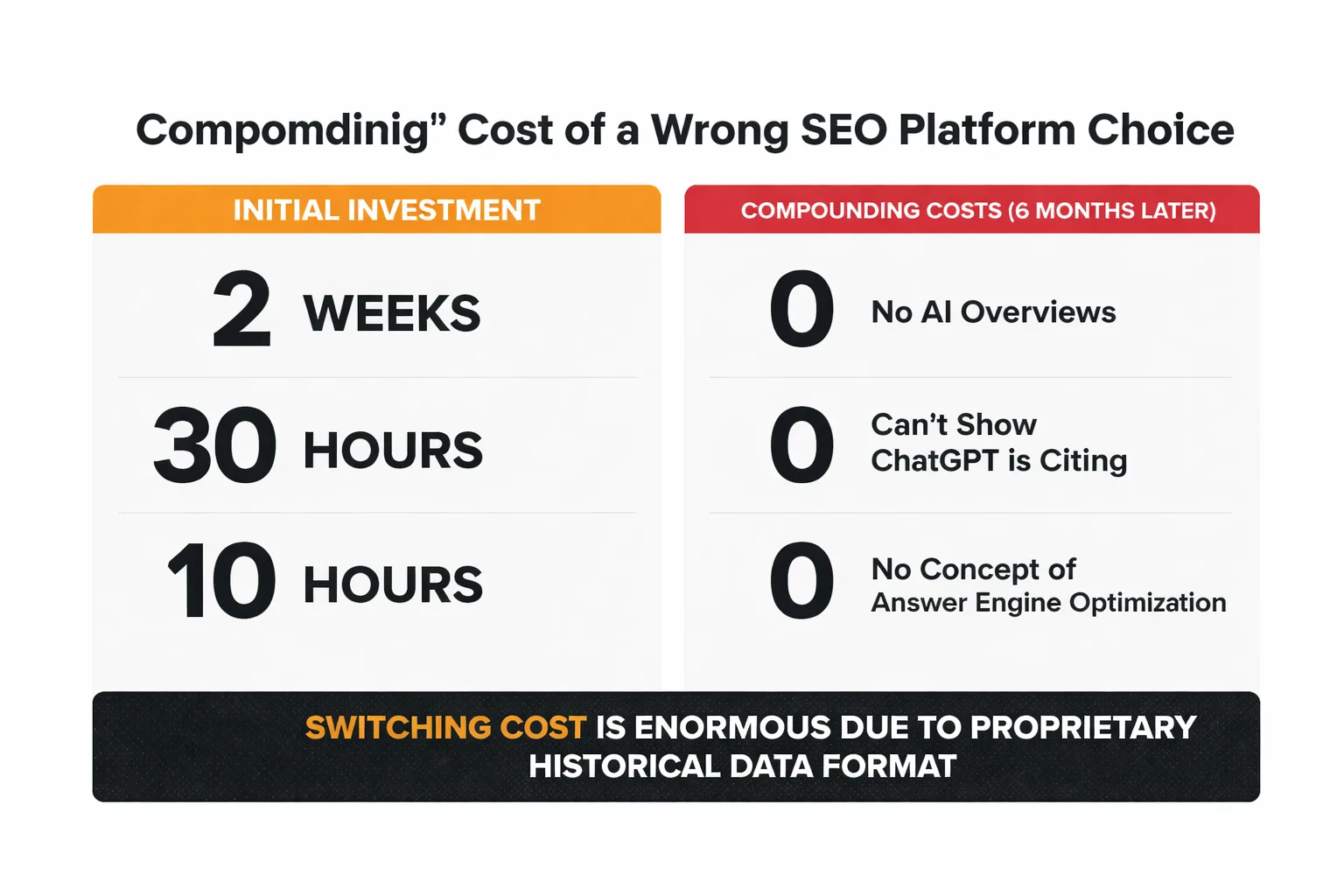
The cost of a wrong choice compounds. You invest weeks learning the interface. You build workflows around its limitations. You train your team on its quirks. Then one day you realize it doesn't track AI Overviews, can't show you which sources ChatGPT is citing, and has no concept of answer engine optimization. Now you're shopping for a replacement, and the switching cost is enormous because your historical data lives in a proprietary format you can't export.
Here's what's changed. The overlap between top Google results and AI-cited sources has dropped from roughly 70% to under 20% by some estimates. You can rank first for a term and still be invisible when a prospect asks ChatGPT for a recommendation. SparkToro's research found that AI tools are highly inconsistent when recommending brands, which makes tracking even harder. If your platform can't surface those citation gaps on day one, you're flying blind in the channels that matter most.
The vendors know this. They're scrambling to bolt AI features onto legacy platforms. A keyword tracker adds a "ChatGPT monitoring" tab that pulls data from a third-party API with a 72-hour delay. A content tool adds an "AI mode" that's really just a GPT wrapper with no quality gate. These additions look impressive in demos. They fall apart in production. I've tested enough of them to know the difference between a platform built for AI search and one that's cosplaying.
That's why I'm writing this. Not to review every tool on the market, but to give you a decision framework that cuts through demo theater and gets to the question that matters: will this platform help me get cited in AI answers, or will it just give me prettier reports about my declining organic traffic?
The 5 Questions to Ask Before You Commit
I've boiled the evaluation down to five questions. Each one eliminates a category of platform that will waste your time and budget. If a tool can't answer all five with specifics (not promises), walk away.
Question 1: Does It Cover AI Search Surfaces Alongside Classic Rankings?
This is the elimination round. If a platform tracks Google rankings but not mentions across ChatGPT, Claude, Gemini, Perplexity, Grok, Google AI Overviews, and AI Mode, it's not built for 2026. Period.
The nuance matters too. Some platforms claim "AI tracking" but only monitor one surface (usually ChatGPT). That's like tracking Google but ignoring Bing. The AI search landscape is fragmented. Each engine has different training data, different citation patterns, and different user intent. A tool like the ChatGPT AI Visibility Checker or the Perplexity AI Visibility Checker can tell you where you stand on individual engines. A full platform should aggregate that across every major surface.
Here's a specific test. Ask the vendor: "Can you show me the actual response text and citations behind my brand mentions in Claude?" If they can't, or if they show you a screenshot from three weeks ago, they don't have real-time AI visibility tracking. They have a scraping script running on a cron job. There's a big difference.
Question 2: Can One Person Run It Without a Dedicated Ops Team?
This question kills more platform deals than any other for small teams. Enterprise tools are built for enterprise workflows. They assume you have a technical SEO specialist, a content strategist, and a data analyst. If you're a founder or a two-person marketing team, a platform that requires three seats and a certification course to use is not a productivity tool. It's a tax.
The honest test: schedule a 15-minute demo and try to do three things. Pull a visibility report. Identify one content gap. Draft one piece of content to fill it. If you can't complete all three in the demo, the platform is too complex for a lean team. I'm not saying powerful tools should be dumbed down. I'm saying the default workflow should be usable by a non-specialist on day one.
In my experience, the platforms that pass this test share a few traits. They lead with diagnosis (here's where you're cited, here's where you're not) rather than configuration (set up your project, connect your properties, define your segments). They surface actionable insights on the dashboard without requiring you to build custom reports. And they publish content directly to your CMS without requiring a separate publishing tool.
Question 3: Does It Show Source-Level Citation Data?
This is where most platforms fail silently. They'll tell you that your brand is mentioned in 12% of ChatGPT responses for a given topic. Great. But which sources is ChatGPT citing to build those responses? If your competitor is cited because a high-authority third-party site mentions them, and you're not cited because nobody mentions you externally, you need to know that. Rank tracking doesn't surface this. AI visibility tracking does.
The Princeton-led GEO paper found that citation sources matter enormously for generative engine optimization. AI engines don't just pull from your website. They pull from the entire web of mentions, reviews, and third-party content about your brand. A platform that only shows your own site's performance is giving you 10% of the picture.
The platforms worth your money will show you a cited-source leaderboard. Which domains does each AI engine cite most often for your topics? Where does your brand appear in that graph? Where are the gaps? This is the diagnostic layer that turns "AI visibility" from a vanity metric into an action plan. If a vendor can't show you this on a demo, they don't have it.
Question 4: What Does Onboarding Actually Look Like?
Vendors lie about onboarding time. Not maliciously, but optimistically. They'll say "30 minutes to set up" when they mean "30 minutes if you already have Google Search Console connected, your sitemap submitted, and your brand entities defined." For a founder starting from scratch, that 30 minutes becomes three days.
Here's what good onboarding looks like in 2026. You enter your domain. The platform scans your homepage and auto-fills your positioning, audience, and topics. It pulls your Search Console data. It runs an initial AI visibility check across major surfaces. You see your first citation gap report within an hour. Not a "welcome" screen. Not a setup wizard. A real report with real gaps you can act on.
If the onboarding involves a kickoff call, a technical audit, and a 30-day implementation plan, you're buying an enterprise tool with enterprise friction. That's fine if you're an enterprise. If you're a five-person team, it's a trap.
Question 5: Is the Output Something You Can Approve Before It Goes Live?
This question matters more than people realize. The promise of an AI SEO platform is automation. But automation without approval is just faster ways to publish bad content.
I've seen what happens when teams skip this gate. Jessica Bowman documented a case study where an organization attempted to generate 100 SEO posts per hour using AI with zero human editing. The strategy failed completely. The AI-generated content lacked uniqueness, actively hurt SEO performance, and decision-makers didn't believe it would happen until testing proved otherwise. Bowman's case study is a warning: bulk AI content without a quality gate doesn't just fail to rank. It degrades your existing SEO performance.
The flip side is real. Siteimprove reports that brands cited in AI Overviews earn 35% more organic clicks and 91% more paid clicks than uncited brands. Quality content gets you cited. Garbage content makes you invisible. Your platform needs a quality gate between generation and publishing. Not optional.
In my own testing, pushing content directly from AI tools without review produced factual errors, choppy sentences, and an unmistakable machine voice that tanked engagement. The quality gate I now use (a 16-dimension quality check that blocks articles below 70/100 from auto-publishing) slows the publishing loop by about 50% compared to raw AI drafts. That slowdown is the point. It's the difference between content that gets cited and content that gets penalized.
Red Flags Hidden in Most Platform Demos
Demos are designed to sell. They show you the best-case scenario: clean data, beautiful dashboards, impressive charts. Here are the red flags I look for when evaluating any platform.
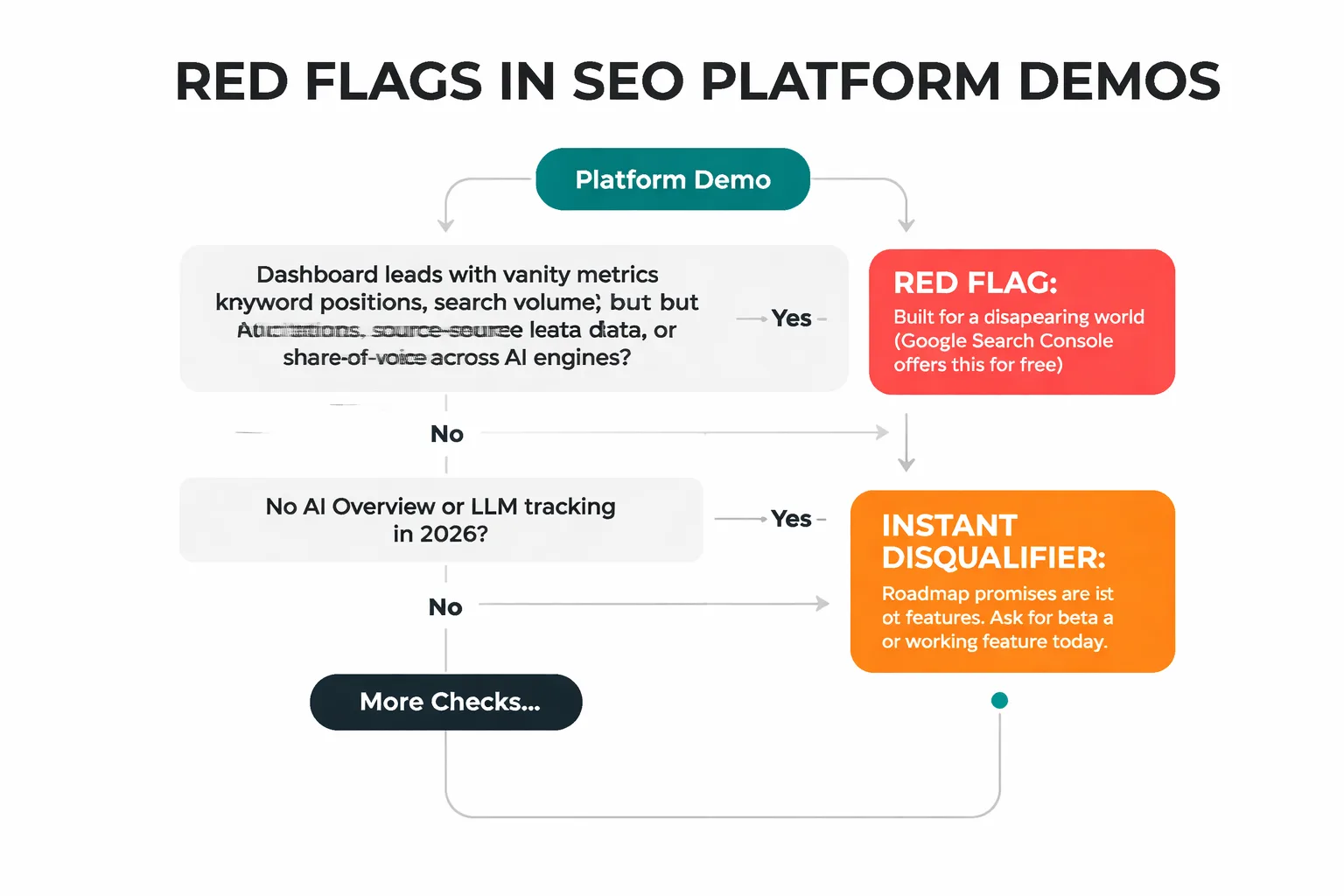
Vanity metrics with no citation data. If the dashboard leads with "keyword positions" and "search volume" but has no mention of AI citations, source-level data, or share-of-voice across AI engines, the platform was built for a world that's disappearing. I'm not saying keyword tracking is useless. I'm saying it's table stakes, not a differentiator. If that's all a platform offers, you can get it for free from Google Search Console.
No AI Overview or LLM tracking. This should be an instant disqualifier in 2026. If the vendor says "that's on our roadmap," ask when. If they say "Q3," ask to see a beta. If they can't show you a working feature today, they don't have it. Roadmap promises are not features.
Content output that skips human review. Any platform that offers content generation needs to show you its quality control process. Not a "you can edit after publishing" workaround. A real gate that evaluates content before it reaches your CMS. Ask to see the quality criteria. Ask what happens when content fails. If the answer is "it publishes anyway and you can fix it later," that's not a quality gate. That's a liability.
Pricing tiers that lock core features behind enterprise plans. This is the most common trap for small teams. The demo shows you AI visibility tracking, citation path analysis, and content generation. Then you look at the pricing page and discover that AI tracking requires the Enterprise tier at $2,000/month. The Starter plan you can afford includes keyword tracking and a site audit. That's not a platform for small teams. That's a platform that uses small teams as a funnel to enterprise upsells.
No data portability. Ask the vendor: "Can I export all my historical data in a standard format?" If the answer is no, or if export requires a support ticket, you're locked in. Data portability is a basic requirement. Any platform that makes it hard to leave is telling you something about how confident they are in retention.
Slow API or reporting latency. This one is subtle but critical. Some platforms cache data aggressively to save on API costs. Your "real-time" dashboard might be showing data from 72 hours ago. For traditional SEO, that's fine. For AI visibility, it's not. AI citations shift rapidly. If your platform can't show you today's citation data today, you're reacting to stale information. Ask about data freshness. Get a specific answer in hours, not "near real-time."
Is your current platform showing you where you're cited in AI answers, or just where you rank on Google?
What a Lean Team Actually Needs vs. What Vendors Sell
Let me be blunt about what vendors sell versus what small teams need, because the gap is enormous.
Vendors sell feature breadth. They'll show you 47 dashboards, 12 report types, competitor analysis across 200 domains, API access for custom integrations, and white-label reporting for client management. These features exist because enterprise buyers need them to justify budgets. A five-person team does not need 47 dashboards. They need three things: diagnosis, action, and measurement.
Diagnosis: Where are you cited, and where are you absent?
This is the foundation. Before you write a single article or build a single link, you need to know exactly where your brand appears in AI answers and where it doesn't. Not guesses. Not estimates. Specific, per-engine, per-prompt citation data. This is what an AI visibility tool provides.
The diagnosis should answer questions like: For which prompts does ChatGPT mention your brand? Where in the response do you appear (first, in a list, last)? Which sources does the AI cite when it mentions you? Which competitors are cited more often, and why? Without these answers, every content decision is a guess.
In my work, I've seen brands that rank #1 on Google for their primary keyword but appear in zero AI answers for the same query. That's not a content problem. That's a visibility problem that requires a completely different fix. Ahrefs found that the top organic result loses roughly 58% of its CTR when an AI Overview appears. If you're in that position and your platform only tracks organic rankings, you have no idea how much ground you're losing.
Action: Fix the gaps with approved, quality-gated content.
Once you know where the gaps are, you need to fill them. This means creating content that AI engines will cite. Not keyword-stuffed blog posts. Well-structured, fact-verified, properly cited content that demonstrates topical authority.
The minimal viable stack for this is: a topic discovery tool that identifies prompts where competitors are cited and you aren't, a content generation engine that produces archetype-aware drafts (listicles, how-tos, explainers each have different structures), and a quality gate that blocks weak content before it reaches your CMS. That's it. You don't need a separate content brief tool, a separate writing tool, and a separate publishing tool. You need one workflow that goes from gap to published article with a human approval step.
Measurement: Did it work?
This is where most platforms fail because they measure the wrong thing. They track keyword rankings and organic traffic. Those are lagging indicators. The leading indicator is AI citation movement. Did your share-of-voice in ChatGPT answers increase after you published three articles? Did you move from "not mentioned" to "cited as a secondary option" to "cited first"? This is the metric that predicts future traffic.
Title Nine achieved 1,000% growth in AI-driven sessions and a 400% increase in content production using Conductor's generative engine optimization approach, as documented in their case study. They also saw 134% growth in non-branded impressions and 30% organic traffic growth year over year. The key? Sarah Cosentino and Carlie Burkhard emphasized scaling smarter by embracing AI search early, moving fast, and staying relentlessly data-driven. They didn't buy more tools. They used the right tool strategically.
Here's the contrast. Enterprise platforms sell you breadth. Lean teams need depth in three areas: diagnosis, action, measurement. If a platform does those three things exceptionally well and nothing else, it's a better investment than a platform that does 47 things poorly.
How Does AI Search Visibility Differ from Traditional Rank Tracking?
This question comes up in every conversation I have with founders, and the answer determines what kind of platform you need.
Traditional rank tracking asks: "Where does my page appear in Google's results for this keyword?" It's a linear, position-based metric. Position 1 gets more clicks than position 5. The relationship is predictable and well-understood.
AI search visibility asks a fundamentally different question: "When a user asks an AI engine about my category, does the engine mention my brand, and if so, in what context?" This is not a position metric. It's a presence metric. And it's far more complex to measure because AI responses are non-deterministic. Ask ChatGPT the same question twice and you may get different brands mentioned each time.
SparkToro's research confirmed this inconsistency. AI tools produce different recommendation lists for the same query, making visibility tracking harder than rank tracking. This means your platform needs to sample multiple responses per prompt to establish a baseline. A single snapshot is noise. A trend over 50+ samples is signal.
The practical implication: a platform that treats AI visibility like rank tracking (check once, report a number) is giving you unreliable data. A platform that samples repeatedly, tracks trends, and shows you the actual response text behind each data point is giving you something you can act on. The difference matters more than any feature comparison I could write.
What Role Does Site Speed Play in AI Citations?
This is the question nobody asks, and it's more important than you think.
Out of 2,138 websites analyzed, faster websites were cited by AI tools 1.47x more often than slower pages, according to research highlighted by Jairo Guerrero. That's not a marginal difference. It's a structural advantage.
The reasoning is straightforward. AI crawlers like ChatGPT-User and Claude's web fetcher have timeout limits and resource constraints. If your page takes 8 seconds to load, the crawler may abandon it before reading your content. If it can't read your content, it can't cite you. Google was relatively patient with slow sites (it would still index them, just rank them lower). AI crawlers are less forgiving.
This has implications for platform choice. If your SEO platform includes a site audit feature, it should specifically flag performance issues that affect AI crawlability. Not just Core Web Vitals for Google. Load times, time to first byte, and render-blocking resources that prevent AI crawlers from reading your content. Most platforms audit for Google's criteria. Few audit for AI crawlers.
The fix is often simple: optimize images, reduce JavaScript bloat, implement proper caching. But you need to know it's a problem first. And if your platform doesn't flag it, you won't.
When Should You Choose a Specialized Tool Over an All-in-One Platform?
Here's my contrarian take: most teams are better off with specialized tools than all-in-one platforms, and the industry's push toward consolidation is wrong for small teams.
All-in-one platforms sell convenience. One subscription, one dashboard, one login. The appeal is obvious. But convenience comes at a cost: every feature is a compromise. The keyword research module isn't as good as a dedicated keyword tool. The content generator isn't as good as a dedicated writing platform. The AI visibility tracker isn't as good as a dedicated citation monitor.
For enterprise teams with dedicated specialists, those compromises are acceptable because each specialist can work around the limitations. For a two-person team, compromises compound. You're not a keyword research specialist working around a weak module. You're a founder trying to do everything at once, and every weak module costs you time you don't have.
The counter-argument is integration. Specialized tools don't talk to each other. You spend time moving data between them. That's a real cost. But here's the thing: if your specialized tools each do their job well, the data movement is minimal. You pull a visibility report, identify a gap, write an article, publish it. That's three steps. If your all-in-one platform does all three poorly, you've saved zero time and produced worse output.
The exception is when a platform genuinely integrates the workflow end-to-end without compromising on any step. That's rare. When you find it, it's worth the premium. But don't assume all-in-one means integrated. Most of the time, it means "we acquired five tools and put them in the same navigation bar."
For teams evaluating answer engine optimization specifically, the question is whether the platform treats AEO as a core discipline or a bolt-on feature. As Siteimprove warns, enterprise marketers who treat AEO as a supplemental SEO tactic rather than a foundational discipline will cede brand authority to competitors. The same applies to platform choice. A platform that treats AI visibility as a tab in the sidebar is telling you it's not a priority.
What This Won't Fix
I need to be honest about boundaries, because no platform solves everything.
First, a platform won't fix a bad product. If your product has poor reviews, no market fit, and zero brand awareness, no amount of AI visibility tracking will make ChatGPT recommend you. AI engines synthesize real-world sentiment. They pull from Reddit, review sites, and forum discussions. If the consensus is negative, your platform will confirm that you're invisible. That's useful information, but it's not a platform problem. It's a product problem.
Second, a platform won't replace strategy. It will tell you where the gaps are. It won't tell you which gaps matter most for your business. A citation in a low-intent prompt ("what is X?") is less valuable than a citation in a high-intent prompt ("best X for Y use case"). You need to prioritize. No tool does that for you automatically, and any tool that claims to is making assumptions about your business that may not hold.
Third, a platform won't build your entity presence overnight. Entity grounding for AI search requires structured data, Wikidata presence, knowledge graph connections, and consistent NAP information across the web. A platform can identify where your entity presence is weak. Building it takes months of outreach, schema implementation, and content development. The platform accelerates the diagnosis. It doesn't eliminate the work.
Making the Final Call: A One-Page Scorecard
If you've made it this far, you have the framework. Now let's turn it into a scorecard you can use in a demo.
| Criteria | Weight | What to Look For | Red Flag |
| AI surface coverage | 25% | Tracks ChatGPT, Claude, Gemini, Perplexity, Grok, AI Overviews, AI Mode | "Roadmap for Q3" |
| Source-level citation data | 20% | Shows which domains AI engines cite for your topics | Only shows mention counts |
| Solo operability | 20% | One person can run the full workflow in under 30 min/day | Requires 3+ seats for basic features |
| Content quality gate | 15% | Blocks weak drafts before publishing to CMS | "You can edit after it goes live" |
| Onboarding speed | 10% | First actionable report within 1 hour | 30-day implementation plan |
| Data portability | 10% | Full export in standard formats | Support ticket required |
Score each criterion 1-5 during your demo. Multiply by weight. Anything below 3.5 total is a pass. Here's why the weights look like this: AI surface coverage and citation data together account for 45% because they're the features that most directly determine whether you'll be cited in AI answers. Solo operability gets 20% because if you can't use the tool, features don't matter. The quality gate gets 15% because bad content actively hurts you. Onboarding and portability are lower weight but still disqualifiers if they score below 2.
The right search engine optimization platform surfaces AI citation gaps on day one. Not after a 90-day onboarding. Not after a kickoff call. Not after you've configured twelve settings. On day one, you should open the dashboard and see: here's where your brand is cited, here's where it isn't, and here's what you can do about it. If a platform can't deliver that, it will slow you down. And in 2026, slow means invisible.
The shift to AI-driven search is not a future trend. It's happening now. 68% of searches end without a click. AI-referred traffic converts 42% better. Faster sites get cited 1.47x more. The data is unambiguous. Your platform choice should be too. Pick a tool that shows you where you stand in AI answers today, helps you close the gaps with quality-gated content, and lets you approve everything before it goes live. That's not a nice-to-have. That's the minimum viable standard for a search engine optimization platform in 2026.
FAQ
What is the difference between an SEO platform and an AI SEO platform?
A traditional SEO platform tracks Google rankings, keyword volumes, and backlinks. An AI SEO platform extends this to track brand mentions and citations across AI search surfaces like ChatGPT, Perplexity, Claude, and Google AI Overviews. The key difference is that an AI SEO platform measures presence in AI-generated answers, not just position in organic results. In 2026, both functions matter, but AI citation tracking is the leading indicator of future traffic.
How much should a small team spend on an SEO platform?
For a founder or two-person team, expect to spend between $100 and $300 per month for a platform that covers both traditional SEO and AI visibility tracking. Anything below $50 likely lacks AI citation features. Anything above $500 is likely priced for enterprise workflows you don't need yet. The test is whether the platform delivers diagnosis, action, and measurement in one workflow. If it does, $200-300/month is a reasonable investment for a team that's serious about AI search visibility.
Can I use free tools instead of a paid platform?
You can cobble together free tools for basic SEO: Google Search Console for rankings, Google Trends for topic ideas, and free AI visibility checkers for spot checks. But free tools don't give you continuous monitoring across multiple AI engines, source-level citation analysis, or integrated content publishing. For a hobby project, free tools work. For a business that needs to be cited in AI answers, the gaps in free tooling will cost you more in lost visibility than a paid platform costs in dollars.
How long should onboarding take for a good SEO platform?
A platform built for small teams should produce its first actionable report within one hour of signup. You enter your domain, the platform scans your site, connects to Search Console, and runs an initial AI visibility check. If onboarding requires a kickoff call, technical setup, or a multi-week implementation plan, the platform was designed for enterprise workflows. For lean teams, that friction is a red flag, not a feature.
What makes content "quality-gated" in an AI SEO platform?
A quality gate is an automated evaluation that checks content against defined criteria before it reaches your CMS. This includes factual verification (every claim source-traced), structural checks (proper headings, citations, schema markup), originality detection (no duplicate content), and readability scoring. Content that fails the gate is blocked from auto-publishing and flagged for revision. This is different from "you can edit after publishing," which is not a gate. It's a cleanup after the damage is done.
Should I switch platforms if my current one doesn't track AI citations?
If your current platform only tracks Google rankings and has no AI visibility features, you should start evaluating alternatives now. The shift to AI-driven search is happening faster than the shift to mobile did. Every month you delay is a month of invisible citation gaps. You don't need to switch immediately, but you should set a 90-day deadline: if your current vendor hasn't shipped working AI citation tracking by then, move to a platform that has it today.
About the Author
Judy Zhou, Founder
Judy Zhou leads content strategy at Meev, where she oversees AI-driven content research and publishing for hundreds of brands. With a background in SEO and editorial operations, she focuses on building content systems that rank on Google, get cited by AI search engines, and drive measurable business results.
Stop guessing whether AI engines mention your brand. See your citation gaps across every major AI search surface and start closing them today.