
What Is Generative Engine Optimization, Really?
By Judy Zhou, Founder
Key Takeaways
- Only 11% of domains cited by ChatGPT are also cited by Perplexity, so treat each generative engine as a separate visibility channel rather than assuming SEO overlap.
- Structure content and entities for direct extraction and citation in AI answers instead of optimizing solely for crawler-based page rankings.
- Top-3 organic rankings deliver zero AI citations for many brands, proving that classic SEO metrics miss generative visibility gaps entirely.
- Audit content ops specifically for extractability by models like ChatGPT and Claude to embed your brand in synthesized responses.
A product manager at a mid-size e-commerce brand asked ChatGPT to recommend the best standing desks under $800. Her company's flagship model didn't appear. Not on page two. It simply wasn't mentioned. She opened her analytics dashboard expecting to diagnose a ranking problem. There was no ranking problem. The site had solid domain authority, clean technical SEO, and decent backlinks. The issue was something her existing tools had no name for yet: her brand simply didn't exist, as far as the generative engine was concerned.
What is generative engine optimization? It's the practice of structuring content, entities, and sources so AI search engines (ChatGPT, Perplexity, Claude, Google AI Overviews) surface and cite your brand in generated answers. Not rank it on a page. Embed it in the answer itself. The Semrush GEO research frames it as the discipline of making content extractable by models that synthesize rather than index. In my work auditing content ops at Meev, I've seen brands with zero AI citations despite top-3 organic rankings on the same queries. Only 11% of domains cited by ChatGPT are also cited by Perplexity, which means the overlap between engines is far smaller than most SEO teams assume.
The gap between ranking and being cited is the entire reason GEO exists. Classic SEO optimized for crawlers that index pages and rank them by authority signals. GEO optimizes for models that read pages, synthesize answers, and decide which sources to credit. The mechanics are different. The signals are different. The measurement is different. And if you're still treating AI citations as a byproduct of good SEO, you're losing visibility you don't even know you're missing.
The One-Sentence Definition and Why It Differs From SEO
Here's the definition I use when explaining GEO to founders: generative engine optimization is the practice of making your content, brand, and entity data extractable and citable by AI models that generate answers rather than link to pages.
That definition does a lot of work. "Extractable" means the AI can pull a direct answer from your content without interpretation. "Citable" means the model has enough confidence in your source to attribute it. "Entity data" means your brand exists as a recognized node in the knowledge graphs these models rely on. If you're missing any of those three, you're invisible in generative answers regardless of how well you rank.
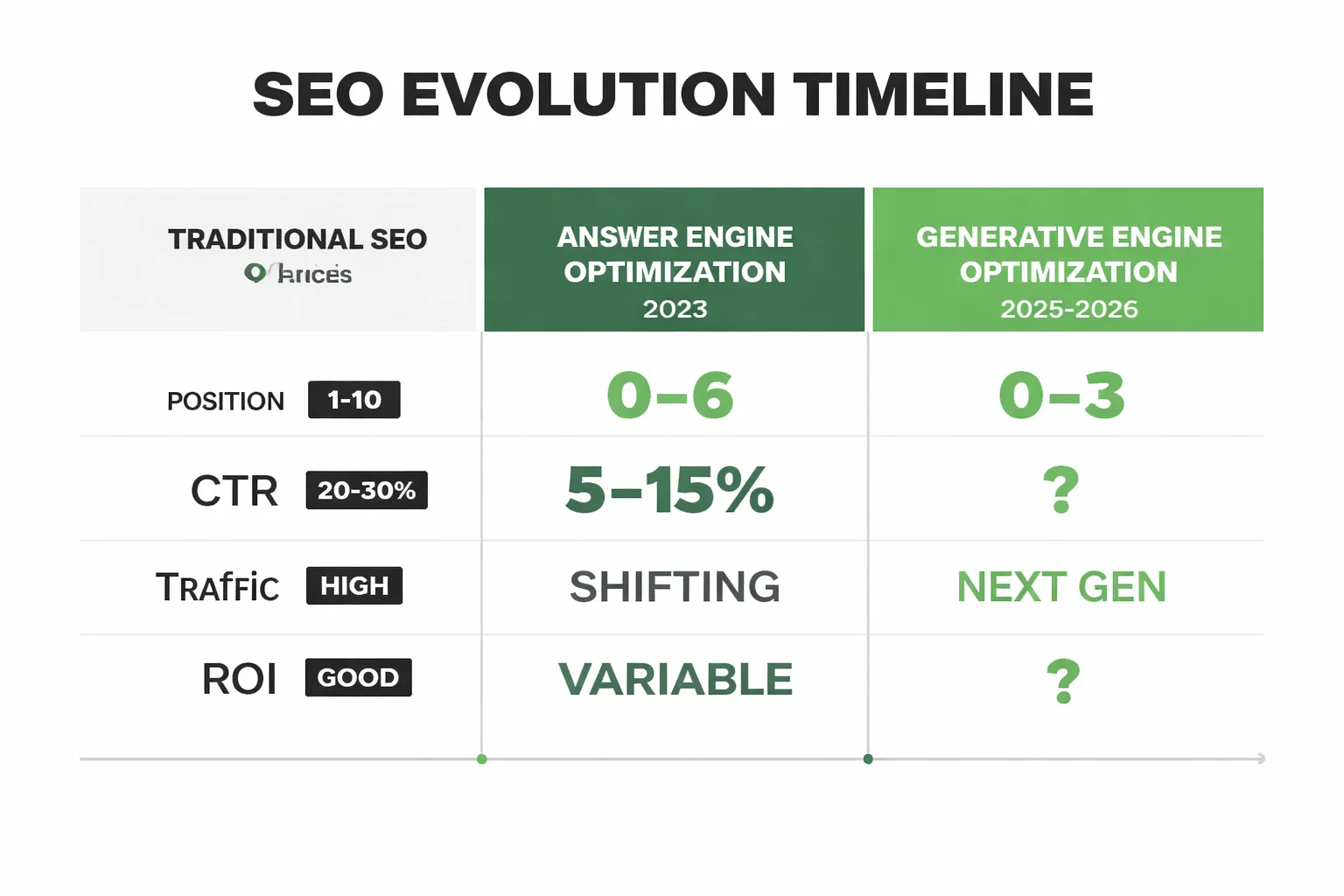
Classic SEO is a link-and-keyword system. You optimize pages to rank on a results page. Users click through to your site. The entire measurement framework is built on impressions, clicks, CTR, and position. GEO inverts that model. There's no results page to rank on. There's no click to measure. The AI generates an answer, optionally cites sources, and the user often never visits any website. The Go Fish Digital GEO case study showed a 3X increase in leads over three months using four levers: prompt mapping, benchmarking, content optimization, and citation tracking. Not one of those levers is a traditional SEO tactic.
The distinction matters because it changes what you optimize for. In SEO, you optimize for a crawler that evaluates page quality. In GEO, you optimize for a language model that evaluates answer quality. Crawlers care about backlinks, page speed, and keyword relevance. Language models care about entity clarity, source authority, and whether your content is structured in a way they can parse and quote directly. I've seen pages with DA 70+ and thousands of backlinks get zero AI citations because their content was a wall of marketing copy with no extractable answers. I've also seen DA 20 sites get cited regularly because they had clean, question-structured, fact-dense content that models could lift verbatim.
What Is Generative Engine Optimization GEO in Practice?
Let me walk through a concrete scenario. A B2B SaaS company selling inventory management software wants to appear when someone asks ChatGPT, "What's the best inventory management software for mid-market e-commerce?"
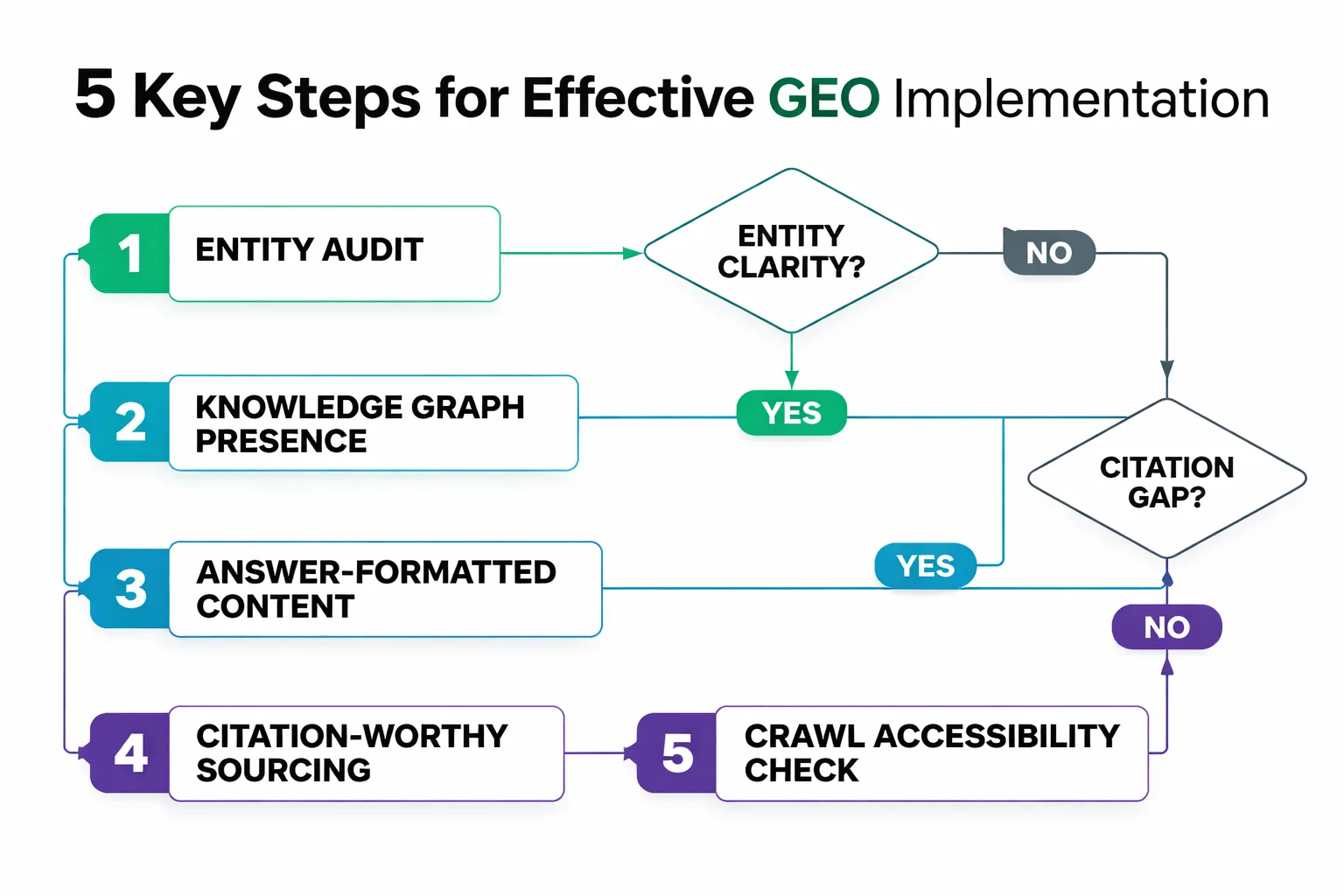
Here's what actually gets them cited. First, their brand needs to exist as an entity the model recognizes. That means structured data on their site, a Wikidata entry, consistent NAP (name, address, product category) across trusted directories, and mentions in sources the model has already ingested. Second, their content needs to answer the exact question in a format the model can extract. A page titled "Best Inventory Management Software for Mid-Market E-commerce" with a comparison table, feature breakdowns, and direct answers under question headings is far more extractable than a generic product page with a hero image and a CTA. Third, they need source authority signals that make the model confident enough to cite them. That means outbound citations to authoritative sources, inbound mentions from sites the model trusts, and content that demonstrates first-hand expertise.
I've tested this pattern repeatedly. The brands that get cited in AI answers share three traits: they have clear entity definitions (the model knows exactly what they are and what they sell), their content is structured for extraction (direct answers under question headings, comparison tables, fact-dense paragraphs), and they're mentioned in multiple trusted sources the model has already ingested during training. Brands that miss any of those three tend to be absent from AI answers even when they rank well organically.
The Directive Consulting analysis puts it bluntly: "If your brand isn't cited or mentioned in the generated response, you are invisible." That's not hyperbole. In the AI search paradigm, absence from the generated answer is functionally equivalent to not existing. There's no page two to fall back on.
How GEO Differs From AEO and LLM SEO
The terminology in this space is a mess. GEO, AEO, LLM SEO, and AI SEO get used interchangeably, and it drives me crazy because they refer to genuinely different things. Let me break them down.
Generative Engine Optimization (GEO) is the broadest term. It covers everything related to getting your brand cited in AI-generated answers across all surfaces. Answer Engine Optimization (AEO) is narrower. It specifically focuses on optimizing content to appear in answer engines that generate direct responses, which includes both AI chatbots and voice assistants. The distinction I draw: AEO is about formatting content for extraction (structured answers, FAQ schema, direct responses), while GEO encompasses that plus entity grounding, knowledge graph presence, and cross-engine citation tracking. You can read a deeper breakdown in our AEO vs GEO comparison.
LLM SEO is the most technical of the three. It refers specifically to optimizing for large language model training data and retrieval pipelines. This includes ensuring your content is in the corpora models are trained on, optimizing for RAG (retrieval-augmented generation) systems, and structuring data for model ingestion. Think of it as the backend engineering layer that GEO and AEO sit on top of.
Here's a comparison to make the distinctions concrete:
| Dimension | GEO | AEO | LLM SEO |
| Scope | All AI answer surfaces | Answer-format optimization | Model training & retrieval |
| Primary goal | Brand cited in answers | Content extracted as answer | Content in model knowledge |
| Key tactics | Entity grounding, citation tracking | FAQ schema, direct answers | Corpus inclusion, RAG optimization |
| Measurement | Citation rate, mention position | Featured snippet capture | Training data presence |
| Tools | AI visibility trackers | Schema validators, content structuring | Corpus analysis, llms.txt |
The practical takeaway: if you're a marketer or founder, you're doing GEO. AEO and LLM SEO are subsets or adjacent disciplines that feed into it. Don't get lost in the terminology wars. Focus on whether your brand appears in AI-generated answers. That's the outcome that matters.
How Does Generative Engine Optimization Work?
How does generative engine optimization work? GEO works by aligning three layers: entity recognition (the model knows your brand exists), content extractability (the model can pull answers from your pages), and source credibility (the model trusts you enough to cite). When all three align, you get cited. When any one is missing, you don't.
Let me explain the mechanics. When you ask ChatGPT or Perplexity a question, the model doesn't search the live web the way Google does. It retrieves information from its training corpus and, in the case of RAG-equipped engines like Perplexity, from a real-time retrieval layer that pulls from indexed web pages. The model then synthesizes an answer from those sources and decides which to cite based on relevance, authority, and extractability.
The retrieval layer is where GEO tactics matter most. Perplexity's citation system uses numbered in-text anchors that link directly to source pages, and its citation precision has been rated as outstanding compared to Google AI Overviews, which often link to lower-tier SEO sites. This means the quality and structure of your content directly affects whether the retrieval system pulls it and whether the model chooses to cite it.
Here's what happens inside the model when it generates an answer. First, it identifies the entities relevant to the query. If someone asks about "best project management tools," the model activates nodes for Asana, Monday.com, Notion, Jira, and other recognized entities in that space. If your brand isn't an entity the model recognizes, you can't appear in the answer. Period. Second, the retrieval system (if present) pulls content from pages that match the query's intent. Pages with clear, structured answers get prioritized. Third, the model synthesizes an answer and cites sources it pulled from. Citation-worthy content is specific, factual, and directly responsive to the query.
This is why entity grounding for AI search is the foundation of GEO. Without entity recognition, no amount of content optimization matters. The model literally cannot surface your brand if it doesn't know you exist as a distinct entity. I've seen companies with excellent content and strong organic rankings get zero AI citations because their brand wasn't a recognized entity in the model's knowledge graph. Fixing that starts with structured data, consistent entity definitions across the web, and presence in the knowledge sources models rely on.
What Is GEO Generative Engine Optimization in Simple Terms?
What is geo generative engine optimization in simple terms? GEO is making sure AI search engines know your brand exists, can extract answers from your content, and trust you enough to cite you as a source. That's it. No jargon required.
Think of it this way. Traditional SEO is like optimizing your store to appear on a map. You want people to find you when they search for what you sell. GEO is like optimizing your store to be recommended by a concierge. The concierge doesn't show a map. They give a direct recommendation. And they only recommend stores they know exist, have heard good things about, and can describe confidently.
For the concierge to recommend you, three things need to happen. They need to know your store exists (entity recognition). They need to be able to describe what you sell accurately (content extractability). And they need to trust that their recommendation won't make them look bad (source credibility). GEO optimizes all three.
The practical implication for most companies is that they need to stop thinking about content as something that ranks on a page and start thinking about it as something that gets extracted into an answer. That means restructuring existing content to include direct answers under question headings, building comparison tables that models can lift verbatim, and ensuring every claim is backed by a citable source. It also means building entity presence outside your own website through structured data, knowledge graph entries, and mentions in trusted third-party sources.
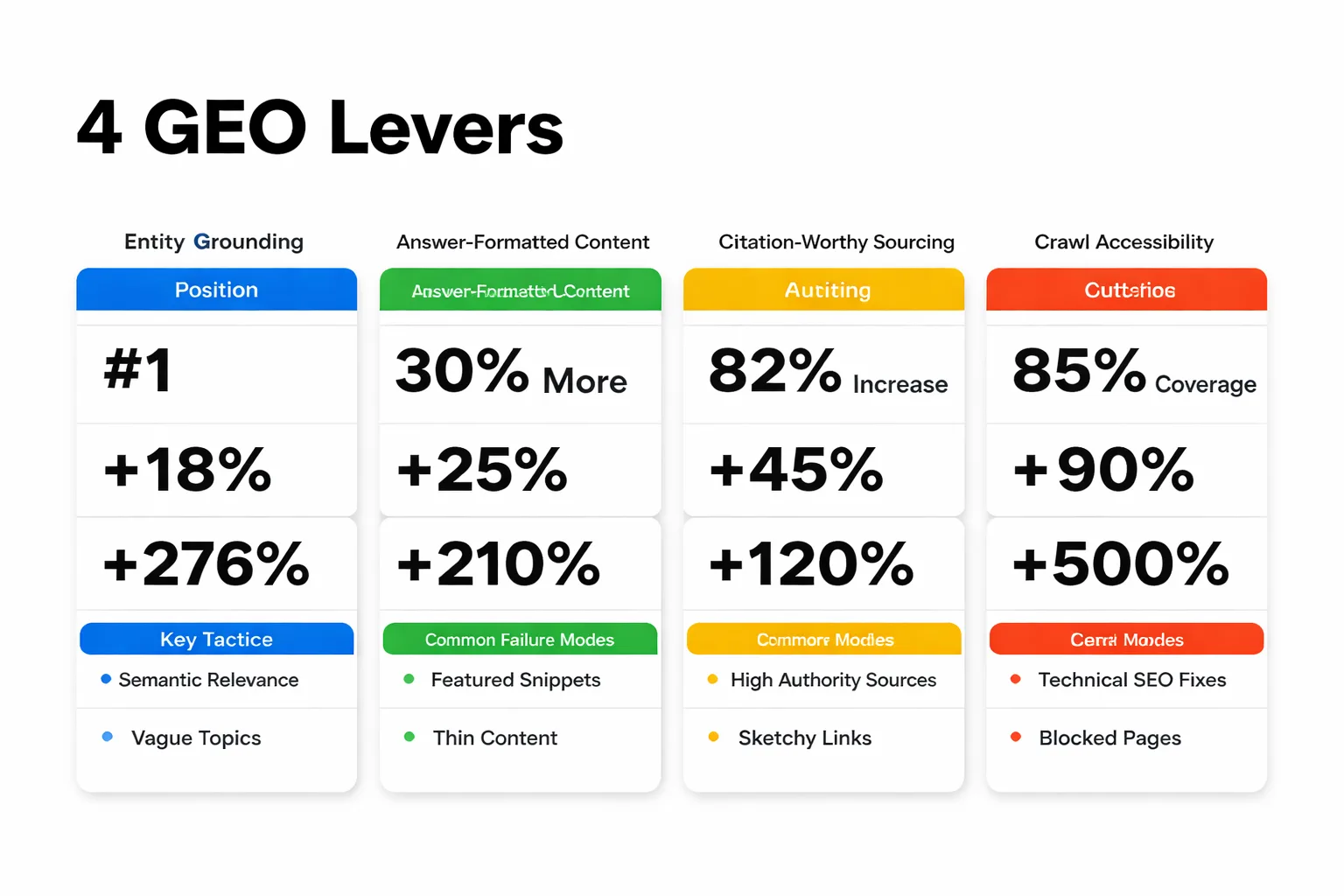
The 4 Levers That Actually Move GEO Performance
I've tested a lot of GEO tactics over the past year. Most of them are noise. Four levers actually move the needle, and I can rank them by impact based on what I've seen across client sites.
Lever 1: Entity Grounding
This is the foundation. Without it, nothing else works. Entity grounding means ensuring your brand exists as a recognized, well-defined entity in the knowledge sources AI models rely on. That includes structured data on your site (Organization schema, Product schema, FAQ schema), a Wikidata entry, consistent entity definitions across directories and review sites, and mentions in sources the model has ingested during training.
The measurable outcome: your brand appears as a recognized entity when the model processes queries related to your category. You can test this by asking ChatGPT or Claude directly about your brand. If the model can describe your company accurately, your entity grounding is working. If it hallucinates or says it doesn't have enough information, you have work to do. Our AI SEO tool includes entity auditing as part of its baseline scan.
Lever 2: Answer-Formatted Content
This is where most companies fail. Their content is written for human readers browsing a website, not for AI models extracting answers. Answer-formatted content means structuring every page so a model can pull a direct, quotable answer without interpretation. That means question headings followed by 40-60 word direct answers, comparison tables with clear column headers, numbered lists for sequential processes, and fact-dense paragraphs that lead with the key point.
The measurable outcome: your content gets extracted into AI answers verbatim or near-verbatim. You can track this by monitoring AI responses for your target prompts and checking whether your content appears in the cited sources. The Perplexity AI visibility checker surfaces this directly.
Lever 3: Citation-Worthy Sourcing
Models cite sources they trust. Trust signals include outbound citations to authoritative primary sources, inbound mentions from high-authority domains, consistent factual accuracy, and demonstrated expertise (E-E-A-T signals). If your content makes claims without backing them up, the model has no reason to cite you over a competitor who does.
The measurable outcome: your domain appears in cited-source leaderboards for your topics. You can track this by monitoring which sources AI engines cite most often for queries related to your category. If you're not in the top cited sources, you need to build more citation-worthy content and earn mentions from domains the model already trusts.
Lever 4: Crawl Accessibility
AI engines need to access your content. This sounds obvious, but I've seen companies block AI crawlers in robots.txt thinking they're protecting their content from scraping. They're actually removing themselves from AI answers entirely. You need to allow access to the crawlers that power AI search engines, serve clean HTML that models can parse, and ensure your content loads fast enough for retrieval systems to index it.
The measurable outcome: your pages appear in the retrieval indices of RAG-equipped engines like Perplexity. You can verify this by checking whether your content appears in Perplexity's cited sources for relevant queries. Our llms.txt validator helps you check whether your site is properly configured for AI crawler access.
How to Know If Your GEO Is Working
This is the question I get most often from founders. "How do I actually measure this?" The answer is that you need to track metrics that traditional SEO tools don't measure.
The three metrics that matter:
AI citation rate is the percentage of relevant prompts where your brand is cited as a source. This is your primary GEO KPI. If you're cited in 5 out of 50 relevant prompts, your citation rate is 10%. Track this over time and watch for movement as you implement GEO tactics.
Mention-to-citation ratio tracks how often your brand is mentioned in an AI answer versus how often it's actually cited as a source. A high mention rate with low citation rate means the model knows about you but doesn't trust you enough to credit you. That's a source credibility problem. A low mention rate means you have an entity recognition problem.
Prompt coverage measures how many of the prompts relevant to your category you appear in at all. If there are 200 prompts a potential customer might ask related to your product category and you appear in 15 of them, your prompt coverage is 7.5%. This metric tells you how much of your addressable AI search surface you're actually capturing.
The challenge is that tracking these metrics manually is brutal. You'd need to run hundreds of prompts across multiple AI engines weekly, capture the responses, parse them for mentions and citations, and track changes over time. That's a full-time job for a person, and most small teams don't have that capacity.
This is where AI visibility reporting tools come in. At Meev, we track brand mentions and citations across every major AI search surface with daily refresh on SERP-driven surfaces and rolling refresh on LLM-driven surfaces. You can see exactly which prompts cite your brand, where in the answer you appear (first, in a list, last), and which sources the AI engine is citing for your topics. The AI visibility checker gives you a baseline in minutes.
The point isn't to replace your SEO analytics. It's to add a layer that measures the visibility you're currently blind to. If you're only tracking organic rankings, you have no idea whether your brand appears in the AI answers your potential customers are reading. And in 2026, that's where an increasing share of buying decisions start.
Is your brand being cited in AI answers, or is it invisible?
The Contrarian Take: Stop Chasing AI Citations Directly
Here's where I disagree with most of the GEO advice I read online. The majority of practitioners focus on tactics designed to game citation: stuffing brand names into content, creating artificial comparison pages, building pages specifically to get pulled into AI answers. That approach is fragile and short-sighted.
The brands that win at GEO don't chase citations. They build entity authority. They make their brand a recognized, well-defined entity that AI models naturally surface because it's the correct answer to the user's question. They focus on being the best answer, not the most optimized one.
This is the same lesson the SEO industry should have learned from the helpful content updates. Sites that optimized for algorithms got demoted. Sites that optimized for users survived. The same principle applies to GEO. Models are trained to surface the most helpful, accurate, authoritative answer. If you focus on being that answer, citations follow naturally. If you focus on gaming the citation mechanism, you'll get short-term wins that evaporate when models update.
The practitioner Anthony Saccon made an observation that resonates with me: "The damage isn't visible" when SEO strategies fail to translate to AI visibility. Sites still load fast, backlinks look healthy, but rankings lose relevance in AI search. The damage is silent. You don't see a traffic drop because there was never traffic to lose. You just never appear in the answers your customers are reading.
That's the real risk. Not that you'll get penalized. That you'll simply never exist.
Generative Engine Optimization Statistics Worth Knowing
Hard numbers in this space are still scarce because the field is new. But the data points that exist tell a clear story.
The Go Fish Digital case study remains the most concrete documented result: a 3X increase in leads over three months using four GEO levers (prompt mapping, benchmarking, content optimization, citation tracking). That's not a traffic metric. It's a revenue metric. GEO directly drove business outcomes, not just visibility.
On the divergence between engines, the overlap is surprisingly small. Only 11% of domains are cited by both ChatGPT and Perplexity. This means optimizing for one engine doesn't automatically optimize for others. You need to track each surface independently.
On user behavior, nearly one in five generative AI conversations are about finding information. That's a massive share of discovery intent flowing through AI engines. If your brand isn't in those answers, you're losing discovery opportunities that didn't exist as a channel two years ago.
On citation precision, Perplexity uses numbered in-text anchors and has been rated as having outstanding citation precision, while Google AI Overviews have been rated as moderate and often link to lower-tier SEO sites. This means the quality of your content matters more on Perplexity, where citation is precise and source-attributed, than on Google AI Overviews, where the citation mechanism is looser.
AI Visibility Solutions With Best Generative Engine Optimization
The tool landscape for GEO is fragmented. Most tools do one thing: track mentions or generate content. Very few do both, and almost none close the loop between diagnosis and action.
When I evaluate AI visibility solutions with best generative engine optimization capabilities, I look for three things. First, does it track across every major AI search surface (not just one or two)? If you're only tracking ChatGPT, you're missing Claude, Gemini, Perplexity, Grok, Google AI Overviews, and AI Mode. Second, does it show you which sources AI engines are citing for your topics? Knowing you're not cited is useless without knowing who is. Third, does it help you close the gap? Tracking without action is just expensive reporting.
The top solutions for AI visibility and generative engine optimization combine tracking with content generation and citation gap analysis. The best AI visibility products with generative engine optimization features don't just tell you where you're missing. They tell you what to write, how to structure it, and which sources to target for outreach.
I'm biased here because I build one of these tools. But the bias comes from living through the problem. At Meev, we built the platform I wished existed when I was doing this manually. Daily tracking across every major AI surface. Cited-source leaderboards that show exactly which domains AI engines trust for your topics. Content generation that's archetype-aware (a listicle gets different retrieval weights and structure than an explainer). A 16-dimension quality firewall that blocks weak drafts before they reach your CMS. And citation path outreach that finds the publishers AI engines actually cite and drafts personalized pitches to them.
The ChatGPT AI visibility checker and the broader AI visibility tool suite exist because the gap between knowing you're invisible and knowing what to do about it is where most teams get stuck. You don't need a full analytics team to close that gap. You need the right data and a system that acts on it.
What This Actually Means for Your Brand
GEO is not a new name for SEO. It's a different discipline with different signals, different measurement, and different outcomes. If you take one thing from this article, let it be this: your organic rankings tell you nothing about your AI search visibility. A brand can rank #1 on Google and be completely absent from ChatGPT, Perplexity, and Claude. I've seen it happen across dozens of sites.
The brands that will win in 2026 and beyond are the ones that treat AI citations as a first-class metric, not a byproduct of SEO. They track their citation rate across every major AI surface. They structure content for extraction, not just for ranking. They build entity authority in knowledge graphs, not just backlink profiles. And they measure their progress with tools designed for the AI search era, not tools built for a world of blue links.
If you're not sure where you stand, start with a baseline. Run your brand through an AI visibility tracker and see what comes back. The results will probably surprise you. Most brands I audit are cited in far fewer prompts than they assume. The gap between perception and reality is where GEO work begins.
What is generative engine optimization, really? It's the difference between being found and being invisible in the answers your customers are already reading. The question isn't whether to invest in it. The question is how much visibility you're already losing by waiting.
FAQ
What is the difference between GEO and SEO?
SEO optimizes content to rank on search engine results pages. GEO optimizes content to be cited in AI-generated answers. SEO targets crawlers that index and rank pages. GEO targets language models that synthesize answers and cite sources. The key difference is measurement: SEO tracks impressions, clicks, and position. GEO tracks citation rate, mention position, and prompt coverage.
How long does it take to see GEO results?
Based on the Go Fish Digital case study, measurable results (3X lead increase) appeared within three months. However, entity grounding work can take longer because it depends on knowledge graph updates and model retraining cycles. Content optimization for extraction can show results within weeks if your pages are already crawled by RAG-equipped engines like Perplexity.
Do I need different content for GEO than for SEO?
Not necessarily different content, but differently structured content. The same information needs to be reformatted for AI extractability: direct answers under question headings, comparison tables, fact-dense paragraphs, and structured data markup. Content that ranks well organically can often be restructured to also perform well in GEO without a full rewrite.
Which AI engines should I track for GEO?
Every major AI search surface: ChatGPT, Claude, Gemini, Perplexity, Grok, Google AI Overviews, and AI Mode. Since only 11% of domains are cited by both ChatGPT and Perplexity, tracking just one engine gives you an incomplete picture. Each engine has different retrieval systems, citation mechanisms, and training data, so your visibility will vary across them.
Can small companies compete in GEO?
Yes. Unlike traditional SEO where domain authority and backlink volume create high barriers to entry, GEO rewards content structure, entity clarity, and source credibility. I've seen DA 20 sites out-cite DA 70 sites because their content was better structured for extraction. Small companies that invest in entity grounding and answer-formatted content can compete effectively.
Is GEO replacing SEO?
No. GEO complements SEO. Organic search still drives significant traffic, and traditional ranking signals still matter. But GEO addresses a visibility layer that SEO doesn't cover: presence in AI-generated answers. Brands need both. The risk isn't that SEO stops working. It's that SEO alone leaves you invisible in the AI answers your customers are increasingly reading instead of clicking through to results pages.
About the Author
Judy Zhou, Founder
Judy Zhou leads content strategy at Meev, where she oversees AI-driven content research and publishing for hundreds of brands. With a background in SEO and editorial operations, she focuses on building content systems that rank on Google, get cited by AI search engines, and drive measurable business results.
Stop guessing about your AI search visibility. Run a free scan across every major AI engine and see exactly where your brand appears and where it doesn't.