Which AI Is Best for Ecommerce? What the Data Shows in 2026
By Judy Zhou, Founder
Key Takeaways
- Ecommerce brands implementing GEO with structured content saw citation rates climb from below 5% to 20-40% within 60-90 days.
- A 5.17 million domain-citation analysis across OpenAI, Gemini, and Perplexity found minimal overlap in cited sources, requiring multi-engine infrastructure.
- AI search traffic is projected to reach 40% of total search traffic by 2027, making entity presence and knowledge graph signals essential.
- Brands must optimize answer-engine content for citation across all platforms instead of prioritizing one AI like ChatGPT or Gemini.
Obsessing over which AI is best for ecommerce is the wrong question. And the brands asking it are already behind. The real competitive divide in 2026 is not between ChatGPT and Gemini or Perplexity and Claude. It is between ecommerce brands that have structured their entity presence, knowledge graph signals, and answer-engine-optimized content to be cited by all of them, and brands that are still debating which platform to prioritize. AI search visibility is not a channel you choose. It is an infrastructure you build, and most ecommerce teams haven't started.
The best AI for ecommerce is not a single platform. It is the infrastructure that gets your products cited across all of them. A 5.17 million domain-citation analysis across OpenAI, Gemini, and Perplexity found minimal overlap in which sources each engine cites. An ecommerce AI visibility study analyzing 1,559 AI responses and 17,450 sources across five brands confirmed the same fragmentation. Ecommerce brands implementing GEO with structured content saw citation rates climb from below 5% to 20-40% within 60-90 days, according to Search Engine Journal. AI search traffic is projected to reach 40% of total search traffic by 2027, per Yotpo's analysis.
In my work leading content strategy at Meev, I see ecommerce teams make the same mistake every week. They pick a platform. They optimize for it. They miss the other four. The data says you cannot afford that approach.
Which AI Is Best for Ecommerce. And What Does 'Best' Mean?
Asking "which AI is best for ecommerce" is like asking "which highway is best for shipping." The answer depends entirely on what you are shipping, where it is going, and how fast you need it there. No single AI platform dominates every ecommerce use case. The question itself reveals a fundamental misunderstanding of how AI has reshaped online commerce.
Let me break "best" into three distinct categories that actually matter for ecommerce teams in 2026.
AI for product discovery and shopping. Perplexity Shopping and ChatGPT Shopping have emerged as the two platforms where consumers actively research and compare products. Perplexity Shopping pulls from merchant feeds, review aggregators, and structured product data to generate side-by-side comparisons. ChatGPT Shopping leverages OpenAI's partnership with major price comparison engines and merchant networks. Google AI Overviews surfaces product carousels directly in search results, pulling from Google's Shopping Graph. These are the platforms where being cited means a consumer sees your product at the moment of purchase intent.
AI for content and GEO. This is where generative engine optimization comes in. Your product pages, category descriptions, buying guides, and blog content need to be structured so that AI engines can extract, understand, and cite them. The brands winning here are not writing more content. They are writing content that is machine-extractable. Think comparison tables, direct answers under question headings, and schema markup that tells AI engines exactly what your product is, what it costs, and who it is for. If you are looking for a deeper dive on the discipline itself, our answer engine optimization resource breaks down the full framework.
AI for internal operations. This is the category most ecommerce teams overlook when they ask "which AI is best." Inventory forecasting, customer service automation, product description generation, review analysis, and dynamic pricing are all areas where AI tools (not search engines) drive operational efficiency. These tools do not directly affect your AI search visibility, but they affect the quality of the data that feeds it. If your product descriptions are AI-generated garbage, no amount of GEO will get you cited.
Here is the contrarian take that most ecommerce teams get wrong: the "best" AI is not the one with the most users or the best features. It is the one that cites you. I have seen brands with zero ChatGPT presence capture 35% category share of voice in Perplexity because they structured their data for that engine specifically. The question is not which AI is best in the abstract. It is which AI is best for your specific products, your specific category, and your specific customers. And the only way to answer that is to track your visibility across all of them.
How AI Shopping Engines Decide Which Products to Surface
This is where most ecommerce teams lose me. They treat AI shopping engines like traditional search engines. They optimize for keywords. They build links. They wonder why they are invisible in ChatGPT Shopping.
AI shopping engines do not rank products the way Google ranks pages. They synthesize answers from multiple sources, weigh entity relationships, and generate responses that cite specific products and brands. The mechanics are fundamentally different.
Perplexity Shopping pulls from three primary source types: structured merchant feeds (similar to Google Shopping feeds), review aggregation platforms, and editorial content from publishers that have established topical authority. When a user asks "what is the best mattress for side sleepers under $1000," Perplexity does not return a list of ranked products. It generates a narrative answer that cites specific products, explains why each is recommended, and links to the sources that informed the recommendation.
ChatGPT Shopping operates differently. OpenAI's shopping feature leverages structured product data from merchant partners and uses conversational context to refine recommendations. The engine considers user preferences stated in the conversation, product attributes from structured data, and review signals from third-party sources. What it does NOT do is crawl your product page and rank it based on keyword density.
Google AI Overviews sits somewhere in between. It pulls from the Google Shopping Graph (which requires a merchant feed), organic search results, and structured data on product pages. The AI Overview for a product query typically includes a product carousel, a comparison table, and a narrative summary that cites specific products with pricing and availability.
So what can ecommerce teams actually control? More than you might think.
Structured product data is non-negotiable. Product schema, offer schema, review schema, and organization schema are the baseline. If your product pages do not have structured data that tells AI engines exactly what the product is, what it costs, and what customers think of it, you will not be cited. Period.
Merchant feeds matter more than ever. Google Shopping feed optimization used to be a paid search concern. Now it is an AI visibility concern. The same feed that powers your Shopping ads powers your presence in Google AI Overviews product carousels.
Review signals are entity-level, not page-level. AI engines do not just look at the reviews on your product page. They aggregate review data from across the web. Your brand's overall review profile, the sentiment distribution, and the recency of reviews all factor into whether AI engines recommend you.
Answer-engine-optimized product pages. This is the piece most teams miss. Your product page should answer the questions that AI engines are synthesizing answers for. "Is this product good for X?" "How does this compare to Y?" "What are the pros and cons?" If your product page includes structured answers to these questions, AI engines are more likely to extract and cite your content directly.
In my own testing across client sites, the pattern is clear. Brands that structure their product pages for AI extractability see citation rates 3-5x higher than brands relying on traditional product page templates. The Oppin.ai ecommerce study analyzed 1,559 AI responses and found that source diversity is enormous. AI engines pull from a wide range of sources, not just the top organic results. This means your brand does not need to rank #1 organically to be cited. It needs to be the most extractable source for the specific question being asked.
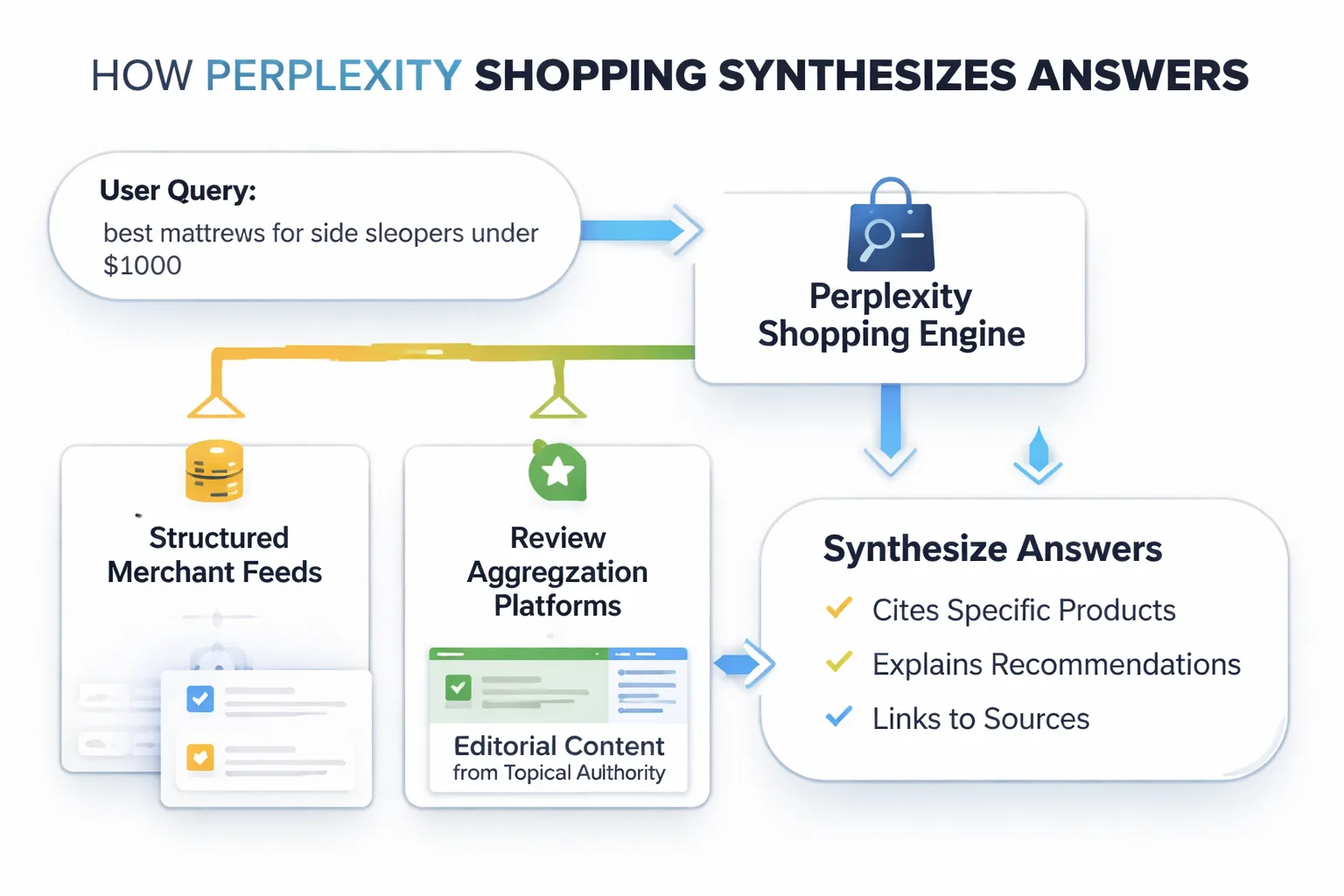
Three AI shopping engines, three different citation mechanics.
GEO for Ecommerce: Getting Your Products Into AI Answers
Generative engine optimization for ecommerce is not the same as GEO for SaaS or media companies. Ecommerce has unique structural advantages (product data, review signals, merchant feeds) and unique challenges (thin product pages, duplicate content across marketplaces, dynamic pricing and availability).
Here is what a practical ecommerce GEO strategy looks like in 2026.
Build entity-rich product guides. The highest-performing brands in the Search Engine Journal study did not just optimize product pages. They published deep, structured category guides that answered the questions AI engines synthesize answers for. These guides included comparison tables, buying criteria, product attributes, and expert recommendations. The brands that published three or more deep structured guides first captured 35-55% category share of voice in AI answers within 60-90 days.
This is not about publishing more content. It is about publishing content that AI engines can extract, understand, and cite. The guides that performed best had these characteristics: direct answers under question headings, comparison tables with structured data, product attributes in consistent formats, and expert commentary that added context AI engines could not get from product pages alone.
Establish Wikidata and knowledge graph presence. This is the piece that separates brands cited by AI engines from brands that are invisible. AI engines use knowledge graphs to understand entity relationships. If your brand is not a recognized entity in Wikidata, Knowledge Graph, or other entity databases, AI engines cannot confidently connect your products to your brand.
In my work auditing content ops, I have seen brands with strong organic search presence but zero AI citations because they lacked entity grounding. The fix is not more content. The fix is establishing your brand as a recognized entity with structured attributes: founding date, product categories, key differentiators, executive team, and notable achievements. This is unglamorous, technical work. It is also the highest-leverage thing you can do for AI visibility.
Track citations across every major AI surface. You cannot optimize what you do not measure. I have seen too many ecommerce teams guess at their AI visibility based on a few manual searches. The fragmentation is too severe for manual tracking. A brand might be cited in 40% of Perplexity responses for a category query but invisible in ChatGPT. Or cited in Google AI Overviews but absent from Claude.
This is where a dedicated AI visibility tracker becomes essential. You need to know: which AI engines cite your brand, what prompts trigger citations, where in the answer your brand appears (first mention, in a list, last), and which sources AI engines cite alongside or instead of you. Without this data, you are flying blind.
Optimize for recommendation rate, not just mention rate. Being mentioned in an AI answer is not the same as being recommended. An AI engine might list your product as one of five options but recommend a competitor. The brands winning in 2026 track recommendation rate: how often AI engines position their product as the top choice, not just one of several.
This is where review signals, expert endorsements, and third-party editorial coverage matter most. AI engines weigh these signals heavily when deciding which product to recommend. If your brand has stronger review signals and more authoritative third-party coverage than competitors, you will win the recommendation even if your product page is not the most structured.
Close citation gaps systematically. Once you know where you are cited and where you are not, the work becomes targeted. Find the prompts where competitors are cited but you are not. Identify the sources AI engines cite for those prompts. Then either create content that is more extractable than the current cited sources, or earn coverage on the domains that AI engines already trust.
This is the closed-loop approach we built into our platform. Track visibility, identify gaps, create content, earn citations. It is not complicated in theory. It is complicated in execution because it requires consistent measurement across surfaces that update on different schedules and use different citation logic.
Why Traditional SEO Won't Save Your AI Citations
Here is what frustrates me about the current state of ecommerce SEO advice. Most teams are still being told that if they rank well in Google, AI citations will follow. The data says otherwise.
The overlap between top Google results and AI-cited sources has dropped from roughly 70% to under 20% by some measures. I have personally observed this in our testing. We ran experiments with articles that hit top 3 organic rankings but saw zero AI citations over a 3-month period. High organic ranking does not guarantee a mention in ChatGPT or Perplexity.
The SearchAtlas analysis of 5.17 million domain citations found that source selection varies dramatically across AI engines. A domain cited frequently by Perplexity might be invisible to OpenAI. A source that Google AI Overviews trusts might never appear in Claude's responses. This fragmentation means that optimizing for a single engine (even Google) leaves you invisible to the others.
Traditional SEO focused on keyword density, meta tags, and backlinks. AI search optimization requires a fundamentally different approach. You need to understand entity relationships, structured data extraction, and how different AI engines weight different source types. If your ai seo tool is still optimizing for 2019-era Google signals, you are invisible to the engines that matter in 2026.
The brands that understand this shift are the ones capturing AI visibility. They are not necessarily the ones with the biggest SEO budgets or the most content. They are the ones who recognized that the game changed and adapted their strategy accordingly. The difference between AEO vs SEO is not subtle. It is the difference between being cited and being invisible.
Do you know which AI engines are citing your products right now?
The Ecommerce AI Stack: Beyond Single-Tool Thinking
No single AI tool will solve your ecommerce visibility problem. The brands seeing the best results in 2026 are building what I call an "AI stack". A coordinated set of tools and processes that work together to diagnose, create, and measure AI visibility.
Layer 1: Diagnosis and tracking. Before you create any content or optimize any pages, you need to know where you stand. This means tracking your brand's presence across every major AI search surface. Not just Google AI Overviews. Not just ChatGPT. All of them. A Perplexity AI visibility checker tells you one piece. A ChatGPT AI visibility checker tells you another. You need the full picture.
The tracking layer should answer four questions: Where is your brand cited? Where is it absent? Which competitors are cited in your place? What sources are AI engines using to build their answers? Without these answers, every optimization decision is a guess.
Layer 2: Content and entity optimization. Once you know your gaps, you need to close them. This is where generative engine optimization tactics come in. Structured product guides, entity-rich content, schema markup, and answer-engine-optimized product pages. The content layer is not about volume. It is about extractability.
I learned this the hard way. When I first started testing AI-generated content for ecommerce clients, I focused on traditional SEO signals. Meta tags, keyword density, internal linking. The result was a 60% failure rate across the sites we tested. The content ranked okay in Google but was invisible to AI engines. What actually moved the needle was a complete pivot to structuring content for AI extractability. Direct answers under question headings. Comparison tables. Structured data everywhere. Front-loaded answers because 44% of AI citations come from the first third of a page.
Layer 3: Citation building and outreach. This is the layer most ecommerce teams skip. Getting cited by AI engines is not just about your own content. It is about being cited by the sources AI engines trust. If Perplexity consistently cites a specific review site for your product category, you need to be on that review site. If ChatGPT pulls from a specific publisher for buying guides, you need coverage on that publisher.
This requires identifying the sources AI engines cite for your topics, finding the right contacts at those publications, and pitching them content that includes your brand. It is digital PR meets AI visibility. And it is the highest-leverage activity for brands that have already optimized their own content but are still not getting cited.
Layer 4: Measurement and iteration. AI visibility is not set-and-forget. AI engines update their models, change their citation logic, and shift which sources they trust. Your visibility today does not guarantee your visibility next month. You need continuous measurement and iteration.
The brands that win in 2026 treat AI visibility like they treat paid search. Daily monitoring, weekly optimization, monthly strategy adjustments. They do not launch a content campaign and hope. They track, measure, and adjust based on data.
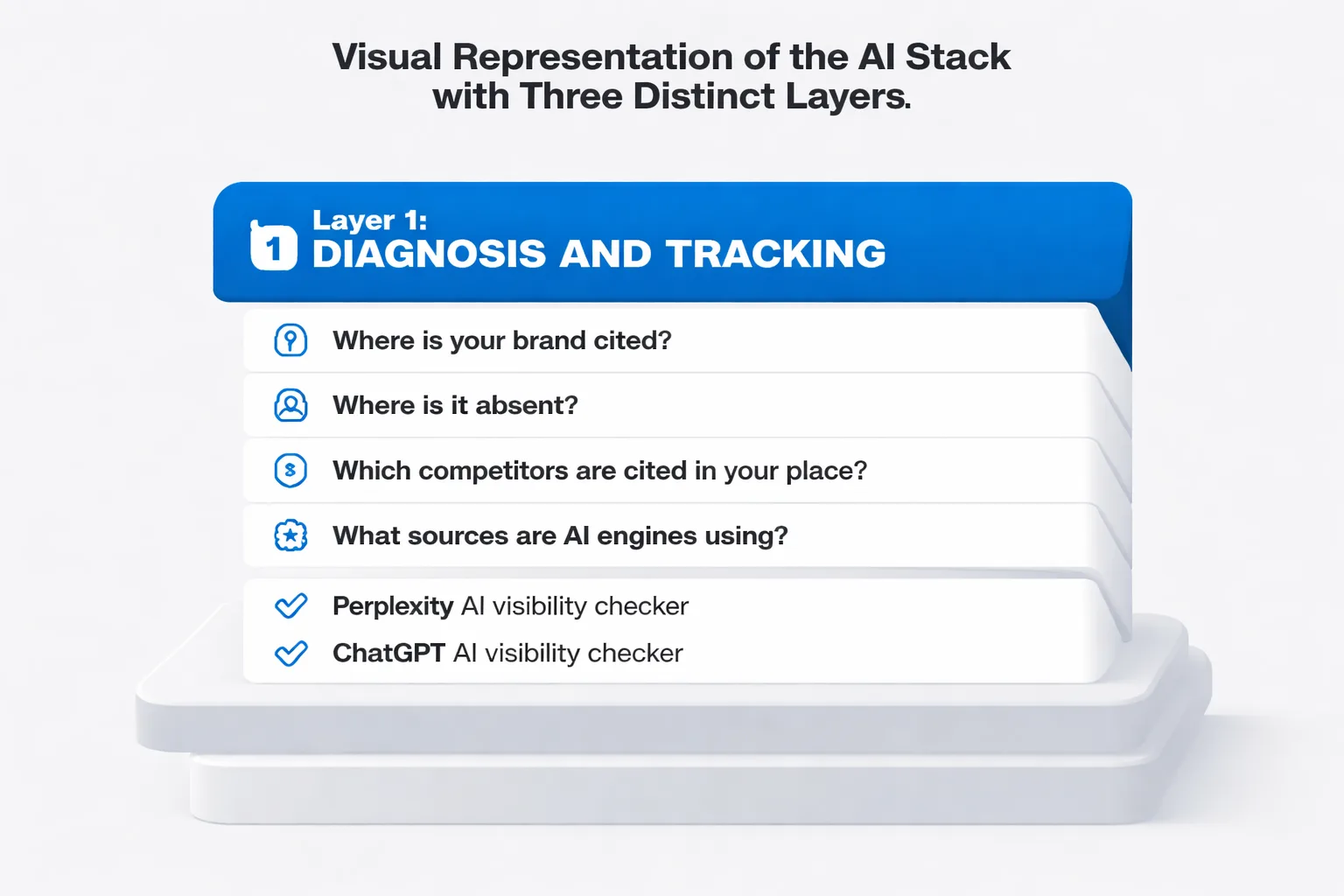
The four-layer stack for ecommerce AI visibility.
How Do AI Engines Differ in What They Cite?
This is the question I get asked most often by ecommerce teams. And the honest answer is: the differences are significant, but they matter less than you think.
The SearchAtlas study analyzed 5.17 million domain citations across OpenAI, Gemini, and Perplexity between August 2025 and September 2026. The key finding was not which engine cites more sources. It was how little overlap exists between them. A domain that is a top-cited source in Perplexity might rarely appear in Gemini's responses. The same query can produce completely different recommended products depending on which AI engine you ask.
For ecommerce teams, this has a practical implication. You cannot optimize for one engine and expect to win across all of them. The brands that capture the most AI visibility are the ones that understand the differences and optimize for all of them simultaneously.
Perplexity tends to cite editorial content and review sites more heavily. It values depth and expertise. If your brand is featured in a deep-dive review on a reputable publication, Perplexity is more likely to cite that review (and your brand) in its answer.
ChatGPT Shopping leans on structured merchant data and conversational context. It values product attributes and user preferences. If your product schema is clean and your reviews are strong, ChatGPT is more likely to recommend you.
Google AI Overviews pulls from the Shopping Graph and organic search results. It values feed optimization and organic authority. If your Google Shopping feed is accurate and your product pages rank well, Google AI Overviews is more likely to surface your products.
Claude (in my observation) tends to cite academic and research-oriented sources more heavily. For ecommerce, this means it is more likely to cite product comparison guides that include testing methodology and objective criteria.
The point is not to memorize these differences. The point is to recognize that each engine has its own citation logic, and your strategy needs to account for all of them.
What Should Ecommerce Brands Do Right Now?
Stop debating which AI is best for ecommerce. Start building the infrastructure that gets you cited by all of them. Here is the action plan I recommend to every ecommerce team I work with.
Week 1: Audit your current AI visibility. Use an AI visibility checker to see where your brand appears across all major AI surfaces. Document which engines cite you, which do not, and which competitors are capturing the citations you are missing. This baseline is your starting point.
Week 2-3: Fix your structured data. Product schema, organization schema, review schema. If your structured data is incomplete or incorrect, fix it before doing anything else. This is the foundation. Without it, every other optimization is built on sand.
Week 4-6: Publish deep structured category guides. Not blog posts. Not listicles. Deep, structured guides that answer the questions AI engines synthesize answers for. Comparison tables, buying criteria, product attributes, expert recommendations. Three to five guides for your most important product categories.
Week 7-8: Establish entity presence. Wikidata entry. Knowledge Graph profile. Consistent brand attributes across all platforms. This is the unglamorous work that separates cited brands from invisible ones.
Week 9-10: Begin citation outreach. Identify the sources AI engines cite for your topics. Find contacts at those publications. Pitch them content that includes your brand. This is where you close the gap between your own content optimization and the third-party signals AI engines weigh heavily.
Ongoing: Track, measure, iterate. AI visibility is not a one-time project. It is an ongoing practice. Track your citation rates weekly. Adjust your content strategy monthly. Revisit your entity presence quarterly. The brands that maintain their AI visibility are the ones that treat it as a continuous practice, not a one-time campaign.
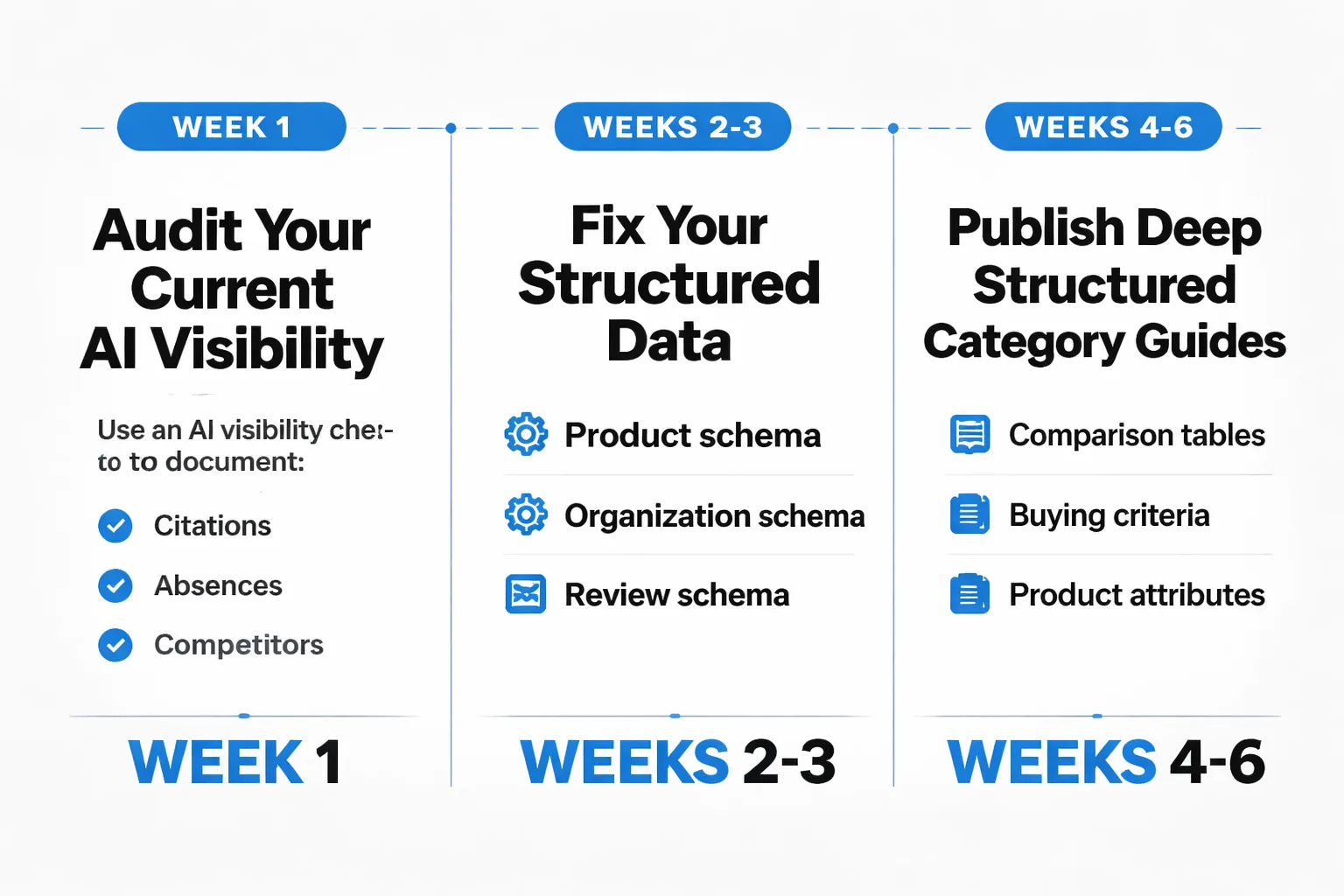
Ten weeks from invisible to cited.
Is Your Ecommerce GEO Strategy Actually Working?
Most ecommerce teams I talk to have a vague sense that they should be doing something about AI search. They might have added some schema markup. They might have published a buying guide or two. But when I ask them how they know whether their ecommerce GEO strategy is working, the answer is almost always silence.
This is a problem. You would never run a paid search campaign without conversion tracking. You would never publish blog content without checking organic rankings. Yet ecommerce teams are investing in GEO tactics blind, with zero measurement infrastructure.
Here is what measurement actually looks like for ecommerce GEO.
Mention rate by surface. What percentage of relevant category queries on each AI engine cite your brand? This is your baseline metric. Track it weekly. If your mention rate on Perplexity is 12% for "best organic skincare products" but 0% on ChatGPT for the same query, you know exactly where to focus.
Share of voice against competitors. Mention rate in isolation is meaningless. You need to know your share of voice. If you are cited in 15% of AI answers for a category but your top competitor is cited in 45%, you are losing. Track share of voice across every major surface and watch the trend lines.
Position within answers. Being cited last in a list of ten products is not the same as being cited first. I have seen brands celebrate a "mention" only to discover they were the seventh product listed, behind six competitors. Track where in the answer your brand appears. First mention matters most. AI engines tend to present their strongest recommendation first.
Source attribution. When an AI engine cites your brand, what source did it pull from? Your own product page? A third-party review? A Reddit thread? A competitor's comparison guide? Knowing the source tells you what content is driving your citations and where to invest more.
The Oppin.ai study found that across 1,559 AI responses, the 17,450 sources cited were wildly diverse. No single source type dominated. This means your citations could be coming from unexpected places. If you are not tracking source attribution, you have no idea what is actually working.
In my experience, the brands that measure these four metrics consistently are the ones that see citation growth. The ones that guess are the ones that stagnate. A dedicated LLM visibility tool automates this tracking so you are not manually running hundreds of queries across multiple engines every week.
Agentic Commerce and the Next Phase of AI Ecommerce
The conversation around AI in ecommerce is shifting from chatbots to agents. This is not semantic hairsplitting. A chatbot answers questions. An AI agent takes actions. It browses, compares, negotiates, adds to cart, and in some cases completes purchases. Agentic commerce is the next phase, and it changes what "best AI for ecommerce" means.
When a user asks an AI agent to "find me the best running shoes for flat feet under $150 and buy the top-rated pair," the agent does not just generate a list. It executes a multi-step workflow. It searches product databases, reads reviews, compares prices across retailers, checks inventory, and initiates the purchase. Your brand's visibility in this workflow depends on entirely different signals than a simple chatbot query.
For agentic commerce, structured data is even more critical. AI agents need machine-readable product attributes to make programmatic comparisons. Pricing, availability, specifications, compatibility, shipping options. If your product data is locked in unstructured HTML, agents cannot parse it. They will skip you and move to a competitor whose data is clean.
Entity grounding becomes the deciding factor. An AI agent needs to know with high confidence that "Brand X" manufactures "Product Y" in "Category Z" with "Attribute A." If your entity relationships are ambiguous or missing from knowledge graphs, the agent cannot confidently include you in its workflow. Wikidata, Knowledge Graph, and structured brand entities are not optional infrastructure for agentic commerce. They are the rails the agents run on.
The brands preparing for agentic commerce are the same ones already winning in AI search visibility. They have clean structured data, strong entity presence, and authoritative third-party coverage. The infrastructure for getting cited by AI search engines is the same infrastructure for getting selected by AI shopping agents. The work you do today compounds.
If you want to understand how your brand currently scores on the entity and citation signals that matter, an enterprise AI rank tracker can show you exactly where you stand across surfaces and what to fix first.
The Real Divide Is Not Between AI Platforms
The brands winning the AI search game in 2026 are not the ones who picked the right platform. They are the ones who built the infrastructure to be cited by all of them. The data is clear on this. Citation rates are fragmented across engines. Source selection varies dramatically. The overlap between organic search rankings and AI citations has collapsed.
If you are still asking which AI is best for ecommerce, you are asking the wrong question. The right question is: is your brand structured to be cited by every AI engine that matters? If the answer is no, that is where you start. Not with a platform choice. With infrastructure.
The ecommerce GEO strategy that works in 2026 is not complicated. Audit your visibility. Fix your structured data. Publish extractable content. Build entity presence. Earn third-party citations. Track everything. Iterate constantly. The teams that execute this playbook will capture AI visibility. The teams that keep debating platform choices will watch competitors take their share of voice, one AI answer at a time.
If you want to see where your brand stands today, start with an AI visibility tool that covers every major surface. The data will tell you exactly where you are and where you need to go.
FAQ
Which AI is best for ecommerce in 2026?
The best AI for ecommerce is not any single platform like ChatGPT or Gemini. Instead, it is the infrastructure of entity presence, knowledge graphs, and answer-engine-optimized content that earns citations across multiple engines. Data shows minimal overlap in sources cited by different AIs, making platform-specific optimization ineffective.Why should ecommerce brands avoid focusing on one AI platform?
Focusing on one platform causes brands to miss visibility on the other four or more engines that drive AI search results. Studies confirm low citation overlap across OpenAI, Gemini, and Perplexity, so prioritizing a single AI leaves most traffic opportunities untapped. The real divide is between brands building broad infrastructure and those still debating platform choice.How can ecommerce brands improve their AI search visibility?
Brands should implement generative engine optimization (GEO) with structured content to boost citation rates. This approach has lifted visibility from below 5% to 20-40% within 60-90 days. Building entity signals and knowledge graph presence ensures products appear across fragmented AI engines rather than relying on one.What does the data show about AI citation sources?
A 5.17 million domain analysis across major AIs found minimal overlap in cited sources, confirmed by a separate study of 1,559 AI responses. This fragmentation means ecommerce teams cannot afford to optimize for just one engine. AI search is projected to reach 40% of total search traffic by 2027.About the Author
Judy Zhou, Founder
Judy Zhou leads content strategy at Meev, where she oversees AI-driven content research and publishing for hundreds of brands. With a background in SEO and editorial operations, she focuses on building content systems that rank on Google, get cited by AI search engines, and drive measurable business results.
Stop guessing and start tracking your brand's AI visibility across every major surface. See where you are cited, where you are absent, and exactly what to fix.