

By Judy Zhou, Founder
Key Takeaways
- An SEO platform in 2026 must centralize rank tracking, content analysis, backlink monitoring, and AI citation measurement or it functions as a relic.
- AI Overviews reduce organic click-through rates for position-one content by 58%, per Ahrefs data.
- Brands cited in AI-generated answers earn 35% more organic clicks and 91% more paid clicks than uncited brands.
- Track visibility across Google, ChatGPT, Perplexity, and Google AI Overviews to avoid operating with only half the search picture.
A senior SEO director at a mid-market e-commerce brand pulled up her platform's weekly report on a Tuesday morning and saw green across the board. Rankings up, impressions stable, crawl errors resolved. By Thursday, her VP had forwarded a Slack message from the sales team: customers kept saying they'd found a competitor through 'the AI.' Her platform had no data on that. No citation tracking, no AI visibility score, no entity coverage report. Everything looked fine. Nothing actually was.
That story isn't a hypothetical. I've heard variations of it from marketing teams across the industry. A search engine optimization platform in 2026 is software that centralizes rank tracking, content analysis, backlink monitoring, and AI citation measurement into a single workflow. If your platform doesn't track how ChatGPT, Perplexity, and Google AI Overviews cite your brand, it's not a platform. It's a relic. According to Ahrefs, AI Overviews reduce organic click-through rate for position-one content by 58%. Meanwhile, brands cited in AI-generated answers earn 35% more organic clicks and 91% more paid clicks than uncited brands. The platform you buy this year needs to close that gap.
What Is an SEO Platform? (The Short Answer)
The simplest definition: a search engine optimization platform is an integrated software system that helps you measure, improve, and monitor your visibility across search surfaces. In 2026, "search surfaces" means Google, but it also means ChatGPT, Claude, Gemini, Perplexity, Grok, Google AI Overviews, and AI Mode. If your platform only covers the first one, you're operating with half the picture.
The distinction between a tool and a platform matters more now than it ever has. A tool does one thing. A rank tracker tracks ranks. A backlink checker checks backlinks. A content editor edits content. A platform integrates those functions into a closed loop: measure visibility, find gaps, close them with content, publish, and re-measure. That loop used to be aspirational marketing copy. Today, the platforms that survive actually execute it.
The overlap between top Google results and AI-cited sources has plummeted from roughly 70% to under 20%. I keep coming back to this number because it reframes the entire buying decision. You can be #1 for a keyword on Google and completely invisible to the LLM that your prospect is using to research purchases. A platform that doesn't measure that invisibility is giving you a false sense of security.
In my work auditing content operations at Meev, I've seen teams pour budget into traditional SEO platforms that report pristine ranking data while their AI visibility is effectively zero. The platform dashboards look great in executive presentations. The reality on the ground is that customers are asking ChatGPT for recommendations, getting competitor names, and never visiting the client's site at all. A modern search engine optimization platform has to surface that gap.
Consider what happens when a marketing team presents a monthly report showing keyword position improvements, organic traffic stability, and a clean technical audit. The leadership team nods. Everyone feels good. But nobody in that room knows whether Perplexity cites the brand when a prospect asks "best project management tool for remote teams." Nobody knows whether Google AI Overviews include the brand in its generated summary. The platform that generated that report is structurally blind to the most consequential visibility shift in a decade. That's not a minor feature gap. It's a fundamental measurement failure.
How SEO Platforms Changed After AI Search Arrived
The shift happened faster than anyone predicted. For nearly two decades, SEO was the cornerstone of digital visibility. You optimized for Google, tracked rankings, built backlinks, and watched traffic grow. The workflow was linear and predictable. Then generative search broke the linearity.
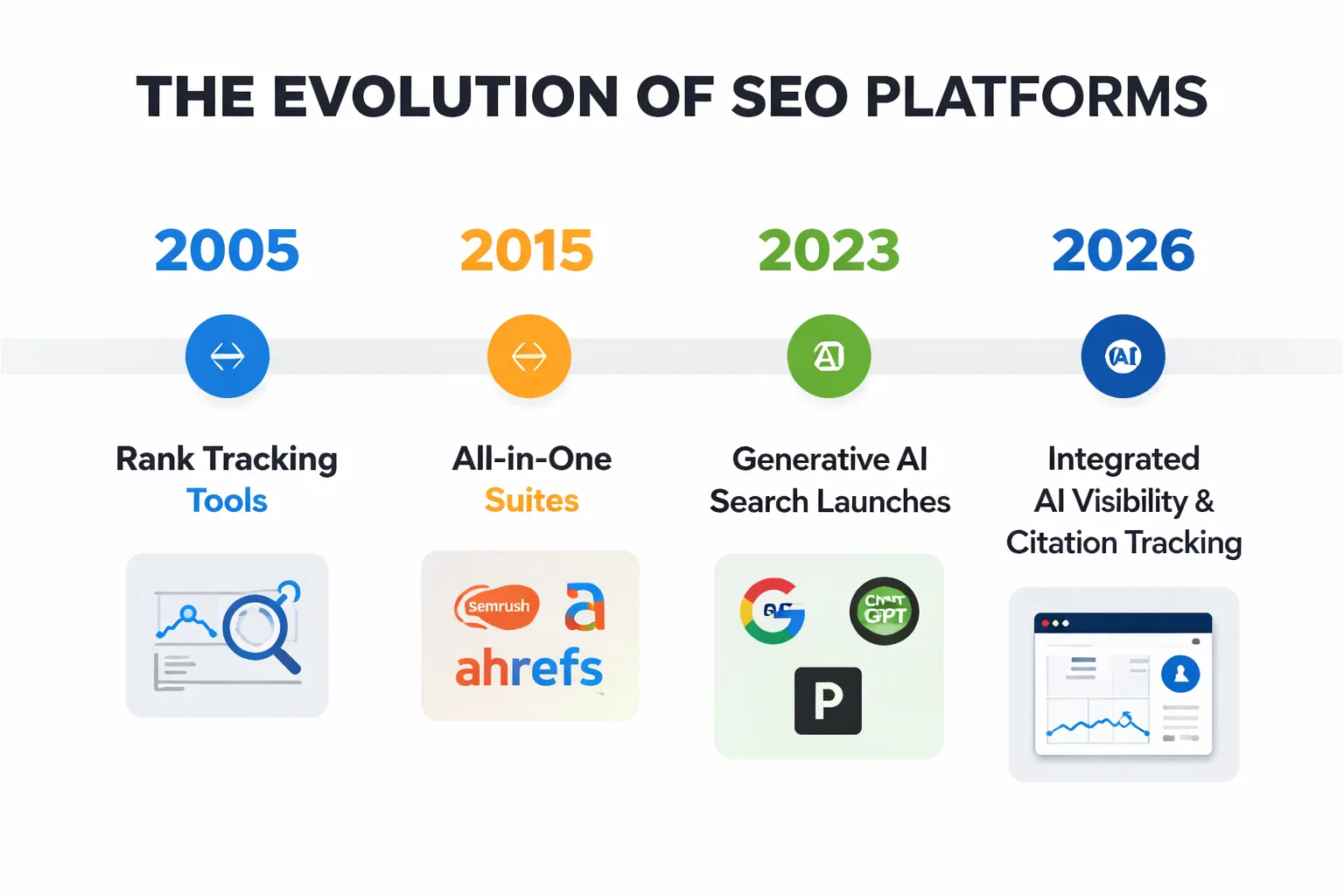
Google AI Overviews, ChatGPT search, and Perplexity created a new visibility layer that traditional platforms don't measure. Aleyda Solís warned about this exact scenario: treating traffic-based metrics as a proxy for AI visibility is a mistake. Companies see organic traffic remain stable while their content gets deprioritized or excluded from AI citations entirely. By the time the traffic drops, the competitive damage has already compounded.
The numbers tell the story. ChatGPT handles over 2 billion queries daily, and AI-referred sessions grew 527% year-over-year through mid-2025. That's not a trend you can ignore by checking your Google Search Console dashboard. The traffic is flowing through a different pipe now, and most platforms don't have sensors on it.
Eli Schwartz made a point that resonated with me: traditional SEO agencies are struggling to justify fees as AI-generated overviews consume clicks that once drove traffic to websites. The same disruption is hitting platforms. If your platform sold you on rank tracking and content generation, and now ranks don't translate to traffic because AI answers absorb the click, what exactly are you paying for? The platforms that adapt are building AI visibility tracking directly into their core workflow. The ones that don't are selling you 2018 software at 2026 prices.
The mechanics of the disruption are worth understanding. When Google shows a traditional SERP, ten blue links compete for clicks. Position one gets roughly 27% of clicks. Position two gets 15%. The distribution is well-documented and predictable. When Google shows an AI Overview, it generates a synthesized answer at the top of the page. The user reads the summary, sees cited sources, and may or may not click through. The Ahrefs study found that AI Overviews reduce organic CTR for position-one content by 58%. That means the #1 organic result loses more than half its clicks when an AI Overview appears above it. Your platform needs to tell you when AI Overviews appear for your target keywords, not just where you rank.
Core Features Every SEO Platform Needs in 2026
Let's get specific. Here's what a legitimate search engine optimization platform must include this year.
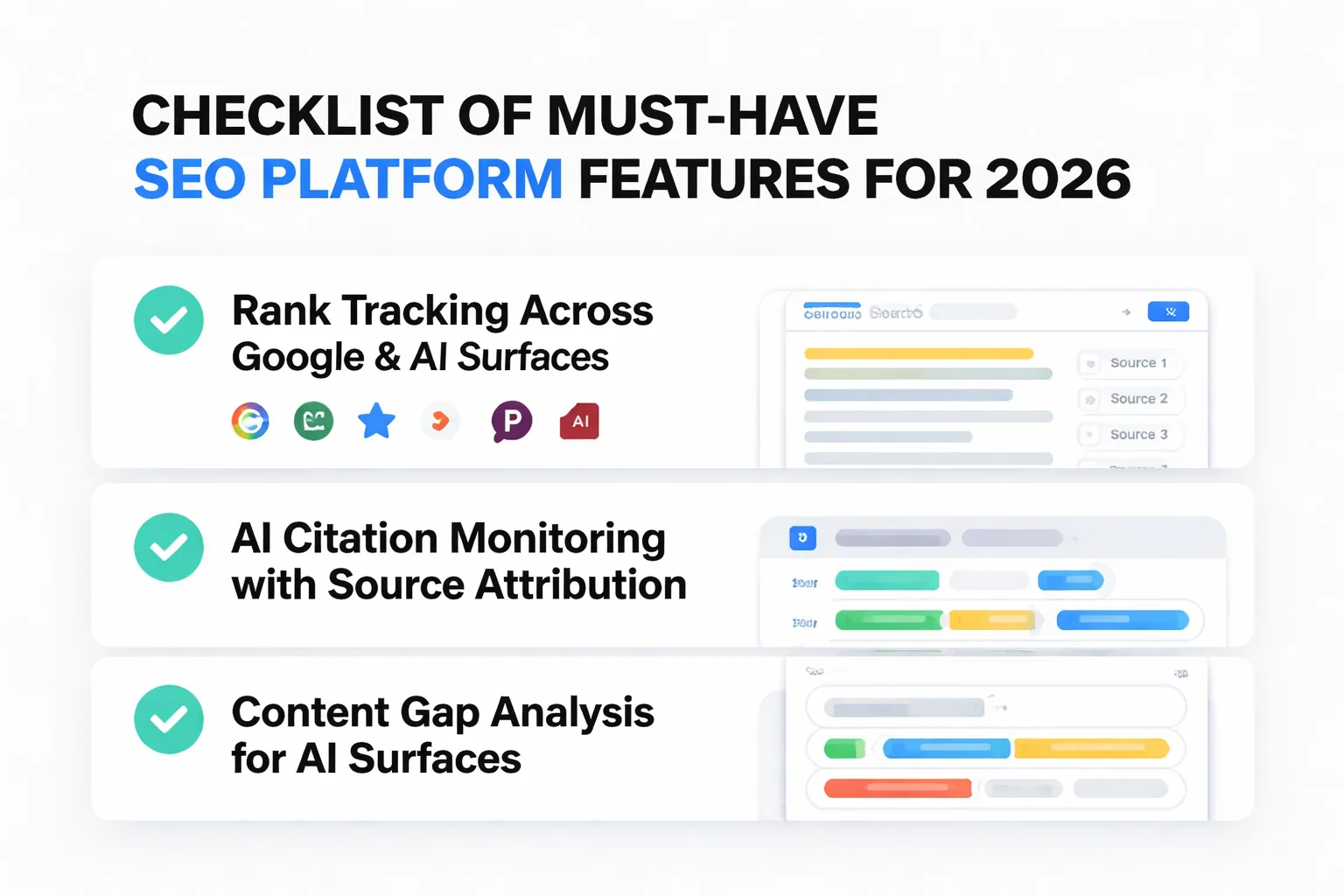
Rank tracking across Google and AI surfaces. Traditional Google rank tracking is table stakes. The differentiator is whether the platform also tracks where your brand appears in AI-generated answers. That means monitoring ChatGPT, Claude, Gemini, Perplexity, Grok, Google AI Overviews, and AI Mode. Not as a bolt-on feature. As a core dashboard.
AI citation monitoring with source attribution. When an AI engine cites your brand, you need to know where in the answer you appear (first mention, in a list, last), what the full response text says, and which sources the AI used to build that answer. A Perplexity AI visibility checker or ChatGPT visibility tool should be part of the platform's native capability, not a separate subscription.
Content gap analysis for AI surfaces. Traditional content gap tools show you keywords competitors rank for that you don't. AI content gap analysis goes further: it shows you prompts where competitors are cited in AI answers and you're absent. This is a fundamentally different dataset. A keyword gap might show you're missing "best CRM for startups." An AI citation gap shows you that when someone asks ChatGPT "what's the best CRM for a 5-person startup," your competitor gets named and you don't.
Entity grounding and knowledge graph presence. AI engines build answers from structured data and entity relationships, not just keyword-matched pages. Your platform needs to assess whether your brand exists as a recognized entity in Wikidata, Google's Knowledge Graph, and the sources that LLMs use for grounding. Without entity presence, you're invisible to AI systems regardless of how good your content is. This connects directly to answer engine optimization as a practice.
Content publishing workflow with quality controls. A platform in 2026 shouldn't just analyze. It should help you close the gaps it finds. That means integrated content generation, quality gating (not just publishing whatever an LLM spits out), and direct CMS publishing with automatic indexing. The quality gate is the part most platforms skip. I've seen what happens when teams skip it: factual errors, choppy sentences, and machine-voice content that tanks engagement.
Here's a research finding that surprised me. A PwC/arXiv study benchmarking 14 LLMs found that citation factual accuracy ranges from 39% to 77%, even when link validity exceeds 94% and relevance exceeds 80%. That means an AI engine can cite a URL that works, point to a topically relevant page, and still get the facts wrong more than half the time. Your platform needs to verify citations, not just count them.
The implication for platform buyers is severe. If your platform reports that you're "cited in 45 AI answers this week," but 23 of those citations contain factually inaccurate information about your product, you're not winning. You're being misrepresented at scale. A 2026 platform needs to go beyond citation counting. It needs to surface the actual response text so you can verify what the AI said about you. And it needs to track citation accuracy trends over time, because LLM behavior changes with every model update.
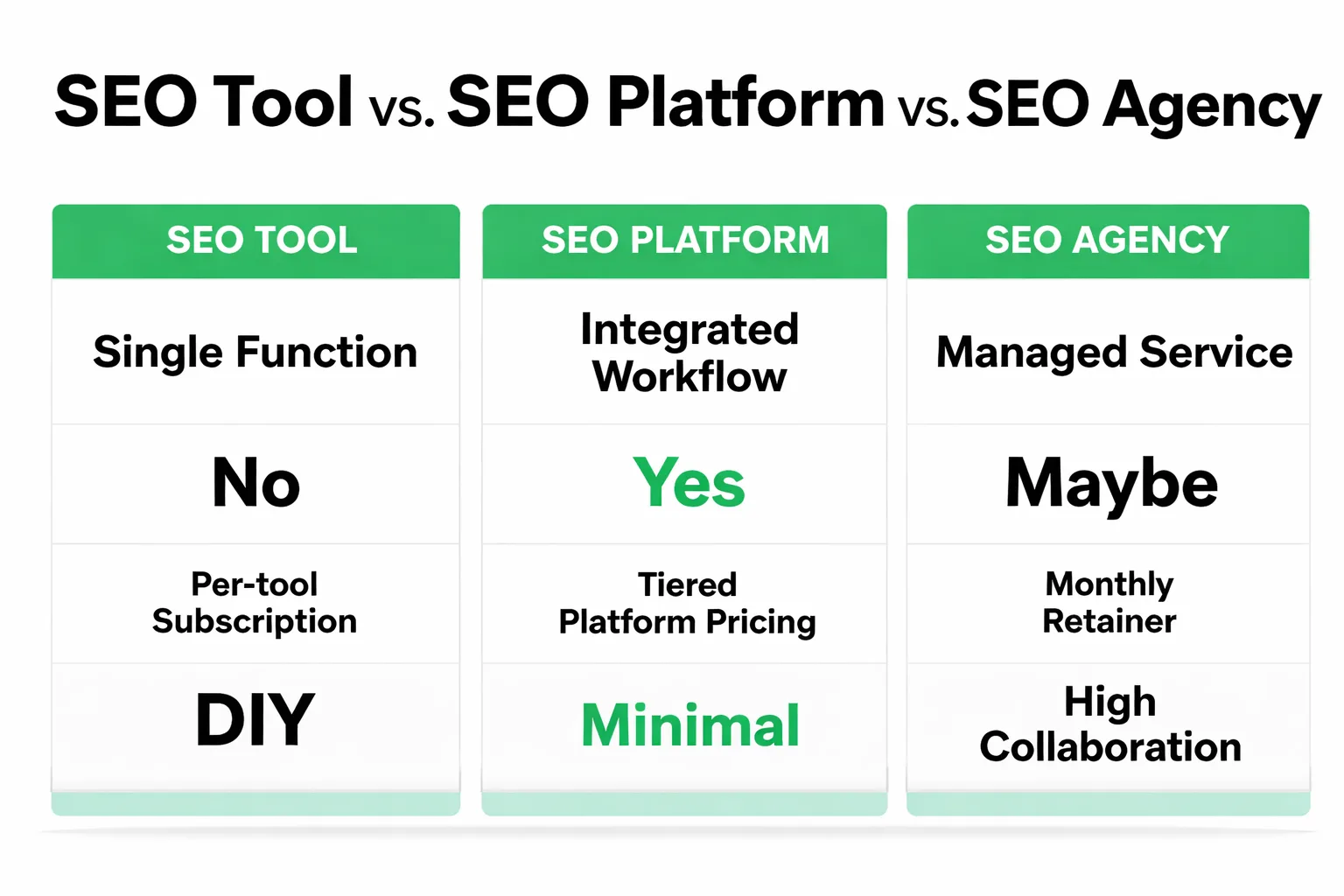
SEO Platform vs. SEO Tool vs. SEO Agency
These three categories get conflated constantly, and the confusion costs buyers real money. Let me draw clear lines.
A tool solves one problem. Ahrefs started as a backlink analysis tool. Surfer was a content optimization tool. A website rank checker tracks positions. Tools are valuable because they go deep on a single function. But they don't talk to each other. You export from one, import into another, and manually stitch insights together in a spreadsheet. That's not a workflow. That's duct tape.
A platform integrates multiple functions into a closed loop. It measures visibility (Google + AI), identifies gaps, helps you create content to fill those gaps, publishes that content, and re-measures. The key word is "closed loop." When you fix a gap, the platform should reflect the improvement in its next measurement cycle. Tools give you data. Platforms give you a system.
An agency is a managed service. You pay humans to do the work that a platform automates. Agencies are appropriate when you need strategic guidance, custom implementations, or industry-specific expertise that software can't provide. But agencies that haven't adapted to AI search are selling you the same ranking-focused services that worked in 2020. Eli Schwartz's observation about agencies struggling to justify fees applies here. If your agency's monthly report shows keyword rankings but no AI citation data, you're paying for yesterday's results.
The practical question is which combination you need. A small team might use a platform as their entire SEO operation. A larger team might use a platform for execution and an agency for strategy. A solo founder might start with a few tools and upgrade to a platform when the manual stitching becomes unsustainable. The mistake is buying an agency when you need a platform, or buying five tools when you need one integrated system.
Let me give you a concrete example of how this plays out. I worked with a SaaS company spending $4,000 monthly on three separate tools: one for rank tracking ($99/month), one for content optimization ($89/month), and one for backlink monitoring ($99/month). They also had a part-time SEO consultant ($3,500/month) who stitched the data together in weekly reports. Total spend: roughly $3,800 monthly for tools and consultant. The consultant's reports showed keyword positions and backlink growth. Nobody could answer whether ChatGPT cited the brand. Nobody could identify which AI prompts triggered competitor mentions. They replaced the entire stack with a single platform at $269/month that tracked AI visibility, generated content to fill citation gaps, and published directly to WordPress. The consultant shifted to strategic review instead of data stitching. The platform didn't just save money. It surfaced visibility data that the old stack literally could not see.
Is your current platform tracking AI citations, or just Google rankings?
How Does AI Citation Tracking Actually Work?
AI citation tracking works by sending prompts to LLMs and analyzing their responses for brand mentions, competitor mentions, and source URLs. The platform queries AI engines with prompts relevant to your industry, captures the full response text, identifies where your brand appears (or doesn't), and maps which sources the AI cited to build that answer. This is fundamentally different from traditional rank tracking, which checks your position on a SERP for a keyword.
The mechanics matter because they determine data quality. Some platforms scrape AI responses, which is fragile and inconsistent. Others use direct API integrations with LLMs, which is more reliable and allows for consistent measurement over time. The platforms worth buying use direct integrations. Scraping breaks when an AI engine changes its UI, which happens constantly.
The output should give you three things per prompt: whether your brand was mentioned, where in the response it appeared (first mention matters more than last), and which external sources the AI used to construct its answer. That third piece is gold. If you know that AI engines cite Domain X and Domain Y for your topic, you can target those domains for outreach and mentions. That's how you build AI search visibility systematically instead of hoping the LLM notices you.
There's a measurement challenge that most platforms gloss over. LLM responses are non-deterministic. Ask ChatGPT the same prompt twice and you may get different answers with different citations. This means a single snapshot is unreliable. A robust platform needs to query each prompt multiple times over a period and aggregate the results to identify stable patterns. If your brand appears in 7 out of 10 queries for a given prompt, that's a 70% citation rate for that prompt. If it appears in 1 out of 10, that's noise. Platforms that report a single snapshot as "you are cited" or "you are not cited" are giving you misleading data. The right approach is probabilistic: citation rate per prompt, tracked over time, with trend lines that show whether your visibility is improving or degrading.
The ChatGPT AI visibility checker approach illustrates this well. Instead of checking a prompt once, it runs the prompt across multiple sessions and tracks mention position, sentiment, and source attribution across all runs. This gives you a citation stability score that single-snapshot tools simply can't provide.
Why Does Entity Grounding Matter for AI Search?
Entity grounding matters because AI engines don't read the web the way Google's crawler does. They build answers from structured entity relationships stored in knowledge graphs. If your brand isn't a recognized entity in those graphs, AI engines literally don't know you exist.
Think of it this way. Google's crawler visits your page, reads the HTML, and indexes the content. That's how traditional SEO works. An LLM like ChatGPT builds answers from its training data and from real-time retrieval of sources it trusts. Those trusted sources are heavily weighted toward structured data: Wikidata entries, Wikipedia articles, knowledge graph panels, and high-authority third-party mentions. Your beautifully optimized blog post about your product doesn't register if it's not connected to an entity the LLM recognizes.
This is why I tell teams that what is AI search optimization is really a question about entity presence. You need to exist as a structured entity before any content strategy matters. That means claiming and enriching your Wikidata entry, building Wikipedia presence (if notable enough), getting listed in industry databases and directories that AI engines use as reference sources, and earning mentions from publishers that LLMs trust. The content you publish on your own site is the last step, not the first.
Let me make this tangible. Say you sell accounting software for freelancers. Your blog has 200 well-optimized posts. You rank on page one for "best freelance accounting software." But when someone asks ChatGPT "what's the best accounting software for freelancers," the AI names three competitors and never mentions you. Why? Because those competitors have Wikidata entries with structured properties (industry, product type, target audience, founding date). They have Wikipedia pages. They're mentioned in "comparison of accounting software" lists on high-authority sites. Your 200 blog posts exist in a content silo that the LLM's retrieval system doesn't weight heavily. Entity grounding is the bridge between your content and the LLM's answer-building process. Without it, your content is invisible to AI regardless of its quality.
A platform that assesses entity grounding should tell you: does your brand have a Wikidata entry? Is it complete? Does it have the right properties? Are you mentioned in the authoritative third-party sources that AI engines cite for your category? If the platform can't answer these questions, it's not evaluating the full picture.
When Should You Invest in a Full Platform?
The trigger is simple: when the cost of stitching tools together exceeds the cost of a platform, you buy the platform. For most small teams, that happens when you're managing more than two tools manually and still can't answer the question "are we cited in AI answers?"
There's a sizing question too. A solo founder or a two-person marketing team doesn't need an enterprise platform with 15 domains and 10 seats. They need a platform that covers one domain, tracks AI visibility across all major surfaces, and includes content publishing so they can close gaps without hiring a writer. The pricing should be transparent. If you have to get on a sales call to learn what the platform costs, that's a red flag.
Data freshness is another criterion. Google SERP data should refresh at least weekly. AI surface data is harder to refresh because LLM responses are non-deterministic, but the platform should have a clear refresh cadence. Daily for SERP-driven surfaces like AI Overviews. Rolling for LLM-driven surfaces. If the platform can't tell you when its AI data was last refreshed, you're working with stale information.
Approval workflows matter more than people think. A platform that auto-publishes AI-generated content without human review is dangerous. I've tested this. The content quality from raw LLM output without editorial gating is abysmal. The AEO vs. SEO distinction matters here. AEO requires higher content quality standards because AI engines are pickier about what they cite than Google is about what it ranks. Your platform needs a quality gate that blocks weak drafts before they reach your CMS.
The approval workflow should be specific. It's not enough to have a "draft" status. The platform should block publication based on objective quality criteria: factual claims must be source-traced, content must meet a minimum quality score across multiple dimensions, and potential Google penalty risks must be flagged. I've seen platforms that publish whatever the LLM generates with a single click. That's not a workflow. That's a liability. A 16-dimension quality firewall that blocks articles scoring below 70 out of 100 from auto-publishing is the kind of gate that separates a platform from a toy. The gate should check article-level signals (factual accuracy, structural completeness, originality, readability) and portfolio-level signals (cannibalization risk, duplicate content, topical overlap with existing pages).
What Agentic SEO Means for Platform Buyers
Agentic SEO is the next evolution, and it's already arriving in platforms. The concept is simple: instead of humans manually executing SEO tasks (research keywords, write content, check rankings, repeat), AI agents handle the execution loop continuously. The platform discovers opportunities, creates content, publishes it, measures results, and adjusts. All autonomously, with human approval at critical checkpoints.
Siteimprove and Frase both position agentic SEO as a shift from reactive, manual SEO to proactive, continuous AI-driven optimization. I agree with the framing. The question for buyers is whether the platform's agentic features are real or marketing fluff.
Real agentic SEO means the platform can autonomously discover topics from multiple sources (Google Trends, RSS feeds, Reddit, Search Console), prioritize them based on your AI visibility gaps, generate archetype-specific content (a listicle shouldn't be written the same way as an explainer), gate that content through a quality check, publish it to your CMS, submit it for indexing, and then measure whether it moved the needle on AI citations. If the platform just has a "generate content" button that spits out a generic article, that's not agentic. That's a chatbot with a CMS integration.
The generative engine optimization angle ties in here. GEO is the practice of optimizing content specifically for AI-generated answers. Agentic SEO automates the GEO workflow. The platform finds where you're absent from AI answers, creates content designed to get cited, and measures whether citations increase. That closed loop is what separates a 2026 platform from a 2023 tool with an AI feature bolted on.
Here's a concrete example of how agentic SEO changes the daily workflow. In the old model, a marketing manager spends Monday researching keywords. Tuesday writing briefs. Wednesday reviewing drafts. Thursday editing. Friday publishing. The following week, they check rankings. The loop takes two weeks minimum. In an agentic model, the platform identifies a citation gap on Monday morning (competitor cited for "best invoicing software for contractors," you're absent). By Monday afternoon, it has drafted a fact-verified article targeting that prompt. The quality firewall has already blocked and regenerated the draft twice because the first version had unsourced claims. By Tuesday, the article passes the gate and lands in the approval queue. The marketing manager reviews it (15 minutes, not 5 hours), approves, and the platform publishes to WordPress, pings IndexNow, and submits the sitemap to Google Search Console. By Friday, the platform is already measuring whether the article moved the needle on AI citations for that prompt. The loop that took two weeks now takes two days, with 15 minutes of human input instead of 20 hours.
How to Evaluate Whether a Platform Fits Your Team
Let's make this concrete. Here are the criteria I use when evaluating a search engine optimization platform for a small team.
AI surface coverage. Does the platform track all major AI search surfaces? That means ChatGPT, Claude, Gemini, Perplexity, Grok, Google AI Overviews, and AI Mode. Not three of them. Not "ChatGPT and Perplexity." All of them. If a platform covers fewer surfaces, it's giving you a partial picture. You wouldn't accept a rank tracker that only checks Google on even-numbered days. Don't accept an AI visibility tool that only checks two LLMs.
Citation depth, not just mentions. Mention tracking tells you whether your brand was named. Citation tracking tells you whether your content was sourced. Both matter, but citation depth is what drives the AEO vs. GEO strategy. You want to know which of your pages AI engines cite, which competitor pages they cite instead of yours, and what topics trigger those citations.
Content quality controls. The platform should have a quality gate that blocks weak content before publish. I'm not talking about a spellcheck. I mean a multi-dimensional quality assessment that evaluates factual accuracy, structural completeness, originality, and penalty risk. A 16-dimension quality firewall is what I'd consider the baseline for any platform that auto-publishes content. Without it, you're publishing AI slop that Google penalizes and AI engines ignore.
Pricing transparency. You should be able to see every tier, every limit, and every feature on a pricing page. No "contact sales" for a self-serve product. The tiers should scale logically: more domains, more articles, more prompts, more seats. Annual billing should offer a clear discount. If the pricing page requires a demo call, the platform is either too expensive for your team size or not confident enough in its value to show the price.
Publishing and indexing integration. The platform should publish directly to your CMS (WordPress, Ghost, Shopify, Wix) and handle indexing automatically. That means IndexNow pings and Google Search Console sitemap submission on every publish. If you have to manually submit URLs to Google after the platform publishes, the platform isn't closing the loop.
Multi-language support. If your business operates in multiple markets, the platform should generate content in the languages you serve. Not auto-translated English content. Native-tuned content with language-specific prompts. English, Chinese, and Spanish should be natively tuned. French, German, Portuguese, and Japanese should at minimum be supported with auto-stubbed generation. Most platforms are English-only, which means your international AI visibility is unmeasured and unaddressed.
Self-learning capability. The platform should analyze your published content patterns monthly and refine its future writing based on what's working. If every article is generated from the same static prompt template, the content will plateau in quality. A self-learning engine that adjusts retrieval weights, archetype structures, and quality criteria based on your actual performance data is what separates a platform that improves over time from one that degrades.
The Ecommerce Blind Spot
Here's something most platform reviews completely miss. If you're in ecommerce, the AI search disruption is even more severe than for other industries.
According to research cited by practitioners in the field, 70% of leading retailers don't meet Google's Universal Commerce Protocol for agentic commerce. The problem isn't site quality. The problem is that these retailers haven't structured their product data for AI agents to read and recommend products within conversational interfaces. An ecommerce site with perfect product pages, brilliant copy, and solid Google Ads remains invisible when customers decide to purchase inside ChatGPT instead of visiting the website.
This is the ecommerce GEO and agentic commerce challenge. The AI agent reads product feeds and schema markup, not page design or copy. Your platform needs to audit whether your product data is structured for AI consumption, not just whether your pages load fast and rank for commercial keywords. Ecommerce optimization has been traffic-focused for 30 years. The transaction locus is shifting from the website to the AI conversation interface, and most platforms haven't caught up.
If your platform doesn't have an ecommerce-specific module for agentic commerce readiness, you're flying blind. The green dashboard that says your rankings are up means nothing when your customers are buying inside ChatGPT and never visiting your site.
The practical implication is that ecommerce teams need to audit their product schema, feed structure, and entity data with a completely different lens. Are your products represented as structured entities with properties that AI agents can parse (price, availability, specifications, reviews)? Is your product data accessible via API or structured feeds that AI agents can query? When a customer asks ChatGPT "find me a blue wool sweater under $100 with free returns," does the AI agent have access to your inventory data, or does it only know about competitors who have structured their feeds properly? These are questions your SEO platform should help you answer. If it can't, you're in the 70% of retailers who are invisible to agentic commerce.
What AI Search Optimization Results Actually Look Like
Data on AI search optimization results is still emerging, but early case studies are telling. According to research from the Hedges Company on AI search optimization in the automotive parts industry, websites implementing AI-targeted content optimization achieved a 10% increase in engaged sessions per active user and a 15% increase in engagement rate. Interestingly, those same sites saw a 26% decrease in average engagement time per session.
That last number deserves attention. A 26% decrease in session duration sounds bad in traditional SEO terms. But in the AI search context, it actually signals efficiency. Users who arrive from AI-generated answers have already been pre-qualified by the AI's summary. They know what they want. They don't need to browse. They convert faster and leave. The engagement rate goes up (more meaningful interactions per session) while the time on site goes down (less browsing, more doing). Your platform needs to track these new engagement patterns, not just time-on-page metrics that made sense in the browsing era.
This data point also highlights why ai and search engine optimization require different success metrics. Traditional SEO rewards dwell time and pageviews. AI search optimization rewards precision and conversion speed. A platform that measures only traditional engagement metrics will misinterpret the AI search traffic pattern as a problem (time on site dropping) when it's actually a sign of better-qualified traffic.
What This Actually Means for Buyers
The definition of an SEO platform has fundamentally changed. In 2026, a search engine optimization platform must measure visibility across both traditional search and AI-generated answers, help you close the gaps it finds through quality-gated content, and track whether those efforts result in AI citations. Anything less is a tool wearing a platform's clothes.
The buying decision comes down to one question: can the platform tell you where you're invisible? If it can only show you where you rank on Google, it's answering yesterday's question. Today's question is whether ChatGPT, Perplexity, and Google AI Overviews mention your brand when prospects ask about your category. If your platform can't answer that, you're the SEO director in the opening story. Green dashboards. Blind to reality.
The platforms that win in 2026 will be the ones that treat AI visibility as a first-class metric, not a feature flag. They'll track citations, measure entity presence, gate content quality, and close the loop between diagnosis and action. They'll be built for the world where search happens inside conversations, not just on result pages. And they'll be priced for small teams that need to compete without running a full content operation.
That's the buyer's definition. Anything else is a tool.
FAQ
What's the difference between an SEO platform and an SEO tool?
An SEO tool solves one problem (rank tracking, backlink analysis, content editing). An SEO platform integrates multiple functions into a closed loop: measure visibility, find gaps, create content, publish, and re-measure. Tools give you data points. Platforms give you a system that acts on that data.
How much does an SEO platform cost in 2026?
Pricing ranges from $49/month for entry-level platforms with basic AI visibility tracking to $599/month for agency-tier platforms with multi-domain management, full LLM coverage, and content publishing. The key is transparent pricing. If a platform hides its pricing behind a sales call, it's likely overpriced for small teams.
Can an SEO platform replace an SEO agency?
For execution, yes. A platform can handle rank tracking, AI visibility monitoring, content creation, publishing, and reporting. For strategy, an agency adds value if they understand AI search. If your agency's reports show keyword rankings but no AI citation data, the platform has already surpassed them.
How often should AI visibility data refresh?
SERP-driven surfaces like Google AI Overviews should refresh daily. LLM-driven surfaces like ChatGPT and Claude should refresh on a rolling basis, typically weekly. If a platform can't tell you when its AI data was last updated, the data is likely stale.
What is the difference between AEO and GEO?
AEO (Answer Engine Optimization) focuses on getting your content cited in AI-generated answers across all AI search surfaces. GEO (Generative Engine Optimization) is a subset focused specifically on generative AI engines. The distinction matters because different surfaces have different citation patterns and content preferences.
Do I need entity grounding if I already rank well on Google?
Yes. High Google rankings don't guarantee AI citations. AI engines build answers from structured entity relationships in knowledge graphs, not just keyword-matched pages. If your brand isn't a recognized entity in Wikidata and other knowledge sources, AI systems won't reference you regardless of your Google position.
What should I look for in a platform's content quality controls?
Look for a multi-dimensional quality assessment that evaluates factual accuracy, structural completeness, originality, readability, and Google penalty risk. The platform should block articles below a quality threshold from auto-publishing. A 16-dimension quality firewall with a minimum score of 70 out of 100 is the baseline standard for 2026 platforms.
About the Author
Judy Zhou, Founder
Judy Zhou leads content strategy at Meev, where she oversees AI-driven content research and publishing for hundreds of brands. With a background in SEO and editorial operations, she focuses on building content systems that rank on Google, get cited by AI search engines, and drive measurable business results.
See exactly where your brand is cited across every major AI search surface, and close the gaps with quality-gated content your team approves before publish.