

By Judy Zhou, Founder
Key Takeaways
- An AI SEO agent autonomously researches, creates, and publishes content optimized for AI surfaces like ChatGPT, Perplexity, and Google AI Overviews, closing the loop from citation-gap diagnosis to direct CMS publication.
- 76.95% of cited URLs in AI answers fall outside the organic top 10, so traditional rank tracking no longer predicts visibility.
- Wikipedia accounts for 12-13% of ChatGPT citations, making it a higher-impact target than most organic rankings.
- Marketers already spend $100M+ per year on AI visibility tracking despite zero peer-reviewed studies confirming measurement consistency.
Your SEO strategy was built for a search engine that no longer runs the game.
An AI SEO agent is software that autonomously researches, creates, and publishes content optimized for AI search surfaces like ChatGPT, Perplexity, and Google AI Overviews. Unlike traditional SEO tools that only report rankings, an AI SEO agent closes the loop: it diagnoses citation gaps, writes answer-engine-optimized content, tracks LLM citation rates across every major AI engine, and publishes directly to your CMS. The category exists because 76.95% of cited URLs in AI answers fall outside the organic top 10 (OrganiKPI, May 2026), meaning traditional rank tracking no longer predicts AI visibility. Wikipedia accounts for 12-13% of ChatGPT citations (Similarweb, Jan-Feb 2026), and $100M+ per year is already spent on AI visibility tracking despite zero peer-reviewed studies validating whether AI recommendations are consistent enough to measure (SparkToro). The shift from answer engine optimization to fully agentic SEO is not a future trend. It is the current operating reality.
What Is an AI SEO Agent?
An AI SEO agent is software that autonomously researches, creates, and publishes content optimized for AI search surfaces. That is the concise definition. Now unpack it.
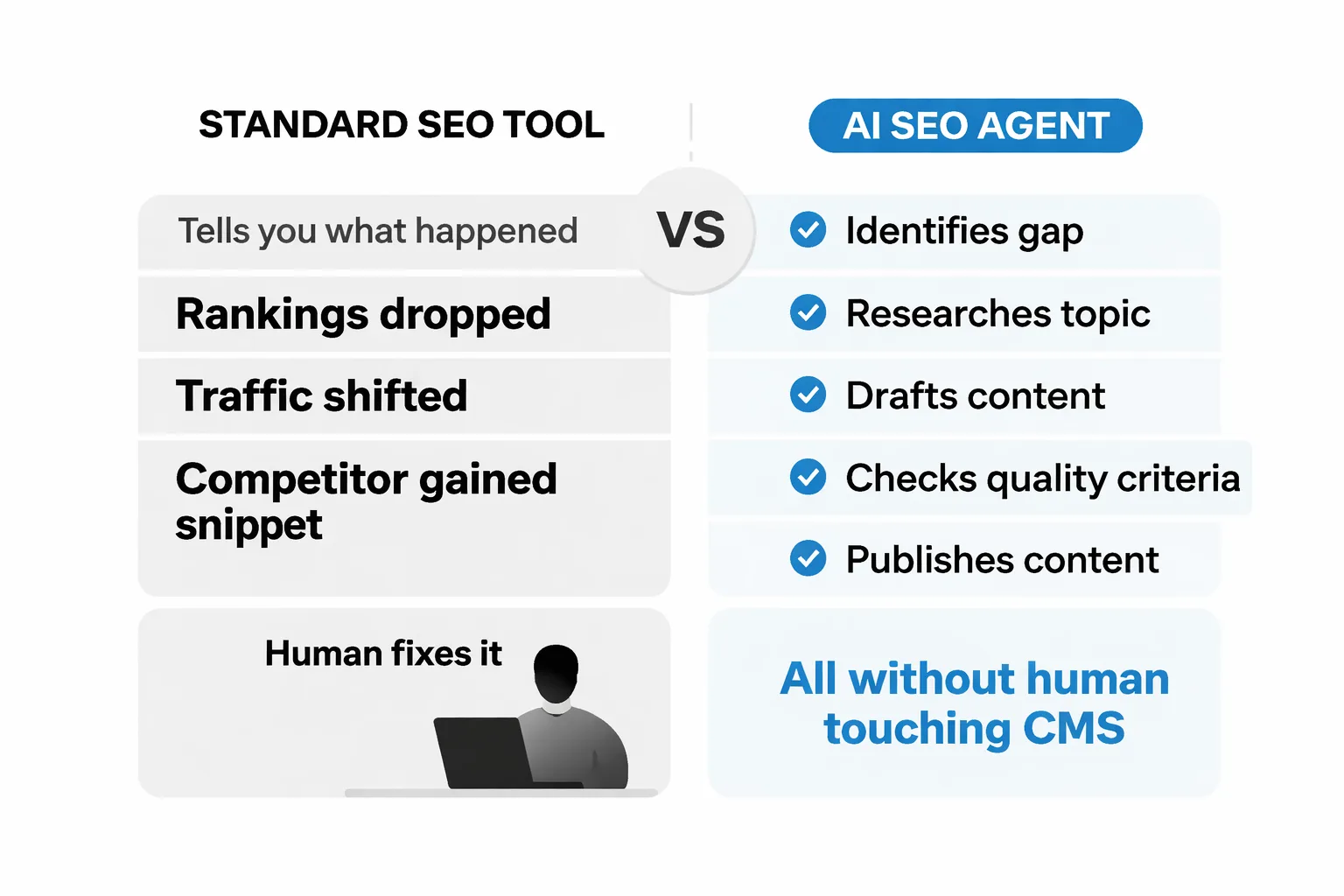
The word "agent" does the heavy lifting here. A standard SEO tool tells you what happened. It shows your rankings dropped, your traffic shifted, or a competitor gained a featured snippet. Then you, the human, go fix it. An agent does the fixing. It identifies the gap, researches the topic, drafts the content, checks it against quality criteria, and publishes it. All without you touching the CMS.
But here is where the 2026 definition diverges from what most people picture. The old mental model of an AI SEO agent was a smarter version of a content generator: you give it a keyword, it writes a blog post, it publishes. That is not agentic. That is automation with extra steps. A true ai seo agent operates against a different goal entirely. Its objective is not to rank on page one of Google. Its objective is to be cited inside AI-generated answers.
That distinction changes everything about how the agent works. It does not just write content. It writes content structured for extraction by large language models. It does not just track rankings. It tracks whether ChatGPT, Perplexity, Gemini, Grok, and Google AI Overviews mention your brand, where in the answer you appear, and which sources those engines cite instead of you. It does not just optimize for keywords. It optimizes for entity grounding, ensuring your brand exists as a disambiguated entity in knowledge graphs like Wikidata, because that is how AI systems resolve what a brand actually is.
This is why the definition has to be forward-looking. An AI SEO agent that only does keyword research and content generation is a 2024 tool with a 2026 label. The real definition includes the full closed loop: diagnose AI citation gaps, generate answer-engine-optimized content, publish it, track whether it moved the needle on AI visibility, and repeat. Anything less is a feature, not an agent.
How an AI SEO Agent Differs from a Standard SEO Platform
The difference between a standard SEO platform and an AI SEO agent is the difference between a thermometer and a thermostat. A thermometer tells you the temperature. A thermostat changes it.
Standard SEO platforms (Ahrefs, Semrush, Moz, the usual suspects) are thermometers. They measure. They report. They show you keyword positions, backlink profiles, site audit scores, and SERP feature occupancy. The intelligence is in the presentation. You still have to interpret the data, decide what to do, write the content, publish it, and wait.
An AI SEO agent is a thermostat. It measures, decides, acts, and measures again. The distinction matters because the gap between diagnosis and action is where most SEO programs stall. A team gets a site audit showing 200 missing meta descriptions, 40 broken internal links, and 15 thin-content pages. Three weeks later, half of those issues are still there. Not because the team is lazy. Because the distance between "here is the problem" and "here is the fix" requires human bandwidth that small teams do not have.
The aeo vs seo comparison makes this concrete. Traditional SEO platforms track blue-link rankings. AI SEO agents track whether your brand appears inside AI-generated answers across ChatGPT, Claude, Gemini, Perplexity, Grok, Google AI Overviews, and AI Mode. These are fundamentally different measurements. You can rank #1 for a keyword and still be invisible in AI answers, because AI engines synthesize information from sources that may not include the top-ranking page.
Here is the structural breakdown:
| Capability | Standard SEO Platform | AI SEO Agent |
| Primary goal | Rank #1 on Google SERP | Be cited in AI-generated answers |
| What it tracks | Keyword positions, backlinks, site health | LLM citation rates, mention position, share of voice across AI engines |
| What it produces | Reports, dashboards, recommendations | Published, fact-verified content on your CMS |
| Human involvement | High. Human writes and publishes | Low. Human approves, agent executes |
| Entity focus | Keywords and links | Knowledge graph presence, Wikidata QIDs, entity disambiguation |
| Optimization target | Search engine crawlers | LLM retrieval and extraction systems |
| Feedback loop | Manual: check rankings, adjust, repeat | Autonomous: detect gap, write, publish, re-measure |
The last row is the one that matters most. The feedback loop determines whether the tool is agentic or passive. A standard SEO platform gives you data. You act on it. Weeks pass. You check if it worked. An AI SEO agent compresses that cycle to hours or days. It detects a citation gap (your competitor is cited for a topic where you have expertise), researches the topic, drafts an article structured for AI extraction, runs it through a quality firewall, publishes it, and then monitors whether the AI engines start citing you instead. That is the closed loop.
One more thing the comparison table does not capture: the underlying technology. Standard SEO platforms are built on crawlers and keyword databases. AI SEO agents are built on LLMs, retrieval-augmented generation (RAG) pipelines, and agentic frameworks that allow multi-step execution. The agent does not just retrieve data. It reasons about what to do with it.
What to Look for When Evaluating AI SEO Agents
Most teams evaluating AI SEO agents focus on the wrong things. They look at content generation speed, keyword coverage, or the number of integrations. Those are features. The criteria that actually determine whether an agent will move your AI visibility are structural.
Here are the non-negotiables.
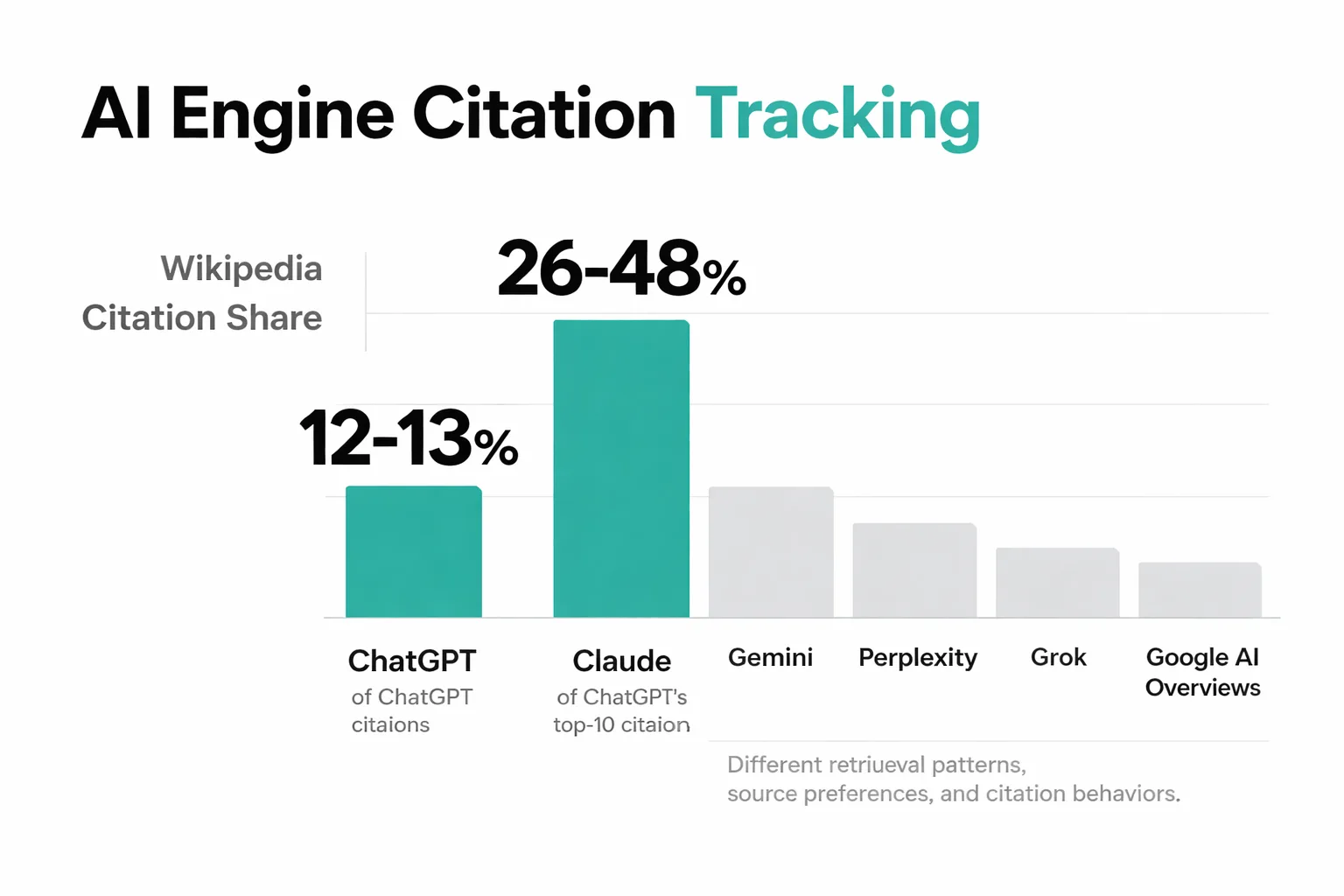
Multi-engine AI citation tracking. If the agent only tracks ChatGPT, it is blind to 80% of the AI search market. You need coverage across ChatGPT, Claude, Gemini, Perplexity, Grok, Google AI Overviews, and AI Mode. Each engine has different retrieval patterns, different source preferences, and different citation behaviors. Wikipedia accounts for 12-13% of ChatGPT citations (Similarweb) but 26-48% of its top-10 citation share (5WPR, May 2026). That gap tells you different engines weight sources differently, and your agent needs to see all of them. A tool that only checks one or two engines gives you a distorted picture.
Source attribution visibility. When an AI engine cites your competitor instead of you, you need to know which source it cited. Not just the domain. The specific page. Without source-level attribution, you cannot close the gap. You are flying blind. The agent should show you the exact response text behind every mention, the citation URL, and the position of your brand within the answer (first, in a list, last). Position matters enormously. Being mentioned last in a list of five tools is not the same as being recommended first.
This is where the framing problem becomes critical. An AI can cite your brand but frame you as a "good starting point" before suggesting a more advanced competitor. That mention counts as visibility in a dashboard, but it actively funnels users away. The metric that matters is not mention rate but favorable framing. Yet most tracking tools cannot distinguish between a positive recommendation and a dismissive name-drop. When evaluating an AI SEO agent, ask whether it captures the context and sentiment of mentions, not just their existence.
Human-approval workflows. This is the anti-slop criterion. Google's Helpful Content System updates have been ruthless against low-quality AI content. Without human oversight, AI-generated content gets flagged and removed, leading to sharp traffic and revenue declines. The agent must have a quality firewall that blocks weak drafts before they reach your CMS. Look for multi-dimensional quality scoring (not just a single "quality score"), plagiarism detection, fact verification with source tracing, and a human approval gate on every article before publish. If the agent auto-publishes without approval, you are one algorithm update away from a penalty.
Accuracy of mention-rate data. This is the sleeper issue. SparkToro found zero peer-reviewed studies validating AI recommendation consistency despite $100M+ per year already spent on AI visibility tracking (SparkToro). LLMs show high inconsistency when recommending brands. The same prompt can produce different recommendations across sessions. This means single-prompt tests produce unreliable data. A credible ai visibility tool must use multi-session testing, rolling refreshes, and statistical aggregation to separate signal from noise. If the agent reports a mention rate based on a single query per prompt, the number is fiction.
Entity grounding capabilities. This is the most overlooked criterion and arguably the most important for 2026. Wikidata QIDs serve as primary entity disambiguation mechanisms in AI citation behavior (Princeton GEO research). If your brand does not exist as a disambiguated entity in knowledge graphs, AI systems cannot reliably identify what you are, which means they cannot consistently cite you. The agent should be able to identify whether your brand has Wikidata presence, structured data markup, and consistent entity signals across the web. This is not a nice-to-have. It is structural infrastructure for AI visibility.
Want to know if AI search engines are actually citing your brand?
When Does an AI SEO Agent Actually Make Sense?
Not every team needs an AI SEO agent. The honest answer is that some teams are better served by a standard SEO platform and a freelance writer.
The decision comes down to three factors: your AI citation baseline, your team bandwidth, and your content velocity needs.
When the category makes sense. An AI SEO agent is worth investing in when your brand has zero AI citation baseline. If you do not know whether ChatGPT mentions you, Perplexity cites you, or Google AI Overviews include you, you have a measurement problem before you have a content problem. The agent solves both: it establishes the baseline (where you are cited, where you are absent) and then closes the gap (writes content designed to earn citations). This is especially valuable for B2B companies where buying decisions are narrative-driven and a single AI recommendation can influence a procurement cycle.
The category also makes sense when your team lacks bandwidth for a full content operation. A two-person marketing team cannot research topics, write articles, publish them, track AI citations across seven engines, analyze competitor footprints, and do outreach to cited publishers. That is six jobs. The agent compresses those into one workflow with human approval gates.
When simpler tools suffice. If you are a large enterprise with a dedicated content team, ten writers, and an in-house SEO strategist, you may not need an autonomous agent. You need measurement (an llm visibility tool or ai visibility tracker) and human execution. The agent's value proposition is compression of the diagnose-write-publish-measure loop. If you already have humans doing each step well, the agent adds automation overhead without proportional gains.
Similarly, if your audience does not use AI search for discovery, AI citation tracking is premature. Some B2B niches still run on trade publications, direct sales, and industry forums. If your buyers are not asking ChatGPT "which CRM should I use," then optimizing for ChatGPT citations is not where your time should go. The agent becomes valuable when your buyers are asking AI engines questions that your brand should answer.
Here is the decision framework:
| Signal | Invest in AI SEO Agent | Stick with Standard Tools |
| AI citation baseline | Unknown or zero mentions | Already tracked, known position |
| Team size | 1-5 marketers, no dedicated content team | 10+ marketers with content specialists |
| Content velocity | Need 10-80 articles/month, cannot produce manually | Already producing sufficient volume |
| AI search relevance | Buyers use ChatGPT/Perplexity for discovery | Buyers use traditional search or referrals |
| Entity presence | No Wikidata entry, weak knowledge graph signals | Strong entity presence already established |
The contrarian take: most teams evaluating AI SEO agents are asking the wrong question. They ask "which platform do you recommend?" when they should ask "is my brand even visible to AI systems?" The platform question presumes you are ready for an agent. The visibility question determines whether you are. Aleyda Solís warns against treating traffic metrics as a proxy for AI visibility and stresses that reliable AI tracking requires multi-session testing due to inherent response volatility (Search Engine Land). If you have not established whether AI engines can even identify your brand as a distinct entity, no agent will fix that. The agent amplifies what exists. It does not create something from nothing.
Why Entity Grounding Is the Hidden Foundation
Here is what almost no one talks about when discussing AI SEO agents: the work happens before the content is written.
Entity grounding is the process of ensuring your brand exists as a recognized, disambiguated entity in the knowledge graphs that AI systems use for understanding. Wikidata is the primary one. When an LLM encounters your brand name, it needs to resolve what entity that name refers to. If your brand shares a name with a geographic location, a common noun, or another company, the LLM may resolve to the wrong entity. Every piece of content you publish then gets associated with the wrong thing.
This is not theoretical. Wikidata QIDs serve as primary entity disambiguation mechanisms in AI citation behavior (Princeton GEO research). Wikipedia contributes approximately 22% of ChatGPT's training data (ConvertMate, 2026). The knowledge graph is not a nice-to-have. It is the structural foundation that determines whether your content has any chance of being cited.
An advanced AI SEO agent should be able to audit your entity presence. Does your brand have a Wikidata entry? Does that entry have accurate structured data (founding date, industry, key people, official website)? Are your brand's entity signals consistent across your website's schema markup, your Google Business Profile, and third-party data sources? If the answer to any of these is no, content generation is premature. You are building a house on sand.
The best geo tools address this at varying levels, but the entity grounding layer is where the real work happens. Content optimization without entity grounding is like optimizing a billboard that no one can read because the letters are in the wrong font. The content exists, but the AI system cannot parse who it is about.
How Agentic SEO Connects to Generative Engine Optimization
Generative engine optimization (GEO) is the practice of optimizing content specifically for generative AI engines. An AI SEO agent operationalizes GEO at scale.
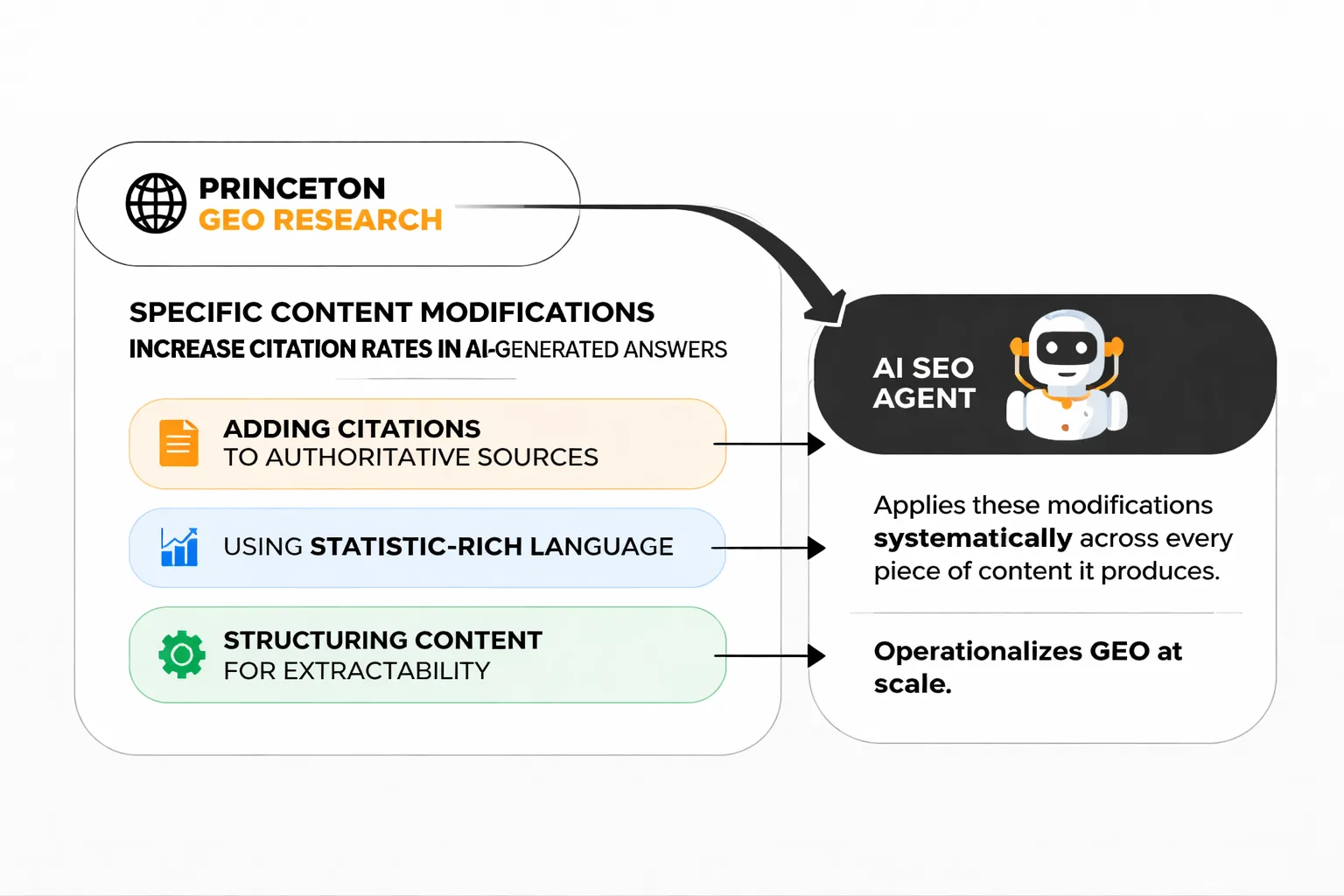
The Princeton GEO research (published on arXiv) established that specific content modifications increase citation rates in AI-generated answers. These include adding citations to authoritative sources, using statistic-rich language, and structuring content for extractability. An AI SEO agent applies these modifications systematically across every piece of content it produces.
The connection between agentic SEO and generative engine optimization is not incidental. It is the reason the agent category exists. A human writer can apply GEO principles to one article at a time. An agent applies them to every article, at scale, with consistent retrieval weights and quality criteria calibrated for AI extraction.
This is where archetype-aware writing becomes relevant. Different content archetypes (listicles, how-tos, explainers, problem-solvers) have different retrieval weights and structural requirements for AI extraction. A listicle needs clear item boundaries and source citations per item. A how-to needs sequential structure and step-level attribution. An explainer needs definitional clarity and entity references. A generic AI writer treats all content the same. An AI SEO agent calibrates its retrieval and structuring to the archetype, because the archetype determines how an LLM extracts information from the page.
The Limitations Nobody Mentions
Every category has limitations, and pretending otherwise destroys credibility.
Response volatility. AI engines do not produce consistent recommendations. The same prompt can yield different brands across sessions, times of day, and model versions. This means AI visibility metrics are inherently noisy. An agent that reports a mention rate without accounting for this volatility is giving you a number that may not reproduce tomorrow. Multi-session testing and rolling averages are not optional. They are the only way to separate real visibility movement from random variation.
Measurement validity. SparkToro's research found that zero peer-reviewed studies validate AI recommendation consistency for tracking purposes (SparkToro). The industry is spending $100M+ per year on tracking tools without proven measurement validity. This does not mean tracking is useless. It means you should treat single-data-point metrics with skepticism and look for trend lines over time, not snapshot numbers.
The framing problem. As discussed earlier, a mention is not a recommendation. A brand cited as a "basic option" before a competitor described as "the professional choice" is technically visible but commercially disadvantaged. Most AI SEO agents track mention rate. Few track framing. This is the hardest problem in the category, and the tool that solves it will define the next generation of AI visibility measurement.
Content quality risk. Autonomous content generation without human oversight is a penalty risk. Google's Helpful Content System does not care that an AI wrote your content. It cares whether the content is helpful. Without a quality firewall and human approval, AI-generated content can trigger classification as low-quality, leading to traffic collapse. The agent must have guardrails, not just generation.
Knowledge graph dependency. Entity grounding depends on third-party infrastructure (Wikidata, schema.org, Google's Knowledge Graph) that you do not control. Your Wikidata entry can be edited by anyone. Your schema markup can be misinterpreted by crawlers. An AI SEO agent that does not monitor your entity presence across these external systems is missing the structural layer that determines whether your content can be cited at all.
Putting It Into Practice
For teams ready to adopt an AI SEO agent, the practical path is straightforward.
Start with diagnosis. Before generating any content, establish your AI citation baseline. Which engines mention you? Where do you appear in answers? Which competitors are cited instead of you? Which sources do AI engines cite for your topics? This is the ai visibility checker layer. Without it, content generation is guessing.
Next, audit your entity presence. Does your brand exist in Wikidata? Does your website have schema markup that clearly defines your entity type, attributes, and relationships? If not, fix this before writing a single article. Content without entity grounding is invisible to the systems you are trying to influence.
Then, set up the closed loop. Configure the agent to monitor citation gaps (prompts where competitors are cited and you are not), generate content targeting those gaps, run every draft through the quality firewall, approve manually, publish to your CMS, and re-measure. The loop should run weekly, not quarterly. AI visibility shifts faster than SERP rankings because the underlying models update continuously.
Finally, track framing, not just mentions. When your brand appears in an AI answer, read the surrounding context. Is the AI recommending you, listing you, or mentioning you as a caveat? If the framing is negative or dismissive, you have a content problem, not a visibility problem. The fix is not more content. The fix is content that reshapes the narrative around your brand.
Meev handles this full loop: diagnosing where a brand is cited or absent across every major AI search surface, generating archetype-aware content gated by a 16-dimension quality firewall, and tracking whether published content moves AI citation rates over time. The platform is built for small teams that need to be found and cited by AI answers without running a full content operation. The diagnosis leads. The content follows. The measurement closes the loop.
What This Actually Means
The definition of an AI SEO agent for 2026 is not about autonomy for its own sake. It is about closing the gap between measurement and action in a search ecosystem where the rules have fundamentally changed. Traditional SEO tools were built for a world where humans type keywords into a search box and click blue links. That world still exists, but it is no longer the only game. AI engines synthesize answers from sources, cite specific pages, and present recommendations that users trust enough to act on without clicking through.
An AI SEO agent is the tool that operates in this new environment. It does not replace human judgment. It compresses the distance between knowing what to fix and fixing it. The brands that win in AI search will not be the ones with the most content or the highest keyword density. They will be the ones with the strongest entity presence, the most extractable content, and the tightest feedback loops between diagnosis and publication.
The category will evolve. The agents that survive will be the ones that solve the hard problems: response volatility, framing measurement, entity grounding, and content quality at scale. The ones that do not will be exposed as glorified content generators with "agentic" marketing copy. The difference between the two is the difference between a tool that changes your AI visibility and a tool that changes your invoice.
For now, the definition stands: an AI SEO agent is software that autonomously researches, creates, and publishes content optimized for AI search surfaces, with the measurement infrastructure to prove it worked. Anything less is a feature dressed up as a product.
FAQ
What is the difference between an AI SEO agent and an AI writing tool?
An AI writing tool generates text from a prompt. An AI SEO agent generates text, but it also diagnoses citation gaps across AI search engines, researches topics autonomously, runs quality checks, publishes to your CMS, and tracks whether the published content increased your AI visibility. The writing tool is one component of the agent. The agent is the full closed loop from diagnosis to measurement.
Can an AI SEO agent replace my SEO team?
No. The agent compresses the execution loop, but human judgment is still required for strategy, brand voice, approval, and interpretation of results. The agent handles the repetitive work (topic research, drafting, publishing, tracking) so a small team can operate at the output level of a larger one. A one-person marketing team with an agent can produce the content volume of a five-person team, but the strategic decisions still need a human.
How accurate are AI visibility metrics given LLM response volatility?
This is an open problem. SparkToro found zero peer-reviewed studies validating AI recommendation consistency despite $100M+ spent annually on tracking. Reliable measurement requires multi-session testing, rolling averages, and trend analysis rather than single-prompt snapshots. Any tool reporting a mention rate based on one query per prompt is producing unreliable data. Look for tools that aggregate across multiple sessions and time windows.
Do I need Wikidata presence for AI SEO to work?
It is strongly recommended. Wikidata QIDs serve as primary entity disambiguation mechanisms for AI systems. Without a Wikidata entry, LLMs may not reliably identify your brand as a distinct entity, which means they cannot consistently cite you. Entity grounding (Wikidata, schema markup, consistent NAP across the web) is the structural foundation that content optimization builds on top of.
How is generative engine optimization different from traditional SEO?
Traditional SEO optimizes for search engine crawlers ranking pages by keyword relevance. Generative engine optimization optimizes for LLM retrieval systems that synthesize answers from multiple sources. The two share some practices (authoritative citations, clear structure) but differ fundamentally in goal: traditional SEO aims for position one on a SERP. GEO aims for inclusion in an AI-generated answer with a citation. An AI SEO agent operationalizes GEO at scale.
What should I check before investing in an AI SEO agent?
Three things. First, establish your AI citation baseline (are you cited anywhere?). Second, audit your entity presence (does your brand exist in Wikidata and knowledge graphs?). Third, confirm your buyers actually use AI search for discovery in your category. If all three check out, an agent will accelerate your results. If any one is missing, fix that first.
About the Author
Judy Zhou, Founder
Judy Zhou leads content strategy at Meev, where she oversees AI-driven content research and publishing for hundreds of brands. With a background in SEO and editorial operations, she focuses on building content systems that rank on Google, get cited by AI search engines, and drive measurable business results.
Stop guessing about your AI visibility. Get a diagnostic baseline across every major AI search surface and start closing citation gaps this week.