
How to Check Any Site's SEO Health by Entering Its Web Name
By Judy Zhou, Founder
Key Takeaways
- Perplexity now processes 780 million monthly queries (up 239% from 230 million in August 2024), so enter your web name into visibility tools to check if AI engines recognize it as a trusted entity.
- The Columbia Journalism Review found a 37% error rate in AI citation accuracy, making regular name-based entity checks the top diagnostic for correcting context in generative answers.
- Google's 2012 Knowledge Graph made recognized entities the gatekeepers of premium visibility, so test your site's health by entering its name rather than relying solely on crawl or ranking data.
- Traditional SEO tools deliver backlink and indexing baselines, but the actionable step for the AI era is probing latent entity maps by searching your exact web name across answer engines.
In 2012, Google's Knowledge Graph launch quietly drew a boundary that would reshape search for the next decade: entities. Brands, people, places. Now existed separately from pages, and only recognized entities earned premium visibility. Most webmasters ignored it. Then came large language models, and that boundary became a wall. Today, when you search or enter a web name into an AI answer engine, the system does not crawl your site in real time; it consults a latent map of entities it was trained to trust. Understanding how that map was built is the starting point for every meaningful SEO health check in the generative era.
When you search or enter web name into any visibility tool, you're not just checking if a site loads. You're probing whether search engines and AI models recognize the site as a distinct entity. A site that doesn't appear when you enter its name has a visibility problem that goes far beyond rankings. Perplexity now processes approximately 780 million monthly queries, up 239% from 230 million in August 2024. If your brand isn't surfaced in those answers, you're invisible to a growing channel. And the Columbia Journalism Review found a 37% error rate in AI citation accuracy, which means even when you ARE cited, the context might be wrong. That's why checking your site's health by name is the single most important diagnostic you can run.
What 'Search or Enter Web Name' Actually Does
Every visibility check starts the same way. You type a domain or brand name into a tool. But what happens next depends entirely on which tool you're using and what signals it prioritizes.
Traditional SEO monitoring software pulls crawl data, indexing status, backlink profiles, and ranking positions. That's the baseline. It tells you if Google can find your site and whether your pages are technically accessible. But it stops short of answering the question that matters more in 2026: does the broader web, including AI answer engines, recognize your site as an entity worth citing?
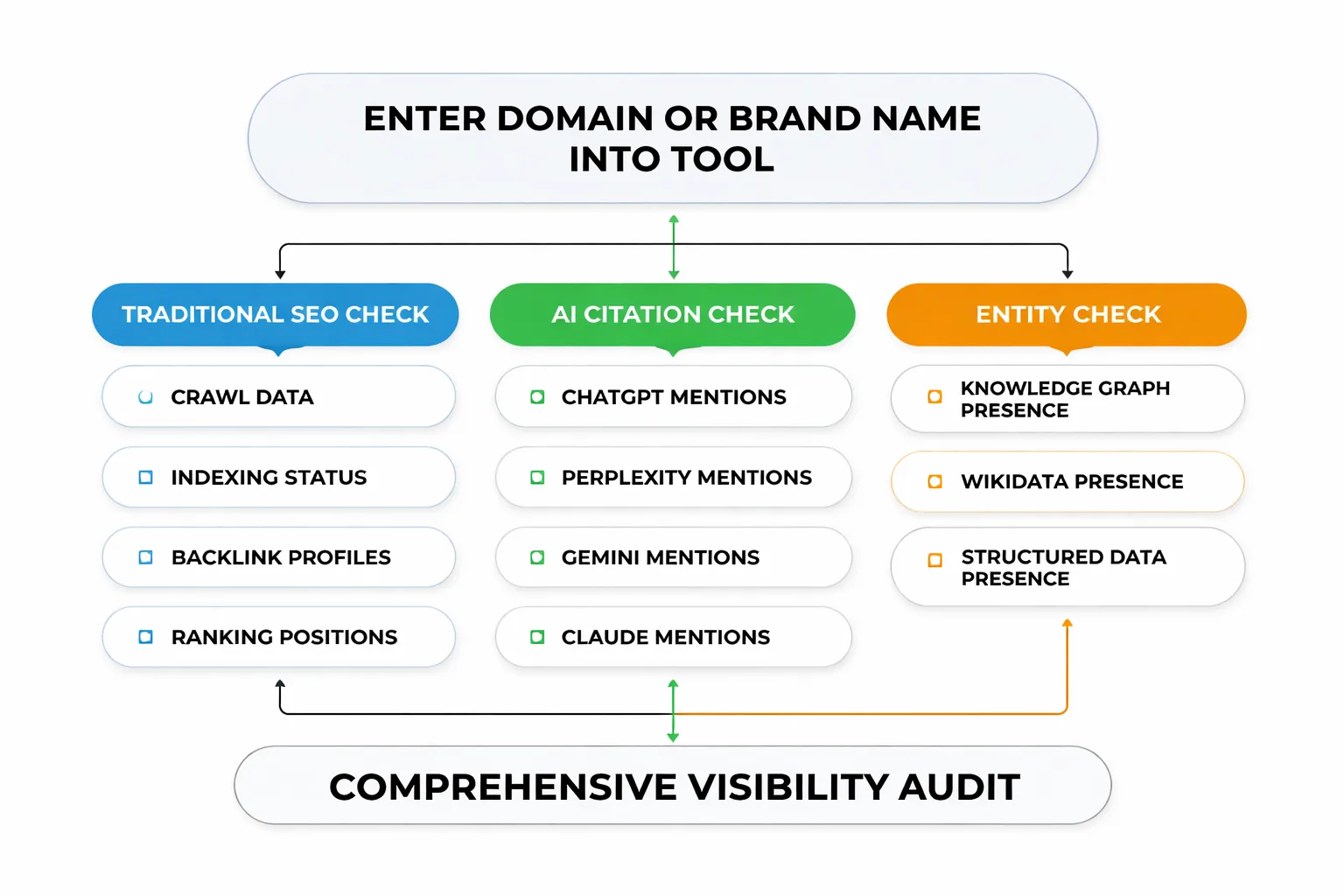
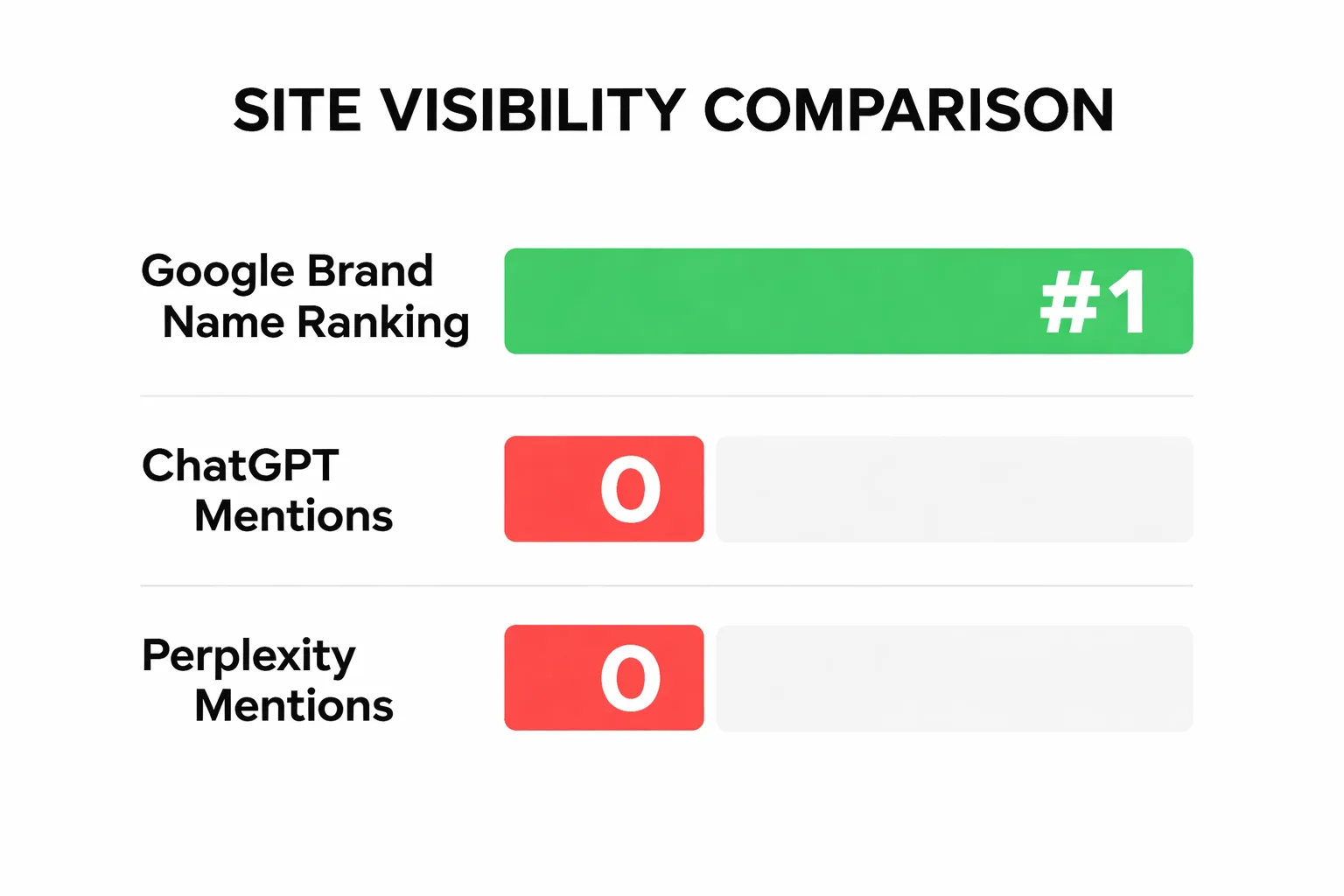
In my work auditing content ops at Meev, I've seen the gap between these two checks firsthand. A site can rank #1 for its own brand name on Google and still have zero presence in ChatGPT or Perplexity. The traditional SEO dashboard shows green. The AI visibility dashboard shows red. Both are correct. They're measuring different things.
The act of entering a web name is really a probe into three layers of visibility. First, the technical layer: can crawlers access the site, is the sitemap registered, are there robots.txt blocks. Second, the ranking layer: where does the site appear in classic SERPs for its core keywords. Third, the entity layer: does Google's Knowledge Graph, Wikidata, and the training corpora of large language models recognize this site as a named entity with attributes like industry, founders, and product category.
Most teams stop at layer one. Some reach layer two. Almost none systematically check layer three. That's the gap that answer engine optimization addresses, and it's where the biggest visibility wins live in 2026.
Think of it like a credit check. When a lender runs your credit, they don't just confirm you exist. They pull your payment history, your debt ratios, your account age. Each signal tells a different story about your financial health. Entering a web name into a visibility tool works the same way. The crawl status is your payment history. The SERP rankings are your debt ratios. The entity presence is your account age. You need all three to get approved.
Step 1. Enter the Domain
Start with the domain itself. Type it into whatever AI visibility tool you're using, or run a manual check by searching the brand name in Google, ChatGPT, Perplexity, and Claude.
The domain entry tells you something immediate. If Google returns the site as the first result when you search its exact name, the technical foundation is probably solid. If it doesn't, you have a serious problem. A site that can't rank for its own name has fundamental issues: penalties, manual actions, or such thin content that Google doesn't consider it authoritative for itself.
But ranking for your own name is the floor, not the ceiling. The real question is what else you rank for. And in 2026, the question extends further: what does ChatGPT say about you when someone asks?
Let me give you a concrete example. I once checked a B2B SaaS company that ranked #1 for their brand name on Google. Their GSC data looked clean. But when I typed their brand name into ChatGPT and asked "what is [brand name]?", the response described them as a "marketing analytics platform." They were actually a customer data platform. The entity data was wrong. Every AI answer that mentioned them was miscategorizing their business, funneling potential buyers to the wrong comparison pages. Their Google rankings were fine. Their AI visibility was actively harmful.
This is why step one isn't just about confirming the site exists. It's about confirming the site exists AND is correctly described across all surfaces. Run the brand name query in Google, ChatGPT, Perplexity, Gemini, Claude, and Google AI Overviews. Read every response. Note what each engine says about who you are and what you do. The discrepancies will surprise you.
Step 2. Read the Crawl and Indexing Status
Once the domain is entered, pull the technical health data. This is where seo monitoring software earns its keep. You need to see four things: crawl errors, indexing coverage, mobile usability, and page speed scores.
I've learned the hard way that sitemap submission alone doesn't guarantee indexing. I've seen pages sit in "Crawled. Currently not indexed" for months despite proper submission. Google prioritizes content quality, mobile-friendliness, and robust internal linking far more than submission status for actual indexing decisions. Bing is more responsive to direct submission, so submit there too, but don't expect Google to follow the same logic.
The crawl check should answer these questions: - How many pages are indexed vs. submitted? - Are there robots.txt directives blocking important sections? - Is there a sitemap, and is it registered in Google Search Console? - Are there manual actions or security issues flagged?
If any of these show problems, fix them before touching anything else. Technical issues cascade. A robots.txt block on your /blog/ directory means none of your content gets indexed, which means none of it ranks, which means no entity signals get built. You're building on quicksand.
Let's break down what each error actually means in practice. "Crawled. Currently not indexed" is Google saying "I found your page, I read it, and I chose not to include it in my index." That's a quality signal, not a technical signal. Google looked at the page and decided it wasn't worth surfacing. The fix isn't to resubmit the URL. The fix is to improve the page. Add depth. Add internal links from authoritative pages. Make it useful enough that Google reconsidered its decision.
"Discovered. Currently not indexed" is worse. Google found the URL (probably through a sitemap or internal link) but didn't even bother to crawl it. This usually means Google has allocated zero crawl budget to the page because it considers the site low-priority or the URL pattern low-value. The fix is to build internal links from high-authority pages on your domain to these discovered-but-uncrawled URLs. Give Google a reason to care.
Page speed matters more than people think, but less than they fear. A Lighthouse score of 40 doesn't kill your rankings. A Lighthouse score of 95 doesn't guarantee them. What matters is the Core Web Vitals pass/fail status. If your LCP is above 2.5 seconds or your CLS is above 0.1, fix it. Those are the thresholds Google actually uses.
Step 3. Check Classic SERP Rankings
After technical health, look at where the site ranks in classic Google search. Pull the top 50 ranking keywords and their positions. Look for three patterns.
First, does the site rank for branded terms? If someone searches the company name, does the official site appear first? It should. If not, that's a red flag suggesting either a penalty or a weak backlink profile.
Second, does the site rank for non-branded, commercially relevant terms? If a CRM company only ranks for its own name and not for "CRM software" or "customer relationship management tool," the site has authority but no topical relevance. Google knows who they are but not what they do.
Third, are there cannibalization issues? Multiple pages ranking for the same keyword with similar positions? That splits click-through rate and confuses both users and search engines about which page is canonical.
This is also where you connect classic SEO to ai and search engine optimization. The keywords a site ranks for in Google are a strong predictor of what it gets cited for in AI answers. If you don't rank for a topic in Google, you almost certainly won't be cited for it in ChatGPT. The correlation isn't perfect, but it's strong enough that fixing Google rankings is step one of fixing AI visibility.
Here's a concrete mechanic to run. Export your top 50 keywords from GSC. For each keyword, note the position, impressions, and CTR. Calculate the opportunity score: keywords in positions 4-15 with high impressions but low CTR are your biggest quick wins. A keyword in position 8 with 5,000 monthly impressions and a 2% CTR means 100 clicks per month. Move that page to position 3, where CTR averages 7%, and you go from 100 clicks to 350. That's a 250-click swing from one optimization pass.
Also check SERP features. Does your site appear in featured snippets? People Also Ask boxes? Knowledge panels? Each of these is a separate visibility surface that AI engines pull from. A featured snippet is particularly valuable because it means Google has already determined your content is the best answer to a specific question. AI engines use that signal too.
Step 4. Check AI Citation Presence
This is the step most SEO checks skip entirely. And it's the one that matters most in 2026.
After entering the web name and confirming technical health and SERP rankings, you need to check whether AI answer engines mention and cite the site. This means running brand-name queries across ChatGPT, Perplexity, Gemini, Claude, and Google AI Overviews.
The Semrush analysis of 248,000 Reddit posts cited across Google AI Mode, Perplexity, and ChatGPT Search revealed that content type, engagement patterns, and structural elements all drive AI search visibility differently than traditional ranking factors. The signals that get you ranked #1 on Google are not the same signals that get you cited by an LLM.
In my work at Meev, I've seen this pattern repeat across hundreds of brands. A site with strong backlinks and good technical SEO gets cited by AI engines. But the framing of that citation matters enormously. An AI might mention your brand as "a good starting point" before recommending a more advanced competitor. That's a citation that actively funnels users away from you. Raw mention count is a red herring. Favorable framing is the metric that actually drives B2B outcomes.
This is why you need to check not just whether you're cited, but how. Pull the actual response text from each AI engine. Read what it says about your brand. Is the description accurate? Is the category positioning correct? Are competitors mentioned alongside you, and if so, how are they framed relative to you?
Perplexity's referral conversion rate is 14.2%, compared to 2.8% from Google. That's a 5x difference. A favorable citation in Perplexity isn't just visibility. It's pipeline. But a 37% citation error rate means you need to verify what's being said, not just that something is being said.
Let me walk through what a proper AI citation audit looks like. For each AI engine, run five query types: (1) the brand name alone, (2) "what is [brand name]", (3) "best [product category]", (4) "[brand name] vs [top competitor]", and (5) "alternatives to [brand name]". These five queries map to different stages of the buyer journey, from awareness to comparison to consideration.
For each query, record three things: does your brand appear, where in the response does it appear (first mention, middle of a list, last), and what exact words are used to describe it. The position of your mention matters. First-mentioned brands in AI answers get disproportionate click-through. Being third in a list of five is marginally better than not appearing at all. Being first with a favorable description is worth more than any single Google ranking.
The "vs" query is especially revealing. When someone searches "[your brand] vs [competitor]" in an AI engine, the response reveals how the AI has categorized both companies. If the AI frames the comparison in ways that favor your competitor, that's a narrative problem. You need content that reshapes how the AI thinks about the comparison. This is where generative engine optimization goes beyond traditional SEO. You're not optimizing for a keyword. You're optimizing for a narrative.
Want to see what AI engines actually say about your brand right now?
Step 5. Identify the Biggest Gap to Fix First
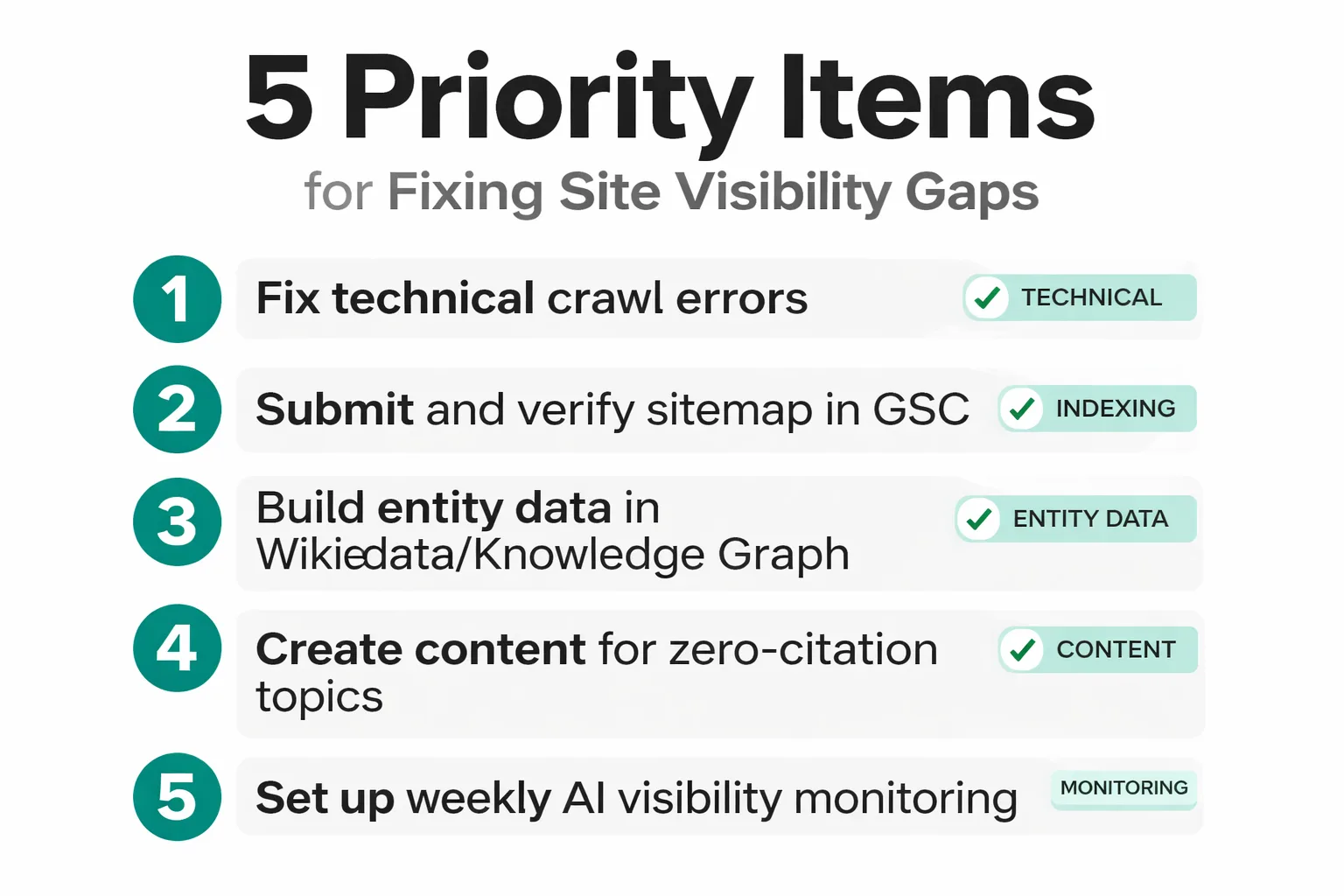
Now you have data from all three layers. Technical health, SERP rankings, and AI citation presence. The final step is triage.
Compare what you found against what you expected. If the site ranks well in Google but has zero AI citations, the gap is entity data. The site exists as a URL but not as a recognized entity in the training data AI models rely on. Fix: build structured entity data through Wikidata entries, Knowledge Graph markup, and consistent NAP (name, address, phone) signals across the web.
If the site has AI citations but they're inaccurate or negatively framed, the gap is content and narrative control. Fix: create authoritative, fact-verified content that defines what your company does, what category it's in, and why it matters. Make sure that content is the kind AI engines cite: structured, sourced, and specific.
If the site has neither rankings nor citations, the gap is foundational. Fix: start with technical SEO, then build topical authority through content, then layer entity signals on top. There's no shortcut here.
The Seer Interactive SEO/GEO case study demonstrated that footer schema changes influenced ChatGPT output within 36 hours. Standard SEO monitoring software would not flag this as a site health issue because it operates outside traditional search ranking metrics. That's the core problem with legacy tools. They measure a world that no longer fully describes your visibility.
Let me give you a triage framework. Score each gap on two axes: impact (how much would fixing this move the needle on business outcomes) and effort (how many hours and dollars would the fix require). A gap where you rank well in Google but have zero AI citations is high-impact, medium-effort. The fix is entity data creation and structured content, which takes weeks not months. A gap where you have technical crawl errors is high-impact, low-effort. Fix those first. A gap where your AI citations are negatively framed is high-impact, high-effort. That's a content strategy project that takes months, but it's the one with the biggest long-term payoff.
The B2B brand that captured 56.67% AI mentions in 90 days (documented in the Seer Interactive research) didn't get there by accident. They got there by systematically addressing entity data, content quality, and citation monitoring in parallel. You can do the same, but only if you know where you stand today.
How Do You Find Your Keywords From the Results?
After running a full site visibility check, the keyword extraction is where strategy becomes concrete. The question "how do I find my keywords?" has a specific answer when you've already entered the web name and pulled the data.
Start with Google Search Console. Export the Queries report. Filter for pages with impressions but low CTR. Those are topics where Google thinks you're relevant but users aren't clicking. Either the content doesn't match intent, or the meta description is weak. Both are fixable.
Next, look at the keywords your site ranks for in positions 4-15. These are your quick-win opportunities. A page ranking #8 for a valuable keyword is one optimization pass away from page one. A page ranking #35 is a content project. Prioritize the former.
Then cross-reference with AI citation data. If you're cited in ChatGPT for a topic where you don't rank in Google's top 10, that's a fascinating signal. It means the AI's training data captured your authority on that topic, but your current content doesn't reinforce it for live search. Double down on that topic with fresh, comprehensive content.
Finally, look at competitor keywords. What terms do competitors rank for that you don't? Those gaps represent content opportunities. But filter ruthlessly. Not every keyword a competitor ranks for is worth chasing. Focus on keywords with commercial intent that align with your product positioning.
Here's the keyword extraction process I use, step by step. First, export all queries from GSC with at least 100 monthly impressions. Sort by position. Everything in positions 1-3 is working. Leave it alone. Everything in positions 4-10 is your optimization queue. Everything in positions 11-20 is your content creation queue. Everything below 20 with high impressions is a signal that Google thinks you should be relevant but your content isn't proving it.
Second, run the same queries through an AI visibility tracker to see which of those keywords trigger AI answers that mention you. The overlap between your Google rankings and your AI citations is your strongest territory. The keywords where you rank in Google but aren't cited in AI are your biggest opportunities. The keywords where you're cited in AI but don't rank in Google are your hidden strengths. Build content around those hidden strengths to reinforce what the AI already believes about you.
Third, look at the cited-source leaderboard for your topics. Which domains does Perplexity cite most often for queries related to your industry? If those domains aren't you, that's your outreach target list. Getting cited by the sources AI engines already trust is the fastest path to getting cited by the AI engines themselves.
What Do Common Errors and Warnings Mean?
When you enter a web name and run a visibility check, you'll encounter specific errors. Here are the most common ones and what each actually means.
"Crawled. Currently not indexed." Google found the page but chose not to include it in its index. This usually means thin content, duplicate content, or low-quality signals. Fix: improve content depth, ensure internal linking, and check for duplicate content issues.
"Robots.txt blocks crawling." A misconfigured robots.txt file is blocking crawlers from accessing important pages. Fix: review the file and ensure critical sections aren't disallowed. This is embarrassingly common.
"Missing sitemap." No XML sitemap means Google has to discover pages through crawling alone. Fix: generate a sitemap, submit it through Google Search Console, and ping IndexNow for faster discovery.
"Zero AI citations." The brand doesn't appear in AI answer engines for its own name or core topics. This is the most alarming error in 2026. Fix: build entity data through Wikidata, structured data markup, and authoritative content that AI models can cite. This is where generative engine optimization becomes essential.
"Thin entity data." The site exists as a URL but has no structured entity information in Google's Knowledge Graph or Wikidata. AI engines don't know what category the business is in, who runs it, or what it does. Fix: create or claim Wikidata entries, implement Organization schema markup, and build consistent entity references across the web.
"Cannibalization detected." Multiple pages on the site compete for the same keyword. Fix: consolidate pages, use canonical tags, and ensure each page targets a distinct primary keyword.
"Mobile usability issues." Pages aren't rendering properly on mobile devices. Since Google uses mobile-first indexing, this means Google sees a broken version of your site. Fix: test pages with Google's Mobile-Friendly Test, fix viewport configuration, and ensure tap targets are appropriately sized.
"No structured data detected." The site has no schema markup. This means Google and AI engines have no machine-readable information about what the site is, what it sells, or who runs it. Fix: implement Organization, Product, and Article schema at minimum. The Seer Interactive case study proved that schema changes can alter AI outputs within 36 hours.
"Slow LCP (Largest Contentful Paint)." The main content of the page takes too long to render. Fix: optimize images, reduce server response time, and eliminate render-blocking resources. The threshold is 2.5 seconds. Anything above that is a fail.
Why Does Your Brand Name Not Appear in AI Search?
This is the question I get most often from founders. They search their brand name in ChatGPT and get nothing. Or worse, they get a competitor. Here's what's actually happening.
AI answer engines don't crawl the web in real time the way Google does. They rely on two things: their training data (which has a cutoff date) and retrieval-augmented generation that pulls from sources they trust. If your brand isn't in the training data and isn't cited by sources the AI trusts, you don't exist.
The fix isn't more content. It's the right content, published in the right places. You need to be mentioned by sources that AI engines already cite. That means getting covered by publications, being listed in relevant directories, and creating content on platforms that AI models treat as authoritative.
Semrush's research on optimizing for the agentic web highlights how visibility is now distributed across multiple platforms with different ranking signals and update cycles. Traditional SEO monitoring assumes visibility is stable and measurable through periodic audits. Agentic SEO reveals that visibility shifts in real time. A schema change can alter ChatGPT output within 36 hours, as Seer Interactive demonstrated. Your monitoring cadence needs to match that speed.
Let me explain the mechanics of why this happens. Large language models are trained on text corpora. If your brand name appears in high-quality, frequently cited sources during training, the model learns to associate your brand with certain topics. If it doesn't, your brand is effectively invisible to the model's parametric memory.
Retrieval-augmented generation (RAG) is the second pathway. When a user asks a question, the AI engine retrieves relevant content from the web in real time and synthesizes an answer. This means even if your brand isn't in the training data, you can still appear in AI answers if your content is retrievable and relevant. But the retrieval step depends on the AI engine trusting the source. If your site has low domain authority, poor technical health, or thin entity data, the retrieval system may skip you entirely.
This is why the LLMs.txt validator matters. It checks whether your site is optimized for AI crawlers specifically. Traditional robots.txt and sitemap.xml are designed for Google's crawler. AI engines have their own crawling behaviors and preferences. If your site isn't optimized for AI discovery, the RAG pathway fails too.
The fix has two parts. First, build entity presence: Wikidata entries, Knowledge Graph claims, consistent structured data across your site. This feeds the training data pathway. Second, publish content that AI engines can retrieve and cite: fact-verified, structured, with clear answers to specific questions. This feeds the RAG pathway. You need both.
How Does Entity Grounding Connect to SEO Health?
Entity grounding is the process by which AI models connect a name to a set of attributes. When ChatGPT mentions your brand, it's not just repeating a string. It's retrieving an entity from its internal representation and surfacing the attributes associated with that entity. If the attributes are wrong, incomplete, or missing, the AI either says nothing or says something incorrect.
This is why checking your site's SEO health by entering its web name is fundamentally an entity audit. The question isn't "does my site rank?" The question is "does the web's collective knowledge graph correctly represent my brand?"
Here's what a strong entity profile looks like. Your brand has a Wikidata entry with accurate industry classification, founding date, headquarters location, and key people. Your homepage has Organization schema markup that matches the Wikidata entry. Your site is referenced by authoritative domains in the context of your industry. Your brand name appears consistently across the web with the same category associations.
A weak entity profile looks like this. No Wikidata entry. No schema markup beyond basic Article tags. Inconsistent brand name usage (sometimes "Acme Inc," sometimes "Acme Incorporated," sometimes just "Acme"). No authoritative third-party references. The brand name is common enough that the AI might be referring to a different entity entirely.
The fix for weak entity data is systematic. Claim your Wikidata entry. Implement Organization schema with accurate attributes. Standardize your brand name across all web properties. Build relationships with authoritative publishers in your industry who can reference your brand in context. Each of these steps reinforces the entity mapping that AI models rely on.
What Won't a Name Search Fix?
Here's where I need to be honest about the limits of this approach.
A name search tells you if your brand is recognized. It doesn't tell you if your content is good. A site can rank #1 for its own name and still have content so thin that no one clicks through, no one links to it, and no AI engine cites it for anything beyond the brand name itself.
A name search also won't fix a broken product narrative. If AI engines describe your company incorrectly, checking your name just confirms the problem. Fixing it requires a content strategy that reshapes how your entity is described across the web. That's a months-long project, not a quick fix.
And if your site has fundamental technical problems, no amount of entity optimization will help. A site that takes 8 seconds to load, has no mobile-friendly design, and blocks half its content in robots.txt is invisible regardless of how strong its Knowledge Graph presence is. Fix the foundation first.
Here's another thing a name search won't fix: your competitive positioning. Knowing that you're cited in 20% of AI answers for your category sounds good until you learn your top competitor is cited in 65%. The name search gives you your number. It doesn't give you the market context. You need share-of-voice tracking to understand whether your visibility is actually competitive or just non-zero.
Finally, a name search won't fix a content quality problem. If your articles are AI-generated slop with no human editing, no original data, and no genuine expertise, no amount of entity optimization will make AI engines cite them. Google's Helpful Content System updates are ruthless. I've seen AI-generated content get flagged and removed, leading to sharp traffic declines. The differentiator isn't the AI. It's the degree of human intervention and the quality of the source material.
Next Steps After Your First Check
You've entered the web name, pulled the data, and identified the gaps. Here's what to do in week one.
Fix technical errors first. If robots.txt is blocking content, fix it today. If the sitemap is missing, generate and submit it now. If pages are stuck in "Crawled. Currently not indexed," improve the content quality and internal linking on those pages. Technical fixes have the fastest payoff.
In week two, start building entity data. Claim or create a Wikidata entry for your brand. Implement Organization schema markup on your homepage. Ensure your NAP information is consistent across the web. These are the signals that feed both Google's Knowledge Graph and the training data AI models rely on.
By week three, address content gaps. If you found topics where you should be cited but aren't, create content that establishes your authority. Make it the kind of content AI engines cite: structured, fact-verified, with clear answers to specific questions.
Set a monitoring cadence. Weekly is the minimum in 2026. The Seer Interactive case study showed AI outputs can change within 36 hours of a schema modification. Monthly checks leave you blind for 29 days at a time. Use a tool like the ChatGPT AI visibility checker or Perplexity AI visibility checker to track mentions across AI surfaces.
Escalate to a full content audit when you find systematic issues. If more than 30% of your pages are thin, if your AI citations are consistently inaccurate, or if competitors are cited for topics where you have no presence, you need a structured content strategy, not just fixes.
Here's a concrete 30-day plan. Days 1-7: fix all technical errors. Submit sitemaps. Fix robots.txt. Resolve crawl errors. Days 8-14: build entity data. Create Wikidata entry. Implement schema markup. Standardize brand name across web properties. Days 15-21: run a content gap analysis. Identify the top 10 topics where you should be cited but aren't. Draft content briefs for each. Days 22-30: publish your first answer-engine-optimized articles. Monitor AI citation changes daily for the first week after publish, then weekly thereafter.
The bottom line is this. When you search or enter web name into a visibility tool, you're running a diagnostic that spans three layers: technical, ranking, and entity. Each layer tells you something different. Each requires a different fix. And in 2026, ignoring the entity layer is the most expensive mistake you can make. AI answer engines now process hundreds of millions of queries monthly. If your brand isn't in their answers, you're not just invisible. You're absent from the fastest-growing channel in search. Run the check. Find the gaps. Close them.
FAQ
What does checking a site's SEO health by entering its web name reveal?
It probes whether search engines and AI models recognize the site as a distinct entity rather than just verifying if the site loads. This visibility check goes beyond traditional rankings to assess presence in latent knowledge maps used by tools like Perplexity. Sites missing from name-based searches face broader invisibility in generative AI channels.Why has entity recognition become critical for SEO since 2012?
Google's Knowledge Graph established entities like brands as separate from web pages, granting premium visibility only to recognized ones. Large language models later reinforced this by consulting trained entity maps instead of real-time crawling. Most webmasters overlooked this shift, creating a growing gap in AI-driven search results.How do AI visibility tools differ from traditional SEO monitoring?
Traditional tools focus on crawl data, indexing status, backlinks, and rankings as a baseline for Google performance. AI tools instead evaluate entity trust signals in their latent maps, affecting citations in answers from engines like Perplexity. This makes name-based checks essential for diagnosing generative-era health issues.What statistics show the stakes of poor AI visibility?
Perplexity processes about 780 million monthly queries, reflecting a 239% growth that amplifies the cost of entity invisibility. A 37% error rate in AI citation accuracy further means even recognized sites risk incorrect context in results. These factors make name-entry diagnostics vital for modern SEO.About the Author
Judy Zhou, Founder
Judy Zhou leads content strategy at Meev, where she oversees AI-driven content research and publishing for hundreds of brands. With a background in SEO and editorial operations, she focuses on building content systems that rank on Google, get cited by AI search engines, and drive measurable business results.
Run a full AI visibility check across every major answer engine and get your gap report in minutes.