

By Judy Zhou, Founder
Key Takeaways
- Between 30% and 50% of search results now start with AI Overviews, cutting website clicks by 30% even as search volume rises.
- 84% to 89% of AI-generated answers cite earned media from third-party publications rather than owned content.
- Effective GEO tools must track AI citations across all major LLMs, surface source attribution, and support content publishing workflows.
- Teams should reject repackaged rank trackers and instead adopt platforms that deliver LLM citation tracking plus entity grounding.
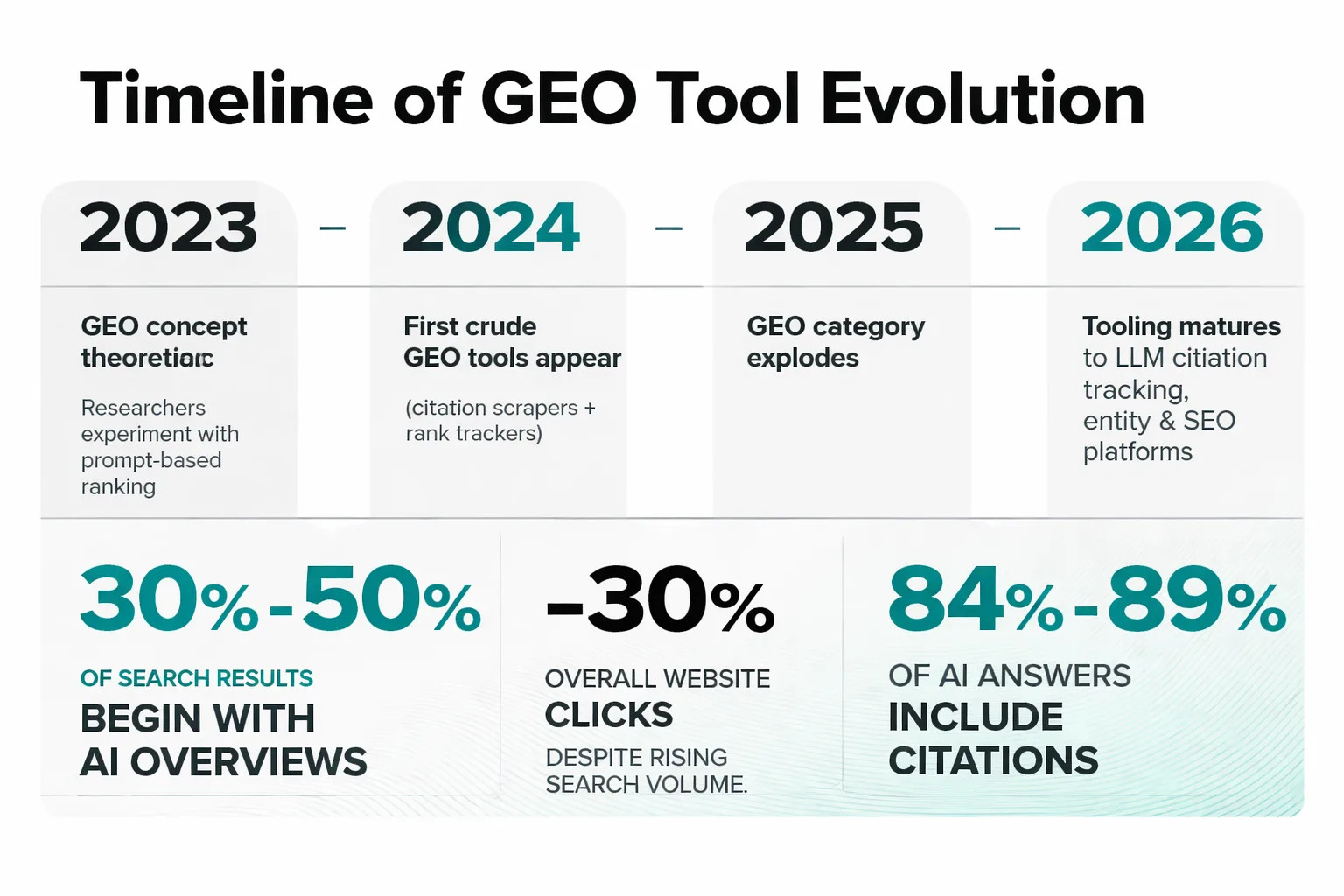
The concept of optimizing for AI-generated answers was largely theoretical as recently as 2023, when only a handful of researchers and early-adopter agencies were experimenting with prompt-based ranking behaviors. By 2024, the first crude generative engine optimization tools appeared. Mostly citation scrapers bolted onto existing rank trackers. By 2025, the category exploded. Now, in 2026, the tooling has matured into something genuinely sophisticated: LLM citation tracking, entity grounding platforms, agentic SEO workflows, and AI visibility dashboards that would have looked like science fiction just three years ago.
Between 30% and 50% of all search results now begin with AI Overviews, and overall website clicks have dropped 30% despite rising search volume, according to Forbes. The win condition has shifted from blue links to citations. 84% to 89% of AI-generated answers come from earned media (third-party coverage in credible publications), not owned content. And the tools that track this? Most of them are repackaged SEO dashboards that wouldn't know a ChatGPT citation from a backlink.
In my work auditing content ops at Meev, I've seen the same pattern repeatedly: teams buy a "GEO tool" that turns out to be a rank tracker with a ChatGPT logo slapped on the dashboard. Real generative engine optimization tools must track AI citations across every major AI search surface, surface source attribution, and support content publishing workflows. If yours doesn't do all three, you're paying for a rebrand.
What Makes a GEO Tool Actually Useful
The market is flooded with tools that claim to track "AI visibility" but actually just scrape a few ChatGPT prompts and call it a day. That's not a generative engine optimization tool. That's a toy.
A genuine GEO tool does three things that traditional SEO tools fundamentally cannot do. First, it tracks AI citations across every major AI search surface: ChatGPT, Claude, Gemini, Perplexity, Grok, Google AI Overviews, Google AI Mode, and DeepSeek. Not just two or three of them. All of them. The reason matters: each LLM has different training data, different retrieval pipelines, and different citation behaviors. A brand that dominates ChatGPT citations might be completely invisible in Perplexity. If your tool only covers one or two engines, you're flying blind on the rest.
Second, a real GEO tool surfaces source attribution. When ChatGPT cites a claim, it's pulling from somewhere. Maybe it's a Wikipedia article, maybe it's a G2 review, maybe it's a blog post from a competitor. The tool needs to show you exactly which sources the AI is building its answers from, because those sources are the ones you need to influence. This is what I call the "citation path": the chain of sources that feed an AI answer. Without it, you're just seeing whether your brand got mentioned. You have no idea why, and no idea how to change it.
Third, a genuine GEO tool supports content publishing. Tracking alone is diagnostic. It tells you where you're absent. But if the tool can't help you close those gaps by creating answer-engine optimized content, it's only doing half the job. The tools that actually work in 2026 pair tracking with content generation that's archetype-aware, fact-verified, and structured for RAG extraction. I've seen too many teams use a tracking-only tool, discover they're invisible in 80% of AI answers, and then have no idea what to do about it. That's a diagnosis without a prescription.
Here's the blunt truth: most tools in this category fail at least two of these three tests. They track mentions but not sources. They cover ChatGPT but not Claude. They generate content but don't verify facts. The ones that pass all three are rare, and they're the only ones worth paying for.
How We Evaluated These Tools
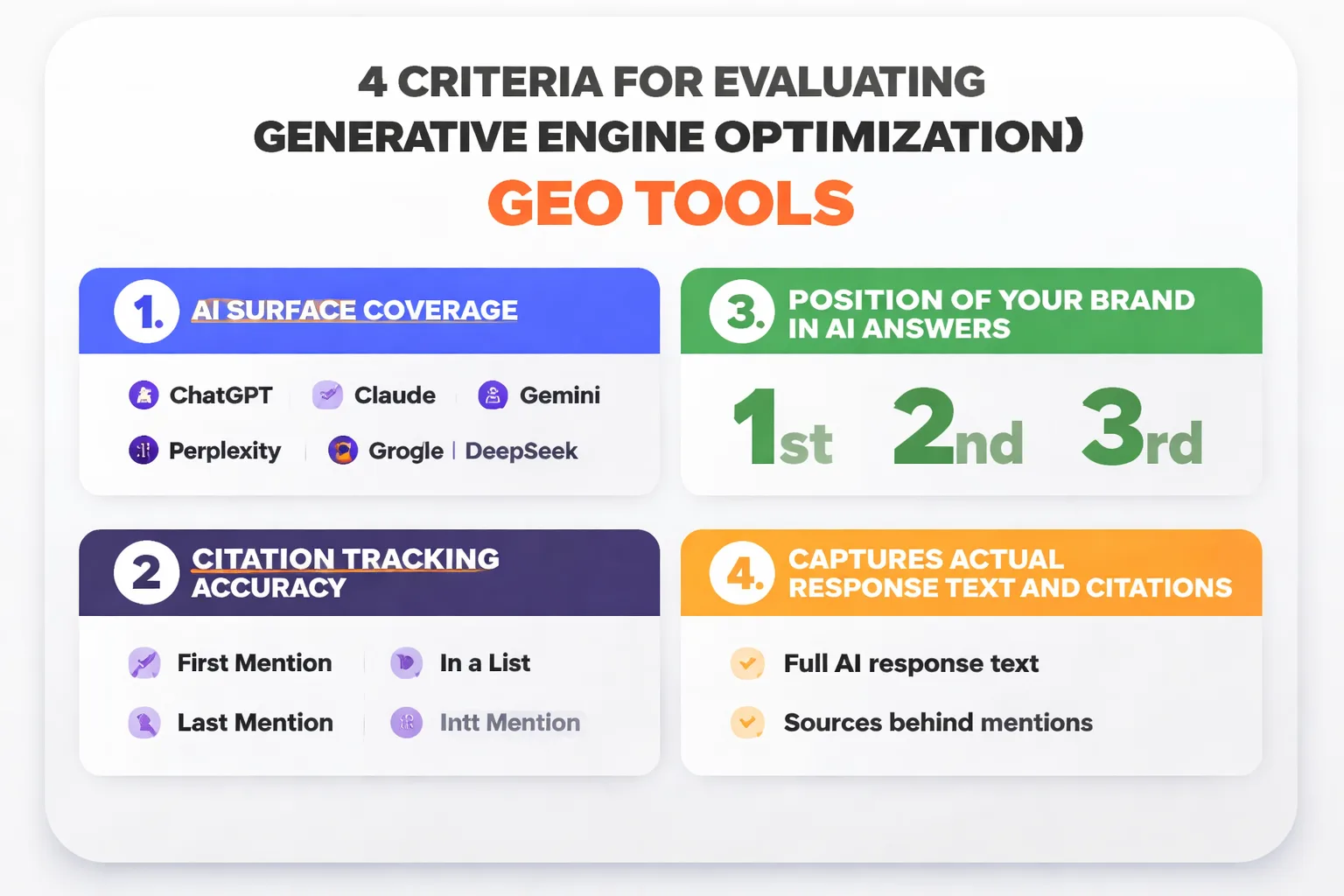
I applied four criteria to every tool in this evaluation. These are the same criteria I use when auditing AI search visibility for brands at Meev, and they're designed to separate substance from marketing copy.
1. AI Surface Coverage. Does the tool track citations across ChatGPT, Claude, Gemini, Perplexity, Grok, Google AI Overviews, Google AI Mode, and DeepSeek? Partial coverage gets partial credit. A tool that tracks only ChatGPT and Perplexity is useful, but it's not a complete GEO solution. The Perplexity AI visibility checker approach of drilling into individual engines matters because citation behavior varies wildly between them.
2. Citation Tracking Accuracy. Does the tool show where in an AI answer your brand appears (first mention, in a list, last)? Does it capture the actual response text and the citations behind every mention? Or does it just give you a binary "mentioned / not mentioned" flag? The position of your mention matters enormously. Being cited first in a ChatGPT answer is worth far more than being the seventh item in a list. Tools that don't track mention position are giving you a flat image of a three-dimensional problem.
3. Content Workflow Support. Can the tool act on what it finds? Does it identify content opportunities (prompts where competitors are cited but you aren't)? Does it generate or publish content to close those gaps? Does it support answer engine optimization workflows, or is it purely diagnostic? A tool that only tracks is like a doctor who diagnoses but never treats.
4. Data Freshness. How often is the data refreshed? AI search results are less stable than traditional SERPs. A tool that checks your visibility once a month is operating on stale data. Daily refresh on SERP-driven surfaces (like Google AI Overviews) and rolling refresh on LLM-driven surfaces (like ChatGPT) is the minimum viable cadence in 2026.
I also looked at whether tools offer industry share-of-voice metrics (what percentage of AI answers cite you vs. competitors) and whether they surface cited-source leaderboards (which domains AI engines cite most for your topics). These are advanced features that separate professional-grade tools from hobbyist experiments.
Comparison Table
Below is a side-by-side breakdown of the GEO tools I evaluated. I've focused on the criteria that matter: which AI surfaces they monitor, whether they track citations with source attribution, whether they support content publishing, pricing tier, and best-fit use case.
| Tool | AI Surfaces Monitored | Citation Tracking | Content Publishing | Pricing Tier | Best-Fit Use Case |
| Meev | ChatGPT, Claude, Gemini, Perplexity, Grok, Google AI Overviews, AI Mode, DeepSeek | Full (position + source attribution + response text) | Yes (archetype-aware, fact-verified, multi-platform publish) | $49-$599/mo | Teams that need tracking AND content generation in one platform |
| LLM Pulse | ChatGPT, Perplexity, Gemini, Claude, Grok | Full citation attribution | No | Starts at €49/mo | Teams that need pure citation tracking across major LLMs |
| SE Ranking | Google AI Overviews | Partial (AI Overview presence) | No (separate SEO suite) | $55-$239/mo | SEO teams adding AI Overview tracking to existing workflow |
| Profound | ChatGPT, Perplexity, Gemini, Claude | Citation tracking with prompts | No | Enterprise pricing | Enterprise teams needing deep prompt analysis |
| Otterly.ai | ChatGPT, Perplexity, Gemini | Brand mention tracking | No | $49-$499/mo | Brand teams monitoring mention frequency |
A few notes on this table. LLM Pulse starts at €49 per month and offers full citation attribution across five models, which makes it the strongest pure-tracking option for teams that already have a content engine. (LLM Pulse) SE Ranking has added generative engine optimization features, but its coverage is limited to Google AI Overviews, not the full LLM spectrum. (SE Ranking)
The gap that stands out: most tools in this space are tracking-only. Only Meev combines full-surface citation tracking with archetype-aware content generation and publishing. That matters because the diagnostic-to-action loop is where most teams stall. You discover you're invisible in 70% of AI answers, and then... nothing. The tool can't help you fix it.
If you want a deeper look at the broader tool landscape, our best GEO tools resource covers additional options with more granular feature breakdowns.
Which Type of Team Should Use Which Tool
The right generative engine optimization tool depends entirely on your team size, your existing workflow, and what you're trying to accomplish. I've broken this into three segments based on what I see in practice.
Solo founders who need fast diagnosis. If you're a founder wearing five hats, you need a tool that gives you a quick visibility snapshot without a learning curve. Your priority is answering one question: "When someone asks ChatGPT about my category, does my brand show up?" You don't need enterprise-grade prompt analysis. You need a ChatGPT AI visibility checker that runs fast and tells you where you stand. A tool like LLM Pulse at €49/mo works if you just want tracking. If you want tracking plus content generation to close gaps (because as a solo founder, you don't have time to write articles manually), Meev's Lite tier at $49/mo gives you 10 articles and 10 prompt checks per month.
Small marketing teams running content operations. This is where it gets interesting. A 3-5 person marketing team needs more than diagnosis. They need to know which prompts competitors are cited for, which sources AI engines are pulling from, and they need a way to publish content that closes those gaps. The AI visibility tool needs to integrate with their CMS (WordPress, Ghost, Shopify) and it needs to produce content that actually ranks. Not AI slop. Content that's fact-verified, archetype-aware, and structured for RAG extraction. For these teams, Meev's Pro tier ($269/mo) or Starter tier ($99/mo) is the sweet spot, depending on volume needs. The key differentiator is the closed loop: track citations, find gaps, generate content, publish, re-measure.
SEO teams that need GEO layered onto existing workflows. If you already have a rank tracker, a content workflow, and an established SEO operation, you don't want to rip and replace. You want to add GEO as a layer. SE Ranking works if your primary concern is Google AI Overviews and you want it integrated with your existing SEO suite. For broader LLM coverage, you might pair a tracking tool (like LLM Pulse or Profound) with your existing content stack. The risk here is fragmentation: your SEO data lives in one tool, your AI citation data lives in another, and your content publishing happens in a third. That's why I lean toward integrated platforms. An AI SEO tool that handles both traditional rankings and AI citations in one dashboard eliminates the context-switching tax that kills productivity.
The AEO vs SEO distinction matters here. If your team still treats AI visibility as a side project, you're already behind. It needs to be a core workflow, not a monthly check-in.
Want to see where your brand actually appears in AI answers?
How Does Entity Grounding Change Tool Requirements?
Entity grounding is the real battle in AI search in 2026. If your GEO tool doesn't account for it, you're optimizing for the wrong thing.
Here's what entity grounding means in practice. AI engines don't just match keywords. They build knowledge graphs. When someone asks "What's the best project management tool for small teams?" ChatGPT doesn't scan the web in real time and return the top 10 results. It retrieves information from its training data and its retrieval pipeline, and it constructs an answer based on entities: which companies it recognizes, which ones have consistent third-party citations, which ones have structured data that's easy for RAG systems to extract.
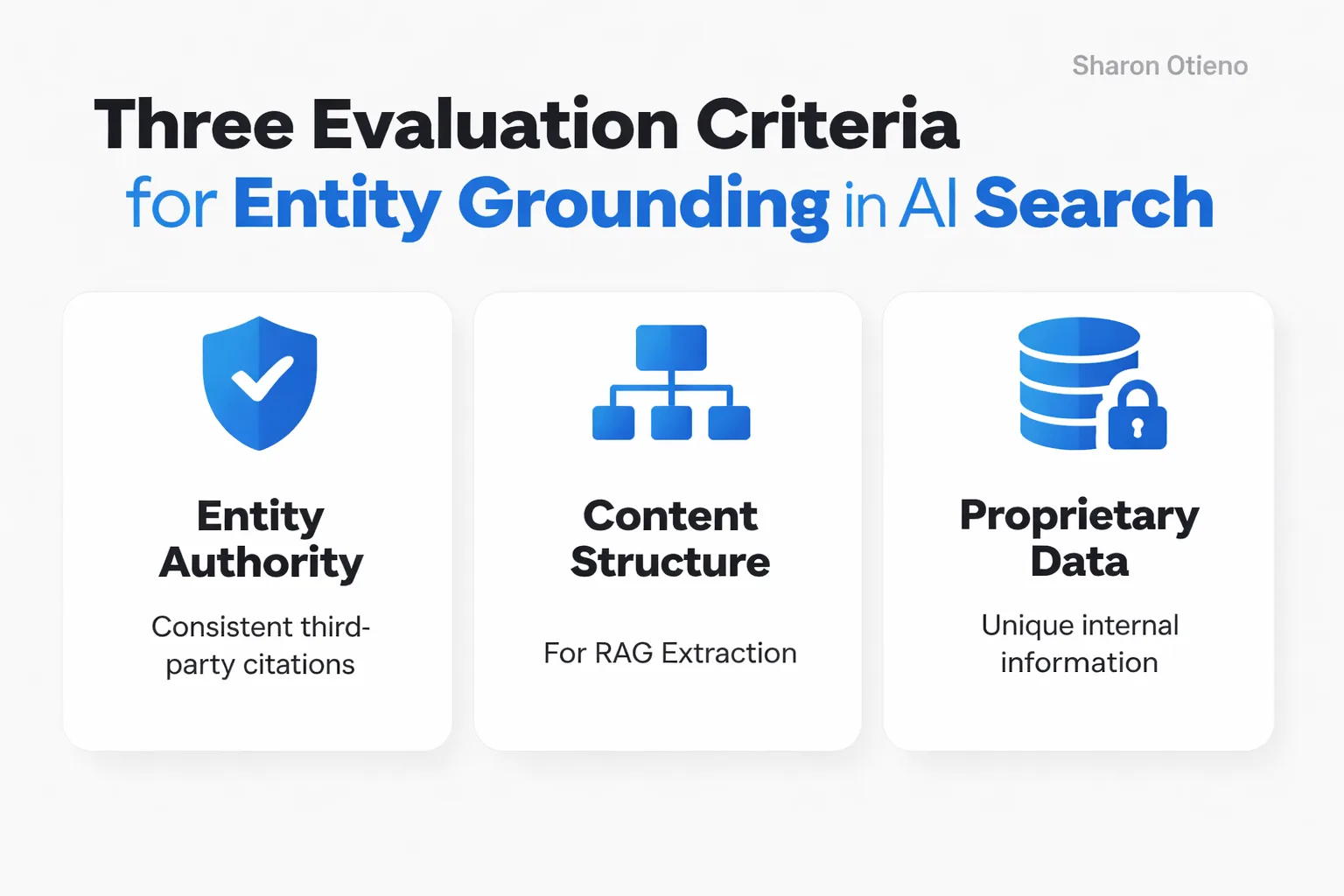
Sharon Otieno, an AI content strategist, describes entity grounding as the deciding factor in whether your brand appears in AI responses at all. She identifies three evaluation criteria: Entity Authority (consistent third-party citations), content structure for RAG extraction, and proprietary data. Her assessment is blunt: "If you fail those three checks, you don't just drop to page two. You disappear from the AI response entirely." (LinkedIn)
This changes what you need from a GEO tool. It's not enough to track whether your brand gets mentioned. You need to track your entity presence. Are you in Wikidata? Are you consistently cited across trusted third-party sources? Is your content structured with schema markup that RAG systems can parse? Google's own AI optimization guide emphasizes the importance of structured data and clear content organization for AI features.
A tool that only tracks brand mentions is operating at the surface level. A tool that tracks entity authority, source diversity, and content structure is operating at the level where AI citations are actually won and lost. When I evaluate most effective AI visibility tools with generative engine optimization capabilities, entity grounding support is the feature that separates the serious tools from the toys.
Why Does Source Attribution Matter More Than Rankings?
Because rankings are a proxy, and AI citations are the actual outcome.
In traditional SEO, you rank for a keyword and you get traffic. The relationship is direct. In AI search, the relationship is indirect. Your brand gets cited in an AI answer because the AI's retrieval pipeline found your content (or content about you) and determined it was relevant and authoritative enough to include. The ranking of your own website is one factor, but it's not the only factor, and often it's not even the dominant factor.
84% to 89% of AI-generated answers come from earned media, not owned content. This means the sources AI engines cite are usually third-party publications, review sites, and reference platforms. Your own blog post ranking #1 for a keyword might never get cited by ChatGPT if the AI prefers to pull from a G2 review or a Wikipedia article.
This is why source attribution is the killer feature in a GEO tool. When you can see exactly which domains AI engines cite for your topics, you can shift your strategy. Instead of trying to rank your own site for every query, you focus on getting cited by the sources the AI already trusts. This is what I call Machine Relations: the practice of influencing the third-party sources that feed AI answers, rather than trying to rank your own pages directly.
A cited-source leaderboard is the feature that makes this actionable. It shows you, for any given topic, which domains appear most frequently in AI citations. If Wikipedia, G2, and TechCrunch are the top three cited sources for your category, those are the platforms you need to be present on. A GEO tool without this feature leaves you guessing.
The Seer Interactive case study illustrates how directly you can influence AI citations. They modified their footer text from "Remote-First" to "130+ clients, 97% retention rate" and ChatGPT reflected the change within 36 hours. (Chris Long / LinkedIn) They monitored the prompt "tell me about Seer Interactive" over two years. This is a powerful demonstration of how AI engines ingest and reflect entity information, but it also highlights a risk: if you optimize footer text or entity descriptions without substantive backing, AI models may amplify misleading claims.
When Does Tracking Become Wasted Spend?
This is where I push back on the standard GEO tool playbook. Tracking without action is wasted budget. Full stop.
I've seen teams spend $200-$600 per month on AI visibility dashboards, discover they're cited in 15% of relevant prompts, and then... nothing. They look at the dashboard weekly. They watch the number go up or down by a few percentage points. They feel informed. But they never close the gap. The prompts where they're absent stay absent because nobody creates content to address them.
This is the failure mode that nobody talks about in GEO tool reviews. The tracking feels productive because you're measuring something. But measurement without intervention is just expensive anxiety. If your tool tells you you're invisible in 80% of AI answers and you have no mechanism to change that, you're paying for a diagnosis with no treatment plan.
The second failure mode: tracking the wrong prompts. Some tools let you input any prompt you want to track. Teams often track brand-name prompts ("Tell me about [Company]") because those are the ones where they already appear. That's ego-tracking, not visibility-tracking. The prompts that matter are category prompts: "What's the best [product category] for [use case]?" Those are where buyers are actually asking AI engines for recommendations, and those are where most brands are invisible.
The third failure mode: treating all AI surfaces equally. ChatGPT has different citation behavior than Perplexity. Google AI Overviews pulls from different sources than Claude. A tool that gives you a single "AI visibility score" across all surfaces is averaging apples and oranges. You need per-engine drill-downs with the actual response text behind every mention. An AI visibility tracker that doesn't show you the raw AI response is hiding the context you need to make decisions.
How Do You Measure AI Visibility ROI?
This is the question every founder and marketing lead asks me, and the honest answer is: it depends on what you're measuring against.
Traditional SEO ROI is straightforward. You rank for a keyword, you get clicks, you attribute conversions. The chain is linear. AI visibility ROI is messier because the chain is indirect. A ChatGPT citation doesn't produce a click. It produces an impression in a synthesized answer. The user might act on it immediately, might remember your brand for later, or might never act on it at all.
Here's how I approach it. First, track citation share-of-voice: what percentage of relevant prompts cite your brand vs. competitors? This is your baseline. If you move from 10% to 25% citation share over six months, that's measurable progress, even if you can't attribute specific revenue to it.
Second, track referral traffic from AI surfaces. Google Search Console now shows traffic from AI Overviews. Perplexity and ChatGPT send referral traffic when users click through on citations. This traffic is smaller than traditional organic search, but it's highly qualified. Someone who clicks through from an AI citation is already deep in the consideration phase.
Third, track branded search volume. When AI engines cite your brand in category prompts, branded search for your company name tends to increase. This is a lagging indicator, but it's one of the clearest signals that AI visibility is driving real business outcomes.
The AEO vs GEO distinction matters here too. AEO (answer engine optimization) is about getting cited in AI answers. GEO (generative engine optimization) is the broader practice of optimizing for generative engines. The ROI measurement framework is the same for both, but the specific prompts and surfaces you track will differ.
For ecommerce specifically, the ROI conversation shifts toward agentic commerce. PayPal's Open Agentic Commerce Pulse Report found that 95% of surveyed merchants report visibility into traffic from AI agents, and data security is the #1 barrier to agentic commerce investment across all business sizes. (Viktoria Semaan / LinkedIn) If you're an ecommerce brand, your GEO tool needs to track not just whether AI engines mention your products, but whether AI agents can find and recommend them in transactional contexts.
The Agentic SEO Framework
This is where generative engine optimization tools evolve from tracking tools into workflow engines. Agentic SEO is the practice of building automated, closed-loop systems that diagnose visibility gaps, generate content to close them, publish that content, and re-measure. It's the difference between a thermometer and a thermostat.
Here's the framework I use, broken into five phases:
Phase 1: Diagnose. Run a baseline audit across every major AI search surface. Identify which prompts cite your brand, which cite competitors, and which cite neither. This is your visibility map. Tools like the LLM visibility tool approach (tracking citations across ChatGPT, Claude, Gemini, Perplexity, Grok, and DeepSeek) gives you the raw data. The output of this phase is a prioritized list of prompts where you're absent but should be present.
Phase 2: Analyze sources. For each prompt where you're absent, identify which sources the AI is citing. Is it pulling from Wikipedia? G2? A competitor's blog? A trade publication? This is where cited-source leaderboards and citation path analysis come in. You're not trying to rank your own site for every prompt. You're trying to get cited by the sources the AI already trusts.
Phase 3: Generate content. This is where most teams stall. You know where you're absent. You know which sources the AI cites. Now you need to create content that either (a) ranks on your own site for RAG retrieval or (b) gets placed on the third-party sources the AI trusts. For owned content, this means archetype-aware, fact-verified articles structured for RAG extraction. For earned content, this means outreach to the publishers AI engines cite.
Phase 4: Publish and index. Content that sits in a draft doesn't get cited. You need to publish to your CMS, submit to Google Search Console, and ping IndexNow for rapid indexing. This is a mundane step that teams constantly underestimate. I've seen great content sit unpublished for weeks because the publishing workflow was manual and slow.
Phase 5: Re-measure. After publishing, re-run the same prompts. Did your citation share increase? Did you appear in prompts where you were previously absent? This closes the loop and tells you whether your content strategy is actually working.
The AEO tool category is converging toward this closed-loop model. Tools that only do Phase 1 (diagnose) are becoming commoditized. The value is in the full loop.
What This Won't Fix
I want to be honest about the boundaries of what generative engine optimization tools can do, because the marketing copy in this category oversells relentlessly.
First, a GEO tool won't fix a bad product. If your product has poor reviews, weak market fit, or negative sentiment, AI engines will reflect that. They pull from review sites, forums, and social media. A GEO tool can tell you that AI engines are surfacing negative sentiment about your brand, but it can't fix the underlying product issues. I've seen founders panic when their AI visibility dashboard shows negative sentiment, as if the tool caused the problem. The tool is the messenger.
Second, GEO tools won't produce instant results. The Seer Interactive case (36-hour reflection of footer changes) is an outlier, not the norm. Most content changes take weeks or months to be reflected in AI citations. LLM training data has a lag. RAG pipelines refresh on their own schedules. If you publish an article today and expect to see it cited in ChatGPT tomorrow, you'll be disappointed. The teams that win at GEO are the ones that treat it as a sustained practice, not a one-time push.
Third, no GEO tool can guarantee citations. AI engines are opaque systems. Their retrieval and ranking logic is not fully transparent. A tool can identify opportunities and track outcomes, but it cannot guarantee that any specific piece of content will be cited. If a vendor guarantees citations, run.
What This Actually Means
The generative engine optimization tools category has matured past the hype phase, but most teams are still using 2024-era approaches in a 2026 reality. The tools that actually work are the ones that combine full-surface citation tracking, source attribution, and content publishing in a closed loop. Everything else is a partial solution dressed up as a complete one.
If you take one thing from this evaluation, let it be this: tracking without action is wasted spend. A dashboard that tells you you're invisible in 70% of AI answers is useless if it can't help you fix that. The most effective AI visibility tools with generative engine optimization capabilities are the ones that close the gap between diagnosis and treatment.
The shift from blue links to citations is not a trend. It's a structural change in how people find information. Between 30% and 50% of search results now begin with AI Overviews. Clicks are down 30%. The brands that invest in generative engine optimization tools now will build citation equity that compounds over time. The brands that wait will find themselves invisible in the answers their customers actually read.
FAQ: Generative Engine Optimization Tools
What is a generative engine optimization tool?
A generative engine optimization tool is a platform that tracks how often and where your brand is cited in AI-generated answers across engines like ChatGPT, Perplexity, Gemini, Claude, and Google AI Overviews. Unlike traditional SEO tools that track keyword rankings, GEO tools track citation presence, mention position, and source attribution. The most advanced generative engine optimization geo tools also generate and publish content to close citation gaps.
How is a GEO tool different from an SEO tool?
An SEO tool tracks where your website ranks in search results for specific keywords. A GEO tool tracks whether AI engines cite your brand in synthesized answers, which sources those citations come from, and where you appear relative to competitors. SEO tools measure blue links. GEO tools measure AI citations. The what is AEO resource covers this distinction in more depth. Some tools (like Meev) combine both, but most SEO tools have tacked on basic AI tracking without real citation analysis.
What AI surfaces should a GEO tool cover?
At minimum, a GEO tool should track ChatGPT, Google AI Overviews, and Perplexity, which account for the majority of AI search traffic. For full coverage, it should also track Claude, Gemini, Grok, Google AI Mode, and DeepSeek. Each engine has different citation behaviors and source preferences, so partial coverage means partial blindness. An enterprise AI rank tracker should cover every major surface.
Which GEO tools are best for small teams?
For solo founders and small teams, the best generative engine optimization tool is one that combines tracking with content generation, because small teams don't have the bandwidth to run separate tools for diagnosis and treatment. Meev's Lite tier ($49/mo) and Starter tier ($99/mo) are designed for this segment. If you already have a content engine and just need tracking, LLM Pulse at €49/mo is a strong option. The AI visibility checker approach works for teams that want a quick snapshot before committing to a full platform.
Can GEO tools guarantee AI citations?
No. AI engines are opaque systems with proprietary retrieval and ranking logic. A GEO tool can identify citation opportunities, track your visibility over time, and help you create content structured for RAG extraction, but no tool can guarantee that any specific content will be cited. If a vendor guarantees citations, that's a red flag.
How long does it take to see results from GEO?
Most content changes take weeks to months to be reflected in AI citations. LLM training data has a natural lag, and RAG pipelines refresh on their own schedules. The Seer Interactive case (36-hour reflection of footer changes) is an outlier. Sustained, consistent content publishing is more effective than one-time pushes. Expect a 3-6 month timeline for meaningful citation share improvement.
About the Author
Judy Zhou, Founder
Judy Zhou leads content strategy at Meev, where she oversees AI-driven content research and publishing for hundreds of brands. With a background in SEO and editorial operations, she focuses on building content systems that rank on Google, get cited by AI search engines, and drive measurable business results.
Stop guessing about your AI visibility. Run a free audit across every major AI search surface and see exactly where you're cited, where you're absent, and what to do about it.