

By Judy Zhou, Founder
Key Takeaways
- Traditional SEO tools built for ten blue links cannot prevent AI search invisibility, as they ignore how models cite just two sources in a single paragraph.
- Select platforms that combine citation tracking across every major AI surface, guided content publishing with quality gates, and solo-founder workflows priced from $49 to $699 per month.
- 42% of CRM software buyers already use AI search in their evaluation process, according to HubSpot research.
- AI search visitors will surpass traditional search visitors by early 2028, according to Semrush projections.
Traditional SEO tools will not save you from AI search invisibility. Not even the expensive ones. The entire framework of keyword rankings, backlink audits, and page-speed scores was built for a search engine that returned ten blue links, not one AI-generated paragraph that cites two sources and calls it done. For beginners entering the world of answer engine optimization and generative engine optimization today, starting with a legacy SEO platform is not a safe default; it's a head start in the wrong direction. You need something built for how AI actually retrieves and cites information.
The best AI search optimization platform for beginners is one that combines citation tracking across every major AI surface, guided content publishing with quality gates, and a workflow simple enough for a solo founder to operate without an SEO team. Platforms that only track mentions without helping you act on them leave beginners stranded with data and no direction. The tools below range from $49/month to $699/month, and Semrush's AI search impact study projects AI search visitors will surpass traditional search visitors by early 2028. HubSpot's research found that 42% of CRM software buyers already use AI search as part of their evaluation process. That number should stop you cold.
Why Beginners Struggle to Pick an AI Search Optimization Platform
I remember the first time I tried to evaluate AI search visibility tools. Every platform's landing page threw around terms like "LLM citation mechanics," "entity grounding," and "query fanout analysis" as if I had a PhD in machine learning. I didn't. I had a marketing background and a budget. And I had a growing suspicion that the people writing those landing pages didn't fully understand the terms either.
The core problem is that this entire category of tools was built by engineers for engineers. The dashboards assume you already know the difference between a direct citation and an inferred mention. The feature lists assume you understand how retrieval-augmented generation works under the hood. The pricing pages assume you have a procurement team to negotiate enterprise contracts. Most beginners I talk to are founders, solo marketers, or small SEO teams at companies with fewer than 50 employees. They don't need a 40-feature matrix. They need to know: where am I being cited, where am I missing, and what do I write to fix it.
SparkToro's research found something that validated a fear I'd had for months: AI engines are highly inconsistent when recommending brands or products. They tested ChatGPT, Claude, and Google AI and found zero peer-reviewed studies validating AI tool consistency for brand recommendation lists. The industry is spending an estimated $100M+ per year on AI visibility tracking, and we don't even know if the underlying data is consistent enough to be valid. That's a minefield for a beginner. You could spend $300/month tracking metrics that are essentially noise.
This is why I tell every founder I work with: your first AI search optimization platform needs to do more than surface data. It needs to guide you toward action. A dashboard that shows you 47 prompts where your competitor is cited and you're not is useless if it doesn't also help you publish content that closes those gaps. The AI visibility tool you pick should connect diagnosis to treatment in one workflow.
What a Beginner-Friendly Platform Actually Needs to Do
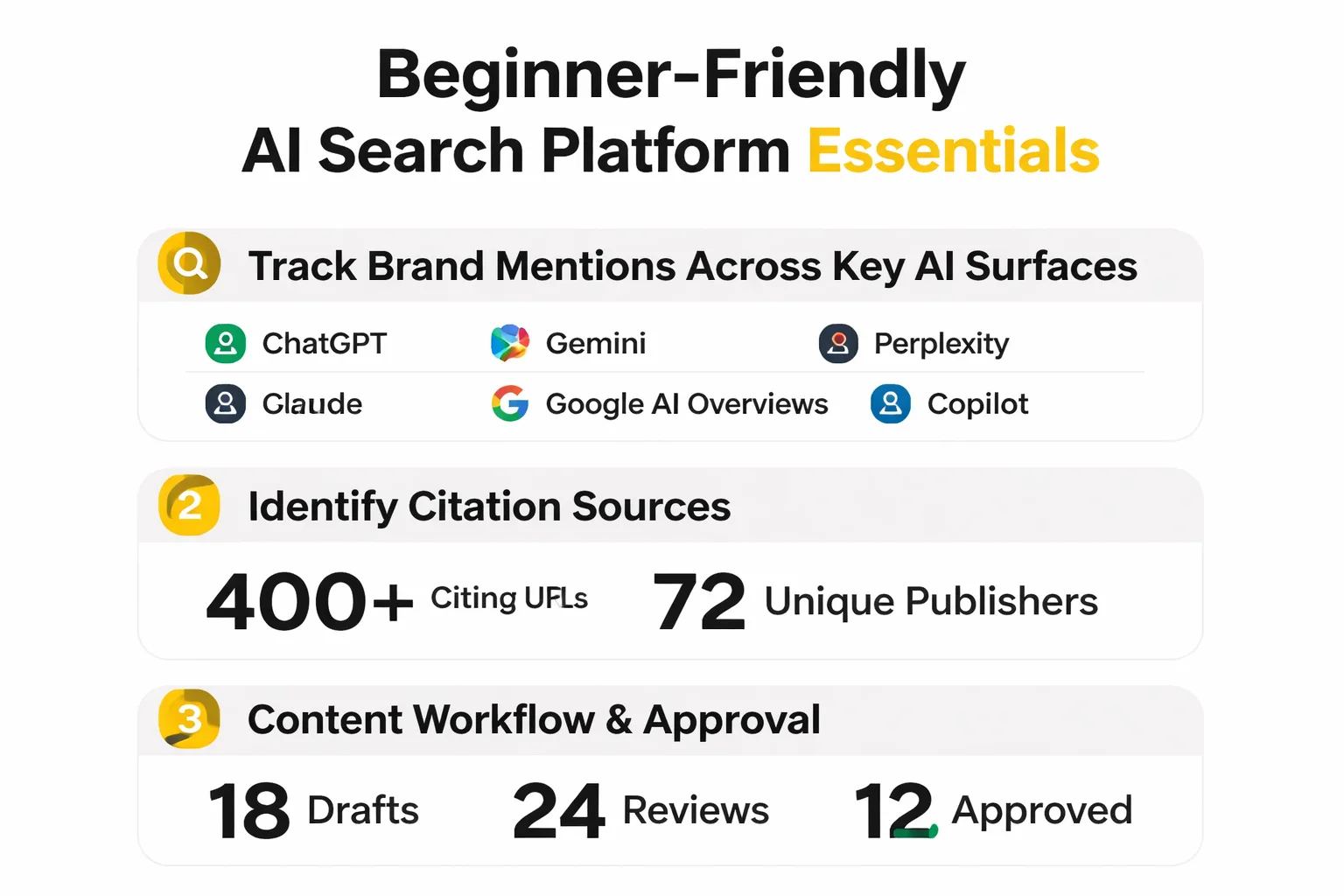
A beginner-friendly platform needs to do three things well. Everything else is a nice-to-have.
First, it needs to track brand mentions across the AI surfaces that matter. That means ChatGPT, Claude, Gemini, Perplexity, Google AI Overviews, and at minimum one or two more. If a tool only tracks ChatGPT, you're getting a fraction of the picture. I've seen teams optimize aggressively for ChatGPT citations only to discover their buyers were actually using Perplexity and Claude for research. The ChatGPT AI visibility checker is a starting point, but it should be part of a broader surface coverage strategy.
Second, the platform needs to identify citation sources. When an AI engine cites a competitor for a prompt you care about, you need to know which URLs and which publishers are feeding that citation. This is where most beginner tools fall short. They'll tell you "your competitor was mentioned 12 times this week" but won't show you the source URLs that earned those mentions. Without source intelligence, you're guessing at what content to create. With it, you can reverse-engineer the exact topics, formats, and publishers that drive AI citations.
Third, and this is the one most platforms skip entirely, the tool needs to help you publish content that closes the gaps it finds. A Perplexity AI visibility checker that surfaces 20 gaps but offers no content workflow is a diagnostic without a prescription. The best platforms for beginners connect the gap analysis directly to content creation, with quality gates that prevent you from publishing AI-generated slop that Google's Helpful Content System will penalize.
I learned this the hard way. I once pushed out a batch of AI-generated articles without human review, hoping the volume would earn citations. Google flagged the content within weeks. Traffic dropped. The lesson: answer engine optimization isn't about flooding the zone. It's about publishing content that AI engines trust enough to cite, which means it also needs to pass Google's quality standards. The two are linked because AI engines train on and reference content that ranks well in traditional search.
How to Evaluate Any AI Search Optimization Platform Before You Commit
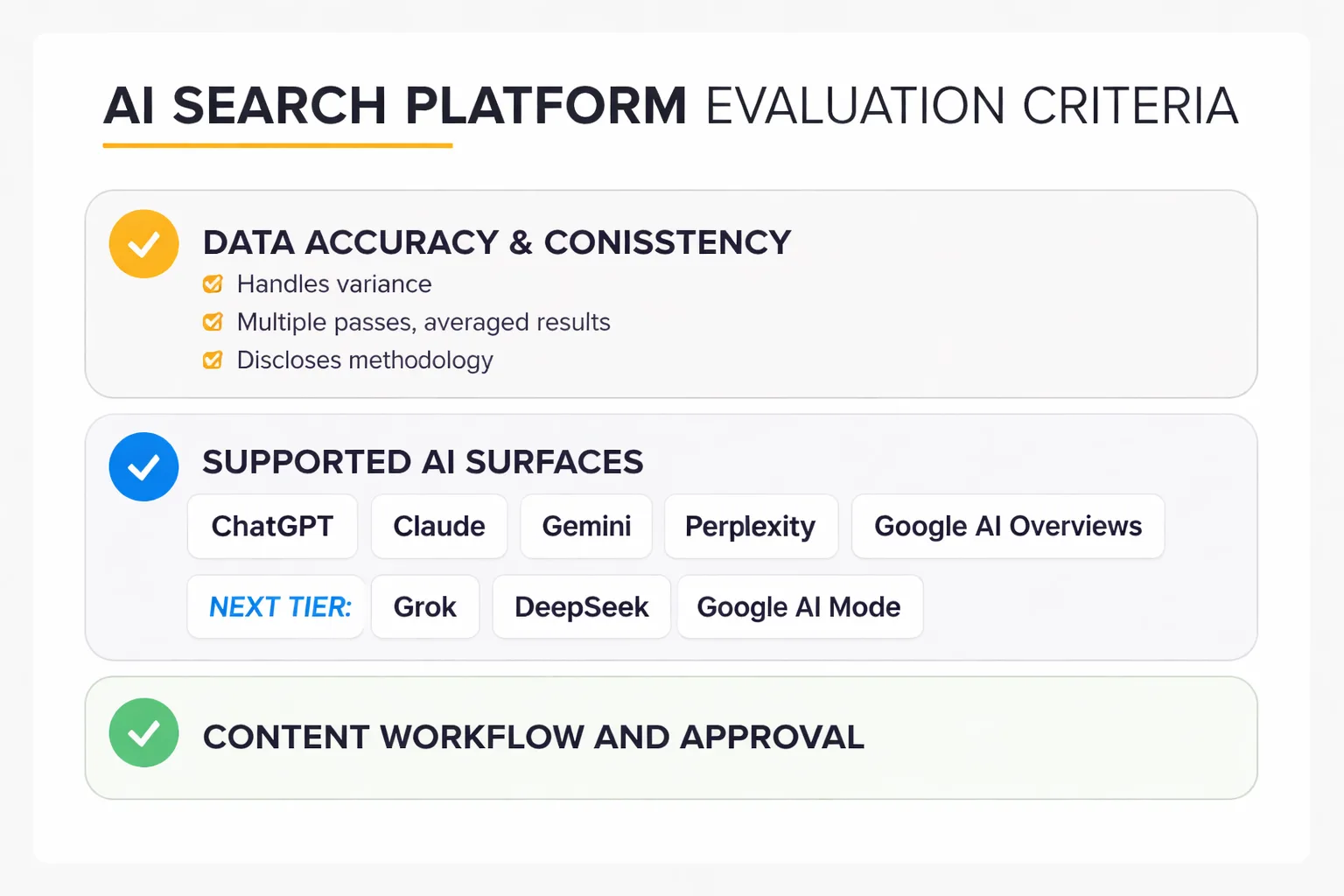
Here's my evaluation checklist. I've refined this through trial and error, and it works regardless of which platform you're considering.
Data accuracy and consistency. Given what SparkToro found about AI inconsistency, you need to ask how the platform handles variance. Do they run multiple passes per prompt and average results? Do they disclose their methodology? A platform that runs one query per prompt and reports the result as gospel is feeding you noise. Look for platforms that acknowledge the consistency problem and build around it.
Supported AI surfaces. The minimum bar in 2026 is ChatGPT, Claude, Gemini, Perplexity, and Google AI Overviews. If a platform covers fewer than these, it's not ready for prime time. Grok, DeepSeek, and Google AI Mode are the next tier. The LLM visibility tool landscape changes fast, so check whether the platform adds new engines as they launch or locks you into a static set.
Content workflow and approval controls. This is where most platforms fail beginners. You want a tool that doesn't just report but also helps you act. Does it suggest topics based on citation gaps? Does it generate content drafts? Does it let you review and approve before anything goes live? If the answer to any of these is no, you'll need to stitch together a second tool to fill the gap, and that defeats the purpose.
Reporting clarity. Can you understand the dashboard in under five minutes? I've audited platforms where I needed a 45-minute onboarding call just to interpret the metrics. For beginners, the report should answer three questions: where am I cited, where am I missing, and what changed since last week. Anything beyond that is noise at the beginner stage.
Pricing transparency. Watch for stacked add-on costs. A platform that advertises $99/month but charges extra per user, per domain, per prompt, and per AI engine can quickly balloon to $500+. Flat-rate pricing with clear quotas is the beginner-friendly model. If you can't calculate your monthly cost from the pricing page without talking to sales, that's a red flag.
Not sure which AI search platform fits your team? Start with a free visibility audit and see where you stand.
How to get your first AI citation win?
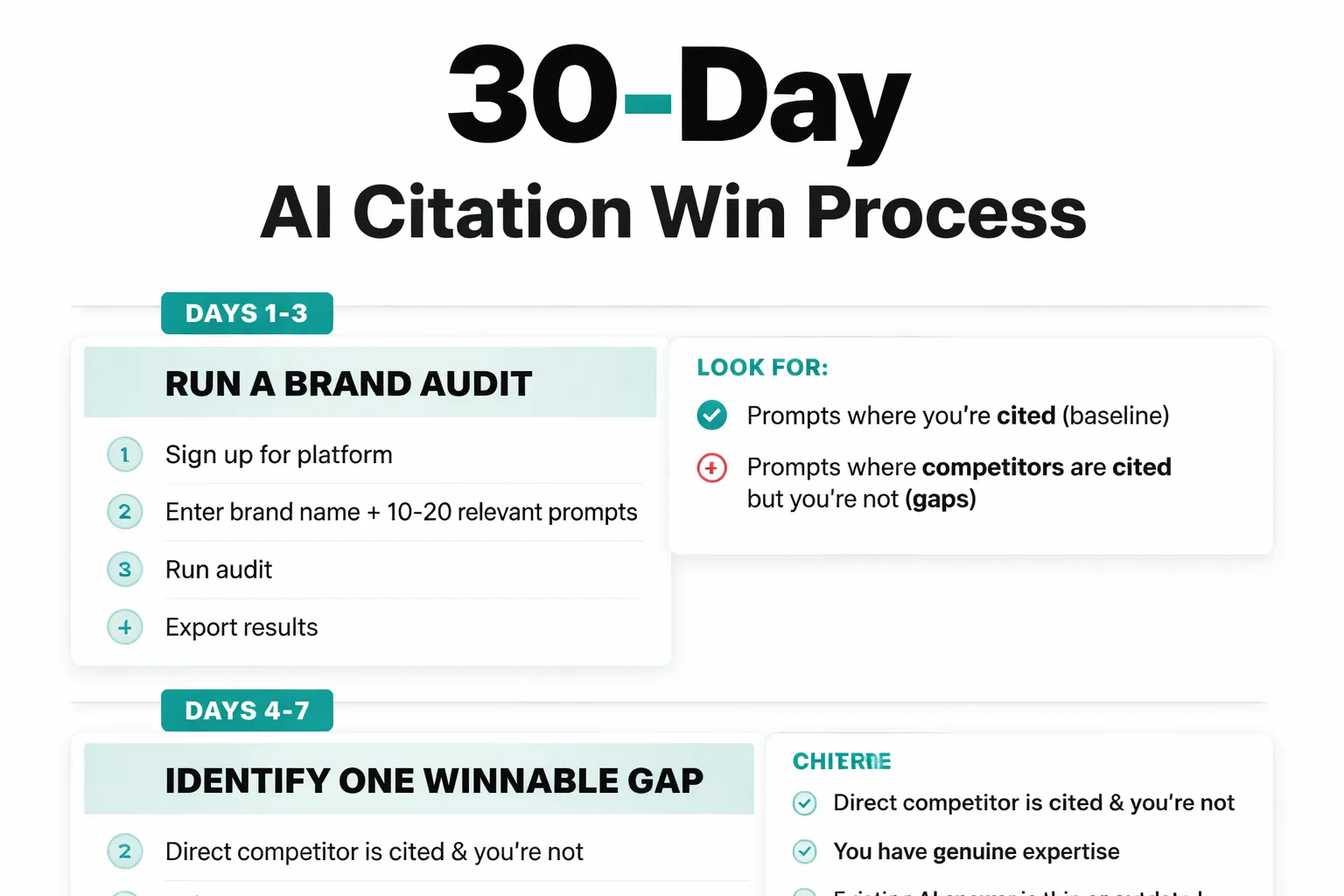
I'm going to walk you through a 30-day process that I've used and seen work. This is not theory. It's the sequence I recommend to every beginner who asks me where to start.
Days 1-3: Run a brand audit. Sign up for a platform that tracks AI citations across multiple engines. Enter your brand name and 10-20 prompts relevant to your product or service. These should be questions your customers actually ask, not keyword-stuffed queries. "What's the best CRM for a 5-person team" is a real prompt. "CRM software small business" is a keyword. Run the audit and export the results. You're looking for two things: prompts where you're cited (your baseline) and prompts where competitors are cited but you're not (your gaps).
Days 4-7: Identify one winnable gap. Don't try to close 20 gaps at once. Pick one. The ideal gap is a prompt where a direct competitor is cited and you're not, where you have genuine expertise to share, and where the existing AI answer is thin or outdated. Use the platform's citation source intelligence to see which URLs the AI engine is referencing for that prompt. This tells you what content format and depth you need to match or exceed.
Days 8-14: Publish one answer-engine optimized article. Write (or generate with quality gates) a single article that directly answers the prompt where you're missing. Structure it for AI extraction: clear question, direct answer in the first paragraph, supporting evidence with inline citations, and a summary section. Use schema markup. Cite authoritative sources. Make it the best single resource on that specific question. The AEO vs SEO framework matters here because you're optimizing for extraction, not just ranking.
Days 15-30: Measure the citation delta. Re-run the same prompt in the same AI engines weekly. Track whether your brand appears, where in the answer it appears (first mention, in a list, last), and whether the article you published is cited as a source. If you see movement, you've proven the loop works. If you don't, the issue is likely content depth or entity grounding. Your brand needs to be recognized as a credible entity for AI engines to cite it, which means consistent NAP (name, address, phone) signals, structured data, and mentions on authoritative third-party sites.
Is Meev best for teams needing tracking and content?
Best for: Teams that want AI citation tracking plus a content engine they can trust to publish. Not just a dashboard that surfaces problems. Differentiated by the 12-dimension Quality Matrix and Helpful Content Risk score that gate every article before it ships.
Meev is the platform I built because nothing on the market combined citation tracking, content publishing, and quality gating in one workflow. It tracks where your brand appears across ChatGPT, Claude, Gemini, Perplexity, Grok, DeepSeek, Google AI Overviews, and AI Mode. Google AI Overviews and AI Mode refresh daily. The other engines refresh on a rolling cadence. What sets it apart is the 12-dimension Quality Matrix plus Helpful Content Risk score that blocks any article scoring below 70/100 from publishing. No other auto-publishing tool has that gate. The Knowledge Base enforcement ensures articles are grounded in your approved claims rather than AI hallucination.
Key features: - Citation tracking across ChatGPT, Claude, Gemini, Perplexity, and Grok on a rolling cadence; Google AI Overviews and AI Mode refresh daily. 12-dimension Quality Matrix plus Helpful Content Risk score. 70/100 publish gate on both. Knowledge Base enforcement. Articles grounded in your approved claims, not AI hallucination. Closed-loop Citation Path (roadmap) — each article mapped to the citation-rate delta it drove. Autopilot topic pool with gap detection from competitor citation patterns
Pricing: 7-day free trial. After the trial, services pause unless you subscribe. Your account stays open and your data stays readable. Lite $49/mo, Starter $99/mo, Pro $269/mo, Agency $599/mo. 20% annual discount. Cancel anytime; hard-cap quotas with no overage fees.
For a beginner, the value proposition is simple. You start with the trial, run a visibility audit, see where you're cited and where you're missing, and then use the content engine to publish articles that close those gaps. The quality gate means you won't accidentally ship content that gets your site penalized. The no-deletion post-trial policy means you can evaluate without risk. If you decide it's not for you, your data stays readable even after services pause.
2. AthenaHQ — Best for growth-stage SaaS teams
Best for: Growth-stage SaaS and content-heavy teams that want direct citation-source intelligence and revenue attribution alongside AI visibility tracking.
AthenaHQ is a Y Combinator-backed GEO platform that identifies exactly which URLs AI systems cite for your target prompts and automates on-page entity tagging at scale. The source intelligence feature is genuinely useful. Seeing which specific URLs AI models reference gives you a concrete content target to match or exceed. The automated schema markup and entity tagging is a time-saver for teams with large content libraries who can't manually tag every page.
Key features: - Source intelligence showing exactly which URLs AI models reference for target prompts. Automated schema markup and entity tagging for large content libraries. Citation, sentiment, and visibility tracking across 8+ AI engines including Claude and Grok. Action Center with optimization workflows and unlimited seats on all tiers
Pricing: Free Essential tier; Starter at $295/month; Enterprise at custom pricing.
The free tier is a good entry point for beginners who want to poke around before committing. But the jump from free to $295/month is steep for a solo founder or small team. The credit-based model also makes monthly spend harder to predict than flat-rate plans. If you're a growth-stage SaaS team with budget and a content library to optimize, AthenaHQ is worth the investment. If you're a beginner looking for your first AI citation, the pricing may be a barrier.
3. Profound — Best for enterprise and fast-scaling teams
Best for: Enterprise and fast-scaling marketing teams that need the deepest AI citation analytics, SOC 2 compliance, and agent-driven automation across multiple markets.
Profound is the category-leading agentic GEO platform. It pairs real-user prompt data from 1.9B+ conversations with autonomous agent workflows to monitor and optimize AI search presence. The Prompt Volumes feature is unique in the market. You can see actual prompt-level data segmented by intent, age, income, and region. That's gold for enterprise teams running multi-market campaigns. The Query Fanout analysis showing how AI engines expand a single prompt into multiple sub-searches is something no other platform offers at this depth.
Key features: - Monitors brand citations across 10+ AI engines including ChatGPT, Claude, Perplexity, Gemini, Grok, DeepSeek, and Google AI Mode. Prompt Volumes built on 1.9B+ real user conversations segmented by intent, age, income, and region. Query Fanout analysis showing how AI engines expand a single prompt into multiple sub-searches. Agentic workflows that automate optimization actions, not just reporting
Pricing: Starter self-serve plan from approximately $82.50/month (billed annually); Growth tier above that; Enterprise at custom pricing.
For beginners, Profound is overkill. The depth of analytics is impressive but unnecessary when you're trying to earn your first citation. The starter plan at ~$82.50/month is accessible, but the platform's complexity exceeds what most beginners need. Profound also doesn't replace a traditional SEO platform, so you'd still need to run both tools in parallel. If you're an enterprise team with SOC 2 requirements and multi-market needs, Profound is the deepest tool available. If you're a beginner, start simpler.
4. Ahrefs Brand Radar — Best for existing Ahrefs users
Best for: Established SEO teams already paying for Ahrefs who want to add AI citation monitoring without onboarding an entirely new vendor.
Ahrefs Brand Radar taps a 260M+ prompt index to track brand citations inside ChatGPT and Google AI Overviews. If you're already in the Ahrefs ecosystem, this is the path of least resistance. The integration means you see AI visibility data alongside your traditional SEO metrics in one dashboard. The competitive benchmarking against rival brands in AI-generated answers is useful for teams that already track competitors in Ahrefs.
Key features: - 260M+ prompt index for broad AI citation coverage. Brand mention and citation tracking across ChatGPT and Google AI Overviews. Integrated inside the existing Ahrefs SEO platform for unified reporting. Competitive benchmarking against rival brands in AI-generated answers
Pricing: From $199/month per AI index or $699/month for all six AI indexes, on top of a required Ahrefs base plan starting at $129/month; realistic all-platform setup near $828/month.
Here's the catch for beginners. The total cost is brutal. A realistic all-platform setup lands near $828/month. That's inaccessible for most beginners and small teams. Claude coverage is also gated to enterprise plans, which limits engine breadth on standard tiers. If you already pay for Ahrefs and have budget, Brand Radar is a natural extension. If you're starting from scratch, don't buy Ahrefs just for this feature.
5. Semrush AI Toolkit — Best for existing Semrush users
Best for: Digital marketers already subscribed to Semrush who want to layer AI citation monitoring onto their existing SEO workflow without switching platforms.
Semrush's AI visibility add-on tracks brand mentions inside Google AI Overviews and ChatGPT Search. The share-of-voice and brand sentiment reporting within the Semrush dashboard is solid for teams that already live in Semrush. The unified reporting connecting AI visibility data with traditional SEO metrics is the main draw. You don't have to context-switch between platforms.
Key features: - AI mention tracking inside Google AI Overviews and ChatGPT Search. Share-of-voice and brand sentiment reporting within the Semrush dashboard. Prompt monitoring with competitive benchmarking against category rivals. Unified reporting connecting AI visibility data with traditional SEO metrics
Pricing: $99/month per domain as a standalone add-on (requires Semrush Pro plan or higher at $139.95/month base); additional users at $99 each and extra prompts at $60 per 50.
The add-on cost structure stacks quickly. Extra users, prompts, and domains each carry separate fees. A solo beginner on Semrush Pro paying $139.95/month base plus $99/month for the AI toolkit is at ~$239/month before adding any extra prompts. The AI visibility features are also shallower than dedicated GEO platforms. If you already have Semrush, it's worth adding. If you're choosing a platform from scratch, look elsewhere first.
6. AIclicks — Best for small business owners and beginners
Best for: Small business owners and beginner marketers who want an affordable all-in-one GEO tool that covers both content optimization and AI citation monitoring.
AIclicks is a beginner-friendly GEO and AI SEO agent platform that combines prompt-level visibility tracking with AI-generated content optimization and ecommerce citation support. The starting price of $59/month is one of the most accessible entry points in the category. The ecommerce product visibility tracking in AI shopping surfaces is a differentiator for product-based businesses. The agency mode for managing multiple client brands under one dashboard is useful for freelancers.
Key features: - Prompt scanning and AI citation tracking across multiple LLM engines. AI-powered content optimization recommendations for GEO and AEO. Ecommerce product visibility tracking in AI shopping surfaces. Agency mode for managing multiple client brands under one dashboard
Pricing: Starting at $59/month; higher tiers available for agencies and enterprise teams.
The depth of per-platform analytics doesn't yet match enterprise-grade tools. For a beginner, that tradeoff is acceptable. You're not trying to run a 10-market enterprise campaign. You're trying to see if your brand shows up in ChatGPT when someone asks about your category. The ecommerce and agentic commerce features are most useful for product-based businesses. If you're a pure service brand, those features are irrelevant.
7. Peec AI (LLMrefs) — Best for budget-conscious agencies
Best for: Budget-conscious marketers and agencies who prioritize maximum AI engine breadth over deep per-platform analytics and want predictable flat-rate pricing.
Peec AI (operating as LLMrefs) covers 11 AI platforms simultaneously at a single flat price. That's the broadest engine coverage per dollar in the category. You get ChatGPT, Google AI Overviews, AI Mode, Perplexity, Claude, Gemini, Grok, Copilot, Meta AI, and DeepSeek. For an agency managing multiple clients, the no-per-seat pricing model is a breath of fresh air in a market where everyone else nickel-and-dimes you.
Key features: - Citation tracking across 11 AI engines: ChatGPT, Google AI Overviews, AI Mode, Perplexity, Claude, Gemini, Grok, Copilot, Meta AI, and DeepSeek. 500 tracked prompts per month at a single flat price. Brand mention and citation share reporting across all covered platforms. Simple onboarding with no per-seat pricing surprises
Pricing: $79/month flat rate for 11 platforms and 500 tracked prompts; no per-seat or per-engine add-on fees.
The tradeoff is depth. Analysis per platform is shallower than Profound or AthenaHQ. There are no advanced features like query fanout analysis, agentic workflows, or revenue attribution. For a beginner who wants broad coverage at a predictable price, Peec AI is a solid choice. For a beginner who wants guided content publishing to close citation gaps, you'll need a second tool.
How Does Entity Grounding Work for AI Search?
Entity grounding is the process of making your brand a recognizable, citable entity in the knowledge structures that AI engines rely on. When ChatGPT or Claude generates an answer, they don't search the live web the way Google does. They retrieve from their training data and from retrieval-augmented generation that pulls from indexed sources. If your brand isn't recognized as a distinct entity with clear attributes (what you do, who you serve, what makes you different), AI engines can't cite you with confidence.
The practical steps for entity grounding are straightforward but tedious. First, ensure your brand has a consistent presence across structured data sources. Wikidata entries, schema.org markup on your site, and consistent NAP information across the web all contribute. Research from the GEO framework paper on arXiv identified citation, source attribution, and entity clarity as key factors in how generative engines select which sources to reference. The Wikidata Workshop 2025 at ISWC** focused on LLM-enhanced knowledge graph completion, which signals that the academic community is actively working on how entities flow into AI outputs.
I'll be honest about the limits of this advice. I searched for a named company case study demonstrating that Wikidata presence directly increased AI citations. I couldn't find one. The GEO research paper provides the theoretical framework, and practitioners recommend entity grounding as a tactic, but no one has published before-and-after metrics linking a specific Wikidata edit to a measurable citation increase. That doesn't mean it doesn't work. It means the research hasn't caught up to the practice. For beginners, I'd treat entity grounding as foundational hygiene rather than a quick-win tactic. Do it because it's good practice, not because you expect a citation within 30 days.
What Is Agentic SEO and Should Beginners Care?
Agentic SEO is the use of autonomous AI agents to execute SEO tasks without human intervention at every step. Instead of a human writing a prompt, reviewing the output, editing, and publishing, an agentic system handles the full loop: research, draft, optimize, publish, and measure. The concept has gained traction in 2026 as LLMs have become capable enough to execute multi-step workflows reliably.
Julian Goldie's work on agentic SEO loops demonstrates that autonomous AI agents can rank content without human intervention. His approach starts with Search Console data (impressions, clicks, CTR) rather than generic keyword estimates, which is a smart grounding strategy. Daniel Foley's case studies show similar results with autonomous agents producing and publishing content that ranks.
Here's my contrarian take on agentic SEO for beginners. Everyone is rushing to build autonomous agents that publish without oversight. I think that's dangerous for beginners. The content quality problem hasn't been solved. Google's Helpful Content System is ruthless, and I've seen AI-generated content get flagged and deindexed within weeks when published without review. The platforms that gate content behind quality checks before publishing are the ones beginners should trust. Autonomy without quality control is a liability.
For beginners, the right approach is supervised autonomy. Let the platform find your citation gaps. Let it suggest topics. Let it draft content. But review everything before it goes live. The AEO tool you use should make review easy, not optional. Once you've published 50+ articles and understand what quality looks like in your niche, you can start loosening the reins. Until then, keep your hands on the wheel.
How Much Does AI Search Optimization Cost?
Purpose-built AI search optimization platforms start at $49/month and range up to $828/month for full-coverage enterprise setups. The pricing models fall into three categories.
Flat-rate with clear quotas is the most beginner-friendly. You pay one price, you get a defined set of features, and there are no surprise add-ons. Meev's Lite tier at $49/month and Peec AI's $79/month flat rate are examples. You know exactly what you're paying and what you're getting.
Add-on pricing is the most common model in the legacy SEO tools. Semrush charges $99/month per domain for its AI toolkit on top of a $139.95/month base plan. Ahrefs charges $199/month per AI index on top of a $129/month base plan. These models make sense if you already use the base platform, but they're expensive for beginners starting from scratch.
Credit-based pricing is the least predictable. AthenaHQ uses this model. You buy credits for queries, and your monthly spend depends on how many prompts you track and how often you refresh. For teams with variable usage, this can be cost-effective. For beginners who want to budget, it's frustrating.
My recommendation for beginners: start with a flat-rate plan under $100/month. Run the 30-day citation win process I outlined above. If you see results and want more depth, upgrade or switch to a platform with more analytics. Don't start with a $500/month commitment before you've proven the loop works.
Making the Right Choice
The best AI search optimization platform for beginners is the one you'll actually use. Not the one with the most features. Not the one with the biggest prompt index. The one that fits your budget, covers the AI engines your buyers use, and gives you a clear path from diagnosis to action.
If you want tracking and content publishing in one platform with quality gates, Meev is built for that exact use case. If you already use Semrush or Ahrefs, their add-ons are the path of least resistance. If you want the broadest engine coverage at the lowest price, Peec AI delivers. If you want the deepest analytics and have enterprise budget, Profound is unmatched.
Start with the 30-day process. Pick one platform. Run the audit. Find one gap. Publish one article. Measure the delta. If the loop works, you've found your platform. If it doesn't, you've spent less than $100 to learn something valuable. Either way, you're ahead of where you were yesterday.
The shift to AI search is not a future event. It's happening now. HubSpot's data shows 42% of CRM buyers already use AI search in their evaluation process. Semrush projects AI search visitors will surpass traditional search by 2028. The brands that establish AI citation presence today will compound that advantage as the shift accelerates. The ones that wait will be building from zero in a market where competitors already hold the citation positions.
FAQ: Common Beginner Questions About AI Search Optimization
How do I get recommended by AI search engines?
Start by auditing where you're currently cited and where competitors are cited but you're not. Then publish content that directly answers the prompts where you're missing. Structure articles for AI extraction: clear questions, direct answers in the first paragraph, supporting evidence with inline citations, and schema markup. Build entity grounding through consistent structured data across your site and the web. AI engines cite sources they recognize as credible entities, so invest in third-party mentions and authoritative outbound citations.
How much does AI search optimization cost?
Purpose-built platforms range from $49/month to $828/month. Beginner-friendly flat-rate plans start at $49-$79/month. Legacy SEO tool add-ons (Semrush, Ahrefs) cost $99-$199/month on top of base plans starting at $129-$140/month. Enterprise platforms like Profound start at ~$82.50/month self-serve but scale to custom pricing. For beginners, a flat-rate plan under $100/month is the right starting point.
How long before I see AI citation results?
Expect 15-30 days for your first citation movement if you follow the gap-to-publish-to-measure loop. The timeline depends on content quality, entity grounding strength, and how frequently the AI engine refreshes its retrieval. Google AI Overviews refresh daily, so you may see movement there first. ChatGPT and Claude refresh on rolling cadences, so changes take longer to surface. Consistency matters more than volume. One well-structured article answering a specific prompt outperforms ten generic posts.
What's the difference between AI search optimization and traditional SEO?
Traditional SEO optimizes for Google's ten blue links. AI search optimization optimizes for AI-generated answers that cite specific sources. The mechanics differ: traditional SEO rewards backlinks and keyword density. AI search optimization rewards entity clarity, direct answers, structured data, and citation-worthy content. The two overlap because AI engines reference content that ranks well in traditional search, but the optimization targets are different. You can rank #1 on Google and never be cited by ChatGPT if your content isn't structured for extraction.
Can I use AI search optimization for ecommerce?
Yes. Ecommerce GEO (generative engine optimization) focuses on getting your products cited in AI shopping surfaces and AI-generated product recommendations. AIclicks offers ecommerce product visibility tracking. The principles are the same: structured product data, entity grounding for your brand and products, and content that answers buyer questions in formats AI engines can extract. Agentic commerce (AI agents making purchase decisions) is an emerging frontier where product visibility in AI answers directly drives revenue.
About the Author
Judy Zhou, Founder
Judy Zhou leads content strategy at Meev, where she oversees AI-driven content research and publishing for hundreds of brands. With a background in SEO and editorial operations, she focuses on building content systems that rank on Google, get cited by AI search engines, and drive measurable business results.
Run your first AI visibility audit today and discover exactly which prompts cite your competitors instead of you.