

By Judy Zhou, Founder
Key Takeaways
- 98.8% of local businesses stay invisible in AI-generated recommendations, requiring dedicated answer engine optimization beyond PageRank signals.
- 73% of B2B websites lost significant traffic between 2024 and 2025 as AI answers replaced traditional organic clicks.
- Organic CTR fell 61% on queries triggering AI Overviews, so treat AI visibility as a distinct discipline from Google ranking.
- AI engines exhibit systematic bias toward earned media over brand-owned content, making third-party citations essential for ChatGPT and Perplexity mentions.
In 2023, when ChatGPT crossed 100 million users and Google quietly accelerated its Search Generative Experience rollout, a new discipline was born without anyone officially naming it. SEOs, growth marketers, and content strategists began noticing that the factors driving AI citations had almost nothing to do with traditional ranking signals. By 2024, the terms answer engine optimization and generative engine optimization had entered the industry lexicon, and a new category of ai search optimization services had emerged to address a problem that PageRank was never designed to solve: getting a language model to trust your brand enough to say your name.
98.8% of local businesses are completely invisible in AI-generated recommendations, according to research analyzing 200+ AI search audits. 73% of B2B websites experienced significant traffic losses between 2024 and 2025 as AI answers cannibalized traditional organic clicks. Organic CTR dropped 61% on queries where AI Overviews appear. And here is the part that should genuinely worry you: an arXiv study by Chen et al. found AI search exhibits a systematic and overwhelming bias toward earned media over brand-owned content. You can rank page one on Google and still get zero mentions in ChatGPT.
That is the problem I want to solve for you in this article. Not with theory. With six concrete steps.
Why AI Visibility Is Now a Separate Problem From SEO
The conventional wisdom in search marketing is that if you rank well on Google, you will be fine. That assumption is now actively dangerous.
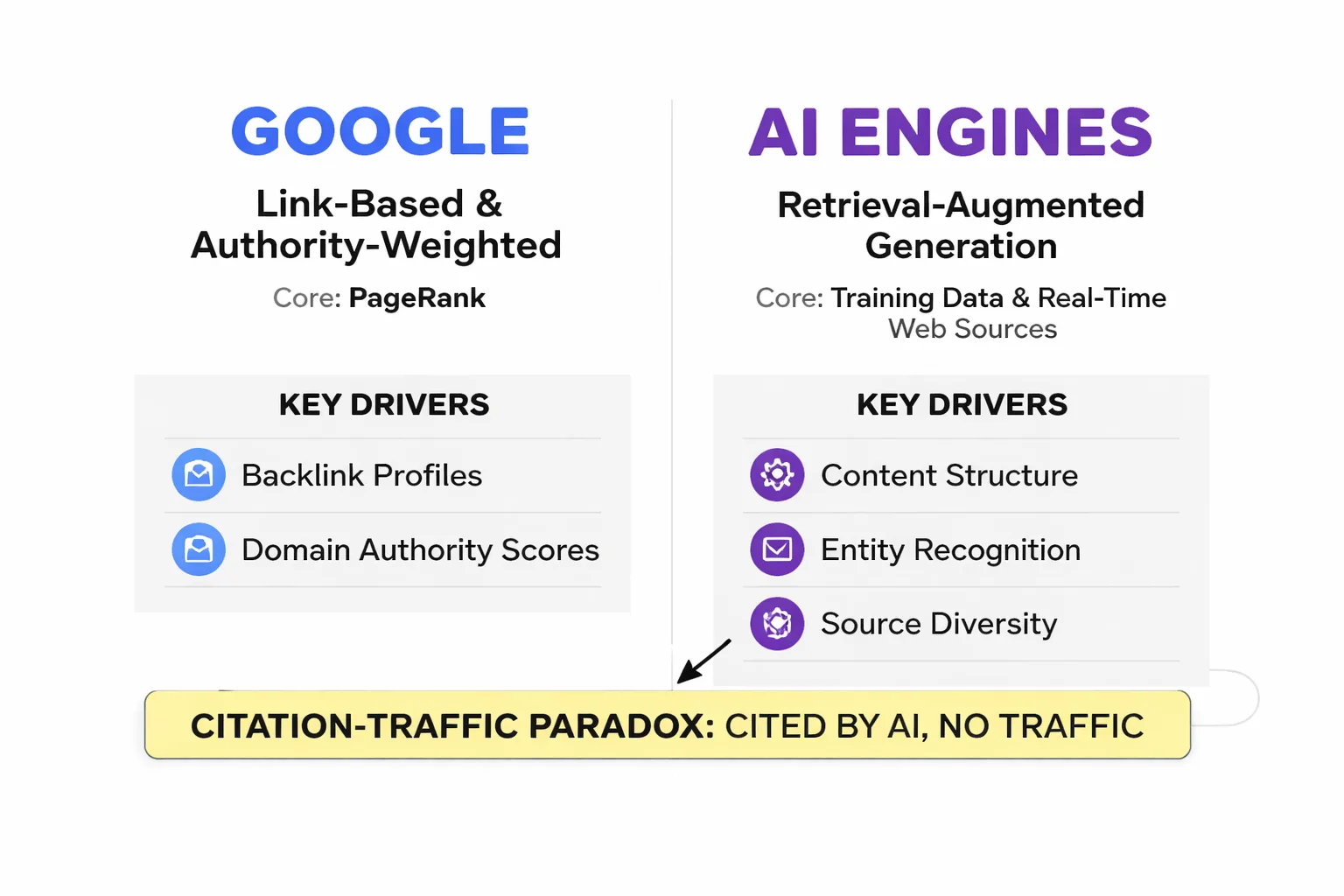
AI engines like ChatGPT, Perplexity, Gemini, and Google AI Overviews do not pull citations the same way Google builds its ten blue links. Google's system is link-based and authority-weighted through PageRank. AI engines are retrieval-augmented generation systems. They fetch content from a mix of their training data and real-time web sources, then synthesize an answer and cite the sources that provided the most useful fragments. The citation decision is driven by content structure, entity recognition, and source diversity, not by backlink profiles or domain authority scores in the traditional sense.
This creates what ZipTie's analysis calls the Citation-Traffic Paradox. You can be cited by AI engines and receive no traffic because the user never clicks through. Or you can rank well in Google and be invisible in AI search because the models prefer third-party earned media over your brand-owned pages. The arXiv GEO paper by Chen, Wang, Chen, and Koudas documents this bias clearly: AI search systematically favors third-party authoritative sources over brand-owned and social content.
I see this disconnect constantly in my work leading content strategy at Meev. A brand will show me their Google Search Console data with 50,000 monthly visitors and page-one rankings for their core terms. Then we run their AI visibility audit and they are absent from ChatGPT, Claude, and Perplexity responses for the exact same queries. Their Google rankings did not protect them. The rules of citation are different.
The shift from traditional SEO to AI visibility is not incremental. It is structural. Google's own AI optimization guide confirms that making content helpful and people-first remains the foundation, but the extractability and structure of that content determines whether a language model can actually use it. If your content is a wall of narrative prose with no clear answer blocks, no entity signals, and no structured data, AI engines will skip you even if you rank first.
This is why AEO and SEO are now distinct disciplines. SEO gets you into the index. AEO gets you into the answer.
Step 1-2: Audit Where You Stand and Fix Your Crawlability
Step 1: Measure Your AI Mention Rate
You cannot improve what you do not measure. The first step is establishing a baseline for your brand's visibility across every major AI search surface.
This means running prompts related to your core topics through ChatGPT, Claude, Gemini, Perplexity, Grok, Google AI Overviews, and Google AI Mode. You need to track not just whether your brand is mentioned, but where in the answer you appear (first mention, in a list, or buried at the end), which sources the AI engine cites alongside or instead of you, and how your share of voice compares to competitors.
The Semrush AI Visibility Index 2026 study analyzed 126 million real US AI search prompts across 22 industries and 4 AI platforms. They identified just 36 Universal brands that won AI visibility every single month. That is 36 brands out of thousands tracked. The bar is high and the field is wide open for teams that move now.
In my work at Meev, I have seen teams skip this step and jump straight to content production. That is a mistake. Without a baseline, you have no way to know if your efforts are moving the needle. You need a tool that tracks AI mentions daily on SERP-driven surfaces and with rolling refresh on LLM-driven surfaces. You can start with our AI visibility checker to get a snapshot, or use a full AI visibility tool for ongoing tracking across all surfaces.
The audit should answer three questions. First, what percentage of relevant prompts mention your brand at all? Second, when your brand is mentioned, is it the first citation or an afterthought? Third, which competitors appear in the prompts where you are absent? Those three data points define your entire optimization roadmap.
Let me give you a concrete example of how this works in practice. Say you run a project management SaaS company. Your audit prompts would include things like "best project management tools for small teams," "alternatives to Asana," and "how to choose project management software." You run each prompt through every AI surface and record the results. Maybe ChatGPT mentions you in 2 out of 10 prompts, always in a list of five tools, never first. Perplexity cites you in 4 out of 10 prompts, sometimes first. Claude does not mention you at all. That is your baseline. Every optimization decision from this point forward should be measured against those numbers.
The mention position matters enormously. Research from the arXiv GEO paper suggests that sources cited first in an AI answer carry more trust weight for future queries. Being mentioned third in a list of five is better than nothing, but it is not the same as being the primary cited source. Track your position over time and watch for patterns. If you are consistently cited first for how-to queries but never for comparison queries, that tells you exactly which content type to strengthen.
Step 2: Confirm Crawlability and Configure llms.txt
AI engines can only cite what they can access. If your key pages are blocked from crawling or your content is not structured for machine readability, you are invisible by default.
Start with a standard technical SEO crawl. Check your robots.txt for AI crawler blocks. Many sites inadvertently block GPTBot, ClaudeBot, PerplexityBot, and Google-Extended in their robots.txt because they copied a restrictive template. If these bots are blocked, your content will not be fetched for real-time retrieval, and you will not appear in AI answers even if your pages rank organically.
You can use our AI Crawler Simulator to check whether major AI bots can actually access your key pages. It simulates the crawl from the perspective of AI-specific user agents and flags any blocks.
Next, configure your llms.txt file. This is a relatively new standard that provides AI engines with a curated guide to your most important content. Think of it as robots.txt for language models. It tells crawlers which pages matter most and how to understand your brand. You can validate your llms.txt configuration with our free tool to make sure it is correctly formatted and not accidentally excluding key pages.
Beyond crawlability, you need to ensure your content is structured for extraction. This means clean HTML with proper heading hierarchies, structured data markup (Organization schema, Article schema, FAQ schema), and consistent entity signals across your site. Google's AI optimization guide recommends making content helpful, people-first, and well-structured. That is the baseline. AI engines reward content that is easy to parse, easy to extract, and easy to cite.
Here is a specific technical checklist for crawlability that goes deeper than most teams go. First, verify that your server response times are under 200ms for AI bot user agents. Slow responses cause crawlers to abandon the page before reading content. Second, ensure your pages return proper HTTP 200 status codes, not 302 redirects that lose link equity. Third, check that your structured data validates in Google's Rich Results Test without errors. Fourth, confirm your sitemap is current and submitted to Google Search Console. Fifth, verify that your canonical tags point to the correct URLs and do not accidentally canonicalize away from your key content pages. Each of these technical details seems small, but together they determine whether AI engines can reliably access and parse your content.
Step 3-4: Restructure Content for Answer-Engine Citation
Step 3: Write Extractable Answer Blocks
This is where most teams fail. They write content for human readers and hope AI engines will figure it out. Sometimes they do. Often they do not.
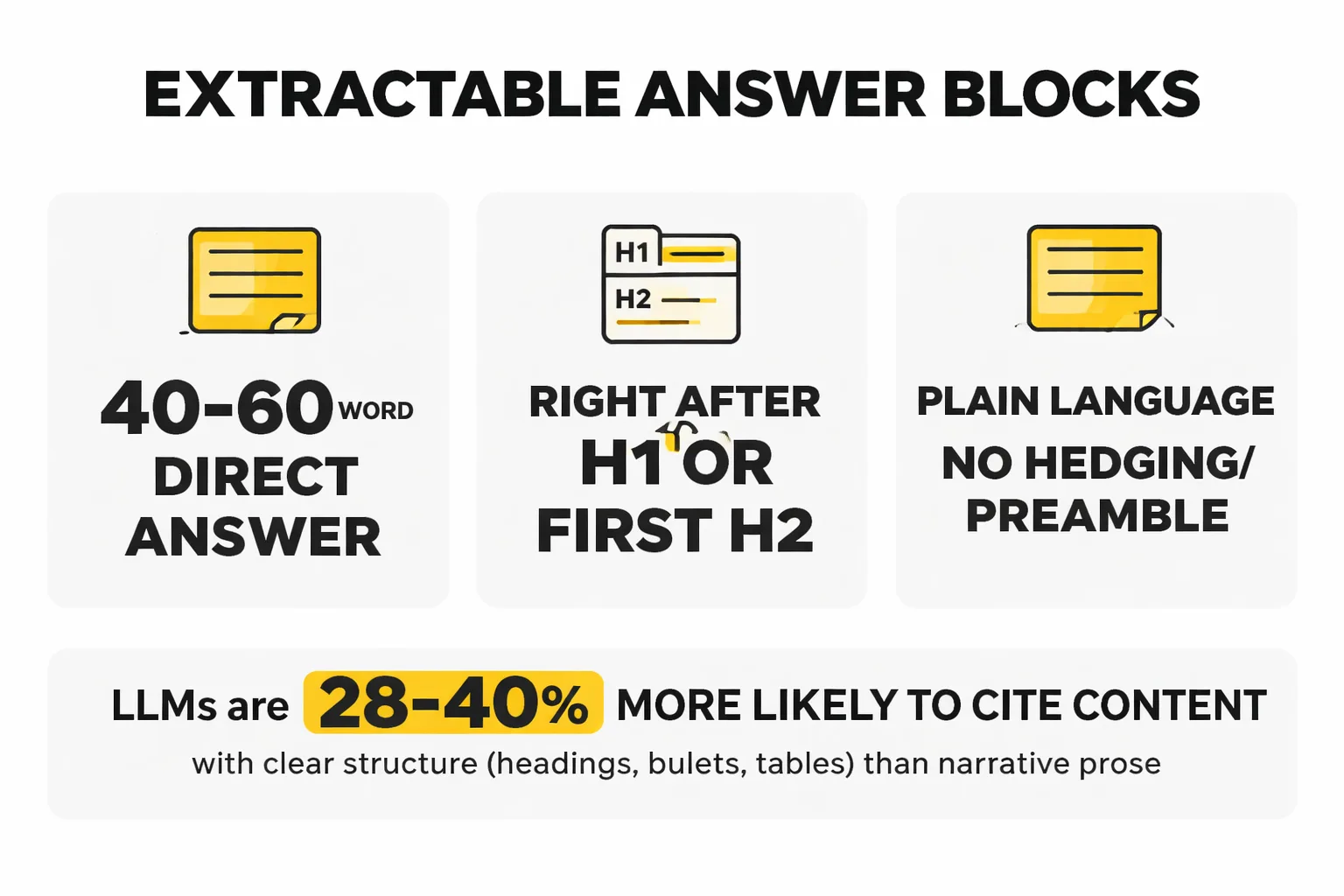
HubSpot's analysis of GEO statistics found that LLMs are 28-40% more likely to cite content with clear structure (headings, bullets, tables) than narrative prose. The original arXiv GEO paper found that including citations, quotations, and structured formatting in content significantly improved AI citation rates. Structure is not a nice-to-have. It is the mechanism by which AI engines decide what to extract.
Here is what an extractable answer block looks like. Write a 40-60 word direct answer to the question your page targets. Put it right after the H1 or the first H2. Use plain language. No hedging. No preamble. Then elaborate below with supporting detail, examples, and evidence.
The pattern is simple but powerful. AI engines perform retrieval-augmented generation. They fetch relevant content fragments and feed them into the generation pipeline. If your page has a clean, self-contained 50-word answer block that directly addresses the query, it is far more likely to be selected as a source fragment than a 500-word narrative that buries the answer in paragraph three.
I recommend rewriting your top 10 organic pages first. These are the pages that already have some authority signal. Add direct question headings (H2s phrased as questions), 40-60 word answer blocks under each, numbered lists for procedural content, and comparison tables for versus queries. Every page should have at least one quotable sentence that would make sense if extracted and cited on its own.
Let me walk you through a real example. Suppose you have a page titled "What is entity grounding for AI search?" Right now, that page probably starts with a 200-word introduction about the history of knowledge graphs, then eventually gets to a definition somewhere around paragraph four. That structure is killing your citation potential. Instead, restructure it so the first thing after the H1 is a bold, 45-word definition: "Entity grounding for AI search is the process of connecting your brand to a verified knowledge graph entry (like Wikidata or Google's Knowledge Panel) so language models can factually attribute information to your organization. It ensures AI engines reference accurate, structured data about your company rather than hallucinating details." Then expand with sections on how to implement it, why it matters, and common mistakes. That opening block is what AI engines will extract.
The same principle applies to listicles. If your page is titled "7 AI SEO Tools to Watch in 2026," do not write a 300-word intro about the state of the industry. Start with a numbered list where each item has a 20-30 word description. Put the context and analysis below the list. AI engines extract the list because it is the most structured, citable format on the page.
Step 4: Build Topical Authority Through Content Clusters
AI engines favor sources that cover a subject comprehensively. This is not new advice in SEO, but the mechanism is different for AI citation. Google uses topical authority as a ranking signal. AI engines use it as a trust signal. If your site has 20 well-structured articles covering every angle of a topic, the AI engine's retrieval system is more likely to pull from your domain repeatedly because it recognizes you as a comprehensive source.
The arXiv GEO research demonstrated that content optimization techniques like statistical data inclusion, citation embedding, and query-relevant formatting improved AI visibility by measurable margins. But the underlying driver is topical depth. A single article on a topic might get cited once. A cluster of 15-20 articles signals that you are an authority worth citing repeatedly.
Build your cluster around a core topic. Write a pillar page that defines the topic and links to 10-15 supporting articles, each covering a specific sub-question. Use what is AEO as a model: one definitive explainer that answers the core question, surrounded by supporting articles that address related queries.
The key is tight clustering. Do not spread your content across loosely related topics. Pick one core topic, map 15-20 sub-questions that a user might ask about it, and write a dedicated article for each. Internal link them all back to the pillar. This creates a dense web of topical authority that both Google and AI engines can crawl and recognize.
Here is how to map your cluster systematically. Take your core topic and brainstorm every question a user might type into ChatGPT about it. If your core topic is "AI search optimization," your sub-questions might include: How does AI search optimization differ from traditional SEO? What are the best AI search engine optimization tools? How do I track my brand's AI visibility? What is entity grounding and why does it matter for AI search? How do I optimize my content for Perplexity citations? Each of those becomes a dedicated article with its own 40-60 word answer block, structured data, and internal links back to the pillar page. The pillar page links out to all supporting articles with descriptive anchor text. This internal linking structure helps AI engines understand the semantic relationship between your pages and recognize your domain as a comprehensive source on the topic.
The density of your cluster matters. Five articles is not enough to signal comprehensive coverage. Thirty articles on a single topic starts to feel like keyword cannibalization. The sweet spot I have observed is 12-20 tightly clustered articles, each targeting a distinct sub-question with no significant overlap. Use cannibalization detection at the planning stage to ensure each article targets a unique primary query.
Step 5-6: Publish Consistently and Monitor Citation Lift
Step 5: Automate Your Content Pipeline
Topical authority requires volume. Not slop. Not 100 AI-generated posts an hour with no human review. But a consistent publishing cadence that builds depth over time.
I have seen what happens when teams go all-in on high-volume, unedited AI content generation. Rankings plummet. Google does not reward sheer volume. The teams that win are the ones that use AI to amplify quality, not replace it. They use AI for research, drafting, and optimization, but they keep human oversight for editing, tone, and strategic decisions.
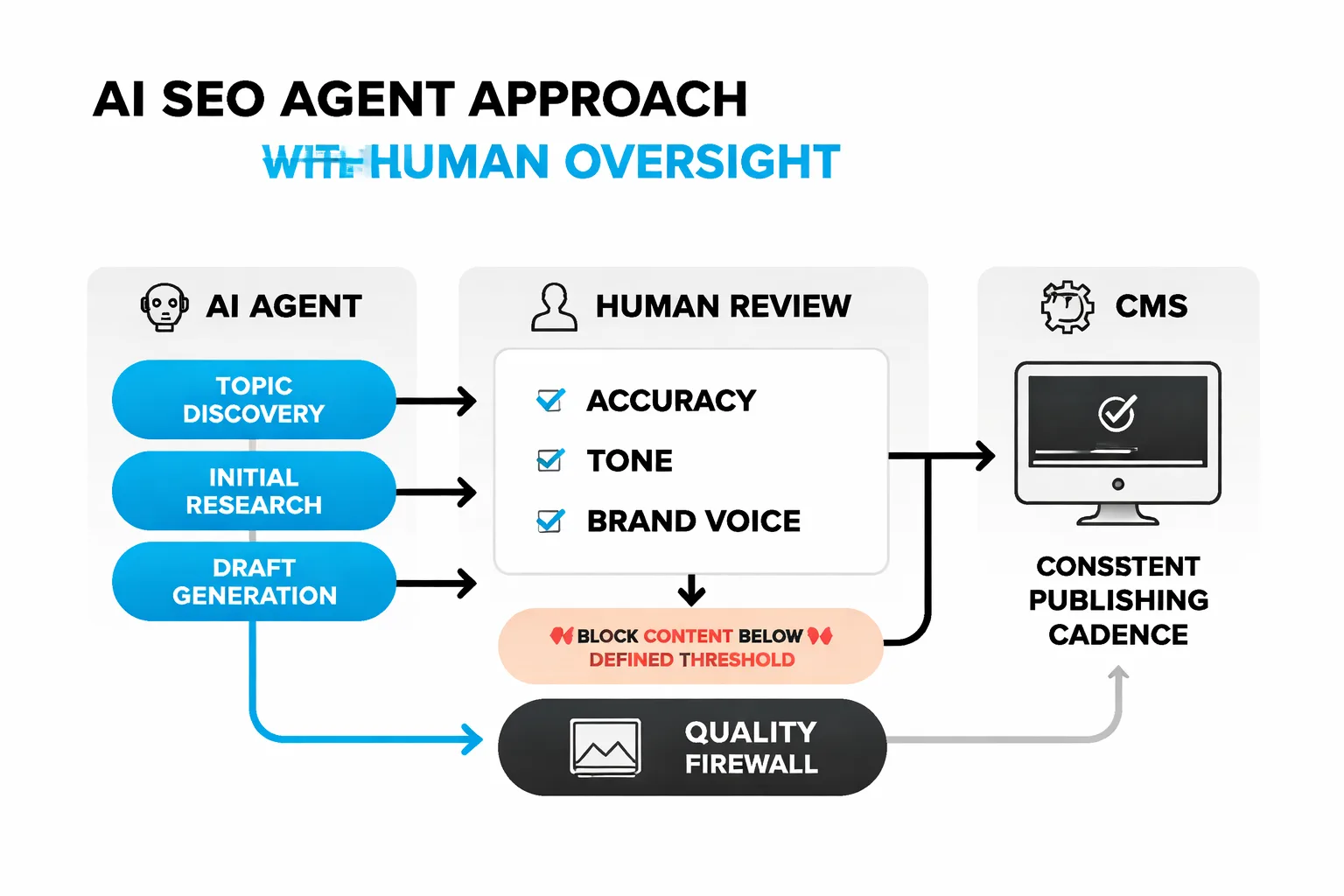
This is where an AI SEO agent approach can work, but only with the right guardrails. The agent should handle topic discovery, initial research, and draft generation. A human should review for accuracy, tone, and brand voice. And a quality firewall should block anything below a defined threshold from reaching your CMS.
At Meev, we built our content pipeline around this principle. The system discovers topics from six sources (Google Trends, RSS, Hacker News, Reddit, DataForSEO, Search Console), drafts archetype-aware articles, and runs every draft through a 16-dimension quality firewall before anything goes live. Articles below 70 out of 100 are blocked. No exceptions. This is the kind of AI for SEO that actually works: automated research and drafting gated by rigorous quality control.
The publishing cadence matters because AI engines refresh their retrieval index regularly. If you publish one article per month, your domain is not top of mind for the retrieval system. If you publish 3-5 well-structured articles per week, you build momentum. Your domain becomes a frequent source for content fragments, which increases the probability of citation.
Multi-platform publishing matters too. Your content should go directly to WordPress, Ghost, Shopify, or whatever CMS you use, with automatic sitemap submission to Google Search Console and IndexNow pinging on every publish. This ensures both Google and AI engines discover your new content fast.
Let me explain why the quality firewall is the single most important feature of any automated content pipeline. When you publish AI-generated content without quality gates, you are gambling with your domain's reputation. Google's algorithms have become increasingly sophisticated at detecting low-value automated content. The issue is not that Google penalizes AI content specifically. The issue is that AI content tends to be generic, surface-level, and indistinguishable from what every other site is publishing. That is what Google devalues. A quality firewall forces the system to meet a minimum threshold for depth, accuracy, and uniqueness before publishing. It checks for factual claims without sources, thin content, duplicate phrasing, and structural issues. Only drafts that pass all checks go live. This is the difference between an AI SEO tool that builds your brand and one that destroys it.
Step 6: Track AI Mention Rate Weekly and Iterate
This is the step that separates teams that win from teams that guess. You need weekly tracking of your AI mention rate across every major AI search surface. Not just Google rankings. AI mentions.
The data points you need are specific. How many prompts mention your brand this week versus last week? Which competitors appear in prompts where you are absent? Which sources are AI engines citing for your topics? And critically, what is the actual response text behind every mention?
Without this data, you are optimizing blind. You might be writing great content that nobody in AI search ever sees. Or you might be cited for the wrong topics while competitors own the prompts that matter.
This is where dedicated AI visibility reporting becomes essential. You need per-LLM drill-down dashboards that show weekly trends, the actual response text behind every mention, and the cited-source leaderboard for your topics. You need to see which domains AI engines cite most often so you can target them for outreach and earned media.
The arXiv research is clear that AI engines prefer earned media over brand-owned content. So if a competitor is being cited because a high-authority third-party publication mentioned them, you need to know that. You need to see the citation path: which publisher, which article, which prompt. Then you can pursue similar coverage.
Iterate on the prompts where competitors are cited instead of you. If Perplexity cites Competitor A for a prompt where you are absent, look at what Competitor A's content does that yours does not. Is their answer block more concise? Do they have more structured data? Are they cited by a third-party source that you are not? Close the gap one prompt at a time.
HubSpot reports that answer engine visitors convert at 4.4x the rate of organic search traffic. When AI summaries appear, click-through rates on traditional links drop 54%. The traffic you lose from AI cannibalization is partially offset by the higher conversion rate of the traffic you gain through AI citations. But only if you are actually cited.
You can track your ChatGPT visibility specifically or monitor your Perplexity citations as a starting point. The key is weekly cadence. Monthly is too slow. The AI search landscape shifts fast enough that a month-old snapshot is already stale.
Let me walk through the iteration process with a specific example. Suppose your weekly tracking shows that for the prompt "best CRM for startups," Perplexity cites three competitors but not you. You look at the cited sources and discover that all three competitors are mentioned in a recent G2 comparison article that Perplexity retrieved. Your brand is not in that article. Your iteration action is clear: pursue a presence on that G2 comparison page, either by claiming your G2 profile and encouraging reviews, or by reaching out to the article author with updated information. The next week, you run the same prompt and check whether your G2 presence moved the needle. This is how you close citation gaps one prompt at a time.
The same iteration applies to content structure. If your tracking shows that you are cited for definitional queries ("what is X") but not for comparison queries ("X vs Y"), that tells you your comparison content needs restructuring. Maybe your versus pages are long-form prose without a clear comparison table. Add the table, add the structured answer block, republish, and monitor the next weekly cycle.
How Does Entity Grounding for AI Search Work?
Entity grounding is the foundation that makes everything else in this article work. Without it, AI engines cannot reliably connect your content to your brand identity.
Entity grounding means linking your brand to a structured, verifiable entry in a knowledge graph that AI engines reference during retrieval. The most important knowledge graphs for AI search are Wikidata, Google's Knowledge Graph, and Microsoft's Bing Entity Search API. When an AI engine encounters your brand name in a piece of content, it checks these knowledge graphs to verify who you are, what you do, and what entities you are connected to. If your brand has no knowledge graph presence, the AI engine has no way to verify your identity, and it is less likely to cite you as a source.
Liam Dunne from Discovered Labs recommends defining your company using the EAV-E formula and implementing Organization schema with sameAs properties linking to authoritative sources. This means your website's structured data should include a sameAs property that links to your Wikidata entry, your Crunchbase profile, your LinkedIn company page, and your G2 profile. These cross-references tell AI engines that all of these profiles represent the same entity.
The practical implementation is straightforward but tedious. First, create a Wikidata entry for your company if one does not exist. Include your legal name, founding date, industry, headquarters location, and official website. Second, add Organization schema to your website's homepage with sameAs properties linking to every authoritative profile. Third, ensure your company information is consistent across all platforms. If your Wikidata entry says you were founded in 2019 but your Crunchbase profile says 2020, that inconsistency can trigger what Discovered Labs calls an AI hallucination penalty, where the AI engine becomes less confident in its understanding of your entity.
I want to be transparent about the limits of entity grounding. The research on this topic, including Discovered Labs' analysis, recommends Wikidata integration but provides no quantitative citation metrics showing how much entity grounding improves AI visibility. The advice is based on how AI systems work mechanically, not on controlled experiments. That said, the mechanical logic is sound: AI engines cannot cite what they cannot identify, and entity grounding is how they identify you.
Want to see where your brand stands in AI search right now?
How to Increase AI Visibility Today: The Minimum Viable Checklist
Here is the scannable, extractable checklist. Each step has one concrete action you can take today.
1. Audit your AI mention rate. Run 20-30 prompts related to your core topics through ChatGPT, Claude, Gemini, Perplexity, and Google AI Overviews. Record which mention your brand and which cite competitors. Use an AI visibility checker to automate this. 2. Fix crawlability. Check your robots.txt for AI crawler blocks (GPTBot, ClaudeBot, PerplexityBot, Google-Extended). Use an AI crawler simulator to verify access. Configure and validate your llms.txt file. 3. Add extractable answer blocks. Rewrite your top 10 pages with 40-60 word direct answers under question-shaped H2s. Use numbered lists, comparison tables, and bold quotable sentences. 4. Build a content cluster. Pick one core topic. Write 15-20 supporting articles, each answering a specific sub-question. Internal link them all to a pillar page. 5. Automate publishing with quality control. Use an AI content pipeline with a quality firewall that blocks weak drafts. Publish 3-5 articles per week. Submit to Google Search Console and IndexNow on every publish. 6. Track weekly and iterate. Monitor AI mention rate across all major AI surfaces every week. Identify prompts where competitors are cited. Close the gap by improving your content structure or pursuing earned media from the sources AI engines cite.
When This Fails: Where the Playbook Breaks Down
I want to be honest about the limits of this playbook because I have seen teams follow every step and still struggle. There are three scenarios where the six-step process above does not work as expected.
First, if your brand has zero existing entity presence. No Wikidata entry, no Crunchbase profile, no Wikipedia mention, no consistent NAP data across the web. AI engines use entity recognition to understand who you are. If your brand entity does not exist in the knowledge graph, no amount of content restructuring will make AI engines cite you. You need to build the entity first. Liam Dunne from Discovered Labs recommends defining your company using the EAV-E formula and implementing Organization schema with sameAs properties linking to authoritative sources like Wikidata, Crunchbase, LinkedIn, and G2. Do this before you write a single answer block.
Second, if you are in a hyper-competitive niche dominated by the 36 Universal brands from the Semrush study. Those brands win AI visibility every month because they have massive earned media coverage, decades of brand authority, and thousands of citing sources. You will not out-cite them by writing better answer blocks. You need to find long-tail prompts where they are absent and build authority there first. Think of it as the content marketing equivalent of local SEO. Win the queries the giants ignore.
Third, if your content quality is genuinely poor. No quality firewall or AI agent can fix a fundamental lack of expertise, experience, authoritativeness, and trust. If your articles are generic, surface-level, and indistinguishable from what five other sites published this week, AI engines will not cite you. They are looking for the best source. If you are not the best source for any given query, you will not be cited. The quality firewall blocks weak drafts from publishing, but it cannot inject expertise you do not have. That has to come from your team.
What This Actually Means
The shift from traditional SEO to AI visibility is not a trend. It is a structural change in how search works. 60% of Google searches now end without a click, according to HubSpot's GEO statistics. AI-referred traffic is up 600% since January 2025. ChatGPT has 900 million weekly active users. These numbers tell you where attention is moving.
The teams that win in this new landscape are not the ones with the biggest content budgets. They are the ones that understand the mechanics of AI citation and build systems to influence it. Audit your visibility. Fix your crawlability. Restructure your content. Build topical authority. Publish consistently with quality control. Track and iterate weekly.
That is the entire playbook. The question is whether you execute it before your competitors do.
If you want to understand the broader framework behind these steps, read our deep dive on AEO vs GEO to see how answer engine optimization and generative engine optimization differ in practice. And if you want to track how your brand is mentioned across AI search, check your AI visibility now.
The brands that get cited by AI engines tomorrow are the ones that start the work today. The ai search optimization services category exists because the old playbook does not solve this problem. You need a new workflow, new tools, and a new measurement framework. The six steps in this article are that framework.
FAQ
How long does it take to see AI citation lift after implementing these steps?
In my experience, you can see initial citation movement within 4-6 weeks of restructuring your content with answer blocks and fixing crawlability issues. Meaningful, sustained lift across multiple AI engines typically takes 3-4 months of consistent publishing and weekly monitoring. AI retrieval indexes refresh at different intervals than Google's crawl, so patience matters. The teams that see fastest results are the ones that start with a thorough audit and fix entity grounding issues before publishing content.
Do I need ai search optimization services or can I do this in-house?
You can absolutely do this in-house if you have the bandwidth for weekly AI visibility tracking, content restructuring, and consistent publishing. The advantage of using a platform or service is the automation layer. Tools that combine tracking, content generation with quality control, and citation path discovery save significant time for small teams. The six steps in this article are the same workflow whether you execute manually or with a platform.
What is the difference between AEO and traditional SEO?
Traditional SEO optimizes for ranking position in search engine results pages. AEO (answer engine optimization) optimizes for being cited inside AI-generated answers. The two disciplines share foundations (quality content, technical accessibility, topical authority) but diverge on tactics. AEO prioritizes extractable answer blocks, entity grounding, structured data, and earned media coverage. SEO prioritizes backlinks, keyword density, and click-through optimization. You can read our full breakdown of AEO vs SEO here.
Which AI search surfaces should I track?
Track every major AI search surface: ChatGPT, Claude, Gemini, Perplexity, Grok, Google AI Overviews, and Google AI Mode. Each surface has different retrieval mechanisms and citation patterns. A brand might be cited frequently in Perplexity but absent from ChatGPT. Weekly tracking across all surfaces gives you the full picture. Prioritize the surfaces where your target audience actually searches.
How does earned media affect AI citations?
The arXiv study by Chen et al. found that AI search exhibits a systematic bias toward earned media (third-party authoritative sources) over brand-owned content. This means getting mentioned in high-authority publications like industry blogs, news sites, and review platforms significantly increases your AI citation likelihood. Pursue earned media coverage from the specific domains that AI engines cite most for your topics. Use citation path analysis to identify those domains.
Is llms.txt necessary for AI visibility?
llms.txt is not strictly necessary today, but it is becoming a best practice. It provides AI crawlers with a curated guide to your most important content, similar to how sitemap.xml helps search engines. While AI engines can discover your content without it, a well-configured llms.txt file ensures they prioritize your key pages and understand your brand context. Validate your llms.txt configuration to make sure it is correctly formatted.
What is the role of an AI SEO agent in AI visibility?
An AI SEO agent automates the repetitive tasks in the AI visibility workflow: topic discovery, content research, draft generation, and publishing. The key is that the agent must be gated by human oversight and a quality firewall. Agents that autonomously publish without quality checks produce generic content that AI engines will not cite and Google may devalue. The effective use of an AI SEO agent is as a research and drafting assistant, not an autonomous publisher.
About the Author
Judy Zhou, Founder
Judy Zhou leads content strategy at Meev, where she oversees AI-driven content research and publishing for hundreds of brands. With a background in SEO and editorial operations, she focuses on building content systems that rank on Google, get cited by AI search engines, and drive measurable business results.
Run a free AI visibility audit and discover exactly which prompts cite your competitors instead of you.