

How to Increase AI Visibility Today Without an Agency
By Judy Zhou, Founder
Key Takeaways
- 57% of Americans now use generative AI while Google AI Overviews appear in over 25% of searches, so brands absent from those answers lose visibility to a growing market segment.
- An Ahrefs study of 75,000+ brands shows AI citations hinge on topical authority, not raw domain strength, rendering traditional backlink strategies insufficient.
- HubSpot confirms AI search visibility tracks three metrics: mention frequency, owned-content citations, and how those mentions are framed.
- Structure entity data, Wikidata presence, and schema markup to match cited competitors, as demonstrated when a smaller brand overtook Marcus in Perplexity results.
Marcus refreshed the Perplexity results one more time. His competitor. A brand half the size of his, with a thinner product line and a clunkier website. Was cited by name in the AI-generated answer. His company was not mentioned anywhere. He had spent three years building domain authority the traditional way, and none of it seemed to matter inside this new kind of search. That afternoon he started pulling apart exactly how the cited brand had structured its entity data, its Wikidata presence, and its schema. And what he found changed how he approached visibility entirely.
I've lived this problem in my own work auditing content ops. 57% of Americans now use generative AI, and Google AI Overviews appear in over 25% of searches. If your brand is not cited inside those generated answers, you are invisible to a growing slice of your market. The Ahrefs study of 75,000+ brands found that AI citation patterns depend heavily on topical authority, not raw domain strength. That means the old playbook of building backlinks and hoping for the best is insufficient. HubSpot's marketing team confirms that AI search visibility measures three distinct things: how often your brand is mentioned, how your owned content is cited, and how those mentions are framed. A high mention rate means nothing if the AI positions your brand as a budget alternative to a competitor. Finding the most reliable ai search optimization tool for data accuracy is the prerequisite to fixing any of this. Without accurate citation data, you are optimizing blind.
Why AI Visibility Is Different From Classic SEO
Classic SEO is measurable because the SERP is a static object you can inspect. You type a query, you see ten blue links, and you count where you rank. The feedback loop is tight. You publish a page, you wait for Google to crawl it, and you watch your position move over weeks. The entire industry of rank tracking is built on this simple premise: the search engine shows you the results, and you track your position in them.
AI search breaks that model completely.
When a user asks ChatGPT or Perplexity a question, the response is generated in real time. There is no static SERP to inspect. The answer changes based on the model's training data, its retrieval-augmented generation pipeline, the specific phrasing of the prompt, and even the conversation history. You cannot "rank" in a generated answer the same way you rank in a SERP because the answer is ephemeral. It exists for that user, in that session, and then it is gone.
This creates a measurement crisis. In my work leading content strategy at Meev, I've seen teams pour effort into answer engine optimization without any way to verify whether their work is actually moving the needle. They publish content. They optimize schema. They build entity pages. But they never check whether ChatGPT actually started citing them. They are flying blind.
The distinction matters more than most teams realize. AI search visibility is not a single metric. It is a composite of three separate measurements: mention rate (does the AI name your brand at all), citation rate (does the AI link to your content as a source), and framing (is the context around your mention positive, neutral, or negative). Traditional rank trackers measure none of these. They were built for a world of static results pages, and that world is shrinking.
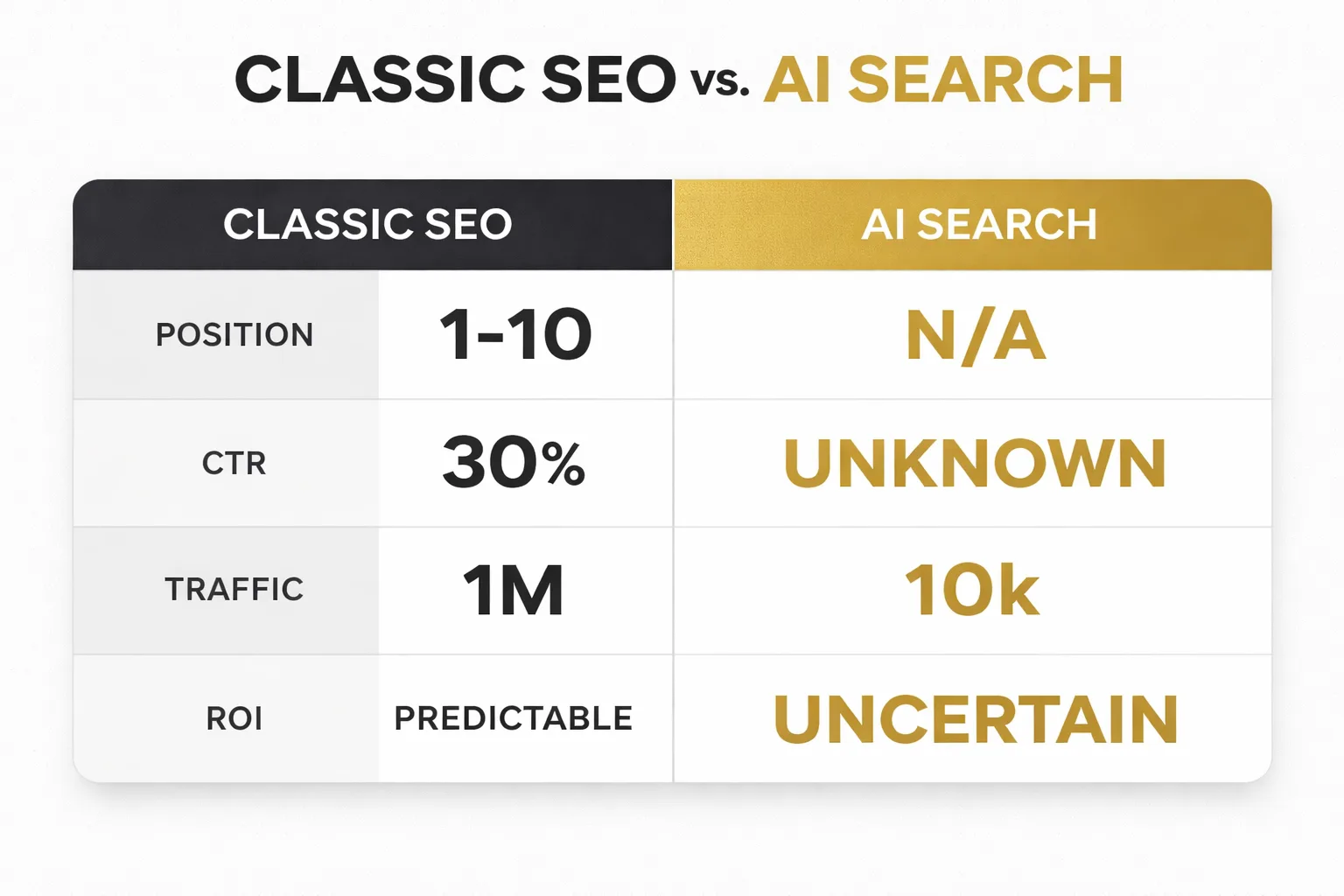
Here is the analogy I use with my team. Classic SEO is like tracking your billboard's position along a highway. You know exactly where it stands, and you can measure how many cars pass it. AI visibility is like tracking whether your brand gets recommended in a conversation between two people at a coffee shop. You cannot see the conversation. You cannot control the phrasing. You can only influence it by making sure the right information exists in the right places for the AI to find and cite.
That is why the measurement problem must be solved before any optimization work begins. If you cannot reliably detect whether your brand is being cited, you cannot optimize. You are guessing. And guessing is expensive.
The practical implications of this measurement gap are enormous. Consider what happens when a B2B buyer asks ChatGPT for a recommendation. The model generates a response based on its training data and any real-time retrieval it performs. If your brand is not in that response, you are not even in the consideration set. The buyer does not visit your site. They do not compare your features. They do not request a demo. You lose the deal before you even knew there was a deal to lose. Traditional SEO at least gave you a SERP position to fight for. AI search gives you nothing unless you can measure and influence the generated answer directly.
What Makes an AI Search Optimization Tool Actually Reliable?
Reliability in this context means one thing: the tool probes real AI engines at scale, not simulated outputs. This sounds obvious, but you would be surprised how many platforms generate their "visibility scores" from internal models that approximate what ChatGPT might say. That is not measurement. That is prediction. And prediction is useless when your goal is to verify whether a specific change you made actually moved the needle.
The first signal to look for is direct API integration. A reliable tool queries the actual models (ChatGPT, Claude, Gemini, Perplexity, Grok, Google AI Overviews) through their APIs or through controlled prompt injection. It does not estimate. It does not simulate. It sends the prompt, captures the response, and parses the citation. If a tool cannot show you the raw response text from the AI engine, treat its metrics with suspicion.
The second signal is query coverage. A tool that tracks 50 prompts is giving you a snapshot. A tool that tracks 500 prompts across your topic space is giving you a map. The enterprise AI rank tracker approach matters here because the variance between prompts is enormous. Your brand might be cited in 30% of prompts related to "best CRM for startups" and 0% of prompts related to "CRM comparison." A small sample size will mislead you into thinking you have a visibility problem when you actually have a prompt coverage problem.
The third signal is citation source tracing. This is the one most tools skip. When an AI engine cites your brand, it is usually pulling from a specific source page. Maybe it found your product page. Maybe it found a third-party review. Maybe it found a Reddit thread. A reliable tool shows you exactly which URL the AI cited, not just that it mentioned your brand name. Without source tracing, you cannot know which content to optimize. You are back to guessing.
The fourth signal is freshness. AI models update their training data and their retrieval indexes on unpredictable schedules. A visibility report from three months ago is stale. A reliable tool runs prompts on a rolling basis, with daily refreshes on SERP-driven surfaces (like Google AI Overviews) and regular refreshes on LLM-driven surfaces (like ChatGPT). If a tool only runs your prompts once a month, you will miss the window between a model update and your competitor's response.
In my experience, tools that fail on even one of these dimensions produce data that looks authoritative but leads to wrong decisions. I have seen teams celebrate a "40% increase in AI visibility" only to discover their tool was measuring simulated outputs that bore no resemblance to what real users were seeing. The celebration lasted until they manually checked ChatGPT and found their brand still absent from every relevant prompt.
Let me give you a concrete example of how this plays out. A SaaS company I advised was using a tool that reported their "AI visibility score" at 68 out of 100. They were thrilled. The number had been climbing for three months. But when I had them manually run 20 prompts through ChatGPT and Perplexity, their brand appeared in exactly 2 of 20 responses. The tool's score was based on a simulated model that over-weighted their Google rankings and under-weighted their actual AI citation presence. They had been optimizing based on a phantom metric for a quarter. That is the cost of unreliable measurement. Not just wasted time, but misplaced confidence. They thought they were winning. They were losing.
How Does AI Citation Tracking Actually Work?
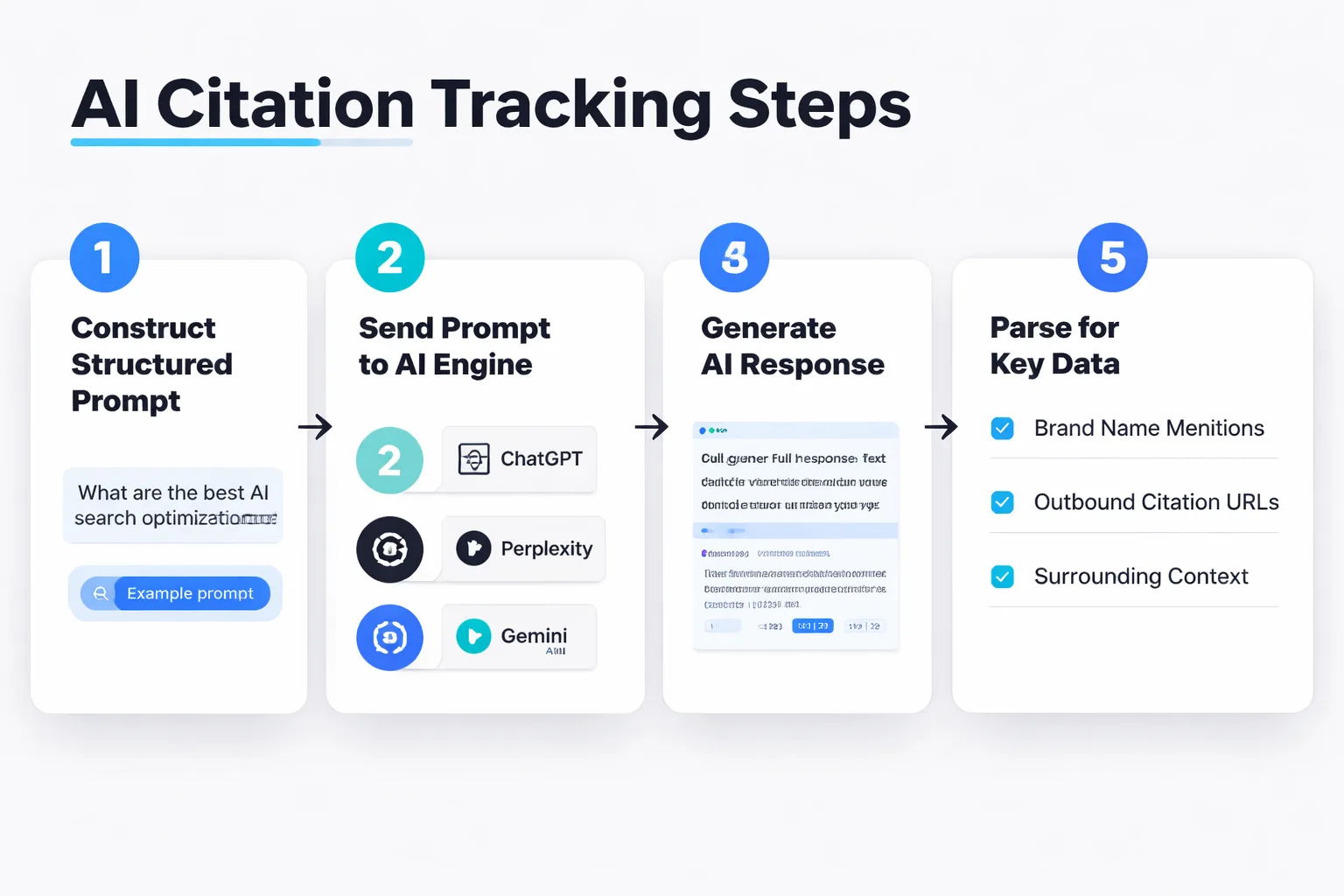
AI citation tracking works by sending structured prompts to real AI engines, capturing the full response text, and parsing it for brand mentions, URLs, and contextual framing. The process sounds simple, but the execution is where reliability lives or dies.
Here is what happens under the hood. The tool constructs a prompt designed to trigger a generative answer. For example: "What are the best AI search optimization tools?" It sends this prompt to the target engine (ChatGPT, Perplexity, Gemini, etc.) through the engine's API. The engine generates a response. The tool captures the full response text, including any citations or source links the engine provides. Then the tool parses that response for three things: brand name mentions, outbound citation URLs, and the surrounding context of each mention.
The parsing step is where accuracy diverges between tools. A naive parser might count any mention of your brand name as a "citation." But there is a massive difference between "Brand X is a popular option" and "Brand X was cited in a 2023 lawsuit for false advertising." Both are mentions. Only one helps you. A reliable tool uses natural language processing to classify the framing of each mention as positive, neutral, or negative, and it surfaces that classification alongside the raw mention count.
The other technical challenge is prompt variance. The same question phrased three different ways can produce three completely different answers from the same AI engine. "Best CRM software," "top CRM platforms," and "what CRM should I use" might all return different brand lists. A reliable tool runs multiple prompt variants per topic cluster and aggregates the results. This is why per-prompt run count matters. One run per prompt gives you a single data point. Five runs gives you a trend. Ten runs gives you confidence.
This is also where the distinction between AEO vs SEO becomes practical rather than theoretical. SEO tracks keyword positions. AEO tracks prompt responses. The tooling requirements are fundamentally different, and trying to use a rank tracker to measure AI visibility is like using a thermometer to measure wind speed. Both are instruments. Neither does the other's job.
The architecture behind citation tracking also determines cost efficiency, which directly affects how many prompts you can afford to run. In building Meev's tracking infrastructure, I insisted on a hybrid LLM approach. We use Perplexity's Sonar API directly at $0.005 per call, compared to alternative data-fetching services that charge $0.027 per call. That roughly 5x cost reduction is not a vanity metric. It means a team with a fixed budget can run 5 times more prompts, which means 5 times more data points, which means tighter feedback loops and faster optimization. When you are evaluating a tool, ask how it handles API costs. Tools that route every query through an expensive intermediary will either charge you more or run fewer prompts to protect their margins. Both outcomes hurt your data accuracy.
Do you know which AI engines are citing your competitors right now?
5 Steps to Increase AI Visibility Starting Today
These steps are designed for a one- or two-person team. No agency required. No massive budget. Just a systematic process you can run yourself.
Step 1: Audit Your Current Citation Rate
Before you optimize anything, you need a baseline. Pick 20-30 prompts that represent your target topic space. These should be the questions your potential customers actually ask AI engines. Not keyword research terms. Natural language questions.
Run each prompt through ChatGPT, Gemini, Perplexity, and Google AI Mode. You can do this manually for a small prompt set, or use a tool like the ChatGPT AI visibility checker or Perplexity AI visibility checker to automate the process. Record three things for each prompt: is your brand mentioned, is your brand cited with a URL, and what is the framing of the mention.
This baseline tells you where you stand. Most teams I have worked with are shocked by the results. They assume they have decent AI visibility because they rank well on Google. They do not. The correlation between Google rankings and AI citations is weaker than most people think.
Let me walk through what a baseline audit looks like in practice. Say you sell project management software. Your 25 prompts might include: "best project management tool for remote teams," "Asana vs Monday alternatives," "project management software for agencies under 20 people," and "cheapest project management tool with time tracking." For each prompt, you run it through ChatGPT, Perplexity, Gemini, and Google AI Mode. That is 100 individual AI responses. You log each response, search for your brand name, and record the context. If your brand appears in 8 of 100 responses, your baseline citation rate is 8%. If your top competitor appears in 45 of 100 responses, their citation rate is 45%. The gap is 37 percentage points. That gap is your optimization target. Every subsequent action should be aimed at closing it.
Step 2: Identify Which Source Pages AI Engines Pull From
When an AI engine cites your brand, it is pulling from a specific source. Sometimes that source is your own website. Often it is a third-party site: a review aggregator, a blog post, a Reddit thread, a news article. You need to know which sources are feeding your brand into AI answers.
For every prompt where your brand was mentioned in Step 1, look at the citation URLs the AI provided. Catalog them. You will start to see patterns. Maybe Perplexity always cites G2 review pages. Maybe ChatGPT pulls from specific blog posts that have strong entity signals. Maybe Google AI Overviews rely heavily on schema-marked product pages.
This is where LLM citation tracking becomes essential. If your tool shows you the cited URLs, you can reverse-engineer which content formats and sources each engine prefers. That intelligence drives every subsequent decision.
The source page analysis often reveals something counterintuitive. You might discover that the AI is not citing your beautifully designed product page at all. It is citing a random blog post from 2024 that mentions your brand in passing. Or it is citing a G2 category page where your listing has 12 reviews and your competitor has 340. The source page tells you where the AI's attention is focused. If you want to change the citation, you often need to change the source page first. That might mean updating your G2 profile, getting listed on a comparison site the AI trusts, or publishing content on a domain the AI already favors. The content on your own website is only one input. Third-party sources carry enormous weight in AI retrieval.
Step 3: Find Prompt Categories Where Competitors Are Cited But You Are Not
Now run the same 20-30 prompts again, but this time track which competitors appear in the answers. Look for the gaps: prompts where a competitor is cited and you are not. These gaps are your optimization targets.
The gap analysis is more nuanced than it sounds. You are not just looking for prompts where you are absent. You are looking for prompts where you are absent AND a competitor is present AND the prompt represents a commercially valuable question. A prompt like "history of CRM software" might be interesting, but it does not drive pipeline. A prompt like "best CRM for B2B SaaS companies under 50 employees" is gold.
I learned this lesson the hard way in my early attempts to boost AI visibility. I focused on raw mention rate, thinking more mentions equaled more leads. That was a significant misstep. An AI could recommend my brand as a "good starting point" before suggesting a more "advanced" competitor, effectively funneling users away. The context of the citation matters more than the citation itself.
This is where the concept of framing becomes critical. In B2B, buying decisions are heavily narrative-driven. If an AI engine frames your brand as the budget option and your competitor as the premium choice, you have lost the deal before the buyer even visits your site. Framing is influenced by the sources the AI cites. If the AI is pulling from review sites where users describe your product as "basic" or "entry-level," that framing will appear in the generated answer. You need to know not just whether you are mentioned, but how you are described. A reliable tracking tool classifies sentiment and framing, not just mention count. Without framing data, you might celebrate a 20% mention rate while your competitor is being recommended as the superior choice in every single one of those same responses.
Step 4: Publish One Tightly Scoped Article Per Gap
For each gap you identified in Step 3, publish one article that directly answers the prompt. Not a broad pillar page. Not a 3,000-word guide covering everything. A tightly scoped, answer-engine optimized article that addresses the specific question the AI was asked.
The scoping is critical. AI engines extract answers from pages that clearly and directly address the question being asked. If your article wanders through five related topics before answering the core question, the AI will find a competitor's page that gets to the point faster. Write for extraction, not exploration.
Each article should include: a direct answer in the first paragraph, structured data (FAQ schema, Article schema), inline citations to authoritative sources, and clear entity signals that connect your brand to the topic. If you are publishing through a platform like Meev, the quality firewall ensures articles below a 70/100 quality score are blocked from auto-publishing, which prevents weak content from diluting your entity signals.
The structure of each article matters as much as the content. AI engines parse headings, lists, and tables more easily than dense prose. If your article includes a comparison table, a numbered list of steps, or a clearly labeled FAQ section with schema markup, the AI can extract those structured elements directly into its response. I have seen articles with strong structured data get cited by Perplexity within 7-10 days of publication. Articles without structured data, covering the same topic with better prose, took 4-6 weeks or never got cited at all. The AI does not care about your writing style. It cares about extractability. Structure your content for the machine, and the human reader benefits from the clarity too.
Step 5: Re-Run the Audit After 2-3 Weeks
AI engines do not update their indexes on a predictable schedule. Google AI Overviews can reflect new content within days because they pull from the live web. ChatGPT's responses change more slowly because they depend on model updates and retrieval pipeline changes. Perplexity sits somewhere in between.
Wait 2-3 weeks after publishing your articles, then re-run the same 20-30 prompts from Step 1. Compare the results. Did your citation rate improve? Did the framing change? Did new source URLs appear?
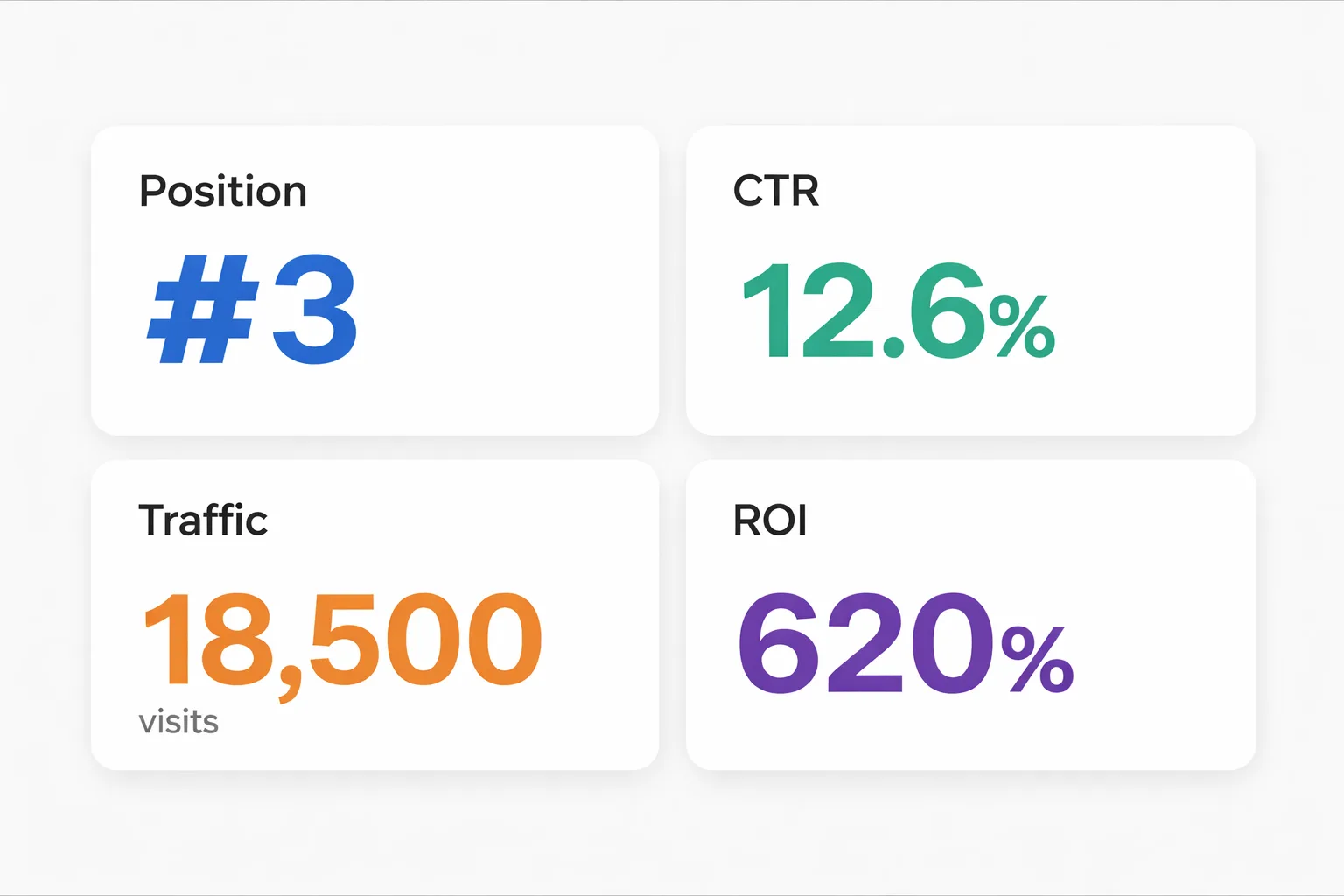
This is your feedback loop. If citation rate improved, double down on the format and topics that worked. If it did not, diagnose why. Was the article too broad? Did the AI engine not crawl it yet? Is a competitor's source page dominating the citation? Adjust and repeat.
The teams that win at AI visibility are the ones that run this loop fastest. Not the ones with the biggest budgets. Not the ones with the most content. The ones that measure, act, and measure again with the shortest cycle time.
A concrete example of what this measurement cycle reveals. In one audit cycle, a team I worked with published 5 targeted articles addressing prompt gaps. After 3 weeks, they re-ran their prompt set. Two of the five articles had generated new citations in Perplexity. One had generated a citation in Google AI Overviews. Two had no effect. The articles that worked shared a pattern: they answered the prompt question in the first 50 words, included a comparison table, and cited at least 3 authoritative external sources. The articles that failed also shared a pattern: they were 1,500+ words, took too long to get to the answer, and lacked structured data. The re-audit did not just measure progress. It revealed the content architecture that AI engines prefer. That insight informed every subsequent article they published.
How to Choose the Most Reliable Tool for Tracking Your Progress
The buying decision comes down to four questions. If a tool cannot answer all four with specific, verifiable features, move on.
Question 1: What data sources does the tool query? It should query every major AI search surface directly. Not just one. Not just Google AI Overviews. The full set: ChatGPT, Claude, Gemini, Perplexity, Grok, Google AI Overviews, and AI Mode. If a tool only tracks one or two engines, you are getting a partial picture. Your customers use multiple AI engines. Your tracking should too.
Question 2: How many runs per prompt? One run per prompt is a snapshot. You need multiple runs to account for variance in AI responses. Look for tools that run each prompt at least 3-5 times and show you the variance. If a tool gives you a single "visibility score" based on one run, that score is unreliable. AI responses are probabilistic, not deterministic. The same prompt can return different answers on different days.
Question 3: Does it show which URLs the AI cited? This is non-negotiable. If a tool tells you that your brand was mentioned but cannot show you the source URL the AI used, you cannot optimize. Source transparency is the difference between a diagnostic tool and a vanity metric. You need to know whether the AI cited your product page, a third-party review, or a Reddit thread. Each source requires a different optimization strategy.
Question 4: Does it surface competitor citation rates alongside your own? Your AI visibility does not exist in a vacuum. If your citation rate went from 10% to 15%, that looks like progress. But if your competitor went from 15% to 30% in the same period, you are losing ground. A reliable tool shows you industry share-of-voice across AI engines, not just your own numbers in isolation.
In my work at Meev, I have seen these four criteria separate useful tools from expensive toys. The AI visibility tracker approach works because it treats each engine as a distinct measurement surface with its own quirks, not as a monolithic "AI" to be scored. Perplexity's Sonar API behaves differently from ChatGPT's model. Google AI Overviews pulls from the live web in ways that Claude does not. A tool that lumps these together into a single score is hiding the nuance you need to make decisions.
The contrarian take here: most teams shopping for AI visibility tools are optimizing for the wrong thing. They want a high "visibility score" to put in a slide deck. What they actually need is raw citation data with source URLs, prompt-level granularity, and competitor benchmarking. The score is a summary. The data is the asset. A tool that gives you a beautiful dashboard with a single score but no drill-down capability is selling you confidence, not intelligence.
There is also a cost dimension to this decision that most evaluation guides ignore. Running prompts against real AI engines costs money. Each API call to Perplexity, each query to ChatGPT, each Google AI Overviews scrape has a marginal cost. Tools that charge $49/month and claim to track 500 prompts across 7 AI engines are either losing money on every account or cutting corners on query volume. Ask the vendor point-blank: how many API calls per prompt per month, and what is the refresh cadence? If they cannot answer with specific numbers, they are likely running fewer queries than they imply. The cheapest tool is not the most reliable tool. But the most expensive tool is not necessarily the most reliable either. Reliability is a function of query volume, source transparency, and data freshness. Price is a secondary variable.
Common Mistakes That Stall AI Visibility Gains
Mistake 1: Optimizing for Google Rankings While Ignoring AI Citation Sources
This is the most common error I see, and it is understandable. Teams have spent years optimizing for Google. They have a playbook that works. They have rank trackers, content calendars, and reporting dashboards built around SERP positions. The instinct is to apply that same playbook to AI visibility.
It does not work.
Google rankings and AI citations are correlated, but the relationship is weaker than you think. A page can rank #1 on Google and never get cited by ChatGPT because the AI is pulling from a different source. A page can rank #5 on Google and dominate AI citations because its structure makes it easy for the AI to extract answers. The AEO vs GEO distinction matters here. Google AI Overviews (GEO) pulls from the live web and behaves more like traditional search. ChatGPT (AEO) generates answers from training data and retrieval pipelines that prioritize different signals.
If you are only looking at your Google rankings, you are measuring a proxy for AI visibility, not the thing itself. You need direct measurement.
The specific failure mode looks like this. A team publishes a comprehensive guide targeting a high-volume keyword. The guide ranks on page 1 of Google within 3 months. Traffic increases. The team reports success. But when they finally check Perplexity and ChatGPT for the same topic, their guide is never cited. The AI is pulling from a competitor's shorter, more structured page that answers the specific question in a numbered list with a comparison table. The team's guide is too long, too narrative, and too unfocused for the AI to extract a clean answer. They won the Google ranking and lost the AI citation. In 2026, losing the AI citation means losing the buyer who never clicks through to Google at all.
Mistake 2: Publishing Content That Is Too Broad to Win a Specific Prompt
AI engines extract answers from pages that directly address the question being asked. Broad pillar pages that cover a topic comprehensively are great for traditional SEO. They are terrible for AI citation because the AI cannot easily extract a specific answer from a 4,000-word page that touches on fifteen subtopics.
I have seen teams publish massive guides and wait for AI citations that never come. The AI looks at the guide, cannot find a clear answer to the specific prompt, and moves on to a competitor's shorter, more focused page that answers the question directly in the first paragraph.
The fix is to break broad topics into tightly scoped articles. Instead of one guide on "AI search optimization," publish five articles: one on how to track AI citations, one on how to optimize schema for AI search, one on entity grounding for AI engines, one on Wikidata and knowledge graph presence, and one on measuring AI visibility ROI. Each article wins a specific prompt category. Together, they build topical authority.
This is where the concept of archetype-aware content becomes relevant. Different prompt types require different content structures. A "what is" prompt ("what is answer engine optimization") needs an explainer article with a clear definition, a comparison section, and an FAQ block. A "how to" prompt ("how to increase AI visibility") needs a step-by-step guide with numbered phases. A "best of" prompt ("best AI search optimization tools") needs a listicle with comparison criteria. If you publish the same content structure for every prompt type, you will win some and lose others based purely on whether your structure happens to match what the AI can extract. Matching content archetype to prompt intent is one of the highest-leverage optimizations you can make. It costs nothing extra to produce. It just requires thinking about the prompt type before you write.
Mistake 3: Measuring Too Infrequently to Detect What Is Working
AI visibility is not a quarterly metric. It is a weekly (or even daily) signal. Models update. Retrieval indexes refresh. Competitors publish new content. If you measure once a quarter, you will see a number that has been influenced by dozens of variables you cannot untangle. You will not know which of your actions caused the change.
The teams that improve AI visibility fastest measure most frequently. They run their prompt set weekly. They track which source pages appear and disappear from citations. They catch model updates within days and adjust their content strategy accordingly. The AI visibility checker approach of running regular audits is not about obsessive monitoring. It is about maintaining a tight feedback loop so that when something changes, you know why.
Consider what happens when you measure quarterly versus weekly. You publish 10 articles in Q1. At the end of the quarter, your citation rate went from 8% to 14%. Which articles caused the improvement? You cannot tell. All 10 were published in the same quarter, and the measurement gap is too wide to isolate effects. Now imagine you measure weekly. You publish 2 articles in week 1. In week 2, you measure and see no change. You publish 2 more in week 3. In week 4, you measure and see a 3% jump. You know the week 3 articles moved the needle. You also know the week 1 articles did not. That is actionable intelligence. You can double down on the format that worked and stop wasting time on the format that did not. Tight measurement cycles turn content production from a guessing game into a controlled experiment.
Reliable data is the prerequisite for every other tactic. Without it, you are not optimizing. You are hoping.
Can You Verify AI Visibility Data Without Relying on a Tool?
Yes, and you should. Even with a reliable tool, manual verification is the best sanity check you can run. Here is how to do it with nothing but a browser and a spreadsheet.
Pick 5 prompts from your tracking set. Open an incognito window in your browser. Go to ChatGPT, Perplexity, and Google AI Mode separately. Type each prompt exactly as your tool sends it. Record whether your brand appears in the response. Record the framing. Record any citation URLs the AI provides. Compare your manual results to what your tool reported for the same prompts.
If your tool says you have a 30% citation rate for a given prompt cluster, and your manual check of 5 prompts in that cluster shows 0 citations, something is wrong. Either the tool is running prompts at a different time than you (freshness gap), or the tool is using a different prompt phrasing (variance gap), or the tool is not querying the real engine (reliability gap). Any of these three problems means your tool's data is not trustworthy for that cluster.
Manual verification does not replace a tool. You cannot run 500 prompts manually every week. But periodic spot-checks keep your tool honest. I recommend running 5-10 manual prompts per month and comparing them to your tool's reports. If the tool's data diverges from manual reality more than 20% of the time, switch tools. The 20% threshold is not arbitrary. In my experience, reliable tools match manual verification at least 80% of the time. Below that threshold, the data is too noisy to drive decisions. You would be better off running fewer prompts manually than trusting a tool that is wrong more than 1 in 5 times.
This is also where understanding entity grounding helps you diagnose discrepancies. When you manually verify a prompt and see a different answer than your tool reported, check whether the AI cited a source page that has changed since the tool's last run. AI engines pull from the live web, and if a source page was updated or removed between the tool's run and your manual check, the discrepancy is explained. That is a freshness issue, not a reliability issue. But if the source page has not changed and the answers are different, the tool may be querying a different model version or using a different prompt phrasing. Document these discrepancies. They tell you exactly where your tool's measurement breaks down.
What This Actually Means for Your Team
The brands winning AI visibility right now are not the ones with the biggest agencies or the largest content teams. They are the ones with the best feedback loops. They know which prompts they are cited in. They know which source pages the AI is pulling from. They know where their competitors are winning. And they publish content that fills specific gaps, measure the results, and iterate.
You can do this yourself. The process I described above requires no agency, no outsourced team, and no massive budget. It requires a reliable tool that probes real AI engines, shows you citation sources, and gives you competitor benchmarking. It requires the discipline to run the audit loop consistently. And it requires the willingness to publish tightly scoped content that answers specific prompts rather than broad guides that try to be everything to everyone.
The shift from classic SEO to AI visibility is not a technology change. It is a measurement change. The engines have evolved. Your tracking needs to evolve with them. Start with the baseline audit. Find your gaps. Publish targeted content. Measure again. That is the entire playbook.
The teams that internalize this loop will compound their advantage over time. Every cycle teaches them something new about which content formats win citations, which source pages the AI prefers, and which prompt categories are commercially valuable. That knowledge is the moat. Not the content itself. Not the backlinks. The feedback loop and the data that powers it.
If you are ready to start measuring your AI visibility with a tool that probes real engines, traces citation sources, and benchmarks against competitors, that is exactly what we built Meev to do. Run your first audit. Find your gaps. Close them. The data will tell you what to do next.
FAQ
What makes AI visibility different from classic SEO?
Classic SEO relies on static SERPs where you can directly count rankings among blue links, creating a tight feedback loop. AI visibility instead depends on dynamic generated answers that cite brands based on topical authority rather than raw domain strength. This shift means traditional backlink strategies alone are no longer sufficient for appearing in AI outputs.Why do smaller brands sometimes get cited more in AI answers than larger ones?
AI citation patterns prioritize structured entity data, Wikidata presence, and schema markup over overall company size or backlink volume. Brands that optimize these elements effectively can appear in generated responses even with thinner product lines or less established domains. The Ahrefs study of over 75,000 brands confirms topical authority drives these outcomes more than traditional metrics.What three factors determine AI search visibility for a brand?
AI search visibility measures how often a brand is mentioned, how its owned content is cited, and how those mentions are framed by the model. A high mention rate loses value if the AI positions the brand as a budget option rather than a leader. Accurate citation tracking data is essential before making any optimizations.How can marketers improve AI visibility without an agency?
Marketers should audit and enhance their entity data, Wikidata entries, and schema to align with how AI systems extract and cite information. Using reliable AI search optimization tools provides the accurate data needed to identify gaps and adjust content accordingly. This approach focuses on topical authority building rather than outsourcing to external teams.About the Author
Judy Zhou, Founder
Judy Zhou leads content strategy at Meev, where she oversees AI-driven content research and publishing for hundreds of brands. With a background in SEO and editorial operations, she focuses on building content systems that rank on Google, get cited by AI search engines, and drive measurable business results.
Run your first AI visibility audit today and find exactly which prompts you are missing.