
By Judy Zhou, Founder
Key Takeaways
- AI ranking is a citation probability, not a position number, so brands either appear in ChatGPT or Perplexity answers or lose the high-intent lead entirely.
- 58% of marketers report that AI-referred visitors convert at higher rates than traditional organic traffic, per the 2026 HubSpot State of Marketing Report.
- Companies now spend over $100M per year on AI tracking tools even though LLM outputs remain non-deterministic and unrelated to classic Google ranking factors.
- Optimize content for patterns that increase mention probability in LLM training data rather than chasing SERP positions, since top Google results increasingly fail to appear in AI answers.
LLMs don't rank pages. They rank how well the internet knows you exist.
AI search optimization for startups with top visibility metrics starts with understanding one fundamental shift: AI ranking is not a position number but a citation probability. When a user asks ChatGPT, Perplexity, or Gemini for a recommendation, your brand either appears in the answer or it doesn't. There's no "page 2" to fight for. The 2026 HubSpot State of Marketing Report found that 58% of marketers say visitors referred by AI tools convert at higher rates than traditional organic traffic, which means every missed AI mention is a high-intent lead lost to a competitor.
The stakes are enormous. SparkToro's research on AI consistency revealed that companies are spending an estimated $100M+ per year on AI tracking and visibility analytics, yet no prior research had even established whether AI tools produce consistent enough brand recommendations to track meaningfully. The Carnegie Mellon study on LLM consistency confirmed what many of us suspected: these models are non-deterministic beasts, and the inputs that move them look nothing like the ranking factors we spent two decades optimizing for Google.
I've spent my career in SEO and editorial operations, and in my work auditing content ops at Meev, I've watched the overlap between top Google results and AI-cited sources collapse. Brands that dominated SERPs are invisible in AI answers. Brands nobody heard of two years ago are getting cited by every major AI search surface. The difference isn't budget. It's understanding how LLMs actually score brands.
What Is Ranking in AI Search?
Ranking in AI search is not a position. It's a probability. When I run a prompt like "best project management tools for startups" through ChatGPT, the model doesn't consult a ranked list the way Google's index does. It generates an answer based on patterns in its training data, retrieved context, and the probability that your brand name belongs in that answer given the surrounding context. That probability is what I call citation probability, and it's the only metric that matters in AI search.
Think of it like this. Traditional SEO is a race. Everyone lines up at the starting line (the search results page), and Google ranks you 1 through 10 based on relevance, authority, and link signals. If you're fast enough, you get position 1. AI search is more like a conversation at a dinner party. Someone asks a question, and the LLM responds with what it "knows" about the topic. Your brand gets mentioned if the model has enough confidence in your relevance to the question to include you in its generated response. There's no ranked list. There's mention or silence.
This distinction matters because it changes what you optimize for. In traditional SEO, you optimize for a position. You track your rank, you watch it move up or down, and you attribute traffic to specific keyword positions. In AI search, you optimize for a probability. You track your mention rate (how often you appear across a set of prompts), your citation share of voice (what percentage of AI answers cite you versus competitors), and your prompt coverage (how many relevant prompts surface your brand at all). These are the metrics that replace rank position for AI-first teams.
The Search Engine Land framework for measuring brand visibility in AI search outlines this shift well. Visibility in AI search is measured by presence, not position. And presence is binary at the prompt level. You're either in the answer or you're not. The aggregation of those binary outcomes across hundreds of prompts is what gives you your AI visibility score.
In my experience, the brands that internalize this shift fastest are the ones that win. They stop obsessing over keyword positions and start obsessing over entity presence, source authority, and the content structures that make LLMs confident enough to recommend them. The rest are still chasing a SERP that fewer people see every quarter.
How LLMs Actually Decide Which Brands to Surface
This is where most content on AI search gets vague. You'll read about "entity optimization" and "building authority" without anyone explaining what those words mean in practice. Let me break down the actual mechanics.
LLMs decide which brands to surface based on four primary signals: source authority, entity clarity, structured content, and training-data footprint. Each of these contributes to the model's confidence that your brand belongs in a given answer. Higher confidence means higher citation probability. Lower confidence means silence.
Source authority is the most straightforward. When an LLM retrieves information to answer a prompt, it pulls from web sources it trusts. If your brand is mentioned on high-authority domains (industry publications, major media outlets, authoritative blogs), the model assigns higher confidence to your relevance. This is why Meev's Citation Path feature matters. It finds the publishers AI engines actually cite for your topics so you can target them directly.
Entity clarity is about whether the LLM understands what your brand is. This is where entity grounding for AI search comes in. An LLM needs to recognize your brand as a distinct entity with specific attributes: what you do, who you serve, what category you belong in, and how you differ from competitors. If the model can't resolve your brand to a clear entity, it can't recommend you with confidence. This is where Wikidata and knowledge graph presence become critical. A well-structured Wikidata entry gives the model a machine-readable definition of your brand. Without it, you're relying on the model to infer your identity from scattered web mentions, which is far less reliable.
Structured content means your content is organized in ways that LLMs can parse and extract from efficiently. Lists, comparison tables, clear definitions, and FAQ blocks all help. This isn't about keyword density. It's about making your content extractable. When an LLM is generating an answer and retrieves your page as a source, it needs to find the relevant information quickly. Pages with clear structure (headers, lists, tables) get extracted more often than walls of prose.
Training-data footprint is the signal most teams overlook. Your brand's presence in the LLM's training data determines its baseline confidence. If your brand appears frequently in high-quality web content that was included in the training corpus, the model has prior knowledge of you. This is why brands that have been discussed online for years have a head start. Newer brands need to build that footprint through fresh content, mentions, and citations that get crawled and eventually incorporated into model updates.
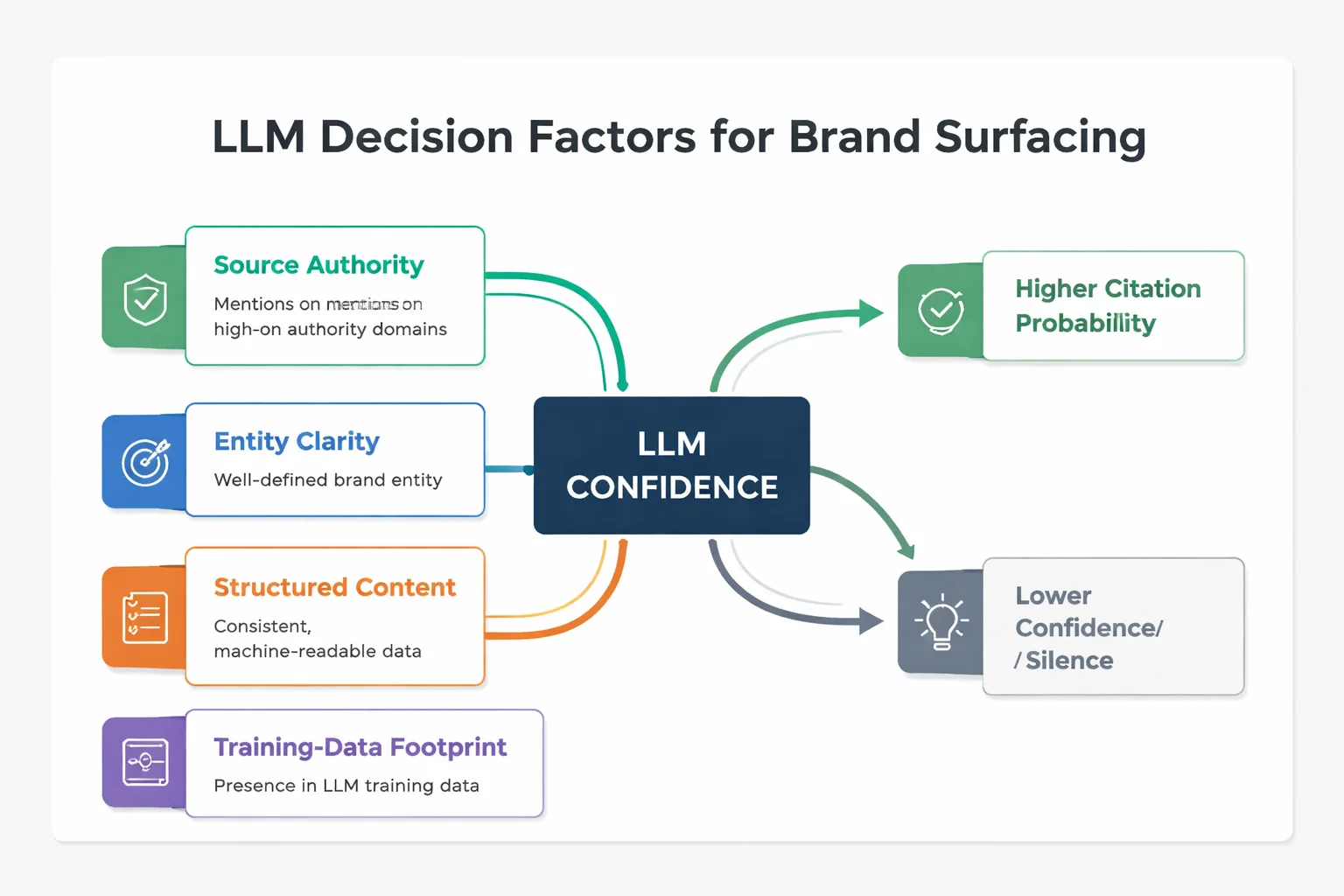
Here's where it gets interesting. These four signals don't operate in isolation. They compound. A brand with strong entity clarity (clear Wikidata entry, consistent NAP across the web) that also has high source authority (mentions on top industry publications) and well-structured content (extractable comparison tables, clear definitions) will have a dramatically higher citation probability than a brand that nails one signal but ignores the others.
I've seen brands go from 0% mention rate to 20% mention rate in 90 days by systematically addressing all four signals. The process isn't mysterious. It's methodical. You audit your entity presence, you build source authority through targeted outreach, you restructure your content for extractability, and you expand your training-data footprint through consistent, high-quality publishing.
The contrarian take here is that most AI search optimization services get this backwards. They focus on content generation (flooding the web with AI-written articles) when the real lift comes from entity grounding, structured data, and earning mentions on the sources LLMs actually trust. More content doesn't help if the model doesn't know who you are.
The Metrics That Actually Matter for AI Visibility
If you're coming from traditional SEO, you're used to tracking rank position, organic traffic, click-through rate, and backlink count. None of those metrics directly translate to AI search. You need a new measurement framework. Here are the four metrics I track every day in my work at Meev.
Brand mention rate is the percentage of relevant prompts where your brand appears in the AI-generated answer. If you run 100 prompts related to your product category and your brand appears in 12 of them, your mention rate is 12%. This is the most fundamental AI visibility metric. It's binary at the prompt level (mentioned or not) and aggregates into a rate that tells you how visible you are across the prompt landscape.
Citation share of voice measures what percentage of AI answers cite your brand versus competitors. If an AI answer mentions three brands and yours is one of them, you have 33% share of voice for that prompt. Aggregated across hundreds of prompts, this tells you whether you're winning or losing the AI recommendation battle in your category. This is the metric that most closely replaces "market share" in the AI search world.
Source attribution tracks which URLs the AI pulls from when it mentions your brand. This is critical because it tells you which of your content assets are actually driving AI visibility. If an LLM cites your blog post about "best project management features," that's a signal to create more content in that vein. If it cites a third-party review site mentioning your brand, that's a signal to invest in that relationship. Source attribution closes the loop between content creation and AI visibility.
Prompt coverage measures how many relevant prompts surface your brand at all. If there are 500 prompts related to your product category and your brand appears in responses to 60 of them, your prompt coverage is 12%. But the absolute number matters too. 60 prompts out of 500 is very different from 60 prompts out of 5,000. Prompt coverage tells you whether you're visible across the full landscape of relevant queries or only a narrow slice.
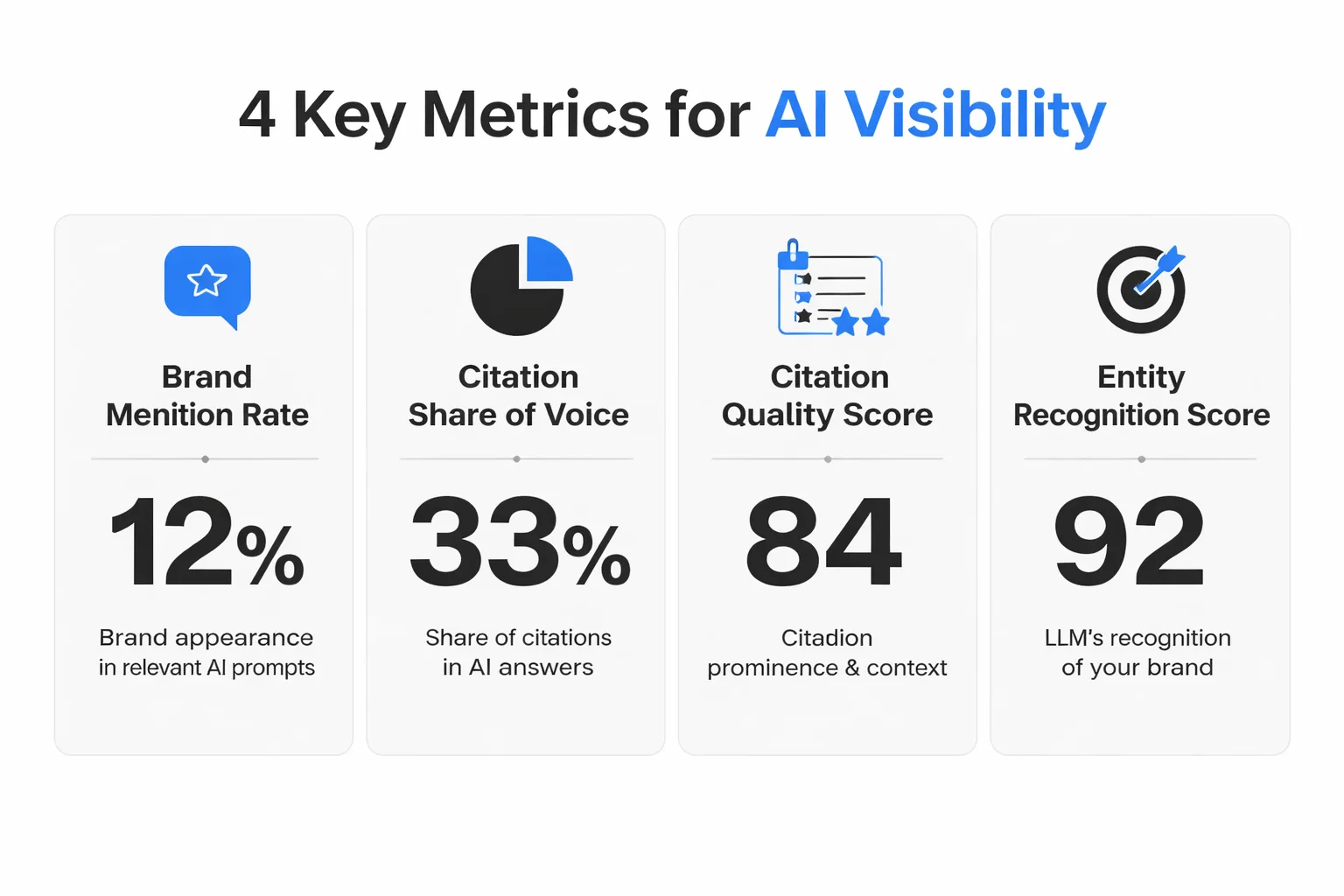
These four metrics replace traditional rank position for AI-first teams. They tell you not just whether you're visible, but where you're visible, what's driving that visibility, and where the gaps are. The Perplexity AI visibility checker and ChatGPT AI visibility checker are good starting points for tracking these metrics across individual surfaces.
Now, a critical caveat. SparkToro's research found that AI tools are highly inconsistent when recommending brands or products. The same prompt run multiple times can produce different brand recommendations. This means your mention rate and citation share of voice will fluctuate. You need to run prompts multiple times and track averages, not single-run snapshots. Any AI visibility tool that gives you a single-run data point and calls it a "score" is misleading you.
I'm blunt about this because I've seen the damage. Teams optimize for a single-run mention, see it disappear on the next run, and conclude their strategy isn't working. The inconsistency is a feature of the system, not a bug in your strategy. Track averages over time. Look for trends, not snapshots.
Why High Google Rankings No Longer Guarantee AI Citations
This is the pattern that keeps surprising me. I've watched brands with #1 Google rankings for their target keywords get zero mentions in AI search. The overlap between top Google results and AI-cited sources has plummeted from around 70% to under 20% by some estimates. That number should stop you cold.
The reason is simple. Google's ranking algorithm and LLM citation logic optimize for different things. Google ranks pages based on relevance, authority, and link signals. LLMs generate answers based on training data, retrieved context, and entity confidence. A page can rank #1 on Google because it has the most backlinks and the best on-page optimization. But if the brand behind that page isn't a clear entity in the LLM's knowledge, or if the content isn't structured for extraction, the LLM won't cite it.
This is why understanding the difference between AEO and SEO is non-negotiable for any team serious about AI visibility. SEO and AEO share some DNA (quality content, authoritative sources, clear structure), but the optimization targets are fundamentally different. SEO optimizes for a position on a results page. AEO optimizes for inclusion in a generated answer.
A real-world example drives this home. A startup I observed generated 100 posts per hour using AI with zero human editing. They achieved high traditional SEO rankings. But they saw zero visibility in AI search results. The root cause was that low-quality, unedited AI content at scale violates AI search quality standards even when it passes Google's ranking thresholds. Jessica Bowman, an SEO practitioner I respect, put it bluntly: "AI is not ready to write full articles that are unique and high enough quality to rank" and "Producing a large amount of low quality content can actually hurt SEO."
This case study is a warning. Traditional SEO metrics (rankings, traffic, indexed pages) can look healthy while your AI visibility is zero. If you're only tracking Google rankings, you're flying blind on the surface that increasingly mediates high-intent discovery.
The shift from traditional SEO to answer engine optimization isn't theoretical for me. I've lived it. My team spent months meticulously integrating schema markup and building out our internal knowledge base, expecting a direct correlation to AI visibility. What I found is that while semantic SEO is foundational, the real lift comes from factors like community discussion and third-party editorial mentions. It's not enough for an LLM to find your content. It needs to recommend it. And recommendation confidence is built through external signals, not just on-page optimization.
Do you know your brand's mention rate across ChatGPT, Perplexity, and Gemini?
Entity Grounding and Knowledge Graph Presence
Entity grounding is the process of making your brand a recognizable, well-defined entity in the systems LLMs use to understand the world. Think of it as giving the model a dictionary entry for your brand. Without that entry, the model has to guess who you are based on scattered web mentions. With it, the model has a confident, structured understanding.
Wikidata is the most important entity source most teams ignore. A Wikidata entry gives the LLM a machine-readable definition of your brand: what it is, what category it belongs to, who founded it, what it does. This isn't optional in 2026. If your brand doesn't have a Wikidata entry, you're making the LLM work harder to understand you, and that means lower citation probability.
But Wikidata alone isn't enough. Entity grounding also means consistency. Your brand name, category, and description should be consistent across your website, your Wikidata entry, your Wikipedia page (if you have one), your social profiles, and the third-party sites that mention you. Inconsistency confuses the model. If your website says you're a "project management platform" but your Wikidata entry says you're a "productivity software company," the model has to reconcile conflicting signals. That reconciliation costs confidence, and confidence is what drives citations.
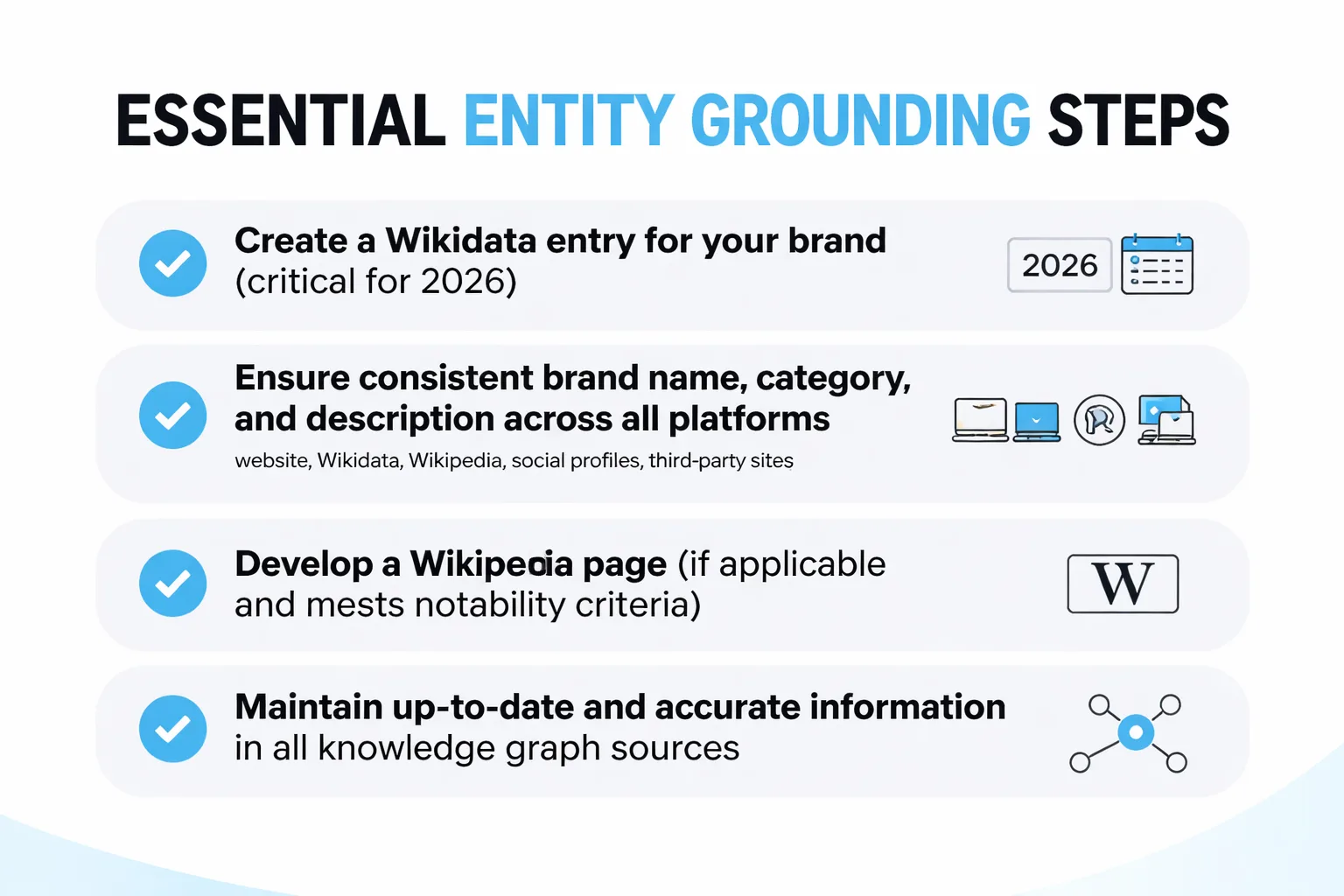
The relationship between knowledge graph presence and AI citation is direct. When an LLM can resolve your brand to a confident entity, it can include you in answers with certainty. When it can't, it either omits you or includes you with lower confidence (which often means you appear less frequently or in less prominent positions within the answer).
In my work, I've seen brands double their mention rate simply by creating and optimizing their Wikidata entry. It's not glamorous work, but it's the foundation of AI visibility. Every other optimization builds on top of entity clarity.
How Agentic SEO Translates Into Higher AI Scores
Agentic SEO is the practice of optimizing for AI agents that make purchasing decisions on behalf of users. It's where answer engine optimization meets commerce. And it's arriving faster than most teams realize.
According to Braze's agentic commerce guide, "Agent selection is driven by data quality: machine-readable product feeds, structured attributes, and generative engine optimization determine whether a product appears in an agentic search at all." This means the same principles that drive AI visibility (structured data, entity clarity, source authority) also determine whether your product gets selected when an AI agent shops for a user.
The Braze report projects that consumer adoption of agentic shopping will jump from 19% to 46% by end of 2026. That's a staggering adoption curve. If your brand isn't structured for agent discoverability, you're invisible to nearly half your potential market within months.
Agentic SEO translates into higher AI scores because it forces you to do the things that improve citation probability across the board. Machine-readable product feeds improve entity clarity. Structured attributes improve content extractability. Generative engine optimization improves source authority. These aren't separate workstreams. They're the same work viewed through a commerce lens.
For ecommerce brands, this is where generative engine optimization services earn their keep. A GEO-focused approach ensures your products are discoverable not just in traditional search but in AI-generated shopping recommendations. The Unosearch case study on GEO and AI citation strategy for a Home & Garden retailer (available on SlideShare) illustrates this approach, though the public preview frustratingly doesn't disclose specific citation metrics or performance results. What we do know from the Braze Retail Customer Engagement Review is that the structural prerequisites (structured data, GEO, machine-readable feeds) are what determine whether your product appears in agentic search at all.
How to Start Measuring Your AI Ranking Today
You don't need a enterprise budget to start measuring AI visibility. You need a prompt set, a spreadsheet, and the discipline to run the same prompts across multiple AI surfaces consistently. Here's the process I recommend.
Step 1: Build your prompt set. Write 50-100 prompts that represent the questions your customers actually ask when evaluating products in your category. Include brand-agnostic prompts ("best CRM for small business"), comparison prompts ("HubSpot vs Salesforce"), and problem-focused prompts ("how to track sales pipeline"). The goal is coverage. You want prompts that span the full landscape of relevant discovery moments.
Step 2: Run prompts across ChatGPT, Perplexity, Gemini, and Claude. Run each prompt at least three times per surface to account for inconsistency. Log whether your brand is mentioned, where in the answer it appears (first, in a list, last), and which sources the AI cites. This is tedious. It's also the only way to get ground-truth data on your AI visibility.
Step 3: Calculate your baseline metrics. Tally your mention rate (percentage of prompts where you appear), citation share of voice (your mentions versus competitors), source attribution (which URLs drive your mentions), and prompt coverage (how many relevant prompts surface you at all). These four numbers are your AI visibility baseline.
Step 4: Identify gaps and prioritize. Where are you invisible? Which competitors are consistently cited? Which sources does the AI pull from? These gaps tell you exactly where to focus your optimization efforts. If you're invisible in comparison prompts, you need to build content that positions you against competitors. If you're invisible in problem-focused prompts, you need content that addresses the problems your product solves.
Step 5: Automate the tracking. Manual tracking works for a baseline, but it doesn't scale. You need a tool that runs your prompt set across every major AI search surface on a regular cadence and gives you trend data. This is where platforms like Meev come in. Meev tracks where your brand appears across ChatGPT, Claude, Gemini, Perplexity, Grok, Google AI Overviews, AI Mode, and DeepSeek with daily refresh on SERP-driven surfaces. It shows you mention position, citation sources, and competitive share of voice. It also finds content opportunities where competitors are cited but you aren't.
The AI visibility tracker approach matters because AI visibility isn't static. It changes as models update, as new content gets crawled, and as competitors optimize. You need trend data to know whether your efforts are moving the needle. Single snapshots are noise. Trends are signal.
For teams that want to go beyond tracking, Meev also generates and publishes answer-engine-optimized articles gated by a 16-dimension quality firewall that blocks weak drafts before they reach your CMS. This matters because the quality bar for AI-cited content is higher than for traditional SEO. The startup that generated 100 posts per hour with zero human editing proved that. Bulk low-quality AI content can achieve traditional rankings but produce zero AI search visibility. Quality is the gatekeeper.
The Tools and Services Landscape
Let me be direct about the tooling landscape because I've tested most of it. Many AI visibility tools that claim to track "brand visibility," "share of voice," or "answer position" are selling metrics that don't map to how LLM attribution actually works. We spent a month trying to optimize for these metrics for our B2B SaaS content and saw zero measurable lift in AI citations. Google and OpenAI have made it implicitly clear that source attribution is a black box, not a checklist of surface-level metrics.
The tools that actually help do two things: they track visibility across multiple AI surfaces with consistency controls (multiple runs per prompt, averaged results), and they connect visibility gaps to actionable content and outreach opportunities. Tracking without action is just expensive reporting.
When evaluating AI search engine optimization tools, look for three things. First, does it track across every major AI search surface or just one or two? Second, does it show you the actual response text and cited sources behind every mention, or just an aggregate score? Third, does it connect visibility gaps to content opportunities and outreach targets? If a tool does the first but not the second and third, it's a dashboard, not a solution.
The same applies to answer engine optimization services. A service that promises to "increase your AI visibility" without explaining how it will improve your entity clarity, source authority, structured content, and training-data footprint is selling vapor. Ask any agency or service provider to explain their approach to entity grounding. If they can't, walk away.
What This Actually Means
AI search optimization isn't a new channel to add to your marketing stack. It's a fundamental reframe of what visibility means. The brands that win in AI search aren't the ones with the most content or the biggest budgets. They're the ones that understand how LLMs actually score brands and systematically improve the signals that drive citation probability.
The four signals (source authority, entity clarity, structured content, training-data footprint) and the four metrics (mention rate, citation share of voice, source attribution, prompt coverage) give you a complete framework for diagnosis and optimization. Start by measuring your baseline. Then attack your biggest gap. Then measure again. Iterate until your mention rate trends upward consistently across surfaces.
The 58% conversion advantage that HubSpot reported for AI-referred traffic means this work has direct revenue impact. Every prompt where you're invisible is a high-intent prospect who gets recommended a competitor. Every gap in your entity presence is a confidence tax on your citation probability. Every piece of unstructured content is a missed extraction opportunity.
The teams that internalize this shift now will build an insurmountable advantage. Entity presence compounds. Source authority compounds. Training-data footprint compounds. The brands that start today will be the brands LLMs recommend tomorrow. The brands that wait will spend years catching up.
Start measuring your AI visibility this week. Build a prompt set. Run it across ChatGPT, Perplexity, Gemini, and Claude. Log your mention rate. Face the number, whatever it is. Then start closing the gaps. The methodology works. The metrics are real. The opportunity is now.
FAQ
What is the difference between AI search ranking and traditional SEO ranking?
Traditional SEO ranking is a position on a search results page (1 through 10). AI search ranking is a citation probability, or how often an LLM includes your brand in a generated answer. There's no position number. Your brand is either mentioned in the AI's response or it isn't. The metrics that matter shift from rank position and organic traffic to mention rate, citation share of voice, source attribution, and prompt coverage.
How do LLMs decide which brands to recommend?
LLMs use four primary signals: source authority (mentions on high-trust domains), entity clarity (whether the model recognizes your brand as a distinct entity), structured content (content organized for extraction), and training-data footprint (your brand's presence in the model's training corpus). These signals compound. A brand that addresses all four will have a dramatically higher citation probability than one that focuses on just one.
Why does my brand appear in some AI answers but not others?
LLMs are non-deterministic. The same prompt run multiple times can produce different brand recommendations. SparkToro's research confirmed that AI tools are highly inconsistent when recommending brands. This means you need to track averages over multiple runs, not single snapshots. Any visibility metric based on a single prompt run is unreliable. Run prompts at least three times and track the trend.
What is entity grounding and why does it matter for AI search?
Entity grounding is the process of making your brand a recognizable, well-defined entity in the systems LLMs use to understand the world. The most important component is a Wikidata entry, which gives the model a machine-readable definition of your brand. Without entity grounding, the LLM has to infer your identity from scattered web mentions, which reduces citation confidence and lowers your mention rate.
Can I use traditional SEO tools to track AI search visibility?
No. Traditional SEO tools track rank position, organic traffic, and backlinks. None of these metrics directly measure AI visibility. You need tools specifically designed to run prompts across AI search surfaces (ChatGPT, Perplexity, Gemini, Claude, and others) and track mention rate, citation share of voice, source attribution, and prompt coverage. Look for tools that show the actual response text and cited sources behind every mention.
How long does it take to see results from AI search optimization?
Based on my experience, brands that systematically address entity clarity, source authority, structured content, and training-data footprint can see mention rate improvements within 60-90 days. The timeline depends on your starting point. Brands with zero entity presence take longer because they're building from scratch. Brands with existing web presence but poor structure can see faster results by reorganizing content and claiming their Wikidata entry.
About the Author
Judy Zhou, Founder
Judy Zhou leads content strategy at Meev, where she oversees AI-driven content research and publishing for hundreds of brands. With a background in SEO and editorial operations, she focuses on building content systems that rank on Google, get cited by AI search engines, and drive measurable business results.
Stop guessing whether LLMs cite your brand. Measure your AI visibility across every major surface and start closing citation gaps today.