

By Judy Zhou, Founder
Key Takeaways
- Only 12% of URLs cited by LLMs rank in Google's top 10 and ChatGPT overlaps with top search results just 8%, proving traditional SEO rankings do not transfer to AI citations.
- ChatGPT referrals convert at 15.9% versus Google organic's 1.76%, delivering a 9x lift as the platform processes 2.5 billion prompts daily.
- Replace keyword optimization with entity grounding, structured data, knowledge graph presence, and deliberate narrative control to actually move LLM citations in 2026.
- AI referral traffic grew 527% year-over-year while Google AI Overviews reach 2 billion monthly users, making absence from generated answers a compounding visibility risk.
The phrase 'answer engine optimization' first circulated in niche SEO forums around 2023, dismissed by most practitioners as a rebranding exercise with no actionable substance. Two years later it has a body of repeatable tactics, a growing set of measurement tools, and a new name that has largely stuck: LLM SEO. The discipline traces its real origin not to a conference keynote but to the moment in late 2022 when early ChatGPT users noticed the model consistently citing certain brands and completely ignoring others. And started asking why.
LLM SEO is the practice of optimizing content and entity signals so large language models cite your brand in generated answers, distinct from ranking for keywords in classic search results. The tactics that actually move citations in 2026 look nothing like traditional SEO. Only 12% of URLs cited by LLMs rank in Google's top 10. ChatGPT's overlap with both Google and Bing top results sits even lower at 8%. The playbook that earned rankings for two decades does not transfer. What does: entity grounding, structured data, knowledge graph presence, and deliberate narrative control.
The stakes are not theoretical. ChatGPT processes 2.5 billion prompts daily with 910 million weekly active users. Google AI Overviews reach 2 billion monthly users across 200+ countries. ChatGPT referrals convert at 15.9% compared to Google organic's 1.76% — a 9x difference. AI referral traffic grew 527% year-over-year. Brands absent from AI answers are invisible to a channel that compounds monthly.
What LLM SEO Actually Means
LLM SEO is not keyword optimization repackaged. It is the discipline of ensuring that when a user asks ChatGPT, Perplexity, Claude, or Google AI Overviews a question related to your category, the model cites your brand, links to your pages, and frames your offering favorably relative to competitors.
The distinction from classic SEO matters more than the terminology. Traditional search ranks pages. AI search surfaces entities, relationships, and corroborated claims. A page can rank #1 on Google for a high-volume keyword and never appear in a ChatGPT answer for the same topic. The 12% overlap statistic proves this: the models are not reading SERPs and picking the top result. They are synthesizing information from training data, real-time retrieval, and entity associations.
This is why answer engine optimization demands a different toolkit. You are not optimizing for a crawler that evaluates page signals. You are optimizing for a model that evaluates whether your brand is a credible, well-documented entity associated with a specific topic. That requires structured data, consistent NAP-like signals across the web, knowledge graph entries, and content that directly answers the questions users type into AI engines.
The AEO vs SEO split is not semantic. SEO asks: does my page rank for this query? LLM SEO asks: does the model know my brand exists, what it does, and does it prefer citing me over competitors when answering this prompt? Different questions, different tactics, different measurement.
Consider the operational difference. Traditional SEO optimization follows a familiar loop: identify a keyword, build a page targeting it, earn backlinks, monitor rank position. LLM SEO follows a fundamentally different loop: identify a prompt cluster where your brand should appear, audit whether the model recognizes your entity, ensure corroborated signals across surfaces, publish Q&A-structured content that directly answers the prompt, and monitor whether the citation appears and how it is framed. The inputs are different. The outputs are different. The measurement is different. A team that tries to run LLM SEO using a traditional SEO workflow will produce content that ranks on Google but remains invisible in AI answers.
The category itself is still fragmenting across terminology. Some practitioners call it GEO (generative engine optimization). Others use AEO (answer engine optimization). The AEO vs GEO distinction is real but narrow: GEO emerged from academic research focusing on generative engines broadly, while AEO emphasizes answer-engine-specific optimization. In practice, the execution is identical. The tactics below apply regardless of what the discipline is called this quarter.
How We Ranked These Tactics
Not all tactics deserve equal attention. The seven selected here passed three filters.
Measurable citation lift. Each tactic has been observed producing a detectable change in AI answer composition. Either a new citation appearing, an existing citation moving higher in the response, or the framing of a mention shifting from neutral to favorable. The Seer Interactive case study is the gold standard: changing footer text from generic branding to specific metrics ('130+ clients, 97% retention rate') produced a ChatGPT citation change within 36 hours. That is not correlation. That is cause and effect.
Applicability for small teams. Tactics requiring a dedicated knowledge engineering department or six-figure tooling budgets were excluded. Every tactic here is executable by a founder, a marketer, or a small SEO team with standard tools. The barrier is knowledge and consistency, not capital.
Evidence from real LLM response audits. Each tactic is grounded in observed behavior across ChatGPT, Claude, Gemini, Perplexity, and Google AI Overviews. Not theoretical models of how AI should work. The data comes from LLM citation tracking across hundreds of prompts, not from a single anecdotal query.
A note on what was excluded. Tactics like paid LLM advertising placements, custom model fine-tuning, and programmatic content generation at scale were considered but rejected. Paid placements are not organic citations. They are ads, and users and models alike discount them. Fine-tuning requires engineering resources and data access that small teams lack. Programmatic content generation without quality gating produces what practitioners call 'AI slop,' and Google's Helpful Content System updates have demonstrated repeatedly that low-quality AI content gets flagged and removed. The tactics that made this list are ones that produce durable, organic citation improvements.
How to compare tactic impact versus effort?
Before diving into each tactic, here is the prioritization matrix. Impact reflects the typical magnitude of citation change observed. Effort reflects the hours and ongoing maintenance required.
| Tactic | Citation Impact | Implementation Effort | Time to First Signal |
| 1. Entity grounding via Wikidata & schema | High | Medium (one-time setup) | 2-6 weeks |
| 2. Footer and boilerplate optimization | High | Low (hours) | 24-72 hours |
| 3. Q&A-structured content blocks | High | Medium (per article) | 1-4 weeks |
| 4. Knowledge graph relationship building | Medium-High | High (ongoing) | 8-16 weeks |
| 5. Source citation density | Medium | Low (per article) | 2-8 weeks |
| 6. Cross-surface brand consistency | Medium | Medium (one-time audit) | 4-12 weeks |
| 7. Prompt-level citation monitoring | Medium | Low (automated) | Immediate |
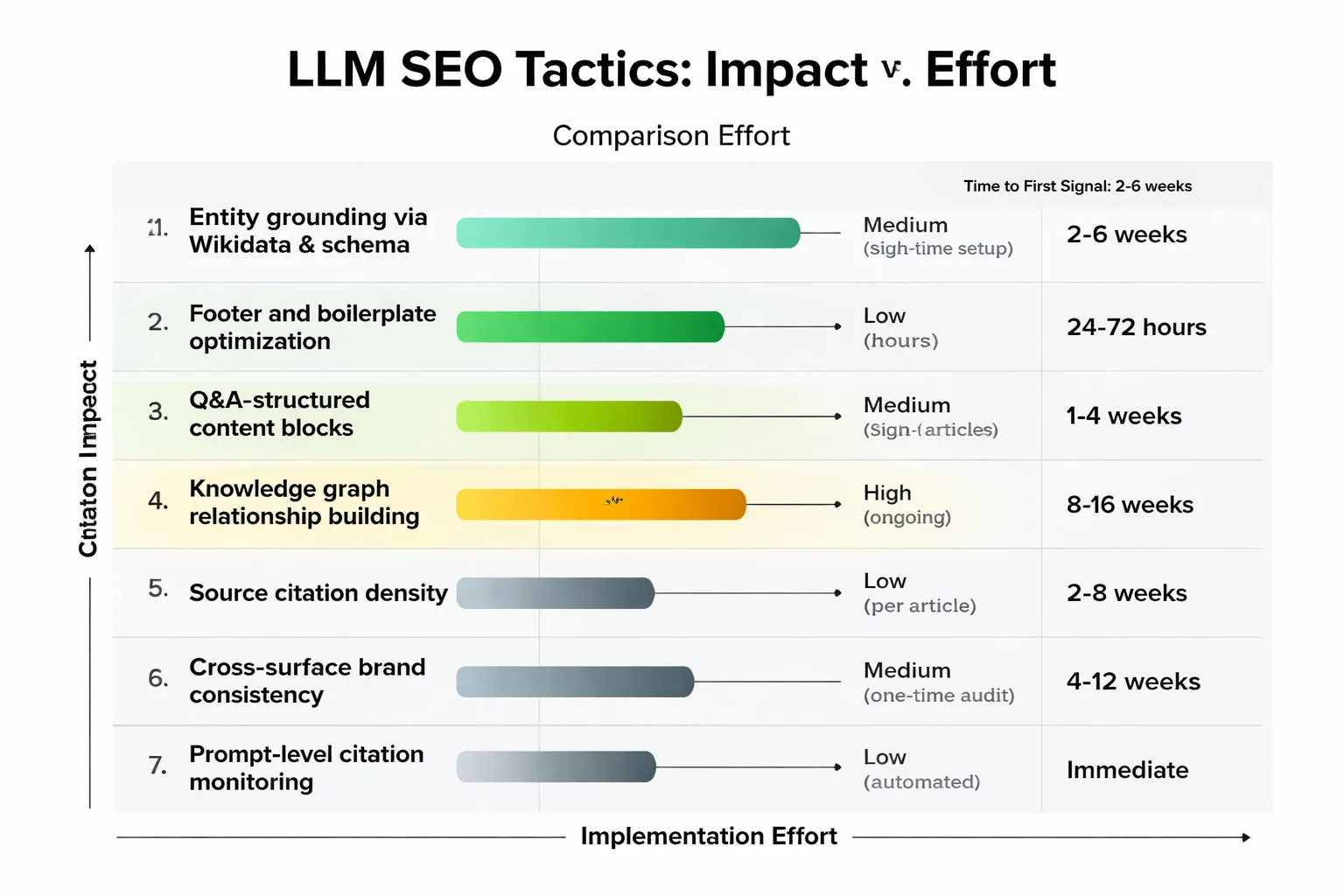
The pattern is clear. The highest-impact, lowest-effort tactic is footer optimization. The highest-impact, highest-effort tactic is knowledge graph relationship building. Small teams should start with tactics 1, 2, and 7. Entity grounding, footer changes, and monitoring. Then layer in content-driven tactics as capacity allows.
How to ground entity using Wikidata schema?
LLMs do not discover brands the way Google's crawler discovers pages. They rely on structured knowledge representations. Wikidata entries, schema.org markup, Wikipedia articles, and entity databases. To determine whether a brand is a real, notable entity associated with specific topics.
If your brand lacks a Wikidata entry, you are functionally invisible to the entity recognition systems that underpin every major LLM. The model cannot cite what it cannot identify. Creating a Wikidata entry with proper properties (P31 instance of, P1056 product or service produced, P159 headquarters location, P856 official website) gives the model a machine-readable identity it can reference and verify.
Schema markup serves the same function on your own pages. Organization schema with accurate name, URL, logo, and same-as properties (linking to your Wikidata entry, LinkedIn, Crunchbase) creates a corroborated entity footprint. The model cross-references these signals. When your schema, your Wikidata entry, your LinkedIn, and your About page all tell the same story, the model gains confidence that your brand is what it claims to be.
The failure mode here is well-documented. Kurt Cagle, a knowledge graph advisor, notes that the number of unsuccessful knowledge graphs far outweighs successful ones, and attributes this to modeling pitfalls rather than technical stack choices. The projects that succeed, per Jinfeng Zhang's analysis, start small, ship fast, and iterate based on feedback. They prioritize one use case, nail it, then expand.
The practical version for a small team: create a Wikidata entry with five core properties. Add Organization schema to your homepage. Link them with same-as properties. That is your entity foundation. Everything else builds on it.
The specific properties that matter most for LLM citation are deceptively simple. P31 (instance of) tells the model what type of entity you are. A company, a software product, a service. P856 (official website) gives the model a canonical URL to associate with your entity. P159 (headquarters location) grounds you geographically. P1056 (product or service produced) connects your entity to what you actually make. P641 (sport) is irrelevant for most brands, but P2650 (interest in) can associate your entity with specific topics or domains. Each property is a pathway the model can traverse from a user's prompt to your brand.
Consider a concrete example. A SaaS company offering project management software wants to be cited when users ask ChatGPT 'what are the best project management tools for small teams?' Without a Wikidata entry, the model has no structured entity to reference. It may know the brand from training data, but it cannot verify the brand's category, features, or market position. With a Wikidata entry specifying P31 (software company), P1056 (project management software), and P856 (official website URL), the model has a machine-readable, cross-referenced identity it can cite with confidence. The difference between 'I think this brand exists' and 'this brand is a verified software company producing project management tools' is the difference between a citation and silence.
Schema markup on your own pages reinforces this. The Organization schema block on your homepage should include your exact brand name, your logo URL, your official website, and same-as links to every authoritative profile: Wikidata, LinkedIn, Crunchbase, GitHub (if applicable). This creates what entity recognition systems call a 'convergent identity' — multiple independent sources confirming the same facts. The model weights convergent signals heavily. Divergent signals (your schema says one thing, your LinkedIn says another) trigger hedging behavior that suppresses citations.
How to rewrite footer with citable claims?
This is the tactic with the best effort-to-impact ratio in LLM SEO. It costs nothing but an hour of copywriting and can produce measurable citation changes within days.
The Seer Interactive experiment proved the mechanism. Seer monitored the prompt 'tell me about Seer Interactive' over two years. Their footer contained generic branding text. ChatGPT's answer about the company was vague and unspecific. The team changed the footer to include concrete metrics: '130+ clients, 97% retention rate.' Within 36 hours, ChatGPT's answer incorporated those exact figures.
AI citations do not happen by accident. As SEO Vendor's analysis frames it: teams that earn citations map the questions people ask to the pages and signals that answer them. The footer is one of the most frequently crawled sections of any site. It appears on every page. It is one of the first places an LLM looks for factual claims about a company.
The tactic is simple. Audit every piece of boilerplate text on your site: footer, about page, meta descriptions, homepage hero. Replace vague claims ('leading provider of...') with specific, citable facts ('130+ clients, 97% retention rate, $2.1B under management'). The model cannot cite a statistic you do not state. Every number in your boilerplate is a potential citation.
The contrarian take: most brands obsess over body content and ignore boilerplate. They write 2,000-word blog posts packed with keywords but leave their footer saying '© 2026 Company Name. All rights reserved.' That is wasted entity real estate. The footer is where the model looks for the company's self-description. Make it count.
The mechanics of why footer text works deserve attention. LLMs process web content by extracting factual statements. Sentences with numbers, proper nouns, and verifiable claims. A footer that says '© 2026 Acme Corp' contains zero extractable facts. A footer that says 'Acme Corp. 50-person team, 3 offices, 200+ enterprise clients, SOC 2 Type II certified' contains four. Each extractable fact is a potential data point the model can incorporate into its answer about your brand. The model is not reading your footer for style. It is mining it for facts.
The same principle applies to your About page, your homepage hero text, and your meta description. These are the surfaces the model encounters first when retrieving information about your brand. They should be dense with specific, verifiable claims. 'We help companies grow' is not a claim. 'We've helped 340 B2B SaaS companies increase organic traffic by an average of 47% in 90 days' is a claim the model can cite, attribute, and present to a user asking about your services.
The speed of the Seer Interactive result (36 hours) reflects how AI crawlers prioritize and process footer content. Footers are stable, present on every page, and consistently structured. Exactly the kind of signal that retrieval-augmented generation systems weight heavily. When you change your footer, the next crawl picks it up. When the next user asks about your brand, the retrieved context includes your updated claims. The citation change is fast because the retrieval mechanism is fast.
How to structure content as Q&A blocks?
LLMs extract answers from pages the same way a human skims for information: they look for question-shaped headers followed by concise, self-contained answers. Content structured as long-form essays forces the model to synthesize and paraphrase, which introduces uncertainty and reduces citation probability. Content structured as explicit Q&A pairs gives the model something it can quote directly.
This is not speculation. It is how every major AI search engine processes retrieved content. Perplexity, Google AI Overviews, and ChatGPT's search mode all preferentially extract from passages that directly answer the implied question. A page that asks 'What is LLM SEO?' and follows it with a 40-60 word answer is more likely to be cited than a page that discusses LLM SEO across 2,000 words of narrative prose.
The implementation is straightforward. For every article, identify the 3-5 questions a user would type into ChatGPT about the topic. Write each question as an H2 or H3. Follow it with a concise, self-contained answer in 40-80 words. Then elaborate with depth, examples, and data. The model extracts the concise answer. The depth signals authority and relevance.
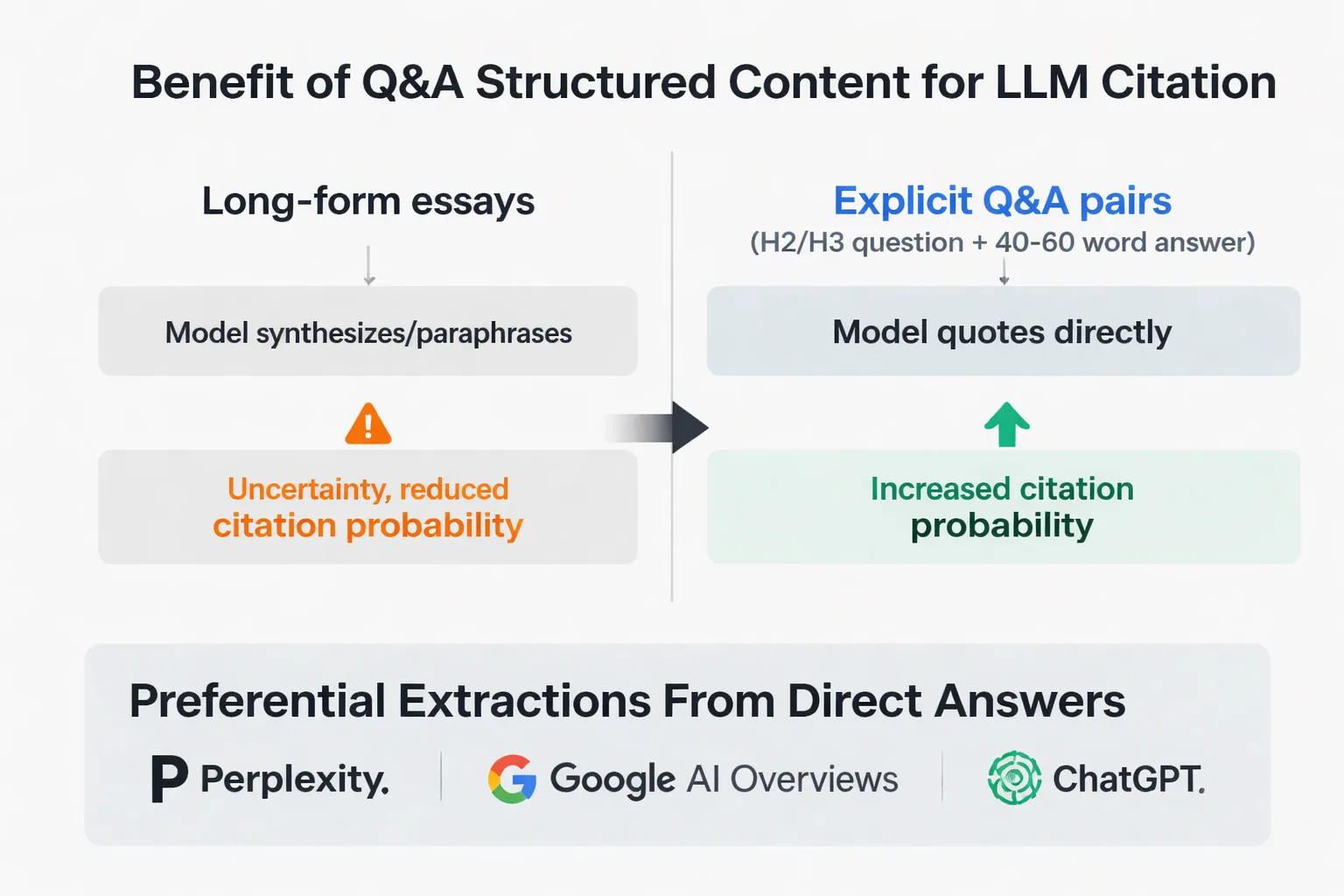
The key detail: the answer must be self-contained. If the model extracts it and presents it to a user, the user should understand it without reading the surrounding context. Answers that reference 'as mentioned above' or 'the table shows' are poor extraction candidates. Each Q&A block should stand alone.
This structure also serves AI search optimization more broadly. Google's AI Overviews, which reach 2 billion monthly users, use the same extraction logic. Q&A-structured content earns citations in both LLM-only surfaces (ChatGPT, Claude) and hybrid surfaces (AI Overviews, AI Mode).
The extraction mechanics matter for how you write. AI search engines use passage-level retrieval, not page-level retrieval. This means the model does not evaluate your entire article as a unit. It evaluates each passage independently. A strong Q&A block on page 3 of your article can earn a citation even if the rest of the article is mediocre. Conversely, a weak Q&A block can prevent a citation even if the surrounding content is excellent. The unit of citation is the passage, not the page.
This changes how you should think about content structure. Traditional SEO optimizes pages: one target keyword, one URL, one ranking. LLM SEO optimizes passages: each Q&A block is an independent citation candidate. An article with 5 well-structured Q&A blocks has 5 chances to earn a citation. An article with 0 Q&A blocks has 1 chance. The model has to synthesize from narrative prose, which is lower-confidence and lower-probability.
The practical standard for Q&A blocks in LLM SEO: each question should mirror how a user would actually phrase it in ChatGPT or Perplexity. Not 'The Importance of Entity Grounding' (a traditional SEO heading). But 'Why does entity grounding matter for AI citations?' (a question-shaped heading that matches user intent). The model matches the user's prompt to your heading. The closer the match, the higher the extraction probability.
4. Build Knowledge Graph Relationships, Not Just Entities
Having a Wikidata entry is necessary but insufficient. The model needs to understand not just what your brand is, but what it relates to. This is where knowledge graph relationships come in.
A Wikidata entry that says 'Meev is a software company' tells the model almost nothing useful. An entry that says 'Meev is a SaaS company, headquartered in [location], producing AI search visibility software, competing with [named competitors], serving the B2B marketing industry' gives the model a rich relational context. When a user asks 'what are the best AI search visibility tools,' the model can traverse those relationships and surface your brand.
The properties that matter most for LLM citation: P1056 (product or service produced), P1830 (owner of), P355 (subsidiary of), P155 (follows) and P156 (followed by) for competitor relationships, P2650 (interest in) for topic associations. Each property you add is another pathway the model can use to reach your brand from a user's prompt.
This is the hardest tactic on the list because it requires ongoing maintenance and a real understanding of knowledge graph modeling. Most knowledge graph projects fail. Cagle's analysis identifies the root causes: projects optimize for completeness over utility, skip rigorous testing because the output 'looks right,' and assume adoption without user validation. Zhang's findings echo this: successful projects start small, ship fast, and iterate.
For small teams, the practical version is: add 3-5 core relationship properties to your Wikidata entry. Do not try to model your entire business. Pick the relationships that map to the prompts you want to be cited for. If you want to be cited when users ask about 'AI search visibility tools,' make sure your entry connects you to that category explicitly.
The relationship modeling that matters most for LLM citation is competitor adjacency. When a user asks 'what are the best [category] tools,' the model retrieves entities connected to that category and presents them. If your Wikidata entry lists your competitors via P155 (follows) or P156 (followed by), and those competitors have strong entity presence, the model can traverse from the competitor to you. This is how brands get cited in comparison answers even when the user did not name them directly.
The second most valuable relationship type is topic association. P2650 (interest in) or P921 (main subject) can connect your entity to specific domains, technologies, or methodologies. A brand entity connected to 'search engine optimization,' 'artificial intelligence,' and 'content marketing' via topic properties will surface in answers spanning all three topics. Without those connections, the model only cites the brand when the user explicitly names it.
The maintenance burden is real but manageable. Wikidata entries should be reviewed quarterly. Properties change. Competitors shift. New products launch. A stale entry with outdated competitor relationships or discontinued products can produce inaccurate citations that mislead users and damage trust. The goal is not a one-time setup. It is a living entity record that reflects your current market position.
Which of these 7 tactics should your team run first? It depends on your current citation baseline.
5. Increase Source Citation Density in Your Content
LLMs are trained to prefer content that itself cites sources. A page that makes claims without attribution is lower-trust. A page that links to primary sources for every statistic, study reference, and factual claim signals the kind of evidentiary rigor the model wants to cite.
This is a direct behavioral observation from LLM citation tracking across hundreds of prompts. Pages with high source-citation density appear in AI answers more frequently than pages with equivalent topical coverage but no outbound citations. The model treats outbound citations as a trust signal, not a leak of link equity.
The implementation is simple but requires discipline. Every statistic gets a source link. Every study reference gets a named attribution. Every factual claim that could be disputed gets evidence. The goal is not to cite for the sake of citing. It is to make each claim independently verifiable.
Pages that cite primary sources are themselves more likely to become primary sources for AI engines. The model extracts not just your content but your sources. When a user asks ChatGPT about a topic and your page is the one that cited the relevant study, your page becomes the bridge between the user's question and the underlying data. That is a citation-earning position.
The practical standard: every article should have at least 3-5 outbound links to primary sources (studies, official documentation, research papers). Secondary sources (blog posts about studies) are weaker than primary sources (the study itself). Link to the real thing.
The trust signal works through a specific mechanism. When an LLM retrieves a passage from your page, it evaluates the passage's epistemic status. How well-supported the claims are. A passage that says 'traffic increased 34%' with no source is an unsupported claim. A passage that says 'traffic increased 34% in 90 days' is a supported claim with a verifiable reference. The model weights supported claims higher in citation selection. It can trace the claim to its origin, which reduces hallucination risk. A property the model is explicitly trained to favor.
This creates a compounding effect. Pages that cite primary sources earn more citations. More citations mean more retrieval exposure. More retrieval exposure means the model encounters your content more frequently, which increases the probability of future citations. The flywheel is real, but it starts with source density.
The distinction between primary and secondary sources matters more in LLM SEO than in traditional SEO. A traditional SEO page might link to a high-authority blog post about a study because the blog post has high domain authority. An LLM-optimized page should link to the study itself. The original research paper, the official documentation, the primary data source. The model can distinguish between primary and secondary sources. It weights primary sources higher in its own epistemic evaluation. Linking to the real thing, not the commentary on the real thing, is a citation-earning behavior.
6. Audit Cross-Surface Brand Consistency
LLMs do not trust a single source. They corroborate. If your website says you are an 'AI search visibility platform,' your LinkedIn says you are a 'marketing analytics company,' and your Crunchbase profile says you are in 'advertising technology,' the model has conflicting signals. It resolves conflicts by hedging. Either not citing you or citing you with vague framing.
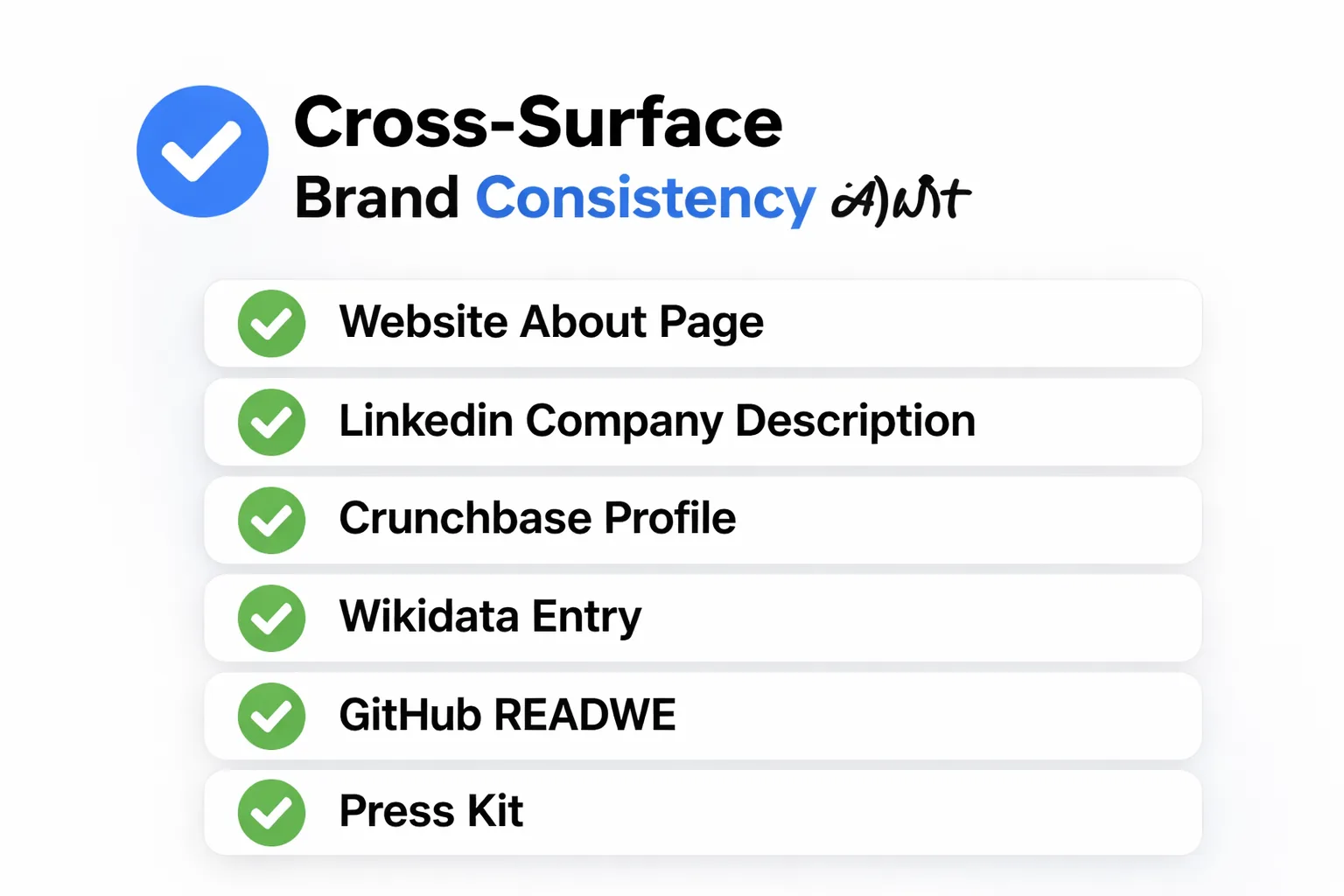
Cross-surface consistency is the tactic that makes every other tactic work better. When your entity signals all tell the same story, the model's confidence in citing you increases. When they conflict, the model discounts all of them.
The audit is straightforward but tedious. List every surface where your brand appears: website (homepage, About, footer), LinkedIn company page, Crunchbase, Wikipedia (if applicable), Wikidata, GitHub (if you have a dev tool), industry directories, review sites. For each, capture: the category descriptor used, the value proposition stated, the founding date claimed, the team size, and the product description.
The goal is not identical wording. It is identical meaning. 'AI search visibility platform' and 'platform for tracking brand mentions in AI answers' can both work if they describe the same thing. But 'AI search visibility platform' and 'marketing analytics company' describe different things. The model sees the gap.
This is where AI search engine optimization tools that track brand mentions across surfaces add value. They surface inconsistencies you would miss manually. The model's framing of your brand in answers is itself a diagnostic: if ChatGPT describes you differently than you describe yourself, you have a consistency problem.
The corroboration mechanism is worth understanding in detail. When an LLM retrieves information about your brand, it does not rely on a single source. It pulls from multiple sources. Your website, your LinkedIn, your Crunchbase profile, your Wikipedia entry (if one exists), news articles, blog posts, and review sites. It then cross-references these sources to build a composite understanding. When the sources agree, the model's confidence increases. When they disagree, the model enters what researchers call 'epistemic hedging' — it either omits the conflicting claim, presents it with heavy qualification ('some sources describe the company as...'), or avoids citing the brand entirely.
The most common consistency failures are subtle. A company rebrands from 'Acme Analytics' to 'Acme AI' but leaves the old name on their Crunchbase profile, their GitHub organization, and three industry directories. The model encounters both names and cannot confidently determine which is current. It may cite the old name, or it may avoid citing the brand at all because the identity is ambiguous. A company describes itself as 'enterprise-grade' on their website but 'built for startups' on their LinkedIn. The model sees a positioning conflict and resolves it by not committing to either framing.
The fix is unglamorous but essential. Create a single canonical brand description: one category descriptor, one value proposition, one founding date, one team size, one product summary. Propagate it across every surface you control. For surfaces you do not control (Wikipedia, industry directories), submit correction requests. The goal is what entity recognition systems call 'identity convergence' — multiple independent sources confirming the same facts about the same entity.
7. Monitor Citations at the Prompt Level
You cannot improve what you do not measure. The final tactic is not a content change but a measurement discipline: track your brand's citation presence at the prompt level across every major AI search surface.
This means monitoring specific prompts. Not just 'your brand name' but the category questions, comparison queries, and problem-focused searches where your brand should appear. 'What are the best AI search visibility tools?' 'How do I track my brand in ChatGPT answers?' 'What is LLM SEO?' Each is a prompt where your brand either appears, appears with unfavorable framing, or does not appear at all.
The Seer Interactive team monitored the 'tell me about Seer Interactive' prompt for two years before and after their footer change. That longitudinal tracking is what made the cause-and-effect relationship visible. Without baseline measurement, you cannot attribute a citation change to a specific tactic.
The practical setup: identify 20-50 prompts that represent your target citation surface. These should include brand-name prompts, category prompts, comparison prompts, and problem-focused prompts. Track each one weekly across ChatGPT, Claude, Gemini, Perplexity, and Google AI Overviews. Record: does your brand appear? Where in the answer (first, in a list, last)? What framing is used? Which sources are cited?
This is where the ChatGPT AI visibility checker and Perplexity AI visibility checker become operational, not just diagnostic. They turn anecdotal observation ('I think we're showing up more') into measured data ('citation rate on target prompts rose from 12% to 34% over 8 weeks').
The framing matters more than the mention. A brand cited as 'a good starting point for beginners' before a competitor described as 'the enterprise standard' is not winning. The mention exists, but the narrative funnels users away. Prompt-level monitoring surfaces framing issues that raw mention-rate metrics miss entirely. This is the hardest part of LLM citation tracking and the part most tools get wrong. They count mentions without reading the context around them.
The prompt taxonomy that matters for monitoring has four tiers, each serving a different diagnostic purpose. Brand-name prompts ('tell me about [brand]') measure whether the model has a coherent, accurate understanding of your entity. Category prompts ('what are the best [category] tools?') measure whether your brand surfaces in the consideration set for your market. Comparison prompts ('[brand] vs [competitor]') measure how the model frames you relative to specific rivals. Problem-focused prompts ('how do I [task your product solves]?') measure whether your brand appears as a solution to the problems your prospects actually articulate.
Each tier requires different optimization. Brand-name prompt failures point to entity grounding gaps. Category prompt failures point to knowledge graph relationship gaps. Comparison prompt failures point to framing and narrative control gaps. Problem-focused prompt failures point to content structure and Q&A gaps. Without prompt-level monitoring across all four tiers, you are optimizing blind. You know citations are happening (or not) but you do not know which type of prompt is failing or why.
The measurement cadence matters. AI models update their retrieval indices on different schedules. Google AI Overviews refresh daily. ChatGPT's web search updates in near-real-time. Claude and Gemini update on rolling cycles. A weekly monitoring cadence captures meaningful changes without noise. A daily cadence creates false signals from normal index fluctuation. Monthly is too slow. You lose the ability to attribute citation changes to specific tactics.
The framing analysis is where most monitoring tools fail. Counting mentions is easy. Reading the context around each mention and scoring it as favorable, neutral, or unfavorable is hard. A mention that says 'Brand X is a popular option, though it lacks enterprise features compared to Brand Y' is technically a mention. It is also a competitive loss. The framing steers the user toward Brand Y. A monitoring tool that reports this as a 'mention' without flagging the unfavorable framing is giving you a false positive. The metric that matters is not mention rate. It is favorable mention rate.
Making the Right Choice for Your Stack
Not every team should run all seven tactics simultaneously. The right starting point depends on three factors: your current citation baseline, your content production capacity, and your team size.
If you are starting from near-zero AI visibility (your brand does not appear in AI answers for category prompts), start with tactics 1 and 2. Entity grounding and footer optimization are the fastest paths from invisible to cited. They require no content production and can produce signals within days to weeks. Add tactic 7 immediately so you have a baseline to measure against.
If you have some AI visibility but inconsistent citations (you appear for some prompts but not others, or your framing is unfavorable), prioritize tactics 3, 5, and 6. Q&A-structured content, source citation density, and cross-surface consistency address the quality and trust signals that determine whether the model cites you consistently and favorably. These are content-driven tactics that require ongoing production capacity.
If you have solid citations but want to expand your citation surface (you appear for brand-name prompts but not category or comparison prompts), focus on tactic 4. Knowledge graph relationship building extends your entity's reach into adjacent topic areas. This is the highest-effort tactic but the one that unlocks new prompt categories where you currently have zero presence.
The common thread across all three scenarios: diagnose before you publish. The best GEO tools share this philosophy. They lead with visibility measurement. What your brand is cited for today, where it is absent, which sources drive the citations that exist. And then close the gap with targeted content and entity work. Publishing without a diagnostic baseline is guessing. The tactics in this article are the actions. The measurement is the prerequisite.
The resource allocation question is practical. A solo founder with 2 hours per week for LLM SEO should spend 100% of that time on tactics 1, 2, and 7. Entity grounding is a one-time setup. Footer optimization is a one-time rewrite. Monitoring is automated once configured. These three tactics produce the highest return per hour invested. A marketing team of 3-5 people with 10-15 hours per week can add tactics 3 and 5. Q&A content and source density. Because these require ongoing content production. A team with dedicated SEO capacity and 20+ hours per week can take on tactic 4 (knowledge graph relationships) and tactic 6 (cross-surface consistency audit), which are the most labor-intensive.
The sequencing also matters for measurement. If you implement all seven tactics simultaneously and see a citation lift, you cannot attribute the lift to any specific tactic. If you implement them sequentially. Entity grounding first, measure for 4 weeks, then footer optimization, measure for 2 weeks, then Q&A content, measure for 4 weeks. You build a causal attribution model. You know which tactic produced which lift. That knowledge lets you double down on what works and stop investing in what does not.
FAQ
Is LLM SEO different from GEO?
GEO (generative engine optimization) and LLM SEO describe the same discipline from different angles. GEO emerged from academic research (the GEO paper from Princeton, IIT, and Georgia Tech) and focuses on optimizing content for generative engines broadly. LLM SEO is the practitioner term that emphasizes the specific challenge of earning citations in large language model outputs. In practice, the tactics are identical: entity grounding, structured content, source citation density, and prompt-level monitoring. The AEO vs GEO distinction matters for understanding the terminology landscape, but the execution is the same.
Does llms.txt actually work?
The llms.txt specification provides guidance to AI crawlers about which pages to read and how to interpret them. In practice, adoption is inconsistent across AI engines. Some models respect llms.txt directives. Others ignore them entirely. The specification is young and standards are still forming. It is not harmful to implement, and it may help with certain engines, but it should not be treated as a reliable citation mechanism. Entity grounding and structured content produce more consistent results.
Is llms.txt mandatory for AI search visibility?
No. LLMs discover and cite content through training data, real-time retrieval, and entity associations. Not through llms.txt directives. A brand with no llms.txt file can earn citations through strong entity signals, Q&A-structured content, and knowledge graph presence. The file is a supplementary signal, not a prerequisite. Teams with limited engineering bandwidth should prioritize schema markup, Wikidata entries, and content structure before investing time in llms.txt.
How long does it take to see citation changes from LLM SEO work?
It depends on the tactic. Footer and boilerplate changes can produce citation shifts within 24-72 hours, as the Seer Interactive case study demonstrated. Entity grounding via Wikidata typically takes 2-6 weeks for the model to incorporate. Content-driven tactics (Q&A structure, source citation density) take 1-8 weeks depending on crawl frequency and retrieval timing. Knowledge graph relationship building is the slowest, often 8-16 weeks before the model traverses new relationships.
Can I track AI citations without a dedicated tool?
Technically yes. You can manually run prompts in ChatGPT, Claude, Gemini, and Perplexity weekly and record the results. For 5-10 prompts, this is manageable. For 50+ prompts across 5+ AI surfaces, manual tracking becomes unsustainable quickly. The value of a dedicated AI SEO tool is not the data collection itself but the trend analysis, framing detection, and competitor benchmarking that manual methods cannot scale to.
The discipline now called LLM SEO is not a rebranding exercise. It is a measurable practice with documented tactics, real case studies, and tools that track outcomes. The brands that earn AI citations in 2026 are the ones that treat entity signals, structured content, and prompt-level monitoring as operational requirements, not optional experiments. The 7 tactics above are the starting point. The measurement is the multiplier.
About the Author
Judy Zhou, Founder
Judy Zhou leads content strategy at Meev, where she oversees AI-driven content research and publishing for hundreds of brands. With a background in SEO and editorial operations, she focuses on building content systems that rank on Google, get cited by AI search engines, and drive measurable business results.
Stop guessing whether AI engines cite your brand. Run a citation baseline audit across ChatGPT, Claude, Gemini, Perplexity, and Google AI Overviews, then close the gaps with the tactics above.