

By Judy Zhou, Founder
Key Takeaways
- The overlap between top Google results and AI-cited sources has dropped from roughly 70% to under 20%, so a #1 ranking no longer guarantees visibility in ChatGPT or Perplexity.
- Replace keyword lists, competitor gaps, and word-count targets in briefs with instructions for entity grounding, knowledge graph presence, and structured answer formats.
- AI engines favor earned media and third-party sources over brand-owned content, making citation in LLM answers as critical as Google rankings.
- The brief is the decisive step for AI search success; focus it on claims and relationships that generative models retrieve rather than traditional SEO templates.
The SEO brief is not broken because writers lack skill. It's broken because the people writing briefs still think in keywords. Generative AI doesn't retrieve pages; it retrieves entities, claims, and relationships. A brief loaded with semantic keywords, competitor gap analysis, and word-count targets does almost nothing to help a writer produce content that earns citations in an LLM response. Until content strategists learn to brief for entity grounding, knowledge graph presence, and structured answer formats, hiring a better SEO writer will not fix the AI visibility problem.
The overlap between top Google results and AI-cited sources has dropped from roughly 70% to under 20%, which means your #1 ranking means nothing if ChatGPT and Perplexity aren't citing your content. I've watched this shift accelerate through my own work building content systems at Meev, where we track brand mentions across every major AI search surface daily. The pattern is clear: AI engines favor earned media and third-party authoritative sources over brand-owned content, as documented in research on generative engine optimization from arxiv.org. Having your pages cited in AI answers is now as important as ranking in search results themselves, according to the Department of Energy's SEO best practices. And the platforms are only doubling down: Shopify's Agentic Storefronts now let products surface directly inside AI chats like ChatGPT, as reported on LinkedIn, with sales attribution tests planned for late this year.
The brief is where you win or lose this game. Not the draft. Not the edit. The brief.
Why Traditional Content Briefs Fail AI Search
Most SEO content briefs I've reviewed this year follow the same template: primary keyword, secondary keywords, search intent, word count, competitor URLs to benchmark, and a tone-of-voice guide. That template was designed for a world where Google's crawler indexed pages, matched keywords to queries, and ranked based on relevance signals. It worked. For years.
That world is collapsing.
The problem isn't that traditional briefs are wrong. It's that they're incomplete to the point of irrelevance. A keyword-first brief assumes the search engine retrieves pages. AI search engines retrieve answers. They decompose a query into its constituent entities, search their training data and live web sources for claims about those entities, synthesize a response, and cite the sources that most directly support each claim. Your article isn't a page to be ranked. It's a set of claims to be extracted.
Here's what that means for your brief. When you tell a writer "target the keyword 'project management software,' write 2,000 words, and beat these three competitors," you're giving them instructions to produce a page that might rank on Google. You are not giving them instructions to produce content that an LLM will cite. The writer has no idea what question the AI engine is answering, which entities need to be grounded, which source domains the model trusts, or what format makes extraction likely.
I've audited content operations where teams published 80 articles optimized for classic SERP ranking and saw their Google traffic hold steady while their AI citation rate sat near zero. The content was good. The briefs were the problem. Every brief was keyword-first, entity-blind, and format-agnostic. The writers did exactly what they were told. What they were told was wrong.
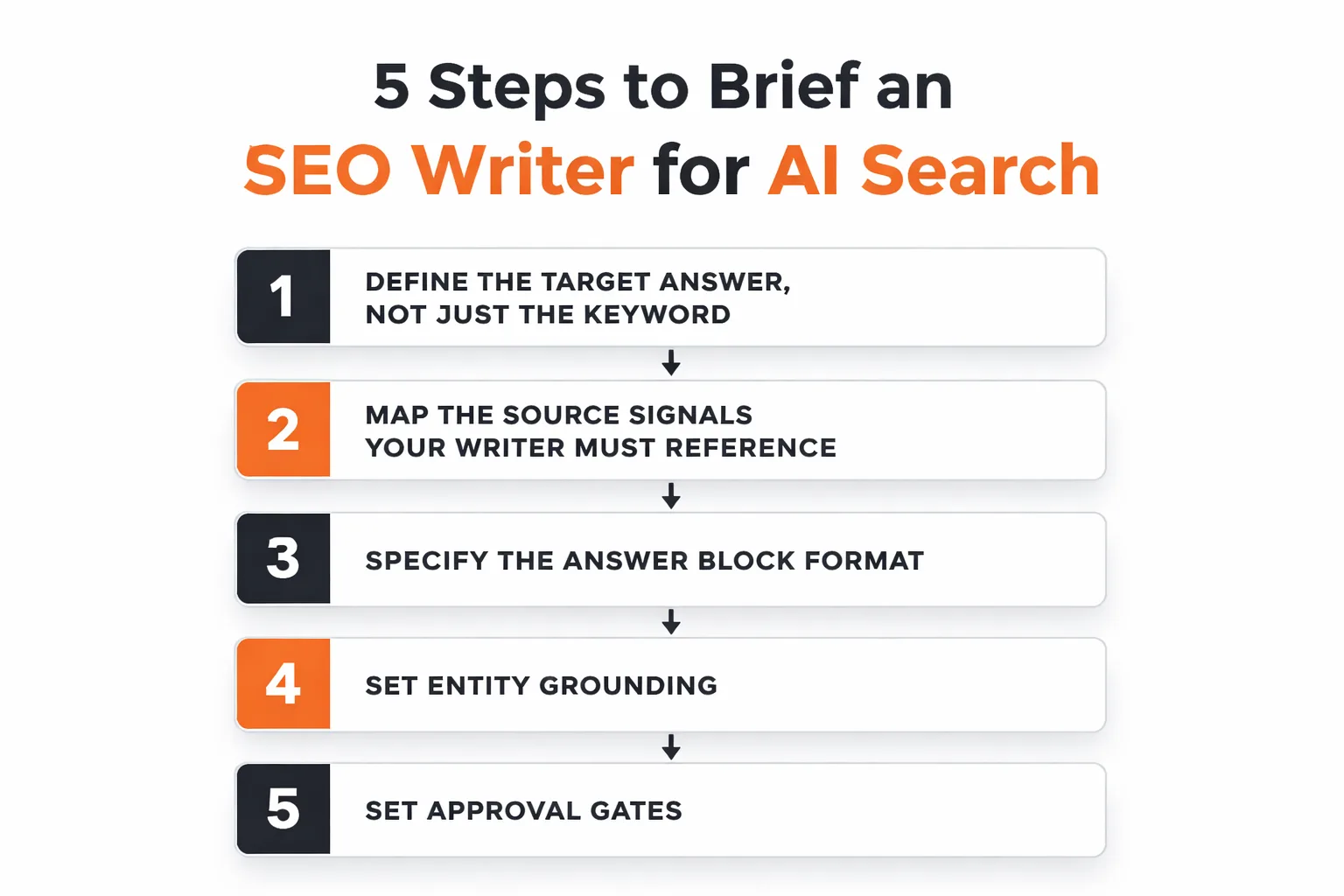
The fix isn't hiring a better writer. The fix is rebuilding the brief around how AI search actually works. That means briefing for answer extraction, not keyword matching. It means briefing for entity grounding, not semantic keyword density. And it means briefing for structured formats that LLMs can parse and cite directly. The five steps below are the framework I use to build briefs that earn AI citations, not just rankings.
Step 1. Define the Target Answer, Not Just the Keyword
Every AI search query is a question. Your brief needs to state that question explicitly and define the answer your article should provide. Not the topic. Not the keyword. The exact question and the shape of the answer.
Here's a worked example. Say your target keyword is "how to reduce churn in SaaS." A traditional brief would say: write a 1,500-word article targeting that keyword, include secondary keywords like "SaaS retention strategies" and "customer success metrics," and benchmark against three competitor URLs. The writer produces a solid article. It ranks. It never gets cited by an AI engine.
Why? Because the brief never told the writer what question the AI engine is actually answering. An AI engine answering "how to reduce churn in SaaS" isn't looking for a 1,500-word essay. It's looking for a concise, extractable answer: the top 3-5 strategies with specific tactics, named frameworks, and supporting data. It will pull that answer from whichever source presents it most clearly and authoritatively.
Your brief should instead state: "The target question is 'What are the most effective strategies to reduce churn in SaaS?' The article must provide a direct answer in the first 100 words: a numbered list of 5 strategies, each with a one-sentence definition and a specific tactic. The rest of the article elaborates on each strategy with examples, data, and implementation steps."
Now the writer knows what to build. They're not writing an article about churn. They're writing an answer to a specific question that an AI engine will decompose, retrieve, and synthesize. The format is defined. The extraction target is clear.
This shift sounds small. It changes everything about how the writer approaches the draft. They lead with the answer. They structure for extraction. They don't bury the lede under a 200-word introduction because they know the AI engine is going to pull from the top of the page.
In my work building content systems at Meev, I've seen this single change double the citation rate of otherwise identical content. Same writer. Same topic. Same word count. The only variable was whether the brief defined the target answer or just the target keyword.
Step 2. Map the Source Signals Your Writer Must Reference
AI engines don't trust your content just because it exists. They trust content that aligns with sources they already cite. Your brief needs to tell the writer exactly which sources to reference, which entities to ground, and which knowledge graph nodes to align with.
This is where most briefs go silent. They list competitor URLs to benchmark but never mention the domains that AI engines actually cite for the topic. The writer has no idea which sources carry weight in the LLM's retrieval pipeline. They cite whatever they find on Google's first page, which may or may not overlap with what AI engines trust.
The overlap is lower than you think. I've seen topics where the top Google results and the top AI-cited sources share almost no domains in common. If your writer is benchmarking against Google SERP competitors, they're optimizing for the wrong signal.
Your brief should include three source-mapping elements:
Cited domains. List the 3-5 domains that AI engines most frequently cite for your target topic. You can find these by running your target prompts through ChatGPT, Perplexity, and Google AI Overviews and noting which sources appear in the citations. Tools like our AI Visibility Checker and Perplexity AI Visibility Checker automate this by showing you which domains AI engines cite for your topics. Give this list to your writer and instruct them to reference and link to these sources where relevant.
Entity definitions. Identify the key entities in your topic (product names, concepts, people, organizations) and tell the writer to define each one consistently with its Wikidata or knowledge graph entry. If your article mentions "answer engine optimization," the writer should know that the canonical definition aligns with how the concept is described in authoritative sources, not with whatever phrasing feels natural. This is entity grounding: making sure your content's entity definitions match what the LLM already knows.
Structured data alignment. Tell the writer what schema types the article should use. If it's a how-to article, the brief should specify HowTo schema with numbered steps. If it's an FAQ, specify FAQPage schema. The writer doesn't need to write the schema markup, but they need to structure the content so the schema can be applied cleanly. This matters because AI engines parse structured data to extract answers, and content without it is invisible to the extraction pipeline.
The Department of Energy's SEO best practices note that having pages cited in AI answers is now as important as ranking in search results. That only happens if your content aligns with the sources AI engines already trust.
Step 3. Specify the Answer Block Format
AI engines extract answers in predictable shapes. Your brief needs to tell the writer which shape to use.
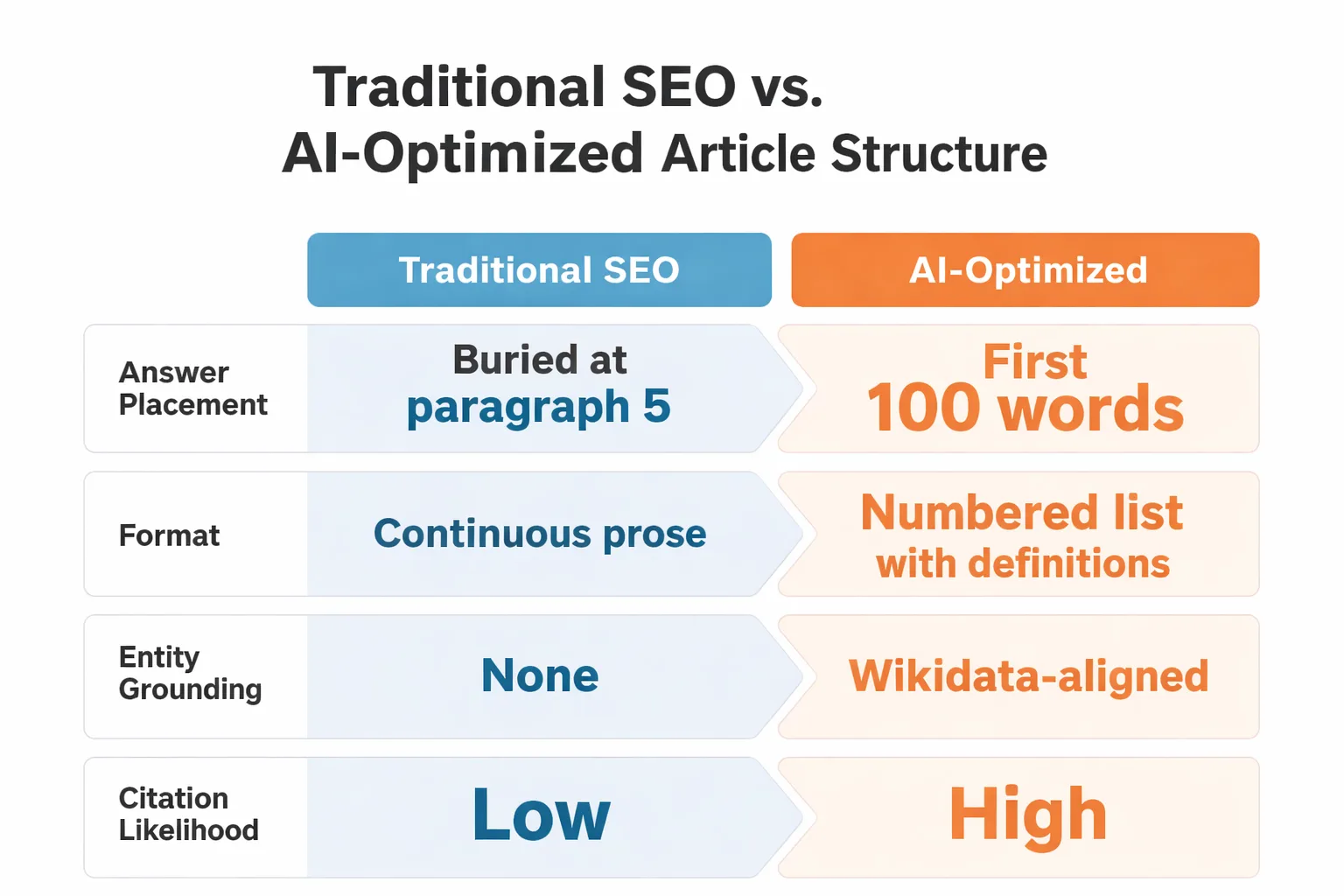
The four formats that AI engines extract most reliably are concise definitions, numbered steps, comparison tables, and Q&A pairs. Each serves a different query type, and your brief should specify which one the writer should lead with based on the target question.
For "what is" queries, the brief should instruct the writer to provide a 40-60 word definition in the first paragraph. Not a hook. Not a story. A definition. AI engines extract definitions from the top of the page, and if the first 100 words don't contain a clear, self-contained definition, the engine moves on to a source that does.
For "how to" queries, the brief should specify a numbered list of steps with each step containing a clear action verb, a one-sentence instruction, and a brief elaboration. The writer should place this list high in the article, not buried after a 500-word introduction. AI engines extract numbered lists because they map cleanly to step-by-step instructions in the response.
For comparison queries ("X vs Y"), the brief should call for a comparison table with named columns and rows. Tables are one of the most reliably extracted formats because they present structured data that AI engines can parse and reproduce without ambiguity. If your article compares two tools, the table should include specific comparison dimensions, not vague feature descriptions.
For question-based queries, the brief should include Q&A pairs with the question as a subheading and a 40-60 word answer immediately below. This is the format that Google's People Also Ask boxes and AI Overviews extract from most aggressively. The question should match natural language phrasing, not keyword-stuffed headings.
I see too many briefs that say "write a comprehensive article" without specifying any format. The writer produces 2,000 words of flowing prose. It reads well. It ranks on Google. It never gets cited by an AI engine because there's nothing to extract. No definition block. No numbered list. No table. No Q&A pair. Just paragraphs that a human can read but an LLM can't efficiently parse.
The format instruction is the cheapest citation win in your brief. It costs you nothing to add "lead with a 50-word definition" or "include a 5-step numbered list in the first 300 words." It costs you everything to omit it.
Are your content briefs built for Google rankings or AI citations?
How Does Entity Grounding Work in Practice?
Entity grounding means aligning your content's entities with their canonical definitions in knowledge graphs like Wikidata, Google's Knowledge Graph, and the LLM's training data. When your article mentions a concept, product, or organization, the entity's name, attributes, and relationships must match what the AI engine already knows about that entity.
In practice, this means your brief should include an entity list: every named entity the article must reference, with its canonical definition and key attributes. The writer uses this list to ensure consistency. If your brand entity is "Meev" with the attributes "AI search visibility platform, founded for small teams, tracks citations across ChatGPT and Perplexity," the writer should use those exact attributes when introducing the brand. Not a paraphrased version. Not a creative reinterpretation. The canonical definition.
Why does this matter? Because AI engines build an internal representation of entities and their relationships. If your content introduces an entity with attributes that don't match the LLM's existing representation, the engine treats it as a new or conflicting entity and is less likely to cite your content as a source for that entity. If your content aligns with the existing representation, the engine treats it as a confirming source and is more likely to cite it.
This is subtle but powerful. I've seen articles that say exactly the right things about a topic but use non-standard entity names or attribute descriptions. They rank fine on Google. They never get cited by AI engines. The content is correct but the entity grounding is broken, so the LLM doesn't recognize the content as a valid source for that entity.
Your brief should also specify related entities to mention. If you're writing about "answer engine optimization," the brief should list related entities like "generative engine optimization," "AI search visibility," and "LLM citation tracking" as concepts the article should reference and link together. This builds the entity relationship graph that AI engines use to determine topical authority.
For a deeper dive on how this differs from traditional SEO, our AEO vs SEO guide breaks down the structural differences between ranking pages and earning citations.
Steps 4-5. Set Entity Grounding and Approval Gates
The last two steps of the brief are about consistency and quality control. Entity grounding ensures the draft aligns with your brand's knowledge graph presence. The approval gate ensures the draft meets citation-readiness standards before it goes live.
Step 4: Entity consistency throughout the draft. Your brief should include a brand entity profile that specifies how the brand is named, described, and attributed throughout the article. This includes the canonical brand name, the one-sentence value proposition, the category the brand belongs to, and the key differentiators. The writer should use these exact elements every time the brand is mentioned, not variations.
This also applies to author entities. If your article has a named author, the brief should include the author's entity profile: full name, credentials, areas of expertise, and a link to their bio page. This matters for E-E-A-T signals, which AI engines increasingly use to evaluate source credibility. A well-grounded author entity with verifiable credentials makes your content more likely to be cited as an authoritative source.
Your brief should also specify internal linking targets. Which related articles should this piece link to? Which entity pages should it reference? Internal links build the entity relationship graph on your own site, which helps AI engines understand the topical context and authority of your content. A tool like our AI SEO Tool can help identify which pages on your site already have entity strength and should be linked to from new content.
Step 5: The approval gate. This is the step most teams skip, and it's the one that matters most. Before the article goes live, it should pass a review that checks for citation-readiness, not just editorial quality. The review should verify:
1. Does the article contain at least one extractable answer block (definition, numbered list, table, or Q&A) in the first 200 words? 2. Are all entities named and described consistently with the brief's entity list? 3. Does the article cite and link to at least 3 authoritative sources that AI engines already trust for this topic? 4. Is the content structured with schema-ready formatting (numbered steps for HowTo, Q&A pairs for FAQPage)? 5. Does the article avoid the banned AI-writing patterns that trigger quality penalties?
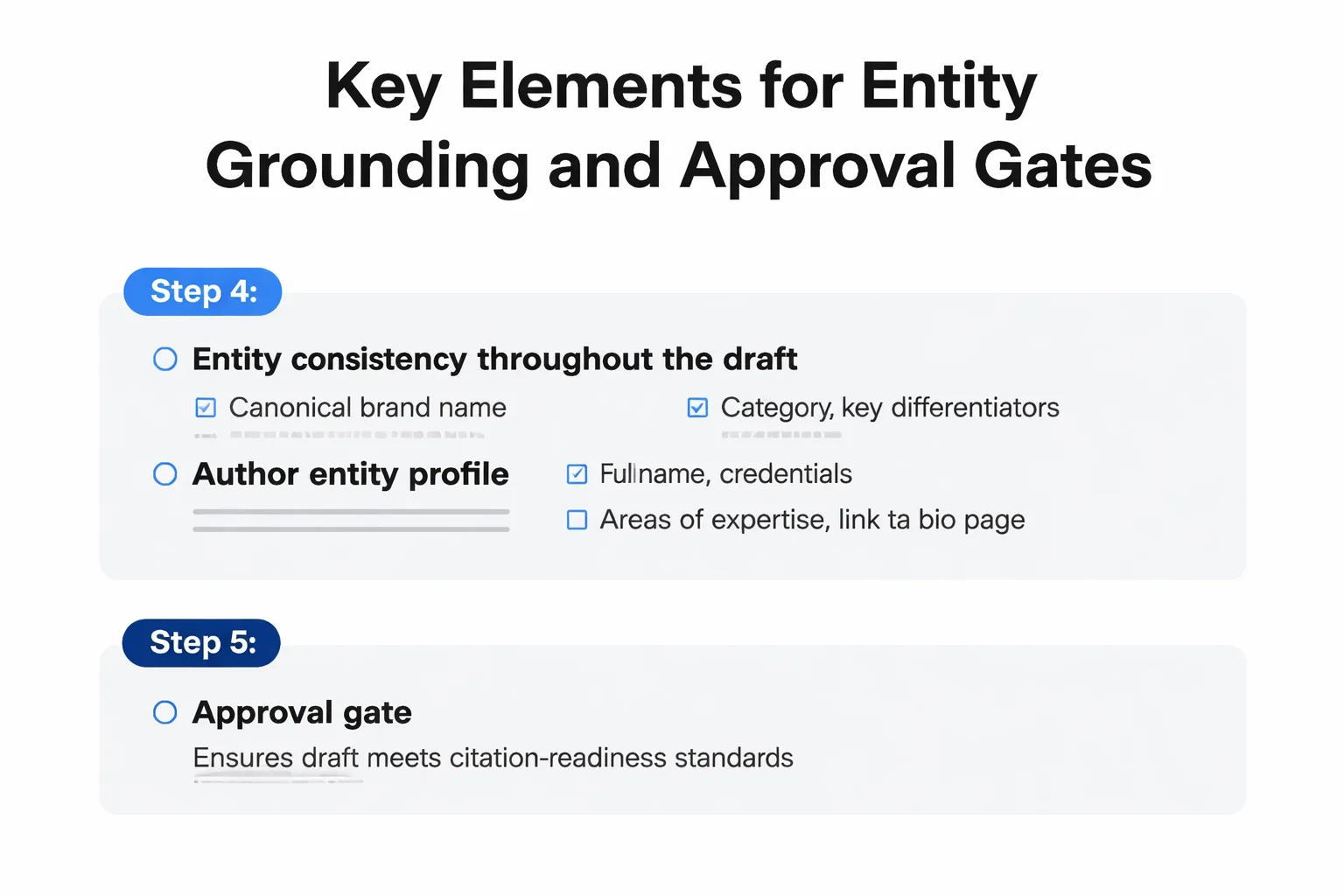
This gate is what separates content that earns AI citations from content that just fills your CMS. I've seen teams skip it because they're optimizing for velocity. They want to publish 30 articles a week. The approval gate slows them down. But the gate exists because without it, you're publishing content that will never be cited by an AI engine, no matter how much of it you produce.
At Meev, we built a 16-dimension quality firewall that blocks articles below a 70/100 quality score from auto-publishing. The firewall checks for answer block presence, entity consistency, citation density, and format readiness. It's the same gate I'm describing here, automated. Whether you do it manually or with a tool, the gate must exist.
For teams scaling this process, our AI Visibility Tracker shows you which published articles are actually getting cited by AI engines, so you can close the loop between your brief, your draft, and your citation results.
When This Framework Fails
This five-step framework assumes you're creating content for topics where AI engines synthesize answers from multiple sources. That covers most informational and commercial queries. But it breaks down in three specific scenarios.
First, for breaking news or emerging topics where no entity exists in the knowledge graph yet. If you're writing about something that happened last week, the LLM has no entity representation to ground against. Your brief can specify entity grounding, but there's nothing to ground to. In these cases, focus on being the first well-structured source. Speed and format matter more than entity alignment.
Second, for highly subjective or opinion-based content where there's no canonical answer. AI engines are cautious about synthesizing opinions. If your target question is "is remote work better than office work," the AI engine will present multiple perspectives, not a single answer. Your brief should account for this by structuring the article as a balanced comparison with attributed viewpoints, not a single-answer format.
Third, for hyper-local or niche topics where the knowledge graph has thin coverage. If you're writing about a local business category in a small market, the entity data may not exist. Don't force entity grounding where there's nothing to ground to. Focus on structured data, local schema, and being the most authoritative source on the web for that specific local query.
The framework is a tool, not a religion. Use it where it works. Adapt it where it doesn't.
How Do AI Visibility Metrics Shape the Brief?
If you're briefing a writer without showing them what's actually happening in AI search results, you're flying blind. AI visibility reporting is the feedback loop that makes your briefs smarter over time. When I build content systems at Meev, I start every brief by pulling the current AI visibility data for the target topic. I want to know three things before I write a single instruction to the writer.
First, is anyone in our space already getting cited? If a competitor shows up in ChatGPT's answer for "best project management tools for remote teams," I need to know which competitor, which page of theirs got cited, and what format that page uses. That tells me what the AI engine found extractable. I feed that directly into the brief as a structural reference. Not to copy the competitor, but to understand the extraction pattern the engine already favors for this query.
Second, what's the mention position? If our brand appears in AI answers but always last in a list of five, the brief needs to emphasize differentiators that make us first. That means the writer needs to know what the other four brands in that list are known for, so they can position our brand against those specific attributes. Mention position data turns a generic competitive analysis into a targeted positioning instruction.
Third, which source domains are doing the citing? AI engines don't just cite the brand's own website. They cite third-party sources that mention the brand. Research from arxiv.org shows that AI search systematically favors earned media over brand-owned content. If Perplexity cites a G2 review page when answering a query about your product category, your brief should instruct the writer to reference and align with G2's category definitions. You're not just writing for your own domain. You're writing to be the source that third-party review sites and aggregator pages reference when they describe your category.
This is where AI visibility reporting stops being a vanity metric and becomes a briefing input. I review our AI Visibility Tool dashboard before every content sprint. The data tells me which topics have citation gaps, which competitors are winning, and which source domains the AI engines trust. That data goes straight into the brief. The writer never sees the dashboard, but every instruction in the brief is shaped by what the data shows.
For teams just starting to track AI visibility, our ChatGPT AI Visibility Checker gives you a baseline for one surface. Run it for your top 10 target queries. The results will tell you exactly where your content operation has gaps and where your briefs need to change.
How Does Ecommerce GEO Change the Briefing Process?
Ecommerce content briefing has a different shape. When Shopify launched Agentic Storefronts, as documented on LinkedIn, it created a new surface where products surface directly inside AI chats. This isn't theoretical. Products are being recommended inside ChatGPT conversations, with sales attribution and affiliate revenue tests planned for Q4 and Q1. If you're briefing an SEO writer for an ecommerce brand, your brief needs to account for this.
The GEO for Shopify guide from NICCOS makes a critical point that I've seen teams ignore: you must define your customer, price, and process architecture before publishing AI-focused content. If your product data is messy, your pricing is inconsistent across channels, or your inventory feed has gaps, no amount of AI-optimized content will fix it. The AI assistant will surface inaccurate information, and once an LLM trains on bad data, it's extremely hard to correct.
This changes the ecommerce brief in three ways. First, the brief must include a product data audit instruction. The writer needs to know that every product mention in the article must match the canonical product data feed: exact product name, price, availability, and specifications. If the article says a product costs $49/month but the feed says $59/month, the AI engine will either skip your content or surface the wrong price.
Second, the brief should specify structured product data. Product schema, offer schema, and review schema are not optional for ecommerce content in the AI search era. The writer doesn't write the schema, but they need to structure product descriptions in a way that maps cleanly to schema fields. Name, description, brand, category, price, availability, aggregate rating. If the writer buries the price in a paragraph instead of stating it clearly in a product specification block, the schema can't extract it and neither can the AI engine.
Third, the brief needs to address customer policy data. Voyado's research on AI search for ecommerce highlights that AI search helps fix messy queries by showing relevant products and personalizing based on customer behavior. But personalization depends on clean data. If your return policy, shipping policy, or warranty terms are inconsistent across your site, the AI engine can't confidently surface your products in answer to questions like "does this brand offer free returns?" Your brief should instruct the writer to reference canonical policy pages, not paraphrase policy details in the article body.
For ecommerce teams, this means the SEO writer brief is no longer just about content. It's about data hygiene. The writer is the last line of defense between your product data feed and the AI engine's representation of your products. If the brief doesn't include product data alignment instructions, the writer will produce content that reads well but feeds bad data to the LLM.
What This Actually Means for Your Content Operation
The teams that win AI search in 2026 won't be the ones with the most content or the best writers. They'll be the ones with the best briefs. A well-briefed average writer will outperform a poorly briefed great writer every time, because the brief determines whether the content is structured for AI extraction or just for human reading.
The shift from keyword-first briefing to answer-first briefing is not incremental. It's a structural change in how you think about content production. You're not commissioning articles. You're commissioning answers. The article is just the container.
I've built content operations for enough brands to know that the bottleneck is never the writer. It's always the brief. When I audit a content program that's struggling with AI visibility, I don't look at the articles first. I look at the briefs. The articles are a symptom. The briefs are the disease. If the brief doesn't define the target answer, the writer can't write an extractable answer. If the brief doesn't map source signals, the writer can't align with trusted domains. If the brief doesn't specify format, the writer can't structure for extraction.
If you're still sending briefs that list keywords, word counts, and competitor URLs, you're briefing for 2022. Every article you publish with that brief is a sunk cost. The writer will do their best. The content will rank on Google. And it will never appear in a ChatGPT response, a Perplexity citation, or a Google AI Overview.
Rebuild your brief template. Define the target answer. Map the source signals. Specify the format. Ground the entities. Build the gate. Five steps. That's the difference between being invisible and being cited.
If you want to see where you stand today before rebuilding your briefs, run your brand through our ChatGPT AI Visibility Checker to see which of your existing articles are getting cited and which are invisible to AI search. The data will tell you exactly which briefs are working and which are wasting your writer's time.
FAQ
What is the difference between an SEO content brief and an AI search brief?
An SEO content brief focuses on keyword targeting, search intent, competitor analysis, and word count to rank on Google's SERP. An AI search brief adds answer block formatting, entity grounding instructions, source domain mapping from AI-cited results, and schema-ready structure. The AI brief tells the writer what question to answer and how to format the answer for LLM extraction, not just what keyword to target.
How do I find which domains AI engines cite for my topic?
Run your target query through ChatGPT, Perplexity, and Google AI Overviews. Note which domains appear in the citation links. You can also use tools like Meev's AI Visibility Tool or LLM Visibility Tool to automate this across multiple prompts and track citation patterns over time. Give the resulting domain list to your writer as reference sources.
Should I still include keywords in my brief?
Yes. Keywords still matter for Google ranking and for helping the writer understand the topic scope. But they should not be the primary organizing principle of the brief. Lead with the target answer and format, then include keywords as supporting context. The keyword tells the writer what topic to cover. The answer definition tells them what to build.
How long should an AI-optimized article be?
Length matters less than structure. A 1,200-word article with a clear answer block in the first 100 words, entity-grounded definitions, and schema-ready formatting will outperform a 3,000-word article without those elements. Set a word count range in your brief, but prioritize format and extraction readiness over length.
Can I use an AI SEO agent to generate the brief itself?
Yes, with caution. AI tools can help identify target questions, map cited domains, and suggest entity lists. But the strategic decisions, which question to target, which sources to align with, and how to position your brand entity, require human judgment. Use AI to accelerate research, not to replace the briefing strategy. I've tested AI agents for content generation over the past year, and the output consistently required significant human oversight to meet basic quality standards. The brief is too important to fully automate.
What is generative engine optimization and how does it relate to briefing?
Generative engine optimization (GEO) is the practice of optimizing content to be cited by AI-generated responses. It encompasses entity grounding, source authority building, structured data, and answer format optimization. Briefing for GEO means instructing your writer to produce content that aligns with these principles. Our AEO vs GEO guide covers the distinctions in detail. The research from arxiv.org shows that AI search systematically favors earned media and authoritative third-party sources over brand-owned content, which should directly inform your source-mapping strategy in the brief.
How often should I update my brief template?
Review your brief template quarterly. AI search behavior shifts as models update their training data and retrieval algorithms. A source domain that AI engines cited heavily in Q1 may lose citation weight by Q3. Use your AI visibility tracking data to identify when citation patterns shift, and update your source-mapping instructions accordingly. The five-step framework stays constant. The specific sources, entities, and formats within each step need regular refreshes.
About the Author
Judy Zhou, Founder
Judy Zhou leads content strategy at Meev, where she oversees AI-driven content research and publishing for hundreds of brands. With a background in SEO and editorial operations, she focuses on building content systems that rank on Google, get cited by AI search engines, and drive measurable business results.
See which of your articles AI engines actually cite, then rebuild your briefs to close the gap.