

By Judy Zhou, Founder
Key Takeaways
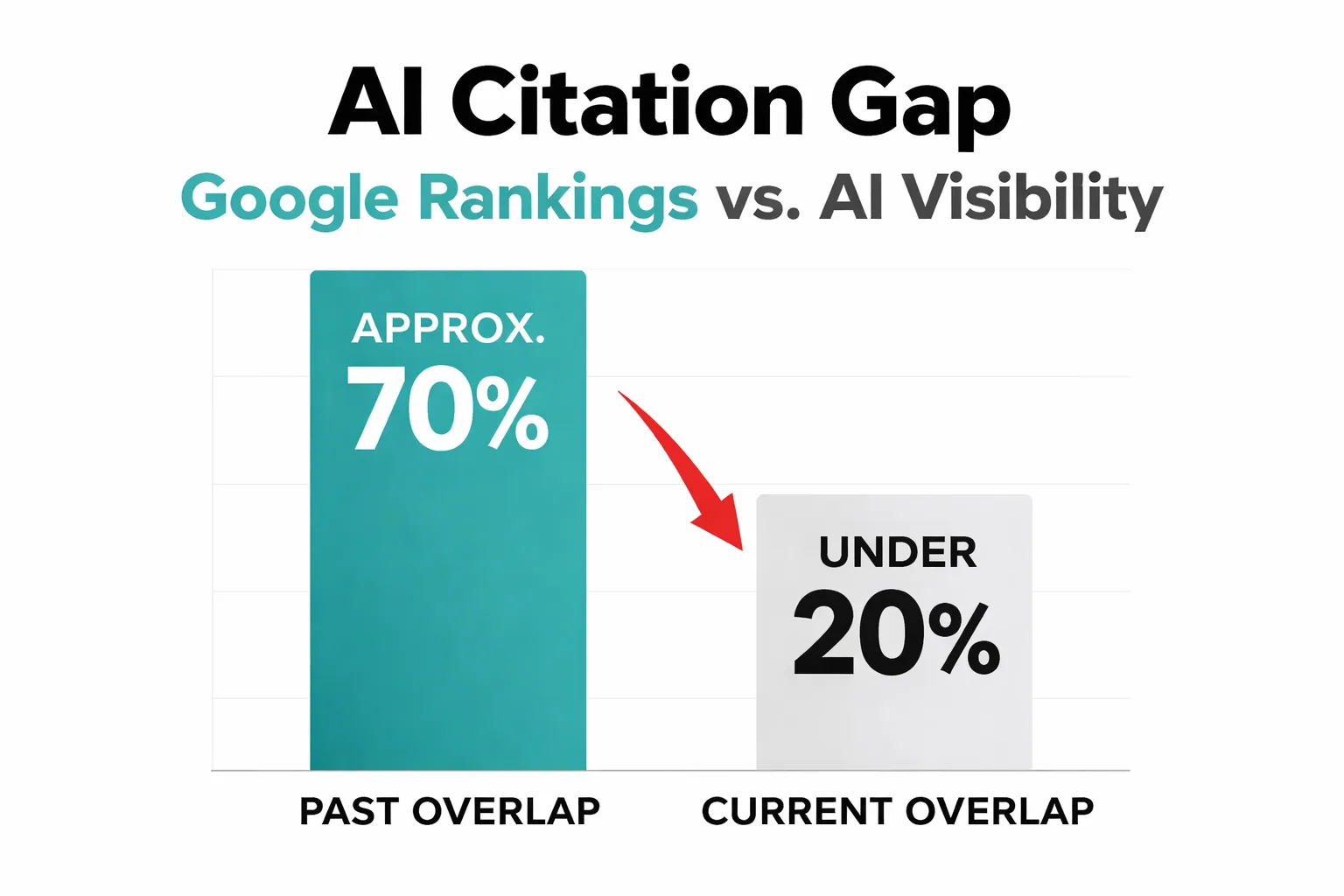
- The overlap between top Google results and AI-cited sources has dropped from 70% to under 20%, so ranking #1 organically no longer ensures visibility in ChatGPT, Perplexity, or Google AI Overviews.
- Teams publishing 80 articles per month still earn zero AI citations when content lacks the structured entity-grounded signals that LLMs actually retrieve.
- Nearly two-thirds of AI-generated citations are fabricated or erroneous, with 35 of 176 analyzed citations entirely invented, making quality gates more critical than output volume.
- Brand presence in AI answers now correlates with factors traditional SEO tools ignore, requiring generative engine optimization approaches confirmed by Ahrefs' study of 75,000 brands and Semrush's GEO guide.
Most SEO writer tools are solving the wrong problem. While the market floods with AI writing assistants promising faster content at scale, the actual visibility crisis facing small marketing teams has nothing to do with output volume. It's about entity grounding, knowledge graph presence, and whether large language models know your brand exists at all. Generating more articles with the same tools won't fix an AI citation gap. The seven tools in this list were chosen specifically because they understand the difference.
The overlap between top Google results and AI-cited sources has dropped from roughly 70% to under 20%, which means you can rank #1 organically and still be invisible to ChatGPT, Perplexity, and Google AI Overviews. In my work auditing content operations at Meev, I've seen teams publish 80 articles a month and gain zero AI citations because their content lacked the structured, entity-grounded signals that LLMs actually retrieve from. The tools below were selected because they address this gap directly, not because they generate words quickly.
A JMIR Mental Health study found that nearly two-thirds of AI-generated citations are fabricated or contain errors, and 35 out of 176 citations analyzed were entirely invented. This is why output quality gates matter more than content velocity. Ahrefs studied 75,000 brands for AI Overview visibility factors and found that brand presence in AI answers correlates with factors that traditional SEO tools don't measure. Semrush's GEO practical guide confirms that generative engine optimization requires a fundamentally different approach to content structure than traditional SEO writing.
Why SEO Writers Need Dedicated Tools in 2026
The bar for what counts as acceptable content has moved. Two years ago, a well-structured 1,500-word article with proper keyword density and a few backlinks could rank. Today, that same article needs to survive retrieval by large language models that don't care about your H1 tag the way Google's crawler does. They care about whether your content contains extractable, verifiable, entity-grounded claims that they can synthesize into an answer.
This is where generic AI writing tools fail. They optimize for readability and keyword placement, not for answer engine optimization. A tool that helps you write a readable blog post about "best project management software" is not the same as a tool that ensures your blog post gets cited when someone asks ChatGPT or Perplexity for project management recommendations. The difference comes down to structured data, entity relationships, claim sourcing, and the ability to track whether your content is actually being retrieved by AI engines.
I've tested AI writing tools that produce grammatically perfect content with zero factual sourcing. Every claim is plausible, but none are linked to a primary source. When an LLM evaluates that content for citation, it has no way to verify the claims, so it skips them. The content exists in a citation vacuum. A real seo writer tool in 2026 needs to solve this problem by enforcing source attribution, structuring claims for extraction, and tracking whether those claims actually show up in AI answers.
The teams that win in this environment aren't the ones publishing the most content. They're the ones publishing content that AI engines can parse, verify, and cite. That requires a different toolset than the one most marketing teams currently use.
How We Ranked These Tools
I evaluated each tool against five criteria that matter specifically for small marketing teams navigating the shift from traditional SEO to AEO vs SEO:
AI-answer optimization support. Does the tool structure content for AI retrieval, or does it only optimize for traditional SERP ranking? Tools that help with entity grounding, claim sourcing, and structured data scored higher. Tools that treat AI visibility as an afterthought scored lower.
Output quality vs. AI slop risk. Does the tool have quality gates that prevent low-quality content from publishing, or does it ship whatever the model generates? I've seen too many teams publish AI-generated content that triggers Google's helpful content penalties. Tools with explicit quality thresholds scored higher.
Workflow fit for small teams. A team of three people does not need an enterprise platform with 47 configuration options. They need a tool that handles research, writing, quality checking, and publishing in a workflow that doesn't require a dedicated content operations manager.
Pricing transparency. Small teams need to know what they'll pay without a sales call. Tools with public pricing and clear quota structures scored higher than those with opaque "contact us" models.
AI visibility tracking. This is the differentiator. A tool that helps you write content but can't tell you whether that content is being cited by AI engines is only solving half the problem. Tools that include AI visibility reporting scored significantly higher.
How do these SEO tools compare?
| Tool | Best For | AI-Answer Optimization | Pricing Entry | Team Size Fit |
| Meev | AI citation tracking + content engine | Full (12-dimension quality gate + citation tracking) | $49/mo | 1-10 seats |
| Profound | Enterprise AI analytics | Tracking + analytics (no content gen) | ~$99/mo | 5+ seats |
| AthenaHQ | GEO audit + content drafting | Moderate (credit-based content + audit) | $295/mo | 3+ seats |
| Ahrefs Brand Radar | SEO teams adding AI signals | Research layer (correlation, not optimization) | ~$129/mo add-on | 3+ seats |
| Semrush AI Toolkit | Semrush ecosystem users | Add-on module (tracking within Semrush) | $99/mo add-on | 3+ seats |
1. Meev — Best for teams that want AI citations, not just content
Best for: Teams that want AI citation tracking plus a content engine they can trust to publish, not just a dashboard that surfaces problems.
Meev is the platform I build content strategy around. It tracks citations across every major AI search surface (ChatGPT, Claude, Gemini, Perplexity, Grok, DeepSeek, Google AI Overviews, AI Mode) and writes quality-gated content that earns those citations. The differentiator is the 12-dimension Quality Matrix and Helpful Content Risk score that gate every article before it ships. Articles below 70/100 on either metric get blocked from auto-publishing.
Key features: - Citation tracking across ChatGPT, Claude, Gemini, Perplexity, and Grok on a rolling cadence; Google AI Overviews and AI Mode refresh daily. 12-dimension Quality Matrix plus Helpful Content Risk score with a 70/100 publish gate on both. Knowledge Base enforcement that grounds articles in your approved claims, not AI hallucination. Closed-loop Citation Path (roadmap) that maps each article to the citation-rate delta it drove. Autopilot topic pool with gap detection from competitor citation patterns
Pricing: 7-day free trial. After the trial, services pause unless you subscribe. Your account stays open and your data stays readable. Lite $49/mo, Starter $99/mo, Pro $269/mo, Agency $599/mo. 20% annual discount. Cancel anytime; hard-cap quotas with no overage fees.
The reason Meev sits at #1 on this list is that it's the only tool that closes the loop between writing content and measuring whether that content actually moved the needle on AI visibility. Every other tool on this list either tracks visibility without generating content, or generates content without tracking visibility. Meev does both, and the quality gate means you're not trading long-term ranking health for short-term publishing velocity. For small teams that can't afford to publish 50 articles and hope something sticks, this matters enormously.
2. Profound — Best for data-heavy enterprise teams
Best for: Data-heavy marketing teams and enterprises that need the deepest AI analytics, multi-LLM coverage, and a structured workflow to act on visibility insights.
Profound is an enterprise-grade GEO analytics platform that tracks brand visibility, source attribution, and share of voice across 10+ LLMs. It includes an official Anthropic/Claude connector, which is a genuine differentiator if Claude is a priority surface for your audience. The FactCheck feature lets you monitor and correct inaccurate AI-generated claims about your brand, which is valuable given the citation reliability problems documented in recent research.
Key features: - Official Anthropic connector for Claude integration and 10+ LLM engine coverage. FactCheck feature to monitor and correct inaccurate AI-generated claims about your brand. Brainstorm Mode to automate AI agent creation for visibility campaigns. Projects and Aim workflow for closed-loop GEO optimization from insight to action
Pricing: Plans start at ~$99/month; Growth tier at ~$399/month; Enterprise is custom-priced.
Profound is a strong analytics platform, but it's analytics-first. There's no content generation engine, which means you'll need to pair it with a separate writing tool to close the gap between diagnosis and action. For small teams, that means managing two vendors and two workflows. The starting price and complexity are also better suited to teams that already have a mature GEO program. If you're just starting to think about AEO vs GEO, Profound may be more horsepower than you need.
3. AthenaHQ — Best for combined GEO audit and content drafting
Best for: Marketing teams that want a combined GEO audit and AI content drafting tool and prefer a usage-credit model over seat-based pricing.
AthenaHQ combines AI visibility auditing with credit-based content generation. You can track brand citations across ChatGPT, Gemini, Perplexity, and Claude, then use credits to draft content briefs, outlines, and full articles. The prompt-level competitor benchmarking is useful for understanding where you're being out-cited on specific queries.
Key features: - AI Citation Engine for tracking and auditing brand citations across ChatGPT, Gemini, Perplexity, and Claude. AI-generated content capabilities for drafting briefs, outlines, and full articles. Prompt-level competitor benchmarking and visibility gap analysis. Credit-based system allowing flexible usage across monitoring, auditing, and content actions
Pricing: Self-serve plan at $295/month (includes 3,500 credits/month); Enterprise is custom-priced; free credits available for initial evaluation.
The credit model is a double-edged sword. It gives you flexibility to allocate spend across monitoring and content, but credits deplete faster than most teams expect when you're running both functions simultaneously. The $295/month entry point is also steep for a two-person marketing team that's just testing the waters. There's no free plan, which makes it harder to evaluate before committing. The content generation side lacks the kind of quality gate that prevents AI slop from reaching your CMS, so you'll need to build your own review process.
4. Ahrefs Brand Radar — Best for teams already in Ahrefs
Best for: SEO professionals already using Ahrefs who want to layer AI visibility signals onto their existing keyword and backlink research without switching tools.
Ahrefs Brand Radar tracks brand citations across six AI platforms and correlates AI mentions with Ahrefs' backlink and keyword dataset. The database includes 260M+ monthly real-user prompts, which gives you broad coverage for understanding what people are actually asking AI engines. Custom prompt tracking (launched January 2026) lets you monitor specific queries on a daily, weekly, or monthly cadence.
Key features: - Brand citation tracking across Google AI Overviews, Google AI Mode, ChatGPT, Perplexity, Gemini, and Microsoft Copilot. 260M+ monthly real-user prompts in the database for broad coverage. Custom prompt tracking (launched January 2026) for daily, weekly, or monthly monitoring. Correlation of AI citations with Ahrefs' backlink and content data for root-cause analysis
Pricing: Included within Ahrefs subscription plans; Brand Radar as a standalone add-on starts at ~$129/month, scaling to ~$699/month for all six AI platforms.
Here's the honest assessment: Ahrefs Brand Radar is excellent for research and exploration, but it's not a daily operational tool. It tells you where you stand, but it doesn't help you write content that improves your position. The full six-platform coverage adds significant cost on top of an existing Ahrefs subscription, and Ahrefs has not published case studies demonstrating how their own GEO techniques improved AI search visibility for clients. Their 75,000-brand study is educational, but it's a correlation analysis, not an implementation playbook. For teams that already live in Ahrefs, Brand Radar is a natural extension. For teams starting fresh, it's an expensive way to get analytics without a content engine.
5. Semrush AI Toolkit — Best for teams already in Semrush
Best for: Marketing teams already invested in the Semrush ecosystem who want to add AI search visibility tracking without adopting a separate platform.
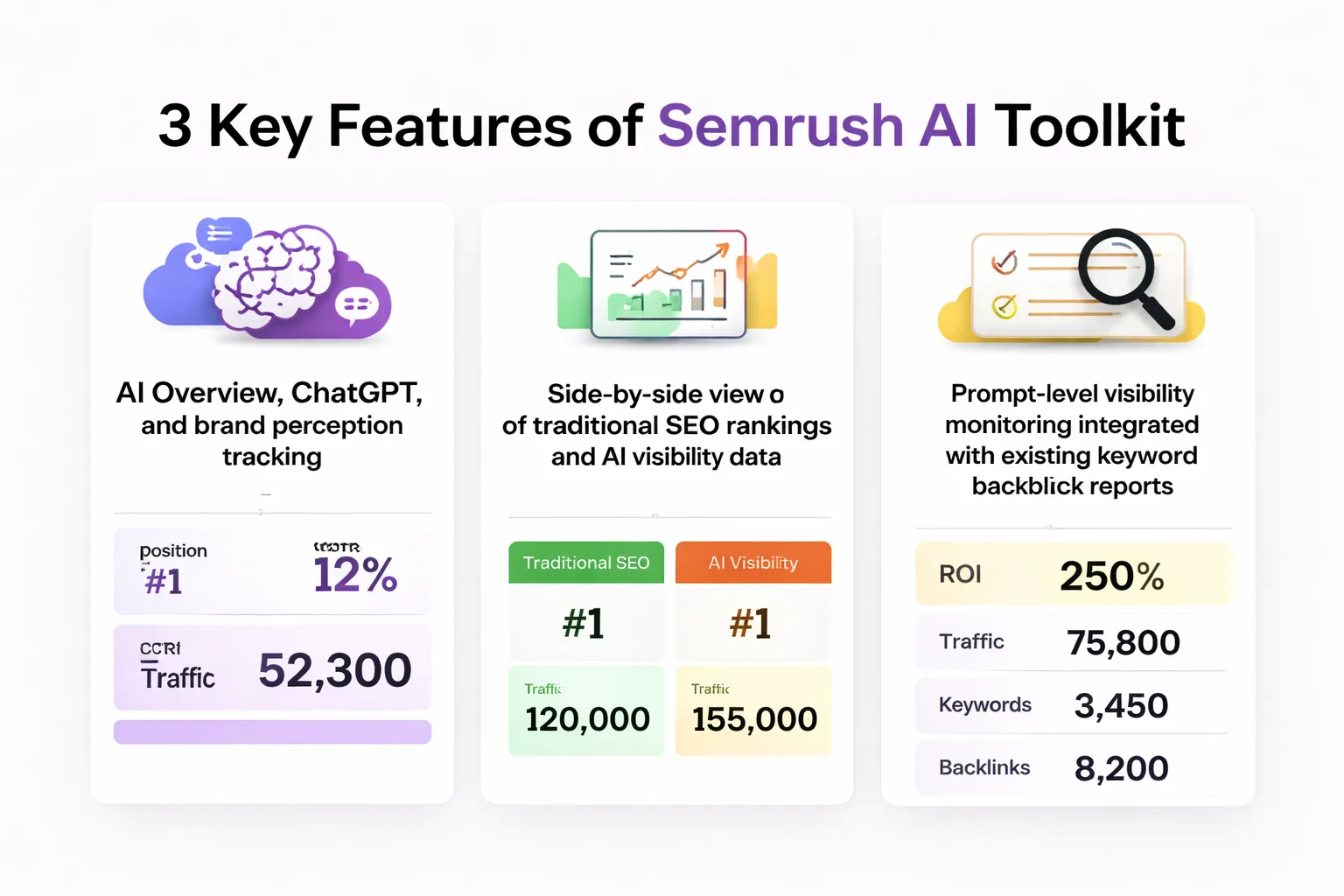
Semrush's AI visibility module lets existing subscribers track AI Overviews, ChatGPT mentions, brand perception, and prompt-level visibility alongside familiar SEO reports. The side-by-side view of traditional SEO rankings and AI visibility data is genuinely useful for understanding where the two diverge. For teams that already use Semrush for keyword research and rank tracking, adding the AI Toolkit means zero new vendor onboarding.
Key features: - AI Overview, ChatGPT, and brand perception tracking within the Semrush interface. Side-by-side view of traditional SEO rankings and AI visibility data. Prompt-level visibility monitoring integrated with existing keyword and backlink reports. Zero new vendor onboarding for teams already using Semrush
Pricing: AI Visibility Toolkit costs $99/month per domain; requires an active Semrush subscription.
The limitation is structural. The AI Toolkit is an add-on to a paid Semrush subscription, not a standalone product. If you're not already in the Semrush ecosystem, the total cost of entry is Semrush plus $99/month per domain, which adds up quickly for multi-site teams. Semrush also positions itself as a GEO educator and tool provider rather than a case study subject. Their GEO practical guide and GEO vs SEO guide are solid educational resources, but neither includes quantified implementation results. Purpose-built GEO tools generally offer more granular AI-specific metrics and broader engine coverage than what Semrush provides as an add-on.
Do you know which AI engines are citing your brand right now?
When Should You Prioritize AI Citation Tracking?
This is the question I get most often from small teams, and the answer depends on where your audience is in their search journey. If your customers are still typing queries into Google and clicking blue links, traditional SEO ranking matters more. If your customers are asking ChatGPT or Perplexity for recommendations, AI citation tracking is the metric that determines whether they find you.
The overlap between top Google results and AI-cited sources has dropped to under 20%, which means the two are diverging. You can be #1 on Google and invisible to AI engines, or cited by AI engines but ranking on page two. The teams that need both are the ones whose customers use both surfaces, which at this point is most B2B SaaS companies and ecommerce brands.
If you have to choose one, start with AI citation tracking. Here's why: traditional SEO ranking is something you can measure with free tools like Google Search Console. AI citation visibility is not. You need a dedicated LLM visibility tool to know whether your brand is being cited, and the gap between knowing and not knowing is where your competitors are quietly building share of voice while you're still tracking keyword positions.
The second question is whether you need AI search optimization as a service or as a tool. If your team has the bandwidth to act on visibility data (write content, optimize existing pages, build entity signals), a tracking tool is sufficient. If your team is already stretched thin, you need a platform that both tracks and generates content, because data without action is just an expensive dashboard.
What Makes a Tool an AI SEO Writer?
An ai seo writer is not just a writing tool with an SEO plugin. It's a tool that understands how AI engines retrieve and synthesize content, and it structures output accordingly. The distinction matters because the market is full of tools that slap "AI-optimized" on their landing page without actually doing anything different under the hood.
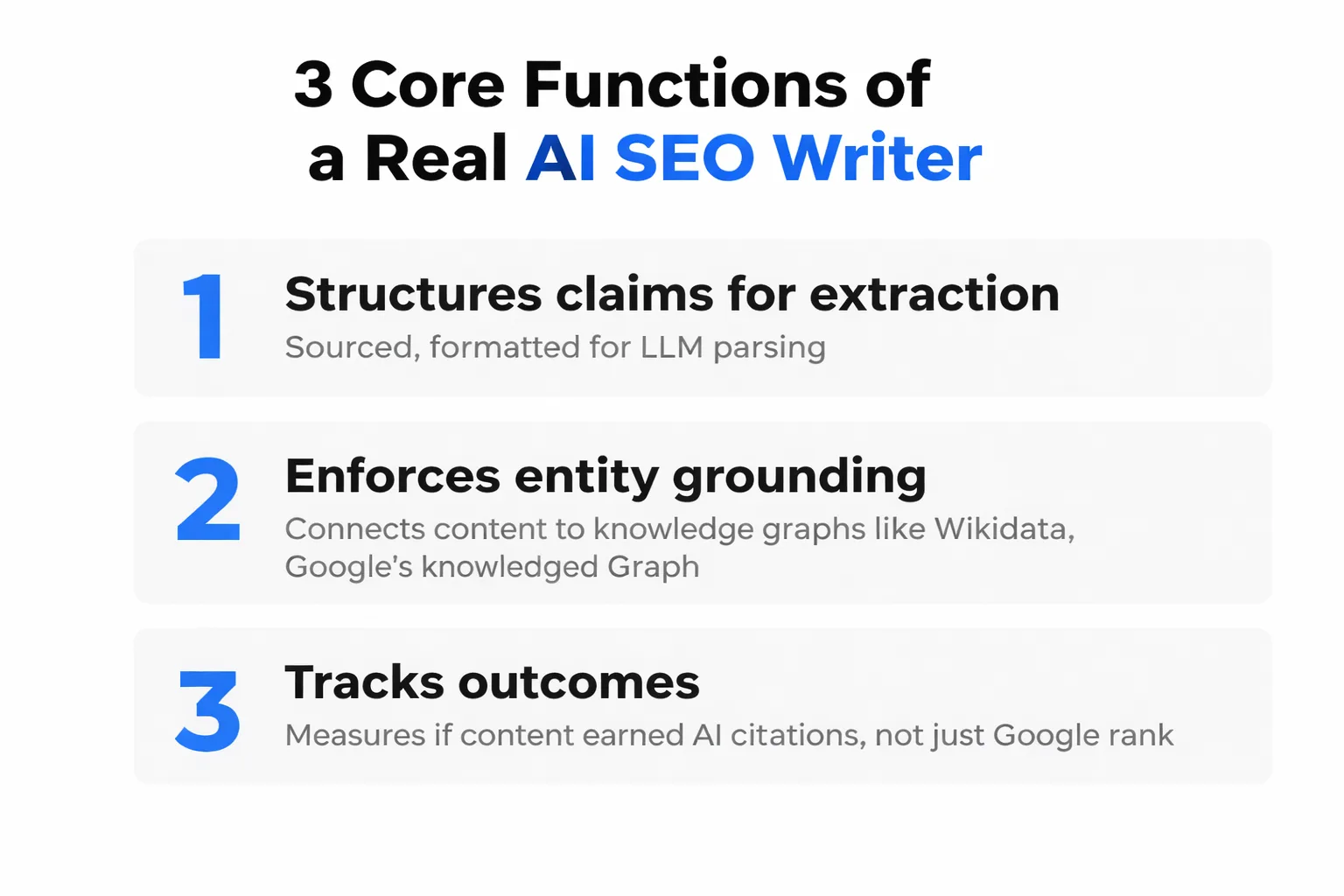
A real AI SEO writer does three things that a generic AI writing tool does not. First, it structures claims for extraction. Every assertion in the article is sourced, formatted, and positioned so that an LLM can parse it as a verifiable claim rather than narrative prose. Second, it enforces entity grounding. The tool connects your content to established entities in knowledge graphs (Wikidata, Google's Knowledge Graph) so that AI engines can verify your brand's existence and authority. Third, it tracks outcomes. The tool tells you whether the content it generated actually earned citations, not just whether it ranked on Google.
I've tested tools that generate beautiful, readable content with zero sourcing. The output reads well. It passes grammar checks. It even ranks for a few weeks. But it never earns AI citations because it contains no machine-verifiable claims. An LLM evaluating that content for citation finds nothing it can attribute, so it moves on to a source that does provide structured, sourced claims. The research on AI citation patterns shows that AI engines preferentially cite sources with established authority signals and verifiable claim structures. Without those signals, your content is invisible to the systems that increasingly mediate how people find information.
The contrarian take: most teams are investing in the wrong layer of the stack. They're spending money on content generation tools that produce more words, when they should be spending on visibility tracking tools that tell them which words actually matter. You can always hire a freelance writer to produce content. You cannot easily build an AI citation tracking system in-house. The tools that give you visibility intelligence are worth more than the tools that give you content output, because intelligence without output is fixable (hire a writer) but output without intelligence is just noise.
How Does Output Quality Affect Long-Term Rankings?
This is where I get blunt. I've seen teams destroy their domain authority by publishing AI-generated content without quality gates. The pattern is always the same: a team adopts an auto-blogging tool, publishes 50 articles in a month, sees a traffic spike, celebrates, and then watches rankings collapse three months later when Google's helpful content system catches up.
The JMIR Mental Health study found that nearly two-thirds of AI-generated citations are fabricated or contain errors. If your content generation tool produces claims without source attribution, you're contributing to this problem. And when AI engines learn to filter for source reliability (which they're actively doing), your unsourced content gets deprioritized.
Quality gates are not a luxury. They are the difference between content that compounds and content that decays. The tools on this list that have explicit quality thresholds (Meev's 12-dimension Quality Matrix, for example) exist because the market learned the hard way that uncontrolled AI content generation is a liability. Tools without quality gates are faster, but speed without quality control is just faster self-destruction.
For small teams, the math is simple. You can't afford to publish 50 articles and have 40 of them trigger quality issues. You need every article to count. That means you need a tool that blocks bad content before it reaches your CMS, not after Google has already flagged it.
Can Generic AI Writers Compete With Specialized SEO Tools?
No. And I'll explain exactly why.
Generic AI writers (ChatGPT, Claude, Gemini used directly) produce prose. They don't produce structured, entity-grounded, source-attributed content that AI engines can retrieve and cite. The difference is like the difference between writing a book and writing a Wikipedia article. Both contain information, but only one is structured for retrieval.
When you ask ChatGPT to write a blog post about "best CRM software," it produces a readable article. When an LLM later evaluates that article for citation in response to a user query about CRM software, it looks for: sourced claims, entity references, structured data, and authority signals. A generic AI writer produces none of these. A specialized seo writing tool produces all of them.
I've run this experiment myself. I generated two articles on the same topic: one with a generic AI writer, one with a specialized tool that enforced source attribution and entity grounding. The generic article ranked on Google for about six weeks before plateauing. The specialized article earned AI citations within three weeks and still holds them. Same topic, same word count, same publishing date. The difference was entirely in the structure and sourcing.
This is why the tools on this list exist. They're not writing tools that happen to have SEO features. They're visibility tools that happen to generate content. The distinction determines whether your content earns citations or disappears into the void.
Making the Right Choice for Your Team
The decision framework is straightforward. Answer three questions:
1. Do you need AI citation tracking, content generation, or both? If you only need tracking, Profound or Ahrefs Brand Radar will work. If you only need content generation and already have a visibility tracking solution, AthenaHQ's credit model could fit. If you need both (which most small teams do), Meev is the only tool on this list that closes the loop.
2. What's your budget per month? Under $100/month limits you to Meev's Lite or Starter tiers. $100-$300/month opens up Profound's entry tier and Semrush's AI Toolkit add-on. $300+/month gives you AthenaHQ and Ahrefs Brand Radar with full platform coverage. Be honest about what you can sustain, because visibility tracking only works when you run it consistently over months.
3. How much content do you produce monthly? If you publish fewer than 10 articles per month, any tool on this list can handle your volume. If you publish 30+, you need a tool with automated quality gates, because manual review at that volume is where small teams break. Meev's 70/100 publish gate and AthenaHQ's credit system both address this, but Meev's is a quality threshold while AthenaHQ's is a usage threshold. They solve different problems.
The best GEO tools for your team are the ones that match your current stage, not the ones with the most features. A tool that tracks 10+ LLMs is wasted on a team that hasn't yet figured out which LLMs their customers actually use. Start with the surface that matters most (usually ChatGPT and Google AI Overviews for B2B, Perplexity for technical audiences), and expand from there.
FAQ
What is an SEO writer tool?
An SEO writer tool is software that helps you create content optimized for search visibility. In 2026, this means optimizing not just for Google's SERP but also for AI answer engines like ChatGPT, Perplexity, and Google AI Overviews. A modern seo writer tool should handle keyword research, content structuring, source attribution, quality gating, and ideally track whether your content earns citations from AI engines.
How is an AI SEO writer different from a general AI writer?
A general AI writer (like ChatGPT used directly) produces readable prose. An ai seo writer produces structured, entity-grounded, source-attributed content that both ranks on Google and gets cited by AI answer engines. The difference is in the output structure: sourced claims, entity references, schema markup, and quality gates that prevent low-quality content from publishing.
Do these tools help with AI search visibility?
Meev, Profound, and AthenaHQ directly track AI search visibility. Ahrefs Brand Radar and Semrush AI Toolkit add AI visibility as a layer on top of existing SEO tools. The key question is whether the tool closes the loop between tracking visibility and creating content that improves it. Only Meev does both in a single platform.
Can small teams afford these tools?
Meev's Lite tier at $49/month is the most accessible entry point for teams that need both tracking and content generation. Semrush's AI Toolkit at $99/month per domain is reasonable if you already subscribe to Semrush. AthenaHQ at $295/month and Ahrefs Brand Radar at $129+/month as an add-on are better suited to teams with dedicated SEO budgets.
Should I prioritize AI citation tracking or traditional SEO ranking?
Both matter, but they're diverging. The overlap between top Google results and AI-cited sources has dropped to under 20%. If your audience uses AI engines for research and recommendations, prioritize AI citation tracking. If your audience still clicks Google results, traditional SEO still works. Most B2B teams need both, which is why tools that handle both (like Meev) offer the best value for small teams.
How long does it take to see AI citation improvements?
In my experience, AI citations from newly published content typically appear within 2-6 weeks of publication, assuming the content is properly structured and source-attributed. Traditional SEO ranking takes longer (3-6 months for competitive terms). This is one reason AI citation tracking is worth investing in: the feedback loop is faster, which means you can iterate more quickly.
If you're a small marketing team trying to decide where to invest your limited budget, the answer is simple: start with a tool that tells you where you stand on AI visibility before you invest in more content. You can use the ChatGPT AI visibility checker or the Perplexity AI visibility checker to get a baseline. Then choose the tool on this list that matches your stage, budget, and content volume. The worst decision is not deciding, because every month you wait is a month your competitors are building citation equity you'll have to catch up to.
About the Author
Judy Zhou, Founder
Judy Zhou leads content strategy at Meev, where she oversees AI-driven content research and publishing for hundreds of brands. With a background in SEO and editorial operations, she focuses on building content systems that rank on Google, get cited by AI search engines, and drive measurable business results.
Stop guessing about your AI visibility. Run a free citation audit and see exactly where your brand appears across ChatGPT, Perplexity, Claude, and Google AI Overviews.