By Judy Zhou, Founder
Key Takeaways
- Roughly 50% of sites cited in Google's AI Overviews for buyer queries do not rank on page one, while 60% of page-one organic rankers receive no AI citations at all.
- Only 38% of AI Overview citations come from the top 10 organic results, showing traditional rankings no longer guarantee visibility in LLM answers.
- 20% of AI search traffic delivers 40% of high-intent conversions, creating a 2x efficiency premium for brands that close their citation gaps.
- A citation gap differs from both a ranking gap and a mention gap, because only a cited link drives referral traffic and measurable AI discovery.
Your brand is invisible to AI search engines. And you probably don't know it yet.
The ai citation gap is the delta between prompts where your brand should appear in AI answers and prompts where it actually does. Research from The HOTH found that roughly 50% of sites cited in Google's AI Overviews for buyer queries do not rank on page one for those same queries, and about 60% of page-one organic rankers are not cited in AI Overviews at all. An Ahrefs study found only 38% of AI Overview citations pull from the top 10 organic results. Meanwhile, Gushwork data shows 20% of AI search traffic yields 40% of high-intent conversions, a 2x efficiency premium for brands present in AI discovery channels. If you are absent from AI citations, you miss the highest-converting traffic.
In my work auditing content operations at Meev, I have seen this pattern repeat across hundreds of brands. Teams obsess over Google rankings while ChatGPT, Claude, and Perplexity answer their buyers' questions without them. The gap is real, measurable, and fixable. Here is how to map and close it.
What an AI Citation Gap Actually Is
A citation gap is not a ranking gap. It is not a mention gap. These three get conflated constantly, and the confusion costs teams months of wasted effort.
A ranking gap means your page does not appear in Google's top 10 organic results for a keyword. You know this problem. You have tools for it. You have been fixing it for years.
A mention gap means your brand name appears in an AI answer but is not cited as a source. The LLM knows about you (maybe from training data, maybe from a Reddit thread) but does not link to your content. This is better than being absent but still weak. A mention without a citation drives zero referral traffic and provides no entity grounding.
An ai citation gap is the most precise and most actionable of the three. It is the delta between the set of prompts where your brand should be cited as a source (based on your product, expertise, and market position) and the set of prompts where your brand is cited as a source. The gap exists on a per-surface basis. You might be cited in Perplexity for a prompt but absent from ChatGPT for the same prompt. You might appear in Google AI Overviews but not in Claude.
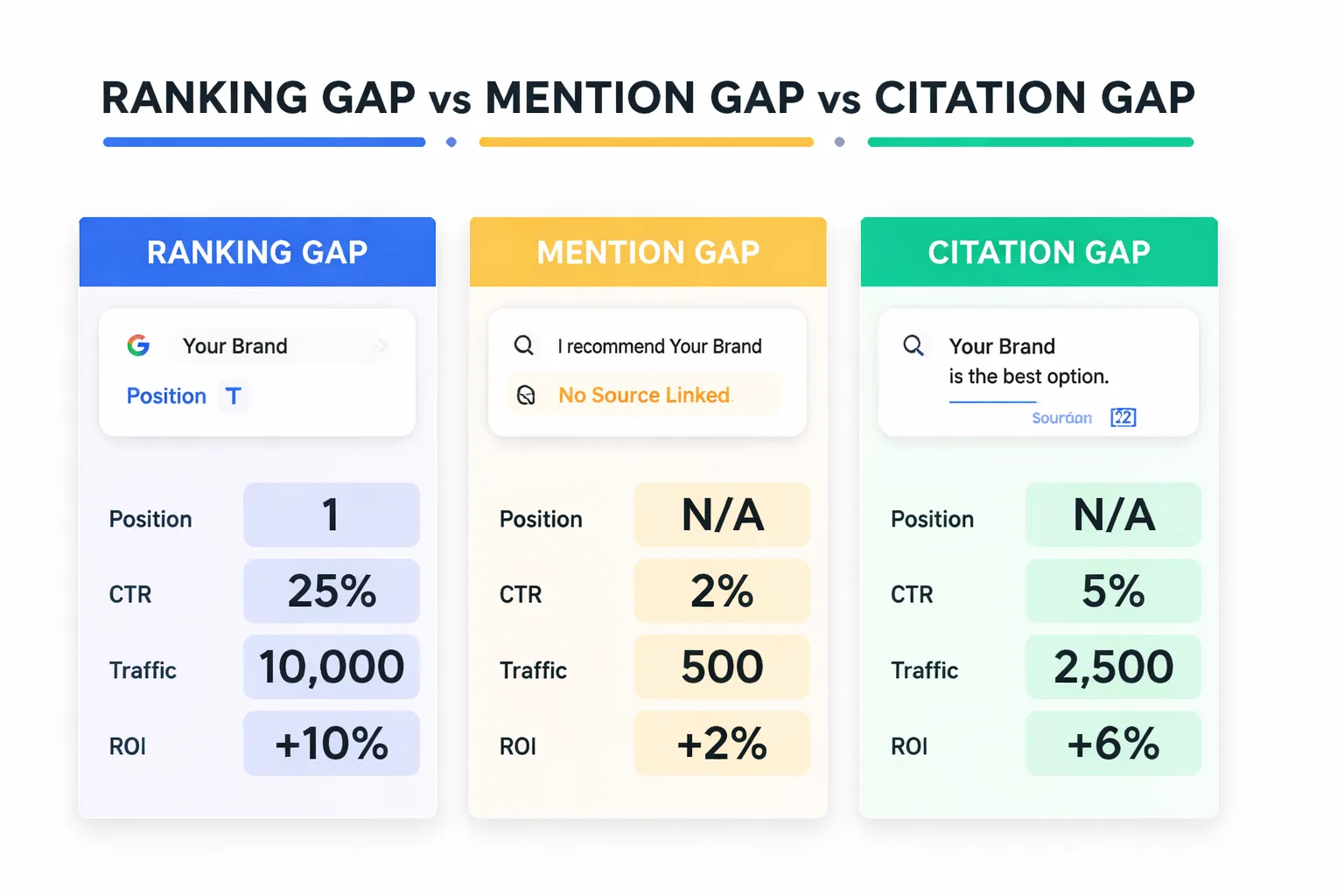
This distinction matters because the fix is different for each. A ranking gap requires SEO work. A mention gap requires entity and knowledge graph work. A citation gap requires answer engine optimization: structuring content so LLMs can extract, attribute, and cite your claims. If you treat all three the same, you will spend months building backlinks while your competitors get cited because they structured their content better.
The data backs this up. A Tinuiti and Profound report analyzing AI citations across nine verticals over four months found that 84% of AI citations are third-party sources. That means even when your brand is the subject of a prompt, the AI is more likely to cite a third-party article about you than your own page. The citation gap is not just about being present. It is about being the source AI engines choose to cite.
Jen Cornwell from Tinuiti noted that these analyses "flatten the nuance of prompt intent, model differences, and vertical context." She is right. A citation gap measured across 100 prompts in SaaS will look different from one measured in ecommerce. The methodology matters more than the aggregate number.
Let me give you a concrete example of how these three gaps diverge in practice. I worked with a B2B SaaS brand that ranked #2 organically for "best CRM for small teams." Strong ranking, no ranking gap. When we ran that same query through ChatGPT, the LLM mentioned the brand by name in its answer but did not cite the brand's comparison page or product page. It cited a G2 category page and a Forbes Advisor listicle instead. So the brand had no mention gap (it was named) but a severe citation gap (no link to their content). The fix was not to build more backlinks to improve their ranking. The fix was to publish a structured comparison guide with a citation-friendly table that ChatGPT could extract and attribute. Within six weeks of publishing that guide with proper schema markup and front-loaded claims, the brand earned its first direct citation in ChatGPT for that prompt. The ranking did not change. The citation did.
Step 1: Build Your Prompt Inventory
Most teams skip this step. They jump straight to running prompts through tools and get noisy, unactionable data because they tested random queries instead of a structured inventory.
Your prompt inventory is the foundation of the entire mapping exercise. It is a curated list of buyer-intent prompts your brand should be cited for. Not keywords. Prompts. The way someone types a question into ChatGPT or Perplexity.
Start with three buckets.
Bucket 1: Direct brand prompts. These include your brand name. "Is [your brand] good for [use case]?" "How does [your brand] compare to [competitor]?" "What are alternatives to [your brand]?" These are prompts where you should absolutely be cited. If an AI answers a question about your own product and cites a third-party review site instead of your documentation, that is a citation gap.
Bucket 2: Category prompts. These do not include your brand name but describe your product category. "What is the best [tool type] for [use case]?" "How do I [task your product solves]?" "What are the top [your category] platforms in 2026?" These are prompts where your content should earn citations because you have expertise.
Bucket 3: Problem prompts. These describe the problem your audience has before they know your category exists. "Why is my [metric] dropping?" "How do I fix [common pain point]?" "What causes [issue related to your space]?" These prompts map to top-of-funnel content that establishes entity authority.
Aim for 40-60 prompts total across these three buckets. Fewer than 40 and your data is too thin to spot patterns. More than 60 and you will spend weeks on baseline measurement without proportional insight. I recommend splitting roughly 20% direct brand, 50% category, and 30% problem prompts. The category bucket is where most commercially valuable citation gaps live.
For each prompt, record the intent type (informational, comparison, transactional), the expected source type (your product page, a blog post, a comparison guide), and the commercial value (high, medium, low). This metadata drives prioritization later.
Here is how I build the inventory in practice. I start with Google Search Console data. Pull the top 50 queries driving organic traffic to your site. These are queries where Google already thinks you are a relevant source. Convert each query into a natural-language prompt. The query "crm for small teams" becomes "What is the best CRM for small teams?" The query "project management tool comparison" becomes "How do project management tools like Asana, Monday, and [your brand] compare?" This gives you a starting set grounded in actual search demand.
Next, I layer in competitor prompts. Identify 3-5 competitors and search for their brand names in ChatGPT and Perplexity. Record the prompts where competitors are cited. Add those prompts to your inventory. If an AI cites your competitor for a prompt, you should be cited too.
Finally, I add problem prompts from community sources. Reddit, Hacker News, and Quora threads where your target audience asks questions are gold mines for prompt discovery. These prompts often have lower commercial intent but high citation value because they establish entity authority that feeds into category prompts later.
The inventory is not static. Revisit it quarterly. New competitors enter the market, new product categories emerge, and AI engines shift what they cite. A prompt that was irrelevant in Q1 might become commercially valuable in Q3 because a competitor launched a feature that changed the conversation.
Step 2: Run Baseline Measurements
Once your prompt inventory is locked, you need to run every prompt across every major AI search surface and record whether your brand is cited. This is how to measure ai search visibility in a way that produces actionable data, not vanity metrics.
The surfaces you need to test: ChatGPT, Claude, Gemini, Perplexity, Grok, Google AI Overviews, and Google AI Mode. Each has different citation mechanics. Perplexity cites web sources inline. ChatGPT cites selectively and inconsistently. Claude rarely cites at all unless using its web search feature. Google AI Overviews cite with link cards. Understanding these differences matters because a citation gap on Claude might be structural (Claude does not cite often) rather than competitive (your content is weak).
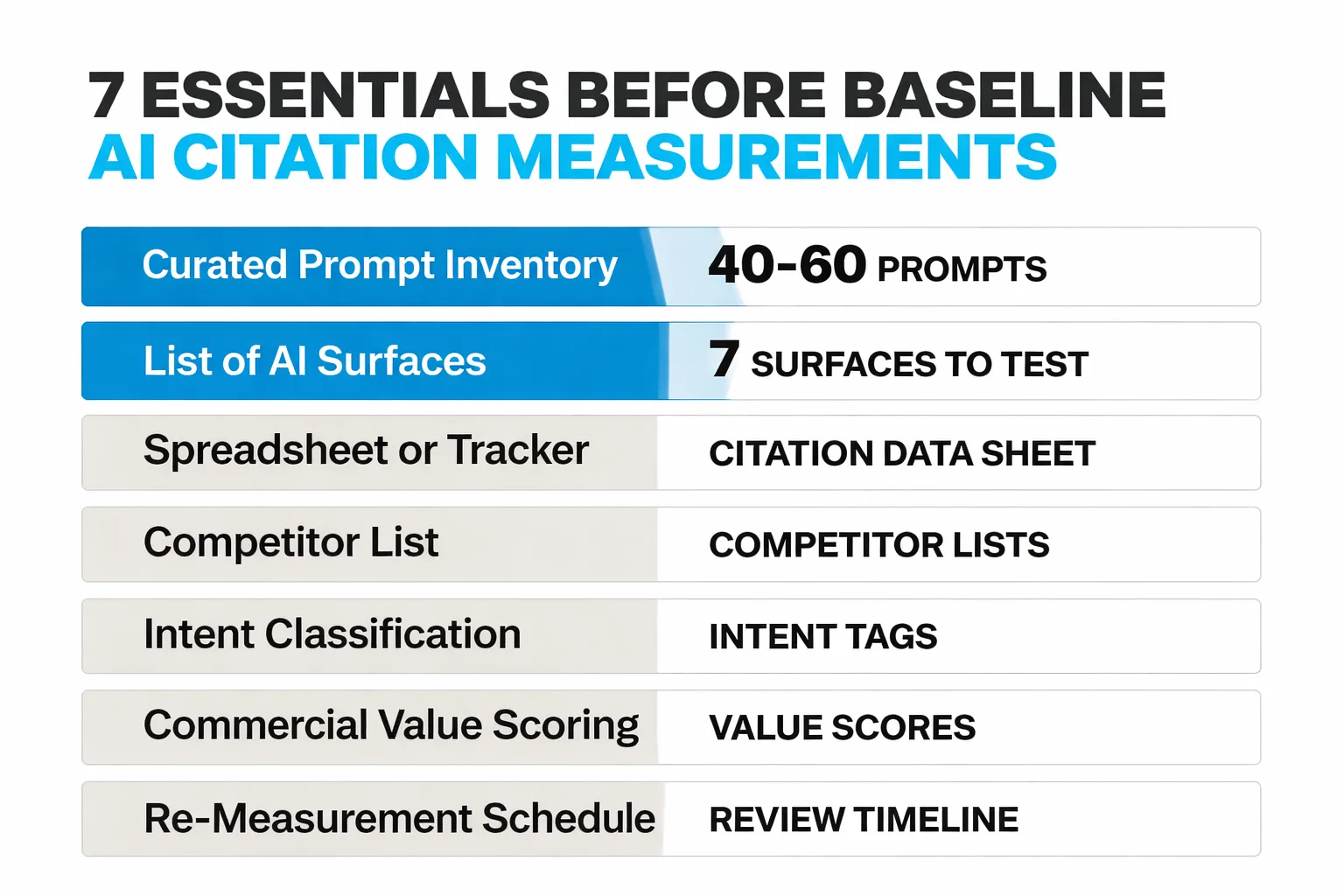
Run each prompt manually or use a tool that queries these surfaces directly. If you are doing this manually, run each prompt three times per surface on different days. LLM outputs are non-deterministic. A single run gives you a snapshot, not a baseline. Three runs give you a stability range.
For each prompt-surface combination, record four data points:
1. Is your brand mentioned? (yes or no) 2. Is your brand cited with a link? (yes or no) 3. What position is your citation? (first, in a list, last) 4. What sources are cited instead of you? (record the domains)
The fourth data point is the one most teams skip. It is also the most valuable. When you know which domains AI engines cite for your topics, you know which publishers to target for outreach, which content formats earn citations, and where your entity signals are weak. This is what I mean by mapping the gap. You are not just measuring absence. You are mapping the competitive landscape that fills the space where you should be.
In my own experience, I spent a month trying to optimize for proprietary visibility metrics from various tools, thinking I could game the system for our B2B SaaS content. We saw zero measurable lift in ai citations. Google and OpenAI have made it clear that source attribution is a dynamic, non-deterministic process. The only reliable approach is direct measurement: run the prompts, read the answers, and record what you find.
Let me walk you through the actual mechanics of a baseline measurement session. Pick a single prompt from your inventory. Let's use "What is the best AI visibility tool for small teams?" Open ChatGPT and type the prompt. Read the full response. Does the response mention your brand? Does it include a citation link to your site? If it lists multiple tools, where does your brand appear in the list? Record all of this in your tracker.
Now repeat the same prompt in Perplexity. Perplexity's response will look different. It will include inline citations with numbered references. Check whether your brand is cited. Record the citation number and the source page (your homepage, a blog post, a comparison page). Note which competitors are cited and which third-party sources appear.
Move to Google AI Overviews. Search the same prompt in Google. If an AI Overview appears at the top of the results, check whether your brand is cited in the overview's link cards. The HOTH's research found that the #1 organic result was cited in only 4 of 13 AI Overview SERPs analyzed, a 31% citation rate for the top organic result. So even if you rank #1 organically, you might not be in the AI Overview. Record the result.
Repeat for Claude, Gemini, and Grok. By the end of this exercise for a single prompt, you will have 7 data points (one per surface) with 4 dimensions each. That is 28 data cells for one prompt. Across 50 prompts, that is 1,400 data cells. This is why a structured tracker matters. A spreadsheet works fine for the first cycle. If you want to automate this at scale, using an AI visibility tracker can handle the volume and provide daily refresh on SERP-driven surfaces with rolling refresh on LLM-driven surfaces. The key is that the tool must show you the actual response text and citations behind every mention, not just a proprietary score. A score without the underlying citation data is a black box.
One more critical mechanic: vary your prompt phrasing. LLMs are sensitive to how a question is framed. "What is the best CRM for small teams?" and "Which CRM should a small team use?" might produce entirely different citation sets. Run both variants. Record both. The citation gap might be wider for one phrasing than another, and that tells you which phrasing your content needs to target.
Which Surfaces Show the Largest Citation Gaps?
This is where pattern recognition starts. You have a spreadsheet (or dashboard) with prompt-surface combinations and citation outcomes. Now you read the data.
Start by aggregating citation rates by surface. Calculate the percentage of prompts where your brand is cited on each platform. A typical pattern I see looks something like this: Perplexity cites your brand on 30% of prompts where you should appear. ChatGPT cites you on 12%. Claude cites you on 5%. Google AI Overviews cite you on 25%. Grok cites you on 8%.
Those numbers are illustrative, but the shape is real. Perplexity and Google AI Overviews tend to cite more because they are built as search engines with citation mechanics. Claude and Grok cite less because their architectures prioritize synthesis over sourcing. The citation gap on Claude might be 95%, but if Claude rarely cites anyone, that gap is structural, not competitive.
The gap that matters is the one where the surface cites frequently but skips you. If Perplexity cites a source on 80% of your category prompts and you are cited on 20%, that is a 60-point competitive citation gap. That is actionable. If Claude cites a source on 15% of prompts and you are at 5%, the gap is smaller in absolute terms but the surface itself is low-citation.
The Ahrefs study of AI Overviews found that 38% of citations pull from the top 10 organic results. That means 62% of citations come from outside the top 10. Your Google ranking does not protect you. A brand ranking #3 organically for a commercial keyword might assume it appears in the AI Overview above that result. But research from The HOTH found the #1 organic result was cited in only 4 of 13 AI Overview SERPs analyzed. That is a 31% citation rate for the top organic result. Let that sink in.
The surfaces with the largest competitive citation gaps are the ones where you should focus your content and entity work. For most B2B SaaS brands I work with, that is Perplexity and Google AI Overviews. For ecommerce brands, it is often ChatGPT (which increasingly recommends products) and Google AI Mode. The right answer depends on your buyer journey and where your audience asks questions.
I want to be specific about how to read the data here because this is where most teams misinterpret their results. When you aggregate citation rates by surface, you need to normalize for the surface's overall citation behavior. Perplexity might cite your brand on 30% of prompts. That sounds low. But if Perplexity cites any brand on only 50% of prompts (the other 50% get no citations at all), then your 30% is actually 60% of the available citation opportunities. That is a very different picture.
To calculate this normalization, divide your citation rate by the surface's average citation rate across all your prompts. If Perplexity cites someone (anyone) on 80% of your prompts and cites you on 30%, your normalized citation rate is 37.5%. If ChatGPT cites someone on 40% of your prompts and cites you on 12%, your normalized rate is 30%. Now the gap between Perplexity and ChatGPT looks smaller than the raw numbers suggested. The normalization does not change your absolute citation count, but it tells you where you have the most room to improve relative to what the surface actually offers.
This is also where you should cross-reference with your ChatGPT AI visibility checker and Perplexity AI visibility checker data if you are using those tools. The surface-specific checkers give you deeper drill-down capability, including the actual response text behind every mention. Read those responses carefully. The wording the LLM uses when it mentions your brand tells you whether it considers you a primary recommendation or an afterthought listed at the end of a response.
Which Topic Clusters Have the Largest Gaps?
Surface-level analysis tells you where to play. Topic-cluster analysis tells you what to fix.
Group your prompts by topic cluster. If you are a project management tool, your clusters might be "task management," "team collaboration," "project tracking," and "Gantt charts." Calculate citation rates per cluster per surface.
The pattern you will see: some clusters have strong citation rates (your brand is cited 40-50% of the time) and some have near-zero rates. The near-zero clusters are your priority gaps.
But do not just chase the lowest citation rate. Cross-reference with commercial value. A cluster with a 5% citation rate and high commercial value is your top priority. A cluster with a 0% citation rate and low commercial value is a lower priority. I have seen teams spend months closing citation gaps on informational prompts that never convert. The goal is not 100% citation coverage. The goal is citation coverage on prompts that drive pipeline.
Here is a specific example from my experience. We ran a small experiment with 5 articles that hit top 3 organic rankings but saw zero ai citations over a 3-month period. This directly contradicts the idea that organic visibility alone drives AI mentions. The articles were well-researched, long-form, and keyword-optimized. What they lacked was AI extractability: direct answers under question headings, structured data, and front-loaded claims that an LLM can parse and attribute.
44% of AI citations come from the first third of a page. If your key claim is buried in the fifth paragraph, the LLM might read it but will not cite it because the extraction cost is too high. The citation gap is often a structure gap, not an authority gap.
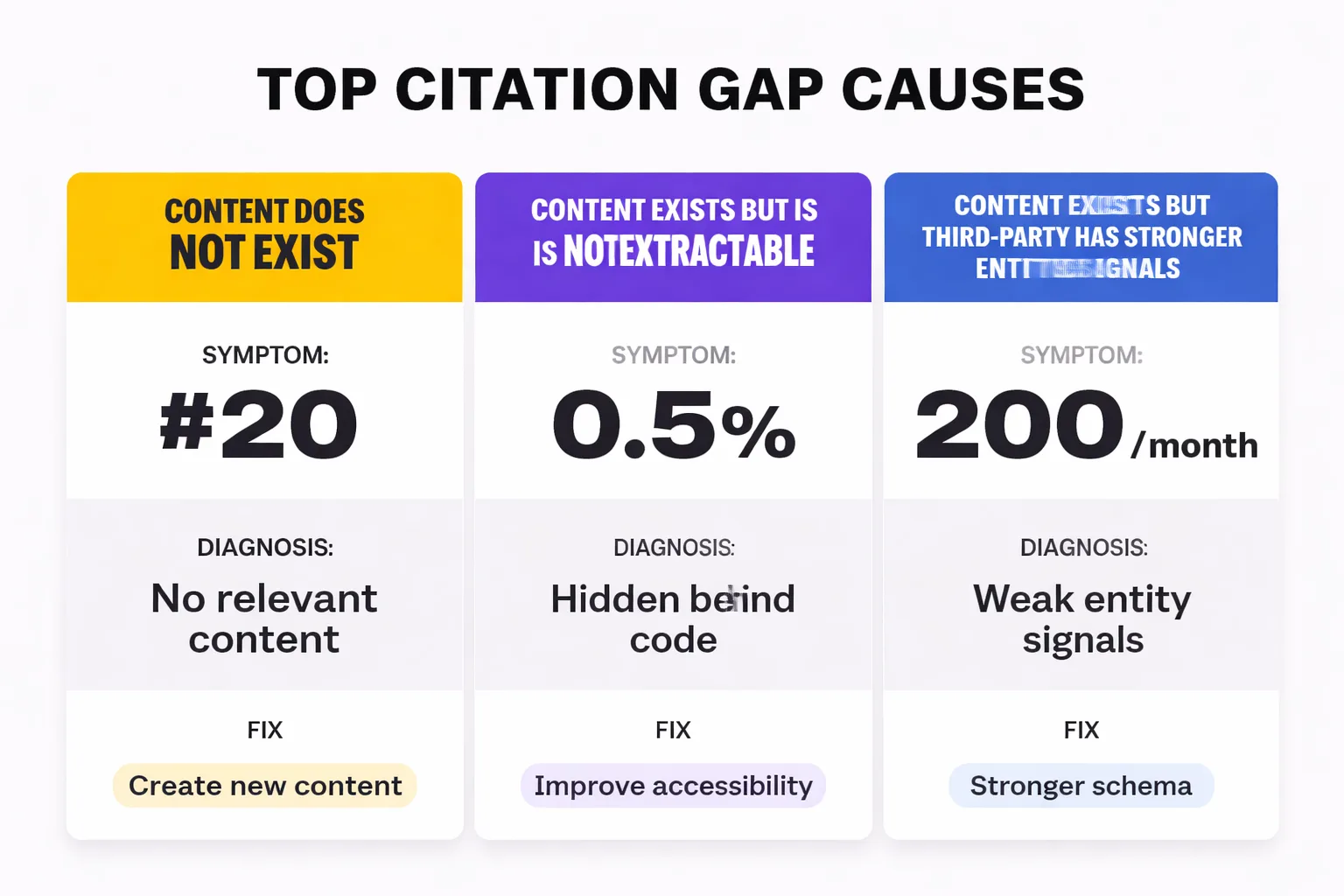
When you identify a topic cluster with a large citation gap, dig into why. Pull the actual AI responses for those prompts. Read what the LLM said. Look at which sources it cited. You will usually find one of three problems:
1. Your content does not exist for that prompt. The LLM has nothing to cite. Fix: create it. 2. Your content exists but is not extractable. The LLM found your page but could not parse a citable claim. Fix: restructure. 3. Your content exists and is extractable but a third-party source has stronger entity signals. The LLM chose to cite Forbes or Wikipedia instead of you. Fix: build entity authority.
Each problem requires a different fix. That is why mapping the gap matters more than measuring it. A number without a diagnosis is just anxiety.
Let me make the cluster analysis concrete with a real example. I worked with an ecommerce brand selling sustainable home goods. Their prompt inventory had four clusters: "eco-friendly cleaning products," "sustainable furniture," "zero waste kitchen," and "green home decor." After running baseline measurements, here is what we found. The "eco-friendly cleaning products" cluster had a 35% citation rate across surfaces. The brand had a strong blog with buying guides and ingredient breakdowns. The "sustainable furniture" cluster had a 5% citation rate. The brand had product pages but no editorial content answering common buyer questions. The "zero waste kitchen" cluster had a 15% rate, and "green home decor" had a 0% rate.
The priority was clear. "Sustainable furniture" had high commercial value (average order value was 4x higher than cleaning products) and a severe citation gap. We created five archetype-specific articles targeting the prompts in that cluster: a comparison guide ("How do sustainable furniture brands compare?"), a how-to guide ("How to choose FSC-certified wood furniture"), an explainer ("What is sustainable furniture?"), a problem-solver ("Is sustainable furniture worth the cost?"), and a listicle ("10 sustainable furniture brands to watch in 2026"). Each article was structured for AI extractability with front-loaded answers, comparison tables, and FAQ schema. Within eight weeks, the citation rate for that cluster rose from 5% to 22% across Perplexity and Google AI Overviews. The "green home decor" cluster was deprioritized because commercial value was low and the effort to build topical authority from scratch was not justified.
This is how cluster analysis turns a flat citation rate into a prioritized action plan. You are not trying to fix everything. You are trying to fix the things that matter.
How Do You Close the Citation Gap?
Closing the gap is where answer engine optimization turns from theory into practice. Each identified gap maps to a specific content or entity action. Here is the framework I use.
For gaps caused by missing content: Create archetype-aware articles that directly answer the prompt. If the prompt is a comparison ("How does X compare to Y?"), write a comparison article with a structured table. If the prompt is a how-to ("How do I do Z?"), write a step-by-step guide with clear numbered phases. If the prompt is a definition ("What is W?"), write an explainer with a bolded definition in the first 50 words.
The format matters because LLMs extract differently from different structures. A comparison table is highly extractable. A 2,000-word narrative essay is not. When I shifted our AI-generated articles to include direct answers under question headings and structured data, the citation rate on Perplexity moved from near-zero to measurable within weeks.
Let me be specific about what "archetype-aware" means in practice. A listicle article ("10 best tools for X") should have each item as a distinct section with a bolded name, a one-sentence description, and a pros-and-cons table. LLMs extract from listicles by matching item numbers to descriptions. If your listicle is a wall of prose with no clear item boundaries, the LLM cannot parse it. A how-to article should have numbered steps with bolded step titles. An explainer should have a bolded definition in the first paragraph followed by sections that expand on different aspects. Each archetype has different retrieval weights and quality criteria. Treating every topic the same is the most common mistake I see in AI content production.
For gaps caused by poor extractability: Restructure existing content. Add a TLDR block at the top with bolded claims. Add FAQ sections with question-shaped headings. Add schema markup (Article, FAQ, HowTo). Front-load your key claims in the first 200 words. Use tables for comparison data. Break long paragraphs into shorter ones with clear topic sentences.
An Ahrefs/Letaido study tracked 1,885 pages that added schema markup and found minimal AI citation movement. This is an important counterpoint. Schema alone does not close the citation gap. What schema does is make your content parseable. If the underlying content is weak, parseable weakness does not earn citations. Structure and substance together are what move the needle.
I learned this lesson the hard way. My team spent months meticulously integrating schema markup and building out our internal knowledge base, expecting a direct correlation to AI visibility. The result was disappointing. Citations barely moved. What I realized was that schema markup makes your content machine-readable but not machine-recommendable. The LLM can find your content, parse it, and understand its structure. But it still chooses whether to cite it based on authority signals, entity strength, and the quality of the claim itself. Schema is necessary but not sufficient.
For gaps caused by weak entity signals: This is the hardest gap to close and the one most teams ignore. When an LLM chooses to cite Wikipedia or a major publication instead of your blog post, the issue is entity authority. The LLM's training data and retrieval systems weight certain sources more heavily.
Closing this gap requires building presence in the sources AI engines actually cite. The Tinuiti/Profound report found 84% of AI citations are third-party. You need to be cited by those third parties. This means digital PR, expert commentary, and getting your brand mentioned in the publications that AI engines treat as authoritative.
It also means building entity presence in knowledge graphs. Wikidata, Wikipedia (if notable enough), and structured entity descriptions help LLMs understand who you are and what you do. If an LLM cannot resolve your brand as a distinct entity, it will struggle to cite you even when your content is excellent.
The entity work is slow and unglamorous. Creating a Wikidata entry for your brand requires establishing notability through third-party sources. Getting listed in industry databases and directories helps LLMs connect your brand to your category. Building author entity profiles with linked LinkedIn accounts, published works, and verified expertise signals strengthens the E-E-A-T signals that LLMs (especially Google's) use to evaluate source credibility. This is foundational work that pays compounding returns over months, not weeks.
For teams that need to scale this work, using an AI SEO tool that combines visibility tracking with content generation can close the loop. You identify the gap, generate archetype-aware content to fill it, publish with quality controls, and re-measure. The re-measurement is critical. I recommend a 30-day cycle for high-priority gaps and a 90-day cycle for lower-priority clusters.
Do you know which AI surfaces are citing your competitors instead of you?
How Does Generative Engine Optimization Differ from Traditional SEO?
This question matters because the citation gap mapping process I described above is fundamentally a generative engine optimization exercise. It is not traditional SEO applied to a new channel. The two disciplines share DNA but diverge in important ways.
Traditional SEO optimizes for crawlers that index pages and rank them by relevance and authority signals. The output is a ranked list of links. Generative engine optimization optimizes for LLMs that synthesize information and generate answers with inline citations. The output is a synthesized response that may or may not include your link. The difference is not just format. It is fundamental to how the systems work.
A crawler reads your page, extracts keywords and links, and stores a ranked index. An LLM reads your page (or retrieves it via RAG), extracts semantic meaning, and decides whether your claim is worth including in its synthesized answer. The citation decision is based on extractability (can I parse this claim?), authority (is this source trustworthy?), and uniqueness (does this source offer something no one else does?). Traditional SEO signals like backlinks and keyword density influence authority but do not directly determine citation.
This is why I have shifted my focus from keyword density to claim density. A page that makes five distinct, citable claims with specific numbers and named sources is more valuable to an LLM than a page that mentions a keyword 15 times but makes no extractable claims. The LLM is not counting keywords. It is looking for sentences it can lift and attribute.
For a deeper comparison of these disciplines, our AEO vs SEO guide breaks down the operational differences, and our AEO vs GEO analysis covers where answer engine optimization and generative engine optimization overlap and diverge. The short version: AEO is about structuring content for extraction. GEO is about optimizing for the generative engine's citation behavior. They are complementary but not identical.
What Role Does Wikidata Play in AI Citations?
This is one of the most misunderstood aspects of AI citation work. Teams hear "knowledge graph" and assume they need to build some complex structured data infrastructure. The reality is more nuanced.
Wikidata is the structured data backbone that many LLMs use for entity resolution. When an LLM encounters your brand name in a prompt, it tries to resolve that name to a known entity. If your brand has a Wikidata entry with proper properties (P31 instance of, P1056 product or material produced, P856 official website), the LLM can confidently identify you as a distinct entity associated with your category. If you do not have a Wikidata entry, the LLM might still recognize your brand from training data, but its understanding will be fuzzier and less confident.
Here is the honest truth: no published primary source statistic measures the exact percentage of LLM citations attributed to Wikidata entities versus unstructured web content. I have looked for this data and could not find it. The available research discusses citation sources broadly (Reddit, YouTube, Wikipedia, third-party links) but does not break down structured data versus unstructured content as a citation driver. Anyone claiming a specific percentage is speculating.
What I can tell you from practice is that entity resolution is a prerequisite for consistent citation. If an LLM cannot confidently resolve your brand as an entity, it will cite third-party sources that describe you instead of citing you directly. Wikidata is one of the strongest entity resolution signals available. It is not a citation guarantee. It is a foundation that makes citations possible.
The practical action here is straightforward. Check whether your brand has a Wikidata entry. If it does not, create one (you need to establish notability through third-party references). If it does, verify that the properties are accurate and complete. Add your official website, your category, your founded date, and your key people. This is 30 minutes of work that pays dividends across every LLM surface.
When This Process Fails
This methodology has real limitations, and pretending otherwise would be dishonest.
First, LLM outputs are non-deterministic. You can run the same prompt on Tuesday and Thursday and get different citations. A baseline measured over three runs is a snapshot, not a ground truth. If you make decisions based on a single measurement cycle, you will chase noise. I have seen teams rewrite articles because they dropped from a citation on one run, only to find the citation returned the next week without any changes. Run measurements multiple times before drawing conclusions.
Second, citation tracking tools have a transparency problem. Some tools show proprietary scores like "AI Visibility Score" or "Recommendation Rate" without exposing the underlying citation data. I spent weeks optimizing for one of these scores and saw zero correlation to actual citations. If you cannot see the raw prompt-response-citation chain, the metric is faith-based. Stick to tools that show you the actual AI response text and the citations behind every mention.
Third, this process assumes your brand is already an entity the LLM can resolve. If you are a pre-seed startup with no web presence, no press coverage, and no Wikipedia entry, the citation gap is not really a citation gap. It is an existence gap. No amount of content structuring will get you cited if the LLM does not know you exist. In that case, your first priority is entity creation: get mentioned on high-authority sites, build a Wikidata entry, and establish your brand as a distinct entity before trying to earn citations.
What This Actually Means
The ai citation gap is not a theoretical problem. It is a measurable, structural reality that determines whether your brand appears in the answers your buyers trust. The data is clear: 50% of AI Overview citations do not come from page-one rankers. 84% of AI citations are third-party sources. 20% of AI search traffic drives 40% of high-intent conversions.
If you are not mapping your citation gaps across ChatGPT, Claude, Gemini, Perplexity, Grok, and Google AI surfaces, you are flying blind. Your Google rankings tell you less than they ever have about whether your brand gets cited in the answers that matter.
The five-step process I walked through is not complicated, but it requires discipline. Build a real prompt inventory. Run baseline measurements across every surface. Read the data by surface and by topic cluster. Map each gap to a specific content or entity action. Re-measure on a schedule.
Generative engine optimization is not about gaming LLMs. It is about making your content extractable, your entity signals strong, and your presence felt in the sources AI engines trust. The brands that do this systematically will compound their advantage. The brands that do not will watch their competitors get cited in answers they should own.
If you want to understand the broader framework behind this work, read our guide on AEO vs SEO and our breakdown of AEO vs GEO to see how answer engine optimization differs from both traditional SEO and generative engine optimization. For checking your current visibility on specific surfaces, our ChatGPT AI visibility checker and Perplexity AI visibility checker are good starting points.
The citation gap is not going to close itself. Start measuring today.
FAQ
What is an AI citation gap?
An AI citation gap is the difference between prompts where a brand should logically appear in AI-generated answers and the prompts where it actually gets cited. This gap means brands miss high-intent traffic, since 20% of AI search traffic drives 40% of conversions according to Gushwork data. It is distinct from traditional SEO issues and requires specific mapping across LLMs.How does an AI citation gap differ from a ranking gap or mention gap?
A ranking gap occurs when a page fails to appear in Google's top 10 organic results, while a mention gap happens when a brand is referenced in an AI answer without a source link. In contrast, an AI citation gap focuses on missing citations as authoritative sources in responses from tools like ChatGPT or Perplexity. Conflating these leads to wasted effort since citation gaps demand different fixes.Why do AI citation gaps matter for brands?
Brands absent from AI citations lose access to the most efficient traffic channel, where 20% of AI searches yield 40% of high-intent conversions. Research shows only 38% of AI Overview citations come from top organic results, leaving many visible sites uncited. This creates a measurable blind spot as LLMs answer buyer questions without referencing relevant content.What data shows the scale of AI citation gaps?
Studies indicate roughly 50% of sites cited in Google's AI Overviews for buyer queries do not rank on page one, and 60% of page-one organic rankers receive no AI citations at all. Ahrefs research confirms just 38% of citations pull from top organic results. These figures highlight how traditional rankings fail to predict AI visibility.About the Author
Judy Zhou, Founder
Judy Zhou leads content strategy at Meev, where she oversees AI-driven content research and publishing for hundreds of brands. With a background in SEO and editorial operations, she focuses on building content systems that rank on Google, get cited by AI search engines, and drive measurable business results.
Stop guessing where your brand is invisible. Run a full AI citation gap analysis across every major LLM surface today.