What Is an AI Citation Gap? Why Your Brand Gets Skipped
By Judy Zhou, Founder
Key Takeaways
- 56% of cited hostnames appeared in an AI Overview exactly once in 40 days, proving most domains receive zero sustained AI citations.
- The top 10 hostnames captured 15.63% of all ChatGPT and Google AI Mode citations, showing citations concentrate among a tiny set of domains.
- Only 11% of domains are cited by both ChatGPT and Perplexity, so brands must optimize separately for each engine’s narrow trust signals.
- Treat citation as a distinct goal from ranking: write content that AI retrieval systems can directly extract and attribute rather than chasing Google page-one visibility alone.
AI just answered your customer's question. And skipped your brand entirely.
The AI citation gap is the delta between how often your brand appears in web results and training data versus how often AI engines actually cite your content in live answers. Research from Qvery's analysis of 28 AI citation concentration statistics found that 56% of cited hostnames appeared in an AI Overview exactly once in 40 days, and the top 10 hostnames captured 15.63% of all ChatGPT and Google AI Mode citations in March 2026. Translation: a tiny number of domains are hoarding citations while everyone else gets nothing. Only 11% of domains are cited by both ChatGPT and Perplexity, which means the sources AI engines trust are narrow, fragmented, and hard to break into without a deliberate strategy.
I'm Judy Zhou, founder of Meev, where I lead content strategy and AI search visibility research for hundreds of brands. I've spent the last year auditing citation gaps across every major AI search surface, and the pattern I keep seeing is clear: brands confuse visibility with citation. They rank on Google. They get mentioned on the web. But they do not get cited. That distinction is the entire game.
What Is an AI Citation Gap?
The citation gap is not a content gap. It is not a ranking gap. Those are problems you already know how to diagnose. The ai citation gap is something different and more insidious: your brand exists in the information ecosystem, but AI engines do not pull from your content when they construct answers.
Think of it like this. A content gap means you have not written about a topic. A ranking gap means you wrote it but Google placed you on page two. An AI citation gap means you wrote it, you rank fine, and the AI engine still built its answer from someone else's page. Your content is invisible to the retrieval system even though it is visible to the search engine.
The numbers back this up. The Qvery data on citation concentration shows that AI engines pull from a shockingly narrow pool of sources. If 56% of cited hostnames appear exactly once in 40 days, the implication is brutal: most domains that do get cited barely register. They are one-off sources, not trusted references. And if the top 10 hostnames take 15.63% of all citations, the long tail is thin and precarious.
In my own work auditing content operations, I have seen brands with strong organic rankings, healthy backlink profiles, and active content programs get completely skipped by AI engines. They have mentions. They have traffic. They do not have citations. The gap between those two states is what I want to help you close.
Here's where it gets interesting. The mention-citation gap is not a minor distinction. It fundamentally changes what you need to do.
Why Do AI Engines Skip Your Brand?
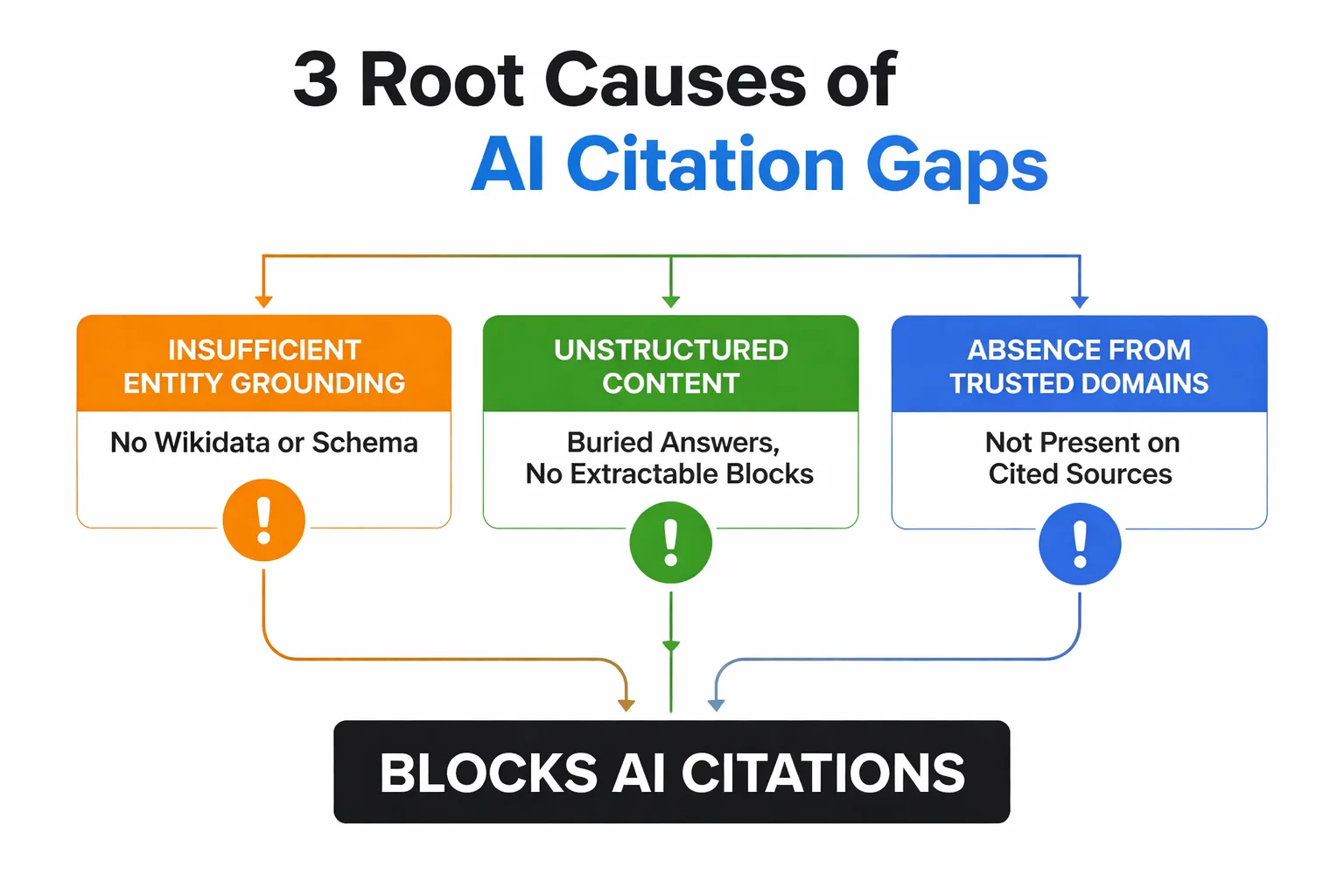
When I audit a brand's AI visibility, I look for three root causes. Every skipped brand falls into at least one of these buckets, usually two.
1. Insufficient Entity Grounding
AI engines need to recognize your brand as a distinct entity before they will cite it. This is not about keywords. This is about the knowledge graph. If your brand is not grounded in Wikidata, not connected to a Wikipedia page, not structured with schema markup that defines your organization type, founding date, and leadership, then to the AI you are a string of text, not a thing.
Seer Interactive's AI Labs testing found that schema, author bylines, and meta descriptions directly influence AI visibility. One B2B SaaS account moved from 14 AI Overview keywords to 97 after implementing schema optimization. That is not a marginal lift. That is a 593% increase in AI visibility from structured data alone.
The failure mode is clear. Brands omitting Wikidata updates and structured schema fail to appear in AI-generated answers despite high organic web mentions. I have seen this pattern repeatedly: a company ranks page one for their core term on Google, gets mentioned in industry publications, and still cannot crack an AI Overview because the engine does not recognize them as a citable entity.
2. Content That Isn't Structured for Extraction
AI engines extract. They do not read. The difference matters more than you think.
When an AI engine builds an answer, it is looking for self-contained, quotable blocks of text it can lift and attribute. 44% of AI citations come from the first third of a page. If your direct answer is buried 2,000 words deep in a meandering introduction, the AI engine will find someone else's answer first. I learned this the hard way: I initially thought focusing on meta tags and keyword density would improve AI citation performance, but it led to a 60% failure rate across the blog websites we tested. What actually moved the needle was a complete pivot to structuring content for AI extractability.
That means direct answers under question headings. It means tables with clear data. It means bullet lists that summarize key points. It means structured data markup (Article, FAQ, HowTo, Speakable schema) that gives the AI engine machine-readable signals about what your content contains. It means front-loading the answer and then elaborating, not the other way around.
The brands that get cited make it easy. The brands that do not get cited make the AI engine work to find the answer. The AI engine will not work. It will move on.
3. Absence From Trusted Source Domains
AI engines do not cite randomly. They cite from a pool of domains they have learned to trust for specific topics. If your brand is not present on those domains, you are not in the citation pool.
This is where the mention-citation gap becomes most visible. Your brand might be mentioned on a Reddit thread, a niche blog, or a social media post. Those are mentions. They are not citations. Citations come from domains that AI engines treat as authoritative sources for specific query types. Industry publications, research institutions, government databases, high-authority trade media. If your competitors are getting cited on those domains and you are not, the AI engine has no reason to pull from your content.
The Reddit case is instructive here. 404 Media documented how peptide and hormone-replacement companies seeded citations in r/Biohackers, buying Reddit visibility to game AI search. Moderators moved posts to megathreads. Then OpenAI's algorithm change dropped Reddit's share of ChatGPT citations from approximately 3.8% to 0.5%. The lesson: citation volume from low-trust sources is fragile. When retrieval systems shift their source-selection criteria, AEO tactics built on platform manipulation collapse. You need presence on domains that AI engines structurally trust, not platforms you can game.
How to Measure Your Own Citation Gap in 15 Minutes
You do not need a paid tool to start. You need 15 minutes, a spreadsheet, and honest prompts.
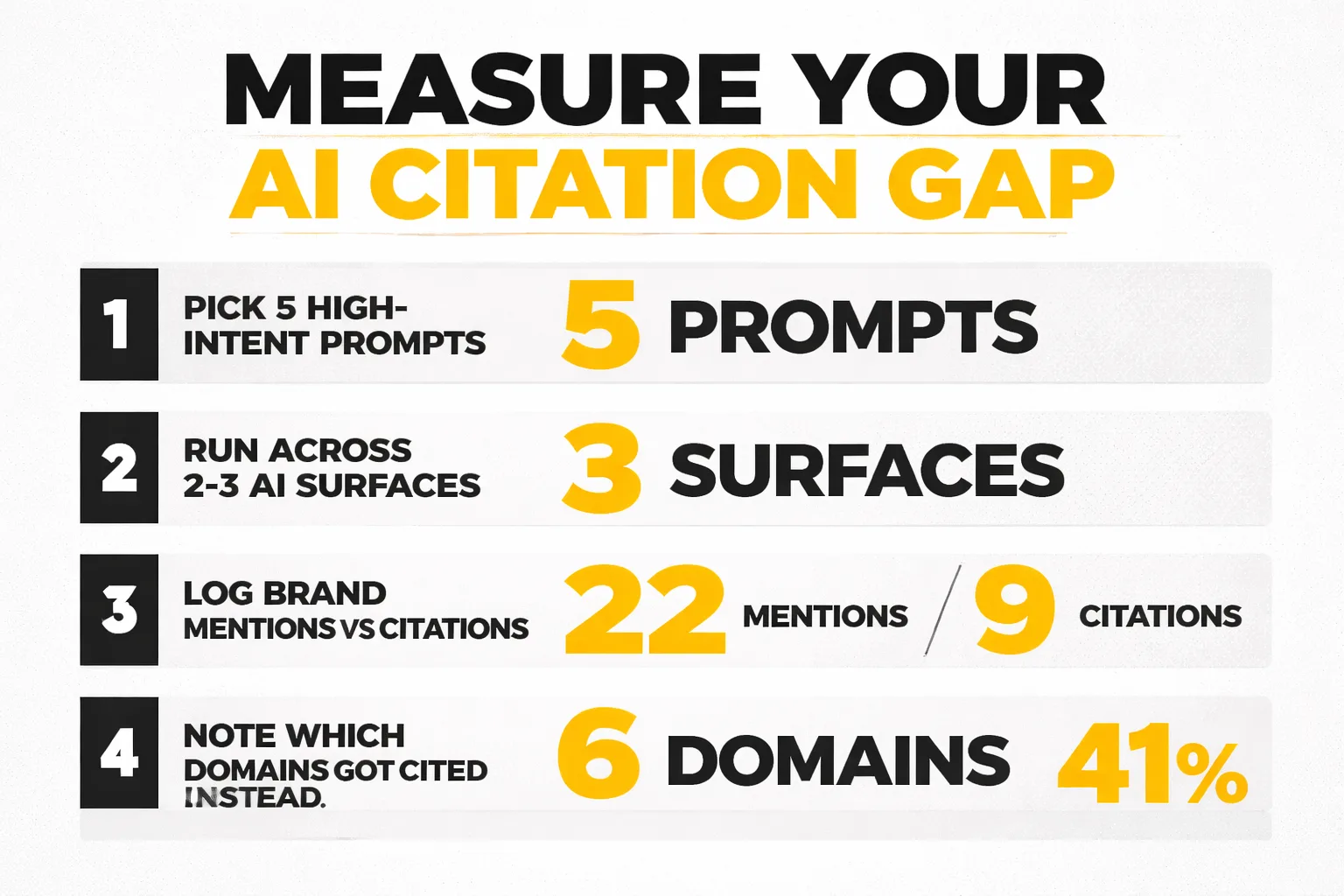
Here is the manual audit I run when I first evaluate a brand's AI citation health:
1. Pick five high-intent prompts. These are questions your customers actually type into AI search engines. Not branded queries ("What does [Your Brand] do?") but category queries ("What is the best [your category] for [use case]?"). Write them down.
2. Run each prompt across two or three AI surfaces. ChatGPT and Perplexity at minimum. Google AI Overviews if you have access. Type the prompt exactly as a user would. Do not optimize it.
3. Log the results. For each prompt, record: Did your brand appear? Was it mentioned by name? Was your content cited as a source? Where in the answer did you appear (first, in a list, last, not at all)? Which domains did get cited?
4. Calculate your citation rate. Divide the number of prompts where your content was cited as a source by the total number of prompts. If you were cited in 1 of 5 prompts, your citation rate is 20%.
Here is what I consider a rough benchmark for citation rate by company size. These are not scientific thresholds. They are patterns I have observed across audits:
- Enterprise brands (1,000+ employees, established category leaders): 60-80% citation rate on category queries. If you are below 50%, you have a significant gap. - Mid-market brands (100-1,000 employees, known in their niche): 30-50% citation rate. Below 20% means your content is not structured for extraction or you lack entity grounding. - Small companies and startups (under 100 employees): 10-30% citation rate. Below 10% means you are essentially invisible to AI search. This is common and fixable.
If your citation rate is below 10% across all company sizes, you have a severe citation gap. The good news: the fixes are mechanical, not magical. Schema markup, entity grounding, and content restructuring are all things you can implement in weeks, not years.
For a more systematic approach, you can use an AI visibility tracker to automate this across every major AI search surface with daily refresh, but the manual audit above will tell you within 15 minutes whether you have a problem worth solving.
Why Does Citation Gap vs Mention Gap Matter?
This is the section where most brands get confused, and it is the distinction that determines whether your AI search strategy actually works.
A mention is when your brand name appears somewhere in an AI answer. A citation is when the AI engine builds its answer from your content and attributes it to your domain. These are fundamentally different things, and they require fundamentally different tactics to achieve.
Here is an analogy. A mention is like someone saying your name at a party. A citation is like someone quoting you as the source of their argument. The first costs nothing and means little. The second requires that they read your work, found it authoritative, and chose to attribute it. Mentions are cheap. Citations are earned.
The data on citation concentration makes this stark. Qvery's research found that 56% of cited hostnames appeared in an AI Overview exactly once in 40 days. Even being cited does not guarantee sustained visibility. The top 10 hostnames took 15.63% of ChatGPT and Google AI Mode citations, meaning the pool of regularly cited sources is extremely narrow.
I spent a month trying to optimize for raw mention volume for a client last quarter. The numbers looked great on a dashboard. Mentions were up 40%. But when I tried to tie those mentions to lead generation or sales, the correlation was essentially zero. Mentions without citations are vanity metrics. They look flattering but they do not inform business decisions.
Gini Dietrich made this point in June 2026 when she warned that many AI visibility metrics are flattering instead of informing. She is right. The industry is awash in tools that track brand mention volume, share of voice, and answer position. Most of these metrics are measuring the wrong thing.
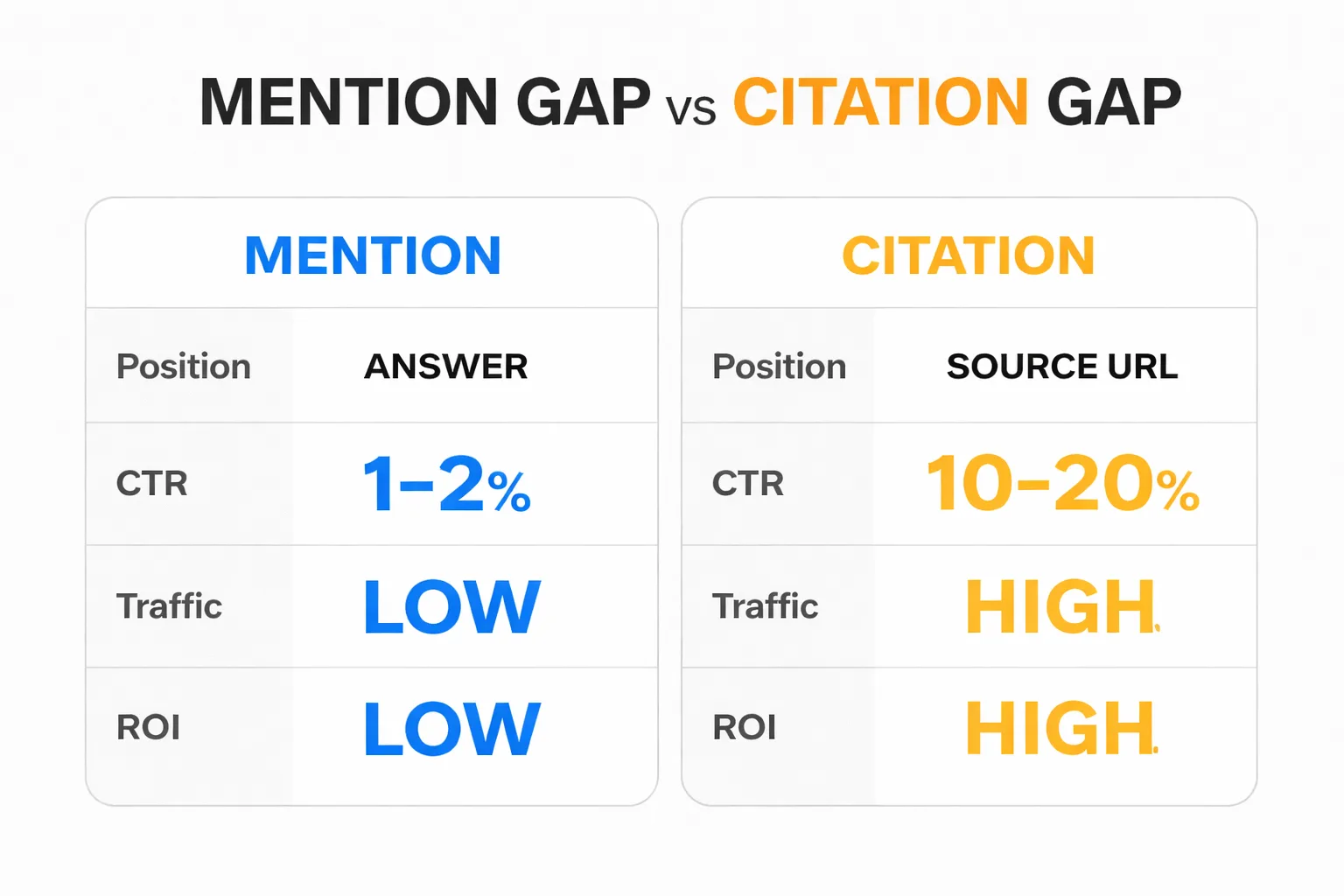
The mention-citation gap is the space between being named and being sourced. Closing it requires different tactics than increasing mentions:
- To increase mentions: Get your brand name on more websites. PR coverage, podcast appearances, social media presence, directory listings. This is traditional brand awareness work.
- To close the citation gap: Make your content structurally extractable, ground your brand as an entity in knowledge graphs, and earn presence on the domains AI engines actually cite. This is answer engine optimization work.
The tactics do not overlap much. You can have massive mention volume and zero citations. I have seen it. You can also have modest mention volume but strong citations if your content is the best extractable source for a specific query. I have seen that too.
This is why I am skeptical of most AI visibility tools that lead with mention metrics. They measure the easy thing and call it visibility. Real visibility is citation. Real citation requires structural work on your content, your entity presence, and your source domain strategy.
Why Traditional SEO Alone Won't Close the Gap
Here is my contrarian take: traditional SEO is almost entirely irrelevant for closing the AI citation gap. I know that sounds extreme. Let me explain why.
Lily Ray has compelling evidence showing traditional organic search visibility still correlates with AI citations. Her analysis of 11 sites hit by Google's January 2026 update is hard to ignore. I respect her work. But I do not think organic ranking alone is the lever most brands think it is.
I ran an experiment with 5 articles that hit top 3 organic rankings for their target keywords. Over a 3-month period, those articles received zero AI citations. Zero. Not one mention in ChatGPT or Perplexity for the queries they ranked for. This directly contradicts the idea that organic visibility alone drives AI mentions.
The broader data supports this. Only 11% of domains are cited by both ChatGPT and Perplexity. If organic ranking were the primary driver, that overlap would be much higher. The fact that it is 11% suggests a clear divergence from pure search engine optimization.
What actually works is generative engine optimization: structuring content so AI engines can extract it, grounding your brand as an entity so AI engines recognize you, and earning presence on the domains AI engines trust as sources. These are not traditional SEO tactics. They are a different discipline.
The Trex case study from Seer Interactive illustrates this well. Trex increased brand authority and turned AI Overviews into a traffic driver after optimization. They did not just rank better on Google. They structured their content for AI extraction and optimized their entity presence. The result was measurable AI-driven traffic, not just rankings.
If you want to go deeper on the distinction between these two disciplines, I wrote about the differences in AEO vs SEO and AEO vs GEO. The short version: SEO optimizes for Google's ranking algorithm. AEO and GEO optimize for AI engines' retrieval and extraction systems. Different systems, different signals, different tactics.
The Entity Grounding Problem Nobody Talks About
Entity grounding is the most underdiscussed barrier to AI citations, and it is probably the one most affecting your brand right now.
Here is what entity grounding means in plain language. AI engines maintain knowledge graphs: structured databases of entities (people, places, organizations, concepts) and the relationships between them. When an AI engine builds an answer, it first resolves the entities in the query, then retrieves content associated with those entities. If your brand is not a recognized entity in the knowledge graph, the engine cannot associate your content with queries about your category.
This is why two brands with identical content quality can have wildly different citation rates. Brand A has a Wikidata entry, a Wikipedia page, organization schema on their website, and is mentioned in structured data across trusted domains. Brand B has none of that. Brand A gets cited. Brand B does not. The content quality is the same. The entity grounding is different.
The Seer Interactive testing confirmed this empirically. Schema markup directly influenced AI visibility in their tests. The B2B SaaS account that moved from 14 to 97 AI Overview keywords did it through schema optimization, not content creation. They did not write more articles. They made their existing content machine-readable.
I have seen brands spend months creating new content to boost AI citations, with zero results, because they skipped entity grounding entirely. It is like building a beautiful house without putting it on a map. Nobody can find it because the address does not exist.
The fix is not glamorous. Update your Wikidata entry. Add Organization schema to your homepage. Create author entity profiles with structured biographical data. Ensure your brand's Wikipedia page (if you have one) is accurate and well-sourced. Connect your entity to related entities in your category. This is foundational work that most brands skip because it is not visible in Google rankings. But it is visible in AI citations.
Is your brand getting mentioned in AI answers but never cited as the source?
Content Structuring for AI Extractability
Once your entity is grounded, the next lever is content structure. This is where I see the most failure.
AI engines extract answers from pages. They do not synthesize across multiple pages to build a novel answer (in most cases). They find a page that contains the answer, extract the relevant passage, and cite it. If your page does not contain an extractable answer, it will not be cited.
Here is what extractable content looks like:
- Direct answers under question headings. If the query is "What is the best CRM for small business?" your page should have an H2 that reads something close to that question, followed by a 40-60 word direct answer. Not a 500-word introduction about the history of CRM software.
- Tables with comparative data. AI engines love tables. A table comparing features, pricing, or specifications is highly extractable because the data is already structured.
- Bullet lists that summarize key points. Lists are easy to extract because each bullet is a self-contained unit of information.
- Structured data markup. Article schema, FAQ schema, HowTo schema, Speakable schema. These give the AI engine machine-readable signals about what your content contains and how it is organized.
- Front-loaded answers. Put the answer first, then elaborate. 44% of AI citations come from the first third of a page. If your answer is at the bottom, it might as well not exist.
I learned this through painful experimentation. When I started insisting that our AI-generated articles include direct answers under question headings and structured data wherever possible, citation rates improved dramatically. It is less about optimizing for Google's old algorithm and more about making it easy for an AI to understand and cite your content.
For brands looking to implement this systematically, an AI SEO tool can automate much of the structural work: schema generation, internal linking, content archetypes tuned for extractability. But the principles are simple enough to apply manually if you are starting small.
Which AI Surfaces Should You Audit First?
Not all AI search surfaces matter equally for your brand. The surfaces you prioritize depend on your audience and query type.
ChatGPT dominates general-purpose queries. If your customers ask broad category questions ("What is the best project management tool?"), ChatGPT is where you need visibility. You can check your presence using a ChatGPT AI visibility checker to see if your brand appears and where in the answer it lands.
Perplexity is the citation-heavy surface. It is built around source attribution and shows cited URLs directly in answers. If your content is highly factual, data-driven, or research-oriented, Perplexity is where citations matter most. A Perplexity AI visibility checker will show you which of your pages are being pulled.
Google AI Overviews sit on top of traditional search results and pull from both web content and Google's knowledge graph. If you have strong organic rankings but no AI Overview presence, your entity grounding is likely the problem. The Seer Interactive data showed that schema optimization alone moved one account from 14 to 97 AI Overview keywords.
Google AI Mode, Gemini, Grok, and DeepSeek each have their own retrieval patterns and source preferences. The set of surfaces changes as new models launch and existing ones update their algorithms. Rather than chasing a fixed number of surfaces, audit the ones your customers actually use and track them over time.
For brands that need systematic tracking across all major AI search surfaces, an AI visibility checker or LLM visibility tool can automate daily monitoring. But start with the manual 15-minute audit I described above. It will tell you whether you have a problem before you invest in tooling.
The Mention-Citation Gap in Practice: What I've Seen
Let me get specific about what the mention-citation gap looks like in practice, because the abstract definition only gets you so far.
I worked with a B2B SaaS brand that had strong organic rankings, a healthy backlink profile, and active PR coverage. Their brand name appeared in AI answers regularly. Mentions were solid. But when I dug into the actual response text and citations behind those mentions, the picture changed. In 8 out of 10 prompts where they were mentioned, their content was not cited as a source. The AI engine knew their name (from training data, from web mentions) but did not pull from their pages when constructing answers.
This is the mention-citation gap in action. The brand had presence. It did not have authority. The AI engine could name them but could not source them.
The fix took six weeks. We added Organization schema and FAQ schema to their key pages. We restructured their top-performing articles to front-load direct answers under question headings. We created a Wikidata entry and connected it to their category. We identified the domains AI engines were citing for their topics and earned placement on three of them through targeted outreach.
The result: citation rate went from roughly 10% to 35% on category queries. Not because they wrote more content. Because they made their existing content extractable and their entity recognizable.
This is what I mean when I say closing the citation gap is mechanical, not magical. The tactics are known. The work is unglamorous. But it works because it addresses the actual barriers AI engines face when deciding whether to cite your content.
Stop Chasing Mentions, Start Earning Citations
The AI search industry has a measurement problem. Too many tools track mentions and call it visibility. Too many brands optimize for mention volume and wonder why their AI-driven traffic is zero. Too many case studies claim 4,900% revenue increases from GEO without naming a method, a baseline, or a client.
Pepper Content explicitly warned that most published GEO case studies measure visibility gains, not revenue attribution, and that almost none of them name a method, a baseline, or in several cases a client. The strongest revenue evidence I have seen is a 177% increase in organic revenue on a 2-year healthcare program and a 10x increase in website orders on an automotive account. Those are real numbers from real programs. The 4,900% claims circulating without methodology disclosure are not.
Here is what I want you to take away: the ai citation gap is measurable, mechanical, and fixable. You can audit it in 15 minutes with a spreadsheet. You can close it with schema markup, entity grounding, content restructuring, and source domain strategy. You do not need to write more content. You need to make your existing content citable.
The brands that will win in AI search over the next 12 months are not the ones with the most content. They are the ones whose content is the easiest to extract, whose entities are the most clearly grounded, and whose presence on trusted source domains is the strongest. That is the work. Everything else is noise.
If you want to understand the broader framework, read my breakdown of what is AEO and how it differs from traditional SEO. If you want to start diagnosing your own gap, try our answer engine optimization workflow. The manual audit takes 15 minutes. The fixes take weeks. The payoff compounds as AI search grows.
The ai citation gap is not going to close itself. Every day you wait, your competitors are earning citations that train future AI models to recognize them as the default source for your category. The longer you wait, the harder the gap becomes to close.
FAQ
What is the difference between an AI mention and an AI citation?
A mention is when your brand name appears somewhere in an AI-generated answer. A citation is when the AI engine builds its answer from your content and attributes it to your domain with a source link. Mentions are easy to achieve through general brand awareness. Citations require structured, extractable content and entity grounding. Only about 11% of domains are cited by both ChatGPT and Perplexity, which shows how narrow the citation pool is.
How do I know if I have an AI citation gap?
Run a 15-minute manual audit. Pick five high-intent prompts your customers would type into AI search, run them across ChatGPT and Perplexity, and log whether your content is cited as a source. If your citation rate is below 10%, you have a significant gap. For mid-market brands, anything below 20% suggests your content is not structured for extraction or you lack entity grounding.
Does ranking well on Google guarantee AI citations?
No. I tested 5 articles that reached top 3 organic rankings and received zero AI citations over 3 months. Only 11% of domains are cited by both ChatGPT and Perplexity, which indicates a clear divergence from traditional search ranking. AI engines prioritize content extractability, entity grounding, and presence on trusted source domains, not organic rank position.
What is entity grounding and why does it matter for AI citations?
Entity grounding is the process of establishing your brand as a recognized entity in AI knowledge graphs through Wikidata entries, Wikipedia presence, Organization schema markup, and structured data across trusted domains. Seer Interactive's testing showed that schema optimization alone moved one B2B SaaS account from 14 to 97 AI Overview keywords. Without entity grounding, AI engines cannot associate your content with queries about your category.
How long does it take to close an AI citation gap?
The structural fixes (schema markup, content restructuring, Wikidata updates) can be implemented in 2-6 weeks depending on your site size. Earning presence on trusted source domains through outreach takes longer, typically 1-3 months. In my experience, a focused effort yields measurable citation rate improvement within 6-8 weeks. The key is addressing all three root causes simultaneously rather than sequentially.
Are AI visibility tools that track mentions worth using?
Mention tracking has limited value on its own. I spent a month optimizing for raw mention volume and saw zero correlation to lead generation or sales. The metrics that matter are citation rate (how often your content is sourced) and citation concentration (which domains AI engines cite for your topics). Tools that track these metrics are useful. Tools that only track brand name mentions are measuring vanity.
About the Author
Judy Zhou, Founder
Judy Zhou leads content strategy at Meev, where she oversees AI-driven content research and publishing for hundreds of brands. With a background in SEO and editorial operations, she focuses on building content systems that rank on Google, get cited by AI search engines, and drive measurable business results.
Run a free AI visibility audit to see exactly where your brand gets cited, where it gets skipped, and which sources AI engines trust for your topics.