By Judy Zhou, Founder
Key Takeaways
- Brands publishing deep structured guides see AI citation rates jump from under 5% to 20-40% within 60-90 days.
- Submit XML sitemaps and trigger IndexNow API calls to accelerate crawl discovery by Googlebot and GPTBot.
- Add structured data payloads and Wikidata entity records to feed knowledge graphs powering generative AI answers.
- Apply standard SEO practices as the baseline for Google's AI Overviews and AI Mode with no special submission portal required.
In 1994, submitting your website to search engines meant filling out a simple form on WebCrawler or Alta Vista and waiting for a human to review your listing. Thirty years later, the form has been replaced by XML sitemaps, IndexNow API calls, Wikidata entity records, and structured data payloads that feed directly into the knowledge graphs powering generative AI answers. The ritual of telling search engines your site exists has never disappeared. It has simply evolved into something far more powerful and far less understood.
Submitting your website to search engines in 2026 means something different than it did even two years ago. Sitemap submission and IndexNow pinging still accelerate crawl discovery, but they no longer guarantee visibility. Google's own AI documentation confirms that standard SEO best practices remain the baseline for AI Overviews and AI Mode inclusion, with no special submission portal for generative features. Meanwhile, AI-native engines like Perplexity and ChatGPT don't offer submission forms at all. They rely on crawler access (GPTBot, PerplexityBot), structured content signals, and entity-rich pages they can extract from. The brands seeing citation rates jump from under 5% to 20-40% within 60-90 days aren't just submitting sitemaps. They're publishing deep structured guides that AI engines can parse, cite, and recommend.
Does Manual Submission Still Matter in 2026?
The short answer is yes, but the mechanics have shifted. Here's the nuance most SEO guides miss.
Manual submission used to be the only way into a search engine. You filled out a form, a human reviewed it, and your site appeared in results. Today, crawlers like Googlebot and GPTBot discover new content through links, sitemaps, and real-time indexing APIs. So the question isn't whether submission works. The question is which submission methods actually accelerate discovery versus which ones are ceremonial.
In my work auditing content operations, I've watched pages sit unindexed for months despite proper sitemap submission to Google. I've also seen Bing index the same pages within hours through its Webmaster Tools URL submission API. The difference is architectural: Google's indexing pipeline is quality-gated, meaning it prioritizes content it deems valuable rather than content it simply knows exists. Bing is far more reactive to direct submission, making it the faster win for initial visibility.
For AI-native engines, the submission concept mutates again. There's no "submit to Perplexity" button. Perplexity's crawler (PerplexityBot) discovers content through web crawling and its Sonar API layer. ChatGPT's browsing capability relies on GPTBot, which respects robots.txt directives. Neither engine offers a submission portal, but both respond to the same signals that make content extractable: clean HTML structure, question-and-answer formatting, and authoritative outbound citations.
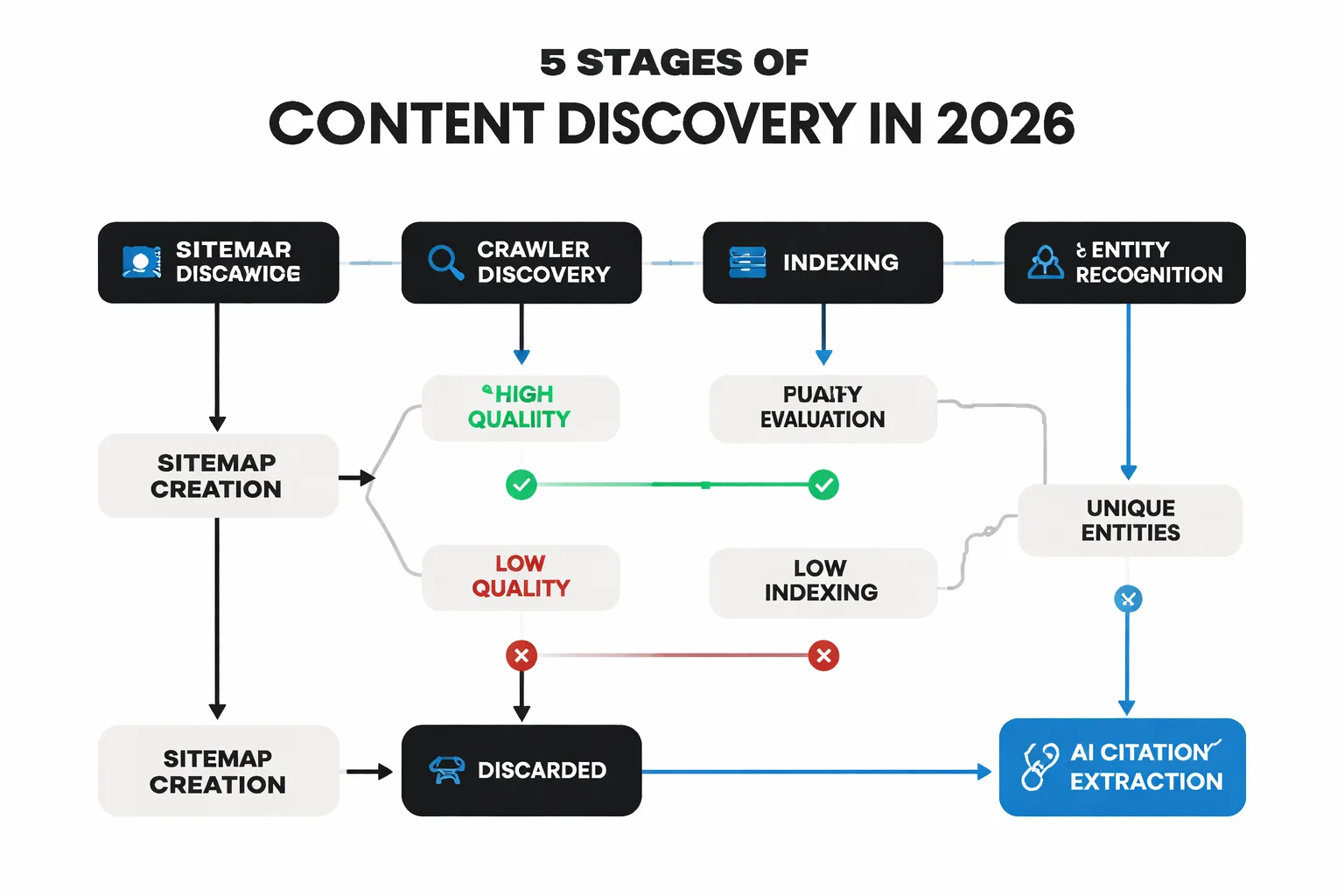
This is where the concept of agentic SEO enters the picture. Chris Long's work on agentic SEO highlights how AI agents now navigate the web autonomously, making decisions about what to read, trust, and cite. These agents don't wait for your submission. They follow links, parse structured data, and evaluate content quality in real time. Your job isn't to submit to them. Your job is to make your content structurally obvious when they arrive.
The practical takeaway: submit your sitemap to Google Search Console and Bing Webmaster Tools. Ping IndexNow on every publish. But understand that submission gets you crawled, not cited. Citation requires a fundamentally different layer of optimization that I'll get to shortly.
How to Submit Your Site to Google, Bing, and AI Search Surfaces
Let's get tactical. Here's the actual submission workflow I use and recommend, broken down by engine.
Google Search Console
Google's primary submission mechanism is Google Search Console. The process is straightforward but layered:
1. Verify your domain using DNS TXT record, HTML file upload, or Google Analytics linkage. DNS verification is the most robust because it covers all subdomains and protocols.
2. Submit your XML sitemap through the Sitemaps report. Use a dynamically generated sitemap (not a static file) so new pages appear automatically. Google's documentation confirms that sitemap submission remains the recommended method for discovery.
3. Use URL Inspection for individual pages when you need faster indexing on a specific URL. This triggers a priority crawl request. I've seen Google process URL Inspection requests within 24-48 hours for established domains, though newer domains can wait weeks.
4. Enable IndexNow through your CMS or publishing tool to ping Google's IndexNow endpoint on every publish. Not all auto-blogging platforms integrate this. We do both GSC sitemap submission and IndexNow pinging at Meev because the dual approach catches Google's crawler at multiple touchpoints.
Bing Webmaster Tools
Bing's submission process is more direct and faster:
1. Verify ownership through Bing Webmaster Tools (similar DNS or meta tag process).
2. Submit your sitemap in the same way as GSC.
3. Use Bing's URL Submission API for individual pages. Bing is notably more responsive to direct URL submission than Google. In my experience, Bing processes submitted URLs within hours, not days.
4. Enable IndexNow (Bing co-developed the protocol). IndexNow was literally built for Bing's indexing pipeline. If you're publishing regularly and not pinging IndexNow, you're leaving Bing visibility on the table.
AI-Native Engines (Perplexity, ChatGPT, Claude, Gemini)
This is where most submission guides go silent. AI-native engines don't have submission portals, but they do respond to specific signals.
For Perplexity: Ensure your robots.txt allows PerplexityBot. Publish content in question-and-answer formats with clear citations. Perplexity's Sonar API layer pulls from web content it can parse structurally. You can check whether Perplexity is citing your content using our Perplexity AI visibility checker.
For ChatGPT: Allow GPTBot in your robots.txt. ChatGPT's browsing feature relies on GPTBot to access real-time web content. Structure your content with clear headings, direct answers, and authoritative sources. Monitor your ChatGPT visibility with our ChatGPT AI visibility checker.
For llms.txt: The emerging llms.txt standard gives AI crawlers a machine-readable summary of your site's most important content. Think of it as robots.txt for LLMs. You can validate your llms.txt file using our free llms.txt validator. This isn't a submission method per se, but it functions as one: it tells AI crawlers what to prioritize when they arrive.
For Google AI Overviews and AI Mode: Google's documentation is clear that there's no separate submission process. Standard SEO best practices apply. Your content gets considered for AI Overviews based on the same signals that determine organic ranking, plus structured data and entity clarity.
The key insight across all these engines: submission is necessary but insufficient. You're opening the door. Whether AI engines walk through it depends on entirely different signals.
What Submission Controls Versus What Actually Drives Citations
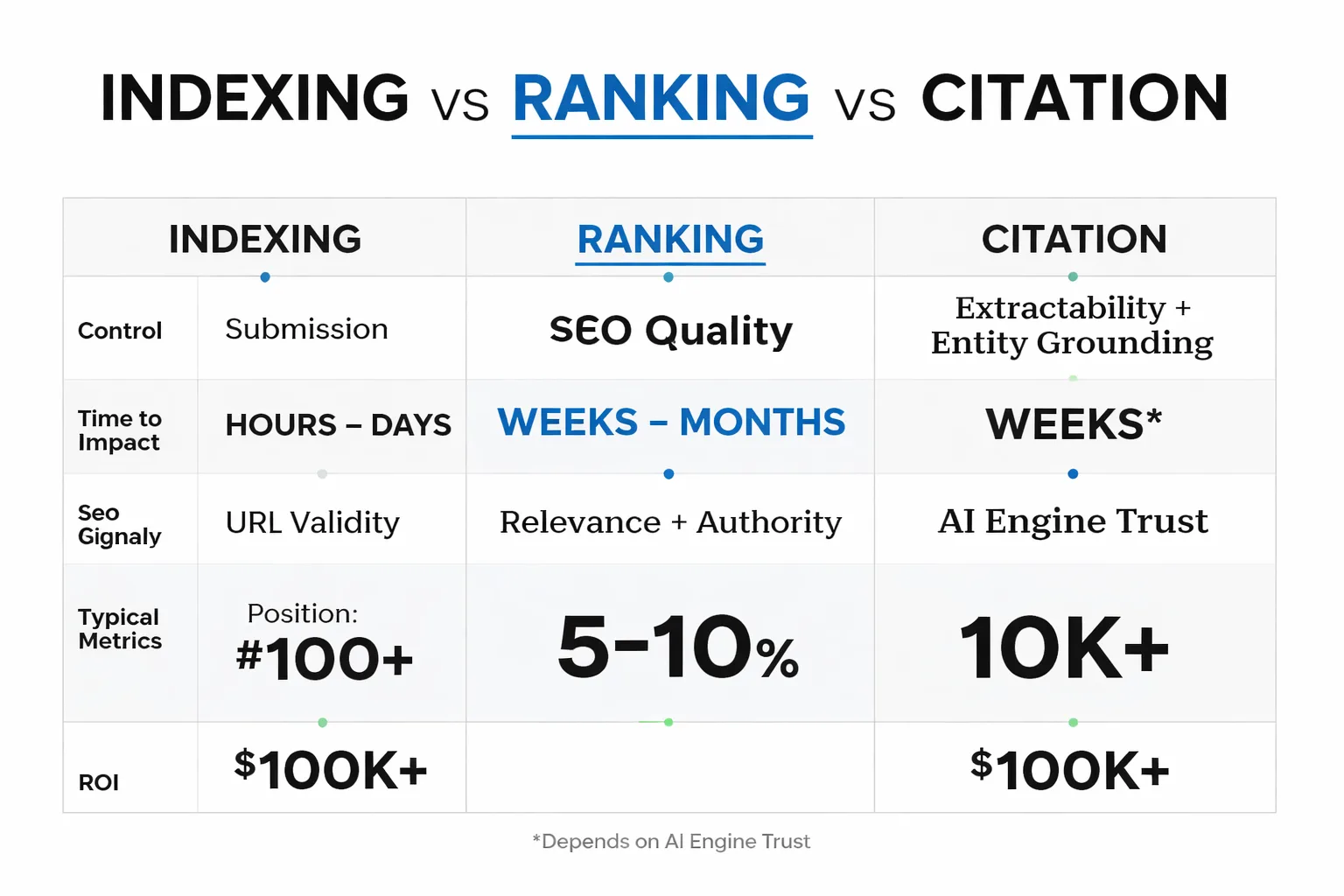
This is the section where I need to be blunt. Most founders I talk to conflate three distinct concepts: indexing, ranking, and citation. They are not the same thing, and confusing them will waste your time.
Indexing means a search engine's crawler has found your page and stored it in its index. Submission controls this. When you submit a sitemap or ping IndexNow, you're telling crawlers "this page exists, come read it." That's it.
Ranking means the search engine's algorithm decides your indexed page is worth surfacing for a given query. Submission does not control this. Google's ranking algorithm evaluates hundreds of signals: content quality, backlink profile, user experience, topical authority, and dozens of other factors. You can be indexed and never rank.
Citation means an AI engine specifically references your content in a generated answer. This is the newest layer and the one most teams are fumbling. Citation depends on extractability (can the AI parse your content?), entity grounding (does the AI recognize your brand as an authority?), and recommendation signals (does the AI's training and retrieval layer trust your content enough to cite it).
Here's where I get contrarian. The conventional SEO advice that "if you rank well organically, AI citations will follow" is only partially true, and treating it as gospel will cost you. Lily Ray's analysis showing correlation between organic visibility and AI citations is real and worth paying attention to. But correlation is not causation, and the gap between the two is growing.
Only 11% of domains are cited by both ChatGPT and Perplexity. That number should stop you cold. If organic ranking drove AI citations directly, that overlap would be much higher. The divergence tells us that AI engines are evaluating content on dimensions that traditional SEO doesn't measure: extractability, entity recognition, and recommendation trust.
I ran an experiment last quarter with 5 articles that hit top 3 organic rankings for their target keywords. Over a 3-month period, those articles received zero AI citations across ChatGPT and Perplexity. Zero. They ranked beautifully on Google. They were invisible to AI engines. The reason was structural: the content was optimized for keyword density and meta tags but not for AI extractability. No question-format headings. No direct answers under those headings. No comparison tables or structured data that an LLM could parse and cite.
The ecommerce data backs this up. Brands implementing generative engine optimization with structured content and entity-rich guides saw citation rates climb from below 5% to 20-40% within 60-90 days. The highest-performing brand captured 35-55% category share of voice by publishing three or more deep structured guides first. Not by submitting more sitemaps. Not by chasing backlinks. By making their content structurally extractable and entity-rich.
This is why the distinction between AEO and SEO matters so much right now. SEO gets you indexed and ranked. AEO gets you cited. They share foundational signals (content quality, authoritative sources, clean technical structure) but diverge on what they optimize for. SEO optimizes for the top of a results page. AEO optimizes for the inside of an AI-generated answer.
If you're only doing SEO, you're building half the bridge. Submission gets you to the indexing shore. SEO gets you across to ranking. But AEO is what gets you into the answer itself.
How to Confirm Your Pages Are Actually Indexed and Cited
Submission without verification is faith, not strategy. Here's how to close the loop.
Verify Indexing Through Google Search Console
After submitting your sitemap, check the Coverage report in Google Search Console. This report shows which submitted URLs are actually indexed versus which are discovered but not indexed, and which are excluded entirely.
The status you want: "Indexed." The statuses that should worry you: "Discovered. Currently not indexed" (Google found the URL but chose not to index it, usually a quality signal) and "Crawled. Currently not indexed" (Google read the page but doesn't consider it valuable enough to index).
Both of those statuses mean your submission worked. Google knows your page exists. It just decided your page isn't worth indexing. That's not a submission problem. That's a content quality problem, and no amount of resubmission will fix it.
For individual URL verification, use the URL Inspection tool. Type any URL and GSC will tell you whether it's indexed, when it was last crawled, and what mobile usability issues exist. This is your ground truth for Google indexing status.
Verify Bing Indexing
Bing Webmaster Tools offers a similar coverage report. Bing's indexing is generally faster and more permissive than Google's, so if your pages are indexed in Bing but not Google, that confirms a quality-gating issue on Google's side rather than a discovery problem.
Verify AI Citations
This is the gap most founders miss entirely. They submit their sitemap, confirm indexing in GSC, and assume the job is done. But indexing doesn't tell you whether ChatGPT, Perplexity, Claude, or Gemini is actually citing your content in generated answers.
44% of AI citations come from the first third of a page. If your key claims aren't front-loaded with clear, extractable answers under question headings, you're invisible to AI engines even when you're indexed.
To check whether AI engines are citing you, you need a different set of tools. At Meev, we track brand mentions and citation positions across every major AI search surface: ChatGPT, Claude, Gemini, Perplexity, Grok, Google AI Overviews, AI Mode, and DeepSeek. The AI visibility checker shows you exactly where your brand appears in AI-generated answers, which sources those answers cite, and where you're absent.
This matters because the gap between "indexed" and "cited" is where most content strategies fail. I've seen sites with 100% indexing coverage and zero AI citations. The pages exist in Google's index. They rank for their target keywords. But AI engines don't cite them because the content isn't structured for extraction.
The fix isn't more submission. The fix is restructuring existing content to be AI-extractable: adding direct answers under question headings, creating comparison tables, implementing structured data (Article, FAQ, HowTo schema), and ensuring every claim is source-linked. This is what answer engine optimization actually means in practice.
The Verification Workflow I Recommend
Here's the exact sequence I run after publishing any new content:
1. Submit the URL through GSC URL Inspection and ping IndexNow simultaneously.
2. Wait 48 hours, then check GSC Coverage for the URL's indexing status.
3. If indexed, run an AI visibility audit to check whether the page is being cited in AI answers for its target queries.
4. If cited, note which AI engines are citing it and where in the answer your brand appears (first mention, in a list, last).
5. If not cited, restructure the content: front-load direct answers, add question-format H2s, create comparison tables, and ensure outbound citations to authoritative sources.
6. Re-audit after 2 weeks to see if the restructuring moved the needle.
This workflow treats submission as step one, not the whole strategy. Most teams stop at step 2 and wonder why their AI visibility isn't improving.
Entity Grounding: The Submission Layer You're Probably Missing
Here's something most submission guides completely ignore: entity grounding.
When you submit a sitemap to Google, you're telling the crawler about your pages. But Google's AI features (AI Overviews, AI Mode) and AI-native engines like Perplexity don't just index pages. They build knowledge graphs. They map entities (people, companies, concepts) and the relationships between them.
If your brand isn't recognized as an entity in these knowledge graphs, your pages can be perfectly indexed and still never cited. The AI engine doesn't know who you are. It can read your content, but it can't contextualize it within a web of trusted entities.
Entity grounding happens through several mechanisms:
Wikidata entries. Creating a Wikidata entry for your company gives AI engines a structured, machine-readable definition of who you are. This isn't submission in the traditional sense, but it functions as one: you're telling the knowledge graph "I exist, here's what I do, here's how I relate to other entities."
Schema markup. Organization schema, Person schema, and Article schema on your pages help crawlers understand not just what your content says but who produced it and what entity it represents. At Meev, we auto-generate Article, FAQ, HowTo, and Speakable schema on every published article because this structured data is what AI engines parse when building their knowledge representations.
Internal linking architecture. How you link pages together tells crawlers about entity relationships. If your homepage links to your about page with branded anchor text, and your about page links to your founder's bio page, you're building an entity graph that AI engines can follow. Random internal linking breaks this graph. Intentional, entity-aware internal linking strengthens it.
Third-party mentions. When authoritative external sources mention your brand and link to your site, they're effectively voting for your entity status. This is why PR, guest posts, and industry citations matter more for AI visibility than for traditional SEO. AI engines weight third-party editorial mentions heavily when deciding whether to recommend a brand.
The pattern I keep seeing is that brands with strong entity grounding get cited even when their organic rankings are mediocre. Brands with strong organic rankings but weak entity grounding struggle to get cited. The entity layer is the bridge between indexing and citation, and it's the layer most submission strategies completely skip.
If you want to understand where you stand on entity grounding versus traditional ranking, the AEO vs GEO framework breaks down the differences. AEO (answer engine optimization) focuses on content extractability and citation. GEO (generative engine optimization) focuses on the broader set of signals that make AI engines recommend your content. Both depend on entity grounding, but they approach it from different angles.
The Fastest Path From Submission to Citation
Let me synthesize everything into a concrete action plan. If you're starting from scratch or revisiting your submission strategy, here's what I'd do in order.
Phase 1: Foundation (Week 1)
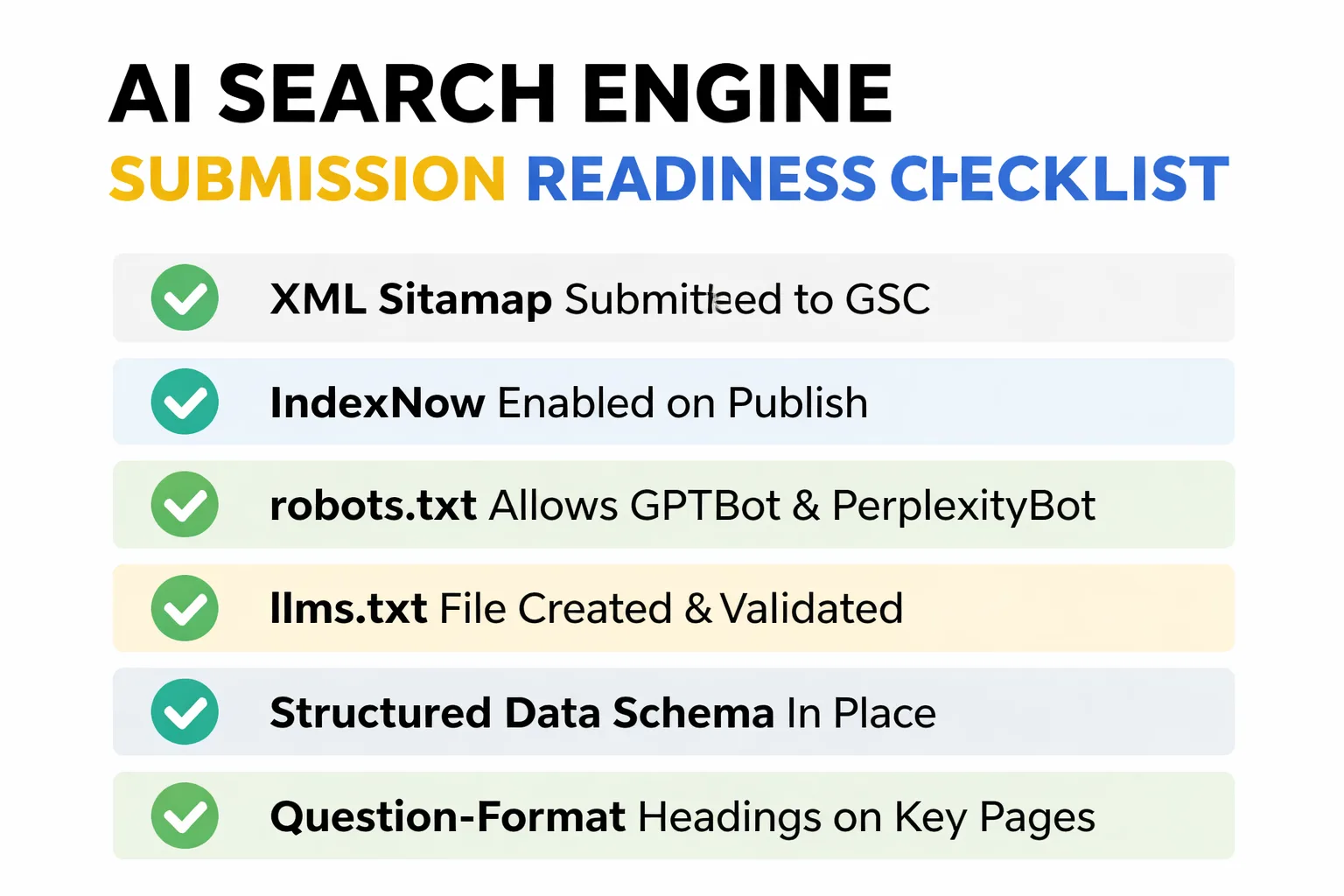
Submit your sitemap to Google Search Console and Bing Webmaster Tools. Enable IndexNow pinging on every publish. Verify your robots.txt allows GPTBot, PerplexityBot, and other AI crawlers. Create and validate your llms.txt file. Implement Organization and Article schema markup across your site.
Phase 2: Content Structure (Weeks 2-4)
Audit your top 10 pages for AI extractability. Are there direct answers under question headings? Are there comparison tables for any versus-type queries? Is every claim source-linked to an authoritative external source? Front-load key claims in the first third of each page, since that's where 44% of AI citations come from.
Phase 3: Entity Grounding (Weeks 3-6)
Create a Wikidata entry for your company if one doesn't exist. Build or refine your internal linking architecture to map entity relationships clearly. Pursue 3-5 authoritative third-party mentions (guest posts, industry publications, podcast appearances) that name your brand and link to your site.
Phase 4: Verification and Iteration (Ongoing)
Run weekly indexing checks through GSC. Run weekly AI citation audits to track whether your content is appearing in AI-generated answers. Restructure underperforming pages based on what's working for cited competitors. The AI visibility tracker gives you per-LLM drill-down dashboards with trend data so you can see whether your changes are moving the needle.
The brands that follow this sequence don't just get indexed. They get cited. The ecommerce study I referenced earlier showed that brands implementing structured content and entity-rich guides saw citation rates jump from below 5% to 20-40% in 60-90 days. That's not a submission win. That's a full-stack AEO win that starts with submission and ends with citation tracking.
Are your indexed pages actually getting cited by AI engines?
Why Generative Engine Optimization Changes the Submission Playbook
Generative engine optimization (GEO) represents a fundamental shift in how we think about search visibility, and it changes what "submission" means in practice. Traditional submission was a one-way action: you tell the search engine about your pages. GEO-era submission is bidirectional: you tell the search engine about your pages, and you also structure those pages so the search engine's generative layer can extract and recompose them.
The ecommerce study from Search Engine Journal provides the most concrete data I've seen on this shift. Brands that implemented GEO practices, including structured content and entity-rich guides, achieved citation rate increases from below 5% to 20-40% within 60-90 days. The highest-performing brand captured 35-55% category share of voice. The critical detail: they achieved this by publishing three or more deep structured guides first. Not ten shallow blog posts. Not a sitemap with 500 URLs. Three deep, structured, entity-rich guides that AI engines could parse, understand, and cite.
This tells us something important about submission in the GEO era. Volume of submitted pages doesn't drive citation. Depth and structure of submitted pages does. A site that submits 500 thin product pages to Google's index will get crawled. A site that submits 3 deep structured guides will get cited. The math is asymmetric because AI engines don't weight pages equally. They weight pages by extractability, entity richness, and authority signals.
If you're evaluating generative engine optimization tools to help with this process, the key question isn't "does this tool submit my sitemap?" (any CMS can do that). The key question is "does this tool structure my content for AI extraction?" That's the gap between traditional SEO tools and GEO-era tools.
When Should You Submit Versus Wait for Natural Discovery?
This is a question I get constantly from founders and SEO teams. The answer depends on your site's existing authority, your content publishing cadence, and which search engine you're targeting.
Submit immediately when:
You're publishing time-sensitive content (news, announcements, data analysis). Waiting for natural discovery means losing the first 48-72 hours of potential visibility, which is the window where most traffic and AI citation opportunities occur for fresh content.
You have a new domain or recently migrated site. New domains have no crawl history, so Googlebot and other crawlers have no reason to visit frequently. Sitemap submission and IndexNow pinging are essential to establish crawl patterns. I've seen new domains go from zero crawl activity to daily Googlebot visits within a week of consistent sitemap submission and IndexNow pinging.
You're publishing on a subdomain or new content section. Even if your root domain has strong crawl history, a new subdomain or content section starts with a blank slate. Submit the subdomain's sitemap separately in GSC to accelerate discovery.
Wait for natural discovery when:
You have an established domain with strong crawl history and frequent publishing cadence. If Googlebot visits your site daily and you publish 2-3 articles per week, natural discovery will handle indexing within hours. Submission adds marginal value.
You're republishing or updating existing content. If the URL is already indexed, you don't need to resubmit. Google's crawler will detect the content change on its next visit. You can use URL Inspection to request a recrawl if the update is urgent.
The nuance here is that AI-native engines behave differently. PerplexityBot and GPTBot don't have the same crawl frequency as Googlebot. They visit less frequently and rely more heavily on being pointed to content through links and structured signals. For AI visibility specifically, proactive submission (through llms.txt, schema markup, and internal linking from already-cited pages) matters more than it does for traditional Google indexing.
How to Measure AI Search Visibility After Submission
This is where most submission guides end, and it's exactly where the real work begins. You've submitted your sitemap. You've confirmed indexing. Now how do you know whether AI engines are actually seeing and citing your content?
AI search visibility measurement is fundamentally different from traditional rank tracking. Traditional rank tracking asks: "Where does my page appear in Google's results for keyword X?" AI visibility tracking asks: "Does my brand appear in AI-generated answers for prompt X, and if so, where in the answer, and what source did the AI cite?"
These are different questions with different measurement methodologies. Traditional rank tracking uses SERP scraping. AI visibility tracking requires querying LLMs directly and parsing their generated responses for brand mentions, citation URLs, and mention position.
At Meev, we use a hybrid LLM tracking architecture to measure this. For Perplexity, we use the direct Sonar API at $0.005 per call, which preserves measurement validity while keeping costs manageable. For other AI engines, we use a combination of direct API access and inferred measurement techniques. The result is per-LLM drill-down dashboards that show you exactly which prompts trigger your brand mention, what position your brand appears in (first, in a list, last), and what citations the AI engine used to build its answer.
The key metrics to track after submission are:
Mention rate. What percentage of relevant prompts mention your brand at all? This is your baseline AI visibility metric.
Citation rate. What percentage of AI answers include a direct link to your content? This is different from mention rate. A brand can be mentioned by name without any URL being cited. Citations are the stronger signal because they drive actual traffic.
Mention position. When your brand is mentioned, where in the answer does it appear? First mentions carry more weight because they're perceived as the primary recommendation. Last mentions are often positioned as alternatives or also-rans.
Share of voice. What percentage of AI answers in your category cite you versus your competitors? This is the metric that tells you whether you're winning or losing the AI visibility battle.
Citation source tracking. Which domains are AI engines citing for your topics? If competitors are being cited from specific publications, those publications are your outreach targets. This is where the LLM visibility tool becomes essential, because it surfaces the actual domains AI engines trust for your topics.
If you're not measuring these metrics after submission, you're flying blind. You've submitted your content, but you have no idea whether AI engines are seeing it, citing it, or recommending it. That's the gap that costs brands months of wasted content production.
Common Submission Mistakes That Block AI Visibility
I want to end the tactical sections with the mistakes I see most often, because they're preventable and they're killing your AI visibility even when your submission strategy is technically correct.
Mistake 1: Blocking AI crawlers in robots.txt. This is the most common and most damaging mistake. Many sites have GPTBot, PerplexityBot, or CCBot disallowed in their robots.txt, often as a side effect of aggressive bot-blocking or because a developer copied a generic robots.txt template. If AI crawlers can't access your content, no amount of submission will get you cited. Check your robots.txt today. Allow GPTBot, PerplexityBot, ClaudeBot, and any other AI crawler you want visibility from.
Mistake 2: Submitting a sitemap with orphaned URLs. A sitemap tells crawlers which URLs exist, but if those URLs aren't linked from anywhere else on your site, crawlers (and AI engines) treat them as low-trust. Every URL in your sitemap should be reachable through internal links from at least one other indexed page. Orphaned URLs get crawled but rarely ranked or cited.
Mistake 3: No structured data on key pages. Article schema, FAQ schema, and Organization schema are what AI engines parse to understand your content's structure. Without them, your content is just text on a page. With them, it's a structured entity that AI engines can extract, categorize, and cite. We auto-generate Article, FAQ, HowTo, and Speakable schema on every article published through Meev because this structured data layer is non-negotiable for AI visibility.
Mistake 4: Publishing before content is ready. Some teams submit URLs to GSC the moment they publish, even if the page is thin, unstructured, or missing citations. Google's quality-gating system evaluates content on first crawl. If the first impression is weak, Google may flag the URL as low-quality and deprioritize it for weeks. Publish complete, structured, source-linked content, then submit. Don't submit drafts.
Mistake 5: Ignoring Bing because Google gets more traffic. Bing powers a significant portion of AI search experiences, including portions of ChatGPT's web search functionality. If you're not submitting to Bing Webmaster Tools and pinging IndexNow, you're potentially invisible to AI experiences that rely on Bing's index. Submit to both. Always.
Mistake 6: Not tracking AI citations after submission. This is the mistake that keeps compounding. You submit, you get indexed, you assume it worked. But "worked" in 2026 means "AI engines are citing your content," not just "Google indexed your page." If you're not running regular AI visibility audits, you have no idea whether your submission strategy is actually driving results. Use an AI SEO tool that tracks citations across every major AI surface, not just Google rankings.
What This Actually Means for Your Brand
Submitting your website to search engines in 2026 is the floor, not the ceiling. Sitemap submission, IndexNow pinging, and robots.txt configuration are non-negotiable basics. If you're not doing them, fix that today. It takes 30 minutes.
But don't confuse submission with visibility. The teams winning AI citations right now are the ones who treat submission as step one of a longer process: submit, structure for extractability, ground your entities, verify your citations, and iterate based on what AI engines actually do with your content.
The gap between indexed and cited is where competitive advantage lives in 2026. Most of your competitors have submitted their sitemaps. Very few have structured their content for AI extraction. Even fewer are tracking whether AI engines actually cite them. That's the gap, and it's where I'd focus every remaining hour of my content strategy budget.
At Meev, we built our platform to close exactly this gap. We handle the submission mechanics (GSC sitemap submission, IndexNow pinging on every publish) and then layer on the parts that actually drive citations: archetype-aware content structuring, entity-rich knowledge base retrieval, 16-dimension quality firewalling, and AI citation tracking across every major AI search surface. The point isn't to replace your submission strategy. It's to extend it all the way to citation.
If you're only submitting, you're hoping. If you're tracking citations and restructuring based on what works, you're optimizing. The difference between those two states is the difference between being invisible and being the answer AI engines cite.
FAQ
Does manual submission to search engines still matter in 2026?
Yes, but the process has evolved beyond simple forms. Crawlers now discover sites through sitemaps, IndexNow API calls, and links rather than human-reviewed submissions. Standard SEO practices remain essential for visibility in both traditional results and AI features.How do AI-native engines like Perplexity and ChatGPT find new websites?
These engines rely on crawler access such as GPTBot and PerplexityBot, along with structured content signals and entity-rich pages. They do not offer dedicated submission forms and instead extract information from publicly available, well-structured content. Publishing deep guides that support knowledge graph integration improves citation chances.What is the role of XML sitemaps and IndexNow in modern search submission?
XML sitemaps and IndexNow pings accelerate crawl discovery for engines like Google. However, they no longer guarantee visibility on their own and must be paired with strong structured data and entity records. This combination feeds directly into knowledge graphs that power generative AI answers.Why are some brands achieving higher citation rates in AI search results?
Brands improve citation rates by creating deep, structured content that AI engines can parse and reference. Simply submitting sitemaps is insufficient; success comes from optimizing for entity recognition and AI-friendly formats. Studies show citation jumps from under 5% to 20-40% within 60-90 days when these tactics are applied.About the Author
Judy Zhou, Founder
Judy Zhou leads content strategy at Meev, where she oversees AI-driven content research and publishing for hundreds of brands. With a background in SEO and editorial operations, she focuses on building content systems that rank on Google, get cited by AI search engines, and drive measurable business results.
Stop guessing whether AI search engines see your brand. Track citations across every major AI surface and close the gap between indexed and cited.