

By Judy Zhou, Founder
Key Takeaways
- 58% of marketers report that AI-referred visitors convert at higher rates than traditional organic traffic.
- Overlap between top Google results and AI-cited sources has fallen from 70% to under 20%, so ranking #1 on Google no longer guarantees AI visibility.
- Reference-grade content earns 3-5x more AI citations than standard content, per OtterlyAI's citation economy report.
- 76.95% of AI-cited URLs fall outside the organic top 10, requiring brands to build entity trust signals beyond keyword rankings.
Imagine a procurement manager at a mid-sized manufacturer. She's not opening Google. She's typing a detailed, specific question into an AI assistant. Something like, 'Which vendors have proven experience with B2B ecommerce automation for industrial parts?' The model responds with three company names, brief descriptions, and enough context that she's already forming a shortlist before she visits a single website. No ad was clicked. No SERP was scrolled. One of those three companies worked deliberately to be there. The other two got lucky. Yours wasn't mentioned at all.
AI search is now a procurement channel, and 58% of marketers say visitors referred by AI tools convert at higher rates than traditional organic traffic, according to HubSpot's 2026 State of Marketing report. Yet most brands have zero visibility into whether they're being recommended. The overlap between top Google results and AI-cited sources has plummeted from roughly 70% to under 20%. Wikipedia alone accounts for 12-15% of ChatGPT citations in the US, and 76.95% of cited URLs in one study fell outside the organic top 10. If you're ranking #1 on Google but lack entity trust signals, you're invisible to the fastest-growing discovery channel in B2B. Reference-grade content receives 3-5x more citations than standard content, per OtterlyAI's citation economy report. In my work auditing content ops at Meev, I see this gap every day. This is why finding a generative engine optimization agency that understands the mechanics of AI trust, not just keyword density, has become a survival priority for small brands.
Why AI Engines Recommend Some Brands and Ignore Others
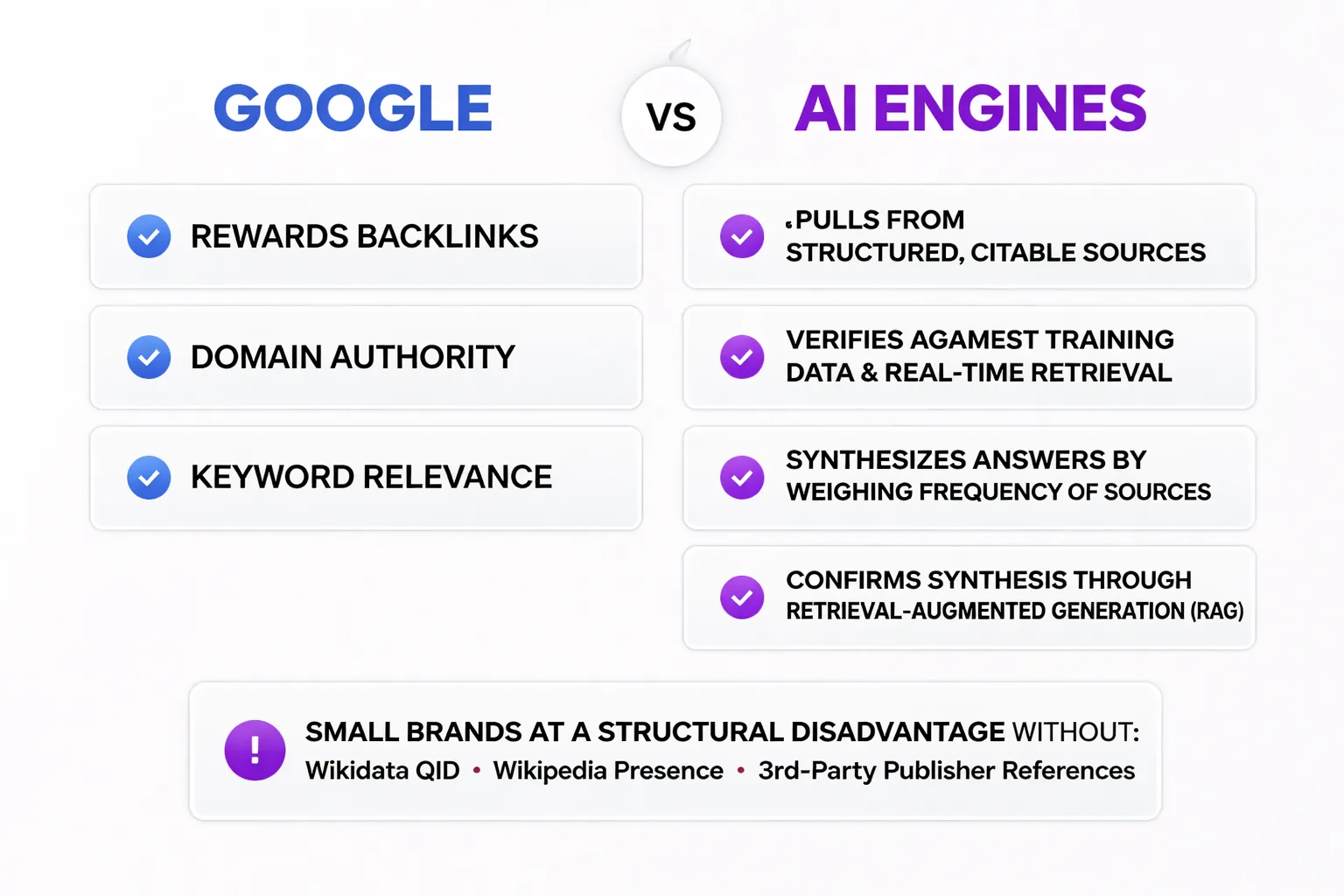
AI engines do not evaluate content the way Google's algorithm does. Google rewards backlinks, domain authority, and keyword relevance. AI engines pull from structured, citable sources that they can verify against their training data and real-time retrieval systems. The mechanic is fundamentally different: an LLM synthesizes an answer by weighing which sources it has seen most frequently in connection with a specific entity, then confirms that synthesis through retrieval-augmented generation (RAG) before presenting it to the user.
This creates a structural disadvantage for small brands. If your company lacks a Wikidata QID entry, has no Wikipedia presence, and isn't referenced across the third-party publishers that AI engines crawl during retrieval, you effectively don't exist as a citable entity. The model has nothing to ground your name to. It doesn't matter how good your blog posts are. It doesn't matter that you rank #3 for your primary keyword. The AI cannot recommend what it cannot identify as a distinct, trusted entity.
I've seen this firsthand. One client we worked with had highly optimized content, strong organic rankings, and a healthy backlink profile. But when we ran buyer-intent prompts across ChatGPT, Perplexity, and Gemini, their brand appeared in exactly zero responses. Their competitors, who had weaker organic metrics but were mentioned frequently on industry forums, Reddit threads, and niche publisher sites, dominated the AI answers. The AI engines weren't evaluating content quality. They were evaluating entity presence across the sources they trust.
76.95% of cited URLs in a study of 153,425 citations were outside the organic top 10, according to OtterlyAI's analysis. That number should stop you cold. It means traditional SEO excellence is no longer sufficient for AI visibility. The citation pipeline runs through entity recognition first, ranking factors second. If your entity isn't grounded in the knowledge graphs and structured data sources that LLMs rely on, your content never enters the candidate pool regardless of how well it ranks.
The implication is uncomfortable for a lot of SEO teams. You can spend months building topical authority clusters, earning high-DR backlinks, and optimizing for Core Web Vitals. Those efforts still matter for Google. But they won't make you visible to AI engines if you haven't done the foundational entity work. That's the gap a generative engine optimization agency is built to close.
What Does Being Recommended by AI Actually Mean?
There's a critical distinction most marketers miss. Being mentioned, being cited, and being recommended are three different outcomes with three different levels of commercial value. I see teams celebrate a passing brand mention in a ChatGPT response as if they've won. They haven't.
A mention is when your brand name appears in an AI response without context or endorsement. The model might say "Companies in this space include [Your Brand], [Competitor A], and [Competitor B]." That's list inclusion. It has some value, but it doesn't position you as the preferred solution.
A citation is when the AI links to your content as a source for a claim it makes. This is stronger. It means the model found your content authoritative enough to reference. But a citation for a definitional blog post doesn't translate to being recommended as a solution. You can be cited for explaining what a term means while a competitor gets recommended as the company to buy from.
A recommendation is when the AI names your brand as a solution in response to a buyer-intent prompt. The user asks "Which tool should I use for X?" and the model responds with your company name, a description of why you're a good fit, and enough context that the user can act. That's the outcome that drives pipeline. That's what HubSpot's data confirms when it reports that AI-referred visitors convert at higher rates.
In my work at Meev tracking AI visibility across every major AI search surface, I've found that most brands conflate these three outcomes. They see their name appear somewhere in an AI response and assume they're "winning AI search." But when we drill into the specific prompts that map to buyer intent, the ones where a user is actively evaluating solutions, they're absent. Their competitors occupy those slots instead.
The gap between mention and recommendation is where commercial value lives. A generative engine optimization agency worth hiring will track all three layers but optimize specifically for recommendation rate on buyer-intent prompts. That's the metric that correlates to revenue.
The 4 Signals That Move AI Recommendation Rate
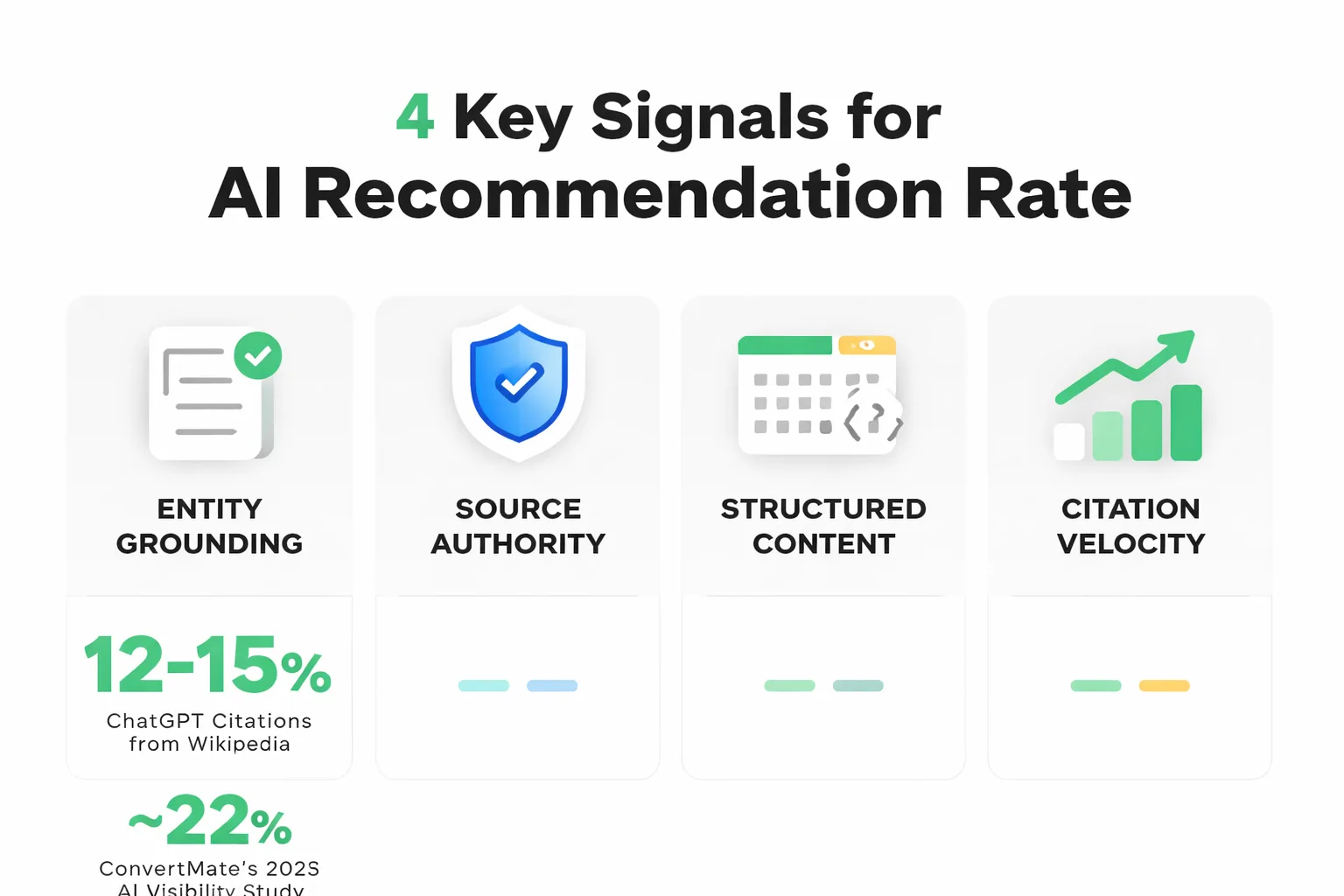
After months of analyzing which brands appear in AI answers and which don't, I've identified four signals that consistently drive recommendation rate. These aren't speculative. They map directly to how LLMs retrieve, evaluate, and cite information.
Signal 1: Entity Grounding
Entity grounding is the foundation. Without it, nothing else works. An AI model needs to recognize your brand as a distinct entity with specific attributes: what you do, who you serve, what problems you solve. This recognition comes from structured data sources, primarily Wikidata and the knowledge graphs that LLMs are trained on.
Wikipedia accounts for 12-15% of ChatGPT citations in the US, according to Similarweb's analysis of 600,000 citation events. Wikipedia also contributes approximately 22% of ChatGPT's training data, per ConvertMate's 2026 AI Visibility Study. If your brand has a Wikipedia page with a linked Wikidata QID, you're giving AI engines a structured entry point to understand who you are.
But here's what most teams get wrong: they think entity grounding is a one-time setup. Create a Wikidata entry, add some schema markup, done. It's not. Entity grounding requires ongoing reinforcement. Every time your brand is mentioned in a structured, attributable way across the web, the entity's confidence score increases. Every time your brand is associated with specific topics, use cases, and competitor sets in third-party content, the model's understanding of your entity sharpens.
The practical implication: you need a Wikidata QID, yes. But you also need a systematic effort to ensure your brand is mentioned in contextually relevant ways across the publishers AI engines crawl. That means industry publications, niche forums, and structured directories that LLMs weight as authoritative for your vertical.
Signal 2: Source Authority
Not all sources are equal in the eyes of an AI engine. The model doesn't just look at domain authority the way Google does. It looks at how frequently a source appears in its training data for specific topics and how reliably that source provides verifiable, structured information.
Reddit accounts for approximately 29% of ChatGPT citations, according to Similarweb's January-February 2026 analysis. That's not because Reddit has high domain authority in the traditional sense. It's because Reddit threads contain authentic, experience-based discussions that LLMs weight heavily for product recommendations and comparisons. When real users discuss your brand in context, the model treats that as a strong trust signal.
Community platforms capture 52.5% of citations versus 47.5% for brand domains, according to OtterlyAI's report. This means more than half of the sources AI engines cite are not brand-owned content. They're third-party discussions, reviews, and analyses. If your AI search strategy is purely "publish more on our blog," you're missing the majority of the citation surface area.
I've seen brands with thin content footprints but strong community presence outperform brands with extensive content programs in AI recommendations. The brands winning on AI are the ones being discussed, not just the ones publishing. This is why answer engine optimization requires a fundamentally different approach to off-page strategy than traditional SEO.
Signal 3: Structured Answer Content
AI engines prefer content that's structured for extraction. When a model needs to pull a specific answer from a page, it looks for clear, quotable statements that it can attribute. FAQ schema, definition blocks, comparison tables, and step-by-step formats all make your content more extractable.
OtterlyAI found that reference-grade content receives 3-5x more citations than standard content. Reference-grade means content that's structured with clear headings, direct answers to specific questions, verifiable claims with inline citations, and schema markup that helps the model understand the content's structure and intent.
This is where most AI content strategies fail. Teams produce content that's optimized for human readability but not for machine extraction. Long, flowing paragraphs without clear answers. Headings that are clever but not descriptive. Claims without sources. The model can't extract what it can't parse.
The fix is structural. Every page you want cited by AI should answer a specific question in the first paragraph. It should use descriptive H2s that match how users phrase prompts. It should include schema markup (FAQ, HowTo, Speakable) that explicitly tells the model what the content is about. And every claim should link to an authoritative source so the model can verify it.
Signal 4: Citation Velocity
Citation velocity is the rate at which your content and brand are referenced across the web over time. It's the AI equivalent of link velocity in traditional SEO, but it measures a broader set of signals: mentions in publisher articles, appearances in community discussions, citations in industry reports, and references in structured data sources.
86% of AI citations come from brand-managed sources, according to Yext's research. Wait, that seems to contradict what I said about community platforms capturing 52.5% of citations. It doesn't. Yext's finding refers to the source of the cited URL, not the platform where the citation originates. Brand-managed pages (your blog, your product pages, your documentation) are the most frequently cited URLs. But the decision to cite them is influenced by how often they're referenced across third-party platforms.
Think of it this way: your content is the candidate. Third-party mentions are the endorsements that get your content shortlisted. The model retrieves your page because it's been trained to associate your brand with the topic, and that association comes from external references. High citation velocity across diverse sources signals to the model that your brand is an active, authoritative participant in your space.
The Seer Interactive case study illustrates how quickly AI engines can respond to new signals. They modified footer text from "Remote-First" to "130+ clients, 97% retention rate" and ChatGPT reflected those changes within 36 hours. That speed cuts both ways. If your citation velocity drops, your AI visibility can degrade just as fast.
Do you know which buyer-intent prompts your brand is absent from?
How to Measure Whether AI Is Recommending You Today
You can't fix what you haven't measured. The first step in any AI visibility program is diagnosis: understanding where you stand today across the prompts that matter to your business. This is where AI search visibility tools become essential.
Start by identifying 20-30 buyer-intent prompts relevant to your product. These aren't keywords. They're the natural-language questions a prospect would type into ChatGPT or Perplexity when evaluating solutions. "What's the best platform for B2B ecommerce automation?" "Which tools integrate with Shopify Plus for inventory management?" "How do mid-sized manufacturers handle parts catalog sync?"
Run each prompt across ChatGPT, Perplexity, Gemini, and Google AI Overviews. Log which brands appear, in what position (first, in a list, last), and which sources the AI cites to support its answer. This gives you a baseline recommendation rate: the percentage of buyer-intent prompts where your brand appears as a named solution.
Most brands I've audited are shocked by their baseline. They assume they're visible because they rank well on Google. They're not. The overlap between top Google results and AI-cited sources has dropped to under 20%. You can be dominant in traditional search and completely absent in AI answers.
Next, identify the sources those AI answers cite. Which publishers are feeding the model's recommendations? Which competitor pages are being referenced? This tells you where you need to build presence. If the model consistently cites a specific industry publication for your topic, that publication needs to mention your brand. If it pulls from Reddit threads, you need authentic discussions happening there.
73% of sites have technical barriers blocking AI crawler access, according to OtterlyAI. Before you invest in content optimization, verify that AI crawlers can access your site. Check your robots.txt, ensure your content isn't gated behind authentication walls, and confirm that your server responses don't block known AI crawler user agents.
This diagnostic phase is non-negotiable. Without it, you're guessing. And in a channel where the rules are still being written, guessing is expensive. A proper audit tells you exactly which gaps to prioritize: entity grounding, source authority, content structure, or citation velocity. It also gives you a benchmark to measure against as you implement changes.
Using a dedicated AI visibility tracker automates this process. Instead of manually running prompts across multiple engines every week, you get continuous monitoring with trend data showing whether your recommendation rate is improving or declining over time. That trend line is your north star metric for AI search performance.
What Does a Generative Engine Optimization Agency Do Differently?
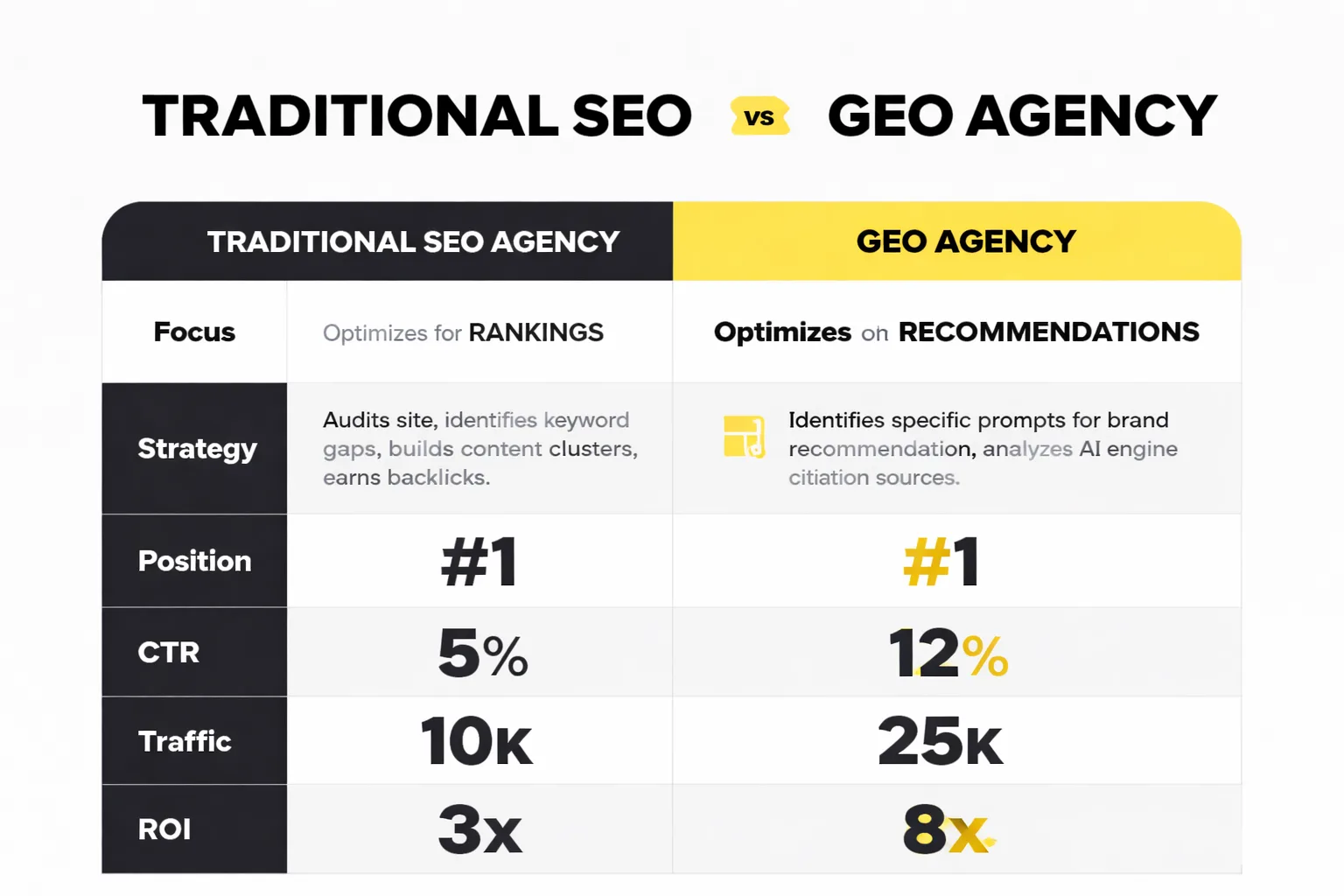
A traditional SEO agency optimizes for rankings. A generative engine optimization agency optimizes for recommendations. The distinction sounds subtle, but the execution is fundamentally different.
A traditional agency will audit your site, identify keyword gaps, build content clusters, and earn backlinks. All of that still matters. But a GEO agency goes further. It identifies which specific prompts your brand should be recommended for, analyzes which sources AI engines cite for those prompts, and builds a strategy to close the gap between your current visibility and your target state.
In my work at Meev, I've seen what happens when brands try to apply traditional SEO logic to AI search. They publish more content, target more keywords, and build more backlinks. Their organic traffic might even improve. But their AI recommendation rate stays flat because they haven't addressed the underlying signals: entity grounding, source authority, structured content, and citation velocity.
A generative engine optimization agency (or a platform like Meev that operationalizes this work) starts with diagnosis. It tracks your brand's appearance across ChatGPT, Perplexity, Gemini, Grok, Google AI Overviews, and AI Mode. It identifies the prompts where competitors are cited and you're not. It surfaces the specific publishers AI engines trust for your topics.
Then it closes the gap. This means producing answer-engine-optimized content that targets specific prompts, structured with schema markup and inline citations that make it extractable. It means building entity presence through Wikidata, knowledge graph enrichment, and structured data. It means pursuing mentions on the third-party publishers that AI engines cite, not just earning backlinks for link equity.
The Seer Interactive case is instructive here. They didn't just publish content. They modified how their brand was described in structured elements of their site, and ChatGPT reflected those changes within 36 hours. That's the kind of targeted, signal-specific optimization that a GEO agency specializes in.
But I need to flag a risk. The same speed that makes AI visibility attractive also makes it volatile. If your optimization tactics are flagged as manipulative, or if the model is retrained, your visibility can disappear overnight. This is why sustainable GEO requires genuine entity building, not tactical hacks. A good agency will tell you that. A bad one will promise you instant AI visibility through tricks that don't last.
The concept of agentic SEO is relevant here. It's not simply "AI for SEO." It requires encoding deep domain expertise into specialist agents with quality-control processes that review outputs. As Itay Malinski notes, poorly implemented agentic strategies without human expertise will produce what he calls "hallucinated garbage." The same principle applies to GEO. Without genuine expertise guiding the strategy, you're just generating noise.
This is why the quality firewall matters. At Meev, every article we generate passes through a 16-dimension quality check before it reaches your CMS. Articles below 70/100 are blocked from publishing. This isn't because we're perfectionists. It's because AI engines are increasingly discriminating about what they cite. Publishing low-quality content doesn't just fail to earn citations. It can actively damage your entity's trust score by associating your brand with unverified, poorly structured information.
How Does Entity Grounding Actually Work?
Entity grounding is the process by which an AI model establishes a persistent, identifiable representation of your brand in its internal knowledge structures. Think of it as giving the model a filing card for your company that it can reference whenever your name comes up.
The filing card has fields: your brand name, what you do, who you serve, your key differentiators, your competitors, your industry category. The model fills these fields from multiple sources. Wikidata provides the structured backbone through QIDs (unique identifiers that disambiguate your brand from similarly named entities). Wikipedia provides narrative context. Your website provides self-declared attributes through schema markup. Third-party mentions provide external validation.
When a user asks an AI engine a question that touches on your space, the model retrieves entities associated with that topic. If your entity is well-grounded, with a rich filing card filled from diverse sources, you're more likely to be retrieved as a candidate for the answer. If your entity is poorly grounded, with missing fields or single-source attribution, the model may not retrieve you at all.
This is why entity grounding for AI search is the prerequisite to everything else. You can have the best content in your industry. You can have the highest-quality product. If the model doesn't have a well-populated filing card for your brand, you won't be recommended.
The practical steps are straightforward but require persistence. First, claim or create your Wikidata QID. Ensure it has accurate attributes: industry, products, founding date, key personnel. Second, ensure your website uses Organization schema markup that mirrors your Wikidata entry. Third, pursue mentions on the sources AI engines weight heavily: Wikipedia (if you meet notability criteria), industry publications, and structured directories. Fourth, monitor how AI engines describe your brand over time to catch inaccuracies or gaps.
When Should You Invest in GEO Versus Traditional SEO?
This is the question I hear most from founders and marketing leaders. The answer isn't "abandon SEO for GEO." It's "recognize that the two serve different purposes and budget accordingly."
Traditional SEO still drives the majority of organic traffic for most B2B companies. Google remains the dominant search engine by volume. If you're not ranking for your primary keywords, you're leaving money on the table. Keep investing in content quality, technical SEO, and link building.
But AI search is growing fast, and it captures a different kind of intent. When someone types a question into ChatGPT, they're often further along in the buying process than someone scrolling a Google SERP. They want a recommendation, not a list of links. AI-sourced traffic converts 4.4x higher than traditional organic search, according to DiscoveredLabs.
The right approach is hybrid. Maintain your traditional SEO program. Allocate a portion of your budget to GEO. Start with diagnosis: understand your current AI visibility, identify your gaps, and prioritize the signals that will move the needle. Then build incrementally: entity grounding first, structured content second, citation velocity third.
For small teams without the bandwidth to run a full GEO program internally, this is where a generative engine optimization agency or a platform like Meev adds the most value. We handle the diagnosis, the content production, the citation gap analysis, and the ongoing tracking. You approve everything before it goes live. The goal isn't to replace your SEO strategy. It's to extend it into the AI search channel.
The brands that will win the next five years of search are the ones building entity trust signals now. Not in six months when AI search has become undeniable. Not next year when competitors have already established their presence. Now. The cost of being late is compounding. Every day your brand is absent from AI answers, your competitors are building the entity associations and citation patterns that will make them the default recommendation. The longer you wait, the harder it is to displace them.
If you're serious about being recommended by AI, start with diagnosis. Understand where you stand. Then build the signals that matter. That's what a generative engine optimization agency does. That's what we do at Meev. And that's what will determine whether your brand shows up in the answer that procurement manager reads before she ever visits your website.
FAQ
What is the difference between AEO and GEO?
AEO (Answer Engine Optimization) focuses on structuring content so AI engines can extract answers from it. GEO (Generative Engine Optimization) is broader: it encompasses content optimization, entity grounding, citation building, and visibility tracking across AI search surfaces. AEO is a subset of GEO. Think of AEO as the content layer and GEO as the full strategy. Learn more about the distinction in our AEO vs GEO comparison.
How long does it take to see results from GEO efforts?
The Seer Interactive case showed changes reflected in ChatGPT within 36 hours, but that was a specific test of footer text modification. Building sustainable AI recommendation rate typically takes 8-12 weeks of consistent effort across entity grounding, content optimization, and citation building. The timeline depends on your starting visibility, competitive density, and how quickly you can build third-party mentions.
Can I do GEO myself or do I need an agency?
You can start yourself. Claim your Wikidata QID, add schema markup to your site, structure your content for extraction, and run manual prompts across AI engines to benchmark your visibility. But scaling requires consistent monitoring, content production, and outreach. That's where a generative engine optimization agency or platform like Meev adds value: we operationalize the ongoing work.
Does GEO replace traditional SEO?
No. Traditional SEO and GEO serve different channels with different mechanics. Google still drives significant organic traffic. AI search captures high-intent buyers who want recommendations, not link lists. The right strategy invests in both. Use our AEO vs SEO guide to understand where to allocate budget.
Which AI engines should I track for visibility?
At minimum, track ChatGPT, Perplexity, Gemini, and Google AI Overviews. These four surfaces account for the majority of AI search traffic. If you serve technical audiences, add Claude and Grok. If you serve international markets, add DeepSeek. The key is consistent tracking over time, not one-off checks. Try our ChatGPT visibility checker to start.
What makes content "reference-grade" for AI citations?
Reference-grade content has four characteristics: it answers a specific question in the first paragraph, uses descriptive headings that match user prompts, includes inline citations to authoritative sources for every claim, and uses schema markup (FAQ, HowTo, Article) to signal structure. OtterlyAI found reference-grade content receives 3-5x more citations than standard content.
About the Author
Judy Zhou, Founder
Judy Zhou leads content strategy at Meev, where she oversees AI-driven content research and publishing for hundreds of brands. With a background in SEO and editorial operations, she focuses on building content systems that rank on Google, get cited by AI search engines, and drive measurable business results.
Stop guessing about your AI visibility. Run a full audit across every major AI search surface and build the trust signals that get you recommended.